
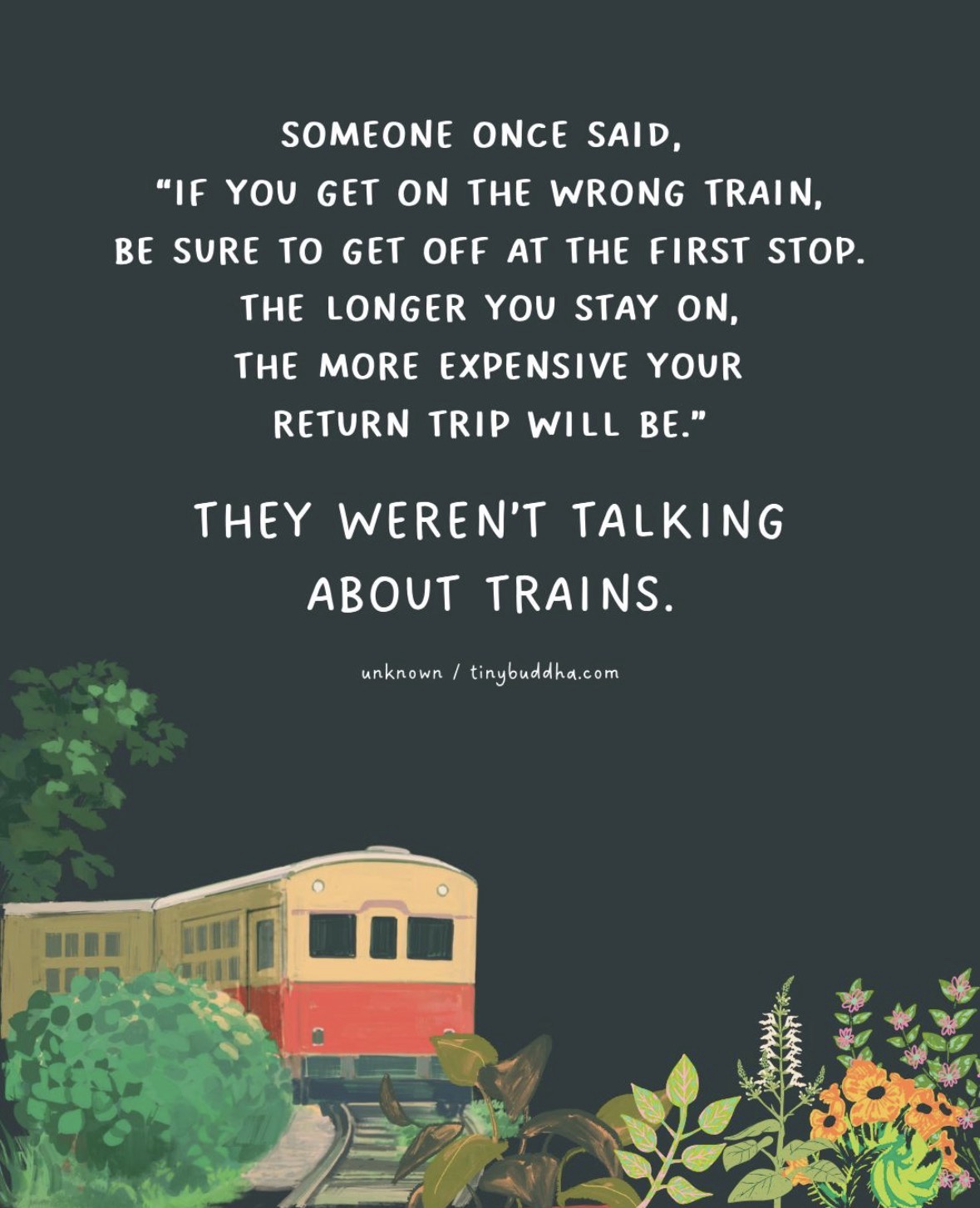
Someone once said that if you get on the wrong train, you should get off at the first stop. The longer you stay on, the more expensive the return trip will be.
They weren’t talking about trains.
They were talking about that job you knew wasn’t right three months in, but you stayed three years. They were talking about the relationship that felt heavy from the beginning, but you kept convincing yourself it would get lighter. They were talking about the habit you picked up “just for now” that quietly became your normal.
The thing about the wrong train is that it rarely feels wrong at the platform. It looks polished. It sounds convincing. Sometimes everyone else is boarding it too. There’s momentum. There’s excitement. There’s the subtle pressure of not wanting to look foolish by stepping back off.
So you sit down. You tell yourself it’s fine. You’ll reassess later.
But later has a cost.
Every stop you pass makes it harder to admit you shouldn’t be there. Pride gets involved. So does fear. You start calculating what you’ve already invested — the time, the money, the emotional energy — and instead of cutting your losses, you double down. You stay because you’ve stayed.
That’s the trap.
We think leaving early is failure. We think changing direction means we were wrong. But staying on the wrong path doesn’t prove commitment. It just increases the price of correction.
The real courage isn’t in enduring something misaligned. It’s in recognizing it quickly.
It’s in saying, “This isn’t for me,” before the sunk cost becomes your excuse.
It’s in walking away when it’s still awkward instead of waiting until it’s unbearable.
Most people don’t get stuck because they can’t see the wrong train. They get stuck because they don’t want the discomfort of getting off. Getting off means explaining yourself. It means disappointing someone. It means facing uncertainty.
But staying means something else.
It means slow erosion.
It means waking up years later wondering how you got so far from where you meant to be.
And here’s the quiet truth: the earlier you course-correct, the cheaper it is. Not just financially. Emotionally. Spiritually. Mentally.
The first stop might feel inconvenient. The second might feel embarrassing. By the tenth, it feels devastating.
There’s wisdom in small exits.
Quitting the conversation when it turns toxic.
Changing strategy when the data says it’s not working.
Pivoting the project before you burn the team out.
Ending the pattern before it becomes identity.
You don’t have to stay just because you started.
You don’t have to keep proving something that no longer needs proving.
Sometimes growth looks less like pushing through and more like stepping off.
The people who build lives they actually want aren’t the ones who never choose wrong. They’re the ones who refuse to stay wrong for long.
They listen to that early discomfort. They pay attention to that quiet nudge. They respect the first stop.
So if something feels off right now — a direction, a decision, a dynamic — don’t ignore it just because it hasn’t become catastrophic yet. Catastrophe is just what happens when we keep riding past the obvious exit.
There’s no medal for enduring the wrong journey.
There’s only relief in choosing the right one sooner.
And sometimes the bravest, smartest, most self-respecting thing you can do is stand up, grab your bag, and step off at the very next stop.
 Kenrick Vaz