
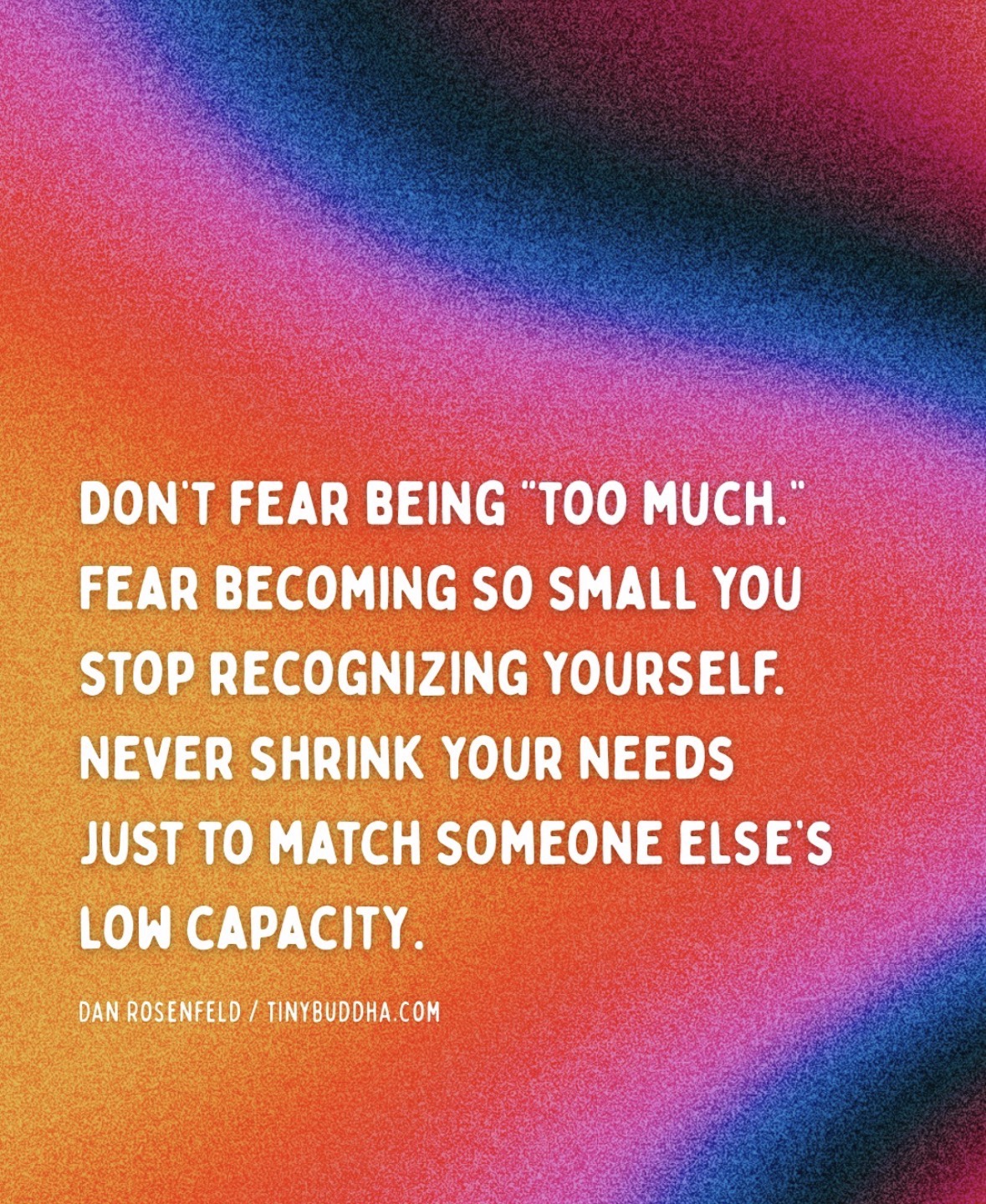
There’s a strange kind of pressure a lot of us grow up with.
Not the loud, obvious kind. Not the pressure to perform, win, or achieve. I’m talking about the quieter pressure. The one that tells you to soften your opinions, lower your expectations, hide your emotions, and become easier to handle.
Be less intense.
Be less sensitive.
Need less.
Expect less.
Take up less space.
And if you do that long enough, something subtle starts to happen.
You become more acceptable to others… but less familiar to yourself.
That’s the part no one talks about enough.
A lot of people are afraid of being “too much.” Too emotional. Too passionate. Too expressive. Too ambitious. Too honest. Too needy. Too loving. Too deep.
But what if the real danger isn’t being too much?
What if the real danger is slowly editing yourself down until you barely recognize the person in the mirror?
That kind of shrinking doesn’t happen overnight. It happens in tiny negotiations with yourself.
You don’t say what bothered you because you don’t want to seem difficult.
You pretend you’re okay with crumbs because asking for consistency feels “high maintenance.”
You laugh off things that hurt because you don’t want to look dramatic.
You keep making yourself more understandable to people who have made no effort to understand you.
And somewhere along the way, you start mistaking self-abandonment for maturity.
You call it being patient. Easygoing. Flexible. Chill.
But sometimes it’s not peace. Sometimes it’s just quiet resentment dressed up as emotional intelligence.
There’s a huge difference between being adaptable and being invisible.
Healthy relationships—whether it’s friendship, family, love, or even work—do require compromise. Of course they do. Not every preference needs to become a principle. Not every moment needs to become a confrontation.
But compromise should never cost you your core.
You should not have to betray your values to keep someone comfortable.
You should not have to mute your voice to be considered “safe” to love.
You should not have to lower your standards because someone else refuses to rise.
And you definitely should not have to apologize for having needs.
That last one is important.
Some people have a very limited emotional range. Limited capacity. Limited accountability. Limited willingness to communicate. Limited ability to show up consistently.
That doesn’t automatically make them bad people.
But it does make them the wrong people to use as a measuring stick for your needs.
If someone can only offer confusion, inconsistency, avoidance, or bare minimum effort, the answer is not to convince yourself you suddenly need less.
The answer is to tell yourself the truth: their capacity is low, and your needs are valid.
That truth can be uncomfortable because many of us have been conditioned to believe that having needs makes us difficult. That asking for clarity makes us demanding. That wanting reciprocity makes us entitled.
It doesn’t.
It makes you human.
You are allowed to want communication.
You are allowed to want consistency.
You are allowed to want honesty.
You are allowed to want effort that doesn’t feel forced.
You are allowed to want relationships where you don’t have to decode everything.
And yes, you are allowed to walk away from places where you are constantly asked to make yourself smaller just to keep things going.
One of the hardest lessons in life is realizing that not everyone has the capacity to meet you where you are. And an even harder lesson is realizing that it’s not your job to become less so they can feel like enough.
Read that again.
It is not your job to become less so someone else can avoid growing.
That applies everywhere.
In your personal life, it means not settling for emotional half-presence while pretending it’s love.
In friendships, it means not always being the one who reaches out, understands, forgives, and adjusts while the other person coasts on your generosity.
At work, it means not constantly downplaying your ideas, instincts, or standards because other people are intimidated by excellence, clarity, or conviction.
Being “too much” is often just what low-capacity environments call people who know who they are.
Sometimes “too sensitive” means emotionally aware.
Sometimes “too intense” means deeply invested.
Sometimes “too demanding” means you’ve stopped accepting the bare minimum.
Sometimes “too much” simply means you’ve outgrown spaces that only knew how to value the smaller version of you.
That doesn’t mean every feeling is right, or every expectation is reasonable. Self-awareness still matters. Growth still matters. Reflection still matters.
But shrinking should not be your default survival strategy.
You can be self-aware without self-erasing.
You can be kind without becoming convenient.
You can be loving without becoming endlessly accommodating.
You can be patient without becoming passive.
You can be understanding without abandoning your own understanding of what you deserve.
And maybe that’s the real work—not becoming louder for the sake of being noticed, but becoming more loyal to yourself.
Because once you stop betraying yourself to keep the peace, a lot becomes clear.
You notice who only liked you when you were easy to manage.
You notice who benefited from your silence.
You notice who called your boundaries “attitude” because they were used to unlimited access.
You notice who disappears when you stop overfunctioning.
And while that can feel lonely at first, it’s also freeing.
Because the people who are truly meant for you won’t require a reduced version of you.
They won’t need you to be smaller to stay connected.
They won’t punish honesty.
They won’t weaponize your needs.
They won’t make your fullness feel like a flaw.
The right people may not agree with you all the time. They may not mirror you perfectly. They may even challenge you in healthy ways.
But they won’t make you feel like your authenticity is a burden.
That’s how you know the difference.
So if you’ve been carrying the fear of being “too much,” maybe it’s time to reframe it.
Maybe your depth isn’t the problem.
Maybe your standards aren’t the problem.
Maybe your honesty, tenderness, ambition, intensity, or emotional fluency aren’t the problem.
Maybe the real problem is how often you’ve tried to fit all of that into places too small to hold it.
Stop measuring yourself against people who only know how to receive fragments.
Stop turning your needs into negotiable items just because someone else lacks the capacity to meet them.
Stop calling self-erasure maturity.
You do not need to become less real, less expressive, less honest, less loving, less alive to be easier for other people.
You just need to stop auditioning for spaces that require you to disappear.
Because there is a cost to shrinking.
And eventually, the cost becomes your own reflection.
So no—don’t fear being “too much.”
Fear the day you become so edited, so muted, so manageable, that the truest parts of you no longer feel at home inside your own life.
And then choose differently.
Choose the hard honesty of being fully yourself over the temporary comfort of being easily accepted.
Choose standards over scraps.
Choose wholeness over approval.
Choose to stay recognizable to yourself.
 Kenrick Vaz