
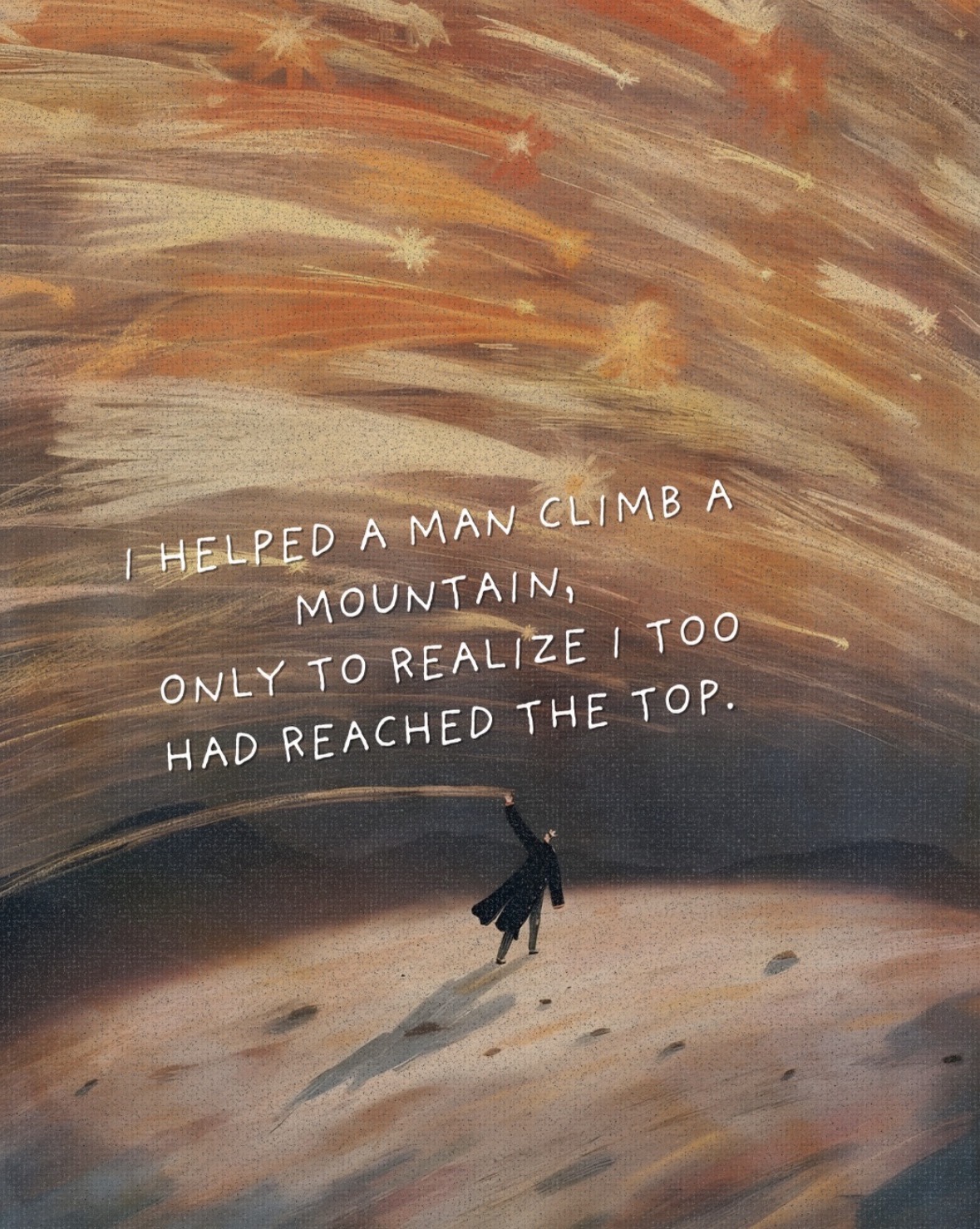
I helped a man climb a mountain, only to realize I too had reached the top.
At first, it sounds like a poetic way of talking about generosity. Help someone, feel good about it, move on. But if you sit with it a little longer, it starts to say something deeper—something a lot less obvious about growth.
We’re wired to think of progress as something personal. Your goals. Your climb. Your finish line. It’s always framed as you versus the mountain. And the assumption is simple: if you’re spending your time helping someone else up, you must be slowing yourself down.
But that’s not always how it works.
Sometimes, helping someone else is the climb.
Think about the moments where you’ve guided someone—maybe a colleague who was stuck, a friend going through something, or even your own kid figuring out the world one small step at a time. In those moments, you’re not just giving instructions. You’re learning patience, sharpening your own understanding, and seeing things from angles you wouldn’t have discovered alone.
You start explaining things more clearly. You start noticing gaps in your own thinking. You become more aware, more intentional. Without realizing it, you’re evolving.
And the strange part? There’s no dramatic “arrival.” No big flag at the top. One day you just pause and think, I’ve come further than I thought.
That’s the quiet nature of this kind of growth. It doesn’t announce itself. It accumulates.
We often underestimate how much perspective shifts when we step out of our own heads and invest in someone else’s journey. When you’re only focused on your own climb, every obstacle feels heavier, every delay more frustrating. But when you’re helping someone else, the same obstacles start to look different. They become shared problems, not personal burdens.
You stop measuring progress only by how fast you’re moving. You start valuing how meaningful the movement is.
And here’s where it gets interesting: helping others doesn’t just build skills—it builds identity. You begin to see yourself as someone who can lift, guide, support. That changes how you show up everywhere else. At work. At home. In the way you think about challenges.
You’re no longer just climbing. You’re becoming the kind of person who knows how to climb—and how to bring others along.
There’s also a subtle confidence that comes with this. Not the loud, chest-thumping kind. The quiet kind. The kind that says, I’ve seen hard things, and I’ve helped someone through them. That sticks.
Of course, this doesn’t mean you should ignore your own path or constantly put yourself second. There’s a difference between helping and losing yourself. But when it’s genuine—when it comes from a place of intention rather than obligation—it rarely takes away from your journey.
More often than not, it deepens it.
The truth is, most of us are chasing visible milestones. Promotions. Achievements. Recognition. Things that clearly signal, “You’ve made it.” But some of the most meaningful climbs don’t look like that at all. They happen in conversations, in small acts, in moments where no one’s keeping score.
And that’s why they’re easy to miss.
You don’t always realize you’ve grown because you weren’t focused on growing. You were focused on someone else.
But growth doesn’t need your attention to happen. It just needs your participation.
So the next time you find yourself spending time helping someone else—explaining, guiding, supporting—don’t think of it as time taken away from your own progress. There’s a good chance it is your progress.
And one day, almost unexpectedly, you’ll look around and realize something.
You’re not at the base anymore.

