
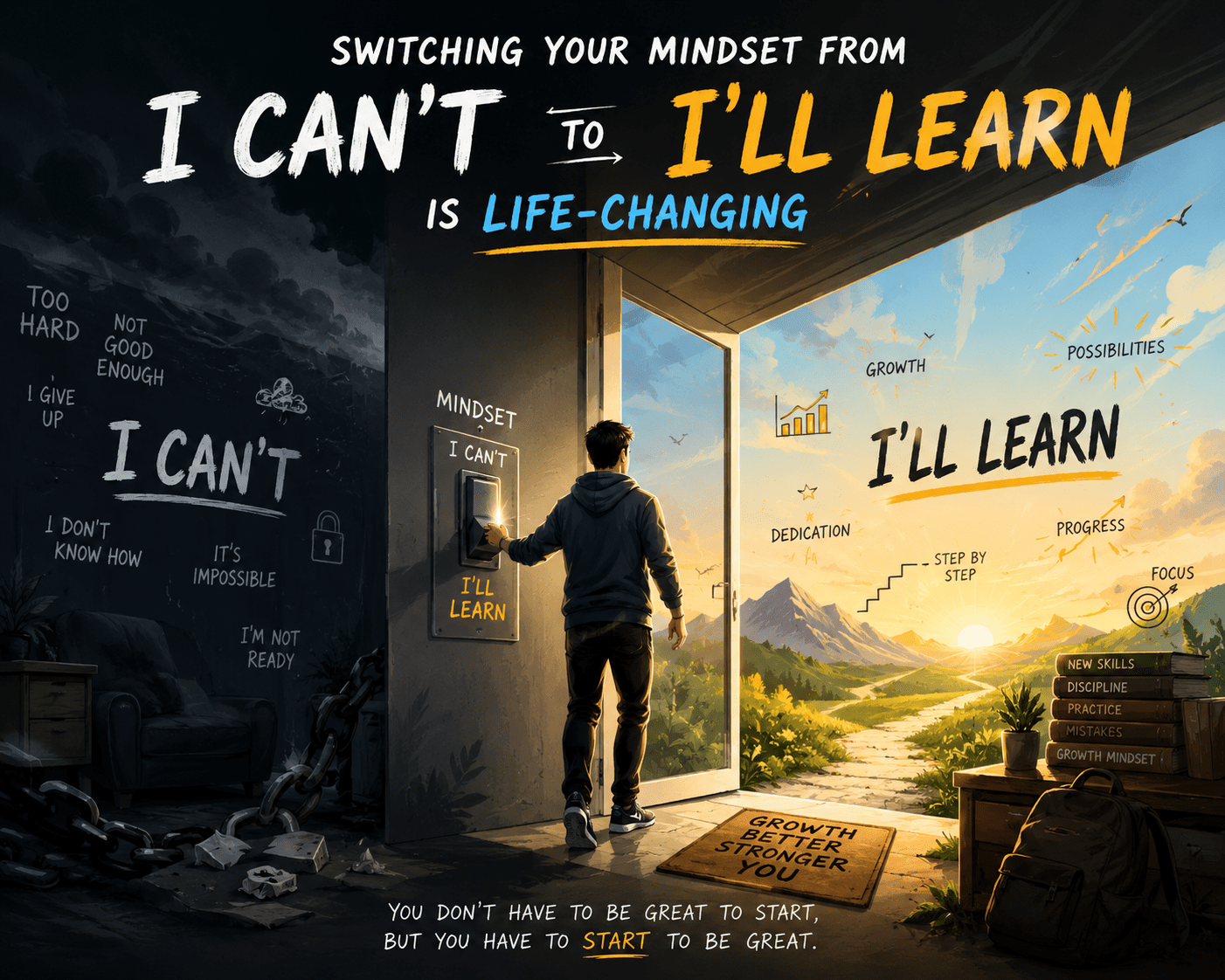
“I can’t do this.”
That sentence can shut down a conversation before you even give yourself a chance.
“I’ll learn how to do this.”
That sentence opens a door.
The difference is only a few words, yet the mindset behind them can change how you approach work, relationships, challenges, and even the things you once thought were completely out of reach.
We often treat ability as something fixed. You either know how to do something or you don’t. You either have the skill or you lack it. That way of thinking makes every unfamiliar task feel like a test of whether you are good enough.
Try looking at it differently.
You don’t need to know everything before you start. You need to be willing to learn.
Think about the first time you used a tool at work that seemed complicated. Maybe you opened it and had no idea where to begin. A few tutorials, some trial and error, a couple of mistakes, and suddenly you knew your way around it.
The tool didn’t become easier because it changed.
You became better because you learned.
That applies to almost everything.
Someone who says, “I can’t present to senior leaders,” may simply need more practice presenting. Someone who says, “I’m not technical enough to understand AI,” may need a few weeks of learning the basics. Someone who says, “I could never start my own business,” may need to learn about sales, finance, hiring, and everything else that comes with running one.
The starting point matters.
“I can’t” puts a period at the end of the sentence.
“I’ll learn” leaves room for another chapter.
There is something else that changes when you adopt this mindset. Failure becomes useful.
If your mindset is “I need to be good at this,” making a mistake can feel embarrassing. You start avoiding situations where you might look inexperienced.
If your mindset is “I’m learning this,” a mistake becomes information.
You tried something. It didn’t work. You figured out why. You try again.
That is how children learn. A three-year-old doesn’t decide they are bad at riding a bike because they fall over. They get back up because falling is part of figuring it out.
Adults often make learning harder than it needs to be because we care so much about looking capable.
We hesitate to ask basic questions.
We avoid admitting that we don’t understand something.
We stay with familiar tasks because they make us feel competent.
Then we wonder why we aren’t growing.
The people who keep moving forward are often comfortable being beginners again.
Technology makes this even more obvious. The tools we use today can change within months. A skill that felt valuable five years ago may need to be updated. New platforms appear. New AI tools arrive. New ways of working become normal.
You cannot know everything that is coming.
You can build the habit of learning.
That habit is far more valuable.
The next time you catch yourself saying, “I can’t do this,” pause for a second.
Ask yourself, “What would I need to learn to get there?”
Maybe the answer is a YouTube tutorial.
Maybe it is a conversation with someone who knows more than you.
Maybe it is a course, a book, ten failed attempts, or three uncomfortable weeks of practice.
That question turns a wall into a path.
You don’t need confidence before you begin. Sometimes confidence shows up after you have spent enough time learning.
So change the sentence.
“I can’t” becomes “I haven’t learned it yet.”
“I’m not good at this” becomes “I need more practice.”
“I don’t know how” becomes “I’ll figure out where to start.”
Those small changes can alter what you attempt, how long you stick with it, and what you believe you are capable of doing.
You may surprise yourself with what becomes possible once “I can’t” stops being the final answer.

