
Think you’re a “Coaching Leader”?
That might be the exact thing holding your team back.
Most managers proudly say: “I follow the coaching style.”
But real leaders?
They adapt—because one style can’t solve every problem.
When you shift your style, you improve:
✅ Team performance
✅ Engagement
✅ Ownership
✅ Results
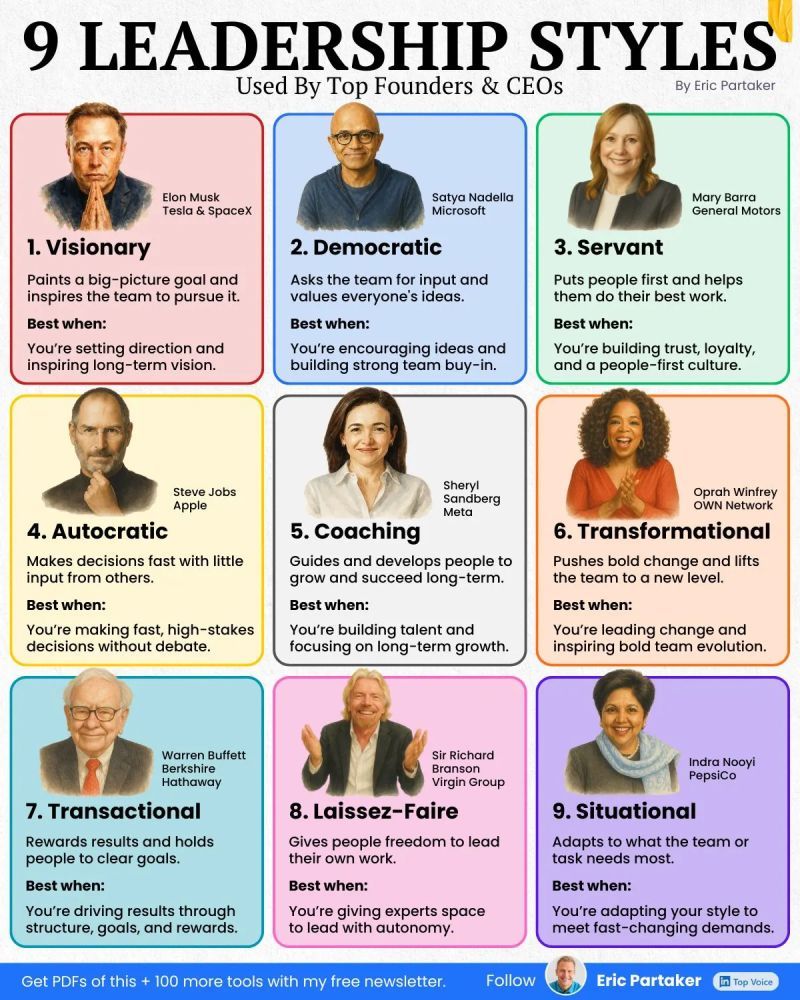
Here’s a BD team–focused cheat sheet on when each leadership style works—and how to use it smartly:
🔥 1. Visionary Leadership
Use when: energy drops, targets slow down
Do this:
• Reconnect the team to the “bigger mission”
• Show how their work creates impact
🤝 2. Democratic Leadership
Use when: cross-functional alignment is needed
Do this:
• Ask for input before decisions
• Build plans together to drive buy-in
🧭 3. Servant Leadership
Use when: the team feels blocked or overloaded
Do this:
• Ask what’s slowing them
• Remove roadblocks so they can execute
⚡ 4. Autocratic Leadership
Use when: time is limited + decisions are stuck
Do this:
• Make the call—clear, calm, confident
• Bring back momentum
🎯 5. Coaching Leadership
Use when: someone is still building BD confidence
Do this:
• Give frequent feedback
• Celebrate small wins to build competency
🚀 6. Transformational Leadership
Use when: the team is ready for the next level
Do this:
• Set a bold vision
• Model the growth mindset you expect
📌 7. Transactional Leadership
Use when: follow-through begins slipping
Do this:
• Set crystal-clear goals & timelines
• Reinforce accountability
🧘♂️ 8. Laissez-Faire Leadership
Use when: top performers are in flow
Do this:
• Give autonomy
• Stay available—don’t micromanage
🔄 9. Situational Leadership
Use when: no one style fits
Do this:
• Read the room
• Lead with intention, not ego
The truth:
You don’t need to master all styles.
But you MUST be:
🔹 Self-aware
🔹 Flexible
🔹 Tuned into your team’s reality
💬 What’s your default leadership style?
And which one do you need to lean into more this year?
The Mind Map
The reason you feel behind?
You’re overloaded:
Feeling stuck isn’t failure—
it’s your mind saying
something needs
to shift.
When you
know what is draining
you and what is fueling you,
your momentum comes back fast.
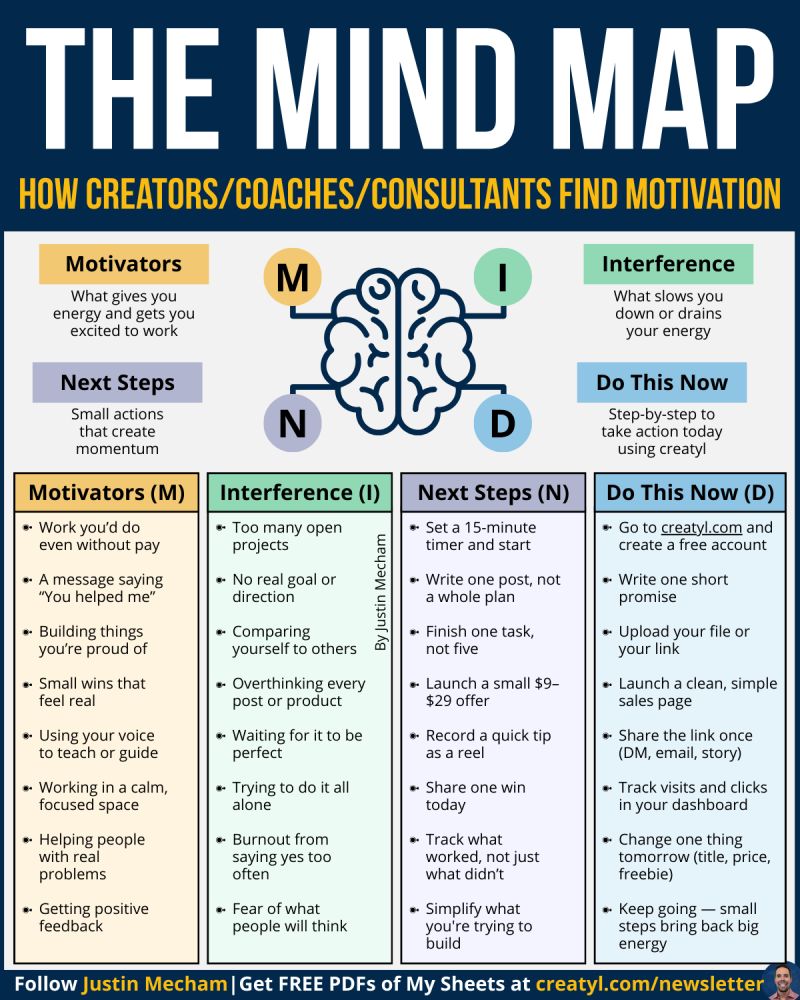
That’s what the MIND Map is for—
a clear way to see why you stalled.
And how to get moving again, try this:
🟨 M — Motivators
Do more of what lifts your energy
🟩 I — Interference
Clear what drains you
🟪 N — Next Steps
Move with tiny actions
🟦 D — Do This Now
Write a strong promise, build a simple offer
Start with three small steps:
• Add one motivator today.
• Remove one interference.
• Finish one tiny task to restart momentum.
Momentum doesn’t return all at once—
it returns the moment something finally clicks.
And that moment can be today.
More Than We Ask For
There’s a quiet truth about people that we don’t always want to admit.
Most of us can tell when we’re being “handled.”
Not in a dramatic, movie-villain way. But in the everyday way—when someone is trying to steer us with pressure, guilt, fear, flattery, or incentives that feel transactional. When the message is less about us and more about what they want from us.
And here’s the thing… manipulation works.
It works in workplaces.
It works in relationships.
It works in parenting.
It works in marketing.
It works in leadership.
At least for a while.
Because when you manipulate people, you can often get the result you’re aiming for. You can get compliance. You can get the task done. You can get the “yes.” You can get the output. You can get the performance.
But it comes with a limit.
People will give you exactly what you pay for.
They’ll do what’s required. Nothing more.
They’ll follow the instructions. Nothing extra.
They’ll hit the target. Then stop.
They’ll show up physically, but mentally they’ll be elsewhere.
They’ll deliver the bare minimum and quietly protect the rest of their energy for something that actually feels meaningful.
And honestly, you can’t even blame them.
Because manipulation turns human effort into a transaction. It reduces trust into a strategy. It makes people feel like they’re being used, not valued. And once someone feels like a tool, they stop acting like a teammate.
You’ll still get results—but you’ll lose the best part of what people can offer: their heart.
Inspiration is different.
Inspiration doesn’t push.
It pulls.
It doesn’t rely on control.
It relies on connection.
When you inspire people, you’re not trying to extract something from them. You’re trying to awaken something inside them.
You’re saying, “This matters.”
You’re saying, “You matter.”
You’re saying, “What we’re building is worth your best effort.”
And that changes everything.
Because inspired people don’t just do what they’re told.
They think.
They care.
They notice things others ignore.
They bring ideas.
They solve problems before they become escalations.
They protect the quality even when no one is watching.
They take ownership like it’s personal.
Not because they have to.
Because they want to.
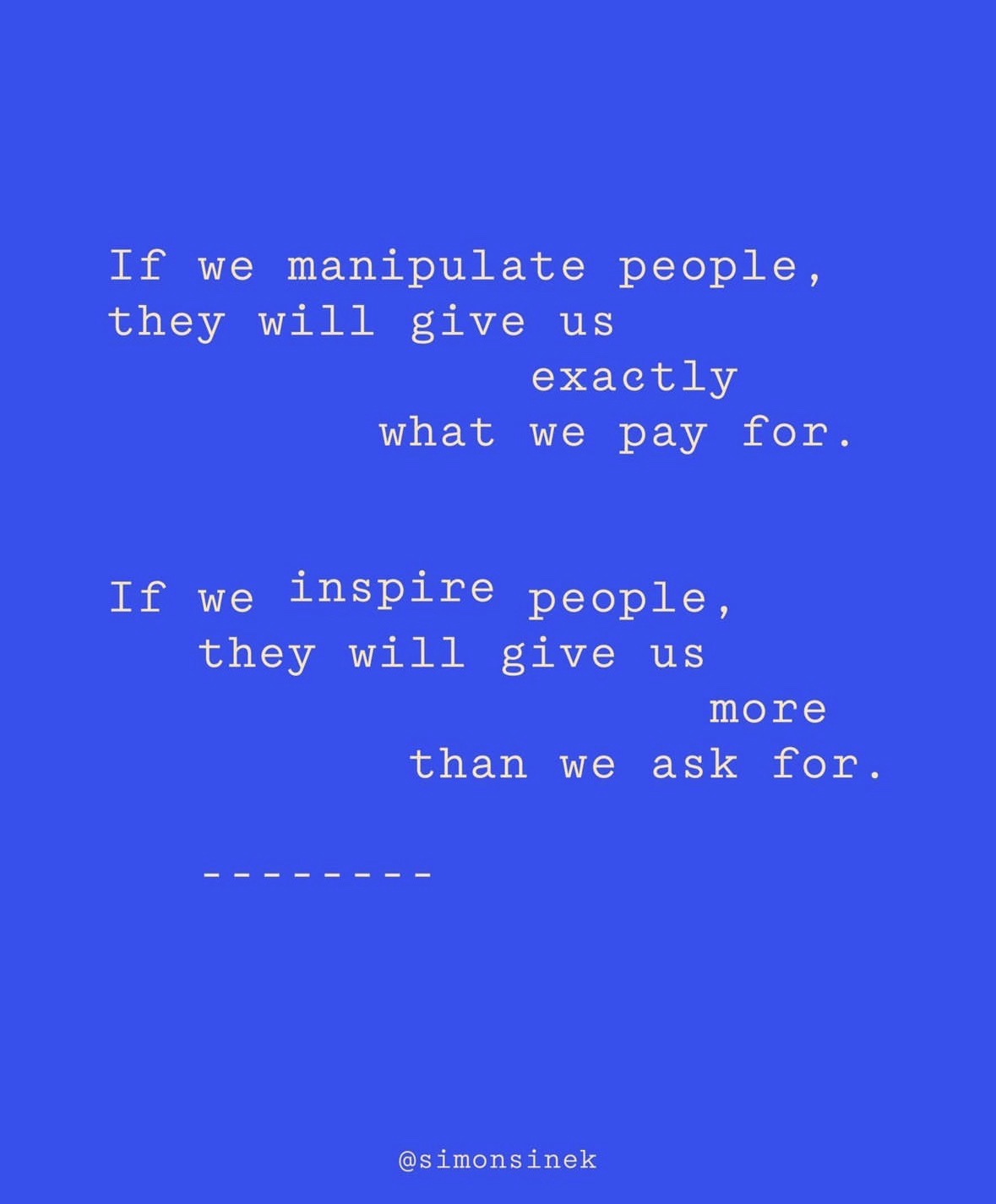
That’s the part of the quote that hits the hardest:
If we inspire people, they will give us more than we ask for.
More than the job description.
More than the timeline.
More than the expectation.
More than the minimum.
And you’ve seen it, haven’t you?
You’ve seen the person who stays late—not because they’re afraid, but because they genuinely want the team to win.
You’ve seen someone advocate for a customer when it would’ve been easier to just close the ticket.
You’ve seen someone teach a teammate patiently, even when they’re busy, because they remember what it felt like to be new.
You’ve seen someone raise their hand and say, “This isn’t right,” even though it’s risky to speak up.
That doesn’t come from manipulation.
That comes from meaning.
And meaning is a powerful fuel.
But inspiration isn’t a speech.
It’s not a slogan on a wall.
It’s not a “motivational quote of the day” in a meeting invite.
Inspiration is built in small moments.
It’s built when leaders tell the truth instead of spinning the story.
It’s built when someone gives credit publicly and feedback privately.
It’s built when you keep your word—even on the small stuff.
It’s built when you listen without waiting for your turn to talk.
It’s built when you treat people like adults, not resources.
It’s built when you don’t just ask, “What did you deliver?”
…but also ask, “How are you doing?”
Because people don’t go above and beyond for a system.
They go above and beyond for people who make them feel safe, seen, and significant.
Now, let’s be real—there will always be pressure.
Deadlines will exist.
Metrics will exist.
Targets will exist.
Budgets will exist.
And not every day will feel inspiring. Some days are just grind days. Some days are just “get it done” days.
But even then, manipulation isn’t the answer.
Because manipulation always has a cost.
It costs trust.
It costs creativity.
It costs loyalty.
It costs psychological safety.
It costs the invisible effort that separates a good team from a great one.
And eventually, it costs retention too.
People might stay on payroll, but they mentally check out.
Or worse—they leave, and you’re left wondering why “no one is hungry anymore.”
They were hungry.
They just didn’t want to be used.
Inspiration, on the other hand, compounds.
When you inspire people, they don’t just work harder.
They work freer.
They bring their best selves.
They bring courage.
They bring pride.
They bring energy you didn’t have to beg for.
And yes, they’ll still want to be paid fairly.
Inspiration doesn’t replace compensation.
But it does something compensation can’t do.
It turns work into contribution.
So here’s a simple question worth asking—whether you’re leading a team, building a product, raising kids, or just trying to be a better friend:
Am I trying to control people…
or am I trying to connect with them?
Because control can get you compliance.
But connection gets you commitment.
And commitment is where the real magic lives.
That’s where people give you more than you ask for.
Not because they’re manipulated.
Because they’re inspired.
7 Styles of Thinking
92% of people get stuck because they rely on just one or two thinking styles.
And so they keep running into the same walls… over and over again.
I used to be like that too.
My weapon of choice was always analysis: charts, data, processes.
It worked — until it didn’t.
One day I hit a problem that numbers simply couldn’t solve.
I remember staring at my screen for hours, adding more data, more models… nothing moved.
Then a friend said: “What if you don’t think about it logically at all?”
It sounded stupid. But I tried.
And to my surprise — the whole thing clicked.
That’s when it hit me:
The real power isn’t in sticking to one way of thinking.
It’s in switching between them.
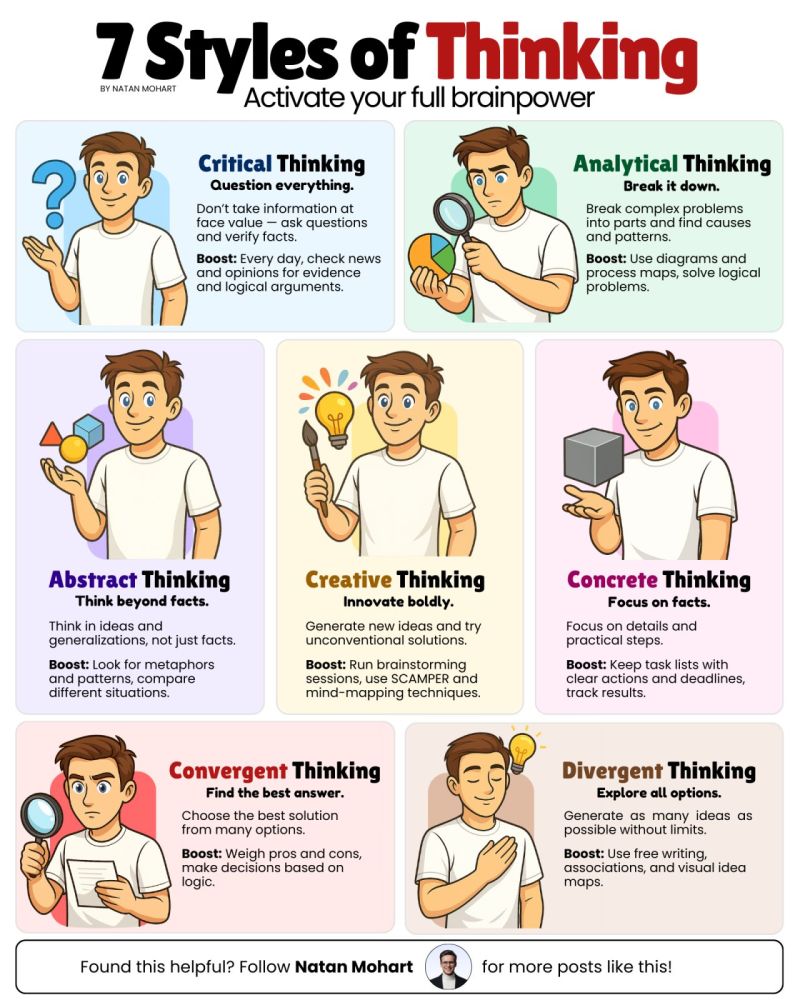
Here are the 7 styles worth mastering:
1. Critical Thinking
2. Analytical Thinking
3. Abstract Thinking
4. Creative Thinking
5. Concrete Thinking
6. Convergent Thinking
7. Divergent Thinking
Each one does something different.
One makes you doubt, another helps you connect the dots, another forces you to act.
Together? They turn thinking into a superpower.
📊 I put the details into my infographic below, with simple ways to practice each style.
💬 Which 2 thinking styles would you keep if you had to choose?
Types of Intelligence
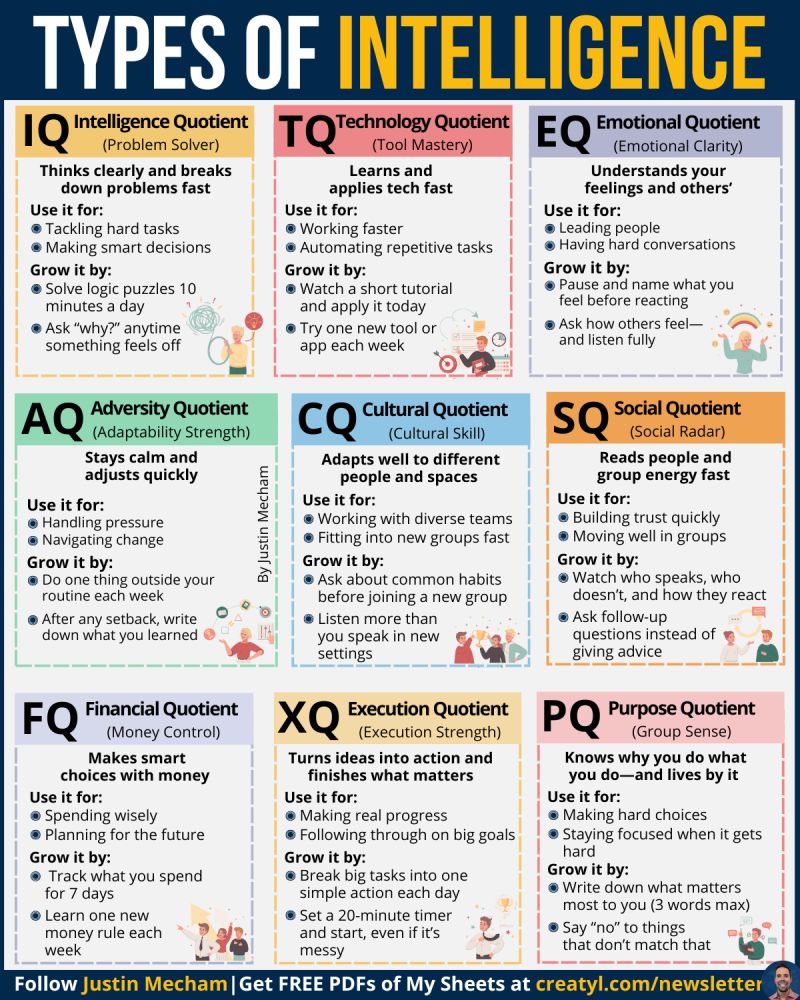
Schools tested one intelligence—
But real life runs on many:
Most people spend years feeling “not smart
enough” only because they were
measured by the wrong ruler.
In real work, real teams, and real life—
very different strengths rise to the top.
Here are nine forms of intelligence
that shape real success:
🟡 IQ — Problem solver
Breaks problems down fast.
🔴 TQ — Tech mastery
Learns tools quickly.
🟣 EQ — Emotional clarity
Understands feelings — yours and others’.
🟢 AQ — Adaptability strength
Stays steady under pressure.
🔵 CQ — Cultural skill
Adapts to people and spaces easily.
🟠 SQ — Social radar
Reads people and group energy fast.
⚫ FQ — Money control
Makes smart money choices.
🟤 XQ — Execution strength
Turns ideas into action.
⚪ PQ — Purpose sense
Knows your “why” and follows it.
Now here’s the part most people miss:
You don’t need to grow all nine.
You only need to grow the one
that moves your life
forward right now.
Start simple:
• Pick one intelligence to grow this week.
• Do one tiny action from its list today.
• Notice what changes after seven days.
Because you’re not defined by
one type of intelligence.
You’re shaped by the strengths
you choose to use.
And the moment you stop grading yourself
by the wrong measure—
You finally start seeing the
strengths you already have.
Master The Art of Negotiation
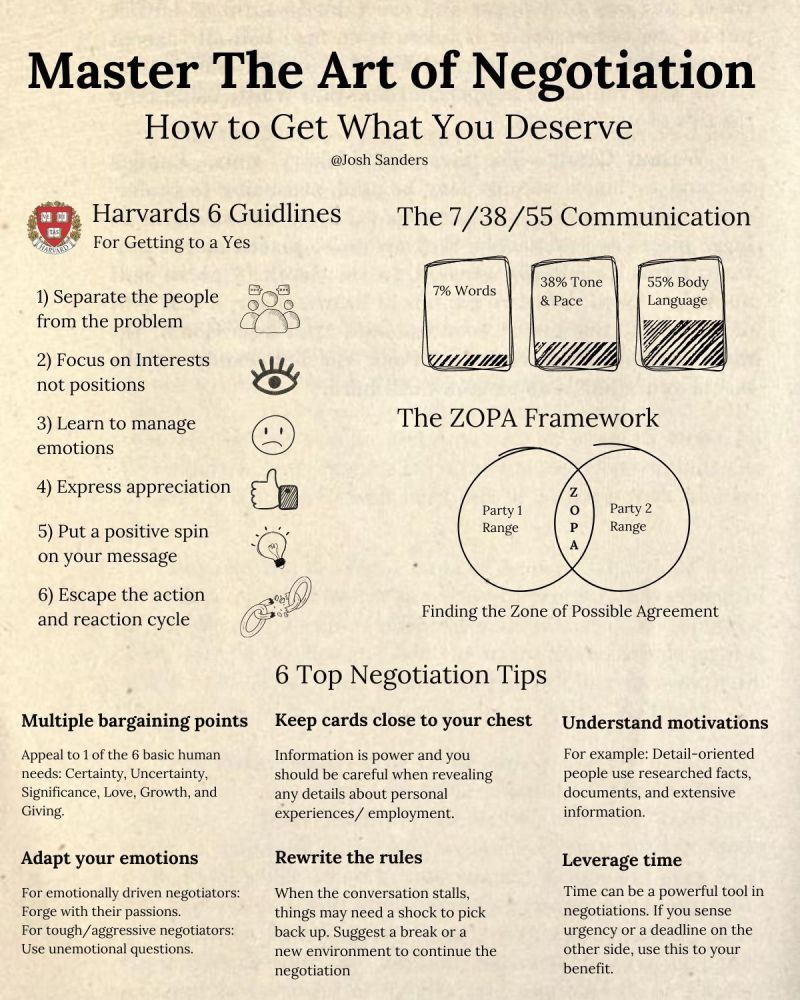
How to Get What You Deserve:
An unfortunate truth in life:
Most people are not getting what they deserve.
The solution?
Negotiating what you deserve.
People who learn how to negotiate well:
↳ Gain greater respect and recognition
↳ Get higher-paid opportunities
↳ Progress faster in life
Start improving your negotiation skills today.
Steal this cheatsheet now!
Harvards 6 Guidelines to Yes:
1. Separate the people from the problem
2. Focus on Interests, not positions
3. Learn to manage emotions
4. Express appreciation
5. Put a positive spin on your message
6. Escape the action and reaction cycle
Understand which types of communication
To work on:
↳ 7% words
↳ 38% Tone and pace
↳ 55% body language
Figure out the Zone of Possible Agreement
And negotiate from there.
With 6 bonus tips to level up your negotiation!
Remember:
Closed mouths don’t get fed.
Negotiate what you truly deserve.
What’s your top tip for negotiation?
Let me know below!
Helpful vs Hurtful
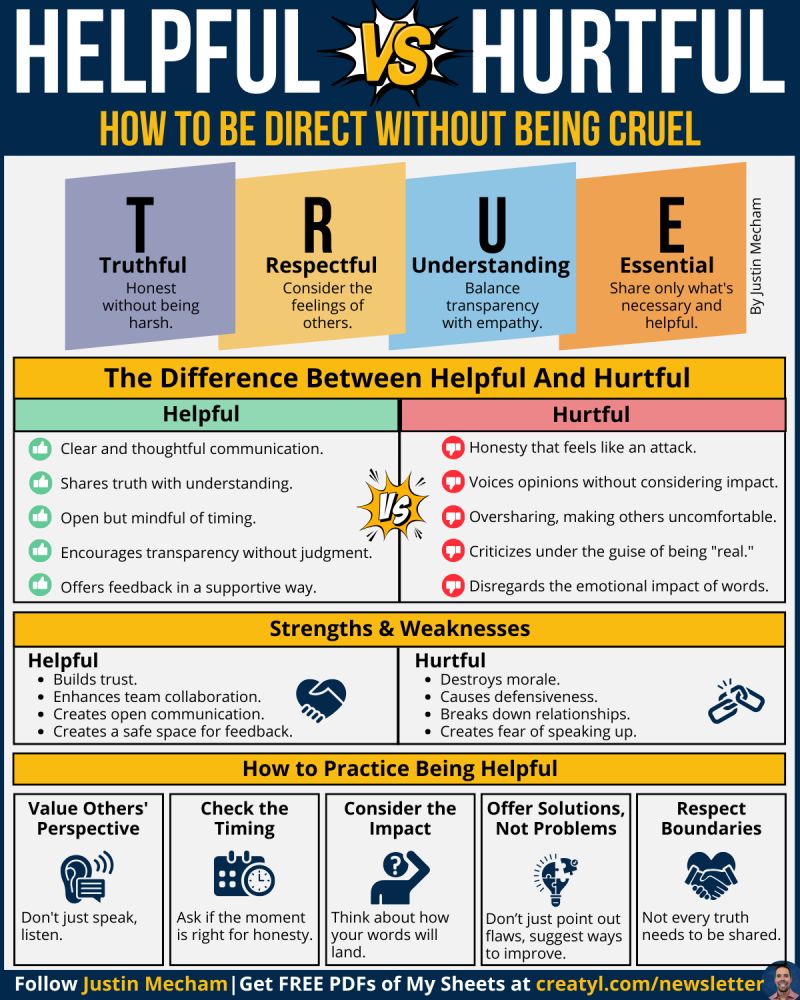
Honesty isn’t the problem—
How you deliver it is:
Most people don’t mean to be hurtful.
But the wrong delivery can
turn truth into damage.
Before you speak, pause
and ask yourself one thing:
Is this helpful or is this hurtful?
Here’s the T.R.U.E. test to guide you:
🟪 Truthful
→ Honest, not harsh
🟨 Respectful
→ Care about the human, not just the point
🟦 Understanding
→ Share with empathy, not ego
🟧 Essential
→ Say only what helps, nothing extra
Here’s the part most leaders miss:
Helpful leaders make people
feel safe enough to improve.
Hurtful leaders make people afraid to try again.
The difference isn’t skill.
It’s intention, delivery, and self-control.
If you want your team to grow—your words
have to feel safe enough for them to listen.
Avoid Burnout
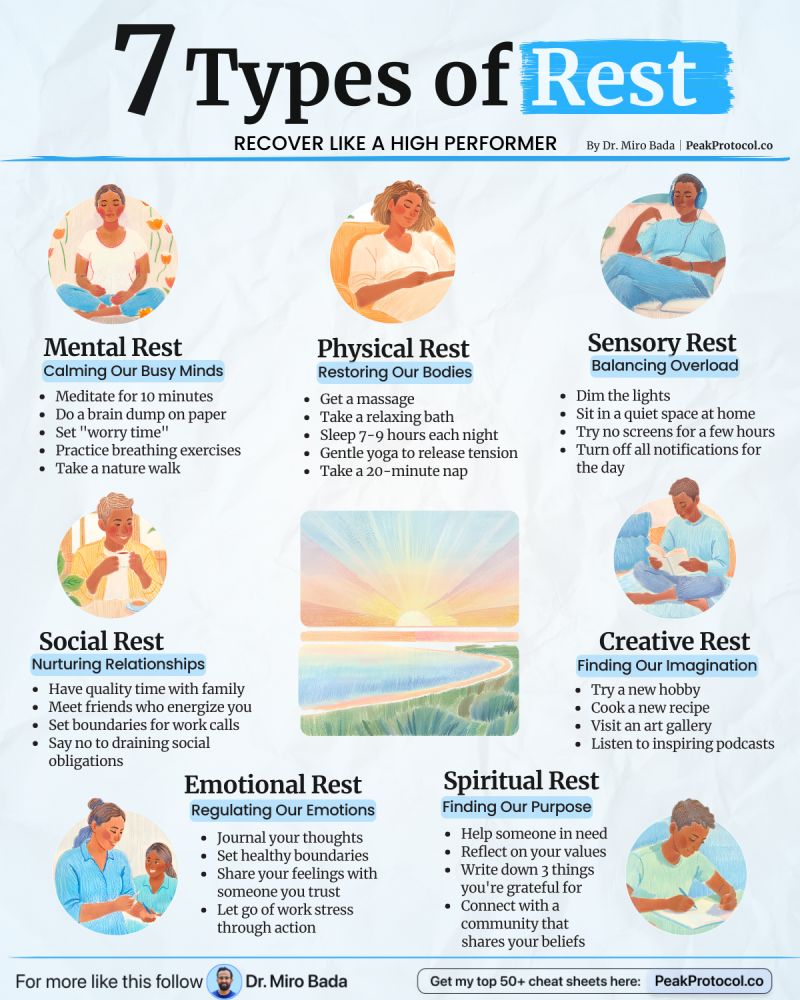
Burnout is not your fault.
But it’s your responsibility to fix it.
Ignoring this almost cost me my career. 🚨
I wore burnout like a badge of honor.
Until it wore me out beyond repair.
Dr. Dalton-Smith’s work offers us a way out.
↳ Rest beyond sleep
↳ Recharge your mind
↳ Refuel your purpose
Here are the 7 types of rest we need to thrive:
1/ Mental Rest: Calming Our Busy Minds
✅ Clear stress to restore focus
↳ Meditate for 10 minutes
↳ Do a brain dump on paper
↳ Set “worry time” to address concerns
↳ Practice breathing exercises (4 in, 4 out)
↳ Take a nature walk without your phone
2/ Physical Rest: Restoring Our Bodies
✅ Release physical tension
↳ Get a massage
↳ Take a relaxing bath
↳ Sleep 7-9 hours each night
↳ Release tension with gentle yoga
↳ Take a 20-minute recovery nap
3/ Sensory Rest: Reducing Sensory Overload
✅ Reset your nervous system
↳ Dim the lights
↳ Sit in a quiet space at home
↳ Turn off all notifications for the day
↳ Try a digital detox for a few hours
4/ Social Rest: Nurturing Our Relationships
✅ Choose your social circle wisely
↳ Have quality time with family
↳ Meet a friend who energizes you
↳ Set boundaries on weekend work calls
↳ Say no to draining social obligations
5/ Creative Rest: Embracing Our Imagination
✅ Find your creative joy
↳ Try a new hobby
↳ Cook a new recipe
↳ Visit an art gallery or museum
↳ Spend time in nature for fresh ideas
↳ Listen to inspiring podcasts
6/ Emotional Rest: Regulating Our Emotions
✅ Process and release emotional stress
↳ Journal your thoughts
↳ Set healthy boundaries with others
↳ Share your feelings with someone you trust
↳ Let go of work stress through action
7/ Spiritual Rest: Finding Our Purpose
✅ Refresh your ‘why’ and values
↳ Help someone in need
↳ Reflect on your values and purpose
↳ Write down 3 things you’re grateful for
↳ Connect with a community that shares your belief
By the way,
Burnout is contagious.
Fix it before it causes any more serious damage.
Scaling the Leadership Mountain
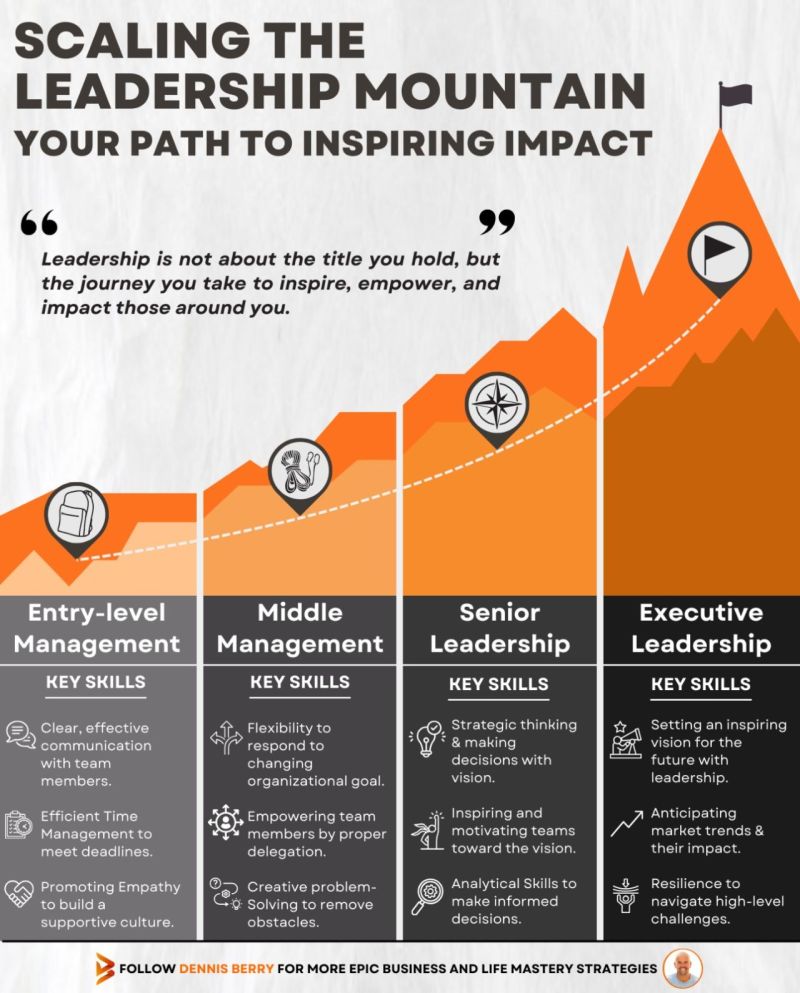
Leadership isn’t about reaching the top…
It’s about surviving the climb.
Each level has challenges and rewards.
But, each is required to get to the next level
Here’s your guide to mastering each stage: 👇
🚀 Entry-Level Management: Building the Foundations
↳ Effective Communication: Develop clear, concise messaging to establish trust
↳ Time Management: Balance project timelines and team needs
↳ Problem-Solving: Take initiative to tackle challenges and obstacles
✅ Impact: Strong foundational skills at this stage build team confidence and set a collaborative, transparent culture from the start.
🔥 Middle Management: Bridging Strategy with Execution
↳ Strategic Thinking: Align team goals with broader company objectives
↳ Team Development: Identify strengths and invest in growth
↳ Cross-Departmental Collaboration: Break down silos to drive cross-functional projects
✅ Impact: These skills create a culture of growth and purpose, boosting team motivation and aligning daily efforts with broader goals.
🏆 Senior Leadership: Shaping Culture and Driving Transformation
↳ Visionary Leadership: Inspire teams with a clear vision and roadmap for long-term goals.
↳ Change Management: Lead teams through transformations smoothly
↳ Advanced Decision-Making: Make high-stakes decisions that balance risk with opportunity.
✅ Impact: Senior leadership skills instill a sense of purpose and security, inspiring teams to innovate while feeling supported through change.
🚀 Executive Leadership: Leading with Legacy in Mind
↳ Strategic Foresight: Anticipate market shifts and adjust strategies
↳ Influence and Negotiation: Drive alignment among stakeholders and gain buy-in at the highest levels.
↳ Organizational Stewardship: Focus on sustainability, ethics, and the long-term impact of leadership decisions.
✅ Impact: Executive skills ensure that every team operates under a shared mission, creating a resilient culture that thrives even in complex, uncertain times.
Climbing the leadership mountain isn’t easy, but the view from the top is priceless.
What stage are you in❓
Be Water in the Hard Places
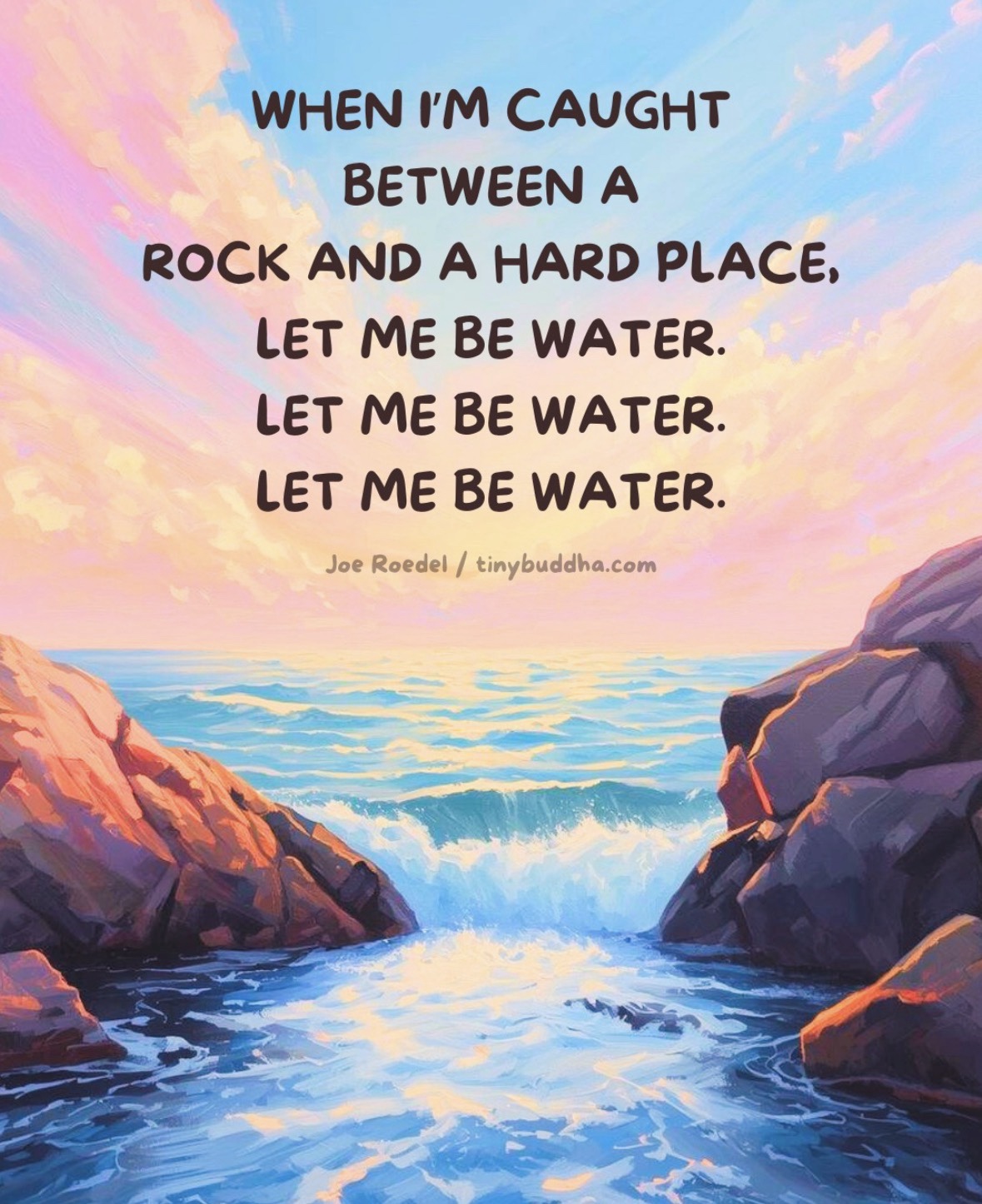
You know that feeling when life backs you into a corner?
When every option feels like it costs you something.
When you’re stuck between a rock and a hard place, and you can almost hear the pressure in your own head.
That’s the moment this line hits different:
“When I’m caught between a rock and a hard place, let me be water.”
Because if we’re honest, most of us don’t want to be water in that moment.
We want to be steel.
We want to be loud.
We want to be right.
We want to force the outcome.
We want to push the rock. Break the wall. Win the argument. Fix the situation instantly.
We want the problem to move.
But some problems don’t move.
Some situations don’t respond to force.
They respond to patience. To wisdom. To flexibility. To time.
And that’s where water becomes such a powerful image.
Water doesn’t panic when it meets resistance.
It doesn’t slam itself into the rock screaming, “Why won’t you change?”
It doesn’t throw a tantrum because the path is blocked.
Water simply adjusts.
It flows around.
It slips through.
It finds the crack you didn’t even notice.
It reshapes itself without losing what it is.
That’s not weakness. That’s strength with self-control.
Because being water doesn’t mean you’re avoiding the problem.
It means you’re refusing to let the problem harden you.
That’s the real danger of hard places, isn’t it?
Not the stress. Not the deadlines. Not the conflict.
It’s what pressure does to our personality.
Pressure can make you sharp.
Pressure can make you rigid.
Pressure can make you defensive.
You start speaking in absolutes.
You start reacting instead of responding.
You start carrying yourself like every conversation is a fight you have to win.
And slowly, without realizing it, you become the rock.
Unmovable.
Cold.
Hard to reach.
But water stays reachable.
Water stays alive.
Water can be calm even when everything around it is chaotic.
Water can be gentle without being fragile.
Water can take shape without losing identity.
And that’s why the phrase repeats:
“Let me be water. Let me be water. Let me be water.”
Because it’s not a one-time decision.
It’s a prayer you have to keep making.
Especially when you don’t feel like it.
Especially when you feel misunderstood.
Especially when you feel trapped.
Especially when you feel like the world is demanding an answer from you right now.
Being water means you don’t rush to prove yourself.
You don’t rush to punish.
You don’t rush to burn bridges just to feel powerful for five minutes.
You stay fluid.
You stay open.
You stay willing to learn something new, even when you’re uncomfortable.
Sometimes being water looks like taking a breath before you reply.
Sometimes it looks like walking away for an hour instead of saying the thing you’ll regret for a year.
Sometimes it looks like admitting you don’t know what to do yet, but you’re not going to make it worse by forcing a decision.
And yes, sometimes being water means you cry.
Because water is honest.
It doesn’t pretend it isn’t affected.
It moves with the truth of what it’s carrying.
But here’s the part people forget: water is not just soft.
Water can be powerful.
It can carve through stone over time.
It can wear down what seems impossible.
It can reshape entire landscapes without shouting about it.
That’s what consistency does.
That’s what quiet resilience does.
That’s what faith does too, if you think about it.
Faith isn’t always thunder and miracles and dramatic breakthroughs.
Sometimes faith is staying steady in the waiting.
Faith is saying, “I don’t know how this is going to work out… but I’m not going to become bitter while I figure it out.”
Faith is refusing to let hardship turn you into someone you don’t recognize.
Because the truth is, the rock and the hard place might not move today.
But you still get to choose who you are inside that space.
You can choose to become sharper and harder and more reactive.
Or you can choose to become wiser, calmer, and more adaptable.
You can choose to be water.
To flow instead of fight everything.
To bend instead of break.
To stay grounded instead of getting stuck.
And maybe that’s the whole point.
Not that life won’t trap you sometimes…
But that even when it does, you don’t have to lose yourself in the pressure.
So when you feel cornered, overwhelmed, or unsure…
When the path isn’t clear and the options aren’t great…
When you’re caught between a rock and a hard place…
Let yourself be water.
Not because you’re giving up.
But because you’re choosing to keep moving forward—
with grace, with patience, and with strength that doesn’t need to prove itself.
Let you be water.
Let you be water.
Let you be water.
 Kenrick Vaz