
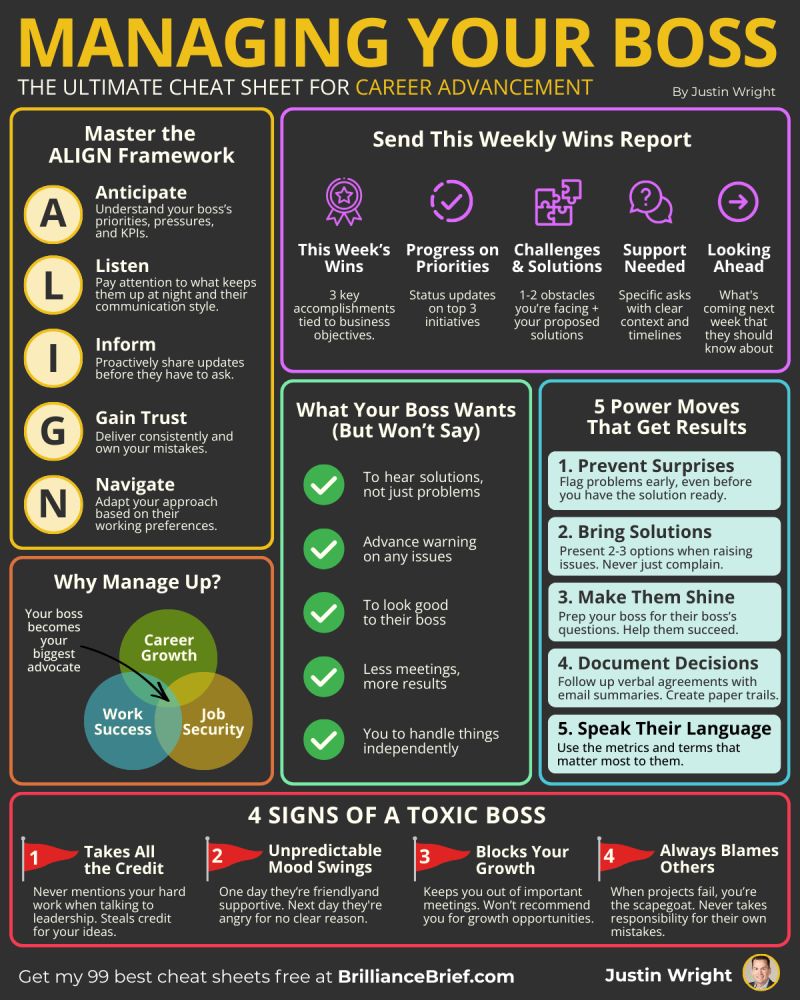
Your boss holds the keys to your next promotion.
But managing up isn’t about playing politics.
It’s about being smart.
Most people think managing up means brown-nosing.
Being fake. Manipulating. Playing games.
They’re dead wrong.
Managing up is about serving your boss
the same way you serve your team.
Because when your boss succeeds,
your whole team rises.
Including you.
Think about it.
You spend hours helping your team grow.
Supporting their development.
Clearing their roadblocks.
Why wouldn’t you do the same for the person who
has a big impact on your career trajectory?
You see, the truth is…
Your boss is drowning in priorities.
Fighting battles you’ll never see.
Making decisions with half the information.
When you make their life easier,
it comes back to help you too.
Success is a byproduct of helping others.
It’s not politics.
It’s partnership.
Send that weekly update.
Bring solutions, not problems.
Flag issues before they blow up.
Because your boss can be either
your biggest champion
or your biggest barrier.
In most cases, you get to choose which one.
Managing up is leadership in action.
Master it.
Agree? Disagree? I want to hear your perspective.
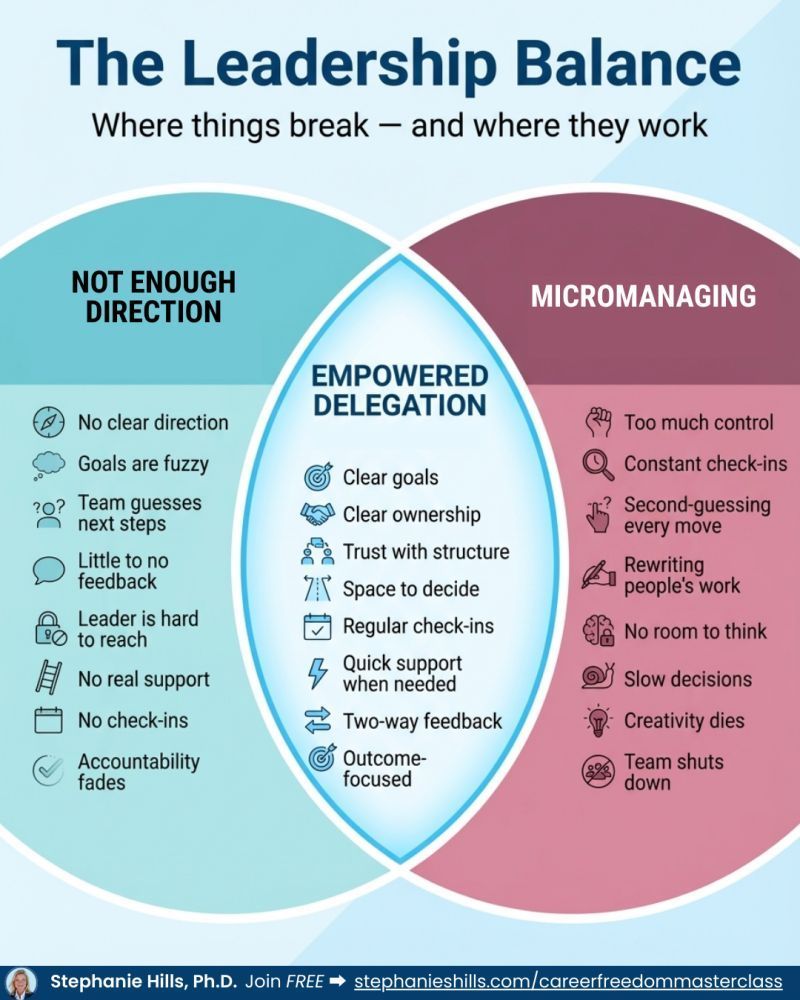
The Leadership Balance
I’ve seen this play out on so many teams.
A leader thinks they’re giving freedom,
but the team feels lost.
A leader thinks they’re being helpful,
but the team feels watched.
It’s a quiet tension you only notice when you’re in it.
Trying to do great work
with unclear direction
or constant check-ins.
Most teams get stuck between two extremes:
Not enough direction.
Or too much control.
Neither builds trust.
Neither builds confidence.
Neither creates great work.
And here’s the hard truth:
Leaders slip between both without meaning to.
Good intentions.
But no structure.
No shared expectations.
The shift happens with empowered delegation.
Not hands-off.
Not micromanaging.
A middle path that actually works.
⭐️ What Truly Moves Teams Forward 🌟
🔹 Clear goals that remove guessing
→ People finally know what good looks like
→ Stress drops and focus rises
🔹 Ownership that builds confidence
→ People feel trusted and capable
→ They take pride in their work
🔹 Trust with structure
→ Leaders stop hovering
→ Teams stop fearing mistakes
🔹 Space to decide
→ Creativity shows up
→ Hidden strengths finally surface
🔹 Regular check-ins that support
→ No one feels alone
→ Small issues never turn into big ones
🔹 Quick help when needed
→ Teams move faster
→ Work stops getting stuck at roadblocks
🔹 Two-way feedback
→ Leaders grow
→ Teams grow with them
🔹 Outcomes over oversight
→ People focus on impact
→ Motivation and ownership rise
That’s when people step up.
That’s when teams move faster.
That’s when leaders finally breathe again.
If you’re in that messy middle
trying to lead well without burning out,
you’re not alone.
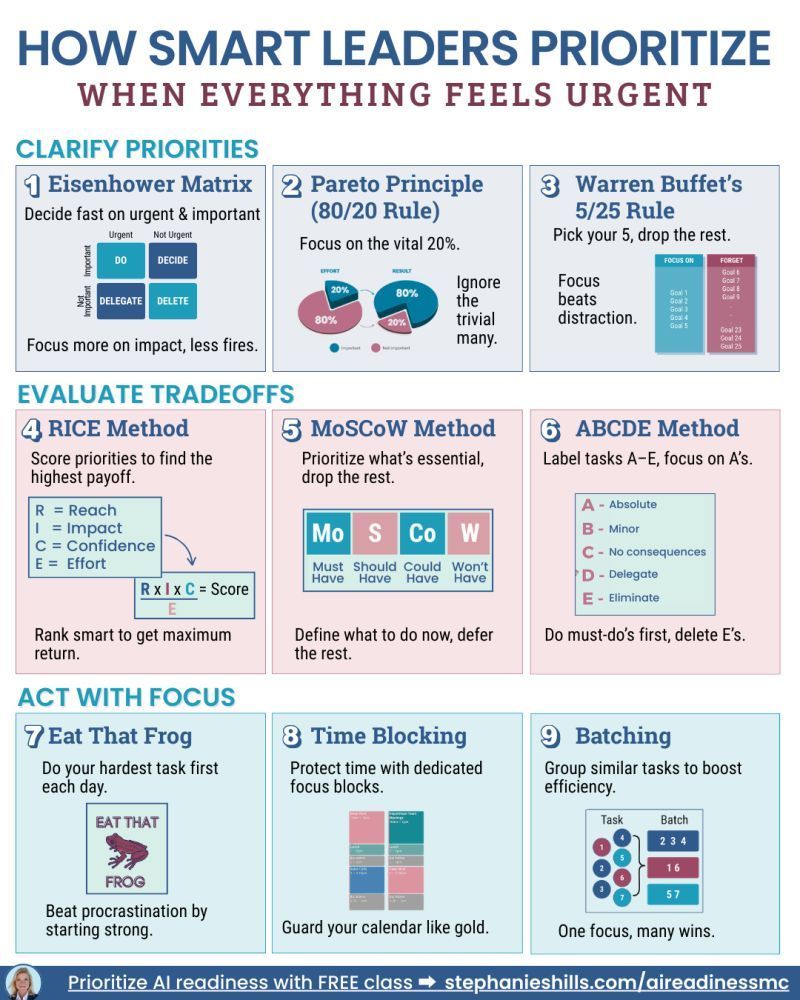
How Smart Leaders Prioritize
Every email marked “ASAP.”
Every request needed “immediate attention.”
My team was drowning in priorities.
Deadlines slipped.
Morale tanked.
Focus vanished.
Sound familiar?
Here’s how we turned chaos into clarity
and real results:
First, we used the Eisenhower Matrix:
→ True urgency: System outages
→ Important but planned: Feature releases
→ Delegate: Minor updates
→ Eliminate: Nice-to-haves
The key? We did this with the customer.
They helped categorize each request.
Their buy-in made all the difference.
Without it, this would’ve been just another failed process.
The result?
✔️ Less team overwhelm
✔️ Clearer project milestones
✔️ A happy customer, they got what truly mattered
Once we saw it work,
I built a playbook every smart leader
can use when everything feels urgent:
1. Eisenhower Matrix
→ Urgent vs important. Know where to focus.
→ Spend less time on fires, more on impact.
2. Pareto Principle (80/20 Rule)
→ The vital few drive most results.
→ Focus on the 20% that matters.
3. Warren Buffett’s 5/25 Rule
→ Choose 5 goals, ignore the other 20.
→ Focus beats distraction.
4. RICE Method
→ Score by reach, impact, confidence, effort.
→ Rank smart for maximum return.
5. MoSCoW Method
→ Must, Should, Could, Won’t.
→ Define essentials, defer the rest.
6. ABCDE Method
→ Label tasks A–E, focus on A’s.
→ Do must-do’s first, delete E’s.
Then, we put structure behind the strategy:
7. Time Blocking — 2 hours of deep client work daily.
→ No meetings, no interruptions.
→ Pure focus on what matters most.
8. Eat That Frog — tackle the hardest task first.
→ Before email, before admin.
→ Start strong, stay strong.
9. Batching — group similar tasks for efficiency.
→ One focus, many wins.
The payoff?
✔️ 3x more client face time
✔️ Smoother operations
✔️ Real work-life balance finally
Most leaders fix urgency.
The best leaders fix what matters next.
You’ve learned how to prioritize tasks.
Now it’s time to prioritize AI readiness.
The leaders and high achievers
who win in the next five years
won’t just manage urgency.
They’ll strategically prepare for AI.
Nothing About You
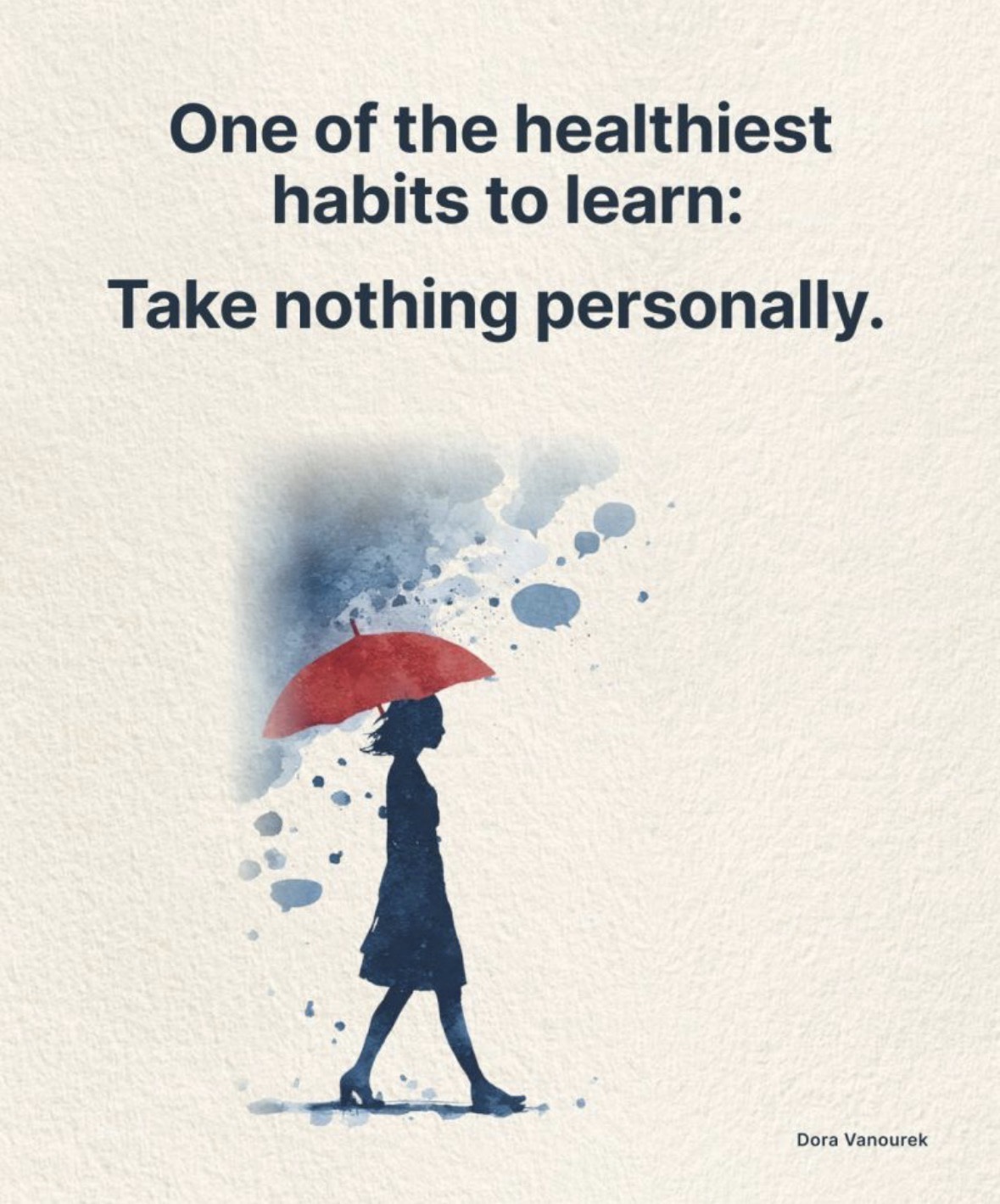
One of the healthiest habits you’ll ever learn sounds almost too simple to matter: take nothing personally.
Not because nothing hurts. Not because people don’t say careless things or make unfair assumptions. They do. All the time. But most of it has very little to do with you.
People speak from where they are, not from who you are.
Think about it. Someone snaps at you—it might be stress, pressure, a bad day, something you’ll never see. Someone underestimates you—it might be their own insecurity, their limited lens, their fear of what they don’t understand. Someone praises you—it might be what they need, what they value, what they recognize through their own story.
It’s all filtered. Everything.
The moment you start taking every reaction, every word, every silence as a reflection of your worth, you hand over control of your peace to people who were never qualified to hold it.
That’s exhausting.
Taking things personally turns small moments into heavy ones. A delayed reply becomes rejection. A passing comment becomes criticism. A difference of opinion becomes a personal attack. You start carrying things that were never meant for you in the first place.
But when you step back, something shifts.
You realize you don’t have to pick up every opinion and examine it like it’s truth. You don’t have to internalize every tone, every look, every offhand remark. You can let things pass through without letting them take root.
That doesn’t mean you become indifferent or cold. It means you become steady.
You still listen. You still care. You still reflect when something is worth learning from. But you stop assuming that everything is about you. You stop attaching your identity to other people’s temporary states.
And there’s freedom in that.
You start responding instead of reacting. You choose what deserves your energy. You protect your mental space a little better. You stop replaying conversations in your head, trying to decode what someone “really meant.” Most of the time, what they meant is simply where they are.
Not who you are.
It also makes your relationships healthier. You give people room to be human—to have off days, to say imperfect things, to not always get it right—without turning it into a personal wound. And in return, you allow yourself that same grace.
Because the truth is, you’ve probably been that person too. Tired. Distracted. Misunderstood. Saying something that didn’t land the way you intended. None of it defined you completely. It was just a moment.
The same applies to others.
Taking nothing personally doesn’t mean nothing affects you. It means you choose what defines you.
It means you stop building your self-worth on unstable ground.
So the next time something stings, pause before you claim it. Ask yourself—does this really belong to me? Or is this just someone else’s perspective passing by?
You don’t have to carry everything you’re handed.
Some things are lighter when you let them go.
How to sound like a consultant
No one hires you to sound smart.
They hire you to make things simple.
One of the most common mistakes I see consultants make is trying to sound impressive instead of clear.
Oftentimes, it’s the leftover programming from decades of corporate.
It works in that setting, but for small and medium business owners,
the easiest method is to make things simple.
Talking about deliverables doesn’t mean you need to sound robotic.
Start by ditching the corporate-speak and learn a few key phrases that’ll build a strong business relationship:
1. When setting the agenda:
❌ “Let’s align on strategic priorities for this engagement.”
✅ “Let’s start with what’s most important to you right now.”
2. When asking a prospect about their problems:
❌ “Can you identify the key pain points impacting your current performance?”
✅ “What’s getting in the way of your business running the way you want it to?”
3. When talking about growth:
❌ “Our objective is to design scalable systems that drive sustainable growth.”
✅ “Let’s build simple systems that help you grow without adding chaos.”
4. When giving feedback:
❌ “Your current strategy appears misaligned with established best practices.”
✅ “There’s an easier way to get the results you’re after.”
5. When presenting results:
❌ “We’ve observed measurable improvement across multiple key performance indicators.”
✅ “You’re up 18%. Here’s what’s working and where we can keep improving.”
6. When facing resistance:
❌ “While I understand your concerns, our methodology has consistently produced results across similar client engagements.”
✅ “I get it. Let’s look at how this would work in your situation?”
7. When selling the next step:
❌ “We offer a comprehensive suite of services designed to optimize profitability and performance.”
✅ “I can help you find and fix the profit that’s already in your business.”
8. When following up:
❌ “I wanted to touch base to confirm receipt of the proposal and inquire about your decision timeline.”
✅ “Just checking in. Does this still feel like the right next move for you?”
9. When wrapping up a meeting:
❌ “Let’s recap the key takeaways and confirm action items for next steps.”
✅ “Here’s what we agreed on and what happens next.”
Business owners aren’t looking for someone to wow them with theatrics.
They’re looking for someone who makes things easier to understand and act on.
If your language feels like jargon, they’ll tune out.
Speak clearly and you’ll build trust fast.
If you’re trying to get clear on how to grow your consulting business, I’ve built a short quiz to help.
It shows you your consulting archetype, highlights your biggest blind spot,
and gives you a practical roadmap for what to focus on next.
Right On Time, Even When You Doubt It
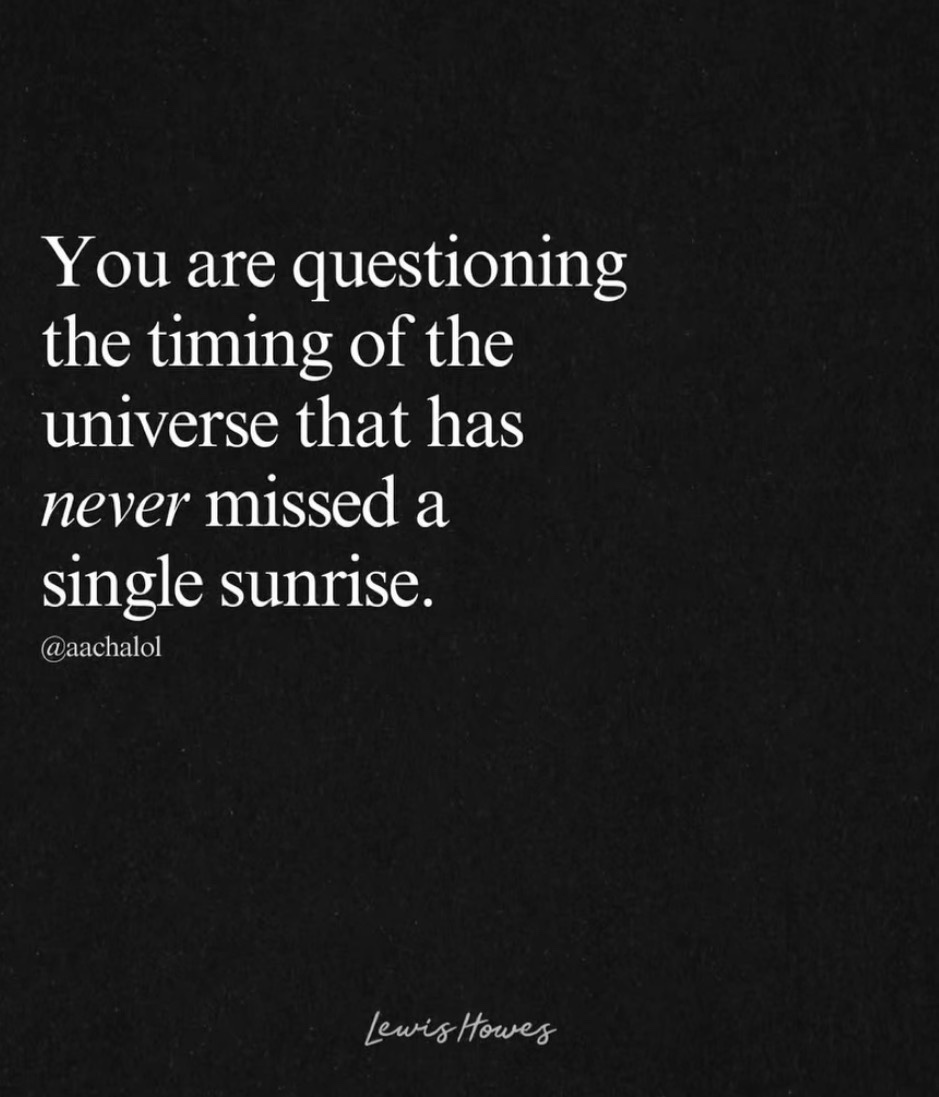
You’re questioning the timing of a universe that has never missed a single sunrise.
Think about that for a second.
Every morning, without fail, light finds its way back. Not early. Not late. Right on time. Clouds don’t confuse it. Storms don’t delay it. Even on the days you can’t see it, it’s still happening exactly as it should.
And yet, here you are, looking at your own life and wondering if something’s off. If you’ve missed your moment. If you’re behind. If things should have happened by now.
It’s such a human thing to do—measure your timeline against expectations you didn’t even consciously choose. A promotion by this age. Stability by that milestone. Clarity by now. As if life runs on a fixed schedule you were supposed to memorize.
But what if it doesn’t?
What if your life isn’t late… just unfolding?
There’s a quiet kind of pressure that builds when things don’t happen when you think they should. It whispers questions that sound a lot like doubt. “Why not yet?” “What am I doing wrong?” “Is something broken?” And slowly, that whisper gets louder until it feels like truth.
But look closer.
Some things in life need time not because they’re delayed, but because they’re being built properly. Foundations don’t get applause. Growth doesn’t always look impressive while it’s happening. Sometimes, it just feels like waiting.
And waiting can feel like failure if you’re not careful.
But there’s a difference between nothing happening and something happening that you can’t yet see.
You don’t question the sunrise because you trust the system behind it. You trust that even in darkness, something bigger is still moving, still aligning, still preparing for the moment it breaks through again.
What if you extended that same trust to your own life?
Not blindly. Not passively. But with the understanding that not everything meaningful arrives on your preferred timeline. Some things arrive when you’re ready to receive them. When you’ve grown into them. When the version of you that exists then can actually hold what you’ve been asking for.
Because getting what you want too early isn’t always a win. Sometimes it’s just a faster way to lose it.
So maybe this isn’t about being late.
Maybe this is about becoming.
Becoming the kind of person who can handle the opportunity. Becoming someone who won’t self-sabotage the thing they prayed for. Becoming steady enough, clear enough, grounded enough that when it finally shows up, you don’t just get it—you keep it.
That kind of timing doesn’t look impressive from the outside. It looks like detours. Like pauses. Like things not working out. But often, those are the exact moments that are quietly redirecting you toward something better aligned than what you originally had in mind.
It’s uncomfortable, though. No point pretending otherwise. Not knowing when something will happen forces you to sit with uncertainty, and that’s not easy. It tests your patience. Your confidence. Your belief in yourself.
But maybe that’s part of it too.
Maybe the waiting is shaping more than just your circumstances. Maybe it’s shaping you.
So instead of asking, “Why isn’t this happening yet?” try asking, “What is this moment asking of me?”
Because even here, even now, something is moving.
You might not see it. You might not feel it. But just like the sunrise, that doesn’t mean it isn’t on its way.
And when it does come, it won’t feel late.
It’ll feel right.
How to make Better Decisions
The quality of your life in 10 years will be determined by the decisions you make today.
But most people make decisions emotionally, then rationalise them logically afterward.
That’s why the same smart people keep making the same bad choices.
Buffett, Munger, Dalio… they all have systematic approaches to decisions.
They don’t trust their gut on big calls.
They trust their process.
Bad decisions compound just like good ones.
The problem is you usually don’t notice until years later.
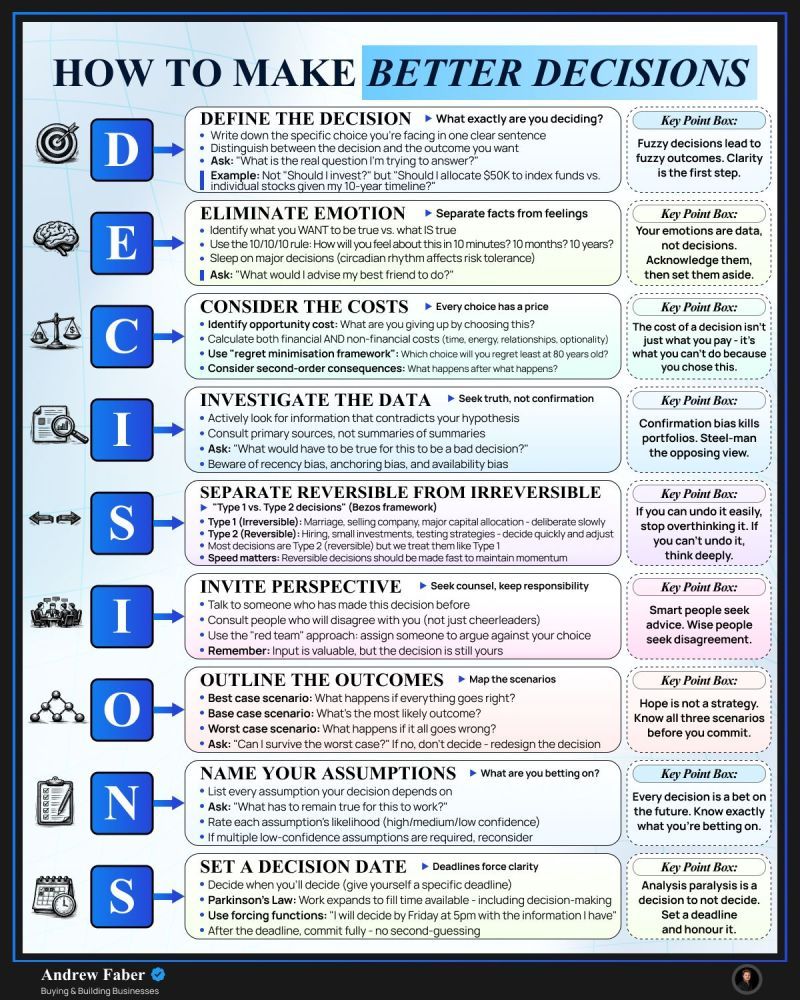
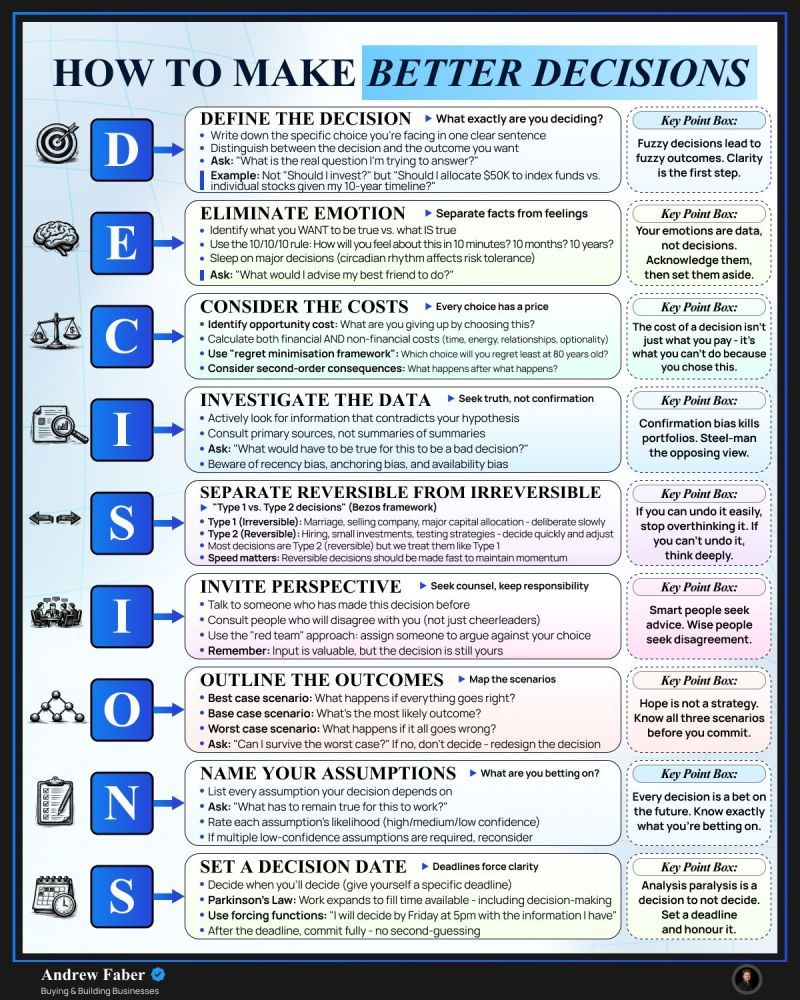
To help, I put together a framework to think through major decisions more clearly.
It works for capital allocation, hiring, partnerships, or anything where the stakes are high enough to warrant slowing down:
D – Define the decision
↳ Write it down in one clear sentence. “Should I invest?” is too vague.
“Should I allocate £50K to this acquisition given my 3-year timeline?” is better.
E – Eliminate emotion
↳ Separate what you WANT to be true from what IS true.
↳ Ask yourself what you’d advise a friend to do in the same situation.
C – Consider the costs
↳ Every choice has a price, and it’s not just financial.
↳ Time, energy, relationships, optionality. What are you giving up by choosing this?
I – Investigate the data
↳ Actively look for information that contradicts your hypothesis.
↳ Ask what would have to be true for this to be a bad decision.
S – Separate reversible from irreversible
↳ Jeff Bezos calls these 1-way and 2-way doors.
↳ Reversible decisions should be made quickly. Irreversible ones deserve more time.
I – Invite perspective
↳ Talk to someone who’s made this decision before.
↳ Better yet, talk to someone who will disagree with you.
O – Outline the outcomes
↳ Best case, base case, worst case.
If you can’t survive the worst case, don’t make the decision. Redesign it.
N – Name your assumptions
↳ Every decision is a bet on the future. List what has to remain true for your decision to work.
↳ If you’re relying on multiple low-confidence assumptions, reconsider.
S – Set a decision date
↳ Decide when you’ll decide.
↳ Analysis paralysis is just a decision to not decide. Set a deadline and honour it.
The goal isn’t to be right 100% of the time.
It’s to have a process that improves your odds and helps you learn from the ones that don’t work out.
Writing down your decisions also creates accountability.
You can look back in a year and see whether your reasoning held up or whether you were fooling yourself.
Having a system won’t guarantee good outcomes…
But it will guarantee better thinking.
One Voice Matters
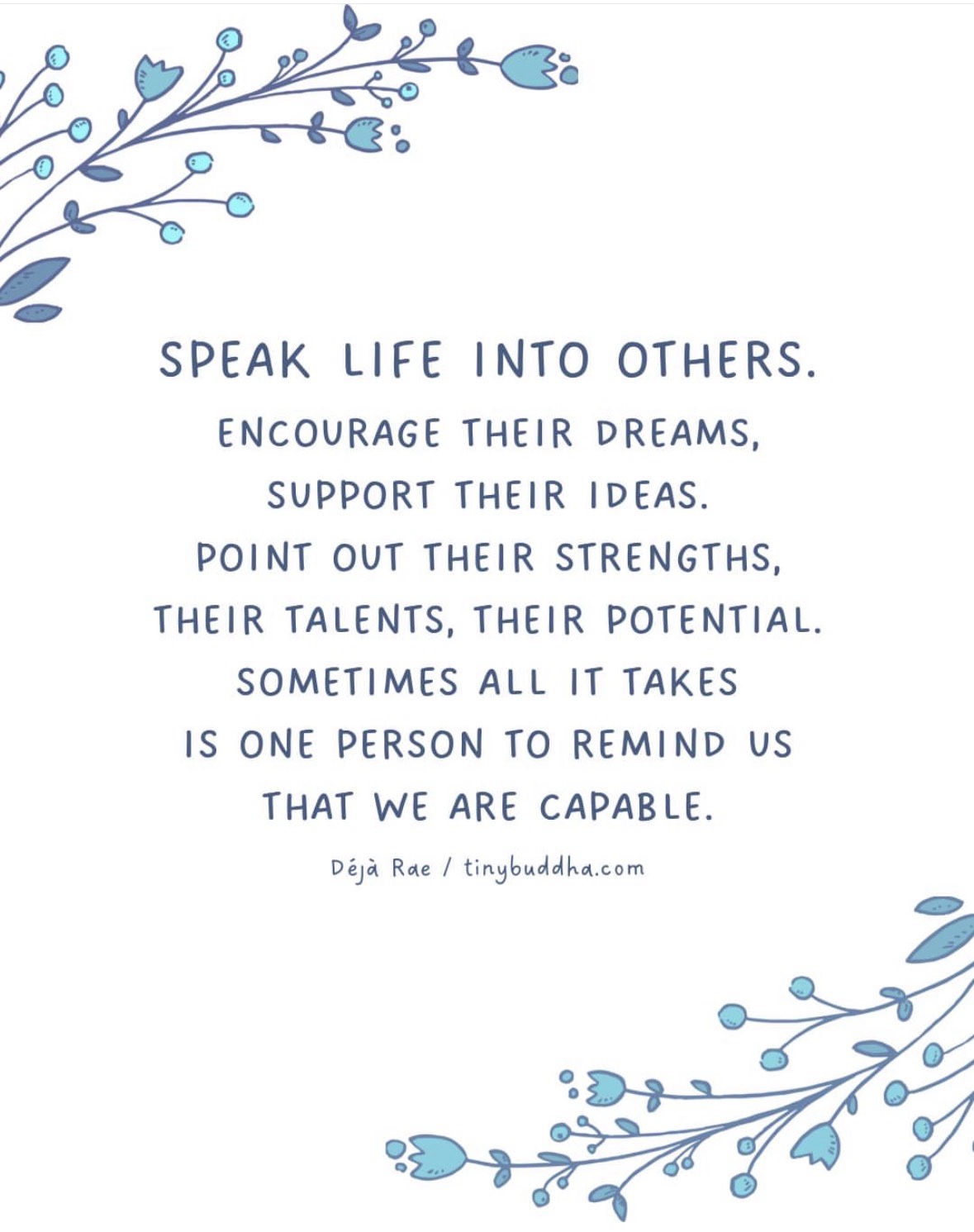
There’s something quietly powerful about being the person who chooses to speak life into others.
Not the loud, performative kind. Not the kind that shows up only when it’s convenient or visible. I’m talking about the everyday moments—the ones that don’t get posted, don’t get applauded, don’t get remembered publicly. A passing comment. A quick message. A sentence spoken at just the right time.
“Hey, you’re actually really good at this.”
“I think you should go for it.”
“I see something in you.”
Simple words. But they land deeper than we realize.
Because most people are walking around with more doubt than confidence. More questions than clarity. More hesitation than momentum. You don’t always see it—but it’s there. The second-guessing. The quiet comparisons. The internal voice that says, “Maybe I’m not cut out for this.”
And then someone steps in—not to fix everything, not to give a grand speech—but just to remind them of what they’ve forgotten about themselves.
That reminder can change things.
It doesn’t suddenly solve all their problems. It doesn’t magically remove fear. But it shifts something. It adds just enough weight on the side of belief to tip the balance. Sometimes that’s all it takes—a small nudge in the right direction.
Think about it. If you trace back moments of growth in your own life, chances are there was someone who said something that stuck. A teacher, a friend, a manager, even a stranger. Someone who saw potential before you fully believed in it yourself.
And here’s the part we underestimate—we have that same ability for someone else.
You don’t need to have all the answers. You don’t need to be more experienced, more successful, or more “qualified.” Encouragement isn’t about authority. It’s about attention. It’s about noticing what’s already there and saying it out loud.
“I see your effort.”
“I see your growth.”
“I see your potential.”
Those words do more than boost morale. They give people permission—to try, to fail, to keep going.
But there’s also a subtle responsibility that comes with this.
It’s easy to default to silence. To assume someone else will say it. To think, “They probably already know.” But they might not. Or they might know it intellectually and still not feel it emotionally. That gap matters.
Filling that gap, even briefly, can make a difference that outlasts the moment.
And it’s not about exaggeration or empty praise. People can tell the difference. Real encouragement is specific. It’s grounded. It points to something tangible—a strength, a pattern, a spark.
“You handled that situation really well.”
“You have a way of making people feel comfortable.”
“You’re consistent, even when things get hard.”
Now it’s not just encouragement—it’s clarity.
The interesting thing is, when you start doing this intentionally, something shifts in you too. You begin to look for the good more often. You notice strengths faster. You pay attention differently. And that changes how you show up—not just for others, but for yourself.
Because the same voice you use for others eventually echoes inward.
But let’s be honest—it’s not always easy.
There are moments when you’re tired, distracted, or caught up in your own challenges. Moments when encouragement feels like extra effort. And sometimes, if you’re not careful, comparison or ego can creep in. It can feel uncomfortable to lift someone else when you’re still figuring things out yourself.
That’s real.
But encouragement isn’t about having everything sorted out. It’s about choosing generosity anyway. Choosing to contribute something positive to someone else’s path, even if yours is still unfolding.
And often, that act of giving becomes a quiet reminder—you’re capable too.
In the end, speaking life into others isn’t about grand gestures. It’s about consistency. It’s about showing up in small, intentional ways that accumulate over time.
A message here. A word there. A moment of recognition when it’s least expected.
You may never fully see the impact. You may never know which sentence stayed with someone, which moment gave them just enough courage to keep going.
But it matters.
Sometimes all it takes is one person to say, “You’ve got this.”
And sometimes, that one person is you.
When you feel…
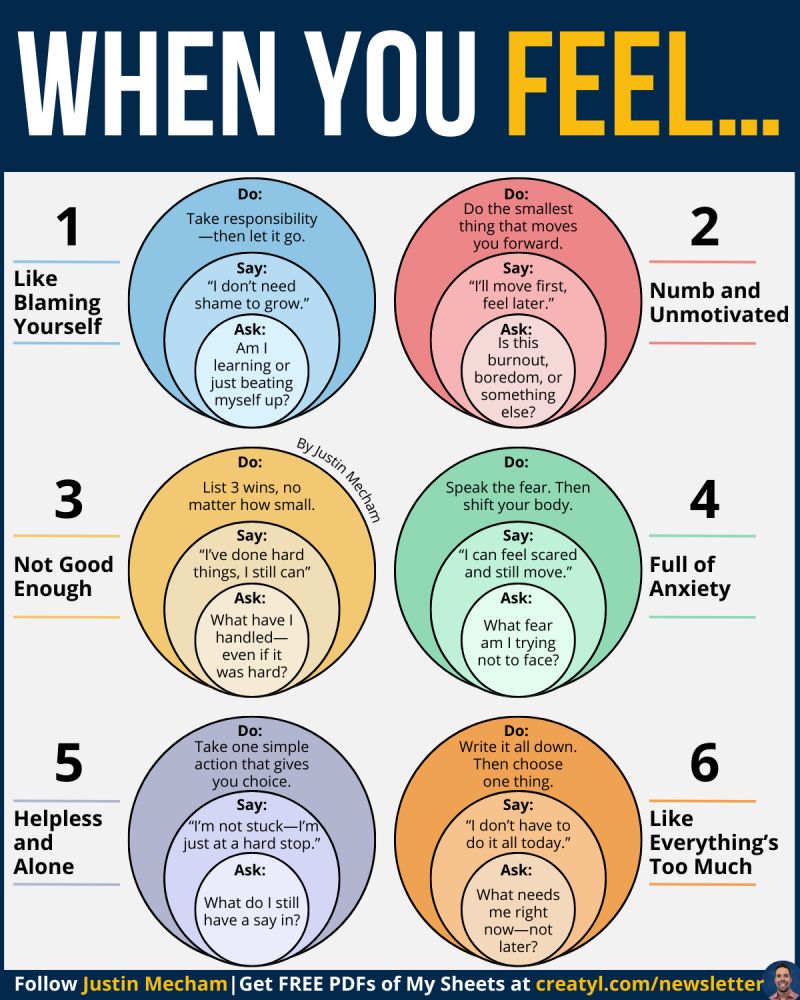
The day I stopped trying to “fix” my mood,
my focus came back. Here’s what I did…
Some days we wake up and feel stuck.
Not physically stuck.
Not just tired.
Stuck inside our own head.
You can grind harder.
You can read another article.
You can wait to “feel ready.”
None of that changes the loop.
What changes it is the first move you make
when your thoughts go sideways.
Feelings are not the enemy.
But waiting on them is the trap.
Here’s my simple reset for
the moments that spiral:
🔵When you’re blaming yourself
• Do: Own it, then release it.
• Say: “I can grow without shame.”
• Ask: Am I learning… or attacking myself?
🔴When you feel numb and unmotivated
• Do: Take the smallest forward step.
• Say: “I’ll move first. Feel later.”
• Ask: Is this burnout, boredom, or something deeper?
🟡When you feel not good enough
• Do: Write 3 wins (tiny counts).
• Say: “I’ve done hard things before.”
• Ask: What have I handled that proves I can?
🟢When anxiety is loud
• Do: Name the fear. Move your body.
• Say: “I can be scared and still act.”
• Ask: What am I avoiding facing?
🟣When you feel helpless and alone
• Do: Take one action that gives you control.
• Say: “I’m not stuck. I’m paused.”
• Ask: What do I still have a choice in?
🟠When everything feels like too much
• Do: Brain dump. Pick one thing.
• Say: “I don’t have to finish today.”
• Ask: What needs me now?
✔️Try this:
• Pick the feeling.
• Do the step.
• Ask the question.
You do not need to wait for clarity.
You need a next step that brings clarity.
Your brain follows what you choose first.
When you lead with action, focus comes too.
And the truth is this:
You are not broken.
You are simply in a moment that will pass
once you show your mind a
next move it can trust.
That is the feeling shift people share back when
they take control of their day instead of
letting their head control them.
Unedited, Unmuted, Unafraid

There’s this quiet pressure in the world to sand yourself down.
Not loudly. Not in a way you can easily point to. But it’s there—in the raised eyebrows, the awkward pauses, the subtle jokes that make you question if you felt “too much.” Somewhere along the way, we start learning that being deeply moved, openly affectionate, or visibly joyful needs to be managed. Filtered. Reduced to something more… acceptable.
So when you tear up at a commercial, you instinctively laugh it off.
When you say “I love you” and it lands a little sooner than expected, you replay it in your head.
When joy hits you like a wave—big, loud, undeniable—you try to contain it, as if it might spill over and embarrass you.
But pause on that instinct for a second.
Why is softness something we think needs editing?
It’s strange when you really look at it. We don’t question numbness the same way. We don’t raise concerns when someone feels nothing, says little, reacts less. That version of being—muted, controlled, detached—has somehow become the baseline. Safe. Mature, even.
But it’s not.
It’s just easier for the world to process.
Softness, on the other hand, disrupts things. It’s unpredictable. It shows up uninvited and refuses to stay within lines. It makes people uncomfortable sometimes—not because it’s wrong, but because it’s honest. And honesty, especially emotional honesty, is rare enough that it catches people off guard.
Think about the last time something genuinely moved you. Not in a polite, “that’s nice” kind of way—but in a way that made you feel it in your chest. That kind of reaction doesn’t come from weakness. It comes from being fully present. From being open enough to let something in without immediately analyzing it or protecting yourself from it.
That’s not something to shrink.
That’s something most people have forgotten how to do.
The same goes for love. There’s this unspoken rulebook about timing—when to say it, how often to say it, how much of it to show. Too soon, and you risk looking naïve. Too much, and you risk looking desperate.
But love doesn’t operate on a schedule.
When you feel it, you feel it. And expressing it—honestly, without calculation—isn’t a flaw in your character. It’s clarity. It’s courage, actually. Because you’re choosing to be seen without guarantees. You’re choosing to give without knowing how it’ll be received.
That’s not something to regret.
And then there’s joy—the kind that doesn’t ask for permission. The kind that shows up loudly, unexpectedly, sometimes at inconvenient times. The kind that makes you laugh harder than necessary, smile longer than usual, feel lighter than you can explain.
People learn to tone that down too.
Don’t be too excited.
Don’t make it a big deal.
Don’t draw attention.
But why not?
Joy isn’t a limited resource you need to ration carefully. It’s not something that needs to be diluted so it fits into a quieter version of yourself. If anything, it’s one of the few things in life that deserves to be felt fully, without apology.
And yet, over time, we start negotiating with all of this.
We trade softness for composure.
We trade expression for control.
We trade depth for convenience.
Not because we want to—but because it feels safer.
Safer to not care as much.
Safer to not feel as deeply.
Safer to not risk being misunderstood.
But safety has a cost.
When you start shrinking your softness, you don’t just lose the “too much” parts. You lose the best parts too. The ability to connect without filters. The ability to feel joy without restraint. The ability to care in a way that’s real, not measured.
You don’t become balanced.
You become distant—from others, and eventually from yourself.
So no, don’t shrink it.
If something moves you, let it.
If you love someone, say it.
If joy hits you, don’t dilute it.
Because the truth is, the world isn’t suffering from people who feel too much.
It’s suffering from people who’ve stopped feeling at all.
And the ones who still do—the ones who cry at commercials, who say things a little too early, who feel joy like it’s fire—they’re not the problem.
They’re the reminder.
The reminder that being human was never meant to be quiet, controlled, and carefully edited.
It was meant to be felt.

