When a Drop Becomes a World

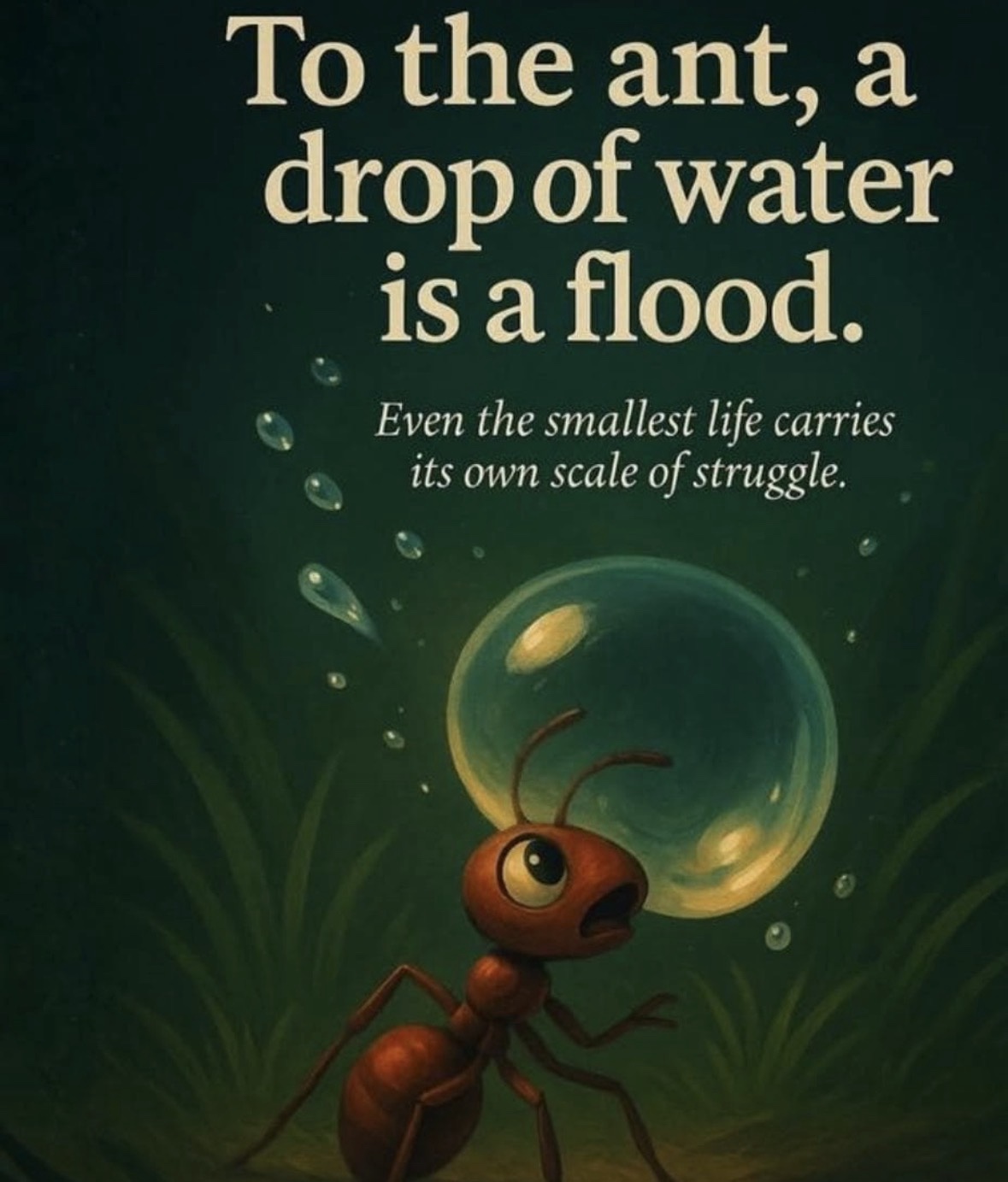
It’s funny how perspective works. To us, a drop of water is nothing—a blink, a bead on a window, a moment that dries before we even notice it. But to the ant, that same drop is a force of nature. A whole flood. A moment that changes everything. And the more you sit with that, the more it sinks in: every life carries a scale of struggle we can’t always see.

We’re quick to compare hardships, aren’t we? We weigh our days against someone else’s and judge our pain based on how “big” or “small” it looks from the outside. But the ant never apologizes for the size of its flood. It simply deals with what’s in front of it, because that’s its world. That’s its reality.

And people are the same. The quiet colleague who seems fine might be carrying weights you’d never expect. Your strongest friend might be wrestling something you’ll never hear about. Even the person who appears to have life “figured out” might be one drop away from feeling overwhelmed. Struggle isn’t universal, but the experience of struggling is.

There’s something strangely comforting in accepting that. It reminds us to soften a little. To stop dismissing our own challenges just because they don’t look dramatic from the outside. And to stop brushing off someone else’s because they don’t match our idea of what “hard” should look like. A drop can be a flood depending on who you are, where you are, and what you’re already carrying.

Maybe the real invitation here is to approach the world with a little more gentleness. To look up from our own path and notice the tiny battles happening around us. To offer patience instead of judgment. Understanding instead of assumptions. And maybe, on the days when everything feels heavier than it should, to give ourselves the same grace.

We’re all just trying to move through our world, step by step, doing our best with whatever falls into our path. Some days it’s sunshine. Some days it’s a storm. And some days it’s just a single drop that somehow feels like more than enough.

What matters isn’t the size of the struggle—it’s acknowledging that it matters at all.
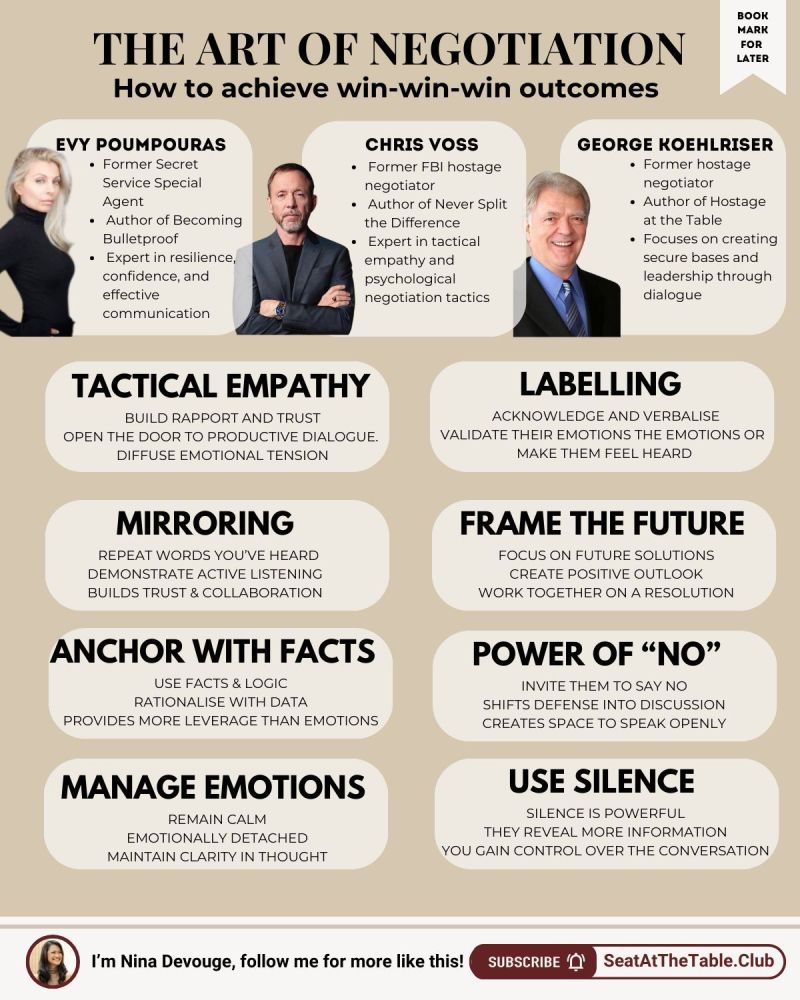
The Art of Negotiation

Negotiation isn’t about winning…
It’s about co-creation.
Too often, we enter negotiations thinking it’s a battle.

But the best negotiators?
They create partnerships.

✔️ They listen deeply, not just to respond, but to uncover hidden interests.
✔️ They reframe rejection—a “no” is often just a request for more clarity.
✔️ They trade value, not ultimatums.

Concessions should feel like a step forward, not a loss.

The goal?

A deal where both parties feel they’ve gained something meaningful.
Because real power in negotiation comes not from forcing agreement, but from building trust.

What’s the best negotiation tactic you’ve learned?

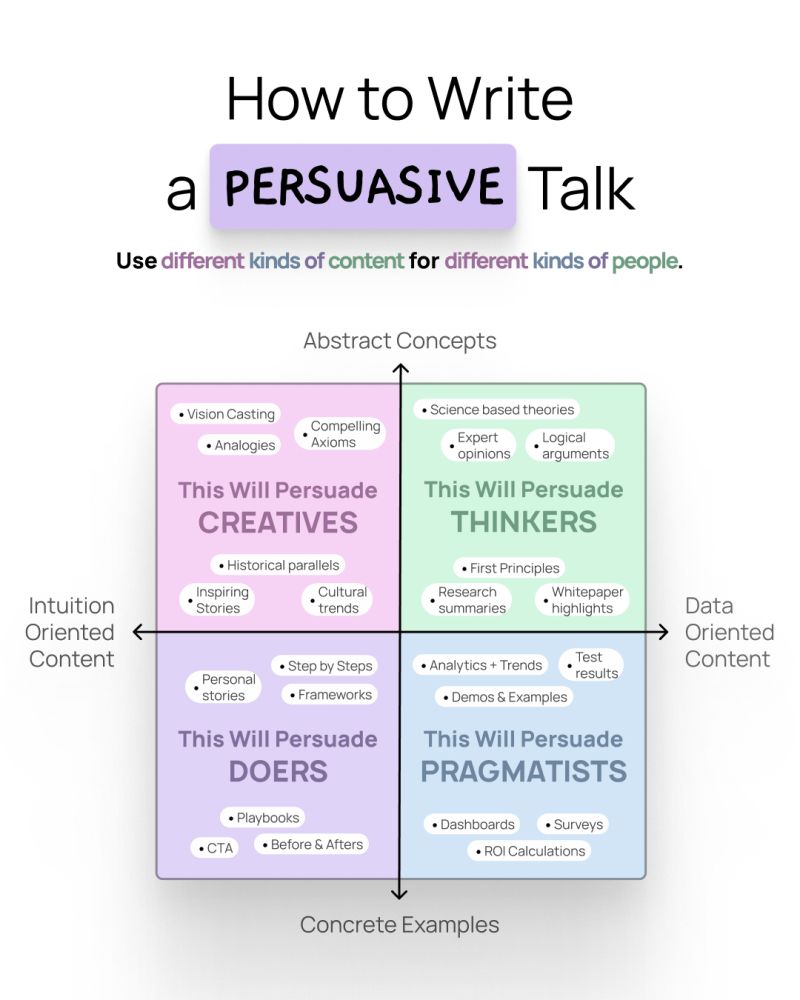
How to Write a Persuasive Talk

There are 4 kinds of people in every audience.
Most speakers only talk to 1. That’s why they fall flat.

Those 4 types are:

• CREATIVES
• THINKERS
• DOERS
• PRAGMATISTS

[Definitions coming below.]

The problem with most speakers?

They are one of those types themselves.
So they write a talk biased toward their own type.

(We all assume everyone is just like us, don’t we?)

But the most persuasive speakers learn to aim at all 4.

→ They get inside each type’s headspace & bias
→ They consider their values and temperaments
→ They intentionally use different kinds of content

Let me show you how it works:

1. CREATIVES
They’re moved by vision, beauty, and big ideas.

To persuade them, use:
→ Analogies
→ Vision Casting
→ Cultural Trends
→ Inspiring Stories
→ Historical Parallels
→ Compelling Axioms

2. THINKERS
They’re drawn to logic and intellectual clarity.

To persuade them, use:
→ First Principles
→ Expert Insights
→ Logical Arguments
→ Research Summaries
→ Whitepaper Highlights
→ Science-Based Theories

3. DOERS
They buy in through clarity, utility, and step-by-steps.

To persuade them, use:
→ CTAs
→ Playbooks
→ Frameworks
→ Step-by-Steps
→ Before & Afters
→ Example Stories

4. PRAGMATISTS
They care about what works, scales, and proves ROI.

To persuade them, use:
→ Surveys
→ Test Results
→ Dashboards
→ ROI Calculations
→ Analytics & Trends
→ Demos & Examples

If you want to give a persuasive talk, remember this:

→ It’s not how well you understand your idea.
→ It’s how well you understand the people hearing it.

Go get ’em.

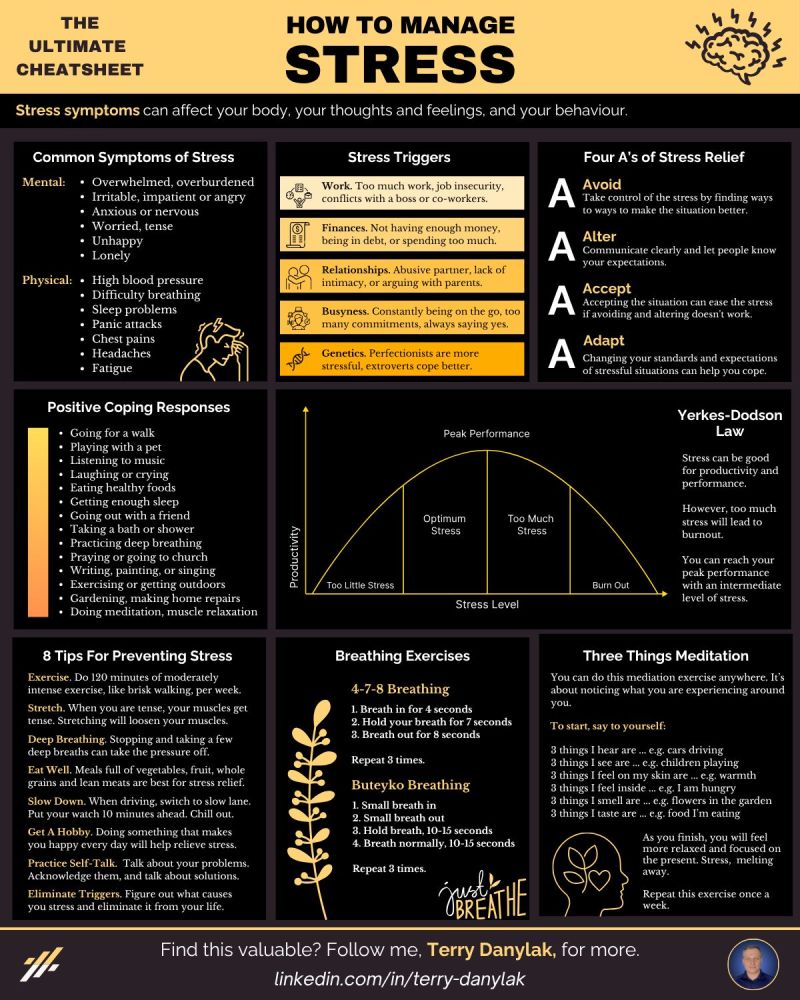
Stress

Stress can destroy your health and your career
(if you don’t manage it well).

But you can not only manage it.
You can conquer it.

Here are 8 tips for preventing stress:

1️⃣ Exercise.
Do 120 minutes of moderately intense exercise, like brisk walking, per week.

2️⃣ Stretch.
When you are tense, your muscles get tense. Stretching will loosen your muscles.

3️⃣ Deep Breathing.
Stopping and taking a few deep breaths can take the pressure off.

4️⃣ Eat Well.
Meals full of vegetables, fruit, whole grains and lean meats are best for stress relief.

5️⃣ Slow Down.
When driving, switch to the slow lane. Put your watch 10 minutes ahead. Chill out.

6️⃣ Get A Hobby.
Doing something that makes you happy every day will help relieve stress.

7️⃣ Practice Self-Talk.
Talk about your problems. Acknowledge them, and talk about solutions.

8️⃣ Eliminate Triggers.
Figure out what causes you stress and eliminate it from your life.

And here’s the best exercise to calm your mind:

🔥 The 4-7-8 Breathing

1. Breath in for 4 seconds
2. Hold your breath for 7 seconds
3. Breath out for 8 seconds

Repeat 3 times.

Don’t let stress take over your life.
Eliminate the triggers and live a happy life.

Trouble Making Your Big Idea Clear?

The question I get most often from CEOs and founders when we inject clarity in their messaging is this:

“Is this always this hard?”

The answer is yes.

But with these simple ideas you can leapfrog 99% of people:

1 – BBQ Test 🍖
↳ Can you explain it to someone at a BBQ – and keep their attention?
↳ No jargon. No slides. Just say what you mean.

2 – Answer “So What?” ❓
↳ People don’t care unless you make them care.
↳ “This matters now because…”

3 – Share 1 Big Idea 💡
↳ Don’t create Frankenideas.
↳ What is the One Thing you want to get across?

4 – Create an Atomic Statement 💥
↳ One explosive sentence, simply expressed, packed with meaning.
↳ (h/t Will Storr)

5 – Run it through the Clarity Filter 🧽
↳ Is it: beneficial, focused, salient, empathetic, minimal?
↳ (h/t Ben Guttmann)

6 – Use Their Words 🗣️
↳ Tell your audience the story they would tell themselves.
↳ Match their mindset, not your expertise.

7 – Record → Review → Refine 🎙️
↳ What looks good on paper often sounds clunky.
↳ Speak it aloud. Refine until it flows.

🧭 Clear messaging isn’t about dumbing it down. It’s the only way to get an idea from your head into theirs.

❓ How do you ensure your message is clear?

10 Secrets of Leaders Who Never Seem Stressed

We all know someone who walks into every room with focus, clarity, and calm, even when everything’s on fire. They’re not superhuman.
They just work differently

Here are 10 things they do that you can do too:

➊ Prep the Night Before
↳ Lay out your clothes. Pack your bag. Write your list.
↳ Start ahead, don’t start behind.

➋ Always Arrive Early
↳ Show up 10 minutes early. Always.
↳ Calm becomes your norm, not your luck.

➌ Schedule What Matters
↳ If it’s important, it gets a time slot.
↳ Free time is for rest, not your memory bank.

➍ Automate the Repeats
↳ Auto-pay. Default preferences. Saved orders.
↳ Don’t rethink the same decisions over and over.

➎ One List, One Brain
↳ Track everything in one place, tasks, goals, ideas.
↳ Fewer lists = fewer misses.

➏ Capture, Then Forget
↳ Write down thoughts as they come.
↳ Free your brain to focus on what matters.

➐ Leave White Space
↳ Block open time every day.
↳ Clearer thinking, better breathing, more creativity.

➑ Build Buffers
↳ Add 15 minutes between meetings.
↳ Breathing room = stress insurance.

➒ Sync Weekly
↳ Align your calendar with your team or family.
↳ Avoid fire drills. Plan instead of react.

➓ Protect Deep Work
↳ One focused block per day, guard it.
↳ Real work > busy work. Every time.

Stress doesn’t come from doing too much.
It comes from managing it poorly.

These 10 systems aren’t about being perfect.
They’re about being intentional.
Great operators trade chaos for clarity.

✅ Block 1 hour today to implement 3 of these.
✅ Start with time blocks and deep work.
✅ Review weekly, refine, don’t restart.

Where Your Power Lives

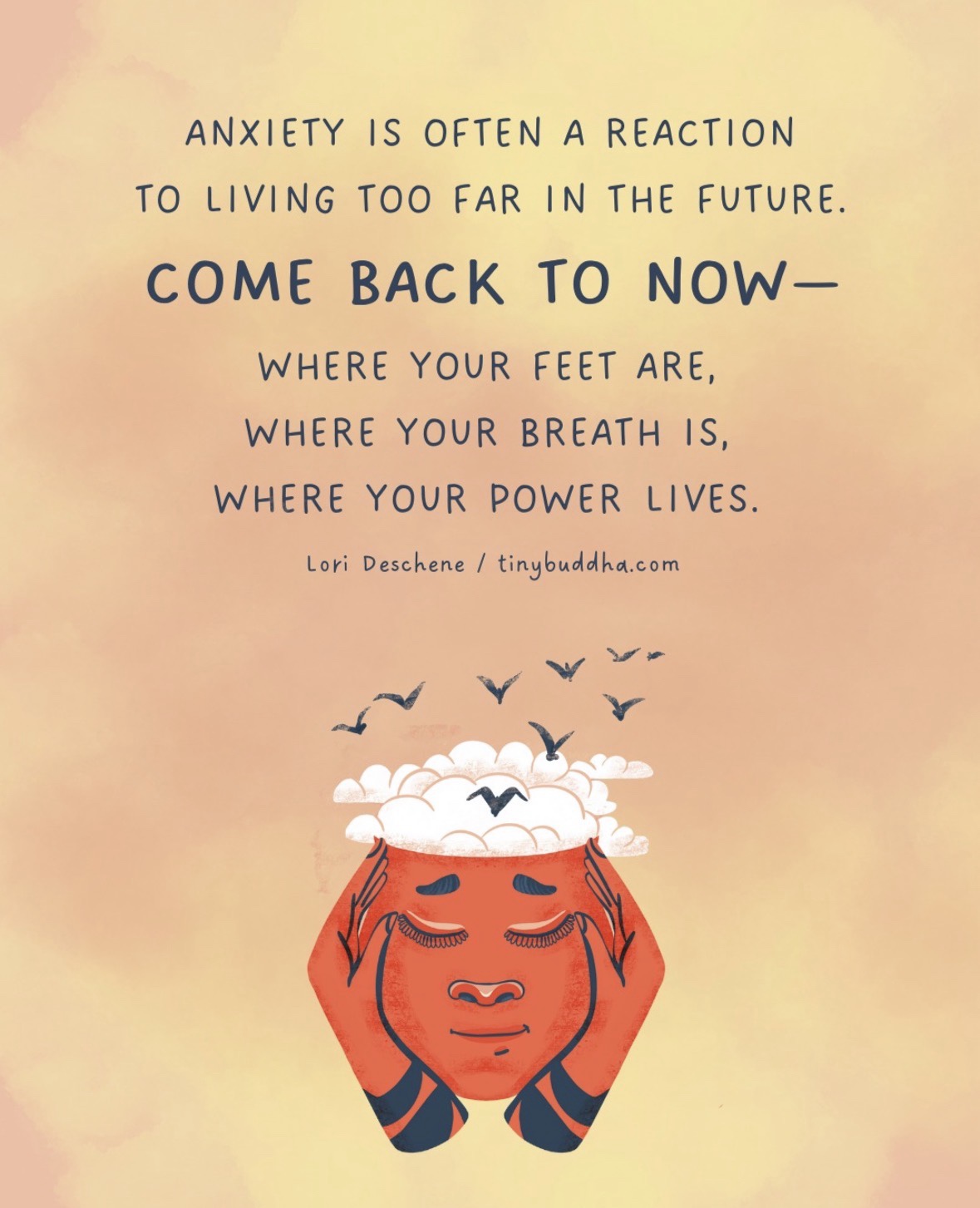
There’s a strange thing our minds do when life feels uncertain: they sprint ahead. Not a gentle jog, not a curious wander—an all-out dash into a hundred possible futures. Most of them unrealistic. Many of them unkind. And before we even know it, our bodies are reacting to moments that haven’t actually happened. That’s the trap of anxiety: we start living in days that don’t exist yet.

It can show up in small ways—like checking your phone for the tenth time for something that hasn’t come. Or in bigger ways—like rehearsing disasters that aren’t actually unfolding. It feels like preparation, but it’s really self-protection wearing the wrong costume. We forget that our power isn’t stored in the places we’re afraid of. It’s here, where we can do something. Where we can breathe. Where our actual life is happening.

Coming back to the present isn’t some poetic instruction; it’s a practical shift. It’s pausing long enough to notice that your feet are actually grounded somewhere right now. It’s realizing your breath might be shallow because you were caught in a storm of “what ifs.” It’s remembering that your body only lives in the current moment, even if your mind tries to time-travel for sport.

There’s a gentleness required to pull yourself back. Not a scolding, not a dramatic reset—just a quiet “come back.” Come back to the chair you’re sitting on. Come back to the sound of your kid playing in the next room. Come back to the conversation you’re actually having instead of the one you’re worrying about. Come back to the version of you that isn’t bracing for impact, but simply existing.

The present has a grounding quality because it’s the only place where anything is real. The future is a sketch. The past is a collection of moments we keep rearranging. But the now—this breath, this heartbeat, this moment—is the only place where clarity ever shows up. And more importantly, it’s the only place where you have any true influence.

When you remember that, anxiety loses some of its grip. Not all of it—because you’re human, and humans worry—but enough that you can stand a little taller. Enough that you can step back into yourself. Enough that you can take one small, doable action instead of wrestling with a whole imaginary month.

Maybe “stay in the present” feels like tired advice. But at its core, it’s an invitation to return to the one place where you’re not powerless. You don’t have to solve Thursday on a Monday. You don’t have to carry every possible outcome today. You don’t have to outrun the future. You just have to be where your feet are.

Your calm lives here.

Your clarity lives here.

Your strength lives here.

And so does your next right step.

10 Worst Ways To Build Company Culture

Most companies focus on the wrong things.

And I made some of these mistakes
when I started my leadership journey too.

But I learned my lessons long ago.

We built our company culture,
and I do everything I can to keep it healthy.

❌ Here are the 10 worst ways to build Company Culture:

1. Pizza Fridays as a fix for burnout.
2. Pushing the “family” rhetoric.
3. Asking for non-anonymous feedback.
4. Micromanaging under the guise of “care”.
5. Big promises with no follow-through.
6. Giving praise without genuine recognition.
7. Underpaying while overpromising “growth”.
8. Forcing employees into social events.
9. Assuming “everyone loves competition”.
10. Confusing perks with culture.

Let’s aim for real, meaningful culture.
Not just superficial fixes.

If we want to retain top talent,
we must invest in building a culture that matters.

What steps are you taking to avoid these common pitfalls?
Let’s share ideas.

A Hope That Doesn’t Wait for Perfect

Somewhere along the way, most of us are taught to hold our breath for the “better.” A better season, a better break, a better answer, a better streak of luck. We convince ourselves that once life calms down, once the chaos settles, once things finally make sense, then we can start living. Then we can relax. Then we can breathe. It’s an easy trap to fall into, because hope is a beautiful thing—but it can quietly turn into a stall button if we’re not careful.

That’s why the line in the illustration cuts so sharply. It’s honest in a way that makes you pause: this might not get better, but I will. There’s a strange kind of freedom in accepting that. Not resignation, not pessimism—just a gentle nod to reality. Not everything around us will magically shift, but we can.

When you stop waiting for life to smooth itself out, you start discovering the small doorways back to yourself. You laugh a little easier, not because everything is funny, but because you’re giving yourself permission to feel light again. You love with fewer conditions, because you no longer expect perfection before opening your heart. You grow, not out of crisis or fear, but out of choice. And you find joy in places that used to feel too ordinary to notice.

It’s like realizing you don’t need the whole world to change its weather before you step outside; you just need a jacket. The storm can stay unpredictable, the clouds can keep doing what they do, and you can still go on living, building, trying, becoming. That shift—from waiting for the moment to be right, to making the moment right enough—changes everything.

We spend so much time hoping life will turn gentle, that we forget we can become gentler ourselves. We wait for circumstances to heal, forgetting we can heal in the meantime. We hope for clarity, not realizing clarity often shows up only after we take the first step, not before.

And quietly, underneath all of this, is the truth most of us learn a little later than we wish: the goal was never a perfect life. The goal was a steady, anchored self. A version of you that can smile on the messy days, rest on the uncertain ones, and still move forward even when the finish line is blurry.

So maybe things won’t get better in the way you imagined. Maybe some situations will stay complicated. Maybe some disappointments won’t fully untangle. But that doesn’t stop you from becoming someone who can hold joy and pain in the same hand without dropping either. Someone who doesn’t wait for life to be easy before choosing to live well.

And when you reach that place—even just for a moment—you realize how powerful it is. You don’t need perfect conditions to feel alive. You don’t need all the answers to feel grateful. You don’t need the future to promise anything before you decide to be hopeful.

You get better. You grow. You soften. You rise. And somehow, in the middle of everything that still feels unfinished, that’s enough.

Build Your Dream

Every day you wait—

Your dream waits too:

Your paycheck feels safe.

But it’s also what’s holding you hostage.

You think you’re staying for security.

But most people are really staying for habit.

Not because it’s the best option—

But because it’s the one they know how to follow.

Here’s the cycle:

🔹 Paychecks feel good
🔹 Job feels “safe”
🔹 Lifestyle grows

And that’s exactly how another year slips by.

But you don’t need to quit tomorrow.

You just need a plan to build your way out.

🟩 The 4 R Game Plan
• Recognize what’s holding you back
• Reduce time-wasters
• Replace them with small offers
• Rise—act on your dream every day

🟨 Your Exit Toolkit
• Time Block 90 mins a day
• Tiny Offer – sell a $10–$50 product first
• Quit Fund – save 3–6 months
• Quit Day – pick a real date
• Skill Stack – learn 1 useful skill each month

🟦 Make It Real Inside creatyl
• Go to creatyl .com and sign up free
• Pick your product
• Add your idea + price
• Publish + share
• Start earning—even while you work

The truth?

You were never stuck.

You were just building someone else’s dream.

It’s time to build your own.