
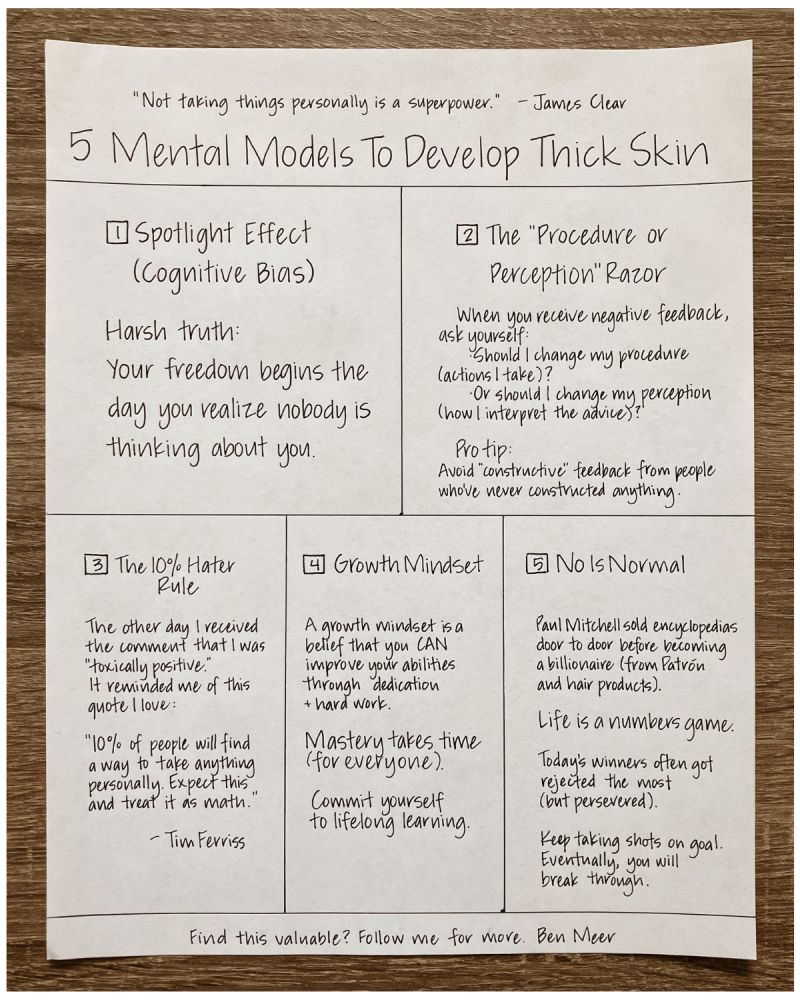
Career superpower: Not taking things personally.
5 powerful concepts to develop thick skin:
1. The Spotlight Effect
Most people are thinking about themselves.
Nobody’s watching you as closely as you think.
Your freedom starts when you stop performing for an imaginary audience.
—
2. The ‘Procedure or Perception’ Razor
When criticism hits, ask:
• Do I change my actions?
• Or do I change how I interpret this?
Skip feedback from people who’ve never built anything.
—
3. The 10% Hater Rule
Tim Ferris put it best: “10% of people will find a way to take anything personally. Expect it and treat it as math.”
It’s not personal. It’s a probability.
—
4. Growth Mindset
Every master was once a beginner.
Becoming a master takes time—
Commit yourself to a lifetime of learning.
—
5. Realize ‘No’ is Normal
John Paul DeJoria faced countless “no’s” selling encyclopedias.
Today, he’s worth billions (Patrón, hair products).
Life rewards persistence, not perfection.
—
Those were 5 concepts to be more resilient.
I think about this quote often:
“Trying to get everyone to like you is a sign of mediocrity.” —Colin Powell
Your dreams are too important to let other people’s opinions stop you.
The Leader Skill Set

Your title doesn’t build trust—
Your habits do:
You don’t need more leadership theory.
You need a clear system for
what great leaders
actually do.
The strongest leaders don’t
just think strategically or
inspire with words.
They build range—
Skills that cover how they think, act,
connect, and adapt under pressure.
This sheet breaks down the 8 quotients
every high-performing leader grows:
⬛ SQ – Navigate group dynamics with skill
🟪 EQ – Read emotions, manage yours
🟫 CQ – Be someone people believe in
🟦 VQ – Lead with bold, simple vision
🟥 IQ – Think clearly under pressure
🟩 XQ – Follow through with action
🟧 RQ – Build real trust with others
🟨 AQ – Stay steady in chaos
You don’t need to master all 8 at once.
Pick one. Build the habit.
Then stack the next.
Most people want better results.
But they skip the habits that create them.
Every leader is made by
small choices no one sees.
And it leaves people better than it found them.
The Fights We Have, The Connection We Want
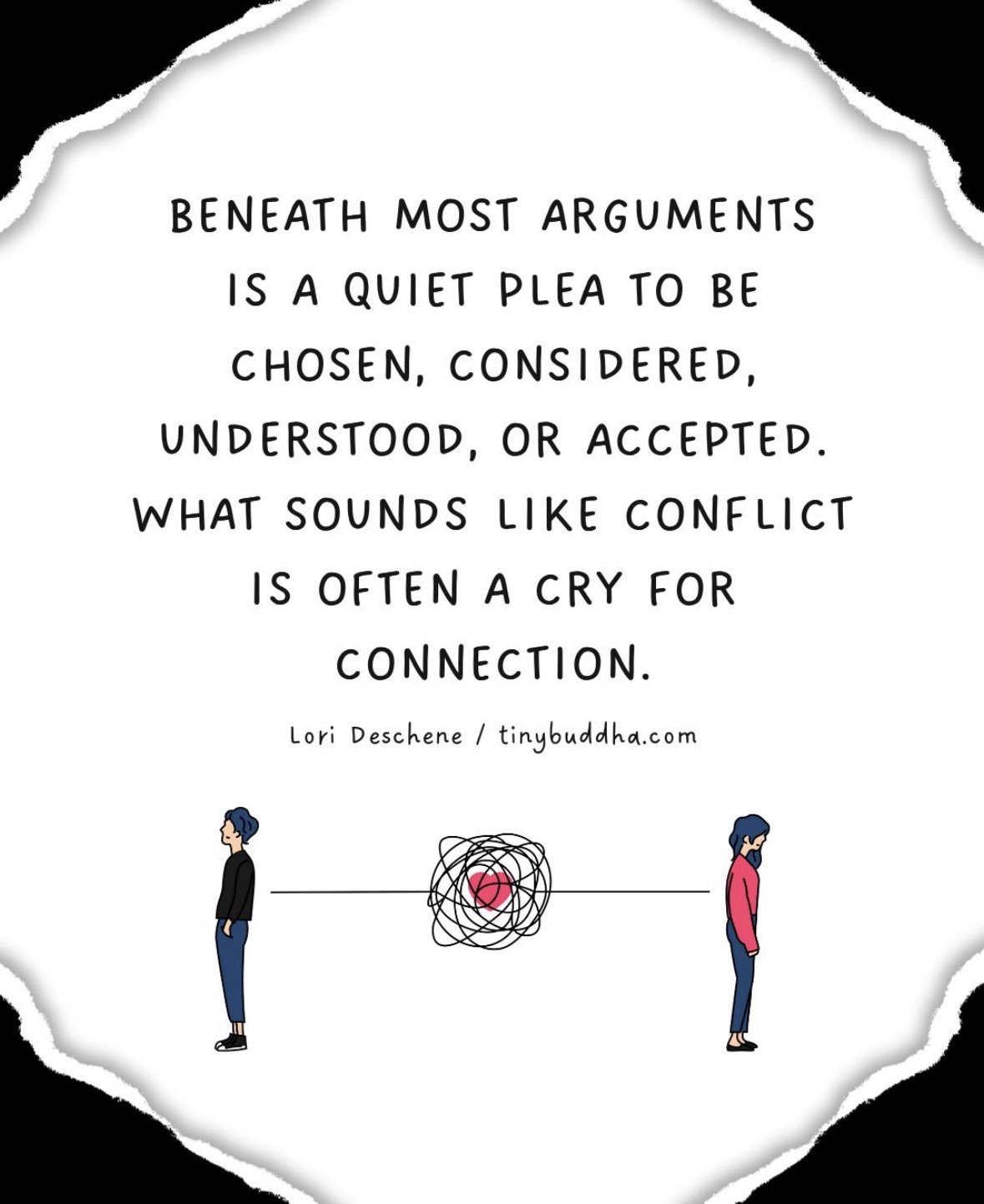
If you listen closely to most arguments, there’s always something softer hiding underneath the sharp edges. We show frustration, we raise our voice, we defend ourselves like we’re in a courtroom—but if you peel back just one layer, the whole thing usually comes down to something far more human. We want to feel chosen. We want to feel considered. We want someone to actually hear us, not just reply to us. And when that doesn’t happen, we push harder, as if volume can deliver what vulnerability could have done more gently.
It’s strange how arguments work. The words we say rarely match what we actually mean. A complaint about plans usually masks a need to feel prioritized. A comment about tone usually hides a desire to feel respected. A defensive reaction often reveals someone who feels misunderstood before a single sentence has even been exchanged. We don’t always know how to ask for connection directly, so we ask for it in the most indirect, chaotic ways possible.
Think about the last time you clashed with someone you care about. In the moment, it probably felt like the conversation was about the thing—the missed call, the forgotten errand, the difference of opinion. But later, with some space, it almost always becomes clear that the real conflict was never about the thing. It was about what the thing represented. Did you think of me? Do I matter to you? Can I trust that you’ll show up for me? Are you hearing me, or just waiting to talk?
We learn over the years that people rarely fight because they don’t care. They fight because they care deeply and feel disconnected. So much of adult communication is really childhood longing wearing grown-up clothes. We crave reassurance, closeness, understanding—but saying those words out loud feels too raw, too exposing. And so we argue. It’s clumsy, but it’s human.
The real magic happens when someone pauses in the middle of tension and remembers that underneath the frustration is a simple, almost childlike need. Suddenly the whole conversation softens. You start listening to the feeling instead of the words. You respond to the need instead of the tone. And just like that, the storm loses its power.
Connections don’t break because of conflict. They break when we forget to look beneath it. When we forget that the person standing across from us—whether it’s a partner, a friend, a sibling, a colleague—just wants to be understood. When we treat arguments like battles instead of invitations. When we react to the surface and ignore the depth.
The more we learn to hear the quiet plea beneath the noise, the easier it becomes to move through tough moments with clarity instead of chaos. Not because arguments disappear—they never will—but because the intention behind them becomes visible. And when you can see the intention, you can respond with compassion instead of defensiveness.
In the end, conflict isn’t the villain we make it out to be. It’s simply a signal that someone is reaching out in the only way they know how at that moment. And if we can meet that reach with awareness, patience, and a willingness to understand, we might discover that the argument wasn’t a breaking point at all—it was a bridge.
The Star of Self-Awareness

How to become more self-aware
One thing we can do is reflect and answer five special questions.
This helps us become more self-aware.
And self-awareness really matters in today’s world, doesn’t it? :)
Let’s jump into the Star of Self-Awareness!
1. “What are my core values and beliefs?”
Why does this question matter?
Because knowing what truly matters to us helps us make better decisions.
It also helps us live in a way that feels true to who we are.
Think of it as a compass guiding us through life.
You know what I mean?
2. “What are my strengths and weaknesses?”
We can’t be self-aware without knowing:
→ What we’re good at
→ And what we’re not so good at
Right?
Knowing what you’re good at lets you do more of it.
Knowing what you’re not good at helps you avoid wasting too much energy trying to fix them.
Doubling down on weaknesses? Not the best move, right?
3. “What are my passions and interests?”
Passions are the things that make you excited and happy, right?
The same goes for interests.
They’re like personal fuel. Bringing joy and fulfillment.
You can’t truly understand yourself without knowing what fuels you.
Are you with me?
4. “What are my goals and aspirations?”
Your goals and dreams are like stars in the sky. Something to aim for.
They keep you motivated and focused on what you wanna achieve in life.
That’s why being aware of them matters.
5. “How do I handle adversity and failure?”
This is an important question.
Knowing how we deal with tough times helps us become more self-aware.
If we see setbacks as dramatic failures, we can shift that perspective.
This question helps us understand how we think about failure.
And over time, change it.
That’s it.
Here’s what you could try:
→ Schedule some “me time” on your calendar
→ Grab a pen and paper
→ And answer those five special questions
If you do, here’s what might happen:
→ You’ll become more self-aware
→ You’ll understand yourself better
→ You’ll know why you do what you do
→ And you’ll let your uniqueness shine
After all, our uniqueness is our ultimate asset, right? :)
How to Lead Hybrid Teams
71% of Gen Z prefer hybrid work set-up.
Not to avoid work, for time that feels worth it.
(Gallup Study 2025)
It makes sense.
They’re early in their careers.
They want to spend time with peers.
Build relationships, and skills.
Hybrid gives them what they need most:
✅ Flexibility for balance
✅ In-person time for connection and mentoring
✅ A workplace that feels intentional and supportive
And it’s not just Gen Z.
Across all generations, hybrid is the top choice.
🔴 Millennials: 60% hybrid (35% remote).
🔵 Gen X: 56% hybrid (35% remote).
🟢 Boomers: 54% hybrid (35% remote).
Hybrid works because it meets what today’s workforce values most:
Flexibility, connection, and purpose.
It’s not about where your team works.
It’s about 𝗵𝗼𝘄 𝘆𝗼𝘂 𝗹𝗲𝗮𝗱 𝘁𝗵𝗲𝗺.
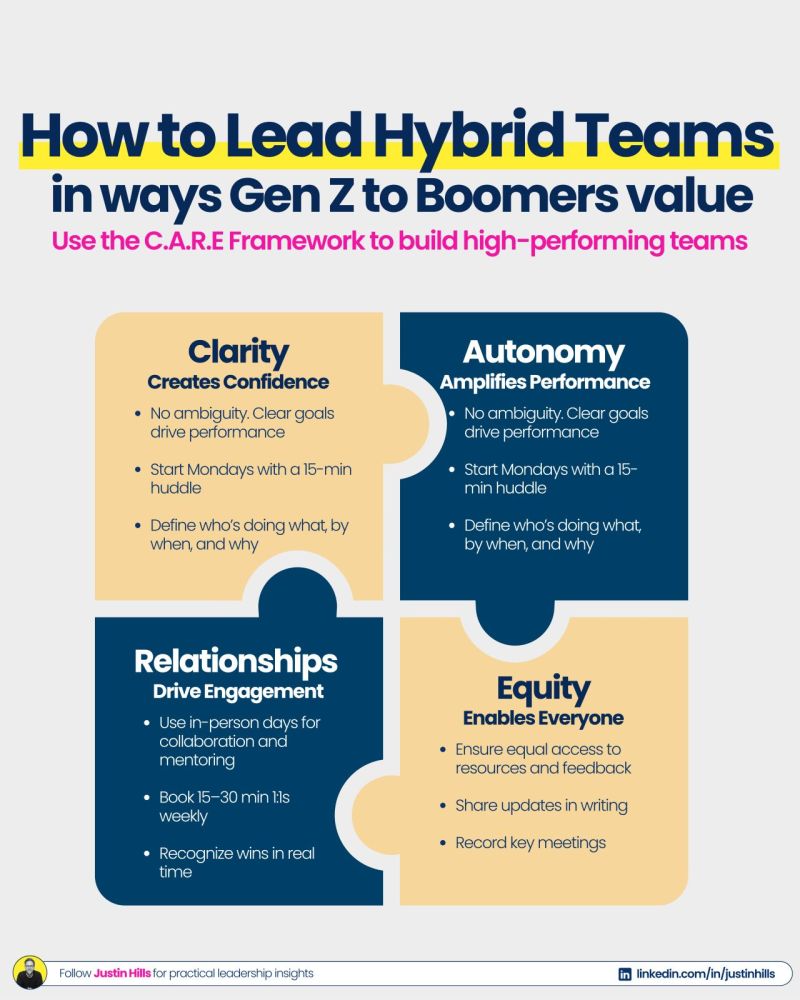
𝗧𝗿𝘆 𝘁𝗵𝗲 𝗖.𝗔.𝗥.𝗘 𝗙𝗿𝗮𝗺𝗲𝘄𝗼𝗿𝗸 𝘁𝗼 𝗵𝗲𝗹𝗽 𝘆𝗼𝘂 𝗹𝗲𝗮𝗱 𝗛𝘆𝗯𝗿𝗶𝗱 𝗧𝗲𝗮𝗺𝘀:
1️⃣ 𝗖𝗹𝗮𝗿𝗶𝘁𝘆 𝗖𝗿𝗲𝗮𝘁𝗲𝘀 𝗖𝗼𝗻𝗳𝗶𝗱𝗲𝗻𝗰𝗲
→ No ambiguity. Clear goals drive performance
→ Start Mondays with a 15-min huddle
→ Define who’s doing what, by when, and why
2️⃣ 𝗔𝘂𝘁𝗼𝗻𝗼𝗺𝘆 𝗔𝗺𝗽𝗹𝗶𝗳𝗶𝗲𝘀 𝗣𝗲𝗿𝗳𝗼𝗿𝗺𝗮𝗻𝗰𝗲
→ Set outcomes, then trust your team to deliver
→ Measure results, not hours logged
→ Flexibility plus trust fuels productivity.
3️⃣ 𝗥𝗲𝗹𝗮𝘁𝗶𝗼𝗻𝘀𝗵𝗶𝗽𝘀 𝗗𝗿𝗶𝘃𝗲 𝗘𝗻𝗴𝗮𝗴𝗲𝗺𝗲𝗻𝘁
→ Use in-person days for collaboration and mentoring
→ Book 15–30 min 1:1s weekly
→ Recognize wins in real time
4️⃣ 𝗘𝗾𝘂𝗶𝘁𝘆 𝗘𝗻𝗮𝗯𝗹𝗲𝘀 𝗘𝘃𝗲𝗿𝘆𝗼𝗻𝗲
→ Ensure equal access to resources and feedback
→ Share updates in writing
→ Record key meetings
How do you make hybrid days feel worth showing up for?
10 Ways to Unlock Quiet Minds

Your quietest team members often have the most valuable insights.
They just don’t feel safe enough to voice them.
While the loudest voices dominate meetings,
Your quiet observers are:
↳ Seeing solutions from different angles
↳ Processing deeper patterns others miss
↳ Noticing problems before they explode
↳ Holding back their best thinking to stay safe
↳ Connecting dots that create breakthrough moments
10 ways to unlock the ideas your quiet people are hiding:
1. Ask quiet people for input after meetings, not during
↳ Contact them within 24 hours: “I’d love your thoughts on what we discussed.”
2. Give them the agenda 48 hours early
↳ Quiet processors need time to think through responses before meetings.
3. Use anonymous idea submission
↳ Create digital suggestion boxes. They’ll share breakthrough thoughts when their name isn’t attached.
4. Replace “Any questions?” with “What questions do you have?”
↳ The second assumes everyone has questions and makes it safe to ask.
5. Start meetings with individual writing time
↳ Give 3 minutes: “Write your initial thoughts before we discuss.”
6. Create “thinking roles” in meetings
↳ Assign someone to be the “what if this fails?” person.
7. Schedule one-on-ones immediately after big decisions
↳ Ask: “Now that you’ve processed, what’s your honest take?”
8. Use small group breakouts before full discussions
↳ Groups of 2-3 first. Quiet voices emerge in smaller spaces.
9. Acknowledge their processing style publicly
↳ “You always think through implications carefully. What patterns do you see?”
10. End meetings with “What didn’t we say?”
↳ Create space for afterthoughts to surface intentionally.
The reality?
Your quiet team members aren’t disengaged.
They’re protecting themselves.
When you create genuine psychological safety,
The quiet voices become your secret weapon.
Your quietest person isn’t your weakest link.
They might be your strongest.
What will you do to hear from the usually silent voices?
Growth vs Gratitude
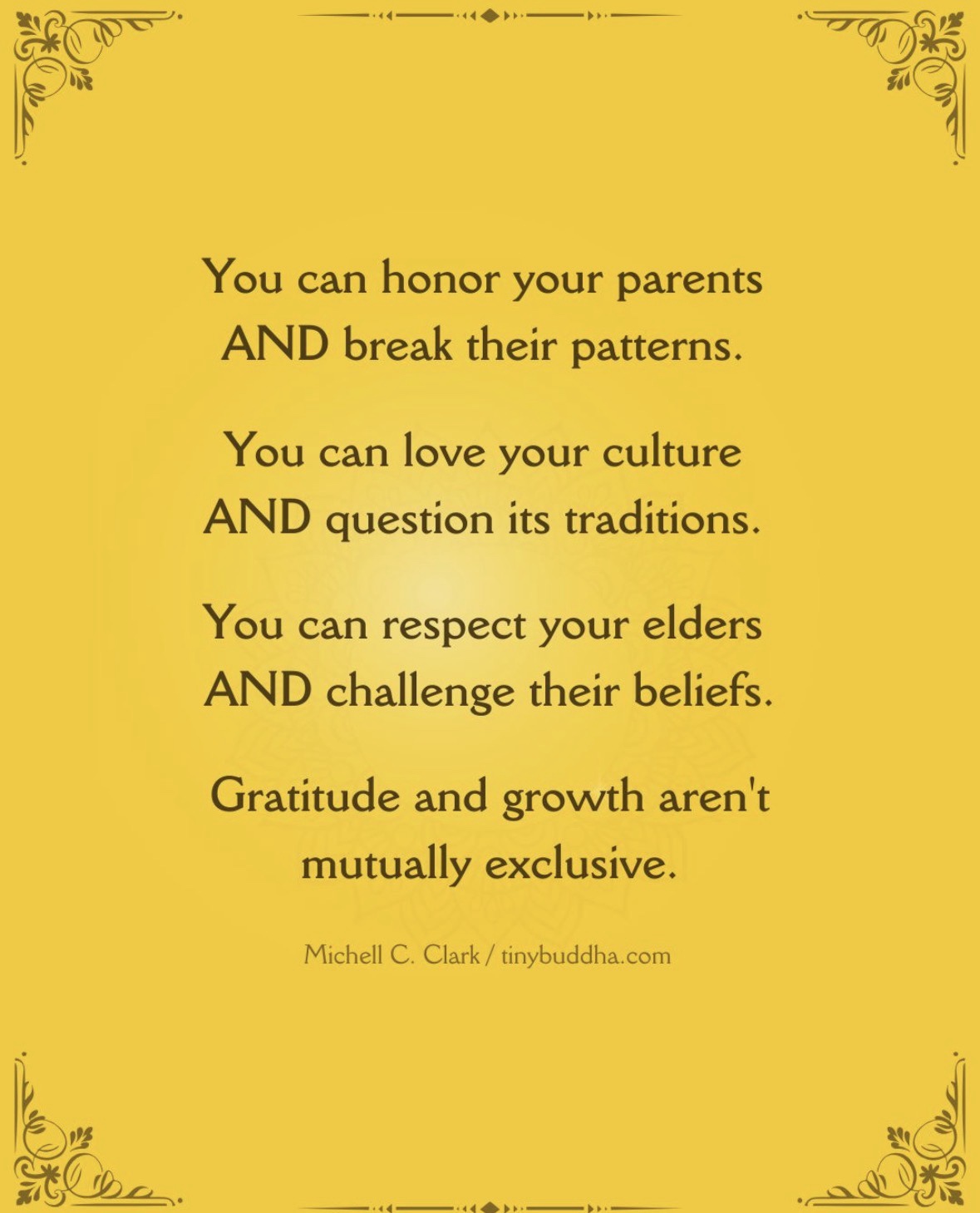
There’s this idea many of us quietly carry: that honoring where we come from somehow means we have to stay exactly the way we were raised. As if gratitude and growth sit on opposite sides of a scale, and choosing one means abandoning the other. But life keeps proving that it isn’t that dramatic. You can hold deep appreciation in one hand and still reach for something new with the other.
Most of us grew up in homes where the rules weren’t just rules—they were culture, identity, family pride, the “right way” to do things. And for the longest time, we took them as unquestionable truths. Respect your elders. Say yes even when your heart says no. Don’t raise your voice. Don’t ask too many questions. Don’t push too hard. Keep your head down and endure. These weren’t just lessons; they were survival mechanisms passed down through generations.
But then adulthood arrives. You build your own life, make your own choices, and suddenly you’re face-to-face with the reality that some of those patterns don’t serve you anymore. Not because they were wrong, but because the world is different now. You’re different now.
That’s where the tension begins. You want to grow, but you don’t want to seem ungrateful. You want to rewrite certain behaviors, but you don’t want to disrespect the people who taught you everything you know. You want to choose mental health over “what will people say,” compassion over ego, boundaries over blind obedience. And deep down, a part of you wonders: Is it okay to question the very things I was raised to honor?
Here’s the truth we often forget: growth isn’t rebellion. Growth is evolution. And evolution is exactly what every generation hopes for—even if they don’t always say it out loud.
You can honor your parents without repeating their fears. You can love your culture without carrying every burden it places on your shoulders. You can respect your elders without inheriting beliefs that limit who you can become. You can appreciate the sacrifices, the struggles, the wisdom—and still walk your own path with clarity and intention.
Breaking patterns doesn’t erase the love behind them. It just means you’re choosing to live with more awareness than the generations before you had the chance to. It means you’re creating space for healthier relationships, kinder conversations, and more emotionally open homes. It means your children will thank you one day for giving them tools you had to teach yourself.
Gratitude and growth aren’t rivals. They’re partners. Gratitude grounds you; growth expands you. One reminds you where you came from; the other guides you to where you’re meant to go. And when you learn to balance both—when you can say “thank you” while still saying “I choose differently”—that’s when you truly honor your roots.
Not by staying the same, but by becoming everything they once hoped was possible.
7 Habits of High Impact Leaders

I once had a manager who changed my view of leadership.
She did something revolutionary:
She treated me like a human being.
When my son was sick, she told me: “Family comes first. We’ll handle things here.”
When I had an idea, she didn’t just listen.
She gave me the resources to make it happen.
When projects succeeded, she made sure everyone knew who did the work.
And when things went wrong?
She asked “What can we learn?” instead of “Who can we blame?”
This taught me the most powerful truth about leadership:
Great leaders don’t just manage people and processes.
• They build trust
• They create safety
• They support growth
Because…
When you treat people like humans first and employees second, they feel more valued.
Think about it:
Would you rather work for someone who sees your potential or just your output?
The answer changes everything.
Leadership isn’t about power.
It’s about impact.
And the biggest impact comes from seeing the person behind the position.
Human first.
Employee second.
That’s where real leadership begins.
Have you ever had a manager who changed how you see leadership?
The CEO Decision Tree
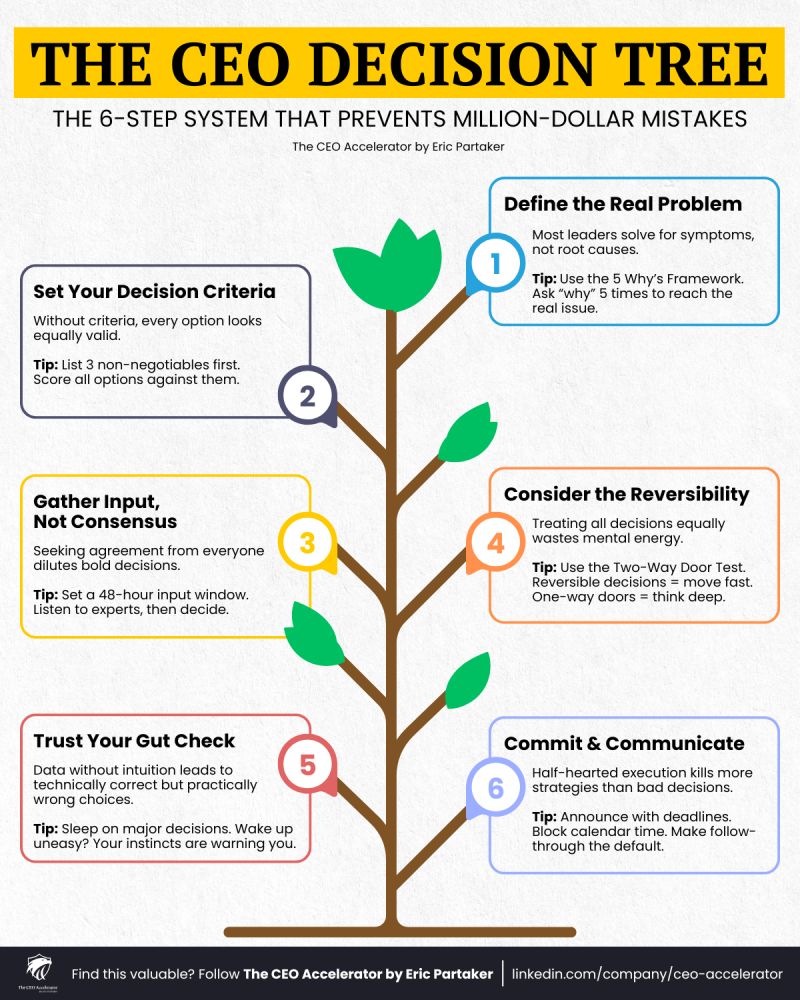
Most CEOs don’t fail from bad decisions.
They fail because they never even made one.
❌ They waver
❌ Delay
❌ Overthink
And it annihilates momentum.
Here’s how top CEOs make confident, clear decisions
(quickly):
1. Define the real problem
↳ Most people solve surface-level symptoms
↳ Ask “why?” five times until it gets uncomfortable
↳ If it feels obvious, you haven’t dug deep enough
2. Set decision criteria early
↳ No criteria = endless debate
↳ Choose your 3 non-negotiables
↳ Score every option before discussing it
3. Gather input, not consensus
↳ Consensus slows you down
↳ Give 48 hours for input
↳ Then decide—solo
4. Consider the Reversibility
↳ Two-way door? Move fast
↳ One-way door? Slow down
↳ Save deep thinking for what really matters
5. Trust Your Gut Check
↳ Data shows what’s visible
↳ Your gut senses what’s missing
↳ Sleep on it. If you still feel off, pause
6. Commit and Communicate
↳ Half-decisions confuse your team
↳ Announce it. Set a deadline
↳ Make reversal harder than follow-through
Clarity beats certainty.
Every. Single. Time.
Which step do you need most this week?
Pick one.
Try it.
Watch what shifts.
Master Your Energy

Most people organize their day by time—
High performers organize by this:
Most people plan their day by the clock.
But time isn’t your most limited resource.
Energy is.
Because even if you have 10 hours free—
If you’re drained, distracted, or scattered…
You’re not getting anything meaningful done.
And here’s what most people never learn:
You don’t run out of time.
You run out of yourself.
Every task falls into one of 3 zones:
🟥 Energy Drains:
Leave you depleted
🟨 Neutral Zones:
Keep things moving, but don’t excite you
🟩 Energy Gains:
Fuel your focus and momentum
But here’s the problem:
Most people spend their best energy
on the wrong things.
Because they believe myths like:
🚫 “You should work until exhaustion”
🚫 “All tasks require equal focus”
🚫 “Busy means productive”
🚫 “Multitasking saves time”
🚫 “Breaks waste time”
None of it is true.
Here’s what is true:
✅ Focus is a skill—protect it
✅ Rest isn’t optional—it’s strategic
✅ Burnout starts small and builds fast
✅ Deep work needs clarity and intention
✅ Not everything deserves your full energy
That’s why you need an Energy Audit.
It gives you:
▶️ Clarity on what really matters
▶️ Fewer drains, more momentum
▶️ More focus and better decisions
▶️ A smarter way to work—without the burnout
Because it’s not just about time management.
It’s about energy precision:
⏳ Time tells you when.
⚡ Energy decides how well.
 Kenrick Vaz