
Want better results?
Start building your people:
People don’t grow in roles.
They grow in cultures.
And when that culture is missing—
Top talent walks.
Motivation drops.
Potential goes quiet.
Growth isn’t a “nice to have.”
It’s the blueprint for:
• Better leadership
• Stronger retention
• Higher performance
• Deeper engagement
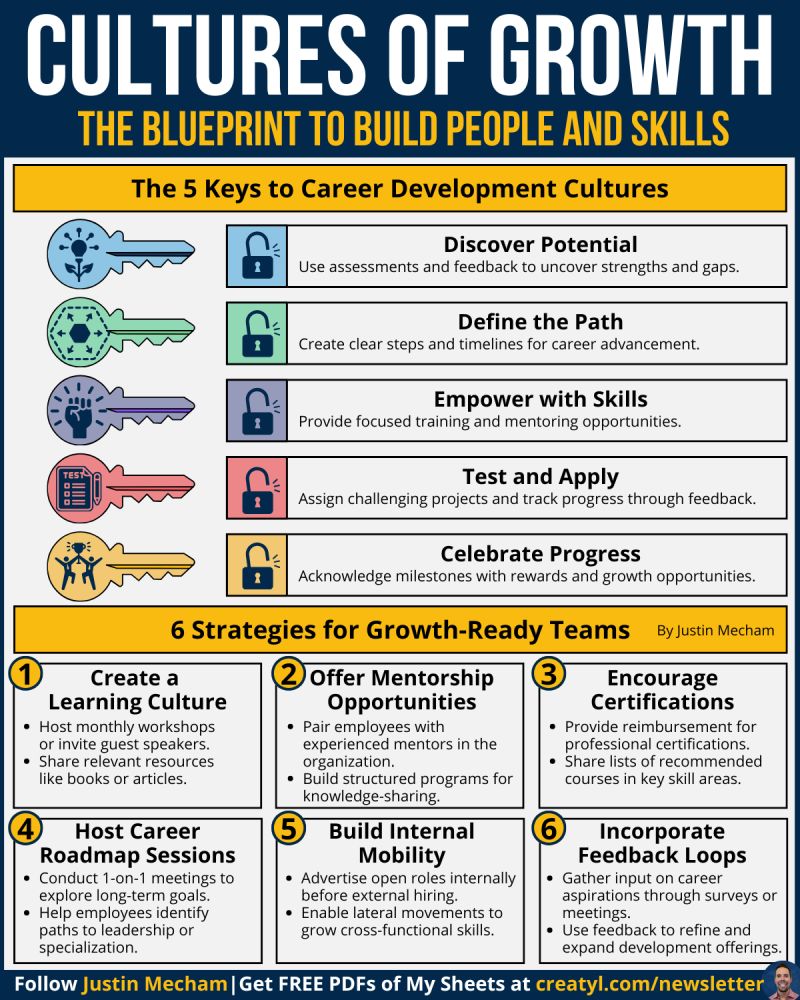
To build a culture of growth:
✅Empower with skills
✅Celebrate progress
✅Discover potential
✅Define the path
✅Test and apply
And to make it real:
☑️Offer mentorship
☑️Build internal mobility
☑️Use feedback to evolve
☑️Host roadmap sessions
☑️Encourage certifications
☑️Create a learning culture
Growth doesn’t happen by chance.
It happens by design.
Use my sheet to start building it.
When people see a future—
They invest in the present.
They lean in.
They rise up.
And when growth becomes the norm—
So does excellence.
The CALM Framework

Leadership has one non-negotiable skill.
(The ashram taught me this.)
❌ It’s not charisma
❌ Not strategy
❌ Not vision
It’s staying calm when everything falls apart.
I’ve coached thousands of leaders, and the truth:
When chaos hits, your team doesn’t watch your plan.
They watch your composure.
The best leaders use the C.A.L.M. Framework:
C – Coach Before Control
↳ Don’t jump in with solutions.
↳ Ask: “What do you think we should do?”
↳ Watch what happens.
↳ Your team starts owning their decisions.
A – Anchor in Values
↳ Everyone wants the quick fix.
↳ Pause. Ask: “Is this who we want to be?”
↳ Let your values guide you.
↳ Not the pressure. Not the panic.
L – Learn From Every Trigger
↳ Feeling frustrated with someone?
↳ That’s feedback about you, not them.
↳ Every reaction teaches you something.
↳ Pay attention to the lesson.
M – Master the Inner Dialogue
↳ How you talk to yourself matters.
↳ Harsh inner critic? Your team feels it.
↳ Be kind to yourself first.
↳ Then watch how it changes your leadership.
Here’s what changed everything for me:
Calm isn’t the absence of stress.
It’s the presence of choice.
Your team needs someone who breathes when the room
holds its breath.
Someone who thinks when others react.
Someone who steadies the ship in the storm.
That’s the leader people remember.
That’s the leader people follow.
What’s one way you’ve led with stillness this week?
12 Things That Require Zero Talent
I used to think high performers had some secret talent.
Now I know it’s the simple things.
Anyone can do these. No degree or title required.
Just choices you make every day.
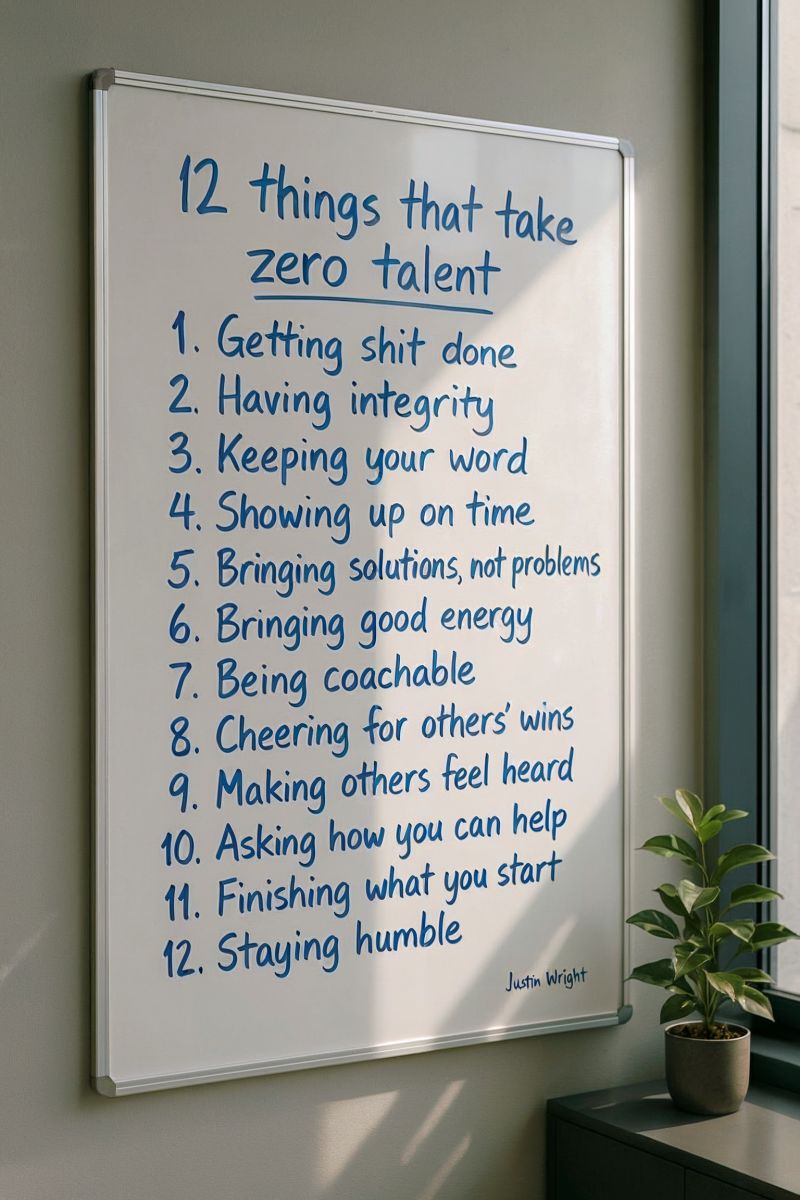
12 things that require zero talent:
1. Getting shit done
2. Having integrity
3. Keeping your word
4. Showing up on time
5. Bringing solutions, not problems
6. Bringing good energy
7. Being coachable
8. Cheering for others’ wins
9. Making others feel heard
10. Asking how you can help
11. Finishing what you start
12. Staying humble
No special skills needed.
No expensive training.
Just decisions.
The person who shows up on time every day?
They show respect and build trust.
The person who finishes what they start?
They’re someone you know you can count on.
Success isn’t complicated.
It’s doing the simple things most people won’t.
P.S. What would you add to the list?
The Heart That Keeps Going On

Some truths don’t announce themselves with fireworks — they just sit quietly in the corner of your life, waiting for you to notice them. One of those truths is this: you’ve made it through more than you admit out loud, and somehow your heart still leans toward hope instead of fear. That alone already says something remarkable about you.
It’s easy to downplay your own resilience. You normalize the storms you survived. You shrug off the weight you carried. You forget how many days you showed up when everything in you wanted to disappear for a while. But if you paused long enough to look back without minimizing, you’d see a path lined with challenges that didn’t break you, only shaped you. You’d see a version of yourself who kept standing even when life felt uneven. And you’d see a heart that kept opening even after being bruised.
There’s a quiet courage in choosing hope after disappointment. It’s not naïve — it’s deliberate. It’s the decision to believe that life still has good chapters ahead of you, even if the last few were messy or tiring. Hope isn’t the absence of reality; it’s the refusal to let the darkest parts of life dictate the rest of the story. And you’ve done that. Over and over again.
But here’s the part we don’t talk about enough: you deserve a life that chooses you back. Not halfway, not occasionally, not only when it’s convenient. You deserve people who match your sincerity. Opportunities that recognize your worth. Moments that feel like they were written with you in mind. A rhythm that doesn’t drain you but fills you. You deserve reciprocity — the kind that doesn’t make you negotiate your value or shrink to fit someone else’s comfort.
Life has a funny way of making you think you should be grateful for scraps just because you’re strong enough to survive them. But strength isn’t meant to be a permanent survival mode. It’s meant to carry you into seasons where things come easier, where you’re not constantly holding yourself together, where love feels like a homecoming instead of a test.
Your journey hasn’t been ordinary. Your endurance hasn’t been accidental. And your hope isn’t misplaced — it’s a preview. A signal of something aligned, something steady, something that doesn’t require you to fight to be seen. The life you’re moving toward is one where your heart is not just resilient, but cherished. Where the kindness you give finally returns to you in ways that feel natural, not earned. Where choosing hope leads you straight into days that choose you back.
So keep going with that same brave heart. Not because you owe it to anyone, but because you’re finally stepping into the life that has been waiting to meet you with the same sincerity you’ve been offering all along.
Teamwork
Many teams focus on the wrong things.
They optimize for speed instead of strength.
Output over alignment. Pace over cohesion.
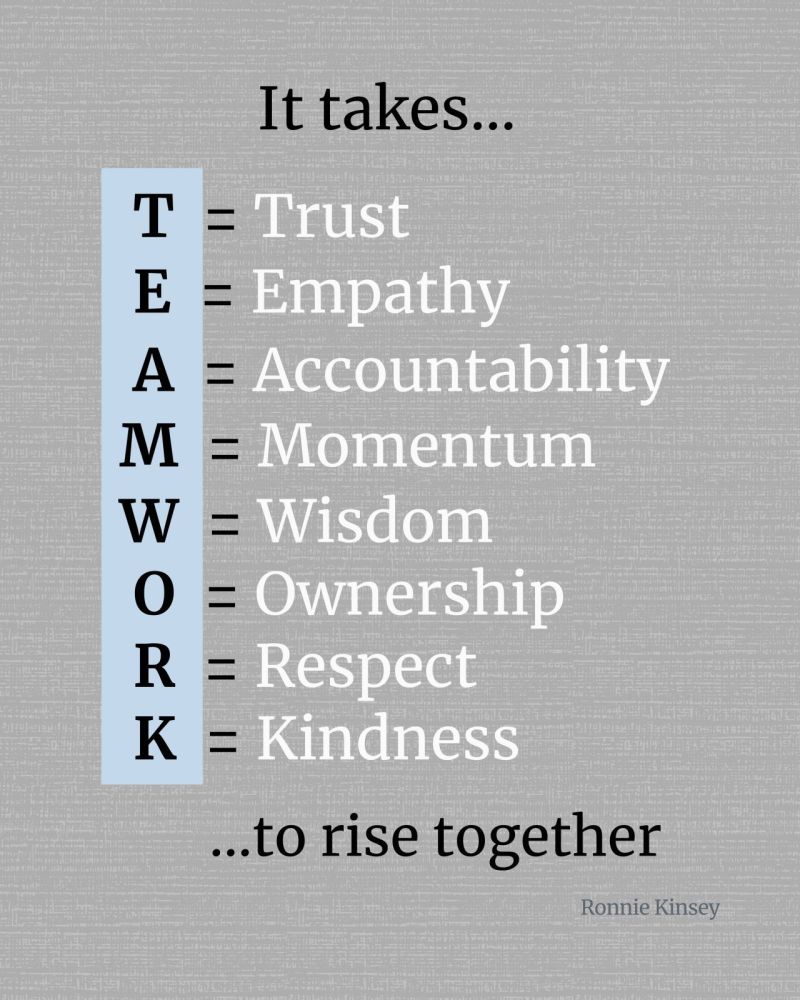
But this acronym says it all:
T – Trust
Not built in meetings.
↳ Earned in the moments between them.
E – Empathy
Not a soft skill.
↳ It’s how we understand what each person needs.
A – Accountability
Not about blame.
↳ It’s about safety, to own mistakes and grow.
M – Momentum
Not from pushing harder.
↳ From moving together with shared purpose.
W – Wisdom
Not knowing everything.
↳ Staying curious enough to keep learning.
O – Ownership
Not control.
↳ Caring enough to take responsibility.
R – Respect
Not given by title.
↳ Earned through consistent action.
K – Kindness
Not weakness.
↳ The strength that holds it all together.
Technical skills are essential, but they’re only part of the equation.
What often makes the real difference is how people show up for each other.
T-E-A-M-W-O-R-K isn’t just a word.
It’s a practice.
A commitment.
A choice, made daily.
Why Growth-Minded Leaders Win in the Long Run
(While Fixed Thinkers Stay Stuck)
A recent Harvard Business Review study shows that teams led by growth-minded leaders perform 25% better and are twice as engaged.
Translation?
A fixed mindset doesn’t just block progress, it repels it. ❌
Whereas a growth mindset?
It compounds. 💪
It transforms: 👇🏼
↳ Pressure into performance
↳ Unknowns into innovation
↳ Setbacks into strategy
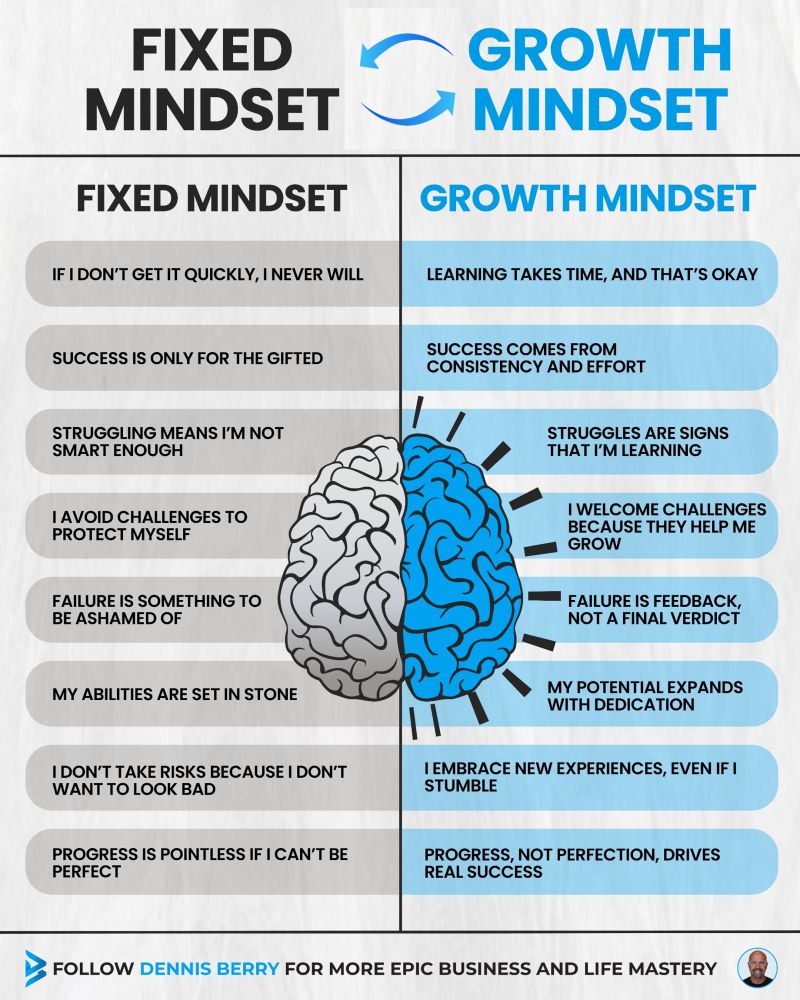
Here are 7 core differences between the two: 👇🏼
(And, why it matters)
🧠 Perspective on Uncertainty
🟥 Fixed Mindset: Avoids ambiguity. Needs guarantees before acting.
✅ Growth Mindset: Leans into uncertainty and makes decisions with incomplete information.
Why Growth?
↳ Growth leaders know clarity often follows action, not the other way around.
🧠 Definition of Success
🟥 Fixed Mindset: Success = always being right.
✅ Growth Mindset: Success = learning, evolving, and getting better.
Why Growth?
↳ The pursuit of mastery beats the illusion of perfection.
🧠 Risk Tolerance
🟥 Fixed Mindset: Overanalyzes and hesitates, fearful of mistakes.
✅ Growth Mindset: Takes calculated risks, knowing failure is part of the equation.
Why Growth?
↳ Without risk, there is no reward. Innovation only happens outside the comfort zone.
🧠 Focus in Tough Times
🟥 Fixed Mindset: Gets distracted by problems.
✅ Growth Mindset: Stays focused on the solution.
Why Growth?
↳ When storms hit, mindset determines whether you sink or adapt and sail forward.
🧠 Handling Other People’s Success
🟥 Fixed Mindset: Feels threatened or inferior.
✅ Growth Mindset: Feels inspired and motivated by others’ wins.
Why Growth?
↳ A rising tide lifts all boats, envy kills momentum, admiration builds it.
🧠 Openness to New Ideas
🟥 Fixed Mindset: Clings to what’s familiar and proven.
✅ Growth Mindset: Actively seeks new input, even if it contradicts old beliefs.
Why Growth?
↳ Stagnation starts when learning stops. Innovation begins where ego ends.
🧠 Mentorship & Leadership
🟥 Fixed Mindset: Hoards knowledge to stay ahead.
✅ Growth Mindset: Shares knowledge to lift others.
Why Growth?
↳ Leaders who teach, scale. Leaders who gatekeep, stall.
Do you have a growth mindset❓
Spot Issues Fast
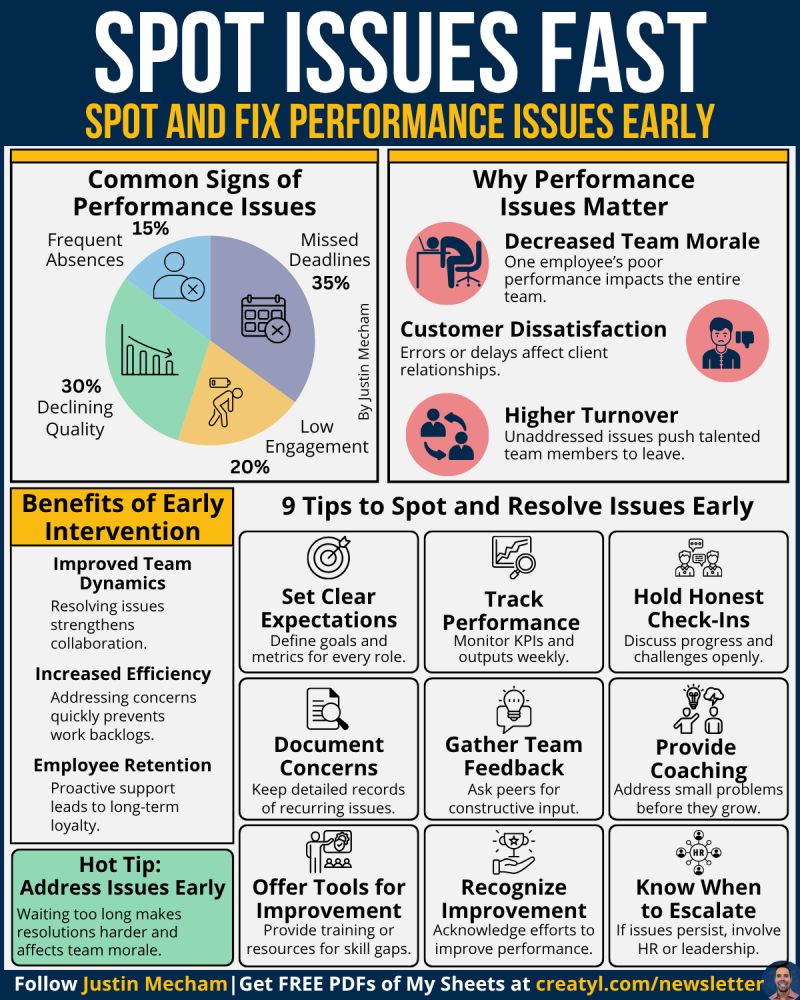
Most performance problems don’t start big—
They start invisible:
Performance issues rarely go away on their own.
They get buried.
They grow in silence.
They spread to everyone else.
The longer you wait –
The harder it is to recover.
⚠️Watch for early warning signs:
• Declining quality
• Low engagement
• Missed deadlines
• Frequent absences
🚫Unaddressed issues lead to:
• Lower team morale
• Frustrated clients
• Slower progress
• Higher turnover
But when you act early –
you protect the whole team.
Fix what’s small before it gets big.
Borrowed Moments
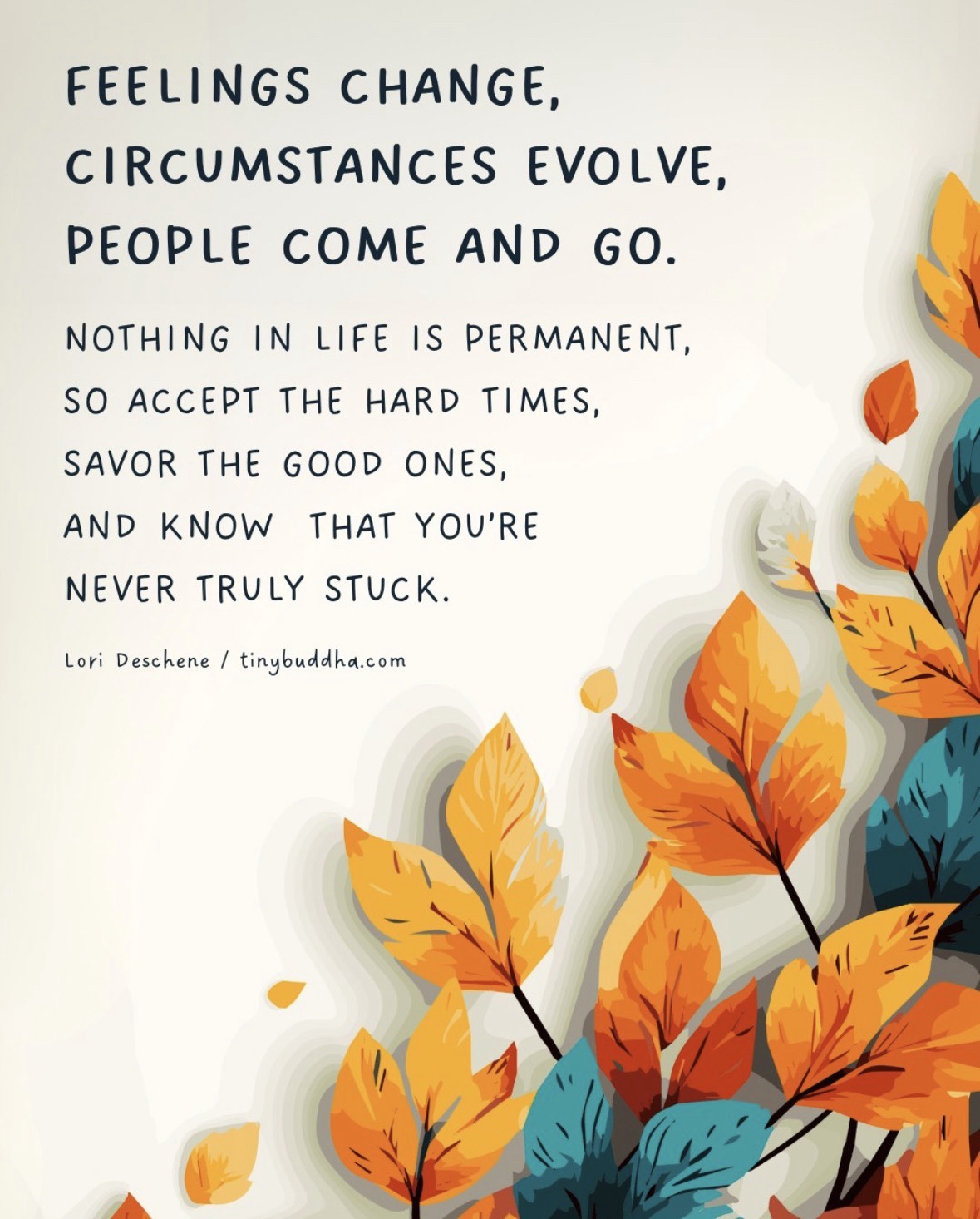
Life has a way of reminding us that nothing stays still for long. Feelings shift, people drift in and out, and the situations we swear are permanent somehow soften, crack, or dissolve into something new. It’s easy to forget that when you’re in the thick of it—when a tough moment feels endless or when a good season feels like it should last forever. But the truth is simpler, and oddly comforting: everything we’re living right now is borrowed. Every joy. Every frustration. Every chapter.
You’ve probably had days where you felt stuck, like life pressed pause while everyone else kept moving. Maybe it was a job that drained you, a relationship that confused you, or a stretch of uncertainty that made you question if anything would ever shift again. But if you look back with an honest eye, you’ll notice you’ve survived every one of those moments. They didn’t last. They changed, sometimes slowly, sometimes overnight, but they changed. And you changed with them.
The same goes for the sweeter days—the ones that feel effortless, the ones you wish you could bottle. A child’s laugh, a peaceful morning, a season where you genuinely feel like you’re in the right place at the right time. These don’t stay forever either, and that’s why they’re precious. Not because they’re rare, but because they’re temporary. They’re meant to be noticed, savored, lived fully before life spins again.
The trick is learning to sit calmly in the middle of all this motion. To understand that the hard moments don’t define you and the joyful ones don’t owe you permanence. When you accept that life is constantly reshaping itself, you stop clinging so desperately to what’s slipping and you stop fearing what’s coming. You start trusting that you can handle the changes, even the ones you didn’t choose.
So if you’re weighed down right now, breathe. You’re not stuck. You’re simply in a moment that won’t last forever. And if you’re in a beautiful season, breathe that in too. Let it soak into your memory. Let it remind you that life will hand you more of these—different shapes, different colors, but just as warm.
Everything moves. Everything shifts. Everything evolves. That’s not something to fear; that’s the quiet rhythm that keeps us growing. And when you learn to move with it instead of fighting against it, life becomes a little gentler, a little lighter, and a lot more honest.
The Hit Refresh Leadership Mindset
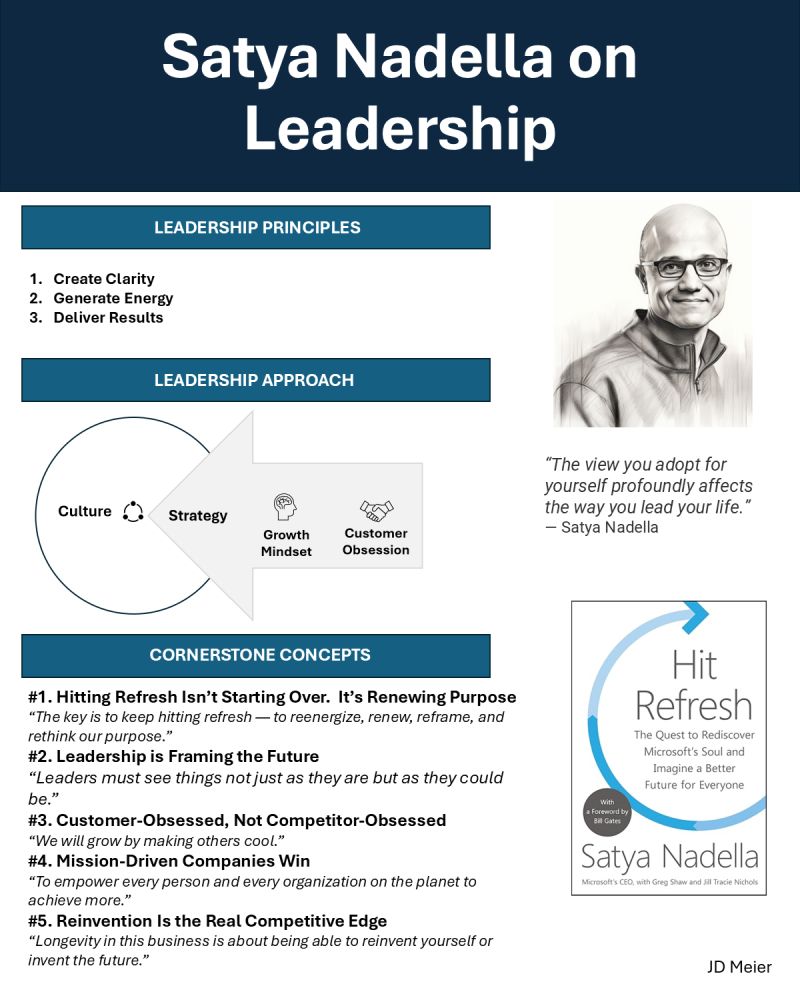
Satya Nadella didn’t just lead Microsoft.
He reimagined what leadership could be:
When he became CEO, he didn’t start with a strategy doc.
He started with a cultural reset:
1. From “know-it-all” to “learn-it-all”
2. From internal battles to customer obsession
3. From protecting the past to inventing the future
What’s his playbook?
𝗟𝗲𝗮𝗱𝗲𝗿𝘀𝗵𝗶𝗽 𝗣𝗿𝗶𝗻𝗰𝗶𝗽𝗹𝗲𝘀
1. Create Clarity
2. Generate Energy
3. Deliver Results
𝗟𝗲𝗮𝗱𝗲𝗿𝘀𝗵𝗶𝗽 𝗔𝗽𝗽𝗿𝗼𝗮𝗰𝗵
– Culture over control
– Growth mindset over ego
– Purpose over politics
𝗖𝗼𝗿𝗻𝗲𝗿𝘀𝘁𝗼𝗻𝗲 𝗖𝗼𝗻𝗰𝗲𝗽𝘁𝘀
1. Hitting Refresh = Renewing Purpose
2. Leaders Frame the Future
3. Customer > Competitor
4. Mission-Driven Companies Win
5. Reinvention Is the Real Edge
𝗧𝗵𝗲 𝗛𝗶𝘁 𝗥𝗲𝗳𝗿𝗲𝘀𝗵 𝗟𝗲𝗮𝗱𝗲𝗿𝘀𝗵𝗶𝗽 𝗠𝗶𝗻𝗱𝘀𝗲𝘁
• From protecting the status quo → to reinventing continuously
• From command-and-control → to empathy and empowerment
• From siloed competition → to shared purpose and collaboration
• From product-first thinking → to people-first design
• From fixed mindset → to growth mindset
His legacy is more than a Microsoft comeback.
It’s a model for leading in an age of change.
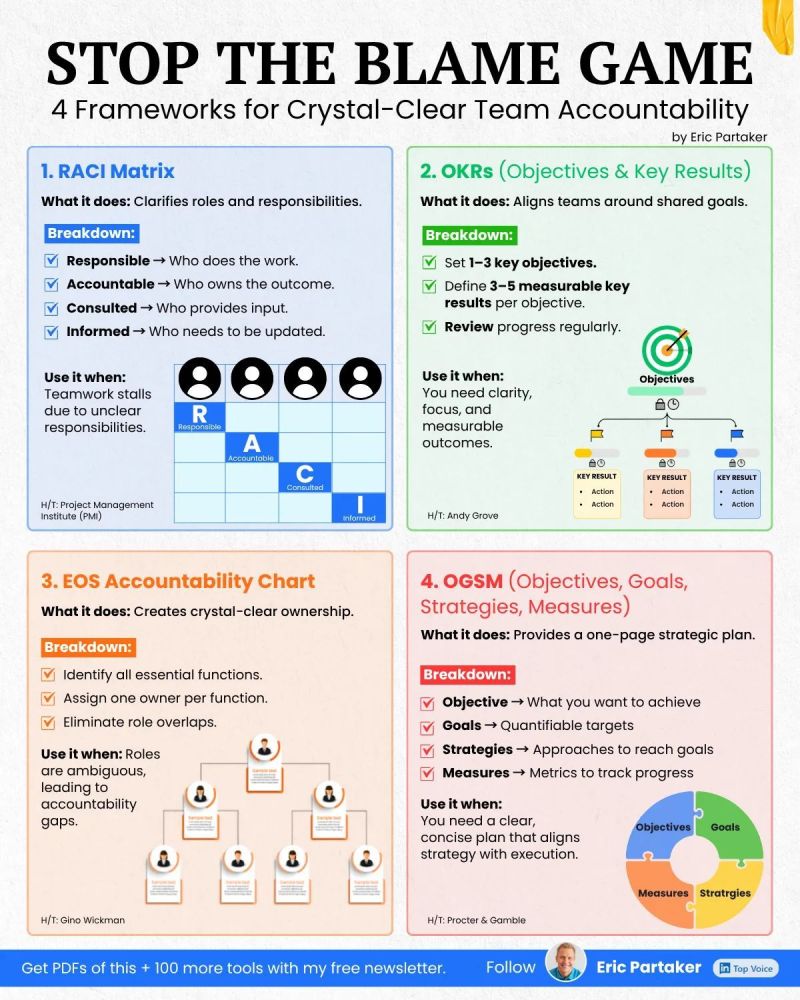
Stop the Blame Game
Here’s what nobody tells you about accountability:
The harder you push, the less they deliver.
I’ve watched CEOs destroy their executive teams this way:
🔥 Public callouts in meetings
🔥 Micromanaging every decision
🔥 Threats disguised as “motivation”
🔥 Fear-based deadline pressure
Result: Your best leaders become corporate zombies.
They show up. They comply. They stop caring.
The expensive truth:
Fear creates compliance.
Clarity creates commitment.
And you need commitment to win.
Real story from last month:
→ CEO constantly berated his team for missing targets
→ 3 VPs quit in 6 months
→ Company lost $2M in transition costs alone
Different CEO, different approach:
→ Created radical clarity around expectations
→ Listened without judgment
→ Built safety to admit mistakes early
→ Revenue up 40% in 12 months
The difference?
One used accountability as a weapon.
The other used it as a framework for excellence.
The 4 frameworks that create compassionate accountability:
1. RACI Matrix – Ends the “whose job is this?” chaos
(Everyone knows their lane AND their value)
2. OKRs – Aligns hearts and minds
(Shared goals create shared ownership)
3. EOS Accountability Chart – One person, one seat
(Clear ownership without overlapping egos)
4. OGSM – Strategy meets reality
(No more “I thought you meant…” conversations)
But here’s the key:
These aren’t hammers to hit people with.
They’re maps to help people win.
The paradox of leadership:
High standards + High support = High performance
High standards + Low support = High turnover
Your leadership team doesn’t need more pressure.
They need more clarity.
Because when accountability comes from compassion, not control:
→ Problems get solved, not hidden
→ Leaders take ownership, not cover
→ Teams push forward, not back
Stop managing through fear.
Start leading through frameworks.
Your leadership team is capable of greatness.
But only if you create the conditions for it.
Save this. Share it with your team.
Because the best leaders don’t create followers.
They create owners.
And ownership starts with clarity.
 Kenrick Vaz