

Every successful CEO I know has one thing in common:
They all hit the wall at some point.
The 80-hour weeks catch up.
The constant decision-making becomes overwhelming.
The weight of responsibility starts crushing creativity.
And here’s what nobody tells you:
The solution isn’t better time management.
It’s better energy management.
Here’s how the best CEOs stay sharp while everyone else burns out:
1. Protect Their Mornings
↳ No emails, no calls, no “quick questions” until you’ve centered yourself.
↳ Your morning sets the tone for everything.
2. Define Top Priorities
↳ Before the chaos starts, identify the 3 things that actually matter today.
↳ Everything else is noise.
3. Schedule Focus Time
↳ Reserve 90 minutes before lunch for your hardest thinking.
↳ Treat it like a board meeting, unmovable.
4. Decline Low-Value Tasks
↳ If it doesn’t drive your goals or support your team, it’s a distraction.
↳ Cut it ruthlessly.
5. Shorten Every Meeting
↳ 30 minutes max. Clear purpose. No exceptions.
↳ Your time is too valuable for meandering conversations.
6. Move After Lunch
↳ Walk. Stretch. Step outside.
↳ Your brain needs the break more than you think.
7. Book Thinking Time
↳ Block 30 minutes daily for pure thinking time.
↳ No screens, no interruptions. Just you and your thoughts.
8. Get Input From One Person
↳ Pick one trusted person to bounce ideas off.
↳ External perspective beats internal overthinking.
9. Eat a Real Meal
↳ Eat real food away from your desk.
↳ Skipping meals doesn’t make you productive, it makes you irritable.
10. Set a Clear Stop Time
↳ Pick a stop time and honor it.
↳ The work will always be there. Your energy won’t.
11. Shut Down Fully
↳ Laptop closed. Apps silenced.
↳ Be a human, not a CEO, for a few hours.
12. Review the Day
↳ Before bed, note what energized you and what drained you.
↳ Patterns reveal everything.
Burnout is a failure of system design.
Your business needs you sharp, not exhausted.
Your team needs you present, not depleted.
Your family needs you engaged, not running on empty.
The Airplane Mode Theory

There’s a moment we all know too well: you’re about to take off, you tap that little airplane icon on your screen, and suddenly the world goes silent. Notifications stop. Messages freeze mid-delivery. But here’s the funny part—the phone doesn’t stop being a phone. The camera still snaps. The music still flows. The notes app is still waiting for your ideas. Everything that matters keeps working; everything that distracts goes quiet.
Somewhere along the way, I realized people work the same way.
We carry around so much noise—opinions we didn’t ask for, expectations we didn’t sign up for, and the constant hum of comparison that’s always waiting to pull us off course. And because it’s everywhere, we start believing it’s essential. That if we aren’t always plugged in, we’ll fall behind. That if we don’t respond, react, or participate in every conversation, opportunity will slip through our fingers. It’s a tiring way to live, and most of the time, it isn’t even true.
Think about what actually happens when you disconnect. At first, there’s the discomfort, almost like your mind reaching for a notification that isn’t there. But give it a moment. Something shifts. You start hearing things you’ve been drowning out—your own voice, your own instincts, the thoughts you’ve postponed, the ideas you’ve been meaning to explore. The volume of the outside world drops just enough for the inside world to speak up.
And it’s rarely dramatic. It’s usually small. A clearer thought. A quieter mind. A better decision. A bit more honesty with yourself.
The irony is that stepping back often makes you move forward faster. When you’re not tangled in every passing opinion or every bit of noise disguised as urgency, you start seeing what truly deserves your energy. You remember what you’re good at. You focus on what actually matters. And you realize that growth doesn’t need an audience—it needs intention, space, and a little bit of quiet.
Switching to your own version of airplane mode isn’t about isolation. It’s about recalibration. You’re not cutting the world out; you’re letting yourself back in. You’re reminding yourself that your thoughts, your creativity, your sense of direction don’t depend on constant external validation. They work just fine on their own. Better, even.
So every now and then, hit that metaphorical airplane mode. Let the noise settle. Let the opinions pass by without stopping at your door. Disconnect just long enough to reconnect with the person who’s been quietly driving you this whole time.
You’ll be surprised how much still works when everything unnecessary goes silent.
9 Formulas for a Happy Life
Tired. Busy. Stuck.
These 9 simple formulas fix all three 👇🏼
We’re masters at overcomplicating everything.
– More strategies
– More tools
– More habits
Yet we end up more overwhelmed and confused than when we started.
What if the path to success and true happiness was actually simpler?
9 formulas for a happy & successful life ✨
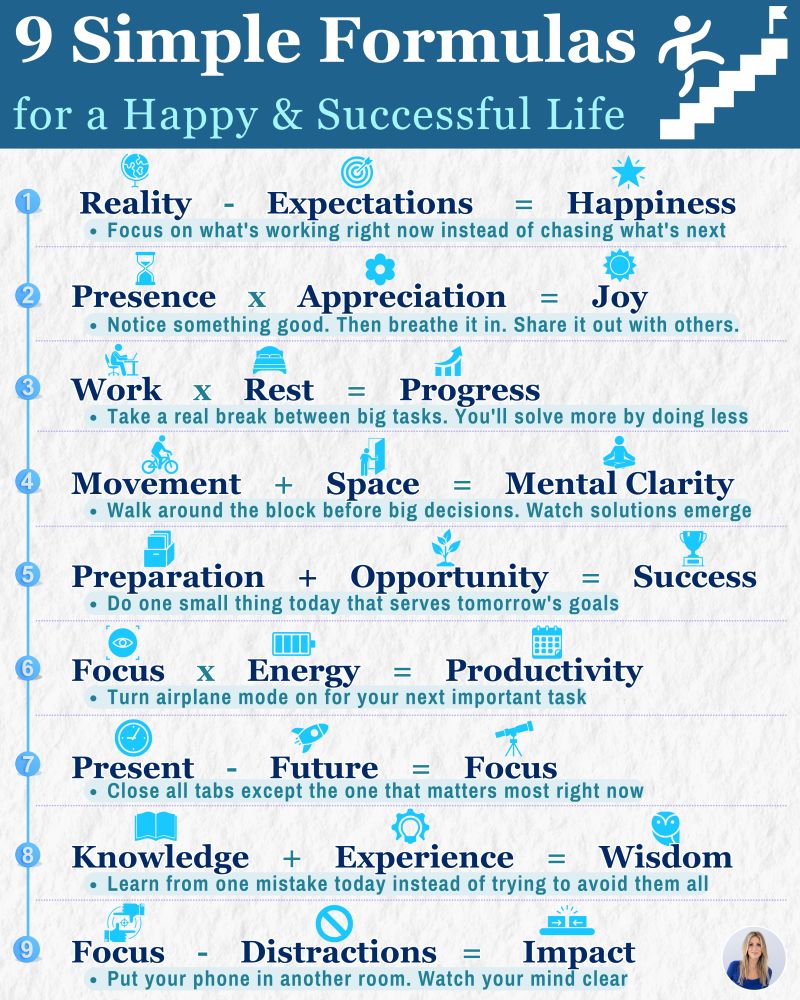
1) Reality – Expectations = Happiness
↳Focus on what’s working right now instead of chasing what’s next.
2) Presence + Appreciation = Joy
↳Notice something good, breathe it in. Then share it out with others.
3) Work x Rest = Progress
↳Take a real break between big tasks. You’ll solve more by doing less.
4) Movement + Space = Mental Clarity
↳Walk around the block before big decisions. Watch solutions emerge.
5) Preparation + Opportunity = Success
↳Do one small thing today that serves tomorrow’s goals.
6) Focus x Energy = Productivity
↳Turn airplane mode on for your next important task.
7) Present – Future = Focus
↳Close all tabs except the one that matters most right now.
8) Knowledge + Experience = Wisdom
↳Learn from one mistake today instead of trying to avoid them all.
9) Focus – Distractions = Impact
↳Put your phone in another room. Watch your mind clear.
Doing more isn’t the solution.
Doing it differently is ✨
What would you add?
Coaching Your Team
Your team doesn’t need a problem-solver.
They need a guide who helps them grow.
Most leaders don’t do that.
They resort to:
❌ Talking instead of listening
❌ Solving instead of supporting
❌ Rushing past the human moment
And their teams feel it.
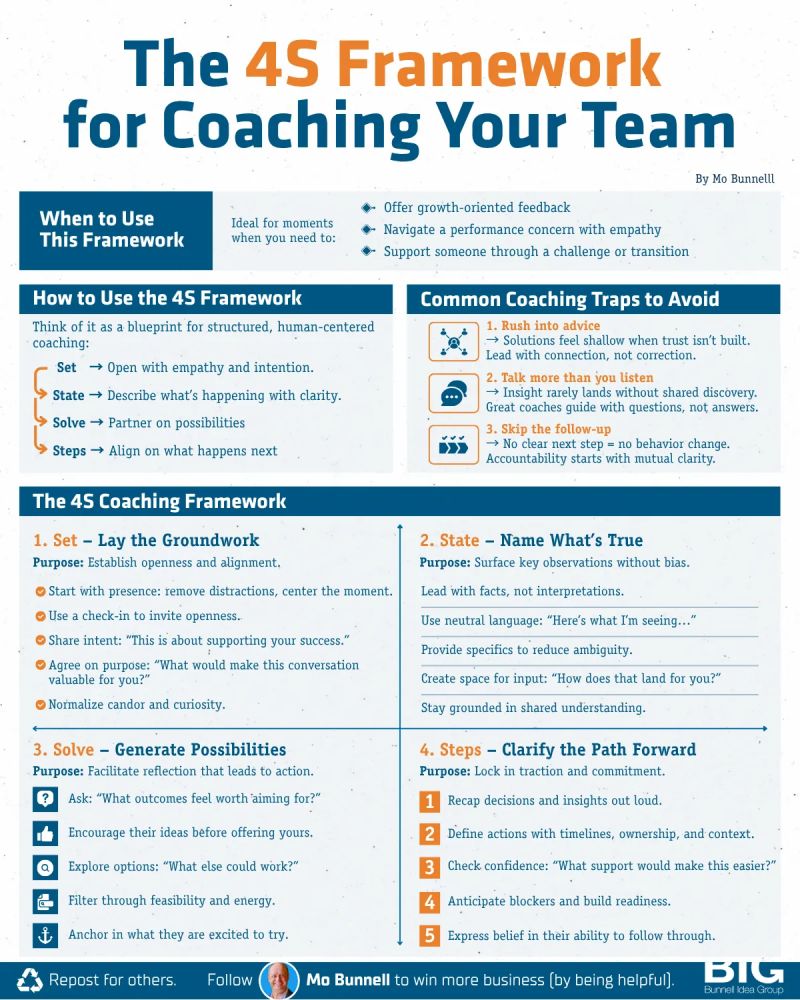
The 4S Framework flips that dynamic.
It’s your cheat sheet for coaching conversations
that land with integrity.
Here’s the flow:
🎯 Set
→ Start with presence, not a packed agenda
👁️ State
→ Share observations, not judgments
🤝 Solve
→ Explore possibilities together, not prescribe answers
✅ Steps
→ Lock in clarity and next steps, not confusion
The magic isn’t in having all the answers.
It’s in being the guide.
Think about your best coach or mentor.
Did they lecture you into growth?
Or did they ask questions that helped you see the way?
That’s the shift.
🟢 When you lead with curiosity, you build trust.
🟢 When you partner on solutions, you build ownership.
🟢 When you clarify next steps, you build momentum.
At the end of the day, your team doesn’t need
another critic.
They need someone who believes they can figure it out,
with the right support.
The 4S Framework makes it simple.
Not easy.
But simple.
9 Signs You’re Burning Out Your Team

It’s not always about working too many hours…
Burnout doesn’t always come from late nights or heavy workloads.
Sometimes, it comes from how people feel while doing the work.
Harsh truth:
You can have the best intentions as a leader and still be creating an environment that quietly drains your team.
Here are 9 signs you might be burning them out without realizing it:
1️⃣ Everything Feels Urgent
When everything’s ASAP, nothing is strategic. Constant pressure erodes focus and trust.
2️⃣ You’re Always “Pushing for More”
Growth is good…until it becomes nonstop. High performers need rest to stay high performing.
3️⃣ Wins Go Unnoticed
If you only give feedback when something’s wrong, motivation fades fast.
4️⃣ There’s No Room for Autonomy
Micromanagement signals distrust. It also drains creativity and morale.
5️⃣ You Change Priorities Constantly
Your team spends more time shifting gears than making progress.
6️⃣ You Don’t Model Healthy Boundaries
If you send 11 PM emails or never take time off, you’re silently setting expectations they’ll follow.
7️⃣ You Avoid Difficult Conversations
Unaddressed tension doesn’t disappear—it spreads. Psychological safety matters.
8️⃣ You Rely Heavily on the Same Few People
Your “go-to” employees may seem fine… until they burn out and check out.
9️⃣ There’s No Clear Path Forward
When people don’t see growth, purpose, or direction, burnout turns into disengagement.
Never forget:
Burnout isn’t just about workload—it’s about culture.
If you want sustainable performance, lead with empathy, clarity, and awareness.
Chaos

If your team is always busy—
Why does everything feel stuck?
🚫 Slow approvals.
🚫 Endless back-and-forth.
🚫 Everyone’s working… but no one’s aligned.
Sound familiar?
It’s not that people don’t care.
It’s that no one’s clear on how
work should actually move.
So what do most leaders do?
💻 Buy new tools.
📋 Add more meetings.
⚠️ Still feel stuck.
More tech doesn’t fix messy decision-making.
And a fancy dashboard won’t solve
unclear roles or bad handoffs.
I’m hosting a free webinar sponsored by BILL
to show you what actually works.
Leading Like an Operator:
Driving Culture, Speed, and
Efficiency in Modern Finance
🗓️ Date: July 23, 2025
⏰ Time: 1pm ET / 10am PT
👥 Save your seat here: https://lnkd.in/gDvYfTVJ
You’ll learn the operator approach that
works—without adding more noise.
Chaos isn’t strategy.
Busy doesn’t mean better.
Clear leadership wins.
Let’s get your team unstuck—fast.
I hope to see you there.
Handling Toxic Co-Workers
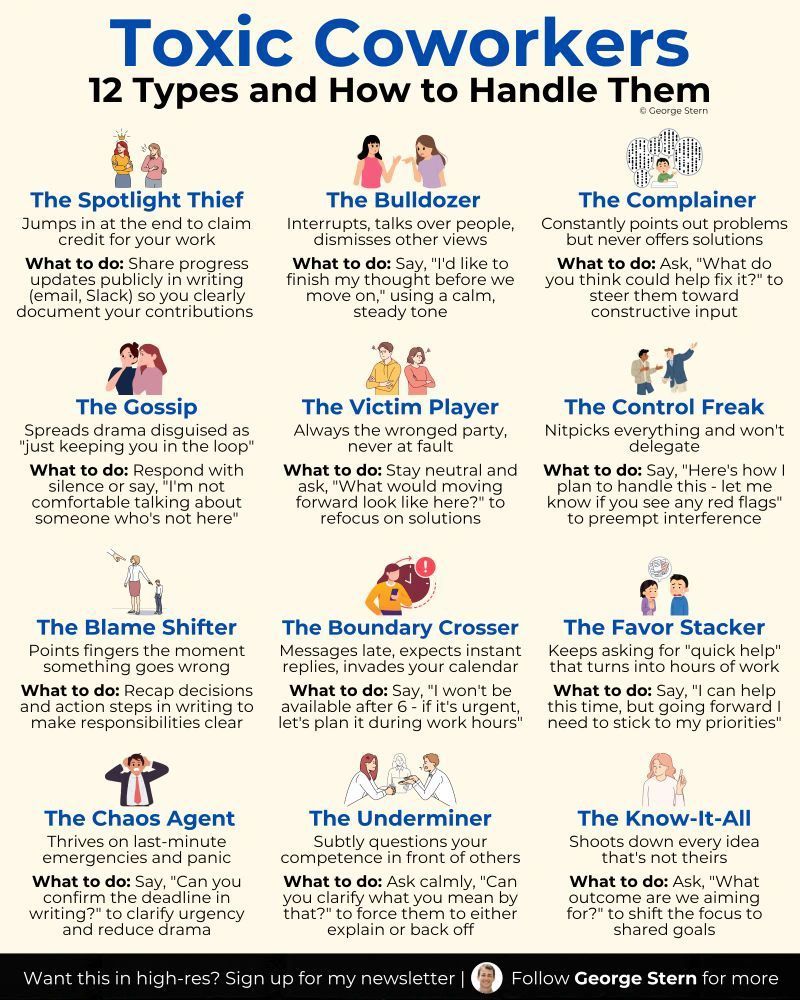
We all know these 12 toxic coworkers.
Handle them like a pro:
Colleagues like this destroy morale and slow down teams.
They:
↳Interrupt
↳Hog credit
↳Spread Drama
↳And make every day harder than it has to be.
You can’t always avoid them.
But you CAN learn to deal with them –
Calmly and confidently:
1. The Spotlight Thief
↳Jumps in at the end to claim credit for your work
↳What to do: Share progress updates publicly in writing (email, Slack) so your contributions are clearly documented
2. The Bulldozer
↳Interrupts, talks over people, dismisses other views
↳What to do: Say, “I’d like to finish my thought before we move on,” using a calm, steady tone
3. The Complainer-in-Chief
↳Constantly points out problems, never offers solutions
↳What to do: Ask, “What do you think could help fix it?” to steer them toward constructive input
4. The Gossip
↳Spreads drama disguised as “just keeping you in the loop”
↳What to do: Respond with silence or say, “I’m not comfortable talking about someone who’s not here”
5. The Blame Shifter
↳Points fingers the moment something goes wrong
↳What to do: Recap decisions and action steps in writing to make responsibilities clear
6. The Control Freak
↳Nitpicks everything and won’t delegate
↳What to do: Say, “Here’s how I plan to handle this – let me know if you see any red flags” to preempt interference
7. The Victim Player
↳Always the wronged party, never at fault
↳What to do: Stay neutral and ask, “What would moving forward look like here?” to refocus on solutions
8. The Boundary Crosser
↳Messages late, expects instant replies, invades your calendar
↳What to do: Say, “I won’t be available after 6 – if it’s urgent, let’s plan ahead during work hours”
9. The Know-It-All
↳Shoots down every idea that’s not theirs
↳What to do: Ask, “What outcome are we aiming for?” to shift the focus to shared goals
10. The Chaos Agent
↳Thrives on last-minute emergencies and panic
↳What to do: Say, “Can you confirm the deadline in writing?” to clarify urgency and reduce drama
11. The Underminer
↳Subtly questions your competence in front of others
↳What to do: Ask calmly, “Can you clarify what you mean by that?” to force them to either explain or back off
If any of these are all too familiar,
Don’t try to match their energy.
Instead, use this sheet to:
↳Set clear boundaries
↳Stay calm under pressure
↳And protect your peace
20 Benefits of Understanding Personality Types

For Your Team:
• Enhanced brainstorming sessions
• Better team problem-solving
• Easier resolution of conflicts
• Fewer misunderstandings
• Stronger team cohesion
• Efficient task allocation
• Better communication
• Tailored development
• Higher engagement
• Lower stress levels
For You:
• Sharper intuition
• Stronger influence
• Improved empathy
• Increased resilience
• Greater adaptability
• Deeper connections
• Increased confidence
• Better self-awareness
• Clearer communication
• Improved decision-making
All great leaders know:
Understanding your team is key to success.
And why is so important?
It shows how each team member:
➟ Thinks & processes information
➟ Interacts & communicates
➟ Handles conflict & stress
With these insights, you can:
➟ Improve team synergy
➟ Tailor your leadership style
➟ Increase overall productivity
Find this valuable?
How to Talk to Toxic People

I’ve been there.
A toxic manager once pushed me to walk away from a job I truly loved.
But here’s what I’ve learned:
You can’t control someone else’s behavior.
But you can control how you respond
and how you protect your peace.
Here are 8 practical phrases that helped me set boundaries and reclaim my confidence:
1️⃣ When they try to guilt you:
“I understand how you feel, but I’m confident in my decision.”
2️⃣ When they dismiss your feelings:
“My feelings are valid, and I’d appreciate it if you respected them.”
3️⃣ When they constantly criticize you:
“I welcome constructive feedback, but this doesn’t feel helpful.”
4️⃣ When they play the victim:
“I hear what you’re going through, but I can’t take responsibility for this.”
5️⃣ When they spread negativity:
“Let’s focus on what we can control and improve.”
6️⃣ When they gaslight you:
“I know my experience, and this is how I see it.”
7️⃣ When they try to control the situation:
“I understand your perspective, but I need to make my own decisions.”
8️⃣ When they interrupt you:
“I’d appreciate it if I could finish speaking before you share your thoughts.”
You’re not responsible for fixing toxic people.
But you are responsible for protecting
your energy, your values, and your peace.
Speak up.
Stand firm.
Every boundary you set teaches others how to treat you.
Lead with Heart

We obsess over numbers.
Revenue. Margins. Forecasts.
But the truth?
Business is 100% about people.
Yet most leaders still focus on:
🎯 KPIs
📊 Metrics
📈 Dashboards
📋 Quarterly results
And they lose sight of the very thing
making the metrics possible:
People.
➟ The ones solving the problems
➟ Delivering those numbers
➟ Building the systems
➟ Closing the deals
Want your business to thrive?
Start with your people.
Show them you care about:
➟ Their growth
➟ Their dreams
➟ Their wellbeing
➟ Their challenges
Because when people feel valued as humans
(not just employees):
➟ They bring their best work
➟ They go the extra mile
➟ They stay longer
➟ They care more
If you want people to care about your business, show them first that you care about them as people.
Business is personal.
It always was.
It always will be.
Lead with heart.
The results will follow.
 Kenrick Vaz