
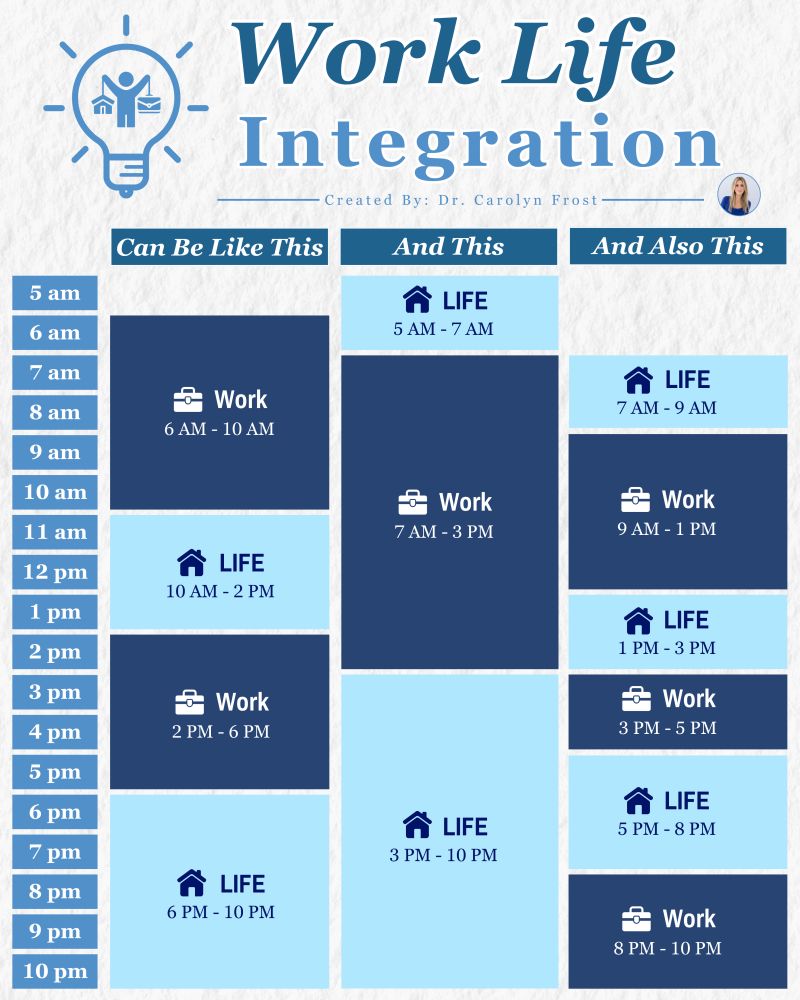
Work-life balance is a myth.
Here’s what actually works:
You’ve tried all the traditional advice.
Block your calendar
Set rigid boundaries
Separate everything neatly
But it’s not working.
You’re still exhausted from trying to split your life into perfect boxes.
Stop dividing your time.
Start integrating with purpose.
Here’s how 👇🏼
1) Design Your Power Blocks
↳ Schedule by energy, not the clock
↳ Some thrive at 5am, others at 10pm – own your pattern
2) Stack Instead of Separate
↳ Take that strategy call on your morning walk (my fav!)
↳ Turn your commute into learning time
3) Create Energy Transitions
↳ Small buffers between modes beat rigid boundaries
↳ Even a 5 min reset ritual naturally shifts your brain
4) Own Your Integration Style
↳ Some thrive in 2-hour blocks, others in quick sprints
↳ Match your natural rhythm, not someone else’s template
5) Master Purposeful Presence
↳ Fully engaged work means deeper focus
↳ Quality of attention beats quantity of hours
Balance divides your life into boxes.
Integration lets you design a life that actually works ✨
Any secrets that work well in your own life? Share below!
Let Me Sit With You for a Minute

There are moments when the world seems determined to move you along. To speed you up. To push you toward a solution before you’ve even had time to feel what you’re feeling. You say something is hard, and almost immediately someone reaches for advice. A tip. A lesson. A bright side. As if discomfort is something to be solved as quickly as possible.
But sometimes that’s not what we’re looking for at all.
Sometimes we’re just tired.
Tired of explaining. Tired of justifying why something hurts. Tired of being told that everything happens for a reason or that we should be grateful it isn’t worse. In those moments, advice can feel like noise. Solutions can feel like pressure. Even encouragement, when it comes too fast, can feel like a quiet way of saying, “You shouldn’t feel this way for long.”
What we want instead is simpler, and in some ways braver.
We want someone to pause with us. To listen without interrupting. To hear the full weight of what we’re carrying and say, “Yeah… that really is hard.” Not as a setup for a lesson, but as a complete sentence. Acknowledgment, without conditions.
There’s a kind of relief that comes from being seen like that. When someone doesn’t try to reframe your pain or rush you toward acceptance. When they don’t tell you what you should do next or how you should feel by now. They just let your experience be real. Valid. Enough.
Being understood doesn’t magically fix what’s broken. It doesn’t erase the problem or make the pain disappear. But it does something quieter and just as important. It tells your nervous system that you’re not alone in this. That you don’t have to defend your feelings or package them neatly to be worthy of care.
A lot of us learned, early on, that big feelings made people uncomfortable. So we learned to soften them. To joke. To minimize. To jump ahead to “I’ll be fine” before anyone could worry. Over time, we got very good at fixing ourselves in front of others. Even when what we really needed was permission to not be okay for a while.
And the truth is, not every moment needs a takeaway.
Some moments just need company.
When someone sits with you in your sadness, your confusion, your overwhelm, without trying to polish it into something more presentable, it creates space. Space to breathe. Space to feel. Space to eventually, at your own pace, figure out what comes next. Or not. Sometimes “next” can wait.
This is true not just for how we want to be treated, but for how we show up for others. It’s tempting to help by fixing. It makes us feel useful, competent, in control. But often the most meaningful thing we can offer is our attention. Our presence. Our willingness to tolerate discomfort alongside someone we care about.
To say, “I don’t have the right words, but I’m here.”
To say, “That makes sense.”
To say nothing at all, and mean it.
There’s a quiet kindness in letting feelings exist without trying to manage them. In trusting that being seen is, sometimes, enough for now. Not everything needs to be turned into growth or gratitude or a lesson learned. Some things just need to be acknowledged for what they are: heavy, complicated, and human.
So if you’re in a season where you don’t want advice, or solutions, or silver linings, that’s okay. You’re not broken for feeling that way. Wanting to be understood before being helped is deeply human.
And if you’re lucky enough to be that person for someone else, remember this: you don’t have to fix them to support them. Sometimes the most healing words are simply, “I see you. And what you’re feeling makes sense.”
The Power of Quiet People
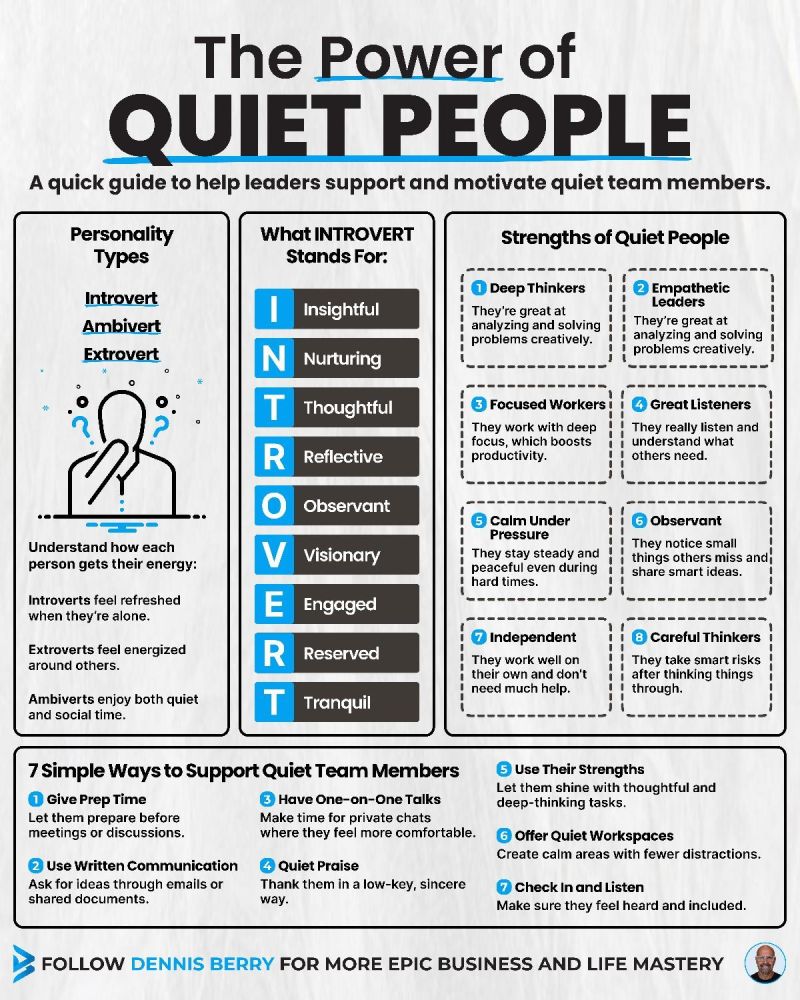
“Quiet people have the loudest minds.”
We don’t talk about this enough.
In a world that rewards the loudest voice in the room, quiet people are often overlooked… yet they carry a depth that can change everything.
While others speak to be heard, quiet people listen to understand.
While others rush to respond, they pause to think.🤔
While others seek attention, they focus on impact.
Here’s what happens when you underestimate them: 👇
❌ You miss the wisdom hidden between their words
❌ You overlook the calm strength they bring
❌ You mistake silence for weakness
The truth?
Quiet people move differently.
They don’t need the spotlight to lead, they lead by example, with precision and intention.
I’ve worked with people who barely said a word in meetings… and yet their one sentence at the right time changed the entire direction of a project.💡
Their strength is not in volume.
It’s in clarity.
It’s in the ability to see what others miss.
Here’s how quiet people create massive impact: 👇
✅ The Observation Edge
↳ They take in more than they put out, catching details that others overlook.
✅ The Patience Play
↳ They’re not rushing to “win” the moment… they’re playing for the long game.
✅ The Depth Advantage
↳ They think deeply before acting, which leads to sharper, more thoughtful decisions.
✅ The Empathy Effect
↳ They notice emotions, patterns, and unspoken truths, building trust without force.
✅ The Strategic Strike
↳ They know when to speak… and when they do, people listen.
Quiet people aren’t just part of the team, they’re often the steady hand that keeps it on course. 🔥
If you’re a quiet person reading this:
You don’t need to be louder to matter.
You just need to keep showing up as you are.
Your presence is already powerful. 💪
Who’s the quietest person you know that has made the biggest impact on your life❓
11 Public Speaking Strategies

75% of people fear public speaking more than death.
Yet it’s the no. 1 skill that accelerates careers.
An incredible resource from my friend Dr. Heather Maietta 🔥
(give her a follow)
Glossophobia, the fear of public speaking, held me back for years.
I wasn’t always afraid of public speaking.
Until I volunteered to present at a charity event and completely froze in front of the crowd.
Since then, I get anxiety for days leading up to a presentation.
But growth lives on the other side of fear.
And it’s never too late to rewrite your story.
Let’s put these 11 confidence-boosting tips into practice:
1/ The 5-5-5 Rule
→ Scan 5 faces, hold each gaze for 5 seconds
→ Repeat every 5 minutes
→ Creates an authentic connection
2/ Power Pause
→ Dead silence for 3 seconds after key points
→ Let your message land
3/ The 3-Part Open
→ Hook with a question
→ Share a story
→ State your promise
4/ Palm-Up Principle
→ Open palms when speaking = trustworthy
→ Pointing fingers = confrontational
5/ The 90-Second Reset
→ Feel nervous? Excuse yourself
→ 90 seconds of deep breathing resets your nervous system
6/ Rule of Three
→ Structure key points in threes
→ Our brains love patterns
7/ 2-Minute Story Rule
→ Keep stories under 2 minutes
→ Any longer, you lose them
8/ The Lighthouse Method
→ Plant “anchor points” around the room
→ Rotate eye contact between them
→ Looks natural, feels structured
9/ The Power Position
→ Feet shoulder-width apart
→ Hands relaxed at sides
→ Projects confidence even when nervous
10/ The Callback Technique
→ Reference earlier points later in your talk
→ Creates a narrative thread
→ Audiences love connections
11/ The Rehearsal Truth
→ Practice the opening 3x more than the rest
→ Nail the first 30 seconds and you’ll nail the talk
Your voice matters.
Don’t let fear choose who gets to hear it.
What’s helped you most with public speaking confidence?
Do More vs Do Better
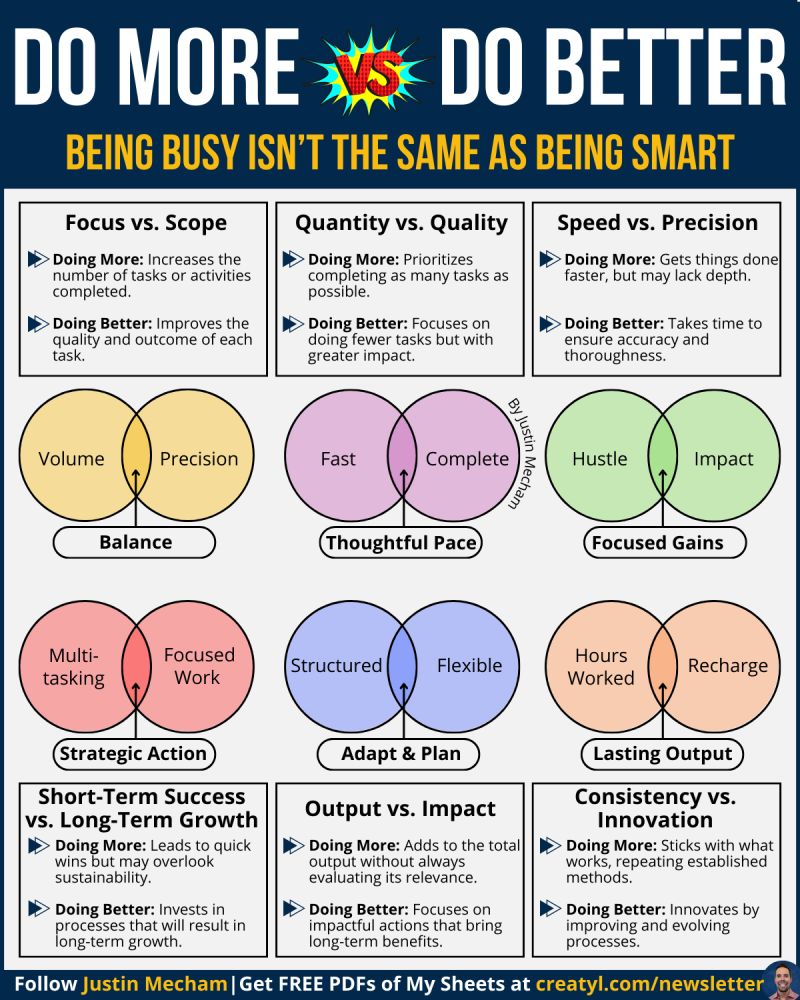
More doesn’t mean better—
It often means broken:
Here’s the hard truth:
Most people chase more —
But wonder why they feel stuck.
🔻 More apps.
🔻 More effort.
🔻 More noise.
🔻 More burnout.
🔻 More meetings.
🔻 More tabs open.
But more isn’t progress.
It’s a pattern.
And patterns don’t change results—
Only your approach does.
Let’s break it down:
The “More” Mindset
This is what keeps people busy but stuck:
🔴 Short-term thinking
🔴 Busy calendars
🔴 Hustle culture
🔴 High volume
🔴 Fast outputs
🔴 Multitasking
🔴 Quick wins
The “Better” Mindset
This is what creates momentum that actually lasts:
🟢 Real growth
🟢 Focused work
🟢 Clear priorities
🟢 Intentional time
🟢 Lasting progress
🟢 Strategic thinking
🟢 Meaningful results
Start small.
Pick one area to improve.
Then do it better — not more.
Popcorn Timing
It’s hard not to look around and measure. At birthday parties, playgrounds, school drop-offs, even family gatherings, the comparisons sneak in quietly. Someone else’s child is talking sooner, reading earlier, sitting still longer, understanding faster. And without meaning to, you start asking yourself questions you never planned to ask. Is my child behind? Am I missing something? Should I be doing more?
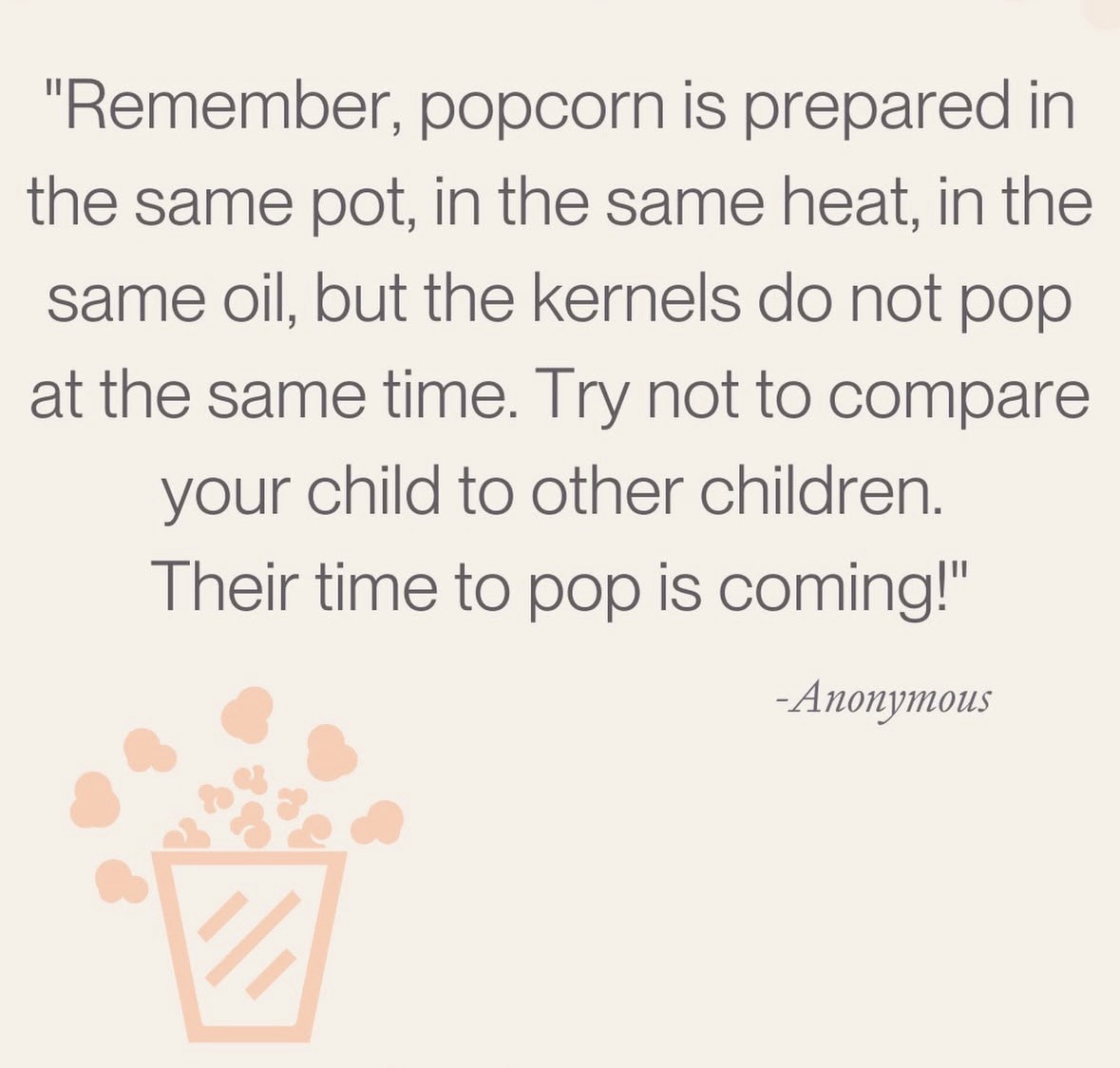
That’s where the popcorn image lands so gently, and so truthfully.
Every kernel sits in the same pot. Same heat. Same oil. Same conditions. And yet, they don’t pop together. Some burst open almost immediately. Others take their time, quietly absorbing heat, changing on the inside long before anything shows on the outside. And a few wait until the very end, then pop so suddenly you wonder how they held on for so long.
Children are like that. Development isn’t a race, even though the world often treats it like one. Growth happens in layers, not timelines. What looks like “nothing happening” from the outside is often a lot happening underneath. Wiring is forming. Confidence is building. Safety is being felt. Curiosity is waking up.
When we compare, we assume that early popping means better popping. But that’s not how it works. Fast doesn’t equal strong. Early doesn’t mean lasting. Loud doesn’t mean right. Some children bloom early and plateau. Others move quietly and then surge forward when they’re ready, with depth and resilience that can’t be rushed.
It’s also worth remembering that the heat isn’t just school or milestones. It’s love, patience, encouragement, boundaries, mistakes, comfort, repetition. All of it matters. And you’re already providing far more of it than you probably give yourself credit for.
Comparison has a way of stealing joy from the present moment. It turns “look at what my child is discovering” into “why aren’t they doing that yet?” It shifts your focus from connection to concern. And kids feel that shift. They feel when they’re being watched with worry instead of wonder.
Trust doesn’t mean ignoring real needs or avoiding support when it’s required. It means understanding that different doesn’t automatically mean delayed, and slower doesn’t mean wrong. It means honoring the child you have, not the child you’ve been told to expect by a chart or a comment or a casual comparison.
Your child’s moment is coming. It may not look like someone else’s moment. It may surprise you. It may arrive quietly or all at once. But it will be theirs, shaped by who they are, not by how closely they matched someone else’s timeline.
So when the noise gets loud and the comparisons start creeping in, remember the pot. Same heat. Same care. Different timing. And that timing? It’s not a flaw. It’s part of the design.
Win The Interview
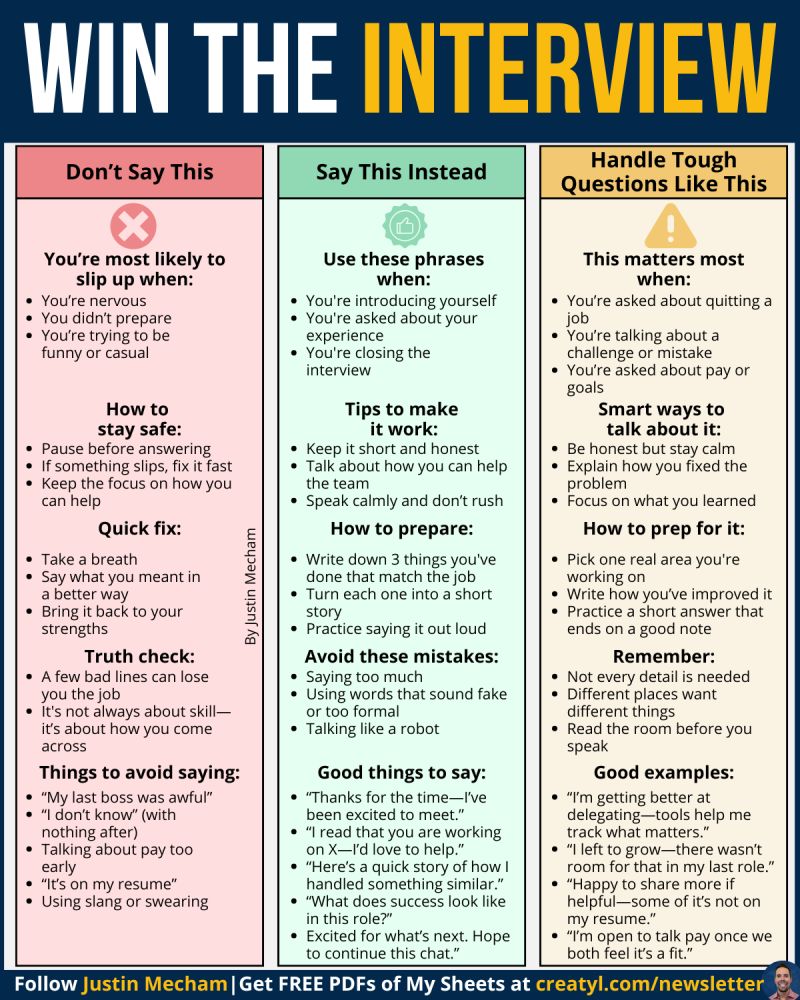
The résumé gets you in the room—
What you say next gets you the job:
Most interviews are lost
before they even start—
Not because you aren’t qualified.
But because of what you say…
and what you don’t.
Common slip-ups:
🟨Talking too much
🟧Rushing through answers
🟨Bad-mouthing a past boss
🟧Sounding fake or too formal
🟨Saying “I don’t know” with nothing after
Here’s what to say instead:
💬 Talk about how you can help the team
💬 Share one short, specific story
💬 Speak calmly and don’t rush
💬 Keep it short and honest
The right answers can shift
the whole conversation in your favor.
They can make you memorable
long after you leave the room.
They can turn a “maybe”
into a “When can you start?”
Appreciation Culture

People who feel valued give more than expected.
That’s why great CEOs prioritize their culture.
Because they know:
A valued team doesn’t just work harder.
They think like owners.
They solve problems before you see them.
They stay through the tough times.
Yet recognition is still one of the most underused leadership tools.
It doesn’t cost millions.
It doesn’t take hours.
It just takes intention.
12 simple ways to build a culture where people feel truly valued:
📢 Team Shout-Out
Praise great work publicly. Let everyone see what excellence looks like.
⏳ Time Back Reward
Finished a big project? Let them leave early. Time is the ultimate currency.
📚 Learning Opportunity
Invest in their growth. The ROI on development always pays off.
☕ Favorite Snack Surprise
Small gestures create big loyalty. Know what fuels your team.
📈 Career Growth Talk
Show them their future. People stay where they see a path.
🙏 Daily Thank You’s
Make gratitude a habit. What gets recognized gets repeated.
🎂 Birthday Celebration
Remember they’re human. Personal touches build real connections.
🕊 Let Them Lead
Trust them with decisions. Autonomy breeds ownership.
📱 Social Media Share
Celebrate wins publicly. Recognition amplifies when it’s visible.
💬 One-on-One Chat
Ask how they’re really doing. Caring conversations change cultures.
🎉 Goal Celebration
Hit a milestone? Celebrate it. Success should feel like success.
✍ Handwritten Thank You
In a digital world, handwritten stands out. Make it personal.
Save this list.
Share it with your leadership team.
Make it part of your operating rhythm.
Because the truth is:
Companies with great cultures don’t happen by accident.
They’re built with intention.
What recognition practice has worked best for your team?
Share below. Let’s learn from each other.
7 Styles of Thinking
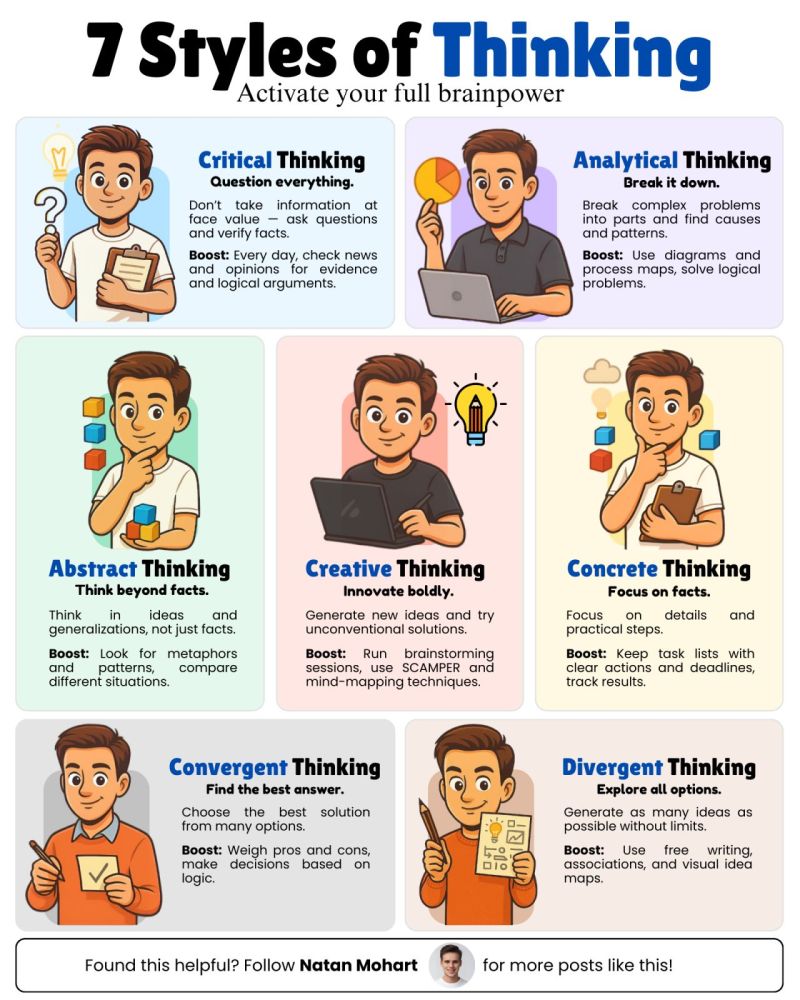
92% of people think in just one or two ways.
That’s why they get stuck in the same problems.
Credits to Natan Mohart, make sure to follow!
_____
The smartest?
They switch between 7 thinking styles — and win.
1. Critical Thinking
Don’t take words at face value. Break them down like a detective at a crime scene.
🚀𝗕𝗼𝗼𝘀𝘁: Fact-check news and opinions daily. Hunt for evidence and logical flaws.
2. Analytical Thinking
Break complex problems into parts. Spot causes and patterns.
🚀𝗕𝗼𝗼𝘀𝘁: Map processes, solve puzzles, visualize data.
3. Abstract Thinking
Look for big ideas and hidden connections behind the details.
🚀𝗕𝗼𝗼𝘀𝘁: Use metaphors and analogies. Spot surprising parallels.
4. Creative Thinking
Generate wild ideas without self-censoring.
🚀𝗕𝗼𝗼𝘀𝘁: Brainstorm freely, try SCAMPER, mind maps, random associations.
5. Concrete Thinking
Focus on details and actions, not just theories.
🚀𝗕𝗼𝗼𝘀𝘁: Make task lists, set deadlines, track progress.
6. Convergent Thinking
Narrow options to the one that makes the most sense.
🚀𝗕𝗼𝗼𝘀𝘁: Compare pros and cons. Trust facts and logic.
7. Divergent Thinking
Generate tons of ideas, way beyond the obvious.
🚀𝗕𝗼𝗼𝘀𝘁: Free write, sketch ideas, don’t stop at the first thought.
💬 Imagine you could only keep 2 of these 7 thinking styles.
Which ones would you choose to survive in the world of ideas? 🤔
The Weight You Were Never Meant to Carry

Somewhere along the way, many of us quietly take on a role we were never officially given. Fixer. Stabilizer. The one who makes things better. If someone is struggling, you feel it’s your responsibility to step in. If something is broken, you instinctively reach for the tools. And if people around you are hurting, you carry that weight like it’s yours to hold.
It usually doesn’t come from ego. It comes from care. From empathy. From the belief that if you don’t help, things might fall apart. So you show up. You listen. You advise. You absorb. And over time, without realizing it, you start confusing compassion with obligation.
The problem is not that you want to help. That part is beautiful. The problem is the silent expectation you place on yourself to make everything okay for everyone. That’s a pressure no one is built to withstand. Not long term. Not without cost.
When you try to fix everything, you slowly disappear from your own life. Your needs get postponed. Your rest gets negotiated. Your emotions get minimized because someone else’s pain feels louder or more urgent. You tell yourself you’ll focus on yourself later, once things calm down, once people are okay, once the chaos settles. But there is always another fire. Another situation. Another person who needs you.
At some point, exhaustion creeps in. Not the kind sleep fixes, but the deeper kind. The kind that comes from constantly being emotionally “on.” From carrying responsibility that was never actually yours. From believing that if someone is unhappy, you somehow failed.
Here’s the truth we resist: you cannot save people from their own journeys. You can support them. Walk alongside them. Care deeply. But you cannot do the inner work for them. And trying to will only drain you and, ironically, help less than you think.
There is a difference between being helpful and being responsible for outcomes you don’t control. You don’t control how others heal. You don’t control their choices, their timing, or their willingness to change. You don’t control how life unfolds for them. Acting as if you do is not kindness; it’s self-erasure.
Setting that weight down doesn’t mean you stop caring. It means you start caring sustainably. It means recognizing the small circle of things that are actually in your control: your actions, your boundaries, your energy, your well-being. It means asking yourself a simple but uncomfortable question: what do I need right now, and why have I been ignoring it?
Sometimes what you need is rest without guilt. Sometimes it’s distance. Sometimes it’s saying, “I can’t hold this for you.” Sometimes it’s letting people experience the consequences that lead to their growth. None of that makes you selfish. It makes you honest.
There is a quiet strength in choosing not to carry what was never yours. In trusting that others are more resilient than you fear. In allowing yourself to be human instead of endlessly capable. When you focus on what you can truly control, you become steadier, clearer, and more present. Ironically, that’s when your support becomes most meaningful.
You don’t have to fix the world today. Or anyone in it. You’re allowed to pause. To breathe. To tend to your own life with the same care you so freely offer others. Set the weight down, even if just for a moment. You were never meant to carry it all.
 Kenrick Vaz