
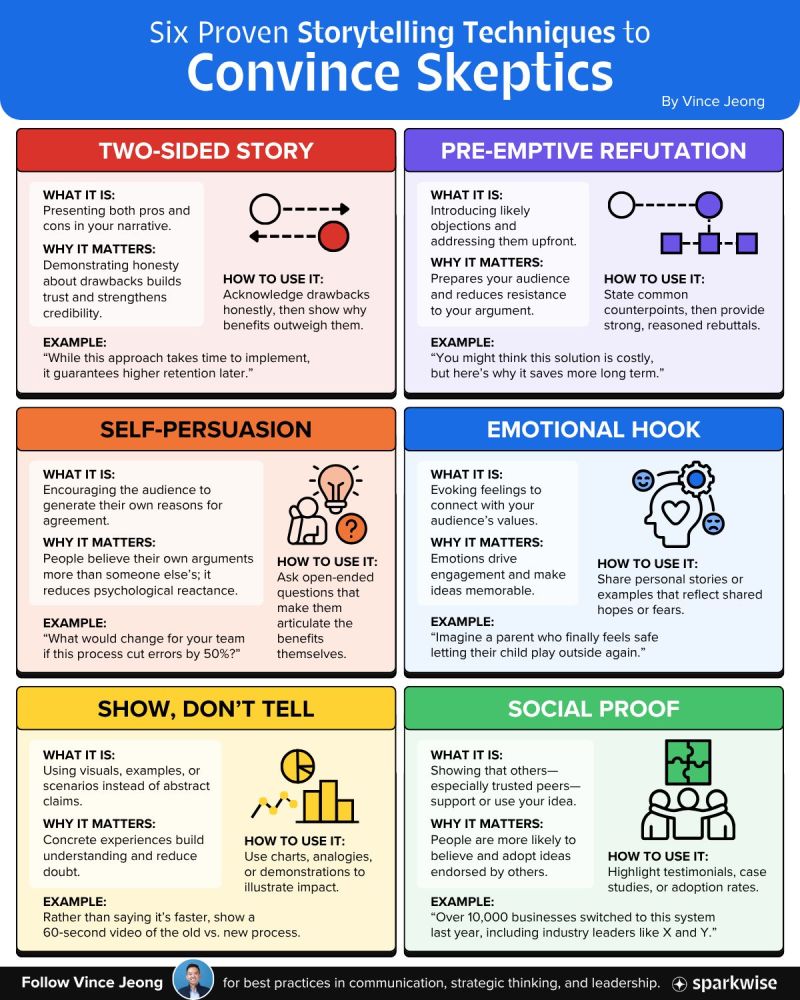
Face pushback on your ideas at work?
6 storytelling techniques that persuade:
1. 𝐓𝐰𝐨-𝐒𝐢𝐝𝐞𝐝 𝐒𝐭𝐨𝐫𝐲
Present both pros and cons upfront.
→ Acknowledge the drawbacks honestly
→ Show why benefits outweigh them
→ Build trust through transparency
You’re more credible
when you seem balanced.
2. 𝐏𝐫𝐞-𝐞𝐦𝐩𝐭𝐢𝐯𝐞 𝐑𝐞𝐟𝐮𝐭𝐚𝐭𝐢𝐨𝐧
Address objections before they’re raised.
→ State common counterpoints first
→ Provide strong, reasoned rebuttals
→ Reduce resistance before it starts
You control the narrative
when you lead with their concerns.
3. 𝐒𝐞𝐥𝐟-𝐏𝐞𝐫𝐬𝐮𝐚𝐬𝐢𝐨𝐧
Let them convince themselves.
→ Ask open-ended questions
→ Guide them to articulate benefits
→ Watch psychological reactance fade
People believe their own arguments more
than anything you could say.
4. 𝐄𝐦𝐨𝐭𝐢𝐨𝐧𝐚𝐥 𝐇𝐨𝐨𝐤
Connect feelings to facts.
→ Share personal stories that resonate
→ Use examples reflecting shared fears
→ Make abstract ideas feel real
Logic tells, but emotion sells.
Even to skeptics.
5. 𝐒𝐡𝐨𝐰, 𝐃𝐨𝐧’𝐭 𝐓𝐞𝐥𝐥
Replace claims with evidence.
→ Use visuals, charts, demonstrations
→ Present concrete examples
→ Make impact impossible to ignore
One proven example beats
ten theoretical explanations.
6. 𝐒𝐨𝐜𝐢𝐚𝐥 𝐏𝐫𝐨𝐨𝐟
Leverage peer influence.
→ Highlight trusted adopters
→ Share testimonials and case studies
→ Show industry leaders using it
Skeptics follow when others they respect
have already moved.
Which technique will you try first?
Strategic Planning
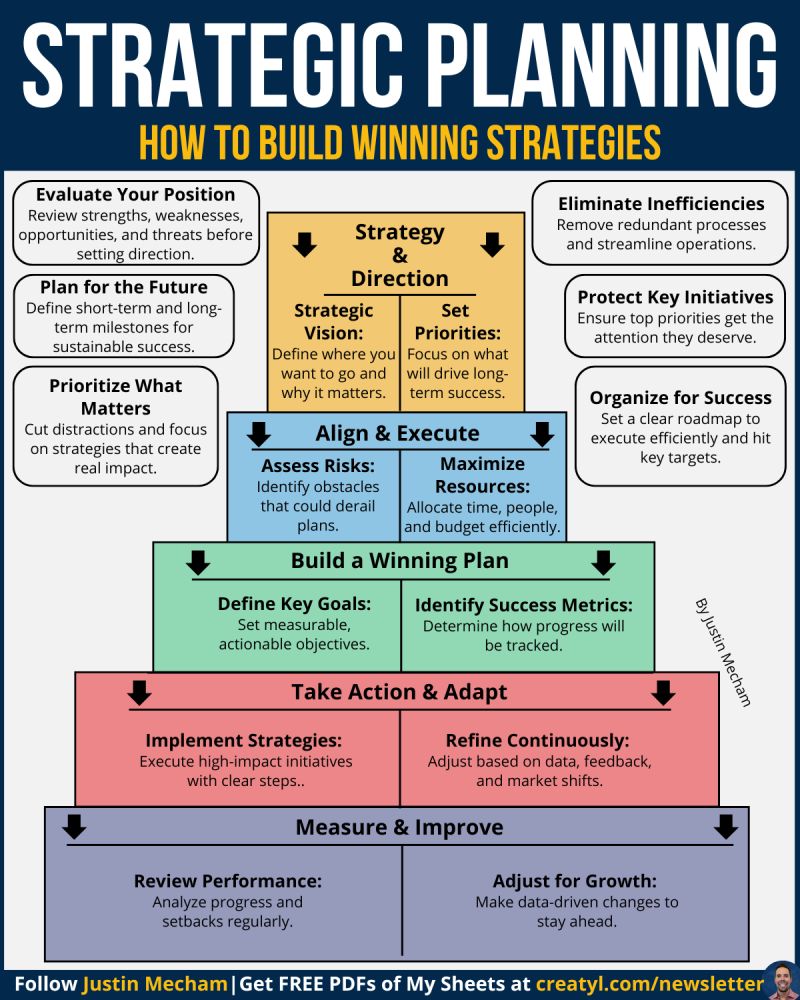
Most “strategies” are wish lists—
Here’s how to build choices, not chores:
Winning strategies aren’t complicated.
They’re clear, deliberate, and built to last.
Start with direction:
🟨 Know exactly where you’re going—and why
🟨 Cut what doesn’t move you forward
Set yourself up to act:
🟦 Name the risks before they name you
🟦 Spend people, time, and money where it counts
Build a plan worth following:
🟩 Set goals you can measure
🟩 Decide exactly how you’ll track progress
Keep it alive:
🟥 Take steps that matter now
🟥 Adjust fast when reality changes
Most plans are only good on paper.
The best ones win because they
adapt without losing focus.
If you get this right, you stop “managing”
and start moving.
You make fewer decisions—but better ones.
You trade busywork for real wins.
And every move you make builds on the last.
How to Give Feedback?
Many managers delay tough feedback.
Not from neglect, but discomfort.
Credits to Justin Hills, make sure to follow!
_____
These quiet fears shape how feedback
is given or not.
→ Fear of emotional reactions
→ Concern about conflict
→ Doubts about whether it will work
This hesitation is common
but it costs teams clarity, growth, and trust.
Yet research in the Journal of Applied Psychology shows:
Frequent, constructive feedback improves performance 12.5%.
Better performance boosts productivity and profitability.
Feedback doesn’t have to feel risky.
With structure, it becomes simple and constructive.
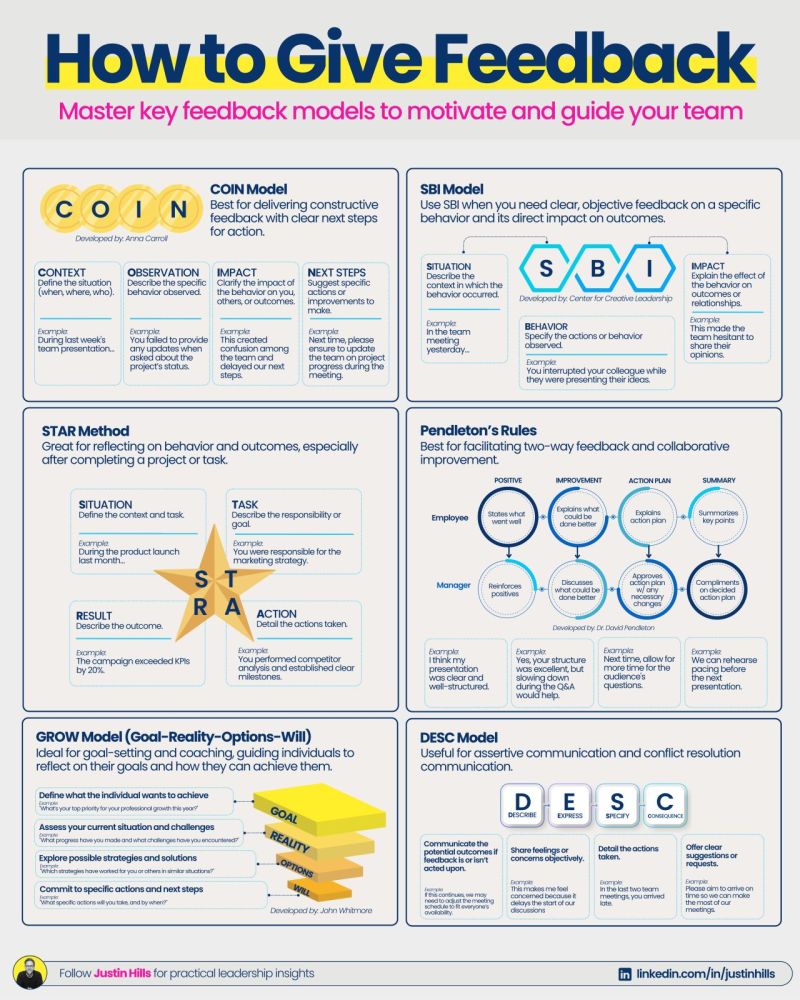
Here are 𝟲 𝗽𝗿𝗼𝘃𝗲𝗻 𝗺𝗼𝗱𝗲𝗹𝘀 𝘁𝗼 𝗺𝗮𝗸𝗲 𝗳𝗲𝗲𝗱𝗯𝗮𝗰𝗸
𝗰𝗹𝗲𝗮𝗿, 𝗮𝗰𝘁𝗶𝗼𝗻𝗮𝗯𝗹𝗲, 𝗮𝗻𝗱 𝘀𝗮𝗳𝗲:
1️⃣ 𝗖𝗢𝗜𝗡 𝗠𝗼𝗱𝗲𝗹 Best for coaching and development.
→ Context: Name when and where it happened.
→ Observation: Share what was seen, stay factual.
✅ Keeps feedback factual and clear
✅ Ends with next steps for improvement
2️⃣ 𝗦𝗧𝗔𝗥 𝗠𝗼𝗱𝗲𝗹 Perfect for reviews or recognition.
→ Situation: Set the context of the event.
→ Task: Define what was expected.
✅ Reinforces what worked well
✅ Builds confidence through specific examples
3️⃣ 𝗚𝗥𝗢𝗪 𝗠𝗼𝗱𝗲𝗹 Helps turn feedback into clear action.
→ Goal: Define what needs to be achieved
→ Reality: Outline what’s happening now
✅ Shows the gap between now and future success
✅ Creates a simple path from feedback to action
4️⃣ 𝗦𝗕𝗜 𝗠𝗼𝗱𝗲𝗹 Perfect for short, specific feedback moments.
→ Situation: Pinpoint the event or context
→ Behavior: Describe the action observed
✅ Makes feedback easy to share often
✅ Removes judgment and confusion
5️⃣ 𝗣𝗲𝗻𝗱𝗹𝗲𝘁𝗼𝗻’𝘀 𝗥𝘂𝗹𝗲𝘀 Great for balanced, two-way feedback.
→ Positives first: Start with what worked well
→ Invite input: Ask what could improve
✅ Encourages dialogue and shared ownership
✅ Makes feedback feel safe and collaborative
6️⃣ 𝗗𝗘𝗦𝗖 𝗠𝗼𝗱𝗲𝗹 Ideal for assertive or tense conversations.
→ Describe: Name what occurred clearly
→ Express: Share the impact it had
✅ Balances clarity with empathy
✅ Concludes with agreed-upon solutions
Clear feedback builds confidence and trust.
It turns tension into coaching and doubt into growth.
The Quiet Power of Small Things
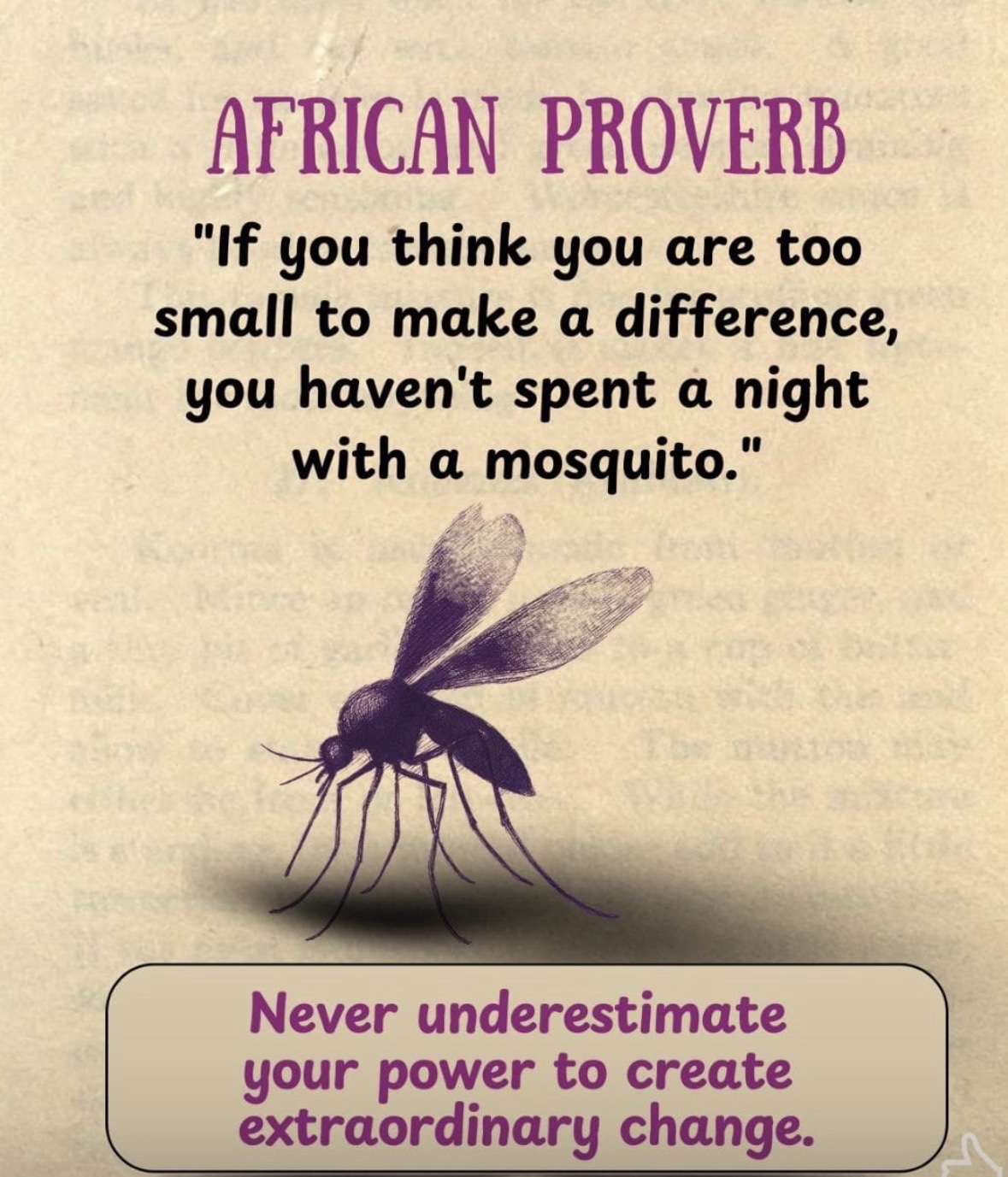
There’s a reason that quote sticks with people. It sounds almost playful at first, maybe even a little funny. A mosquito? Really? But anyone who’s ever spent a sleepless night swatting at the air knows exactly what it’s pointing to. Something tiny, something easy to dismiss, can completely change how a night unfolds.
We grow up believing that impact belongs to the loud, the large, the obvious. The people with titles. The ones with platforms. The ones who seem to enter a room already carrying influence with them. Somewhere along the way, many of us quietly decide that unless we’re operating at that scale, our contribution doesn’t really count.
But life doesn’t actually work that way.
Most change doesn’t arrive with a drumroll. It creeps in through small decisions, repeated actions, and moments that don’t feel historic while they’re happening. A single conversation that shifts how someone sees themselves. One honest piece of feedback that nudges a team in a better direction. A quiet refusal to accept “this is just how things are.”
Think about the people who’ve left a mark on you. Chances are, they weren’t trying to be extraordinary at the time. They were present. They listened. They showed up when it mattered. They said something simple at the right moment. Their influence didn’t come from size; it came from intention.
The mosquito metaphor works because it’s uncomfortable in the best way. It reminds us that power isn’t always about force. Sometimes it’s about persistence. About being impossible to ignore, not because you’re shouting, but because you’re consistent. Because you keep showing up in the same small, deliberate way.
In work, this is especially easy to forget. We wait for permission, for seniority, for the “right time” to speak up. We assume that strategy is set elsewhere and that our role is just to execute. But culture is shaped in the everyday. In how you run a meeting. In whether you give credit or take it. In whether you choose curiosity over cynicism.
Small actions compound. They always have. The problem is that compounding is invisible at first. On day one, it looks like nothing. On day ten, still nothing. Then one day, without much warning, you realize the tone has shifted. The trust has grown. The direction has changed. And suddenly, that “small” thing doesn’t feel small at all.
The same is true outside of work. Being kind when it would be easier to be indifferent. Choosing patience when frustration is justified. Standing up for something quietly but firmly, even when it would be simpler to stay silent. These moments don’t make headlines, but they shape lives.
We often underestimate ourselves because we’re measuring our impact with the wrong ruler. We compare our behind-the-scenes to someone else’s highlight reel. We forget that scale is not the same as significance. A mosquito doesn’t need to be big to matter. It just needs to exist, persist, and do what it does.
So if you’ve ever felt too small, too early, too insignificant to matter, take this as a gentle correction. Your voice counts. Your choices ripple. Your presence changes rooms, even when you don’t notice it happening.
Extraordinary change doesn’t always come from extraordinary people. More often, it comes from ordinary people who stop underestimating the power they already have—and use it, one small moment at a time.
How to Build Passionate Teams?
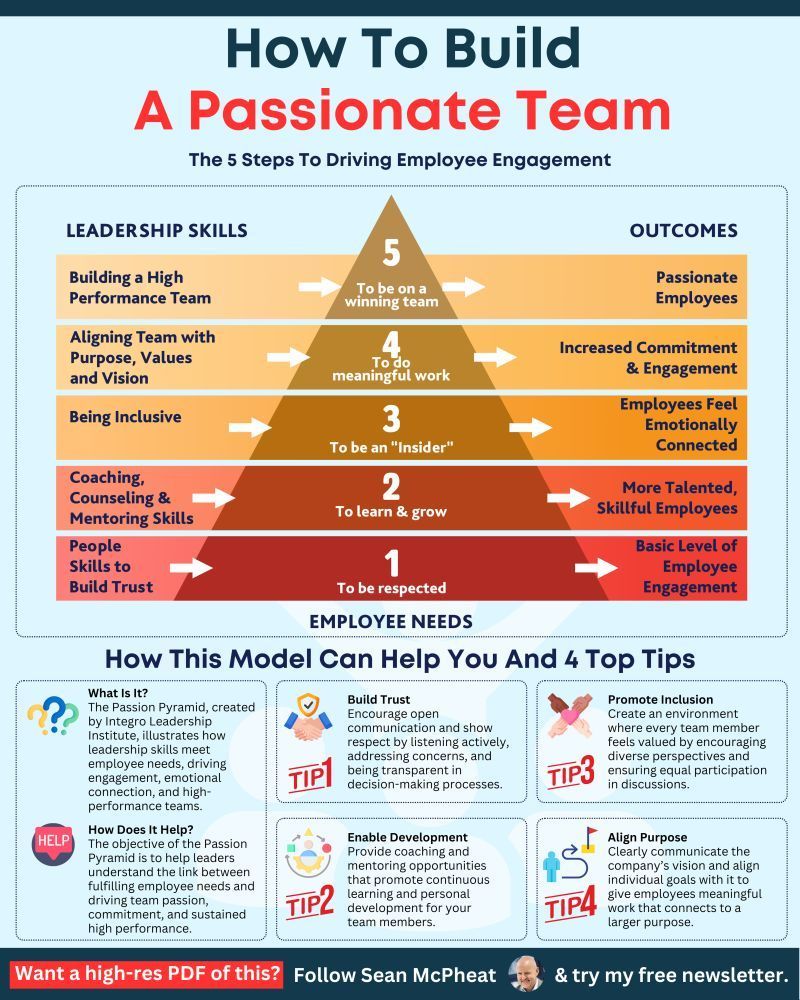
Want a team that’s passionate & engaged?
Here’s how to achieve that ⬇️
High engagement doesn’t start with perks
or ping pong tables.
It starts with how leaders meet the real
needs of their team.
Enter the Passion Pyramid, a 5-step model
that shows the link between leadership skills,
employee needs, and lasting engagement.
Each level builds on the one below:
1. People Skills to Build Trust
Employees need to feel respected.
When trust is missing, so is motivation.
2. Coaching, Counselling & Mentoring
People stay where they grow.
Support their development with real, ongoing guidance.
3. Inclusion
Everyone wants to feel like an insider.
That means listening, involving, and valuing all voices.
4. Purpose, Values & Vision
Meaningful work drives commitment.
Help people connect what they do to why it matters.
5. Building a High-Performance Team
Winning teams create energy.
When people feel part of something successful, they go all in.
Each step isn’t a one-off.
It’s a habit. A daily investment in your team’s experience.
And when you consistently meet these needs?
↳ Passionate employees
↳ Stronger emotional connection
↳ Increased skill and loyalty
↳ A high-performance culture people want to be part of
But skip the foundation, i.e trust, growth and belonging,
and you’ll build on unstable ground.
So ask yourself:
Where in this pyramid are you strong?
Where do you need to level up?
🧠 Remember: You don’t just build engagement.
You earn it, step by step.
What step do you think most teams struggle with?
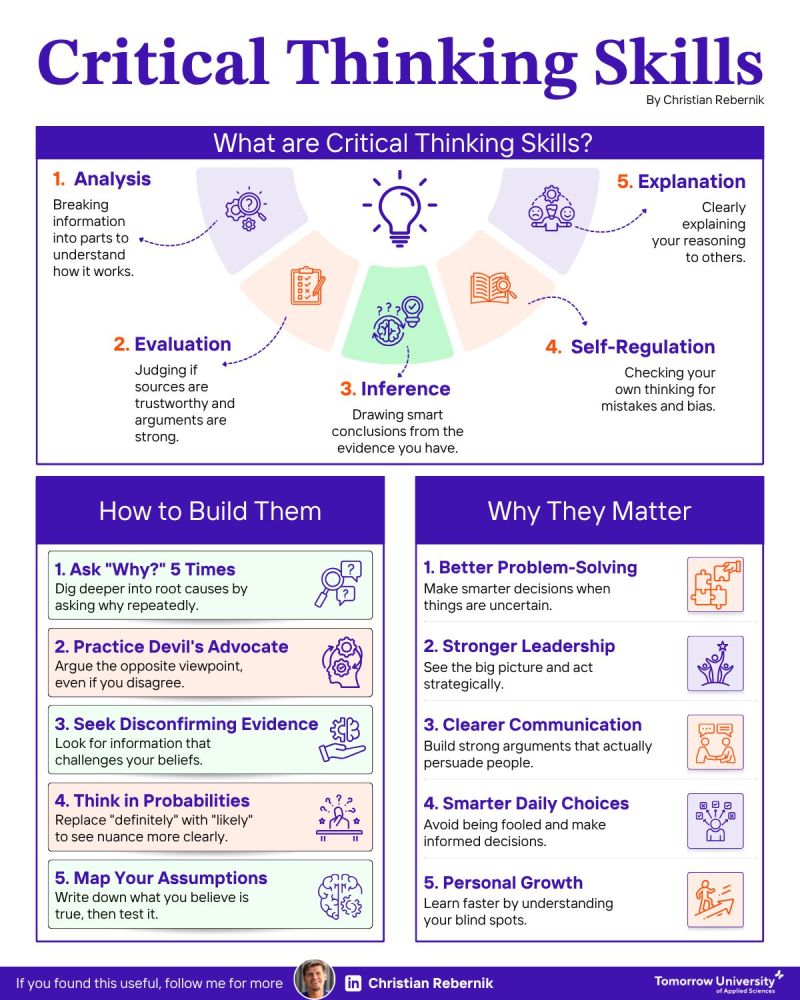
Critical Thinking Skills
Most people think critical thinking means “being smart.”
But it has nothing to do with your IQ.
Credits to Christian Rebernik, make sure to follow!
_____
It’s about using specific tools in your mind.
Tools that help you:
🧠 Handle the unknown
🧠 Spot hidden assumptions
🧠 Make better choices
These 5 skills form the foundation:
1. Analysis
↳ Breaking information into parts to see how it works.
✅ Spot the mechanics behind success
✅ Identify what truly drives results
✅ Separate noise from signal
2. Evaluation
↳ Judging whether sources are trustworthy.
✅ Protect yourself from misinformation
✅ Filter out bad advice quickly
✅ Recognize credible insights
3. Inference
↳ Drawing conclusions from the evidence you have.
✅ Anticipate likely outcomes
✅ Turn incomplete data into action
✅ Make connections others miss
4. Self-Regulation
↳ Checking your own thinking for mistakes and bias.
✅ Course-correct before it’s too late
✅ Stay humble and accurate
✅ Avoid costly blind spots
5. Explanation
↳ Clearly laying out your reasoning so others understand.
✅ Build trust through transparency
✅ Lead with logic, not authority
✅ Win buy-in for your ideas
Want to build these skills?
Try this:
Take your next big decision.
Write down what you assume is true.
Then actively look for evidence that proves you wrong.
This rewires how you think.
Most people defend their first idea.
Strong thinkers test it.
Every bad decision has warning signs.
This practice helps you see them.
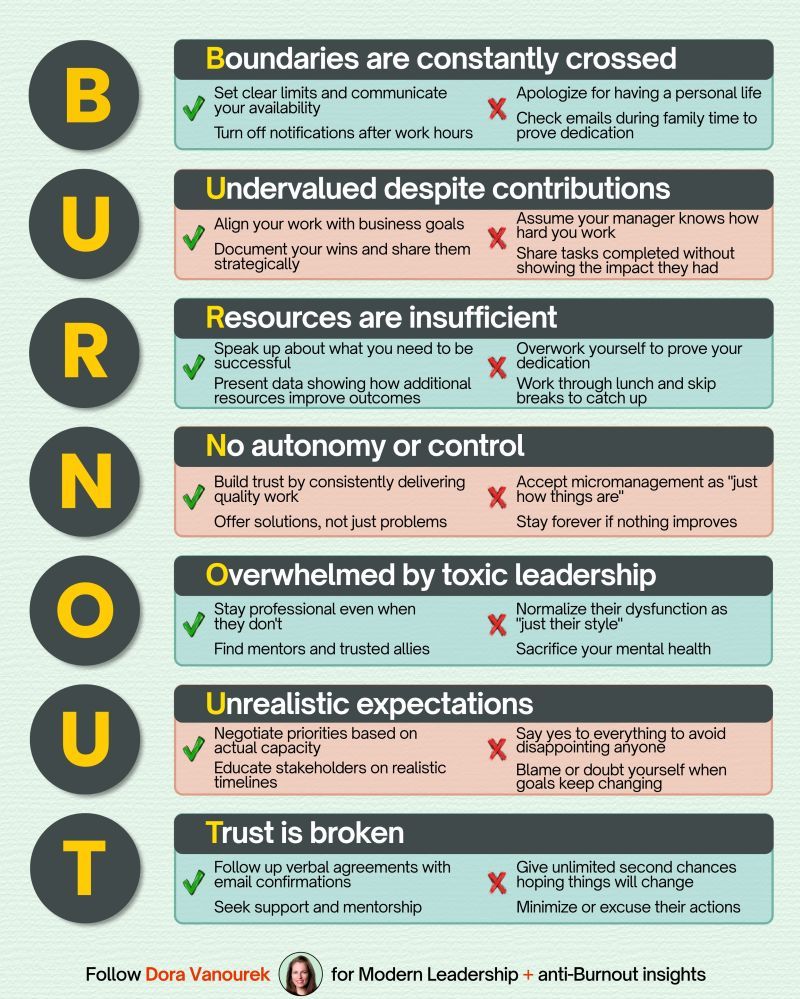
Burnout
Cutting your hours to avoid burnout is like
spending less time in a toxic relationship to fix it.
It doesn’t solve the real problem.
Burnout isn’t just about long hours.
It’s about what’s draining your energy every day:
B – Boundaries are constantly crossed
✅ Set clear limits and communicate your availability
❌ Apologize for having a personal life
U – Undervalued despite contributions
✅ Document your wins and share them strategically
❌ Share completed tasks without showing the impact
R – Resources are insufficient for workload
✅ Speak up about what you need to be successful
❌ Overwork yourself to prove your dedication
N – No autonomy or control
✅ Propose solutions, not just problems
❌ Accept micromanagement as “that’s how things are”
O – Overwhelmed by toxic leadership
✅ Protect your energy and seek allies
❌ Sacrifice your mental health
U – Unrealistic expectations
✅ Negotiate priorities based on actual capacity
❌ Say yes to everything to avoid disappointing anyone
T – Trust is broken
✅ Follow up verbal convos with email trails
❌ Give unlimited second chances
You aren’t here just to survive another week.
You deserve to thrive, feel good, and love your life.
The Feeling People Carry After Working With You
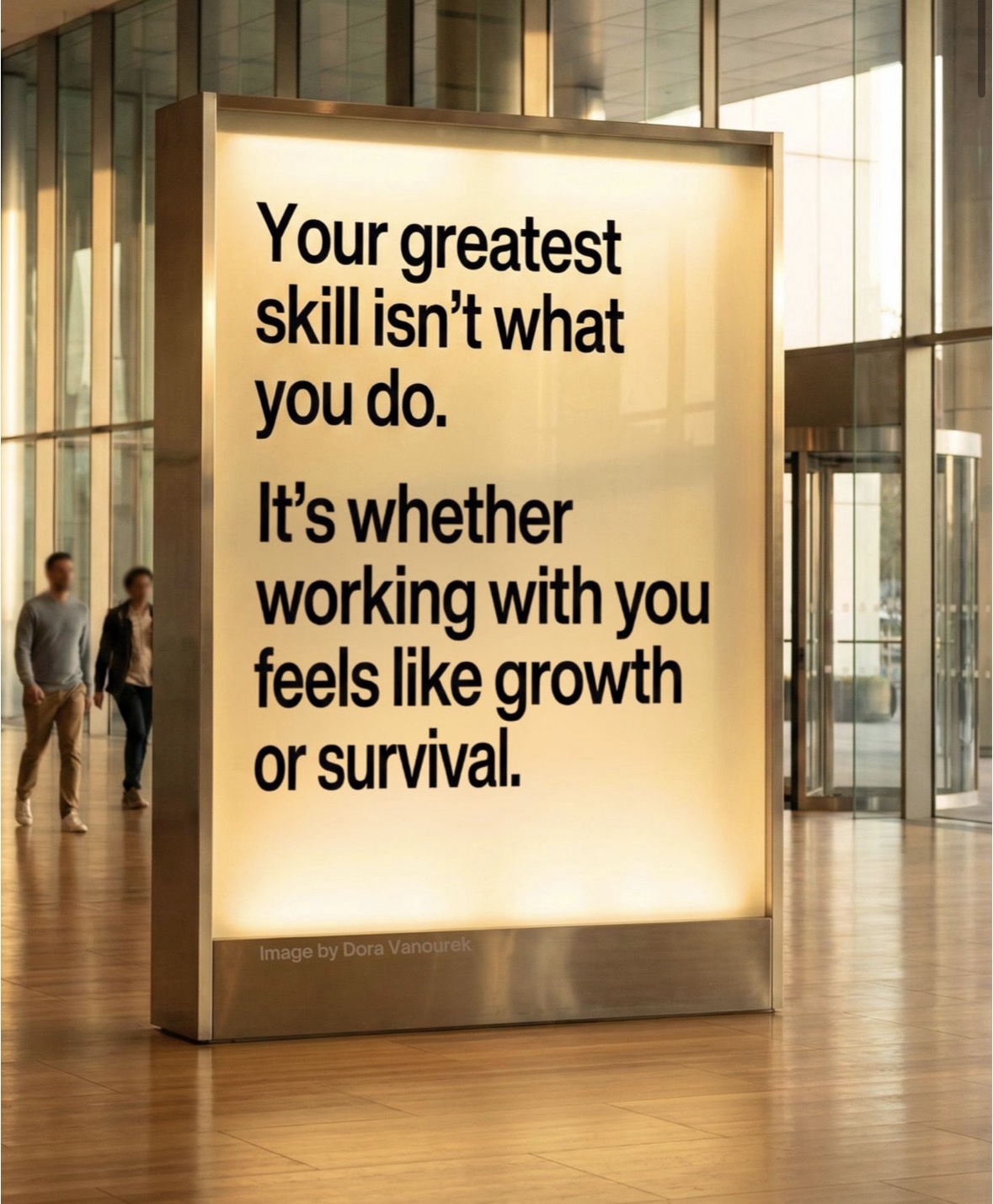
There’s a lot of emphasis on skills these days. What you know. What you’ve shipped. How fast you can deliver. The stack you’ve mastered. The results you can point to on a slide. All of that matters, of course. Competence is table stakes. But it’s rarely the thing people remember most.
What lingers is the feeling.
People may forget the exact details of a project, but they never forget what it felt like to work with you. Whether conversations left them clearer or more confused. Whether meetings drained them or energized them. Whether collaboration felt like a shared climb or a constant battle for air.
That’s where your real reputation is formed.
Some environments feel like growth. You leave a conversation sharper than you entered. You feel challenged, but supported. There’s space to ask questions without fear. Mistakes are addressed, not weaponized. Feedback is honest, but never demeaning. Even on hard days, there’s a sense that you’re moving forward together.
Other environments feel like survival. You’re constantly bracing yourself. Reading between the lines. Protecting your energy. Doing just enough to stay afloat. Every interaction feels like a test, a trap, or a threat. Progress happens, maybe—but at a personal cost that quietly accumulates.
The uncomfortable truth is that two people can deliver the same results and leave wildly different impacts. One can make a team better, stronger, more confident. The other can burn people out while hitting every milestone.
And often, neither realizes the difference they’re creating.
This isn’t about being “nice” all the time or avoiding difficult conversations. Growth is rarely comfortable. Real progress involves tension, disagreement, and accountability. But there’s a world of difference between pressure that sharpens and pressure that suffocates.
When someone works with you, do they feel seen or managed? Do they feel trusted or monitored? Do they feel like their ideas are welcome, or merely tolerated until a decision is already made?
Small moments matter more than we think. How you respond when someone pushes back. How you handle stress when things go wrong. Whether you listen to understand or listen to reply. Whether your presence makes the room feel safer—or smaller.
Over time, those moments add up.
People start to associate your name not just with outcomes, but with an experience. They know whether bringing you into a room will raise the level of thinking or raise everyone’s blood pressure. They know whether working with you will stretch them in a good way or leave them exhausted.
The most impactful professionals aren’t just good at what they do. They make others better at what they do. They create momentum instead of friction. They leave behind confidence, clarity, and a sense of progress—even when the work is hard.
That’s a skill no résumé can fully capture, but everyone can feel.
So maybe the real question isn’t how impressive your work looks from the outside. It’s what kind of environment you create on the inside. Because long after the project ends, that’s what people carry with them.
And that might be your greatest skill of all.
10 Boundary Tests You Didn’t Know Existed

Your boundaries are being tested daily.
Most people fail without realizing it.
People don’t announce “I’m testing your boundaries now.”
They do it subtly, constantly, to see what you’ll accept.
Here are 10 boundary tests happening right now:
1) 📅 Last-Minute Meeting Request
↳ Test: Will you drop everything for poor planning?
↳ Pass: “I can meet Thursday at 2pm. Does that work?”
2) 📱Weekend “Quick Question” Text
↳ Test: Are your personal hours protected?
↳ Pass: Respond Monday: “Catching up on weekend messages…”
3) 😔 Guilt Trip for Saying No
↳ Test: Can they manipulate you into changing your mind?
↳ Pass: “I understand you’re disappointed. My answer remains no.”
4) 🕰️ Assumption You’ll Stay Late
↳ Test: Will you sacrifice personal time without being asked?
↳ Pass: “I have commitments at 6pm. Let’s tackle this tomorrow.”
5) 🏆 Credit-Taking Behavior
↳ Test: Will you let them claim your work?
↳ Pass: “Actually, I developed that strategy. Happy to walk you through it.”
6) ⚡ Response Time Pressure
↳ Test: Can they train you to be instantly available?
↳ Pass: Respond when it works for your schedule, not theirs.
7) ❌ Constant Interruption Pattern
↳ Test: Can they access you anytime they want?
↳ Pass: “I’m in focused work until 2pm. Can we talk then?”
8) 📚 Overloading Assignment
↳ Test: How much can they pile on before you push back?
↳ Pass: “I can take this on if we extend the deadline to…”
9) 🎭 Personal Favor Disguised as Work
↳ Test: Can they get free personal help under work pretense?
↳ Pass: “This seems personal. Happy to refer you to someone who specializes in this.”
10) 🗣️ Emotional Dumping Session
↳ Test: Will you become their free therapist?
↳ Pass: “This sounds tough. Have you considered talking to someone professional?”
Your boundaries aren’t suggestions.
They’re non-negotiable standards.
The people who respect them stay.
The ones who don’t reveal exactly who they are.
Which boundary test do you recognize most in your daily work life?
Win Back Your Time
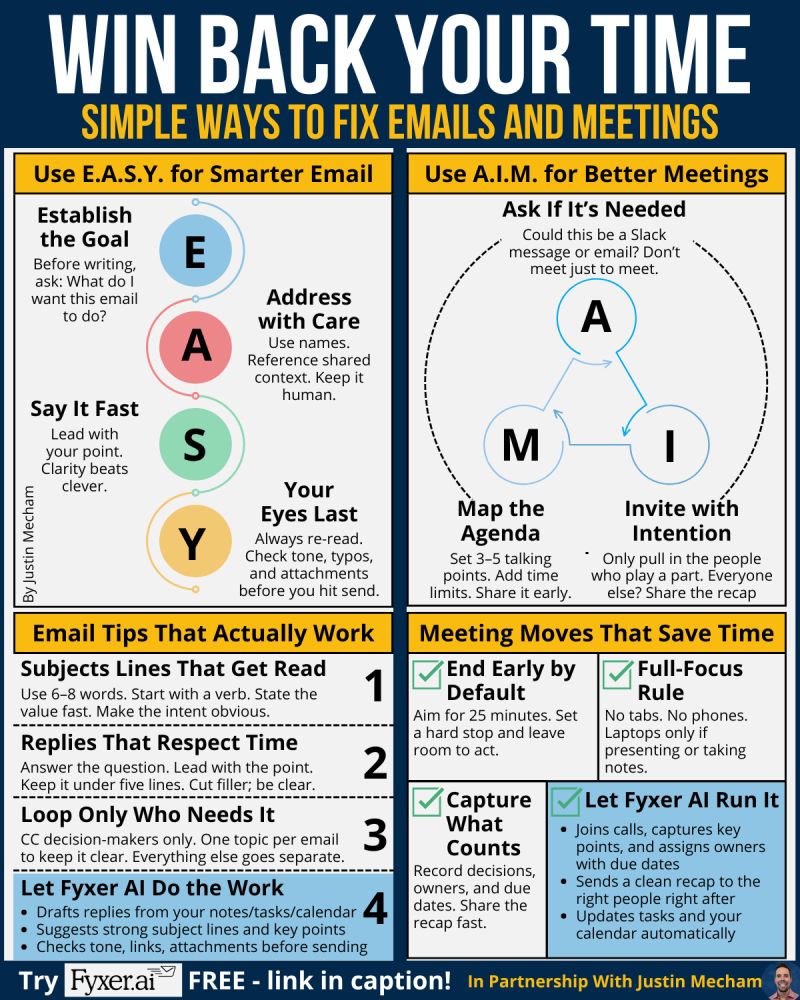
You lose 4+ hours daily to email and meetings—
Here’s how to win back your time:
The real enemy isn’t time.
It’s the friction in how we communicate.
Every day, it’s the same cycle:
🚫 Emails that spiral into threads
🚫 Meetings that are managed poorly
🚫 Decisions that are dragging out for days
The numbers are brutal:
🗓 Email and poorly handled meetings
— Consumes over half the workweek
(Microsoft)
That constant churn:
🔴 Drains focus
🔴 Slows decisions
🔴 Crowds out real work
Want to win back those hours each week?
🟢 Drafts clear, on-point replies
using your notes, calendar, and tasks
🟢 Joins meetings, captures key points,
and assigns owners with deadlines
🟢 Sends clean recaps so nothing slips
If you cut even 30 minutes a day from emails
and by making meetings more effective,
you save 3+ weeks a year.
That’s time you can spend on actual work…
Or on a life outside of it.
 Kenrick Vaz