

Struggling with a workplace that drains your energy and stifles your growth?
Whether it’s micromanagement, blame games, or unending gossip.
Toxic traits can sabotage your work environment and your peace of mind.
From experience, here’s the survival kit to get you through.
8 Signs of Toxic Culture – and What to Do About Them
1. Micromanagement Mayhem
The Sign: Every decision needs approval, no trust, constant checking-in.
Your Move: Set boundaries. Gently push back with facts and results. Show you’re capable, then reclaim autonomy bit by bit.
2. Blame Game Olympics
The Sign: Mistakes = finger-pointing, never learning.
Your Move: Document everything. Cover your back. Speak up with solutions, not just problems.
3. Zero Accountability at the Top
The Sign: Leaders never admit fault, deflect onto the team.
Your Move: Don’t play their game. Stay professional, and if it’s chronic—start planning your exit strategy.
4. Gaslighting Galore
The Sign: You’re told your valid concerns are “overreactions” or “misunderstandings.”
Your Move: Keep a journal. Record conversations, dates, and patterns. Trust your gut—it’s not all in your head.
5. Gossip and Cliques
The Sign: Inner circles rule. Info is currency. Exclusion is the norm.
Your Move: Don’t engage. Stay friendly, not involved. Build alliances based on trust, not tea.
6. Unrealistic Expectations, All. The. Time.
The Sign: Constant overwork, shifting goals, no praise—only pressure.
Your Move: Prioritize like a pro. Clarify what’s urgent vs noise. Say “no” (or “not now”) without guilt.
7. High Turnover = Red Flag
The Sign: People keep disappearing. Fast.
Your Move: Find out why. Learn from others’ exits. Use their reasons to evaluate your own timeline.
8. No Growth, No Recognition
The Sign: You’re stagnant. Promotions are for boss’s pets, not performance.
Your Move: Upskill on your own. Shine outside of work. Prep for a move where you’re valued.
12 signs you’re a top performer.

You’ll rise quickly if you:
1) Take responsibility
You focus on what’s within your control and own the outcome – no blaming, no excuses.
2) Actively seek feedback
You invite critique, even when it stings, and use it to level up.
3) Find solutions
You don’t just flag issues, you suggest ways to fix them, too.
4) Chase growth
You lean into challenges and keep expanding your skills.
5) Manage your energy
You know when to sprint and when to rest, so you don’t burn out.
6) Stay cool in chaos
You don’t panic when things go sideways – you think clearly and adapt.
7) Go the extra mile
You consistently deliver more than what’s asked.
8) Prioritize impact
You aim for meaningful results, not just activity.
9) Elevate your team
You support others, share knowledge, and lead by example.
10) Embrace failure
You treat mistakes as data, not defeat, and you keep moving forward.
11) Communicate clearly
You speak up with honesty, respect, and purpose.
12) Stay consistent
Even when motivation dips, your discipline keeps you moving.
High performers aren’t just born with talent.
They’re deliberate.
They invest in what matters,
And do so consistently.
The Turtle Theory

In a world obsessed with hustle, urgency, and getting there first, turtles are quietly rewriting the rules.
They don’t rush. They don’t panic. They don’t waste energy looking sideways to see who’s ahead.
They simply keep moving — one stroke, one step, one breath at a time.
Through chaos, they keep swimming.
Through calm, they keep swimming.
And somehow, they always find their way to shore.
That’s the thing about patience — it’s not flashy, but it’s undefeated.
Speed means nothing if your journey isn’t sustainable.
You don’t need to sprint; you just need to stay in motion.
Slow progress is still progress. And in the long run, peace will always outlast pressure.
So, the next time you feel the urge to rush, remember the turtle.
You’re not here to win a race no one asked you to run.
You’re here to reach your shore — steady, calm, and on your own time!
The Giraffe Theory

We live in a world that loves to pull you into every argument, every distraction, and every uninvited opinion. It’s easy to get caught defending your path to people who don’t even understand where you’re headed.
But here’s the thing — giraffes don’t lower their necks to argue with turtles.
A giraffe sees further, not just because of its height, but because of its perspective. It lives in a space above the noise, above the daily squabbles, above the distractions that keep others trapped. From that vantage point, it doesn’t need to stop and justify its journey.
The higher you rise — in ambition, in mindset, in purpose — the fewer people there will be who can see what you see. That can feel isolating at times. But it’s also where the clarity lives.
Staying tall means staying true to your vision, even when others can’t grasp it. It means walking your path without constantly bending down to explain yourself to those who aren’t on the same journey.
So, the next time someone tries to pull you into the weeds, remember the giraffe.
Stay tall. Stay focused. And keep walking toward the view only you can see!
Make Stronger Decisions
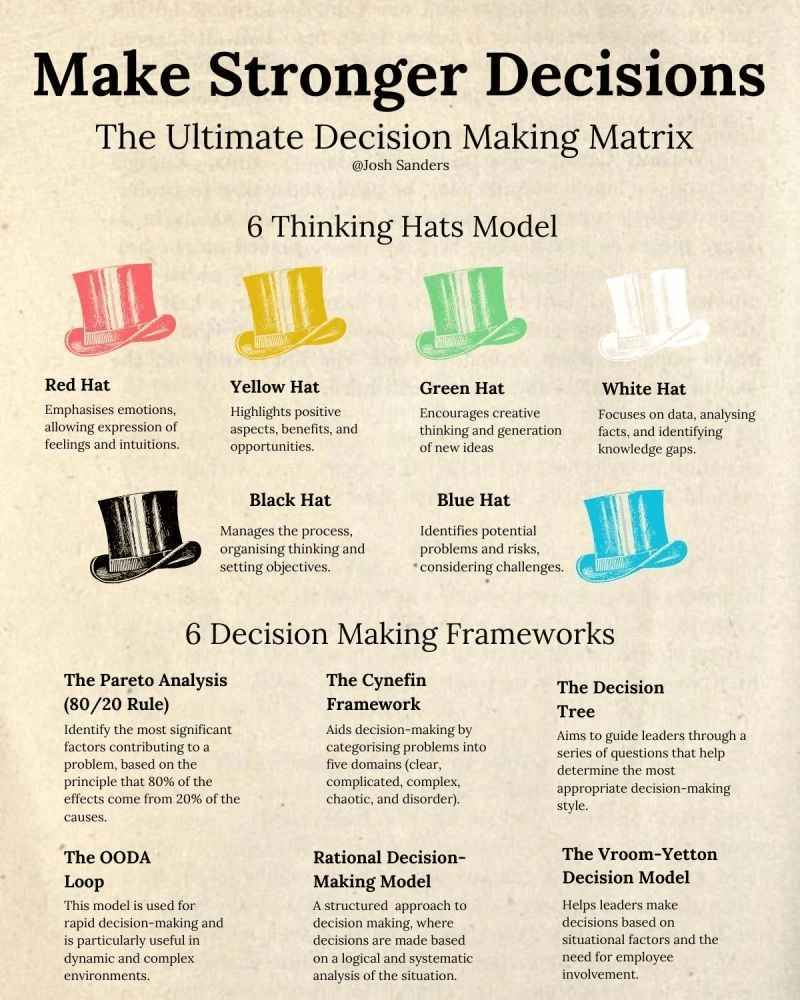
Make Stronger Decisions
The Ultimate Decision-Making Matrix:
Every single day we make 1000s of small decisions.
Yet no one teaches us how to maximise them.
The impact of better decision-making is incredibly clear.
When we make faster and stronger decisions it can:
↳ Relieve stress
↳ Reduce overthinking
↳ Improve productivity
Get started on systemising your decisions today!
Steal these science-backed frameworks:
The 6 Thinking Hats Model:
1. Red Hat
↳ Focuses on emotions.
↳ Allowing the expression of feelings and intuitions.
2. Yellow Hat
↳ Prioritises positive aspects
↳ With a focus on benefits and opportunities
3. Green Hat
↳ Encourages creative thinking
↳ Improve the generation of new ideas
4. White Hat
↳ Highlights the importance of data and analysing facts
↳ As well as identifying knowledge gaps.
5. Black Hat
↳ Spots potential risks and problems
↳ Allows you to consider challenges.
6. Blue Hat
↳ Prioritises processes and systems.
↳ Organises your thinking and helps set objectives.
6 bonus useful decision-making methods:
1. The Pareto Analysis [80/20 Rule]
2. The Cynefin Framework
3. The Decision Tree
4. The OODA Loop
5. Rational Decision-Making Model
6. The Vroom-Yetton Decision Model
From Fortune 500 CEOs to junior execs
These methods can be utilised by anyone!
Steal this cheat sheet today
To make stronger decisions in the future.
10 Tensions of Leadership
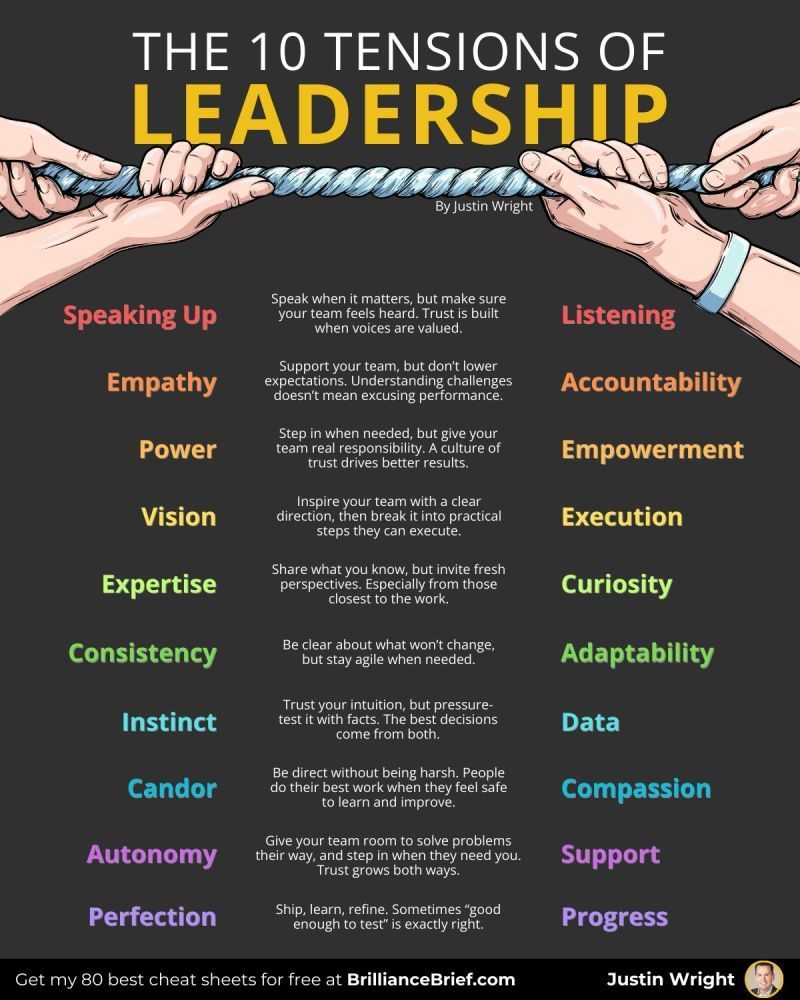
Leadership isn’t a straight line.
It’s a constant balancing act between
competing forces.
These 10 leadership tensions might be the most valuable
framework you’ll see this year:
1. Speaking Up vs. Listening
↳ Know when to voice your opinion and when to create
space for others.
↳ Teams thrive when everyone feels heard, not just
the loudest or highest-paid.
2. Empathy vs. Accountability
↳ Support your people through challenges without
lowering the bar.
↳ Understanding doesn’t mean excusing
poor performance.
3. Power vs. Empowerment
↳ Step in when needed, but give your team
real responsibility.
↳ The magic happens when people feel trusted to deliver
results their way.
4. Vision vs. Execution
↳ Paint the big picture, then break it down into
actionable steps.
↳ Dreams without details rarely become reality.
5. Expertise vs. Curiosity
↳ Share what you know, but actively seek
fresh perspectives.
↳ The best insights often come from those closest
to the work.
6. Consistency vs. Adaptability
↳ Be clear about what won’t change, while staying
flexible elsewhere.
↳ Teams need both stability and the ability to pivot quickly.
7. Instinct vs. Data
↳ Trust your gut, but test it with facts.
↳ The strongest decisions blend intuition with evidence.
8. Candor vs. Compassion
↳ Be direct without being harsh.
↳ People do their best work when they feel safe to
learn and grow.
9. Autonomy vs. Support
↳ Give space for your team to solve problems their way.
↳ Know when to step in and when to step back.
10. Perfection vs. Progress
↳ Sometimes “good enough to test” is exactly right.
↳ Ship, learn, refine. This cycle beats endless polishing
every time.
The truth is…
These tensions aren’t problems to solve.
They’re polarities to manage.
The magic happens in the middle.
In the balance.
In the both/and.
Average leaders choose a side.
Great leaders stand in the center.
The best teams don’t need “perfect” leaders.
They need balanced ones.
Are you brave enough to live in the tension?
7 Styles of Thinking

Most people rely on 1 or 2 ways of thinking.
But the smartest people?
They use all 7.
Let me show you what makes the difference.
💡 Critical Thinking is where it all starts.
It means asking questions before believing things.
Checking if something is really true.
Not just accepting what you hear.
Think of it as your truth detector.
Without it, you risk making bad decisions
based on wrong information.
💡 Analytical Thinking helps you solve big problems
by breaking them into smaller pieces.
Like solving a puzzle, one piece at a time.
Suddenly, what seemed impossible
becomes totally doable.
💡 Creative Thinking helps when the usual way
doesn’t work anymore.
It’s about seeing new connections.
Finding fresh solutions.
Thinking differently than everyone else.
This is where breakthroughs happen.
💡 Abstract Thinking is about seeing the big picture.
While others focus on tiny details,
you see how everything connects.
You spot patterns others miss.
You understand deeper meanings.
💡 Concrete Thinking keeps your feet on the ground.
It’s about facts you can see and measure.
Real things, not just ideas.
This turns dreams into reality.
💡 Convergent Thinking finds the best answer.
When there’s one right solution,
this helps you find it fast.
Like following clues to solve a mystery.
💡 Divergent Thinking creates lots of options.
One problem, many solutions.
No idea is too wild at first.
More choices mean better decisions.
What most people don’t realize is…
You already have all 7 thinking styles.
You just need to practice using them.
How? Try this:
➟ Question what you hear (Critical)
➟ Break big tasks into steps (Analytical)
➟ Ask “what if?” more often (Creative)
➟ Look for patterns in life (Abstract)
➟ Focus on facts first (Concrete)
➟ Find the best solution (Convergent)
➟ Think of many options (Divergent)
The best leaders switch between these styles
like changing gears in a car.
They know which one to use and when.
Your brain is more powerful than you think.
Most people only use a fraction of it.
Start practicing all 7 styles.
Watch how much smarter you become.
Not because you changed.
But because you finally used what was always there.
P.S. Which of the 7 is most valuable?
How To Become A Top Performer
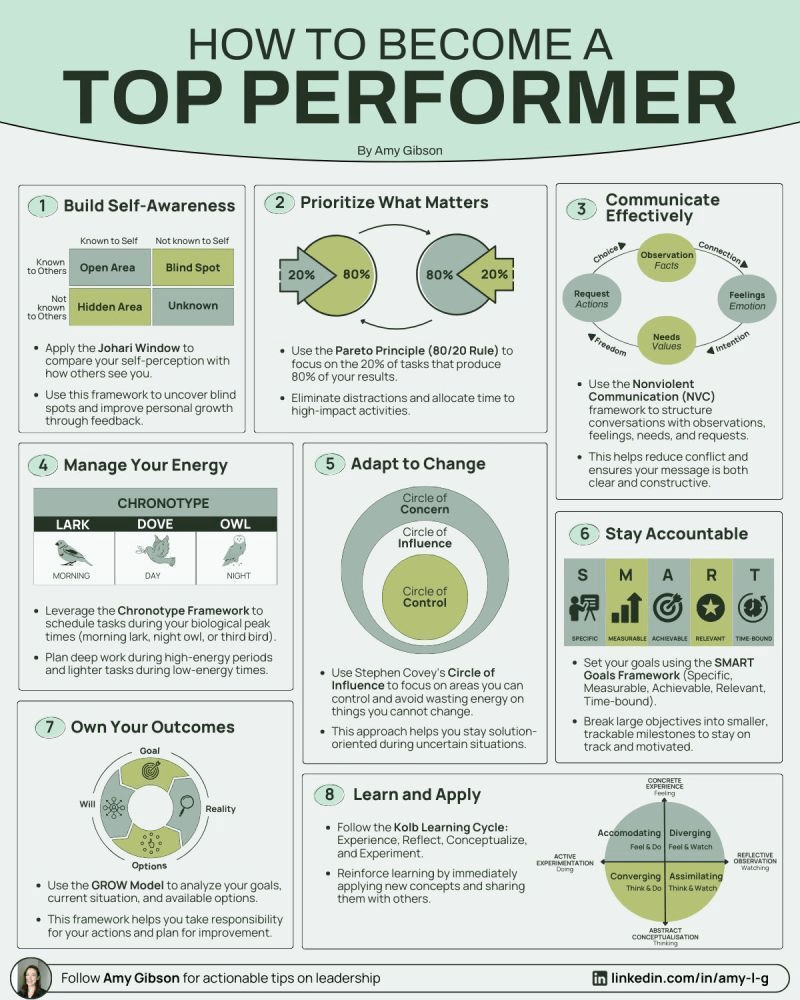
No one is born a top performer.
Talent helps, but these matter more:
Your mindset
Your habits
Your grit
8 rare traits I see top performers master—and how you can, too:
✅ They know themselves deeply
↳ Use feedback to spot blind spots and grow
✅ They focus ruthlessly
↳ Put 80% of your energy into the 20% of actions
that have the most impact.
✅ They communicate with purpose
↳ Master communication to deepen relationships.
✅ They match energy to tasks
↳ Know your peak hours and plan accordingly
✅ They focus on what they can control
↳ Stay solution-focused when things get tough
✅ They set clear, trackable goals
↳ Break big dreams into small daily steps
✅ They own their journey
↳ Take full responsibility for outcomes
✅ They never stop learning
↳ Turn every experience into growth
These aren’t just natural gifts.
They’re skills you can build.
Top performers aren’t perfect.
They’re just committed to getting better.
Every single day.
That’s the real difference.
It’s not about being the best.
It’s about being better than yesterday.
You’ve got this.
Take that first step today.
When Your Soul Whispers, Listen

We live in a world that celebrates hustle, glorifies busy, and too often drowns out the quiet wisdom inside us. But your body, your heart, your intuition—they’re always speaking. The question is: Are you listening?
When your body begs for rest, it’s not weakness—it’s a signal.
When your energy dips after spending time with certain people, it’s not coincidence—it’s information.
When a certain dream keeps nudging at your heart, it’s not random—it’s direction.
So often, we override these signs. We tell ourselves to push through the fatigue, to be polite when we feel drained, to be practical when our soul craves passion. But the truth is, your higher self always knows what’s best for you. It’s miles ahead of your to-do list, your deadlines, and your doubts.
Tuning in isn’t selfish—it’s sacred.
Rest isn’t lazy—it’s necessary.
Protecting your peace isn’t rude—it’s wise.
The life you want begins with honoring what you know deep down. Your body is your compass. Your intuition is your GPS. And your joy? That’s your green light.
So slow down.
Tune in.
Pay attention.
Because the most important guidance you’ll ever receive won’t come from the outside world—it’ll come from within. And when you learn to trust it, everything begins to align.
Your Strategy Needs A Strategy

Your strategy needs a strategy… did you know there are five different approaches to strategy that you can choose from? You should, especially the four non-traditional ones. These are the five approaches to strategy.
Picking the right approach to strategy depends on three dimensions:
Unpredictability: the extent to which it is possible to predict how things will unfold in the next couple of years.
Malleability: the extent to which it is possible to influence the course in which things unfold in the next couple of years.
Harshness: the extent to which keeping your organization going is difficult because of internal and external threats and pressures.
Based on these three dimensions, the Boston Consulting Group (BCG) distinguishes five different strategies:
1. Classical Strategy
Perception of context: Predictable, Unmalleable, Promising
Mantra: Plan
Typical activities: Analyze, plan, forecast, formulate
Key success factor: Accuracy
2. Adaptive Strategy
Perception of context: Unpredictable, Unmalleable, Promising
Mantra: Adapt
Typical activities: Experiment, monitor, iterate, adjust
Key success factor: Flexibility
3. Visionary Strategy
Perception of context: Predictable, Malleable, Promising
Mantra: Build
Typical activities: Envision, convince, build, persist
Key success factor: Power
4. Shaping Strategy
Perception of context: Unpredictable, Malleable, Promising
Mantra: Gather
Typical activities: Collaborate, share, evolve, co-create
Key success factor: Connections
5. Renewal Strategy
Perception of context: Harsh (the rest is no longer relevant)
Mantra: Survive
Typical activities: Scale down, focus, reset, preserve
Key success factor: Resilience
Let this sink in a bit more and have a look at all five.
Then ask yourself the following questions:
– How do you perceive the context you’re in on the three dimensions?
– Which of the five strategies would fit that context?
– What does your current approach to strategy look like and does it fit?
– What do you need to do differently?

