R.E.S.I.L.I.E.N.C.E.

It isn’t something you find. It’s something you build.

When life knocks you down, your ability to rise comes from your habits, mindset, and effort.

Here’s how to build true resilience:

Reflect
↳ Learn from setbacks.

Endure
↳ Keep going despite struggles.

Strengthen
↳ Build mental and physical toughness.

Innovate
↳ Find new ways to overcome obstacles.

Learn
↳ Take lessons from every challenge.

Invest
↳ Prioritize your well-being.

Elevate
↳ Keep pushing yourself to improve.

Navigate
↳ Adapt to change with confidence.

Commit
↳ Stay determined through difficulties.

Energize
↳ Replenish your motivation.

Resilience doesn’t mean avoiding struggle.
It means responding to challenges with confidence, every time.

Which reminder resonates with you most?

Master Delegation

The hardest word for CEOs to say? “No”.

Most CEOs are doing delegation all wrong.
And it’s costing them more than just time.

It’s draining their energy, killing team morale,
and holding back their company’s growth.

Here’s how to master the art of letting go:

1. Identify the Right Tasks
↳ Not everything needs your involvement
↳ Keep strategy and vision for yourself
↳ Let others own the day-to-day wins

2. Choose the Best Person
↳ Assign tasks based on strengths and learning goals
↳ Find hidden talents waiting to shine
↳ Give stretch assignments that excite

3. Set Clear Expectations
↳ Fuzzy expectations create fuzzy results
↳ Clarify the goals and set clear deadlines
↳ Set boundaries that empower, not restrict

4. Trust, but Stay Involved
↳ Be available, not hovering
↳ Trust your people to find their way
↳ Step in only when truly needed

5. Review and Recognize
↳ Make feedback a two-way street
↳ Celebrate progress openly to build trust
↳ Use mistakes as learning experiences

Here’s what most leaders miss:

Great delegation isn’t about giving away tasks.
It’s about growing your next generation of leaders.

Every task you delegate is a seed you plant.
Water it right, and watch your garden grow.

Which task will you let go of first?

Clear Expectations

Confusion isn’t a work problem—

It’s a leadership problem:

When people don’t know what’s expected,
work gets confusing fast.

🚫 Tasks get missed
🚫 Trust starts to break
🚫 People feel frustrated

Studies show half of employees don’t fully know
what their manager expects from them.
[Source: Gallup]

That leads to:

Work done the wrong way
More stress for everyone
Less accountability
Missed deadlines
Confusing goals
More mistakes

But clear expectations change everything.

They make work:

🟢 Faster to complete
🟢 Easier to understand
🟢 Less stressful for everyone

Clarity doesn’t mean you control every step.

It means people know:

What to do if something changes
How progress gets tracked
What success looks like
Who owns each task

The best leaders make expectations clear—

Then trust their teams to do the work.

Because when people know exactly what to do—

They can focus on doing it well.

Business Analysis Frameworks

Most people confuse business strategy with business analysis.

Here’s why that’s a mistake.

Strategy tells you 𝘸𝘩𝘦𝘳𝘦 you’re going.

Analysis tells you 𝘩𝘰𝘸 to actually get there.

If you’re building a business without frameworks like these… You’re flying blind.

Here are 6 essential business analysis tools every operator should know:
—> MOSCOW: Prioritize what 𝘮𝘶𝘴𝘵 get done (and what’s just noise).
—> Use Case Modelling: Clarify how your system or product actually gets used.
—> Gap Analysis: Find the delta between where you are and where you want to be.
—> Design Thinking: Solve real user problems by staying human-centered.
—> C.A.T.W.O.E.: Evaluate solutions from 𝘦𝘷𝘦𝘳𝘺 critical perspective.

These aren’t just theoretical—they help with real-world decisions around features, workflows, and team alignment.

Use this graphic as a cheat sheet to sharpen your thinking, and improve how you solve complex business problems.

12 Habits That Make Everyone Want To Work With You

Want to be everyone’s favorite teammate?

It’s simple. (But not easy):

Just do the obvious things right.

Here are 12 small habits that make a huge difference:

1/ You respond quickly

↳ Set a “24-hour response” rule for all messages

2/ You write clearly

↳ Start every long email with a one-line summary

3/ You keep your promises

↳ Create a “promises tracker” in your notes and review it daily

4/ You admit mistakes

↳ Practice saying “I made a mistake, here’s how I’m fixing it”

5/ You show up prepared

↳ Review the agenda and prepare 2 talking points before every meeting

6/ You finish what you start

↳ Break every project into visible milestones and track progress

7/ You warn about problems early

↳ Send a “heads up” email the moment you spot potential issues

8/ You remember what others tell you

↳ Keep a dedicated “people notes” section in your work journal

9/ You share useful information

↳ Share one useful resource weekly with a relevant teammate

10/ You stay calm under pressure

↳ Practice the 3-breath rule before responding to tense situations

11/ You give clear updates

↳ Send progress updates before being asked

12/ You make time for others

↳ Block 30-minutes of weekly “open office” time for teammates

Small habits, practiced daily, create exceptional careers.

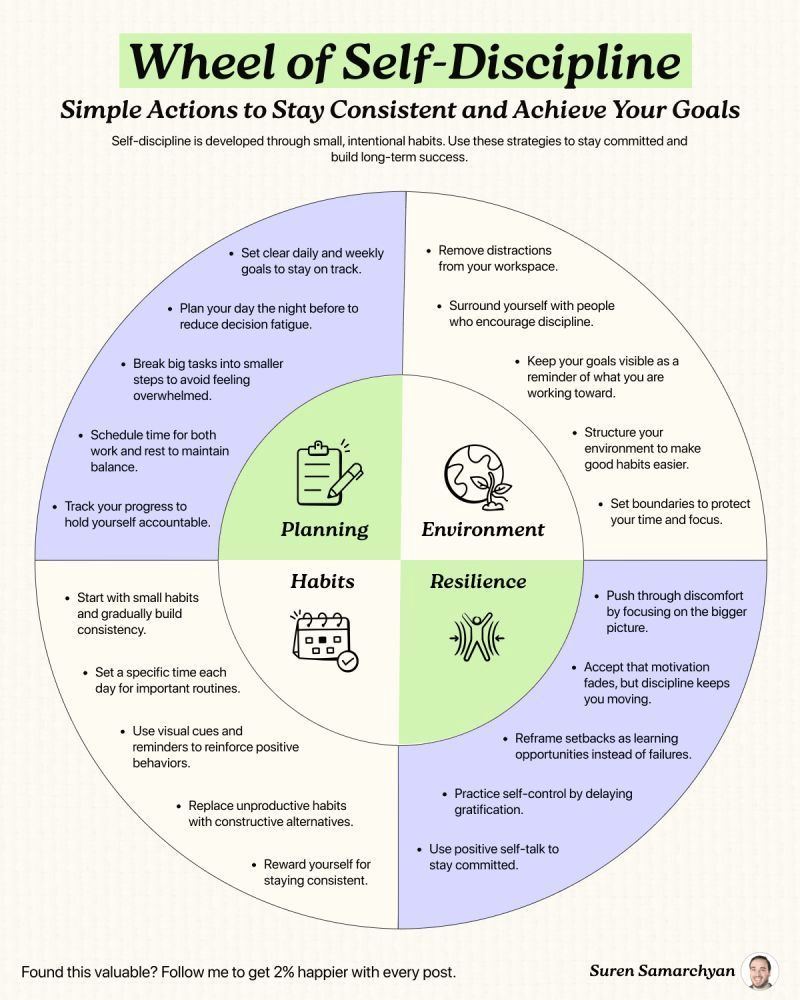
Wheel of Self-Discipline

Discipline isn’t a talent. 

It’s a skill.

And like any skill, it can be built.

The most disciplined people don’t rely on motivation.

They create habits that make success inevitable.

The more distractions you allow, the harder it is to stay on track.

What you prioritize shapes your level of discipline.

There are 4 main pillars of self-discipline:

Planning

↳ Set goals, plan ahead, break down tasks, schedule rest, track progress.

Habits

↳ Start small, set routines, use visual cues, replace badhabits, reward consistency.

Resilience

↳ Think long-term, discipline over motivation, reframe setbacks, delay gratification, stay positive.

Environment

↳ Remove distractions, surround yourself with the right people, keep goals visible, structure your environment, set boundaries.

The fewer excuses you give yourself, the stronger your discipline becomes.

What’s one small change you’ll make today?

8 Signs of People-First Leadership

1️⃣ Empathy

↳ Understands their team’s struggles and challenges.

↳ Responds with care, not just instructions.

2️⃣ Listening

↳ Values every perspective, not just the loudest ones.

↳ Gives full attention—because presence builds trust.

3️⃣ Trust

↳ Creates a safe space where ideas flow freely.

↳ Promotes accountability, not micromanagement.

4️⃣ Clarity

↳ Communicates expectations clearly to prevent confusion.

↳ Ensures every team member knows their role.

5️⃣ Empowerment

↳ Delegates meaningfully—because trust fuels confidence.

↳ Lets the team take ownership of their work.

6️⃣ Recognition

↳ Celebrates contributions, big and small.

↳ Makes people feel valued, not just productive.

7️⃣ Growth

↳ Encourages learning and professional development.

↳ Invests in the team’s long-term success.

8️⃣ Patience

↳ Gives people space to learn and adapt.

↳ Supports thoughtful decisions, not rushed ones.

Because in the end…

Numbers don’t build companies. People do.

When you put your people first:

✅ Teams perform better.

✅ Trust grows stronger.

✅ Success follows naturally.

8 Active Listening Skills Every Leader Should Have

Leader: “So, is that all? Anything else I can help you with?”

Direct Report: “No, that’s all. Thanks.”

Except… that wasn’t all, was it?

There was more.

More that needed to be heard.

This is what most leaders are missing – Active listening.

Active listening is a cornerstone of emotional intelligence.

Coaching demands it.

Effective leadership depends on it.

When clients bring me their problems, they’re rarely sharing the actual issue.

Active listening gets to the nub of it.

Everyone talks about active listening, but what does it actually look like in practice?

Here are 8 active listening skills (and what they sounds like)

1. Be attentive.

“I’m here. Take your time.”

2. Summarise.

“So what I’m hearing is…”

3. Paraphrase.

“It sounds like you’re saying…”

4. Ask open-ended questions.

“What’s your perspective on that?”

5. Ask probing questions.

“What’s the underlying issue here?”

6. Request clarification.

 “Can you help me understand that a bit more?”

7. Holding the space.

The other person thinking.

8. Be attuned to and reflect feelings.

“It seems like this is really frustrating for you?”

This isn’t just for leaders.

Anyone can develop active listening skills, and it will transform your relationships and your career.

When the Clouds Stay, So Do They

There’s a special kind of beauty in those who don’t flinch at the storm.

They don’t rush in to fix you, or preach about silver linings.

They just stay.

Through the gray. Through the silence. Through the rain.

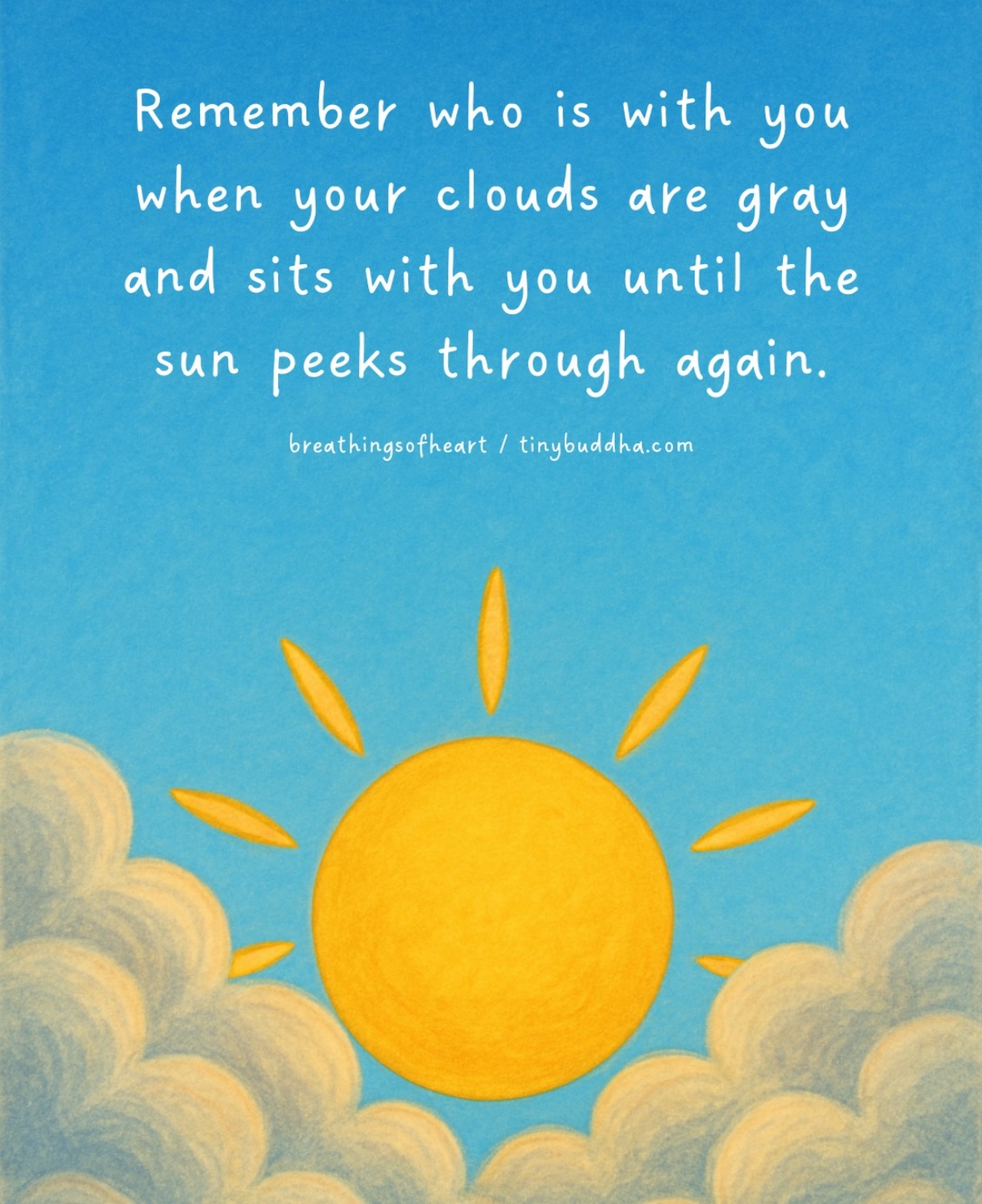
“Remember who is with you when your clouds are gray and sits with you until the sun peeks through again.”

This quote isn’t just poetic—it’s a reminder.

A reminder that real love, real friendship, and real presence don’t always come with noise, grand gestures, or perfectly timed advice. Sometimes, they come in the shape of someone who just… stays. Quietly. Faithfully.


The Gray Days

We all have them.

The days when we’re not okay. When the world feels too loud or too heavy. When the vibrant filter fades and all that’s left are muted skies and tired hearts.

In those moments, we don’t need rescuing—we need remembering.

We need people who remember who we are beneath the cloud cover.

Who hold space for us—not because they have answers, but because they believe the sun will return… and they’re willing to wait with us until it does.


The Art of Showing Up

The illustration behind this quote captures a powerful stillness:

Two figures—one weary, one unwavering.

The storm might be the star of the scene, but the story belongs to the one who stayed.

We live in a world that values fixing, speeding up, or avoiding discomfort altogether. But healing often happens in the stillness. And the presence of someone willing to sit with us there is worth everything.


Be That Person

You don’t need perfect words. You don’t need to solve anyone’s problems.

Just show up.

Be the shoulder, the hand, the quiet space.

Be the kind of soul someone can look back on and say,

“They didn’t try to chase the clouds away… they just held on until the sun found me again.”

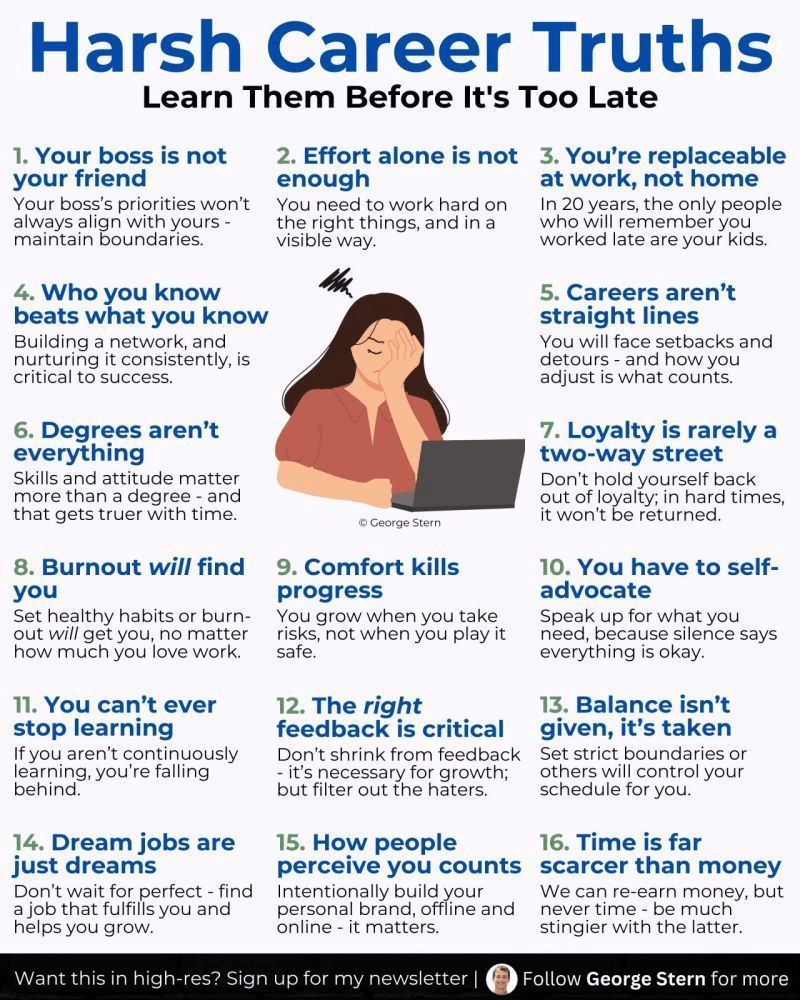
16 harsh career truths

Learn them before it’s too late:

1. Your boss is not your friend

Your boss’s priorities won’t always align with yours – maintain boundaries

2. Effort alone is not enough

You need to work hard on the right things, and in a visible way

3. You’re replaceable at work, not home

In 20 years, the only people who will remember you worked late are your kids

4. Who you know beats what you know

Building a network, and nurturing it consistently, is critical to success

5. Careers aren’t straight lines

You will face setbacks and detours – and how you adjust is what counts

6. Degrees aren’t everything

Skills and attitude matter more than a degree – and that gets truer with time

7. Loyalty is rarely a two-way street

Don’t hold yourself back out of loyalty; in hard times, it won’t be returned

8. Burnout will find you

Set healthy habits or burnout will eventually get you, no matter how much you love work

9. Comfort kills progress

You grow when you take risks, not when you play it safe

10. You have to self-advocate

Speak up for what you need, because silence says everything is okay

11. You can’t ever stop learning

If you aren’t continuously learning, you’re continuously falling behind

12. The right feedback is critical

Don’t shrink from feedback – it’s necessary for growth; but filter out feedback from those you don’t trust or respect

13. Balance isn’t given, it’s taken

Set strict boundaries or others will control your schedule for you

14. Dream jobs are just dreams

Don’t wait for perfect – find a job that fulfills you and helps you grow

15. How people perceive you matters

Intentionally build your personal brand, offline and online – it makes a difference

16. Time is far scarcer than money

We can re-earn money, but never time – be much stingier with the latter

Don’t wait to figure these lessons out the hard way.

Use this sheet to learn from the mistakes of others,

And set yourself up to thrive.