
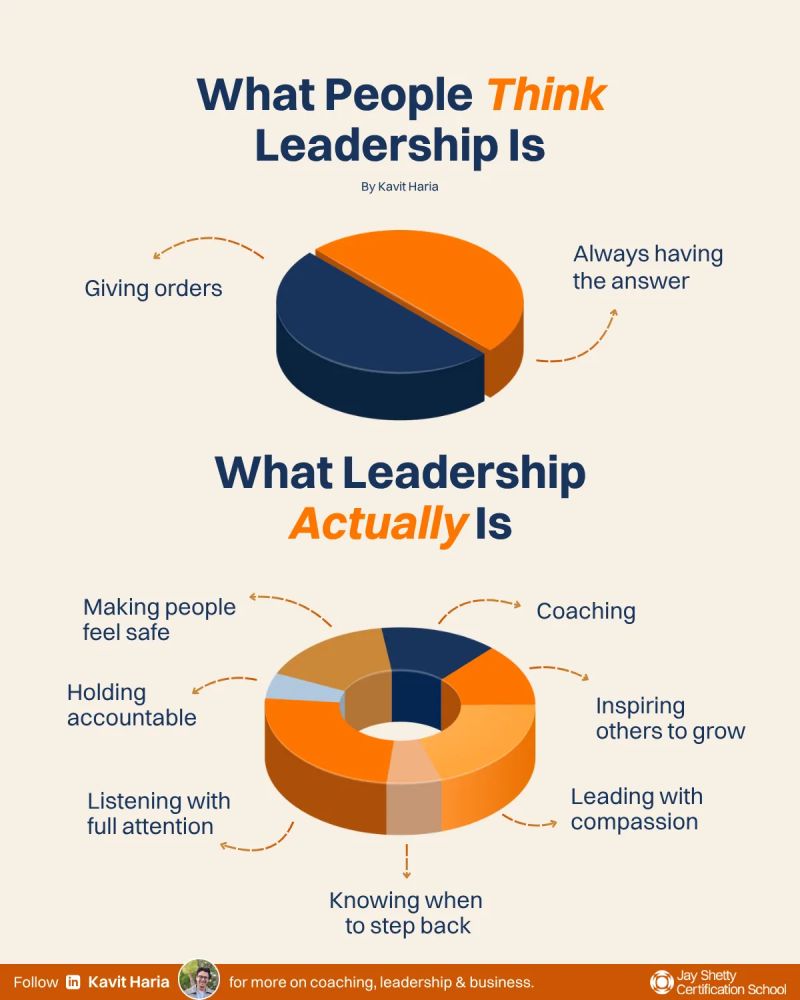
Most people have it backward.
They think leadership is about being in charge.
(It’s not.)
Thinking it’s all about telling others what to do.
Real leadership? It’s about putting others first.
Look at the best leaders you know.
They don’t hog the spotlight.
They shine it on their team.
They don’t have all the answers.
They ask the right questions.
True leadership is:
1/ Coaching, not commanding.
↳ Guide your team to find their own solutions.
2/ Celebrating others’ wins.
↳ Their success is your success.
3/ Listening with full attention.
↳ Really hearing what’s not being said.
4/ Creating psychological safety.
↳ Where mistakes become lessons, not failures.
5/ Leading with compassion.
↳ Understanding that everyone’s fighting a battle.
6/ Knowing when to step back.
↳ Letting your team own their victories.
The irony?
When you stop trying to be the hero,
you become the leader everyone needs.
Because great leaders don’t create followers.
They create more leaders.
Your title might make you a boss.
But your actions make you a leader.
Choose wisely.
Be Thankful for Closed Doors, Detours, and Roadblocks

We often think of success as a straight line—a clear, uninterrupted path from Point A to Point B. But life rarely plays out that way. Sometimes, just when things feel like they’re falling into place, a door slams shut. A job offer disappears. A relationship ends. A plan derails. And in that moment, it’s easy to feel defeated. Lost. Confused.
But here’s a truth that time and perspective often reveal:
Those closed doors, unexpected detours, and frustrating roadblocks are not setbacks. They’re protection.
Roadblocks: Life’s Gentle (and Sometimes Loud) Redirections
Have you ever looked back on something you once desperately wanted and thought, “Thank God that didn’t work out”?
Maybe it was a job that looked great on paper but would have drained your joy.
Maybe it was a person you thought you’d grow with who was actually holding you back.
Maybe it was a plan that felt certain, but had no real alignment with who you were becoming.
What felt like rejection or delay in the moment turned out to be a blessing. Life, in its own mysterious way, redirected you to something better suited to your purpose.
Detours: Growth in Disguise
Detours are the scenic routes of life. They may take longer, seem inefficient, or feel confusing—but they often teach us the most. In the detour, you pick up lessons, meet people, build resilience, and gain clarity you’d never find on the “main road.”
Detours shape you.
They humble you.
They remind you that while you don’t always control the path, you can control your pace, your attitude, and your trust in the journey.
Closed Doors: Silent Guardians of Destiny
We don’t always recognize protection when it arrives. A closed door might feel like failure, but sometimes it’s life keeping you from harm. From settling. From stagnating. From wasting time in places never meant to hold your potential.
Every “no” is a hidden “yes” to something greater—something that aligns with who you are and who you’re meant to become.
So Be Thankful
Be thankful for the relationship that ended—it created space for one rooted in real love.
Be thankful for the job you didn’t get—it freed you to find work that lights you up.
Be thankful for the detour—it showed you a strength you didn’t know you had.
Every closed door isn’t the end of your story. It’s the universe whispering,
“This isn’t your door. Keep walking. Your place is ahead.”
When life reroutes you, don’t lose heart.
The delays aren’t denials.
The roadblocks aren’t punishments.
They are protections.
And one day, you’ll look back and say with gratitude,
“I didn’t see it then… but that was the best thing that never happened to me.”
The Kubler Ross Change Curve

Managing change isn’t easy; a lot fails.
But it can be done; here’s how ⬇️
Handling change effectively requires
understanding and action.
But what’s the method?
There are many change models you can use
and I’m going to cover some of the most
popular in the weeks ahead in a new series.
Today ➡️ The Kübler-Ross Change Curve
This shows you the emotional journey teams
go through during change.
From shock to acceptance.
Understanding this helps you lead with
empathy and action.
Here’s how to support your team through
each stage:
✅ Acknowledge the Shock
↳ Be transparent, answer questions – Hold meetings.
↳ Normalise emotions – Reassure feeling overwhelmed is normal.
↳ Provide context – Explain the reason for the change.
↳ Give time to process – Allow space to absorb the news.
✅ Address Denial
↳ Communicate often – Regularly share updates.
↳ Be consistent – Keep messages clear and steady.
↳ Highlight urgency – Explain why the change is important.
↳ Share real stories – Give examples of similar successes.
✅ Manage Frustration
↳ Listen, offer solutions – Set up feedback sessions.
↳ Create feedback loops – Provide a space for input.
↳ Break it down – Simplify the steps to change.
↳ Acknowledge struggles – Show empathy and understanding.
✅ Support Depression
↳ Check in, offer support – Arrange one-on-ones.
↳ Celebrate small wins – Recognise even small progress.
↳ Offer flexibility – Allow flexible timelines or tasks.
↳ Assign buddies – Pair with supportive colleagues.
✅ Encourage Experimentation
↳ Give room to adapt – Encourage trying new ideas.
↳ Create a safe space – Allow room for mistakes.
↳ Provide resources – Offer tools or training.
↳ Promote teamwork – Encourage team collaboration.
✅ Enable Decisions
↳ Empower ownership – Let them take charge.
↳ Involve early – Ask for input from the start.
↳ Delegate tasks – Give them responsibility.
↳ Recognise leaders – Celebrate those stepping up.
Each stage is crucial for navigating change.
These steps help manage change smoothly,
turning challenges into opportunities.
By understanding these stages, you can
not only cope with change; but thrive through it.
8 Wake Up Calls for Leaders

It might be time to change your leadership style:
As a leader, you won’t be perfect.
But you can learn from your experiences.
Leadership is a work in progress.
It’s important to see when you
could do things differently or better.
How do you know when to change your leadership style?
Pay attention to what’s happening around you.
There are always signs:
❗No one speaks up.
❗Your employees quit.
❗Projects keep getting delayed.
❗There aren’t any new creative ideas.
❗Your team seems unhappy and unmotivated.
❗Feedback is ignored or avoided.
❗You over-control every detail.
❗Your team is burned out.
Seeing these signs is the first step to change.
Don’t take it personally.
See it as an opportunity to grow
both as a leader and a person.
Leadership is about evolution.
Embrace the Surfer’s Mentality

There’s something deeply poetic about the way surfers approach the ocean. They don’t control the waves—they ride them. They don’t resist the tides—they move with them. And that’s a mindset we all could use a little more of.
“Embrace the surfer’s mentality. Life comes in waves.”
What a beautiful reminder that life, like the sea, is ever-changing. Some days, everything flows effortlessly—doors open, conversations click, success feels just within reach. And other days… you’re just waiting. Watching. Wondering when the next wave will come.
The Highs: Catching the Wave
Those high moments in life are exhilarating. A promotion, a breakthrough, the joy of connection, the clarity of purpose. Surfers don’t waste these waves—they ride them with everything they’ve got. They stay present, focused, and grateful for the moment.
So when your wave comes—ride it fully. Be present in your joy, your wins, your growth. Celebrate the momentum. But remember, even this will pass, and that’s not something to fear—just something to know.
The Lulls: Waiting with Patience
And then, there are the lulls. The quiet, still moments when nothing seems to be happening. Surfers know this is part of the rhythm. They sit on their boards, scan the horizon, and wait. Not with frustration, but with patience. With faith. Because they know: another wave will come.
In life, those lulls can feel like setbacks, stagnation, or uncertainty. But they are also opportunities—to rest, reflect, grow stronger, and prepare. The waiting is part of the ride.
The Wipeouts: Learning and Letting Go
Every surfer falls. They misread a wave or get caught in the undertow. But they don’t quit. They resurface, paddle back, and try again. Life will knock us down too. Failures, disappointments, grief, loss—they’re part of the ocean we navigate.
The surfer’s mentality isn’t just about optimism. It’s about resilience. It’s about trust—that even if you fall, you can rise again. Even if you miss a wave, another is always coming.
So embrace the surfer’s mindset:
- Flow with change instead of resisting it
- Celebrate the highs, but don’t cling to them
- Be patient in the quiet, knowing it’s not the end
- Stay resilient through the wipeouts
- And above all, keep paddling—because life, like the ocean, always brings another wave.
The ride isn’t always easy, but it’s always worth it.
So sit on your board, take a deep breath, and get ready.
Your next wave is already on the way.
9 Phrases that Undermine your Authority and Credibility

Your words shape how others see you.
Stop using these 9 phrases ⬇️
Some common phrases weaken your authority without you even realising it.
Here are 9 phrases to stop saying if you want to sound more confident:
1. “I think this might work.”
Sounds uncertain. Instead, say: “I’m confident this approach will work because…”
2. “Sorry to bother you, but…”
Unnecessarily apologetic. Instead, say: “I need a moment of your time to discuss…”
3. “I’m not an expert, but…”
Reduces credibility before you even start. Instead, say: “I’ve looked into this carefully, and here’s my take.”
4. “I’ll try to get it done.”
Sounds noncommittal. Instead, say: “I will have it done by [specific time].”
5. “Does that make sense?”
Suggests doubt in your own explanation. Instead, say: “Let me know if you have any questions.”
6. “I just wanted to check in.”
Makes you sound hesitant. Instead, say: “I’d like an update on this.”
7. “I may be wrong, but…”
Undermines your point before you make it. Instead, say: “Based on my research, here’s my perspective.”
8. “This might be a dumb idea, but…”
Self-sabotaging. Instead, say: “I have an idea worth considering.”
9. “No problem.”
Downplays your effort. Instead, say: “My pleasure” or “Happy to help.”
🧠 Remember: The way you frame your words can
make the difference between sounding hesitant and owning the room.
Why Integrity Matters

90% of our success in life comes from 3 core beliefs…
It’s the small choices when no one’s watching.
👇
➠ Integrity With Ourselves
➠ Integrity With Those Closet To Us
➠ Integrity With Those We Are Just Meeting
Integrity isn’t just something we say.
It matters more than you know.
It’s the bedrock of real connection and continued success.
How?
By acting with integrity in every action.
It’s not complicated.
➠ Integrity We Stand Behind
Hold fast to your values, especially when no one is looking. Your consistency builds respect & trust.
➠ Integrity With Those Closest to Us
Build transparent and honest relationships. These connections are the drivers of your personal and professional life.
➠ Integrity With Strangers
Treat everyone with respect, equality and most importantly kindness. You never know when a current “stranger” will become a major part of your path forward.
Yes, integrity shapes who you are and how you’re seen.
But also…
It propels you towards meaningful success and fulfillment.
• Live for integrity.
• Embrace your true self.
• Ear trust.
• Motivate others with your choices.
The Real Problem Isn’t the Problem
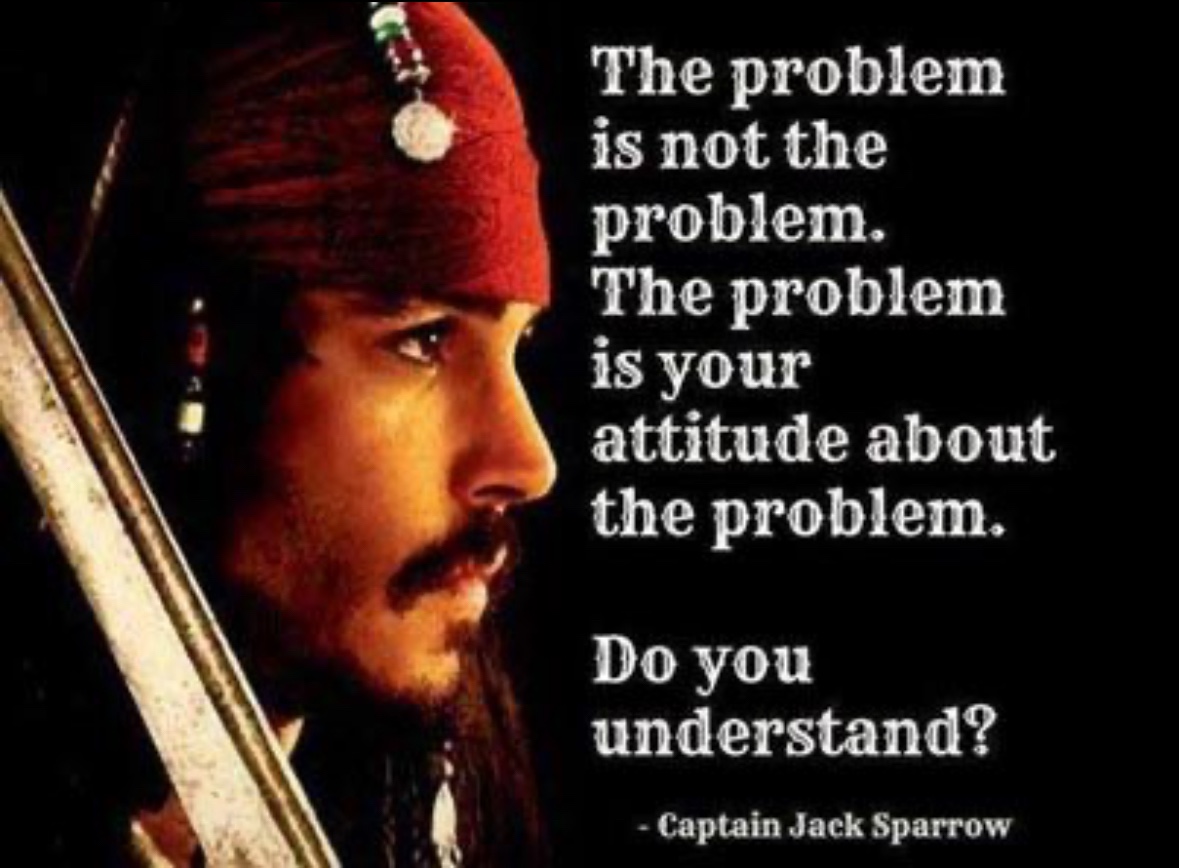
We’ve all faced a situation where something goes wrong—a project delays, a goal feels out of reach, a relationship hits a rough patch. Instinctively, we look outward: what went wrong? But what if we paused and looked inward?
This quote above flips the script on how we deal with challenges. It says, in essence:
The obstacle isn’t what derails us. Our response to it is.
A Tale of Two Reactions
Imagine two people face the same setback:
A startup founder’s product launch fails to meet expectations.
Founder A spirals into frustration, blames the market, and begins doubting their capability. Founder B sees it as a data point, recalibrates their approach, and adapts the marketing strategy.
Same problem. Two outcomes. The difference? Not intelligence. Not funding. Just mindset.
Why Attitude Matters More Than We Think
Your attitude shapes:
Your energy: A negative mindset drains you. A positive one fuels action. Your perspective: Challenges become dead ends or detours, depending on how you see them. Your growth: The right attitude turns every problem into a lesson.
Turning Attitude into Action
Next time you face a problem, try this:
Pause: Before reacting, breathe. Give yourself space to respond instead of react. Reframe: Ask, “What can I learn from this?” or “How could this actually be working for me?” Act with intention: Move forward with a growth mindset, not a victim mindset.
We can’t control every storm that comes our way. But we can control how we sail through it.
Because often, it’s not the wind that holds us back—it’s how we set our sails.
So the next time life throws you a curveball, don’t just ask what the problem is.
Ask: What’s my attitude about it?
That’s where the real power lies!
10 Smart Responses to Difficult People
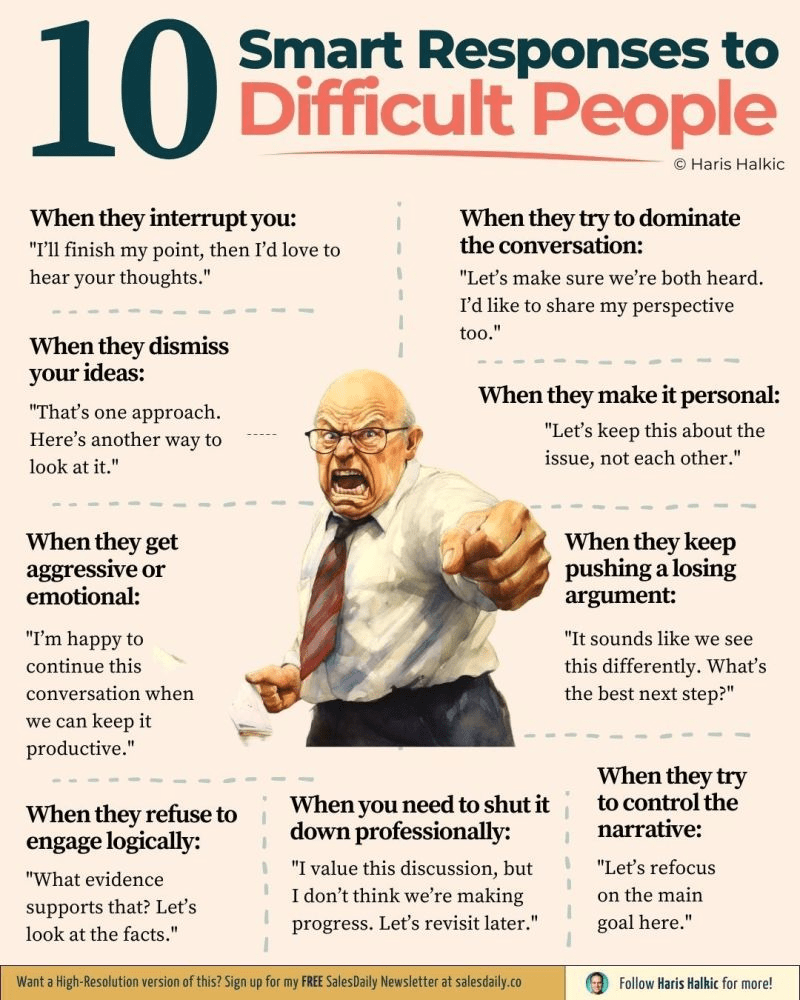
Handle difficult people like a pro
Difficult people are everywhere.
But your response determines the outcome.
It’s not about proving them wrong—
It’s about staying in control and leading the conversation.
Here’s what NOT to do when dealing with difficult people:
🚫 Letting interruptions throw you off
🚫 Reacting emotionally to aggressive behavior
🚫 Engaging in endless, unproductive arguments
🚫 Taking personal attacks to heart
🚫 Allowing others to dominate conversations
🚫 Ignoring logic in heated discussions
Instead, take charge of the conversation with these smart responses:
✅ Stay calm and assertive when interrupted
✅ Reframe dismissed ideas with alternative perspectives
✅ Set boundaries when discussions become unproductive
✅ Keep the focus on facts, not emotions
✅ Acknowledge disagreements and move toward solutions
✅ Redirect conversations when someone tries to control the narrative
You can’t control difficult people—
But you CAN control how you respond.
Mastering these skills will help you in negotiations, leadership, and everyday interactions.
The Sugarcane Test
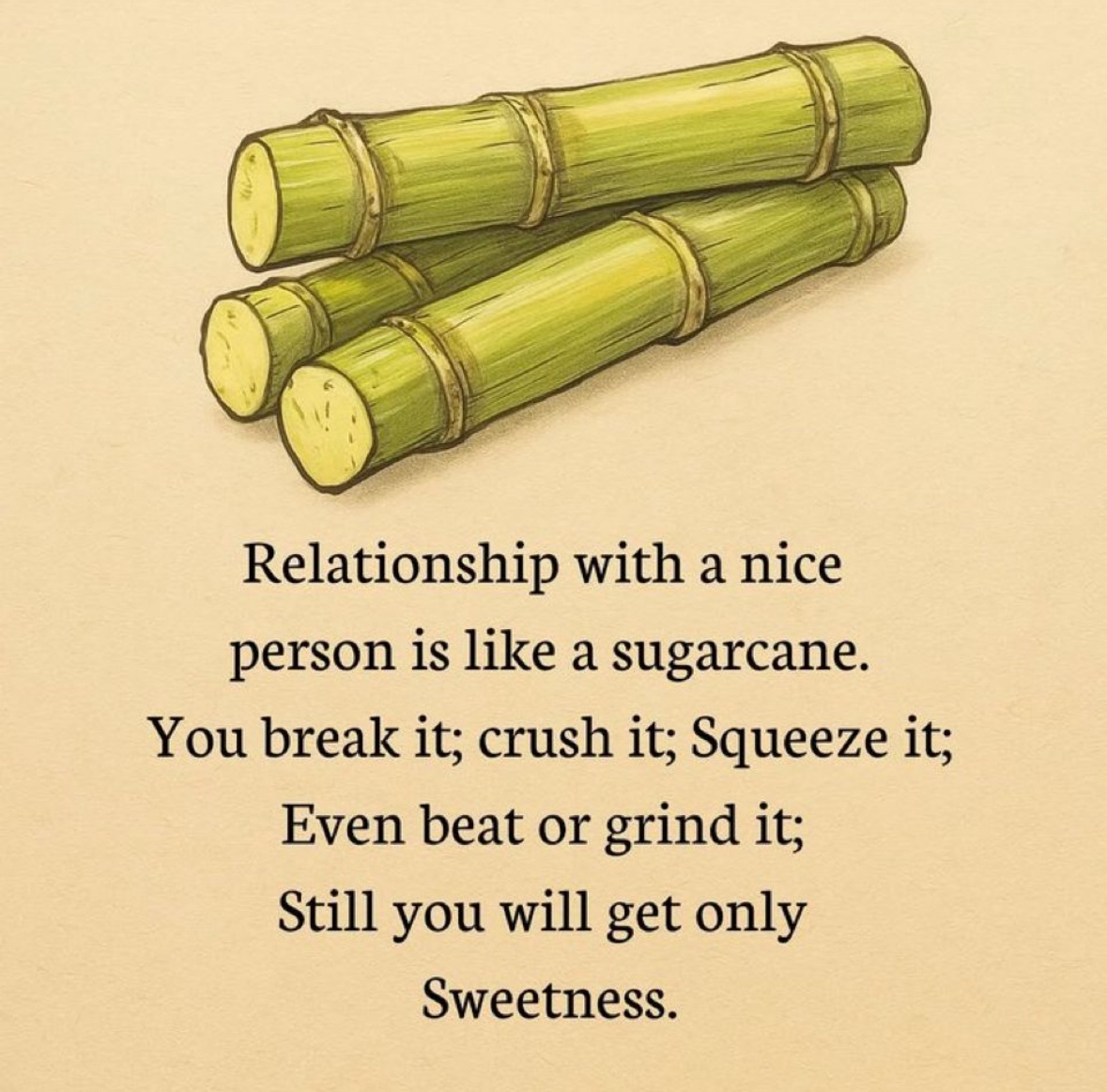
There’s something incredibly powerful about people who remain kind no matter what life throws at them. People who don’t let the bitterness of the world seep into their soul. People who, even when wronged, hurt, or misunderstood, respond not with anger—but with grace.
They’re like sugarcane.
Think about it. You can twist it, press it, grind it down. Yet, the only thing that comes out is sweetness. Not because it’s pretending, but because that’s what it’s made of.
We all know someone like that. Someone who radiates kindness and patience, even in tough situations. Who doesn’t lash out when they’re tested. Who continues to give love, even after being let down. Not out of weakness, but from a deep well of strength and character.
These are the people you want in your life—and the kind of person we should all aspire to be.
Because the true test of character isn’t how we act when things are easy. It’s how we respond when we’re broken, pressured, or disappointed.
Do we become bitter? Or do we become better?
Being “Sweet” Doesn’t Mean Being a Pushover
Let’s be clear: being sweet like sugarcane doesn’t mean letting others walk over you. It doesn’t mean suppressing your voice or pretending you’re okay when you’re not.
What it does mean is responding with maturity, choosing kindness over cruelty, and holding on to your values—even when tested. It means knowing how to set boundaries without becoming cold or harsh. It means not allowing someone else’s behavior to rob you of your true nature.
Why Relationships with Truly Nice People Are a Gift
When you’re in a relationship—be it friendship, family, or love—with someone who is sugarcane-sweet, you feel safe. You know they won’t turn on you at the first sign of disagreement. You can trust their intentions. You can be your authentic self without fear of judgment or retaliation.
And more often than not, their presence makes you want to be a better person too.
In a world that often celebrates sharpness, sass, and savagery, let’s not forget the quiet power of sweetness.
Being nice isn’t outdated. It’s courageous.
And those who stay sweet—even when broken—aren’t fragile. They’re rare, resilient, and radiant.
So if you know a sugarcane-souled person in your life, thank them. Cherish them. Learn from them.
And if you’re striving to be one—keep going. The world needs more of you!
 Kenrick Vaz