
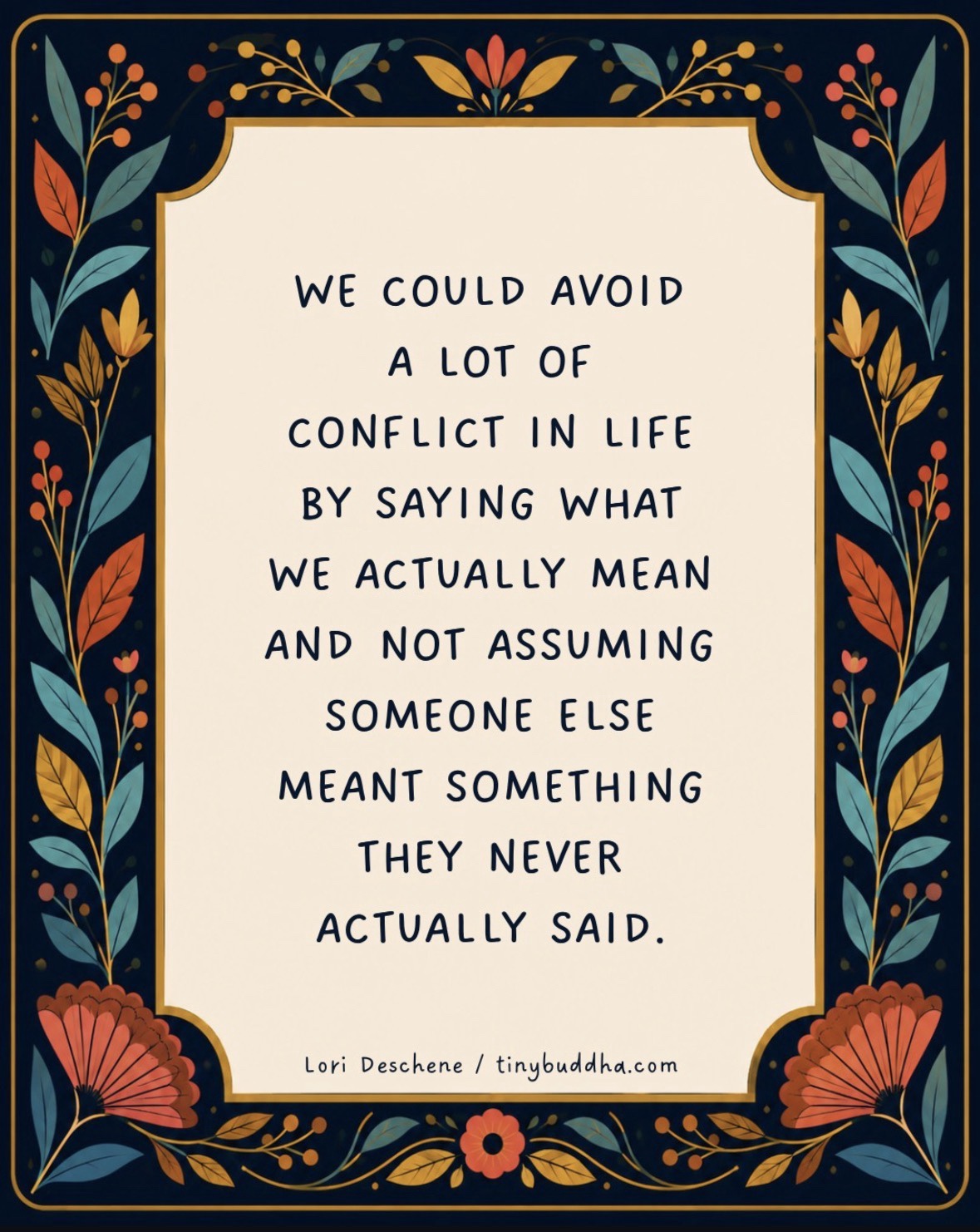
Most fights don’t begin with words. They begin with the story we attach to those words.
Someone replies with a short text. We decide they’re upset.
A coworker walks past without saying hello. We assume they’re ignoring us.
A friend cancels dinner. We convince ourselves we’ve become less important.
None of those things are facts. They’re interpretations that quietly become reality in our minds.
Our brains are wired to fill in missing pieces. We don’t like uncertainty, so we create explanations. The problem is that we’re often wrong.
Think about the last disagreement you had. How much of it was about what was actually said? How much was about what each person believed the other meant?
“I guess you’re busy.”
One person hears a casual comment. The other hears sarcasm.
“We should talk.”
One person means, “Let’s catch up this week.” The other spends the next six hours wondering if they’re about to lose their job.
The words stay the same. The meaning changes because we supply the missing context ourselves.
It happens in families all the time.
A parent says, “You should save your money.”
The child hears, “You don’t trust me.”
A spouse says, “Can you help with dinner?”
The other hears, “You never do enough around here.”
Neither message was spoken. Both were received.
The same thing happens at work.
A manager asks for revisions on a presentation. An employee hears criticism instead of coaching.
A leader says, “Let’s revisit this idea next quarter.” The team assumes the project is dead.
Soon people start reacting to assumptions instead of conversations. Trust slips away one misunderstanding at a time.
The strange part is how confident we become in our assumptions. We rarely stop and ask, “Did they actually say that?”
Most of the time, they didn’t.
A simple question could prevent hours of frustration.
“When you said that, what did you mean?”
“I want to make sure I understood you.”
“Can you explain that a little more?”
Those questions feel awkward for a few seconds. Cleaning up a misunderstanding weeks later is much harder.
There’s another side to this.
We often expect people to understand what we never clearly express.
We drop hints.
We hope they’ll notice we’re upset.
We expect them to read our silence, our expressions, or the change in our tone.
Then we’re disappointed when they don’t.
People can’t respond to messages that were never sent.
If you need help, ask.
If you’re hurt, say it.
If you’re grateful, don’t assume they already know.
If something bothered you, explain what happened instead of expecting someone else to connect dots they can’t see.
Clear communication isn’t about saying more. It’s about leaving less room for imagination.
There’s a reason good relationships survive difficult conversations. The people in them don’t pretend to read minds. They ask questions. They clarify. They give each other the benefit of the doubt before jumping to conclusions.
That takes humility because it means admitting your first interpretation might be wrong.
That small pause changes conversations.
Instead of saying, “I know what you meant,” you ask.
Instead of thinking, “They don’t care,” you check.
Instead of defending yourself against something that was never intended, you give the other person a chance to explain.
Many of the arguments that drain our energy were never about facts. They were about assumptions dressed up as certainty.
The next time a conversation starts to feel tense, separate what was actually said from what your mind added afterward. The difference between those two things is often where peace has been waiting all along.

