
Your calendar’s full.
But nothing moves forward.
That’s not a productivity issue.
That’s a meeting issue.
Look, meetings are supposed to create alignment.
Most just create inertia.
Here’s what I’ve seen from teams that actually win:
Good meetings feel sharp.
Bad ones feel like déjà vu.
So how do you run the first kind?
Try this:
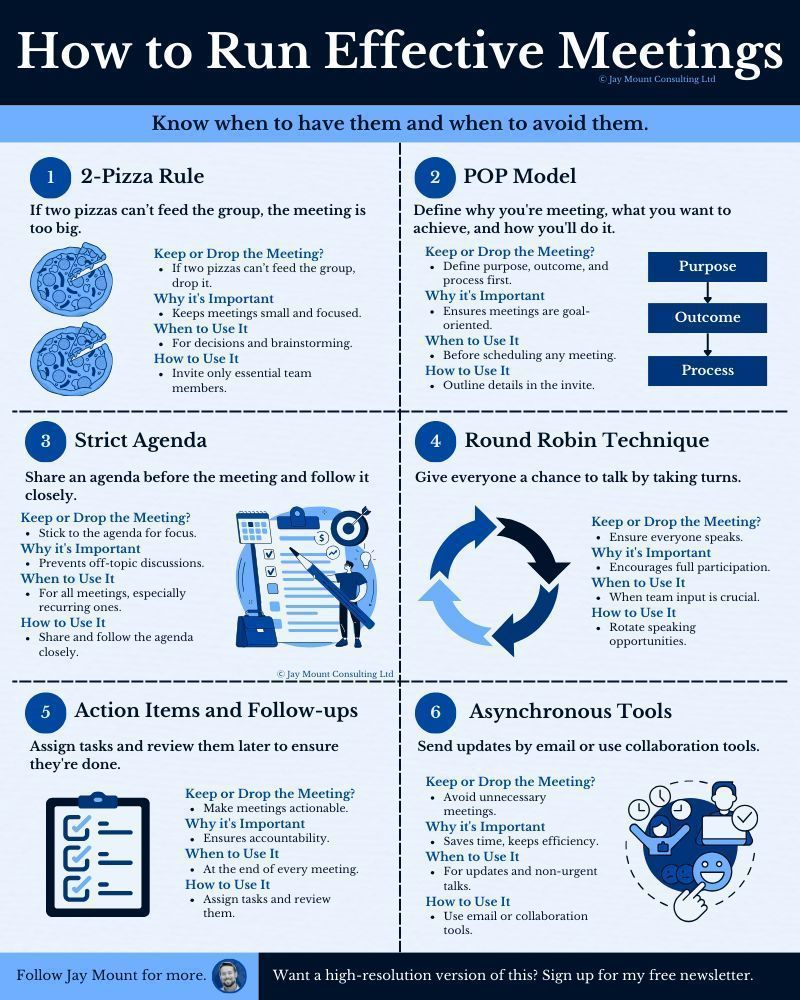
1. 2-Pizza Rule > If two pizzas can’t feed the room, it’s too big.
2. POP > Purpose. Outcome. Process. No POP? Cancel it.
3. Strict Agenda > Send it. Follow it. End it.
4. Round Robin > Everyone speaks. No passengers.
5. Follow-Ups > If nobody owns next steps, it never happened.
6. Async First > Status updates = email, not Zoom.
These aren’t hacks.
They’re culture.
Because the point isn’t more meetings.
It’s momentum.
Save this before your next team sync.
And tell me, what’s the meeting habit your team refuses to drop?
Say It Right
The hardest fight isn’t with them—
It’s with you:
The real conflict isn’t between people—
it’s between emotions.
Most conversations go sideways
before the truth ever gets said.
Not because you’re wrong.
Not because they’re difficult.
But because emotion takes the wheel
and clarity gets lost.
You don’t need perfect words.
You need a simple way forward.
Calm spreads fast, but only
when you carry it first.
Here’s how to lead with calm, not chaos:
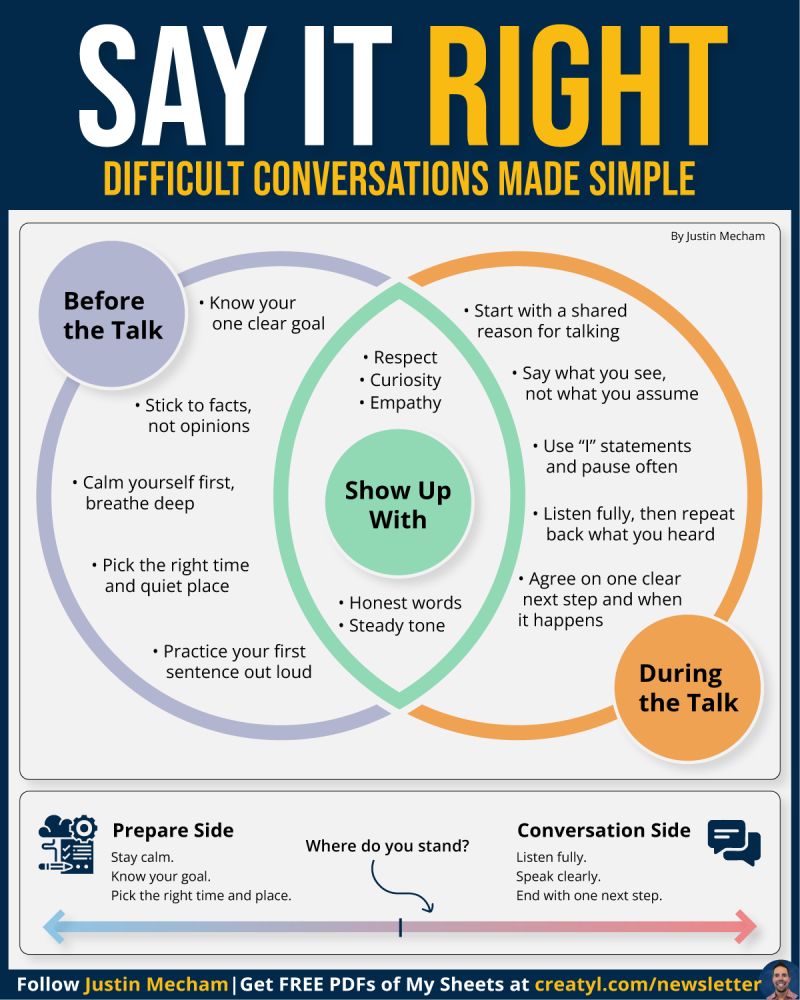
🟣 Repeat what they said back
🟢 Breathe and slow down
🟠 Pick one clear goal
🟣 Use “I” statements
🟢 Agree on one next step
🟠 Stick to facts, not opinions
🟣 Start with one shared reason
Hard talks aren’t solved by talking louder—
They’re solved by thinking clearer.
The people who stay calm
aren’t avoiding conflict—
They’ve trained for it.
They choose clarity over control.
Curiosity over defense.
One step over ten.
Use my sheet to feel ready, not reactive.
Because the next hard conversation
might be tomorrow.
And the way you show up
will shape everything after.
How to Manage Stress
Stress isn’t the enemy
Your reaction is
Most people treat stress like a problem.
But stress is a pattern, and patterns can be rewired.
Here’s what works for me:
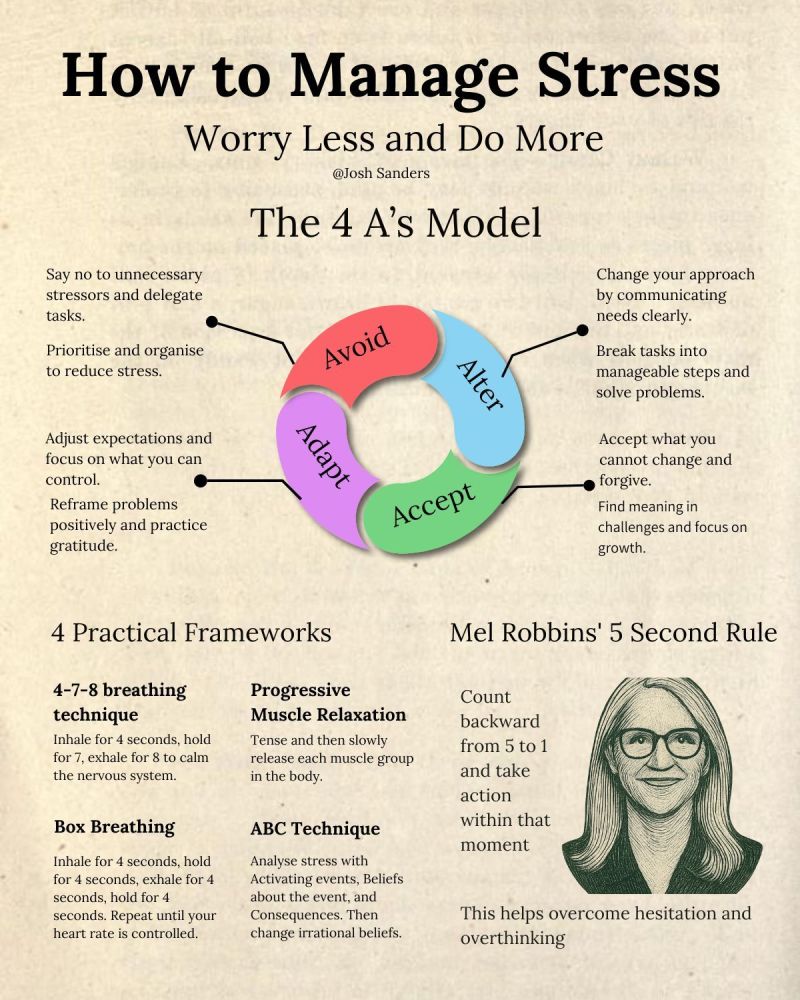
1/ The 5 Second Rule by Mel Robbins
↳ Count 5-4-3-2-1, then move, this really helps stop overthinking before it spirals
Here are 3 more powerful tools to try:
2/ 4-7-8 breathing
↳ Inhale for 4, hold for 7, exhale for 8, relaxes your nervous system
3/ ABC Technique
↳ Break the stress cycle: Activating Event, Belief, Consequence
4/ Progressive muscle relaxation
↳ Calm your body first, your mind follows
A Quiet Dream Is Still a Dream
We’ve been taught, loudly and repeatedly, that a good life starts with a big dream. The kind you can pitch in an elevator. The kind that looks impressive on a stage or fits neatly into a LinkedIn headline. Build something massive. Become someone unforgettable. Leave a mark so large it can’t be ignored.
And when you don’t have that kind of dream—when nothing in you is burning to conquer, disrupt, or scale—it can feel like you’re falling behind. Like everyone else got a map and you somehow missed the handout.
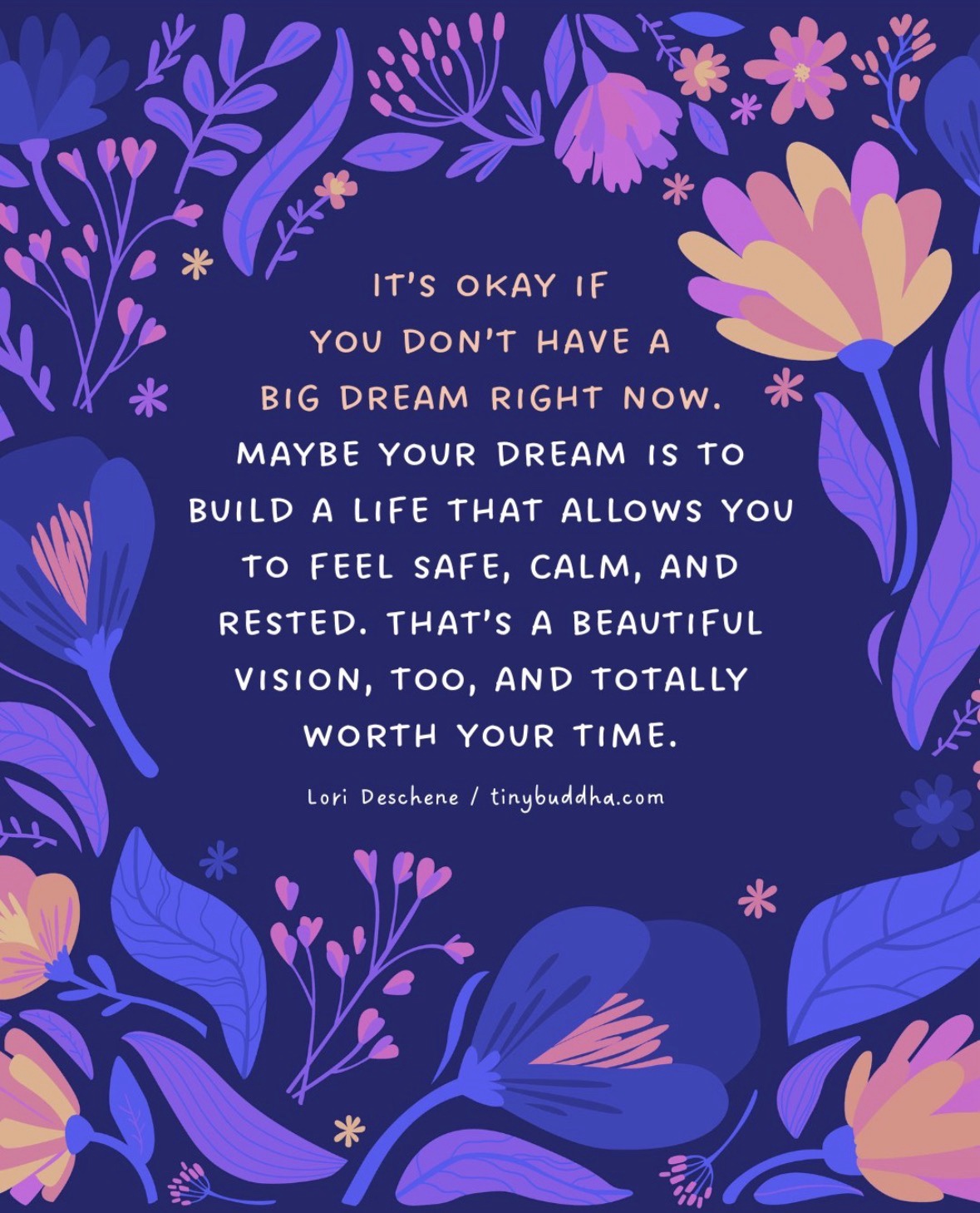
But here’s the truth we don’t say often enough: it’s okay if you don’t have a big dream right now.
Maybe your dream is smaller. Or quieter. Or harder to explain in a single sentence. Maybe your dream is to wake up without dread sitting heavy in your chest. Maybe it’s to have evenings that don’t feel rushed, weekends that don’t feel like recovery zones, or a nervous system that finally gets to unclench.
Maybe your dream is to feel safe. Calm. Rested.
That’s not a placeholder dream. That’s not you giving up. That’s you responding honestly to where you are.
A lot of people carry exhaustion like it’s a personal failure, when in reality it’s a perfectly reasonable response to years of constant pressure. Pressure to perform. To keep up. To be “on.” To turn every hobby into a side hustle and every quiet moment into an opportunity for optimization. Somewhere along the way, rest became something you had to earn, and calm became a luxury instead of a baseline.
So if your ambition right now is to build a life that feels steady instead of spectacular, that doesn’t mean you lack drive. It means you’re paying attention.
There’s a deep kind of wisdom in wanting a life that fits you, instead of forcing yourself to fit a life that looks good from the outside. Wanting predictability. Wanting room to breathe. Wanting mornings that don’t start in panic mode and nights where sleep comes easily, without your mind replaying the day on a loop.
Those desires aren’t small. They’re foundational.
And here’s the part we often miss: big dreams don’t disappear when you choose calm. They tend to grow from it. Creativity comes back when you’re not constantly depleted. Clarity shows up when you’re not always in survival mode. Even ambition, the healthy kind, has a way of resurfacing once you feel safe enough to imagine again.
But even if it doesn’t— even if your life stays beautifully ordinary— that’s still a life well lived.
There is nothing wrong with wanting a home that feels like a refuge. Work that doesn’t hollow you out. Relationships where you don’t have to perform. Days that have a rhythm instead of a constant sense of urgency. These aren’t “low standards.” They’re human standards.
If you’re in a season where your only goal is to get through the day with a little more ease than yesterday, you’re not behind. You’re rebuilding. And rebuilding doesn’t look dramatic while it’s happening. It looks like boundaries. Like saying no more often. Like choosing sleep over scrolling. Like letting go of timelines that were never really yours.
So if you’re waiting for a grand vision to arrive before you give yourself permission to feel okay about where you are, you don’t have to wait.
A life that allows you to feel safe, calm, and rested is not a consolation prize. It’s a beautiful vision. One that’s worth your time. One that’s worth protecting. And in a world that constantly asks you to want more, choosing peace can be one of the bravest dreams of all.
Tough Conversations
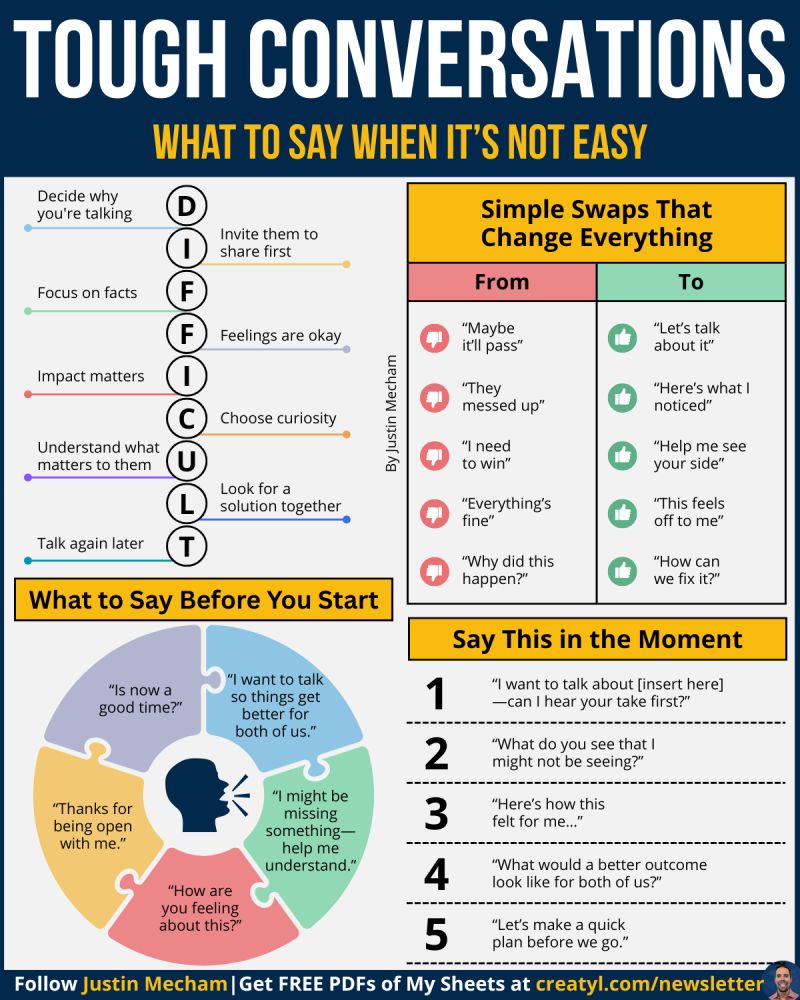
You can say the hard thing—
Without making it harder:
Most people walk into hard conversations
without a plan—
So they either explode…
or say nothing at all.
Both make things worse.
But it doesn’t have to be that way.
There’s a better way to speak up—
without guilt, confusion, or fear.
Use this simple path to start the
conversation, stay calm, and
actually fix what matters:
🔹 D — Decide what matters
🔸 I — Invite them to share first
🔹 F — Focus on facts
🔸 F — Feelings are valid
🔹 I — Impact matters
🔸 C — Choose curiosity
🔹 U — Understand their view
🔸 L — Look for a path forward
🔹 T — Talk again if needed
It’s a map for hard moments.
Now you’ll know what to
say when it matters most:
☑️ “Can I hear your take first?”
☑️ “Help me see your side.”
☑️ “Let’s fix this together.”
Because one clear, kind conversation
can save a project, a person, or a team.
And the earlier you say it—
The easier it becomes next time.
How to Say No
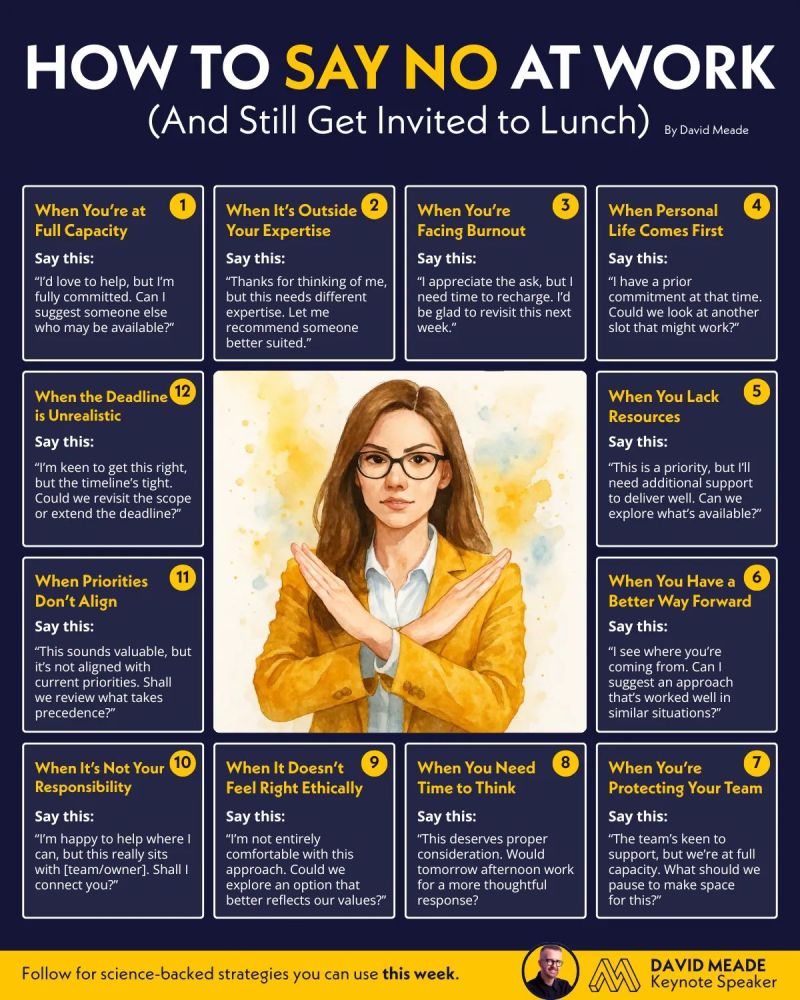
Saying yes to everything is a fast track to burnout.
Saying no (the right way) is how high performers stay:
— Respected
— Focused
— In control
Here are 12 ways to say no
(while still being sort of lovely):
1. When You’re at Full Capacity
“I’d love to help, but I’m fully committed. Can I suggest someone who may be available?”
2. When It’s Outside Your Expertise
“Thanks for thinking of me, but this needs different expertise. Let me recommend someone better suited.”
3. When You’re Facing Burnout
“I appreciate the ask, but I need time to recharge. I’d be glad to revisit this next week.”
4. When Personal Life Comes First
“I have a prior commitment at that time. Could we look at another slot that might work?”
5. When You Lack Resources
“This is a priority, but I’ll need support to deliver it properly. Can we explore what’s available?”
6. When You Have a Better Way Forward
“I see where you’re coming from. Can I suggest an approach that’s worked well in similar situations?”
7. When You’re Protecting Your Team
“The team’s keen to support, but we’re at full capacity. What should we pause to make space for this?”
8. When You Need Time to Think
“This deserves proper consideration. Would tomorrow afternoon work for a more thoughtful response?”
9. When It Doesn’t Feel Right Ethically
“I’m not entirely comfortable with this approach. Could we explore an option that better reflects our values?”
10. When It’s Not Your Responsibility
“I’m happy to help where I can, but this really sits with [team/owner]. Shall I connect you?”
11. When Priorities Don’t Align
“This sounds valuable, but it’s not aligned with current priorities. Shall we review what takes
precedence?”
12. When the Deadline Is Unrealistic
“I’m keen to get this right, but the timeline’s tight. Could we revisit the scope or extend the deadline?”
Being honest though?
No one gets promoted for being the busiest.
They get promoted for being effective.
And effectiveness starts with knowing when – and how – to say no.
The Wheel of Executive Presence
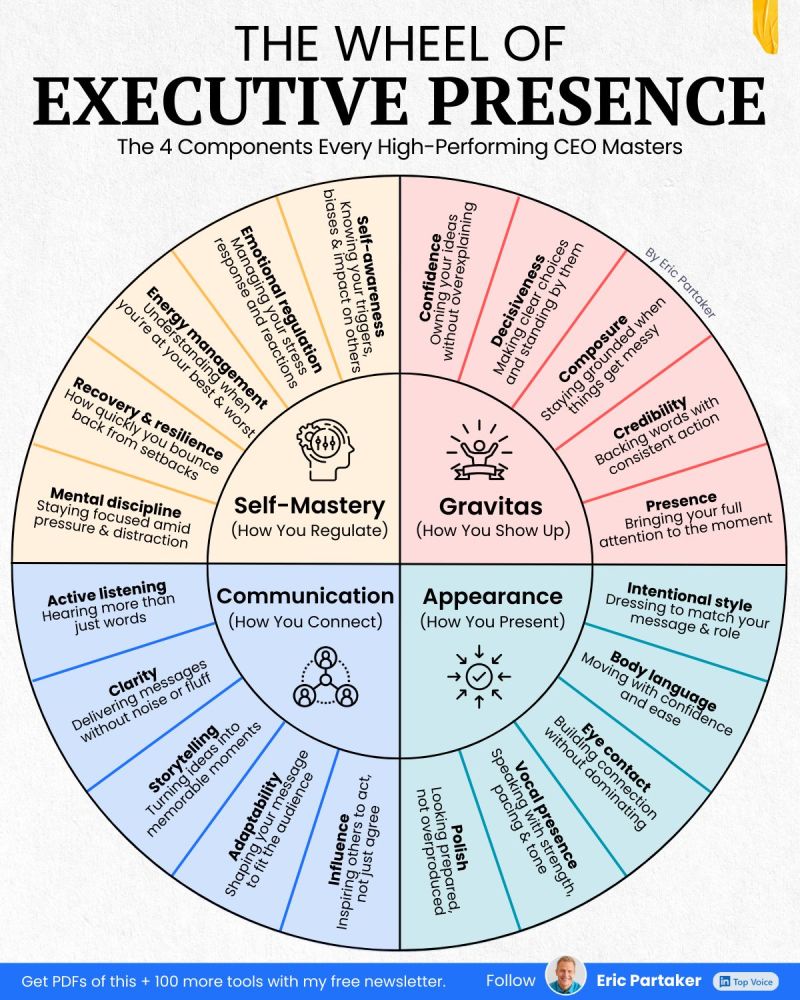
Yes, communication is important.
But you have to listen to lead. Not just give orders.
Equally important?
How you show up (Gravitas)
How you present (Appearance)
How you regulate (Self-Mastery)
Executive presence is how you lead under pressure.
Show up in key moments.
Earn trust without needing to say much at all.
And the best CEOs?
They’re working on it constantly.
Because presence isn’t about being the loudest voice in the room.
It’s about calm, clarity, and credibility.
Especially when the stakes are high.
If you’re:
— Leading a team
— Growing a company
— Navigating tough decisions
— Pitching partners or investors
— Building influence in your industry
Then executive presence is a skill worth mastering.
So what’s it actually made of?
Use my framework:
🟠 Self-Mastery (How You Regulate)
The internal game that makes everything else sustainable:
— Self-awareness
— Emotional regulation
— Energy management
— Recovery & resilience
— Mental discipline
🔴 Gravitas (How You Show Up)
The calm, grounded confidence people trust:
— Confidence
— Decisiveness
— Composure
— Credibility
— Presence
🔵 Communication (How You Connect)
The ability to simplify, influence, and land your message:
— Active listening
— Clarity
— Storytelling
— Adaptability
— Influence
🟢 Appearance (How You Present)
The nonverbal cues that shape perception before you speak:
— Intentional style
— Body language
— Eye contact
— Vocal presence
— Polish
This is the kind of presence that earns trust — fast.
Not by performing.
By leading with intention.
And the best part?
It’s not something you’re born with.
It’s something you build.
Start with 1 quadrant.
Work the muscles.
Watch your leadership transform.
The First Morning of the Year

New Year’s Day arrives without noise. The fireworks are over. The countdown has faded. What’s left is a quieter kind of magic—the kind that feels like a deep breath after a long night.
The first morning of the year has a different weight to it. It doesn’t ask you to rush or resolve everything all at once. It simply sits there, wide open, offering possibility without pressure. A clean page. A gentle beginning.
There’s something comforting about that. You don’t have to prove anything today. You don’t need a plan mapped out to December. All you need is a willingness to step into the year with an open heart.
Miracles don’t usually knock loudly on New Year’s Day. They slip in softly. In the calm. In the moments where you notice how peaceful it feels to start again. In the sense that maybe—just maybe—this year could surprise you in good ways.
Being a magnet for those moments doesn’t mean chasing them. It means allowing them. Choosing to move through the year with kindness, curiosity, and trust. Trust that the right people will cross your path. Trust that good energy grows when you protect it. Trust that happiness doesn’t need grand occasions to exist.
New Year’s Day reminds us that kindness is still powerful. That warmth still matters. That the smallest gestures can ripple farther than we expect. When you lead with grace, you attract people who meet you there. People who make ordinary days brighter and heavy days lighter.
And happiness? It often starts right here. In a slow morning. In coffee that tastes better because there’s nowhere you need to be. In the quiet joy of knowing you’re allowed to begin again without explanation.
Today isn’t about becoming a new person. It’s about returning to yourself. About stepping into 2026 gently, carrying hope instead of expectations.
So on this first day of the year, may you be a magnet for miracles—small and unexpected. May kind people find you and stay. May your energy feel lighter, steadier, and more your own. And may countless happy moments weave themselves into your days, starting right now, on this calm and promising New Year’s morning.
How to Write A Conference Talk
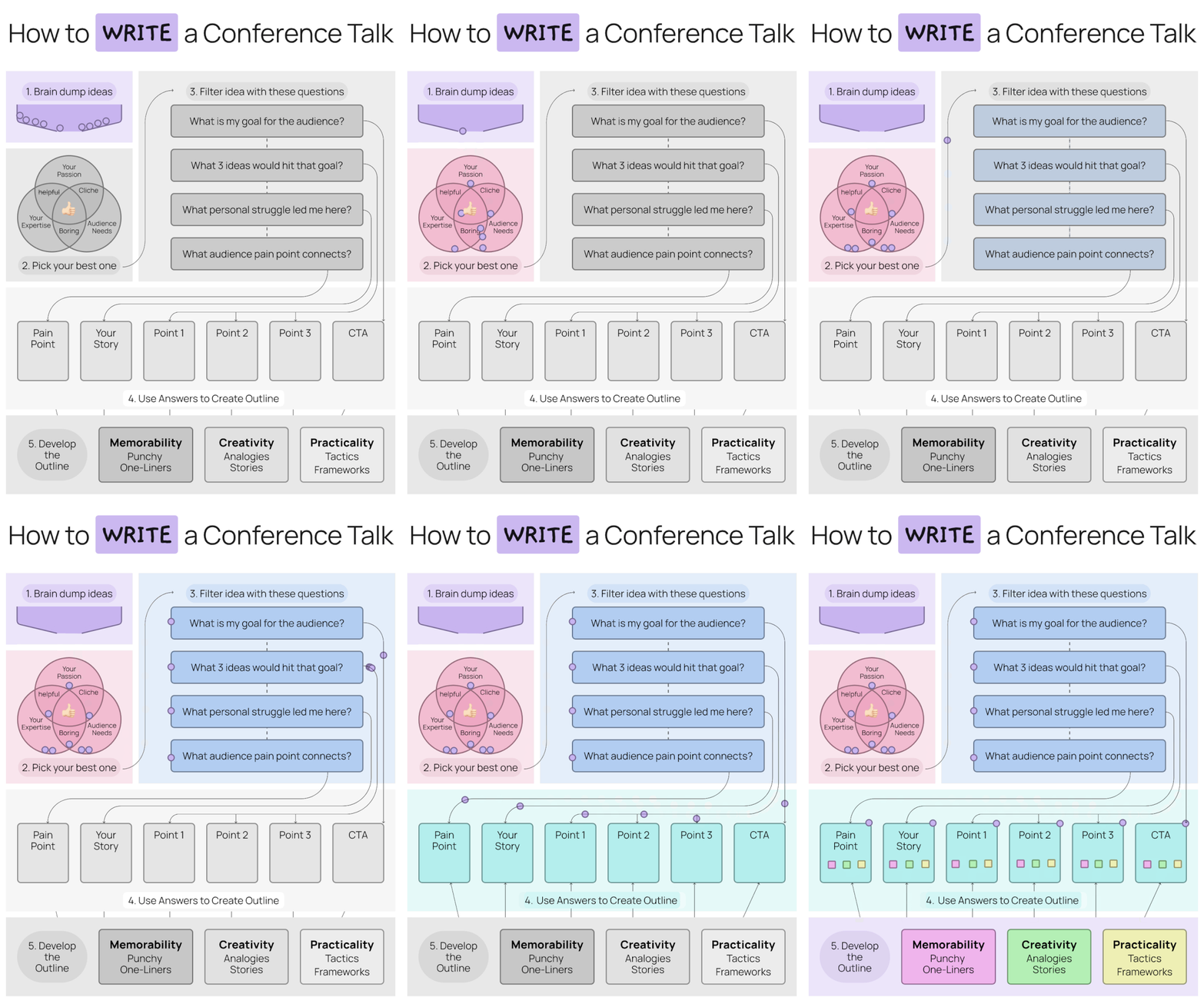
Some can initially win a room by sheer personality.
→ Raw confidence
→ Natural humor
→ Good looking
People will often mention these speakers after:
→ “Have you heard of her before?”
→ “She was the funny one!”
→ “He was so cool!”
But though they MAY remember the SPEAKER…
…here’s what they DON’T remember:
👉🏻 The talk itself. 👈🏻
But why??
Because people with magnetic personalities often have strong stage presence, but write sloppy talks.
They get used to phoning it in because they can get away with it.
→ But they rarely make a lasting difference.
At the same time, many people with middle of the road personalties, can make a massive impact.
It all comes down to the talk itself.
Great talks are great,
even if the speaker isn’t a superstar persona.
People may not remember their charisma,
but they will remember the content.
So:
😎 If you’re a cool kid, fine. → Still focus on content.
🤓 If you’re a nerd, also fine. → Same advice to you.
And when I say content…
I mean specifically the craft of writing a killer talk:
→ Analogies & stories people never forget
→ An outline that is easy to follow and deliver
→ Hooks that work without leaning on charisma
→ Pain points woven into every section of the talk
→ One-liners your audience will quote back to you
Focus on content. Everything else falls into place.
Check the infographic for your roadmap.
You’ve got this!
The Iceberg of Toxic Culture
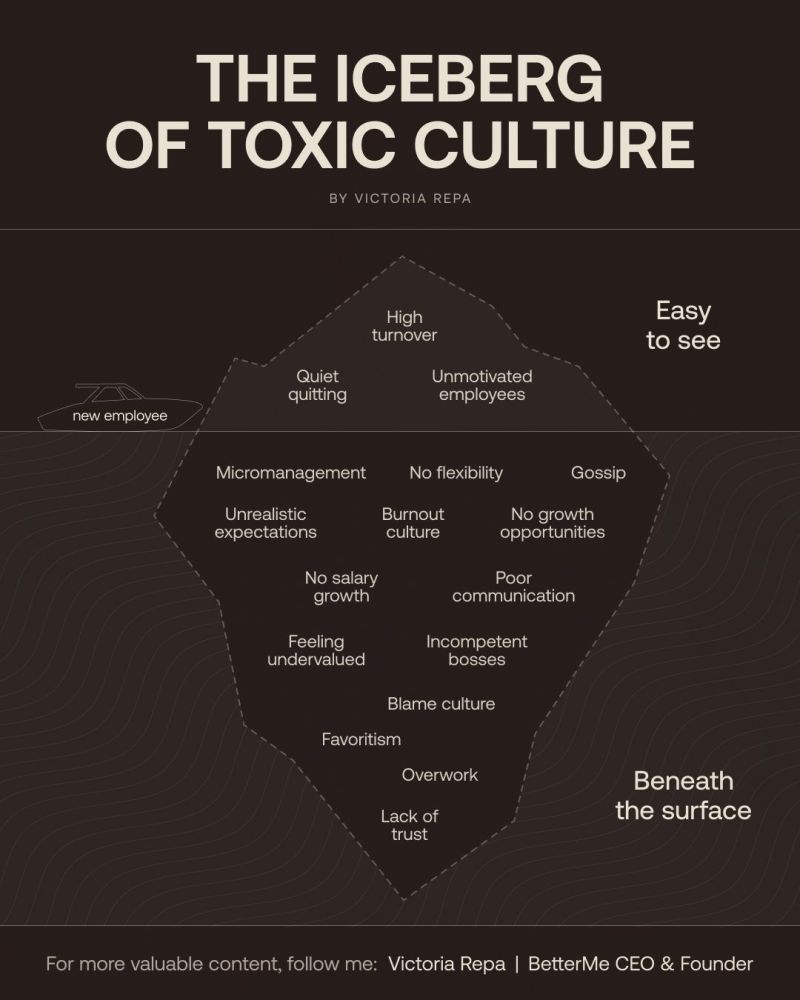
Toxic Work Culture.
Most candidates focus on:
↳ Salary.
↳ Job responsibilities.
↳ Benefits and team activities.
I used to do the same.
And yes, these things matter.
But none of it will matter if you step into a toxic environment.
What’s easy to spot in the first few weeks:
➟ High turnover
➟ Unmotivated employees
➟ Quiet quitting
What’s beneath the surface:
➟ Micromanagement
➟ Favoritism
➟ Incompetent leadership
➟ Blame culture
➟ Lack of trust
➟ No growth opportunities
➟ Overwork and burnout
➟ Unrealistic expectations
➟ No flexibility
➟ Feeling undervalued
➟ Gossip and office politics
➟ Poor communication
➟ Stagnant salaries
Culture isn’t just what’s visible — it’s what’s felt.
A thriving team isn’t built on surface-level perks.
It’s built on trust, respect, and an environment where people want to stay.
The real question:
What’s beneath the surface of YOUR workplace?
Have you ever taken a job only to realize the culture was toxic?
What were the warning signs?
 Kenrick Vaz