
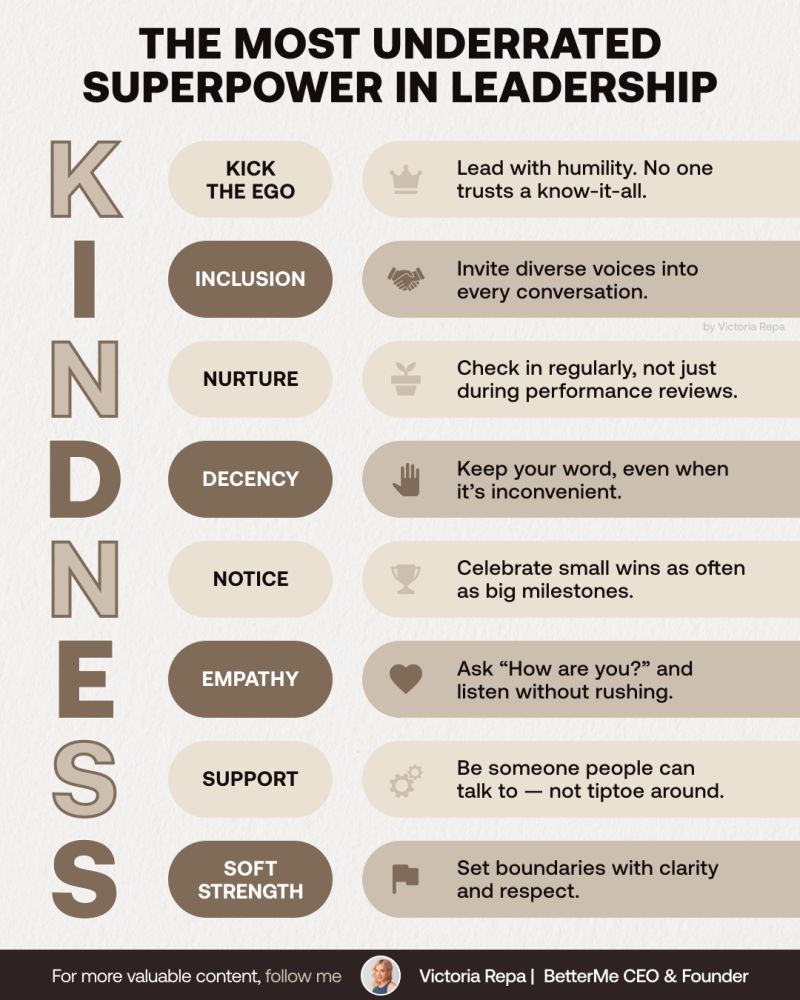
No matter your title or salary — be kind.
90% of managers ignore this superpower.
And they lose their best people because of it.
But the other 10%?
Those who lead with genuine kindness.
They know how to grow and keep great talent.
KINDNESS isn’t about being nice.
Here’s what real kindness looks like in action:
K — Kick the ego and lead with humility.
I — Invite voices that aren’t always heard.
N — Nurture your team’s growth beyond KPIs and job titles.
D — Do what you said you’d do, even when it’s inconvenient.
N — Notice small wins as much as big milestones.
E — Empathy is one of the most powerful leadership skills.
S — Support and offer help before it’s asked for.
S — Set boundaries with clarity and respect.
Kindness is a gift everyone can afford to give.
But for the people around you it’s priceless.
Start practicing these elements of kindness,
and your team will follow your lead.
♻️ Kindness is contagious — so let’s spread it through our networks and build better workplaces.
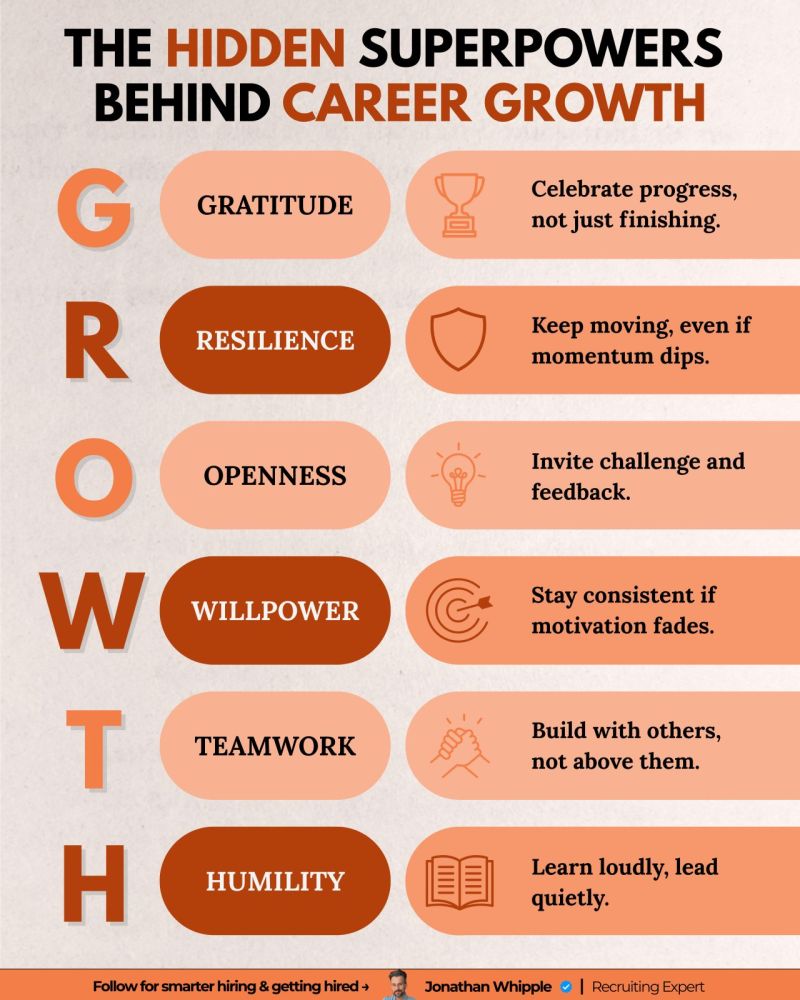
The Hidden Superpowers Behind Career Growth
It’s not hard skills that stall careers.
It’s the soft ones. Here’s how.
I’ve seen this happen dozens of times:
The most talented person on the team…
Who can’t handle feedback.
Who burns out under pressure.
Who alienates everyone around them.
Their career stalls.
No matter how brilliant they are.
So what actually fuels growth?
The soft skills nobody puts on a resume:
1. Gratitude → builds trust
2. Resilience → steadies momentum
3. Openness → invites feedback
4. Willpower → sustains consistency
5. Teamwork → multiplies impact
6. Humility → earns respect
Hard skills get you a seat at the table.
But staying there? Rising higher?
That’s built on trust.
If you want to grow in your career,
don’t just sharpen your skills.
Sharpen your character.
Which soft skill has made the biggest impact on your career?
Let me know in the comments. 👇
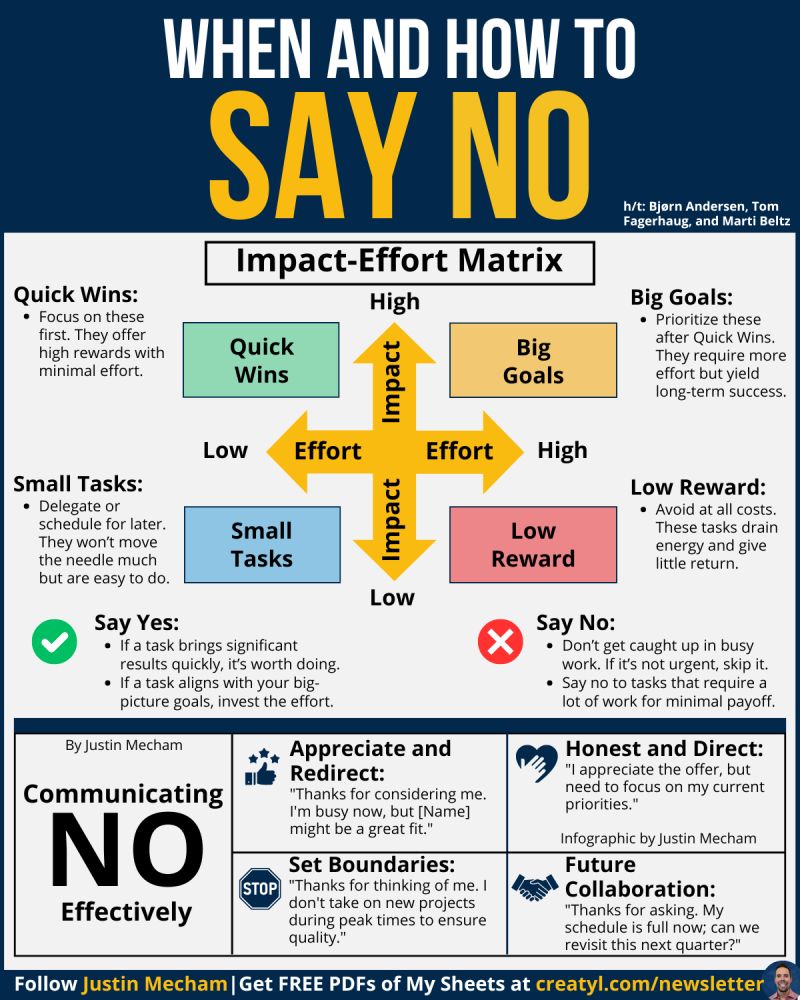
When and How to Say No
“No” is a complete sentence—
But here’s when to say it and how:
Most people aren’t drowning because they’re lazy.
They’re drowning because they’re too helpful.
Saying yes feels like the right thing—
until your calendar’s full and
your focus is gone.
Top performers don’t say yes to everything.
They say yes to the right things.
Start with the Impact-Effort Matrix by
Bjørn Andersen, Tom Fagerhaug, and Marti Beltz:
🟢 Quick Wins
Easy + effective? Do them now.
🟡 Big Goals
Harder, but worth it. Prioritize next.
🔵 Small Tasks
Schedule, delegate, or delay.
🔴 Low Reward
High effort + low return = say no.
You can’t do meaningful work if your time is
buried under meaningless tasks.
Saying yes to everything
is saying no to your real priorities.
So here’s your challenge:
Say no once this week. Just once.
Then watch what it protects:
Your energy. Your goals. Your peace of mind.
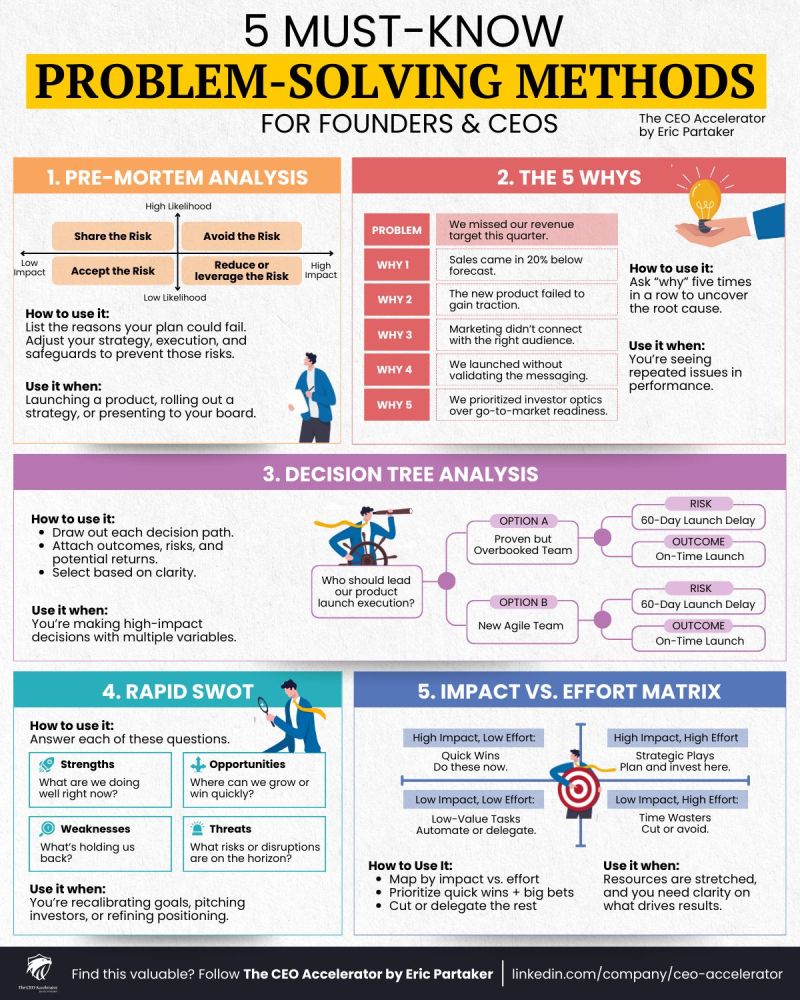
5 Problem Solving Methods
A great solution to the wrong problem is still a failure.
Because here’s the harsh truth:
If you skip the diagnosis, the treatment won’t work.
When something breaks in your business,
a missed goal, a failed launch, a team breakdown…
The instinct is often to jump straight to a fix.
But without understanding the root cause,
you’re just putting a fresh coat of paint on
a cracked wall.
Here are 5 practical methods to help you fix the right
problem, not just the loudest one:
1. Pre-Mortem Analysis
Spot risks before they derail your plans.
Ask: “If this project failed… what went wrong?”
Then adjust your strategy to prevent those scenarios.
💡 Use this when launching, presenting, or rolling out
a new strategy.
2. The 5 Whys
Get to the root cause—not just the symptom.
Ask “Why?” five times in a row until you find
what’s really broken.
It’s uncomfortable.
But that’s where the insight is.
💡Use this for recurring issues in performance
or operations.
3. Decision Tree Analysis
Visualize outcomes before you commit.
Map each option, the risks, and likely results.
This brings clarity to complex decisions,
and removes gut bias.
💡Use this when making high-stakes calls
on hiring, funding, or growth.
4. Rapid SWOT
Cut through the noise and re-center your strategy fast.
Ask:
✅ What’s working?
❌ What’s holding us back?
📈 Where can we win quickly?
⚠️ What’s threatening us?
💡Use this when momentum stalls,
goals feel unclear, or your team seems off track.
5. Impact vs. Effort Matrix
Prioritize with purpose.
High impact, low effort? Do it now.
High effort, low impact? Cut it.
💡Use this when resources are stretched and
everything feels “important.”
Here’s the key takeaway:
You don’t need to reinvent the wheel every
time something breaks.
You just need a smarter way to break the problem down.
The best leaders don’t wait for clarity to show up,
they create it, by asking better questions, earlier.
Which of these methods will you try first?
Listen

Listening is a superpower –
Here’s how you can get it:
We talk about communication skills…
But forget that listening
is communication.
The best leaders aren’t the loudest.
They’re the ones who listen the most.
True listening is how trust is built.
It’s how teams feel seen, heard, and valued.
Poor listening leads to:
🔻 High turnover
🔻 Lower team morale
🔻 Missed opportunities
🔻 Lack of accountability
🔻 Damaged relationships
🔻 Wasted time and energy
🔻 Decreased motivation
🔻 Unclear expectations
🔻 Repeated mistakes
🔻 Frustrated teams
The solution?
Learn to truly LISTEN:
🔹 L-earn
🔹 I-nterpret
🔹 S-upport
🔹 T-une in
🔹 E-mpathize
🔹 N-urture
And use the HURIER model by Dr. Judi Brownell:
👂 Hearing
🧠 Understanding
📝 Remembering
🔍 Interpreting
📊 Evaluating
💬 Responding
Real listening isn’t about staying quiet.
It’s about being fully present,
with the intent to understand.
Top leaders listen more.
They speak last, not first.
They want to learn, not win.
Stay Calm, Stay Powerful
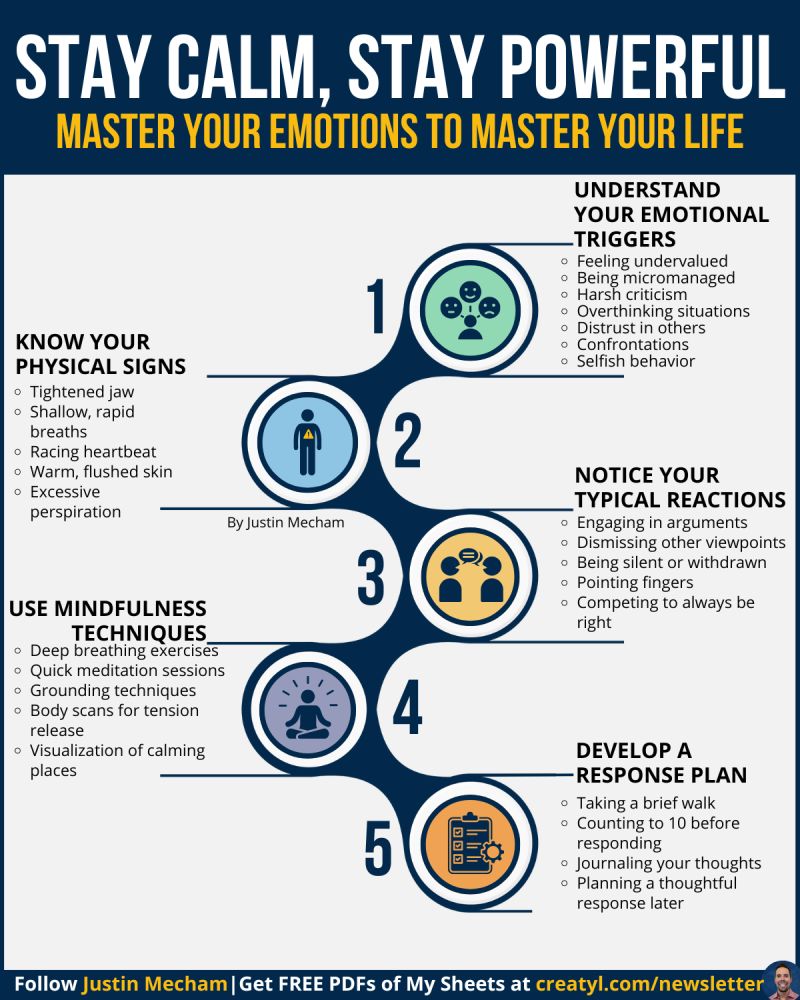
Calm isn’t passive—
It’s controlled power in motion:
Staying calm isn’t about
hiding how you feel—
It’s about knowing what to do with it.
Most people don’t blow
up because they’re weak.
They explode because they never learned
what’s happening under the surface.
This helps you handle it before it handles you:
🟢Watch your stress signals
🔵See what triggers your emotions
🟡Pay attention to how you usually respond
🟣Try one calming trick that works
🟠Create a go-to response plan
Use this when:
‼️ You feel overwhelmed in the moment
‼️ You want to lead with clarity, not emotion
You don’t need to be less emotional.
You just need tools that help
you respond instead of react.
You can’t control every moment.
But you can control how you meet it.
Performance Improvement Plan
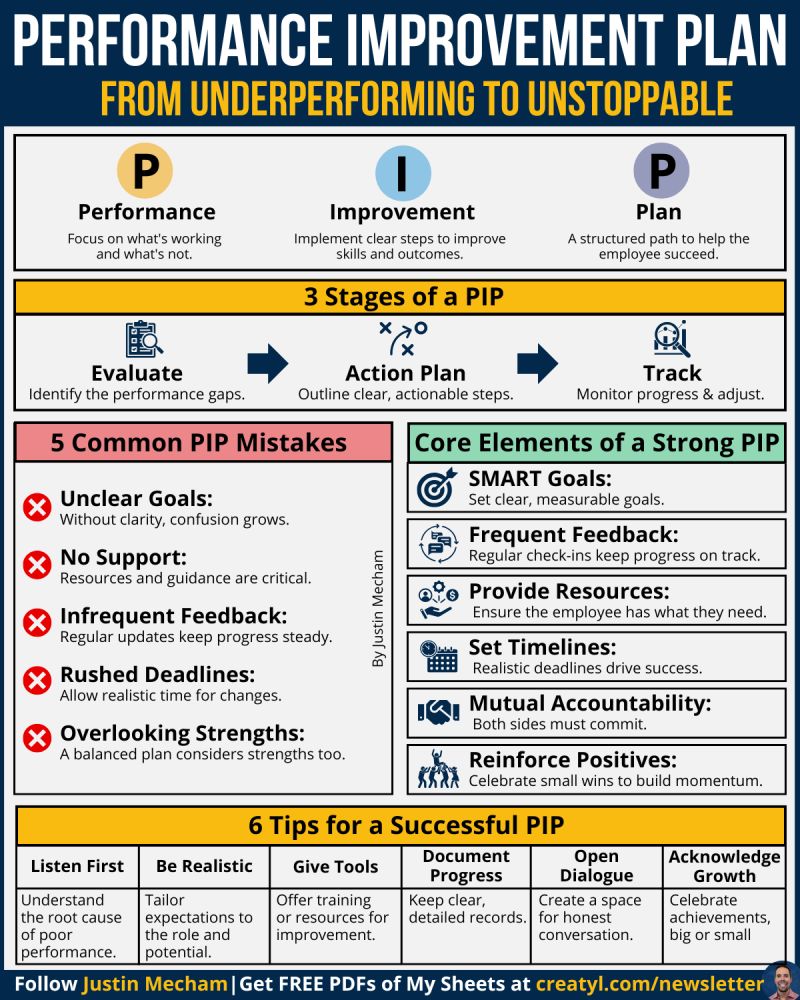
Your people won’t improve –
As long as your plan is broken:
A Performance Improvement Plan (PIP)
shouldn’t feel like a punishment.
It should feel like a path forward.
But here’s what usually goes wrong:
❌ Vague goals
❌ Rushed deadlines
❌ Ignoring strengths
❌ Infrequent feedback
❌ No support or resources
And when that happens –
Performance doesn’t improve.
People disengage.
Trust is lost.
A strong PIP includes:
✅ Shared accountability
✅ Celebrating progress
✅ Tools and resources
✅ Ongoing feedback
✅ Realistic timelines
✅ SMART goals
Done right –
A PIP doesn’t just fix performance.
It builds confidence.
It strengthens trust.
It creates a culture of growth.
Use my guide to do it right.
Because PIPs don’t fail people.
Broken systems do.
Same Storm, Different Boats
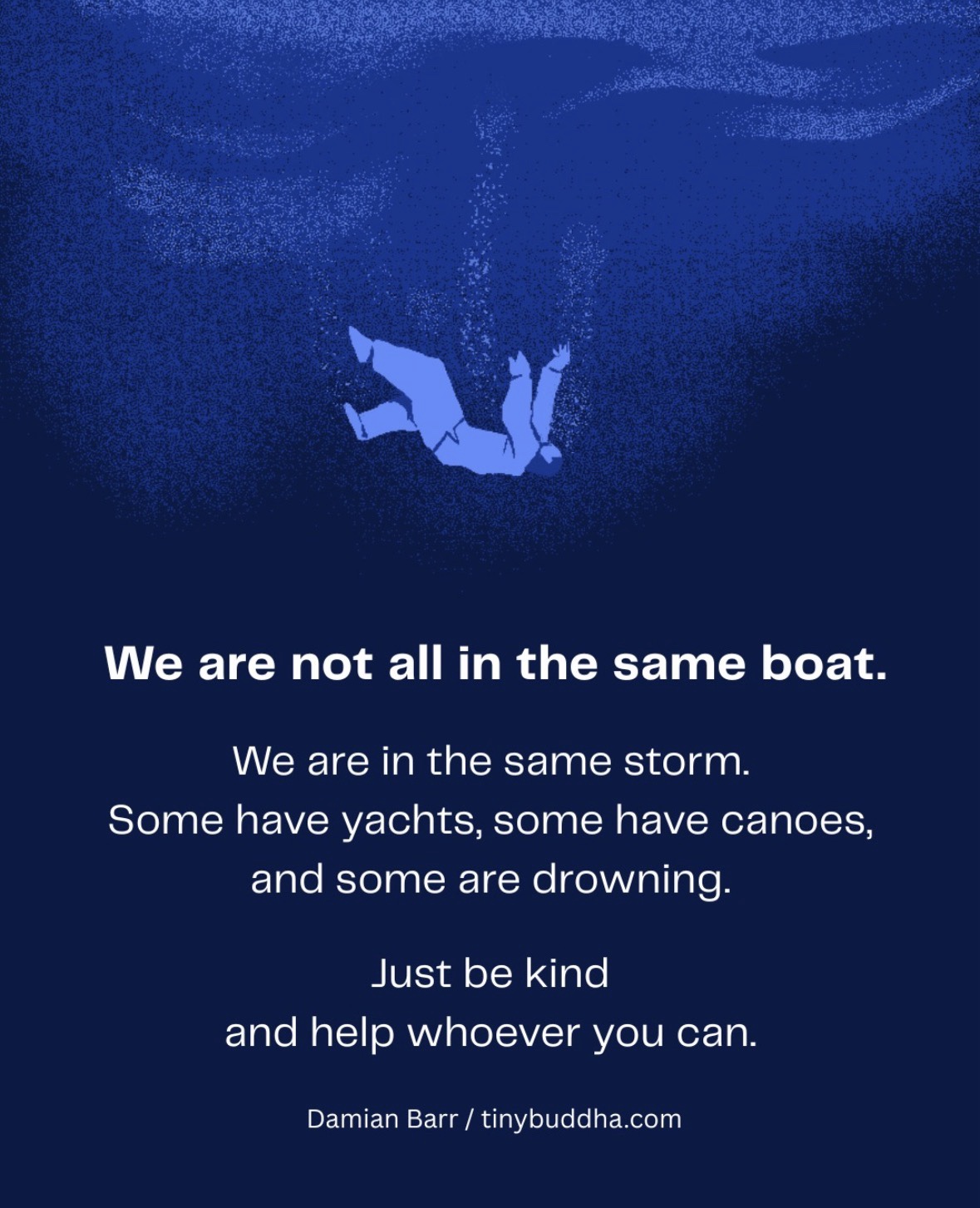
It’s comforting to say we’re all in the same boat. It makes hard seasons feel shared, equal, almost fair. But if we’re honest, that line falls apart pretty quickly.
We’re not in the same boat.
We’re in the same storm.
The rain is hitting all of us. The wind is loud for everyone. The uncertainty is real across the board. But what we’re standing on as we try to stay afloat looks very different.
Some people are riding it out on yachts. They have stability, savings, support systems, flexible jobs, good health, or simply fewer things going wrong at once. The storm is inconvenient, maybe even scary, but their boat is solid. They can wait it out, adjust the sails, trust that they’ll be okay.
Some are in canoes. Light, shaky, exposed. One wrong wave and things start tipping fast. They’re working hard just to keep balance. They might be doing “okay” on the outside, but it takes everything they have to stay upright. There’s no room for extra weight, no margin for error.
And then there are people who aren’t in a boat at all. They’re in the water. Tired. Panicking. Barely keeping their head above the surface. They don’t need motivation quotes or reminders to be grateful. They need help. They need air.
When we forget this, kindness is usually the first thing to go.
We compare someone’s reaction to our own and silently judge.
“Well, I handled it.”
“It wasn’t that bad for me.”
“They should be stronger by now.”
But strength isn’t just about character. It’s also about context. About resources. About what you’re carrying before the storm even hits.
Two people can face the same event and walk away with completely different scars. Not because one is weaker, but because one had more protection.
This is why empathy matters more than ever in hard seasons. Not the performative kind. The quiet kind. The kind that pauses before judging. The kind that asks, “What might their boat look like?”
Kindness doesn’t always mean big gestures. Often, it’s small and unremarkable.
Checking in without needing an update.
Offering help without attaching advice.
Listening without trying to fix.
Giving grace when someone is slower, quieter, sharper, or more withdrawn than usual.
And if you’re on a yacht, this isn’t about guilt. It’s about awareness. You didn’t build the storm, but you might have the ability to help someone else survive it. Sometimes that means throwing a rope. Sometimes it’s just not creating extra waves.
If you’re in a canoe, it’s okay to admit this is hard. You don’t need to minimize your struggle because others have it worse. You’re still in the storm. You’re still allowed to be tired.
And if you’re in the water, hear this clearly: struggling doesn’t mean you failed. It means the conditions are heavy. It means you’re human. Reach out where you can. Even floating for a moment counts.
We don’t need everyone to be heroes. We just need more people to be kind.
Because storms pass faster when we stop arguing about whose boat is better and start helping each other stay afloat.
Hard vs. Soft Leadership Skills
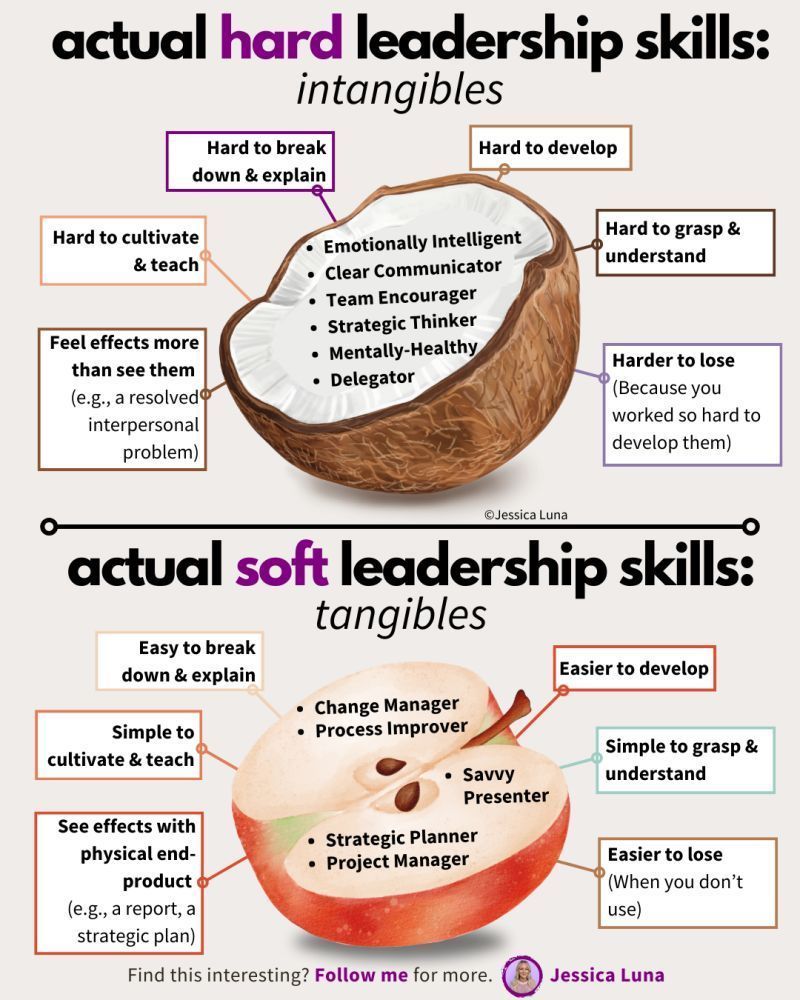
The truth behind “soft” & “hard” skills leaders need
to understand to help their teams grow:
We got it wrong when we started referring to skills as hard & soft.
🪨 Hard skills as we know them – technical skills like computer programming, writing, machinery.
☁️ Soft skills as we know them – interpersonal skills like empathy, communication, patience.
Ask anyone you know – Which is harder: writing a proposal or reading a room?
Most will answer the latter.
It’s because the skills we call “soft” are actually hard. 🥥
They’re mostly hard to:
→ Understand
→ Develop
→ Explain & teach
→ Display (because we have to overcome the associated limiting beliefs)
This is why when someone doesn’t have one of these skills, we often dismiss them.
We think they’re a lost cause because we don’t want to put in the hard investment of helping them develop.
We move onto another candidate or employee that already has it.
The skills we call “hard” are actually soft. 🍎
They’re mostly easier to:
→ Grasp
→ Break down for consumption
→ Replicate
→ And lose
Where do we go from here?
How do we get better?
Let’s stop treating the “soft skills” as something we need to teach in a “soft way” but instead break them down.
We can use our more tangible skills of problem solving, root cause analysis, & training to break down the intangible skills we want in leaders like EQ.
They can all be broken down to their roots & taught. 🧱
Critical thinking is at its core just being curious & questioning everything.
That’s how you build your objectivity & data collection muscles.
And the basis for strategy creation – looking at the pieces on the table & finding the connections between everything.
Use this cheat sheet to start changing the narrative today & identify the must-have tangible & intangible leadership skills.
“Awareness is the greatest agent for change.”
– Eckhart Tolle
One Page Strategy Map
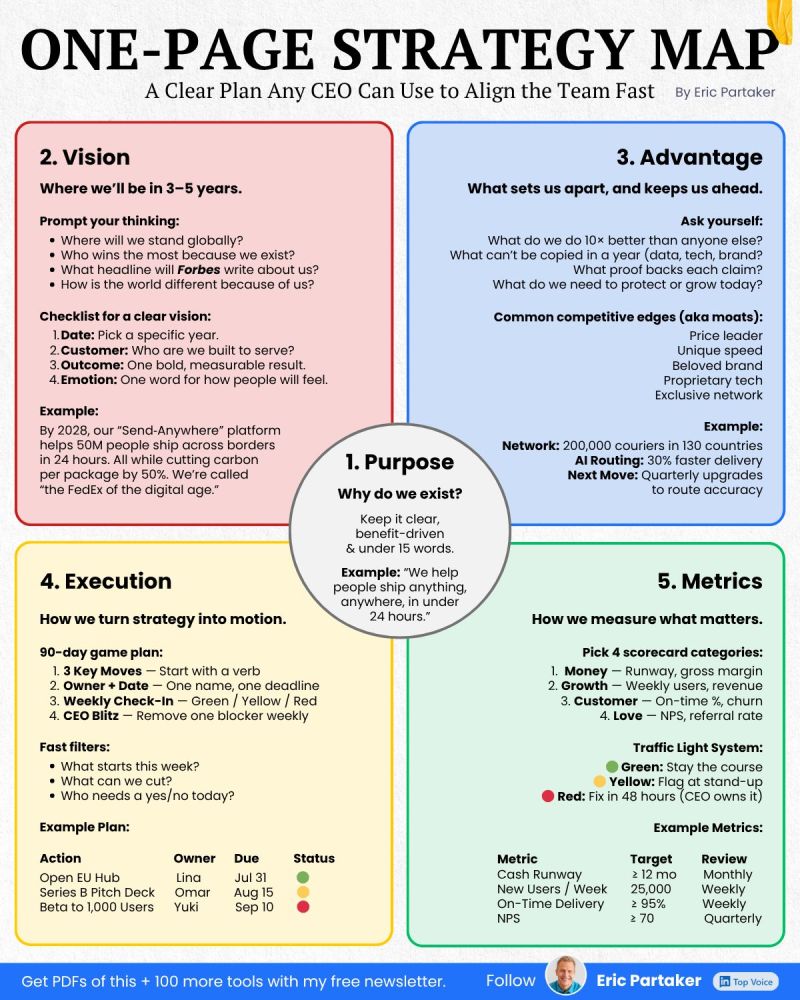
Most teams aren’t misaligned.
They’re just working off 9 different strategies.
Every exec sees the business from a different angle.
And when everyone’s rowing in their own direction,
the boat spins in circles.
Fix that with clarity.
Start here:
1. Purpose – Why do we exist?
→ One simple line. Focused on impact.
2. Vision – Where are we going?
→ Think 3–5 years out. Make it bold, measurable,
and worth chasing.
3. Advantage – Why will we win?
→ Define your edge. Protect what others can’t copy.
4. Execution – How will we move?
→ Focus on 3 key moves. Assign owners.
Check progress weekly.
5. Metrics – How will we know?
→ Pick 4 numbers that track money, growth,
customer success, and love.
Alignment isn’t a 50-slide deck.
It’s a 1-page playbook your whole team can run with.
No fluff. Just clarity, focus, and speed.
That’s how real strategy gets done.
 Kenrick Vaz