Leadership isn’t just strategy.
It’s humanity.
You’ll think the job is about metrics and meetings.
But what no one tells you is this:
1️⃣ You’ll have to deliver hard news while protecting trust.
→ Layoffs. Reorgs. Missed goals. The delivery is the culture.
2️⃣ You’ll lose people you fought to develop.
→ They’ll get poached. Leave. Outgrow the role. It still stings.
3️⃣ You’ll sit with an employee grieving the death of their parent—
and have no idea what to say.
→ It won’t be about fixing. It’ll be about presence.
4️⃣ You’ll be someone’s reason to stay—or go.
→ Your words matter more than you know.
5️⃣ You’ll absorb emotion that was never yours.
→ Fear, burnout, resentment—leadership catches all of it.
6️⃣ You’ll have to prioritize people over process.
→ There will be moments when KPIs don’t matter.
7️⃣ You’ll feel imposter syndrome…
→ Not because you’re faking it, but because the job keeps evolving faster than you can.
8️⃣ You’ll realize trust isn’t given once.
→ It has to be earned every single week.
9️⃣ You’ll have to be the calm during chaos.
→ Even when you’re falling apart yourself.
🔟 You’ll be remembered for how you made people feel—
→ Not for the roadmap you shipped.
This is the part of leadership no one talks about.
But it’s the part that shapes everything.
The Weight You Were Never Meant to Carry
There’s a quiet shift that happens when you finally understand this: your life gets lighter the moment you stop trying to manage other people’s thoughts, reactions, and emotions.
Most of us don’t even realize how much weight we’re carrying. We replay conversations in our heads, tweak our words to land a certain way, soften our truth so it won’t upset someone, or harden it so we won’t look weak. We read into silences. We overexplain. We take responsibility for moods that were never ours to begin with. And slowly, without meaning to, we confuse control with care.
At some point, though, you notice how exhausting that is.
You realize how much energy goes into predicting reactions instead of listening to your own voice. How much time is spent trying to be understood instead of being honest. How often you adjust yourself to fit into spaces that were never designed to hold the real you.
And that’s usually where the shift begins.
Life becomes simpler—not easier, but simpler—when you accept a hard truth: you cannot control how others think, act, or feel. You never could. Even when you did everything “right,” people still interpreted it through their own wounds, fears, and expectations. Their reactions were never a clean reflection of your intentions.
Once that sinks in, something loosens inside you.
You stop rehearsing explanations that no one asked for. You stop carrying guilt for someone else’s discomfort. You stop mistaking their disappointment for your failure. You begin to see the line—clearer than before—between what is yours to own and what is not.
What is yours is simpler, but far more meaningful.
Your job is to stay rooted in who you are. Not the version that wins approval, but the one that feels steady when no one is clapping. The one that can sit with discomfort without abandoning itself. The one that knows its values and doesn’t bargain with them for temporary peace.
Your job is to act with integrity, even when it costs you convenience or popularity. Integrity isn’t loud. It doesn’t need defending. It’s quiet consistency. It’s doing the right thing when no one is watching—and also when everyone is misunderstanding you.
Your job is to stay devoted to your evolution. Not in a frantic, self-improvement way, but in a patient, honest one. Growth doesn’t always look impressive. Sometimes it looks like unlearning. Sometimes it looks like choosing rest instead of proving your worth. Sometimes it looks like saying no without a detailed explanation.
And maybe the hardest part of all: your job is to let go of everything that isn’t yours to carry.
Other people’s expectations.
Other people’s timelines.
Other people’s emotional reactions.
Other people’s need for you to stay the same so they don’t have to adjust.
Letting go doesn’t mean you stop caring. It means you stop confusing responsibility with attachment. You can care deeply without carrying what doesn’t belong to you. You can show up with kindness without sacrificing your center. You can listen without absorbing.
When you live this way, something subtle but powerful happens. Your energy stops leaking. Your decisions become clearer. You respond instead of react. You feel less scattered, less defensive, less desperate to be seen a certain way.
You start moving through life with a different posture—not rigid, not withdrawn, but grounded.
People may still misunderstand you. Some will project. Some will resist the version of you that no longer bends the way it used to. That’s okay. That’s part of the cost of living honestly.
But here’s the quiet reward: you’ll feel more like yourself than you ever have.
And that feeling—the lightness, the steadiness, the inner alignment—is worth far more than the approval you had to give up to get it.
You were never meant to carry everyone else’s weight. You were meant to walk your own path with clarity, integrity, and the freedom that comes from knowing exactly what is—and isn’t—yours to hold.
7 Client Touchpoints
Client touchpoints shouldn’t feel pushy.
They should feel like what they really are:
Building real relationships.
But many client-facing professionals hesitate to follow
up, worried they’ll seem self-serving.
But here’s the shift:
When your touchpoints come from generosity, following
up feels:
✅ Natural
✅ Helpful
✅ Human
Need to follow up with a client soon?
Here are 7 of my favorite trust-building touchpoints that
don’t feel like “selling”:
1. Ask for their perspective
→ “What shifts are you seeing in your market?”
→ Let their insights guide your next step
→ People love being asked what they think
2. Make an introduction
→ Connect them to someone who can help
→ Be specific about the value on both sides
→ Follow up later to see how it went
3. Invite them to something meaningful
→ A small dinner with peers they’ll enjoy
→ A virtual panel on a topic they care about
→ No pitch. Just people they’d want to meet
4. Offer a Give-to-Get
→ “Want to spend 30 minutes tackling that challenge?”
→ Share helpful ideas, no strings attached
→ Let value lead to the next conversation
5. Congratulate and recognize them
→ Repost their big news with a kind comment
→ Mail a handwritten note (or flowers!)
→ Celebrate the personal wins too
6. Send a helpful article
→ Share something outside your company blog
→ Add a quick note: “Thought of you when I read this.”
→ Make it clear you’re thinking of them
7. Send a thoughtful “just because” note
→ “What you said in that meeting stuck with me.”
→ Mention their new puppy or kid’s graduation
→ Yes, snail mail is still magic
In the end, it’s not about being remembered.
It’s about being helpful.
When you show up generously, without pressure, you’re
not just keeping in touch.
You’re building something real.
Pick one. Try it this week.
Let me know how it goes.
7 Traits of Doers
The fastest way to fail is to wait—
The fastest way to win is to do:
Here are 7 traits that set doers apart:
1️⃣ Clarity First
They know what to build.
One sentence, one person, one problem.
2️⃣ Action Over Ideas
They get it done.
Set a date, cut the fluff, ship it.
3️⃣ Steady Under Pressure
When it gets messy, they stay calm.
Pause, pick one step, reset the tone.
4️⃣ Keep It Simple
Less chaos = more progress.
Small blocks, clear lists, strong habits.
5️⃣ Share the Real Stuff
They don’t fake it.
Wins and mistakes both get posted.
6️⃣ Test, Don’t Wait
Every week is an experiment.
Improve it or move on.
7️⃣ Build Fast
They launch small.
Learn from version 1, grow from there.
Use our sheet to see
how to apply these 7 traits—
And start acting like a doer.
Doers don’t wait for permission.
They test, learn, and keep going.
That’s why they win.
The 7 Cs of Communication
You’re not being misunderstood—
You’re not being clear, try this:
People aren’t ignoring you.
They just didn’t understand what you said.
Confusion sounds like silence.
Clarity gets responses.
If your words are messy,
your message gets missed.
Use this 7-part clarity check:
☑️ The 7 Cs by Scott M. Cutlip and Allen H. Center:
🔸 Clear = Easy to get
🔸 Courteous = Be kind
🔸 Concise = Cut the extra
🔸 Correct = Get your facts right
🔸 Concrete = Give real examples
🔸 Coherent = Make it make sense
🔸 Complete = Say the important stuff
☑️ How to use it:
🔸 Plan = Think before you write
🔸 Review = Check for the 7 Cs
🔸 Feedback = Ask if it was clear
🔸 Adjust = Tweak until it works
☑️ At work:
🔸 Double-check your tone and facts
🔸 Back up your ideas with proof
🔸 Write shorter, clearer emails
☑️ In real life:
🔸 Say what you mean
🔸 Be clear in group chats
🔸 Stay kind—even when upset
Confusion costs you attention, trust, and time.
But clarity earns you everything.
Because if your message isn’t clear—
It doesn’t matter.
Still Becoming
There’s a quiet sentence I keep coming back to lately, one that doesn’t shout or demand attention. It just sits there, steady and honest:
The only comparison worth making
You one year ago
You today
Not the version of someone else you see online. Not the highlight reel that shows up uninvited on your screen when you’re already tired. Just you. Then and now.
A year sounds short when you say it out loud. Twelve months. Fifty-two weeks. But when you actually live inside a year, it stretches. It carries ordinary days, heavy days, days you’d rather forget, and a few you wish you could bottle and save. It carries quiet growth that doesn’t announce itself until much later.
If you’re honest, the person you were a year ago didn’t know what you know now. They didn’t carry the same weight, wisdom, or weariness. They hadn’t had that conversation that changed something in them. They hadn’t sat in that silence long enough for clarity to form. They were still guessing in places where you’re now certain, and certain in places where you’ve since learned to soften.
Growth rarely looks like fireworks. Most of the time it looks like showing up again, even when motivation is low. It looks like choosing better words in a hard moment. It looks like walking away from something you once begged for. It looks like learning to pause before reacting. These aren’t things you post about. But they change you.
Maybe a year ago you were running. Chasing approval. Chasing speed. Chasing a version of success that looked impressive but felt hollow. Or maybe you were just trying to survive, putting one foot in front of the other and hoping no one noticed how tired you were. Either way, you’re still here. And that matters more than we give it credit for.
It’s tempting to measure progress by visible milestones. New titles. New roles. New homes. New numbers. But some of the most important growth never shows up on a resume. Learning how to rest without guilt. Learning how to say no without explaining yourself. Learning how to stay when it would be easier to disappear. Learning how to be kind to yourself on days when you fall short.
If you compare yourself only to others, you’ll always lose. There will always be someone ahead, louder, faster, shinier. Comparison like that doesn’t motivate; it drains. But when you compare yourself to who you were, the story changes. You start to notice the small wins. The patterns you broke. The fears you named. The boundaries you built. The grace you extended to yourself when you used to be ruthless.
You might not feel dramatically different. That’s okay. Growth doesn’t always feel like growth while it’s happening. Sometimes it feels like confusion. Sometimes it feels like standing still. Sometimes it feels like going backward before you move forward. But if you look closely, there are signs. You respond differently now. You value different things. You recover faster. You ask better questions.
And maybe, just maybe, you’re a little more honest than you used to be. With yourself. With others. About what you want and what you don’t. About what you can handle and what you can’t anymore. That honesty is progress, even if it came with some discomfort.
This isn’t about perfection. It’s not about becoming some ideal version of yourself who never struggles. It’s about becoming more you. More grounded. More aware. More aligned with what actually matters to you, not what you thought was expected.
So if today feels ordinary, don’t dismiss it. Ordinary days are where most of life happens. They’re where habits form and character takes shape. They’re where you quietly become someone your past self needed.
A year from now, you’ll look back at this version of you too. You won’t remember every detail, but you’ll remember how this season shaped you. You’ll see things you couldn’t see yet. And you’ll probably wish you’d been a little gentler with yourself.
The only comparison worth making isn’t meant to pressure you. It’s meant to ground you. To remind you that growth is personal, nonlinear, and deeply human. You’re not behind. You’re in progress.
And that’s more than enough.
The Anchor Framework
Your team doesn’t need more meetings.
They need a CEO who knows what to do when
everything starts breaking at once.
That’s when teams don’t need more information.
They need anchors.
Clear priorities.
Decisive leadership.
A sense that someone still has the wheel.
I’ve worked with 100s of high-performing CEOs
across industries.
The ones who thrive in chaos aren’t
the loudest or smartest.
They’re the most anchored.
They follow habits like these:
🔹 Setting 1 non-negotiable priority every day.
This creates instant clarity.
If everything’s urgent, nothing is.
🔹 Opening every meeting with purpose.
Not “here’s the agenda.”
But “here’s why this matters to our mission.”
🔹 Blocking time for forward-looking work.
High-growth CEOs don’t just react.
They plan 6–12 months ahead while others
scramble to get through Friday.
🔹 Sharing the “why” behind decisions.
People don’t just want direction.
They want to trust how it’s made.
🔹 Starting team meetings with 2-minute wins.
Tiny shift. Huge morale booster.
It trains the org to focus on momentum,
not just problems.
I’ve put these habits (and more) into
a framework called A.N.C.H.O.R.
It helps you lead when the ground is shifting
(and still move fast).
A – Align Purpose
N – Name Metrics
C – Coach Managers
H – Harness Systems
O – Own Decisions
R – Recognize Wins
The uncomfortable truth?
Most teams aren’t underperforming.
They’re under-led.
And in a world moving this fast,
clarity isn’t optional.
It’s your competitive edge.
Lead with clarity.
Or lose to someone who will.
Designing Your Ambition
Every winning strategy starts with one uncomfortable question:
How ambitious are you willing to be?
A client once told me:
“Our ambition? To grow 5% a year.”
I asked: “Is that ambition… or just survival?”
That moment shifted the entire conversation.
Because ambition isn’t about what feels safe.
It’s about what forces you to rethink your business.
Without ambition, strategy is just incremental improvement.
Ambition sets the ceiling for what’s possible.
And it should scare you a little — otherwise, it’s not really ambition.
So, what’s your true ambition?
Growth, transformation,…
or simply keeping the lights on?
Yesterday Taught Me. Tomorrow Calls Me Forward.
There’s something quietly powerful about standing between what has been and what is still becoming. Yesterday sits behind us like a patient teacher. Tomorrow waits ahead like an open door. And right here—right now—we get to choose how we carry both.
2025 taught me more than I expected. Not in loud, dramatic ways, but in the steady, everyday moments that slowly shape you if you’re paying attention. It taught me that effort doesn’t always show results immediately, and that doesn’t mean it was wasted. Some work is underground for a while, growing roots before anything breaks the surface. I learned that consistency matters more than intensity, and that showing up—especially on ordinary days—is a kind of quiet courage.
Yesterday also taught me about limits. About energy. About how saying yes to everything eventually means saying no to yourself. There were moments when slowing down felt uncomfortable, even irresponsible, but looking back, rest wasn’t the enemy of progress. It was part of it. I learned that burnout doesn’t announce itself loudly; it sneaks in when you ignore the small signals for too long. Listening sooner would have saved time, not lost it.
I learned about people too. About who stays when things are inconvenient. About who celebrates your growth without feeling threatened by it. About how relationships don’t thrive on perfection, but on honesty, patience, and the willingness to keep choosing each other. I learned that it’s okay to outgrow certain spaces, even if they once felt like home. Gratitude and release can exist at the same time.
There were wins in 2025—some visible, some deeply personal. There were also disappointments that didn’t make sense when they happened. But distance has a way of adding clarity. What felt like delay was often protection. What felt like loss sometimes created room for something better suited to who I was becoming. Yesterday taught me that not everything needs to work out the way I planned for it to work out well.
And now, 2026 stands in front of me—not as a promise, but as an invitation.
Tomorrow inspires me because it hasn’t been edited yet. It doesn’t know my mistakes or my fears unless I carry them forward unchanged. It offers possibility without guarantees, which is both terrifying and freeing. Tomorrow doesn’t ask me to be flawless; it asks me to be present. To try again with a little more wisdom than last time. To take what I’ve learned and apply it gently, not harshly.
What inspires me most about tomorrow is the chance to move with more intention. To build slowly and thoughtfully. To choose depth over noise. To create space for what truly matters instead of filling every gap with urgency. Tomorrow inspires me to trust that small, aligned steps taken daily can lead to places that big, rushed leaps never could.
It inspires me to believe that growth doesn’t always look like doing more. Sometimes it looks like doing less, but better. Listening more closely. Responding instead of reacting. Being rooted enough to bend without breaking. Tomorrow invites me to become someone who measures success not just by outcomes, but by peace.
There’s a quiet confidence that comes from knowing you’ve survived your yesterdays. Not perfectly. Not without scars. But with lessons intact. Yesterday taught me. Tomorrow inspires me. And today—today is where the real work happens. Today is where learning turns into living, and inspiration turns into action.
I don’t need tomorrow to be extraordinary. I just need it to be honest. If I can carry forward what yesterday taught me, and step into tomorrow with curiosity instead of fear, that feels like progress. That feels like enough.
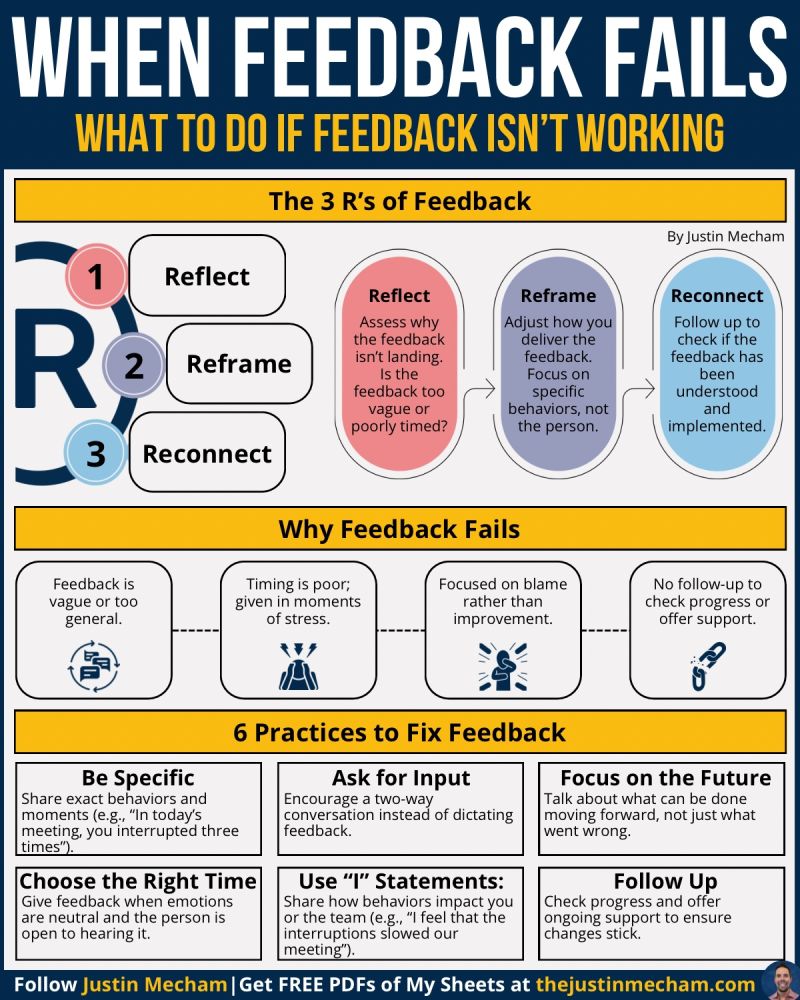
Effective Feedback
Are your teams avoiding tough feedback?
Many people shy away from it because
it feels uncomfortable, awkward, even risky.
But the right tools can make feedback easier.
My 3 favorite frameworks:
1. 𝐒𝐁𝐈 — Direct, objective approach
→ Situation: Set the exact context
→ Behavior: Describe what you saw
→ Impact: Explain the real effect
Good for quick, in-the-moment feedback
about a specific incident that just happened.
2. 𝐂𝐄𝐃𝐀𝐑 — Coaching-inspired approach
→ Context: Agree on the purpose
→ Examples: Share specific instances
→ Diagnosis: Explore root causes
→ Actions: Define next steps
→ Review: Schedule follow-up
Good for address recurring patterns and
creating a plan for lasting behavior change.
3. 𝐅𝐀𝐒𝐓 — Be consistent
→ Frequent: Not just annual reviews
→ Actionable: Focus on changeable behaviors
→ Specific: Use real examples
→ Timely: Strike while it’s relevant
Above all, be fair and caring.
The goal isn’t to prove you’re right.
It’s to help others improve and thrive.
Which framework do you like best?