
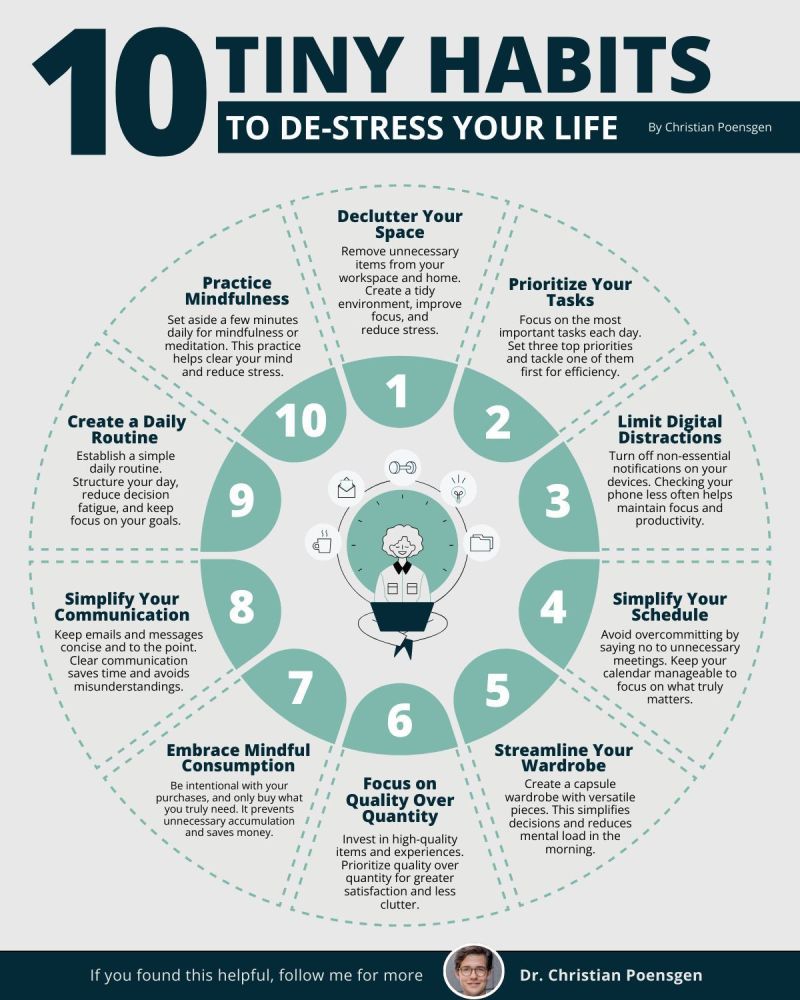
Complexity is the silent killer of productivity.
10 tiny habits to take back control:
1) Declutter your space
↳ Let go of anything you haven’t used in the last 2 years.
↳ Also, ask yourself: “Does this spark joy?”.
2) Prioritize your tasks
↳ Write down your top three priorities each morning.
↳ Timebox and treat focus blocks like appointments.
3) Limit digital distractions
↳ Mute every non-essential notification.
↳ Go phone free 1 hour before and 1 hour after waking.
4) Simplify your schedule
↳ Say no to low-value meetings and invites.
↳ Use the “Hell Yeah or No” rule to protect your time.
5) Streamline your wardrobe
↳ Build a small set of versatile pieces.
↳ Wear what you love and repeat your best outfits.
6) Choose quality over quantity
↳ Invest in durable, well made items.
↳ Buy cheap, buy twice.
7) Practice mindful consumption
↳ Buy only what you truly need or deeply value.
↳ Favor meaningful experiences over more stuff.
8) Simplify how you communicate
↳ Start with the main message, then add context.
↳ Use the Pyramid Principle to stay clear and concise.
9) Create a daily routine
↳ End each day with a short shutdown ritual.
↳ Start the next morning with clarity instead of chaos.
10) Rest deliberately
↳ Set aside time for meditation or deep rest.
↳ Use NSDR to reset your nervous system.
– – – –
Ready to reduce stress at the root?
Pick one habit that resonates and start today.
When you focus on less,
you create more space to breathe, think, and perform.
What is your best tip for de-stressing your life?
When You Stop Auditioning for a Life You Already Own
There’s a quiet shift that happens when you start growing for real.
You stop performing.
You stop scanning the room to see who noticed.
You stop rehearsing arguments in your head.
You stop collecting validation like it’s oxygen.
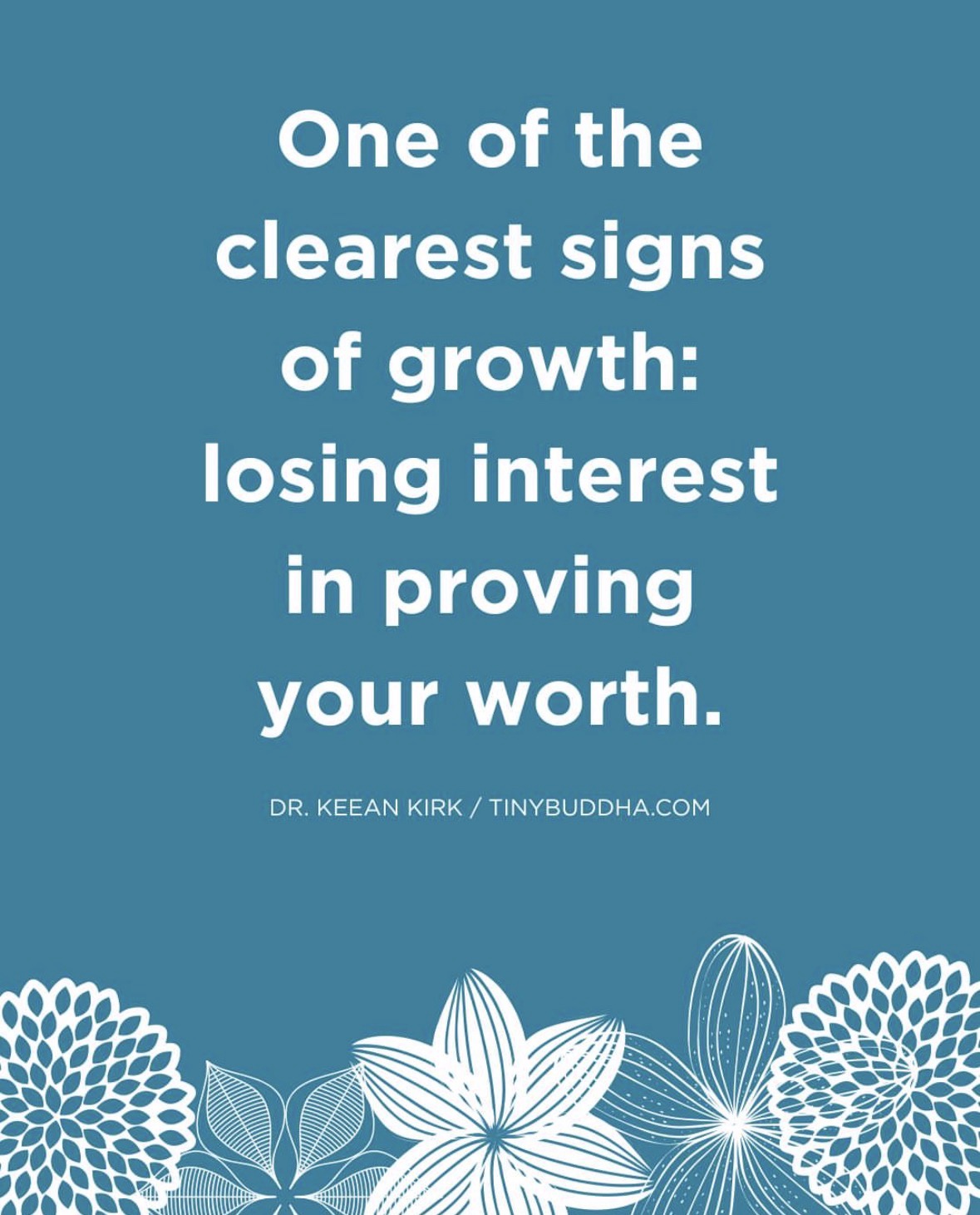
One of the clearest signs of growth is losing interest in proving your worth.
Not because you’ve become arrogant.
Not because you’ve stopped caring.
But because something inside you finally settled.
For a long time, most of us live in audition mode. We over-explain. We over-deliver. We overthink. We chase credentials, applause, metrics, titles, and subtle nods of approval. Even when we’re successful, we’re still trying to justify why we deserve to be there.
We mistake exhaustion for ambition.
We think confidence means having the loudest answer in the room. We think leadership means always being right. We think being valuable means being indispensable.
But growth rewires that.
You start realizing that constantly proving yourself is actually a sign you’re unsure of yourself. When you’re grounded, you don’t need to broadcast it. When you’re capable, you don’t need to convince. When you know who you are, you don’t need a debate to confirm it.
You just show up. And do the work.
There’s a calmness that replaces the old hunger for validation. You speak when you have something meaningful to add, not when you’re afraid of being invisible. You take feedback without crumbling or flaring up. You don’t chase every disagreement like it’s a personal attack on your identity.
You don’t feel threatened by someone else’s shine.
That’s growth.
It’s subtle. It doesn’t announce itself. It doesn’t post about itself. It just quietly removes the noise.
You start choosing peace over being right.
Depth over attention.
Consistency over applause.
And something interesting happens when you stop trying so hard to prove your worth — people begin to feel it.
Your presence changes. You become steady. Reliable. Hard to rattle. Your energy is less reactive and more intentional. There’s less scrambling and more clarity.
You no longer measure your value by how much you can carry. You understand that boundaries are not weakness. Saying no is not laziness. Delegating is not incompetence.
You don’t jump into every conversation to defend your capability. You don’t feel the urge to turn every success into a public receipt. You’re okay letting your work speak without a megaphone.
Because deep down, you know your worth isn’t up for negotiation.
This doesn’t mean you stop striving. It means you stop striving from insecurity.
You still aim high. You still push yourself. You still want to grow. But it’s coming from a different place now. Not from fear of being “found out.” Not from the need to impress. Not from trying to fill a quiet insecurity that keeps whispering, “Are you enough?”
Growth answers that whisper gently.
Yes.
And once you internalize that, everything shifts.
You become more generous with credit.
More patient with process.
More detached from outcomes you can’t control.
You don’t need to win every room. You don’t need to dominate every discussion. You don’t need to outshine. You’re secure enough to collaborate.
You realize the strongest people in the room are usually the calmest.
There’s freedom in no longer auditioning for approval. Freedom in letting go of imaginary scoreboards. Freedom in accepting that not everyone has to understand you for you to be valid.
You stop shrinking to make others comfortable.
You stop inflating to make yourself impressive.
You just stand.
Growth isn’t loud. It doesn’t scream transformation. It often looks like restraint. Like silence. Like walking away from arguments you would have once fought to win.
It looks like choosing alignment over applause.
And maybe the most beautiful part of all — when you stop obsessing over proving your worth, you finally have the energy to live it.
Not for show.
Not for validation.
Just because it’s who you’ve become.
SWOT
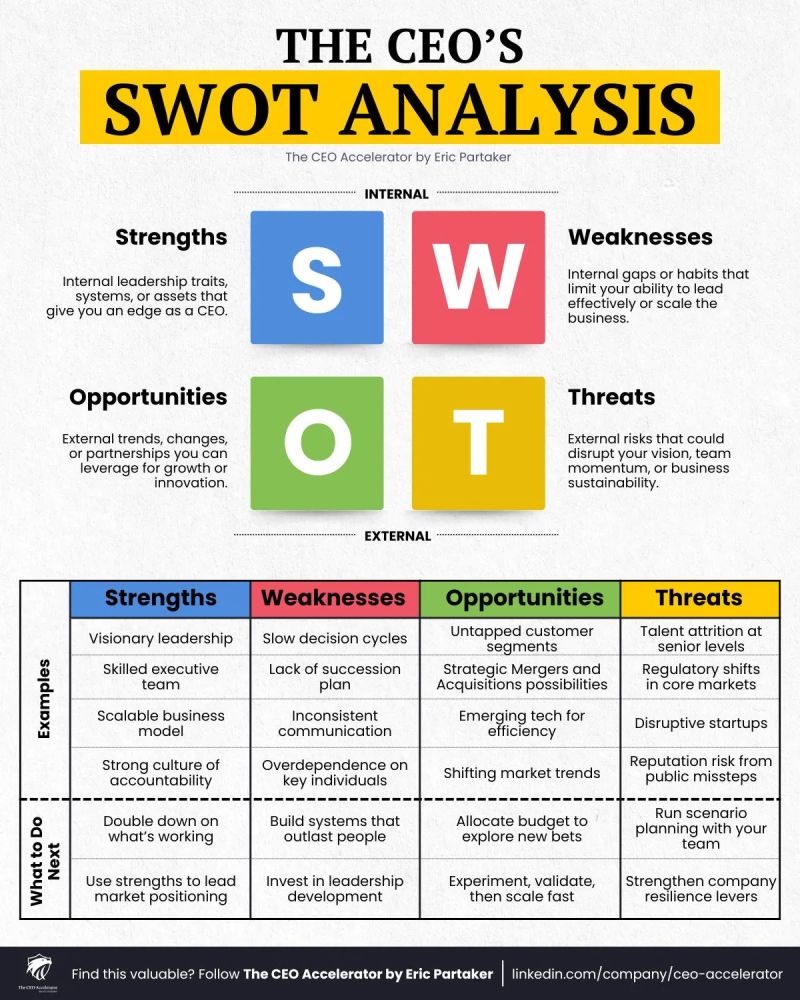
The old-school tool every CEO should still use.
SWOT analysis has been around for decades.
But the best CEOs I coach still use it. Because it works.
Why?
It helps you see what others miss.
Your strengths, weaknesses, opportunities, and threats
aren’t just business school concepts.
They’re the building blocks of clear vision.
And vision is something you can’t delegate.
When your vision is unclear, your team is left guessing.
When it’s sharp, execution becomes effortless.
Use SWOT analysis to sharpen your strategy:
🔍 Strengths (Internal)
• What personal traits give you a competitive edge?
• What systems have you built that actually work?
• Which assets—skills, relationships, resources—aren’t fully leveraged yet?
🔍 Weaknesses (Internal)
• Where do your patterns keep slowing you down?
• What hard conversations are you avoiding?
• Which blind spots are holding your team back?
🔍 Opportunities (External)
• What market trends are moving in your direction?
• Which partnerships or hires could change the game?
• Where could you move faster than competitors?
🔍 Threats (External)
• What risks are hiding in plain sight?
• Which competitor’s momentum makes you uneasy?
• Where is your team vulnerable?
The real value of this tool?
It forces you to step back and see the full picture.
✅ Make better decisions
✅ Get your team aligned
✅ Lead with sharper insight
Take 30 minutes this week.
Map your SWOT.
Share it with your leadership team.
Have each develop their own.
Clarity is a competitive advantage.
The Art of the U-Turn
We’ve all been there – standing in a room, looking at the wallpaper, and realizing with a sinking gut feeling that we don’t recognize a single thing about where we’ve landed.
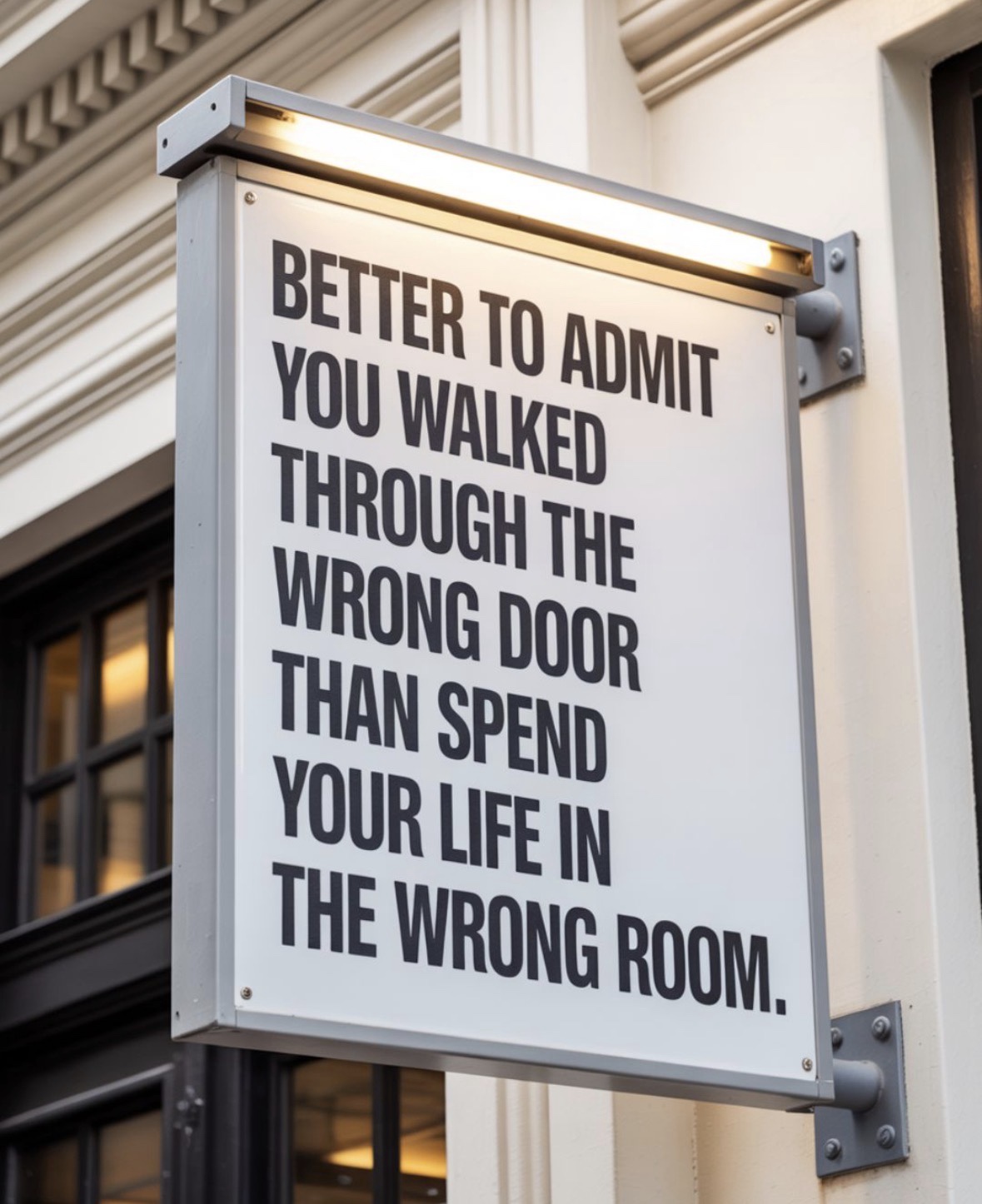
I’ve shared this sentiment before because it’s one of those truths that bears repeating: It is better to admit you walked through the wrong door than to spend your entire life in the wrong room.
It sounds simple on paper, doesn’t it? Just turn around. But in reality, that door behind us often feels like it’s been welded shut by our own pride, or maybe by the sheer amount of time we spent trying to pick the lock to get in. We treat our past decisions like permanent tattoos rather than temporary directions. We stay in the wrong careers, the stagnant relationships, or the outdated versions of ourselves simply because we already unpacked our bags.
There is a specific kind of bravery required to be the person who says, “I was wrong about this.” We live in a culture that obsesses over “finishing what you started” and “sticking it out.” While grit has its place, there is a very fine line between perseverance and self-delusion.
If you’re climbing a ladder that’s leaning against the wrong wall, it doesn’t matter how fast you climb; you’re still going to end up in the wrong place.
Think about the “Sunk Cost Fallacy.” It’s that nagging voice telling you that because you’ve already spent five years or five thousand dollars on something, you have to keep going. But those five years are gone regardless of what you do next. The only thing you can control is whether you waste the next five years. Admitting you walked through the wrong door isn’t a failure of character; it’s an act of massive self-respect. It’s an acknowledgement that your future is worth more than the preservation of a mistake.
The moment you stop trying to decorate a room you hate is the moment you become free to find the one where you actually belong. It’s messy to leave. People might stare as you walk back out into the hallway. You might feel a little foolish standing there with your map turned upside down.
But that temporary embarrassment is a small price to pay for a life that actually fits.
The exit sign is rarely as scary as the prospect of sitting in that wrong room until the lights go out. So, if you’re looking around today and realizing the view isn’t what you hoped for, remember that you aren’t stuck. The door you came in through is still there. You’re allowed to use it.
How to Handle Pressure Like a Professional
Pressure is not a sign of weakness.
It is a signal that responsibility, growth, and expectations are present.
Successful professionals don’t avoid pressure they learn how to manage it effectively.
Here are proven ways to stay calm, focused, and productive under pressure:
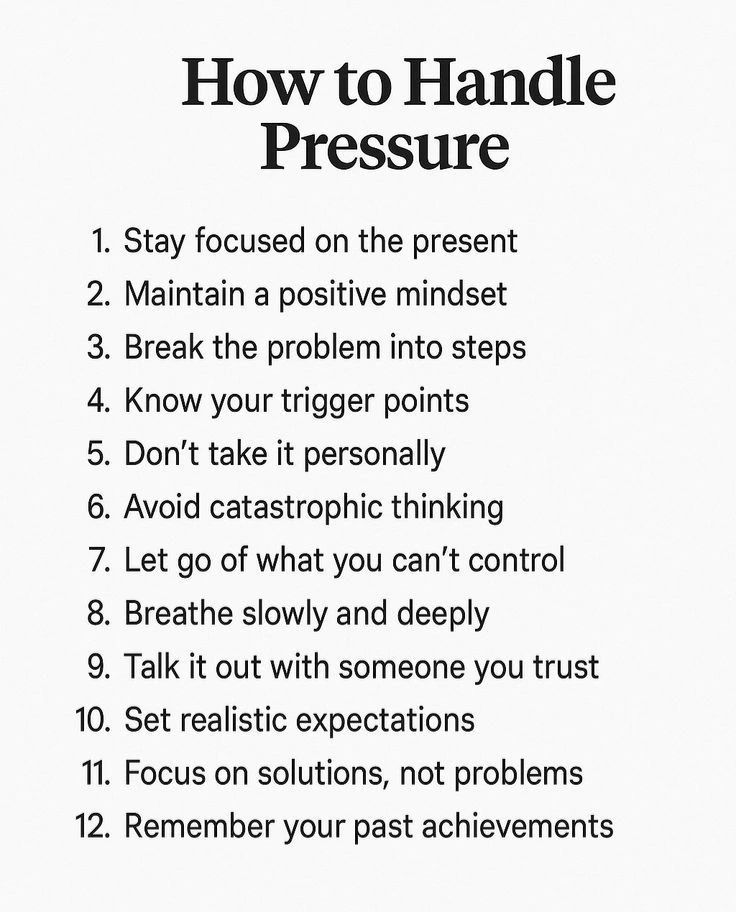
1. Stay focused on the present
Pressure often comes from worrying about outcomes. Bring your attention back to what you can do right now. One clear action reduces anxiety.
2. Maintain a positive mindset
A positive mindset does not ignore challenges. It helps you see opportunities, lessons, and solutions even in difficult situations.
3. Break the problem into steps
Big problems feel heavy. Breaking them into small, manageable steps makes progress achievable and keeps momentum strong.
4. Know your trigger points
Understand what situations, people, or thoughts increase your stress. Awareness gives you control over your reactions.
5. Don’t take it personally
Most pressure is about roles, deadlines, or expectations not about you as a person. Separate your self-worth from the situation.
6. Avoid catastrophic thinking
One setback does not mean failure. Keep facts separate from assumptions and focus on realistic outcomes.
7. Let go of what you can’t control
Energy spent on uncontrollable factors increases stress. Focus on effort, preparation, and attitude these are always in your control.
8. Breathe slowly and deeply
Deep breathing calms the nervous system and clears the mind. A calm body leads to better decisions.
9. Talk it out with someone you trust
Sharing pressure reduces its weight. A fresh perspective often brings clarity and confidence.
10. Set realistic expectations
High standards are good, but unrealistic expectations create unnecessary pressure. Progress matters more than perfection.
11. Focus on solutions, not problems
Problems drain energy. Solutions create momentum. Train your mind to ask, “What can I do next?”
12. Remember your past achievements
You have handled pressure before and succeeded. Confidence grows when you remind yourself of your journey.
Pressure builds professionals.
How you respond defines your growth.
The Four People Every Life Needs (And the Quiet Responsibility That Comes With Them)
At some point in life, most of us realize that independence isn’t the same thing as isolation. You can be strong and still need support. You can be capable and still need guidance. The people who grow with the most steadiness aren’t the ones who never lean on anyone else, but the ones who know who to lean on—and when.
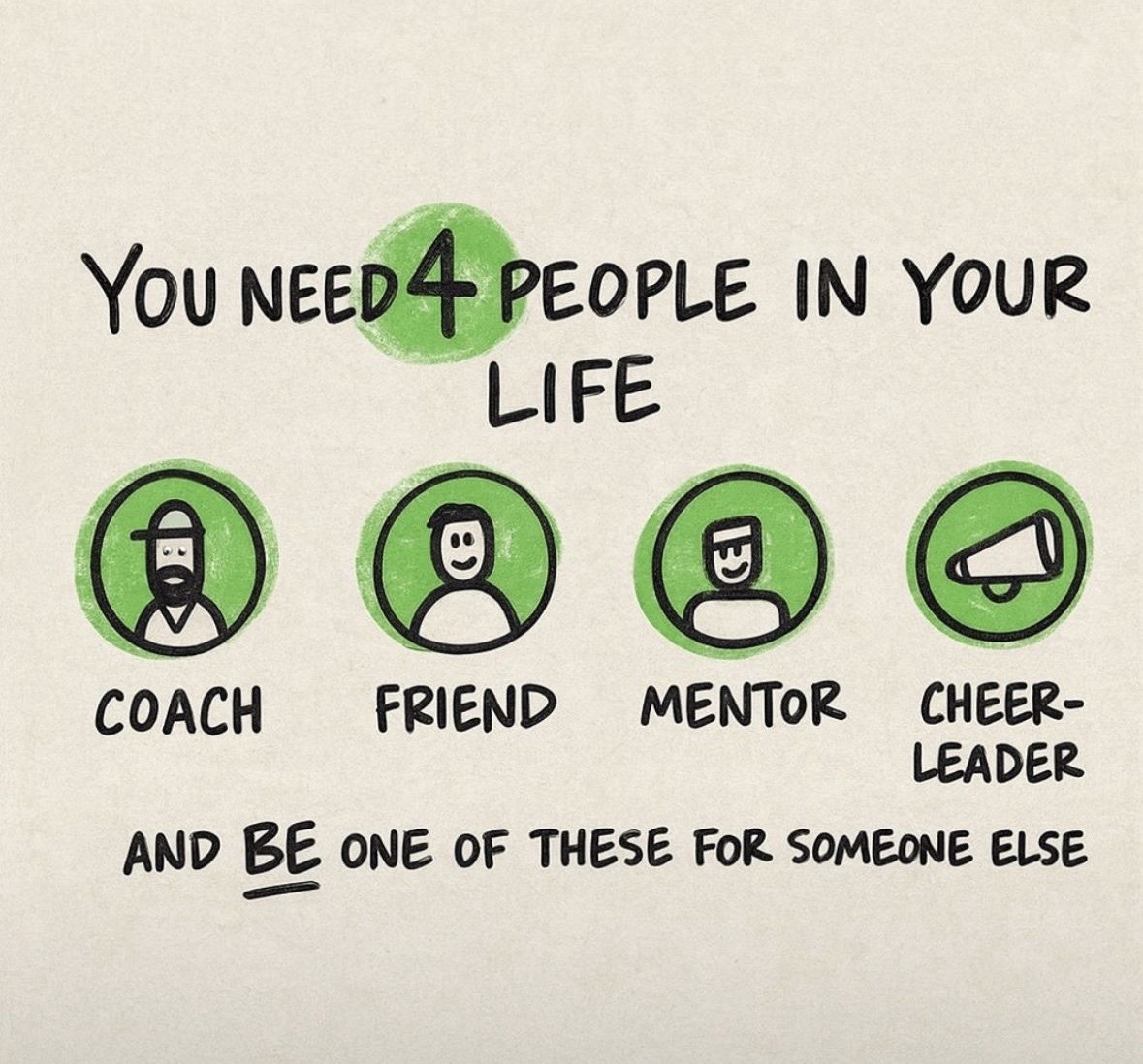
You need a coach. This is the person who helps you sharpen your edge. They see your blind spots before you do and aren’t afraid to point them out. A coach doesn’t just tell you what you want to hear. They ask better questions, raise the bar, and remind you that your current version isn’t your final one. They push you not because you’re lacking, but because there’s more in you.
You need a friend. Not someone who’s there only for the good days, but someone who stays when life gets messy. A friend knows your history, your flaws, and your inconsistencies—and chooses you anyway. With a friend, you don’t have to perform. You don’t have to explain yourself all the time. You can just be human. And that kind of safety is rare and powerful.
You need a mentor. A mentor offers perspective that can only come from having walked the road ahead of you. They help you see the bigger picture when you’re stuck in the moment. They remind you that setbacks are chapters, not conclusions. A mentor doesn’t rush you. They steady you. They help you make wiser choices by sharing what experience has already taught them.
You need a cheerleader. This is the person who believes in you on the days you struggle to believe in yourself. They celebrate your progress without comparison. They remind you of your strengths when self-doubt creeps in. Cheerleaders don’t fix your problems; they give you the emotional fuel to keep moving forward.
And then there’s the part we often overlook.
You’re meant to be one of these people for someone else.
At different moments in your life, you’ll step into each role. You’ll coach someone through a tough decision, mentor someone who’s just starting out, be a steady friend in a hard season, or cheer someone on when they’re ready to give up. You won’t always realize the impact you’re having, but it will matter more than you think.
Life isn’t built through solo effort. It’s shaped through relationships that challenge you, ground you, guide you, and lift you. And when those roles flow both ways, growth stops being lonely and starts becoming meaningful.
What Gives Energy vs. What Drains Energy – A Leadership & Life Lesson
Energy is not only physical.
It is mental, emotional, and behavioral.
How we manage our energy directly decides our productivity, focus, and long-term success.
When we gain energy, we grow.
When we lose energy, even simple tasks feel heavy.
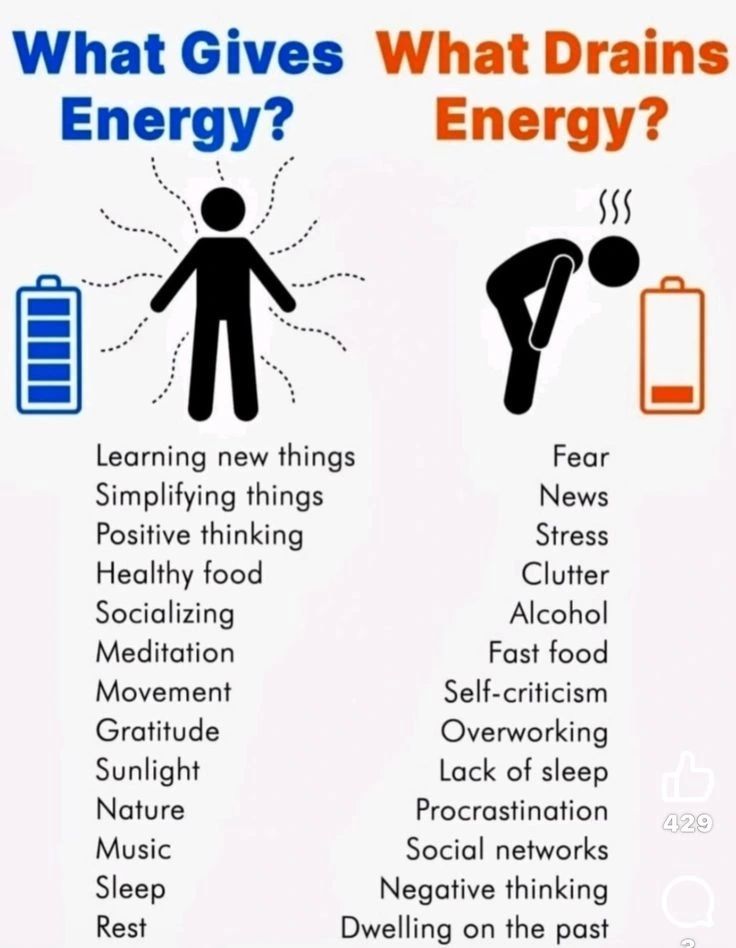
What truly gives us energy?
Learning new things keeps the mind active and confident.
Simplifying work reduces mental overload and improves clarity.
Positive thinking shapes better decisions and stronger resilience.
Healthy food fuels both the body and brain.
Socializing builds emotional balance and reduces isolation.
Meditation and movement help reset the nervous system.
Gratitude shifts focus from problems to progress.
Sunlight, nature, music, proper sleep, and rest restore us naturally.
These habits may look small, but together they build sustainable performance.
What silently drains our energy?
Fear and constant negative news create anxiety.
Stress, clutter, and overworking exhaust the mind.
Alcohol and fast food reduce physical stamina.
Self-criticism weakens confidence.
Lack of sleep breaks focus and discipline.
Procrastination increases pressure.
Excessive social media distracts attention.
Negative thinking and dwelling on the past block growth.
Most energy drains are not sudden they are daily habits we ignore.
Professional insight:
Success is not about doing more.
It is about protecting your energy so you can do what matters better.
Choose habits that recharge you.
Reduce habits that silently consume you.
Your energy is your real asset.
10 habits that will make you happier than 98% of people
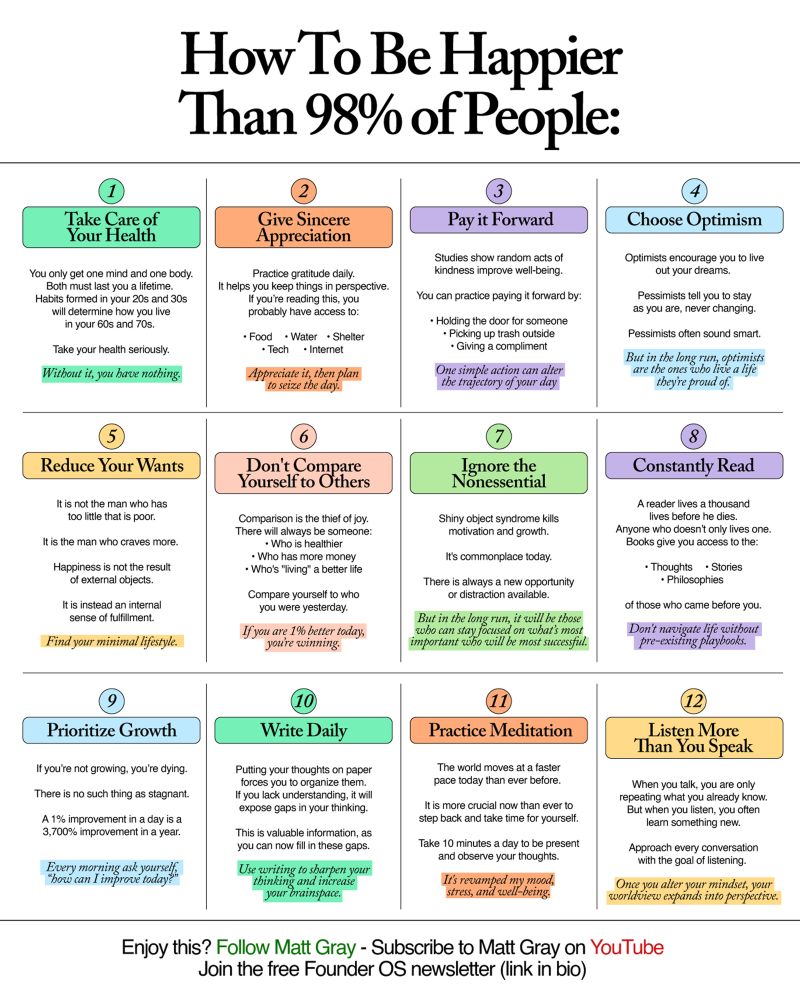
1. Take Care of Your Health
You only get one mind and one body.
Both must last you a lifetime.
Habits formed in your 20s and 30s will determine how you live in your 60s and 70s.
Take your health seriously.
Without it, you have nothing.
2. Give Sincere Appreciation
Practice gratitude daily.
It helps you keep things in perspective.
If you’re reading this, you probably have access to:
• Food
• Water
• Shelter
• Tech
• Internet
Appreciate it, then plan to seize the day.
3. Pay it Forward
Studies show random acts of kindness improve well-being.
You can practice paying it forward by:
• Holding the door for someone
• Picking up trash outside
• Giving a compliment
One simple action can alter the trajectory of your day.
4. Choose Optimism
Optimists encourage you to live out your dreams.
Pessimists tell you to stay as you are, never changing.
Pessimists often sound smart.
But in the long run, optimists are the ones who live a life they’re proud of.
5. Reduce Your Wants
It is not the man who has too little that is poor.
It is the man who craves more.
Happiness is not the result of external objects.
It is instead an internal sense of fulfillment.
Find your minimal lifestyle.
6. Don’t Compare Yourself to Others
Comparison is the thief of joy.
There will always be someone:
• Who is healthier
• Who has more money
• Who’s “living” a better life
Compare yourself to who you were yesterday.
If you are 1% better today, you’re winning.
7. Ignore the Nonessential
Shiny object syndrome kills motivation and growth.
It’s commonplace today.
There is always a new opportunity or distraction available.
But in the long run, it will be those who can stay focused on what’s most important who will be most successful.
8. Constantly Read
A reader lives a thousand lives before he dies.
Anyone who doesn’t only lives one.
Books give you access to the:
• Thoughts
• Stories
• Philosophies
of those who came before you.
Don’t navigate life without pre-existing playbooks.
9. Prioritize Growth
If you’re not growing, you’re dying.
There is no such thing as stagnant.
A 1% improvement in a day is a 3,700% improvement in a year.
Every morning ask yourself, “how can I improve today?”
10. Write Daily
Putting your thoughts on paper forces you to organize them.
If you lack understanding, it will expose gaps in your thinking.
This is valuable information, as you can now fill in these gaps.
Use writing to sharpen your thinking and increase your brainspace.
What’s your goal?
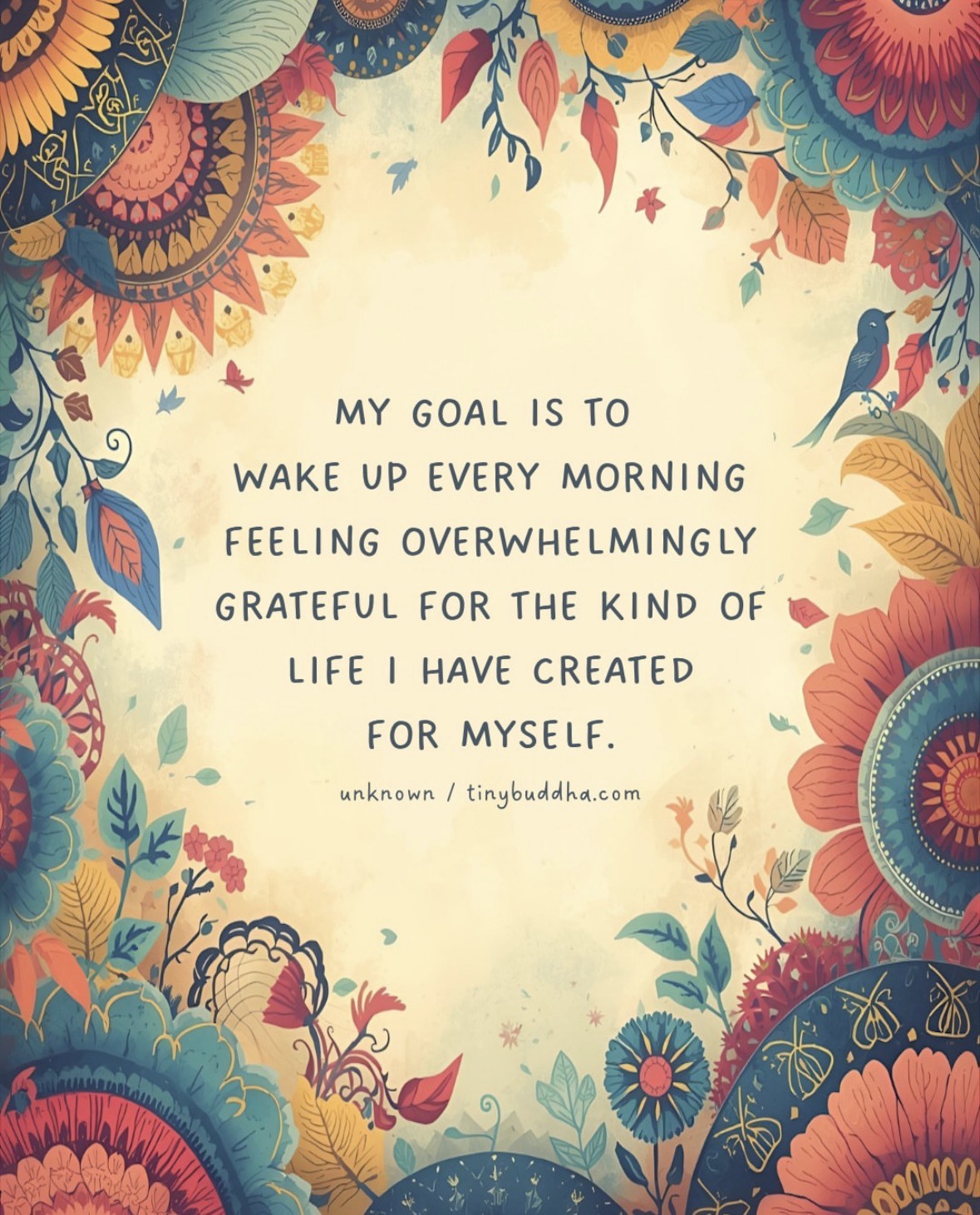
My goal isn’t perfection. It’s not hustle for the sake of hustle, or applause, or proving anything to anyone. My goal is simpler, quieter, and somehow much bigger than all of that.
I want to wake up every morning feeling overwhelmingly grateful for the kind of life I have created for myself.
Not the kind of gratitude that shows up only on vacations or milestone days. Not the highlight reel version. I mean the ordinary-morning kind. The kind that shows up before the phone is checked. Before the day begins asking things of me. The kind that sits there gently and says, you’re okay. You built something that fits you.
Gratitude like that doesn’t come from luck. It comes from alignment. From a thousand small choices made consistently, often quietly, often when no one is watching. It comes from deciding what matters, and then having the courage to let other things matter less.
For a long time, I thought a good life was something that happened after you arrived somewhere. After the promotion. After the recognition. After the chaos settled down. But the truth is, life doesn’t pause while you’re chasing the next thing. It’s happening while you’re becoming. And if you’re not careful, you can build a life that looks impressive from the outside but feels exhausting from the inside.
The kind of life that inspires real gratitude is one that feels honest. One where your days aren’t constantly at war with your values. Where the way you spend your time actually reflects what you say you care about. Where success doesn’t cost you your peace, your health, or your relationships.
It’s waking up knowing you don’t have to pretend today. Knowing you don’t have to abandon yourself just to keep up. Knowing that even on hard days, you’re living in a direction that makes sense to you.
Gratitude, I’ve learned, isn’t passive. It’s built. It’s designed. Sometimes it’s protected fiercely. It means saying no more often than feels comfortable. It means choosing rest when the world rewards burnout. It means choosing presence when distraction is easier. It means redefining winning so it includes joy, not just progress.
Some mornings, gratitude looks like contentment. Other mornings, it looks like relief. And on the best mornings, it looks like quiet excitement. Not because everything is perfect, but because nothing feels wildly out of place.
I want a life where my mornings don’t begin with dread. Where Sundays don’t feel like a countdown. Where success doesn’t require me to shrink parts of myself that matter. I want a life that leaves room for laughter, for faith, for stillness, for growth that doesn’t feel violent.
That kind of life doesn’t arrive fully formed. It’s shaped slowly, through intentional living. Through learning what drains you and what fills you back up. Through paying attention to how your body responds to your choices. Through honoring seasons instead of fighting them.
And yes, there will always be more to want. More to fix. More to chase. But gratitude isn’t about having everything. It’s about recognizing when you have enough, and letting that be a source of joy rather than guilt.
If one day I can wake up, take a deep breath, and feel genuinely thankful for the life I’ve built, the pace I’ve chosen, the people I’ve kept close, and the person I’m becoming, then I’ll know I did something right.
Not because life was easy.
But because it was mine.
6 Decisions That Define A CEO
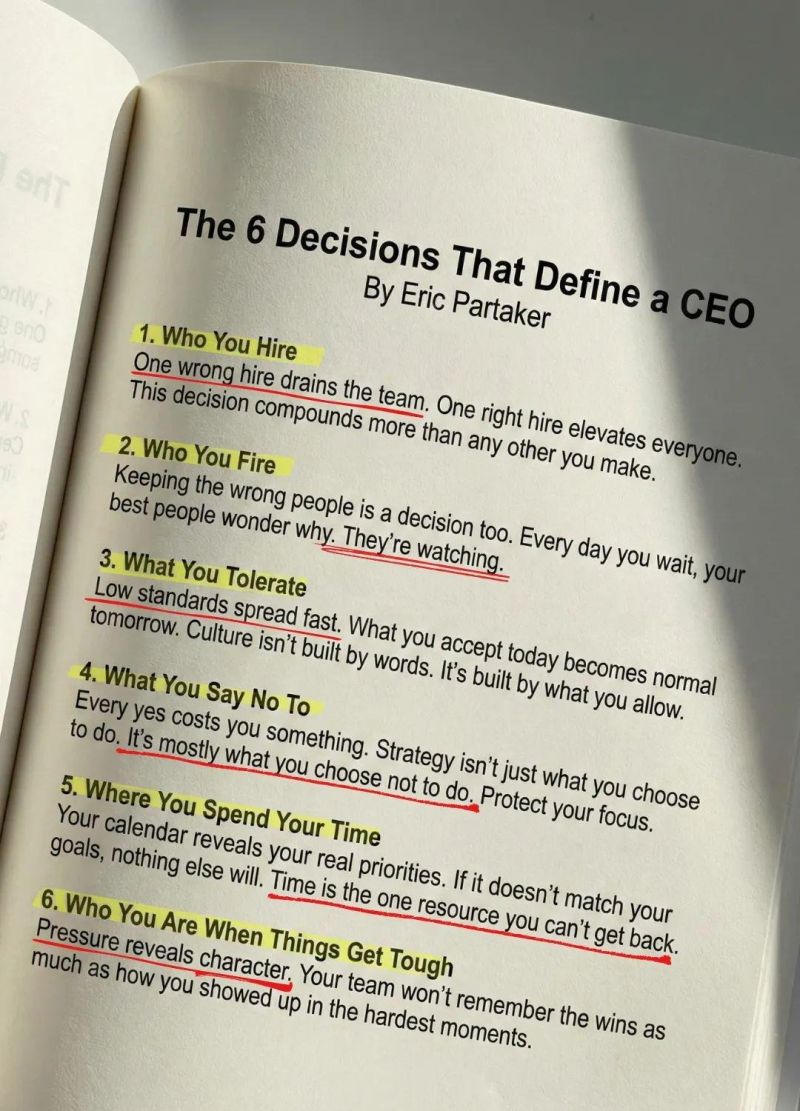
The #1 thing that separates the best CEOs from the rest:
It’s not their vision.
It’s not their strategy.
It’s not even their intelligence.
It’s 6 decisions they make every single day.
Most people think being a CEO is about the big moves.
The acquisitions.
The product launches.
The inspiring speeches.
I used to think that too.
But after years of leading teams, I’ve learned the truth:
Your company is shaped by the small decisions you make repeatedly.
Not the ones that make headlines.
The ones nobody sees.
Here are the 6 that matter most:
1️⃣ Who you hire
One wrong hire drains everyone around them. One right hire elevates the entire team. No decision compounds faster than this one.
2️⃣ Who you fire
Keeping the wrong person is a decision too. Every day you wait, your best people are watching. And wondering why.
3️⃣ What you tolerate
Low standards spread like wildfire. What you accept today becomes normal tomorrow. Culture isn’t built by what you say. It’s built by what you allow.
4️⃣ What you say no to
Every yes costs you something. Strategy isn’t just what you choose to do. It’s what you choose NOT to do. Protect your focus like your future depends on it.
5️⃣ Where you spend your time
Your calendar never lies. It reveals your real priorities. If it doesn’t match your goals, nothing else will.
6️⃣ Who you are when things get tough
Pressure doesn’t build character. It reveals it. Your team will forget the wins. They’ll never forget how you made them feel in the hard times.
You’re already making these decisions.
Whether you realize it or not.
Every person you keep is a decision.
Every meeting you attend is a decision.
Every behavior you tolerate is a decision.
The question isn’t whether you’re making them.
It’s whether you’re making them on purpose.
The best CEOs don’t leave these to chance.
They treat them as sacred.
Because they know the truth:
Your company will never outgrow the standards you set at the top.
Which of these defines a CEO’s legacy most?

