
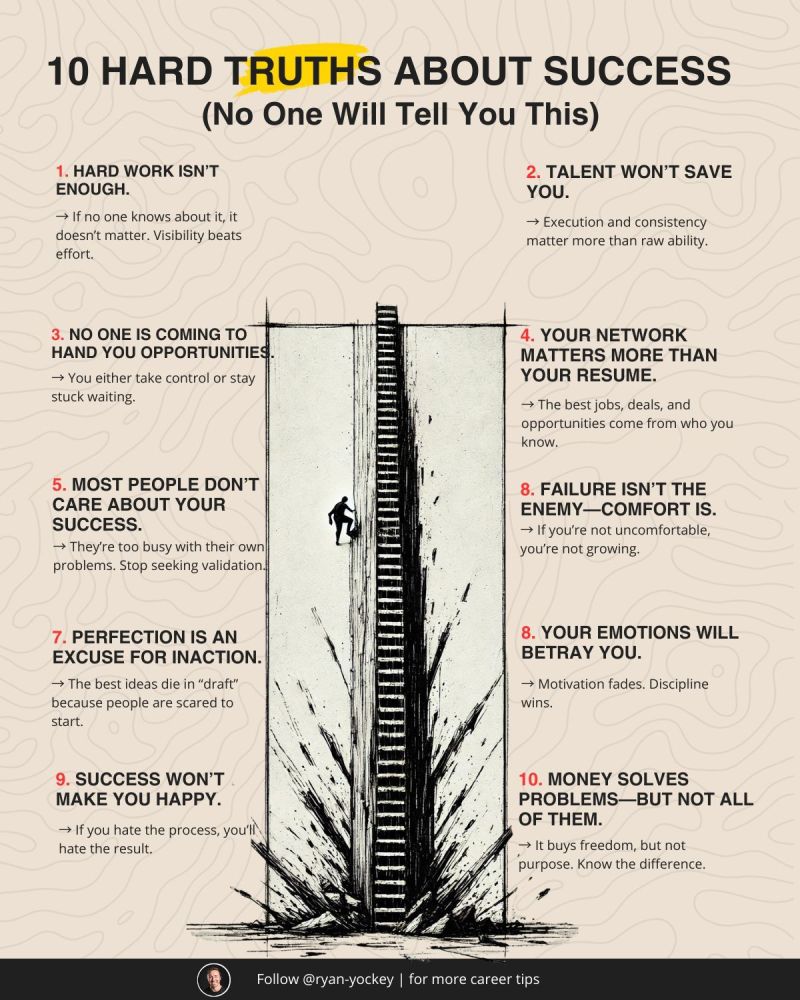
Read this before you waste another year chasing the wrong things.
1️⃣ Hard work isn’t enough.
→ If no one knows about it, it doesn’t matter. Visibility beats effort.
2️⃣ Talent won’t save you.
→ Execution and consistency matter more than raw ability.
3️⃣ No one is coming to hand you opportunities.
→ You either take control or stay stuck waiting.
4️⃣ Your network matters more than your resume.
→ The best jobs, deals, and opportunities come from who you know.
5️⃣ Most people don’t care about your success.
→ They’re too busy with their own problems. Stop seeking validation.
6️⃣ Failure isn’t the enemy—comfort is.
→ If you’re not uncomfortable, you’re not growing.
7️⃣ Perfection is an excuse for inaction.
→ The best ideas die in “draft” because people are scared to start.
8️⃣ Your emotions will betray you.
→ Motivation fades. Discipline wins.
9️⃣ Success won’t make you happy.
→ If you hate the process, you’ll hate the result.
🔟 Money solves problems—but not all of them.
→ It buys freedom, but not purpose. Know the difference.
1️⃣1️⃣ Most people quit too soon.
→ The winners? They just last longer than everyone else.
1️⃣2️⃣ Success isn’t given. It’s taken.
→ No one is going to push you. If you want more, you have to make it happen.
The Enough Theory

Most of us are quietly running an exhausting experiment.
If I improve a little more.
If I explain myself better.
If I become calmer, smarter, more patient, less sensitive, more successful.
Then maybe I’ll finally be enough.
So we try. We adjust. We sand down edges. We overthink text messages, rehearse conversations, apologize for things that didn’t need apologies. We confuse effort with love and self-erasure with growth. And when it still doesn’t work, we turn the conclusion inward: I must be the problem.
But here’s the part we rarely stop to question—what if “enough” was never the variable?
In your best moments, when you are showing up fully, trying honestly, offering the best version of yourself you know how to give, there will still be people for whom it won’t land. They’ll focus on what’s missing. On what you didn’t say right. On who you aren’t yet. No amount of polishing will change the fact that alignment can’t be manufactured.
And in your worst moments—the messy ones, the tired ones, the seasons where you’re not impressive or productive or particularly likable—you’ll find someone who doesn’t need you to perform. Someone who stays. Someone who understands that worth doesn’t disappear just because you’re having a hard chapter.
That’s the quiet truth behind the Enough Theory: love was never about perfection. It was about fit.
The wrong people tend to experience you as a list of flaws to be managed. They notice your pauses, your doubts, your rough edges. They make you feel like love is conditional—something you earn by behaving correctly. Being with them feels like standing trial. You’re always one mistake away from disapproval.
The right people experience you as a whole. They see the same imperfections but don’t treat them as disqualifiers. They notice your light even when you’re standing in the dark. With them, effort feels mutual, not one-sided. You don’t feel smaller trying to be loved; you feel more yourself.
This is where so many of us get stuck. We assume that repeated rejection is proof of unworthiness, when often it’s just proof of misalignment. We keep auditioning for roles we were never meant to play, in relationships that require us to betray who we are to belong.
You were never unworthy.
You didn’t fail because you weren’t enough.
You were just offering yourself to the wrong audience.
And the moment that shifts—when the eyes looking at you are the right ones—something profound happens. You stop trying to convince. You stop overcorrecting. You stop shrinking. Love becomes less about proving and more about being.
The Enough Theory isn’t about waiting for validation. It’s about recognizing that your value isn’t negotiated in other people’s limitations. It’s about trusting that alignment feels lighter, calmer, safer. It doesn’t ask you to disappear to be accepted.
You don’t need to become more lovable.
You just need to be seen by someone who knows how to love what’s already there.
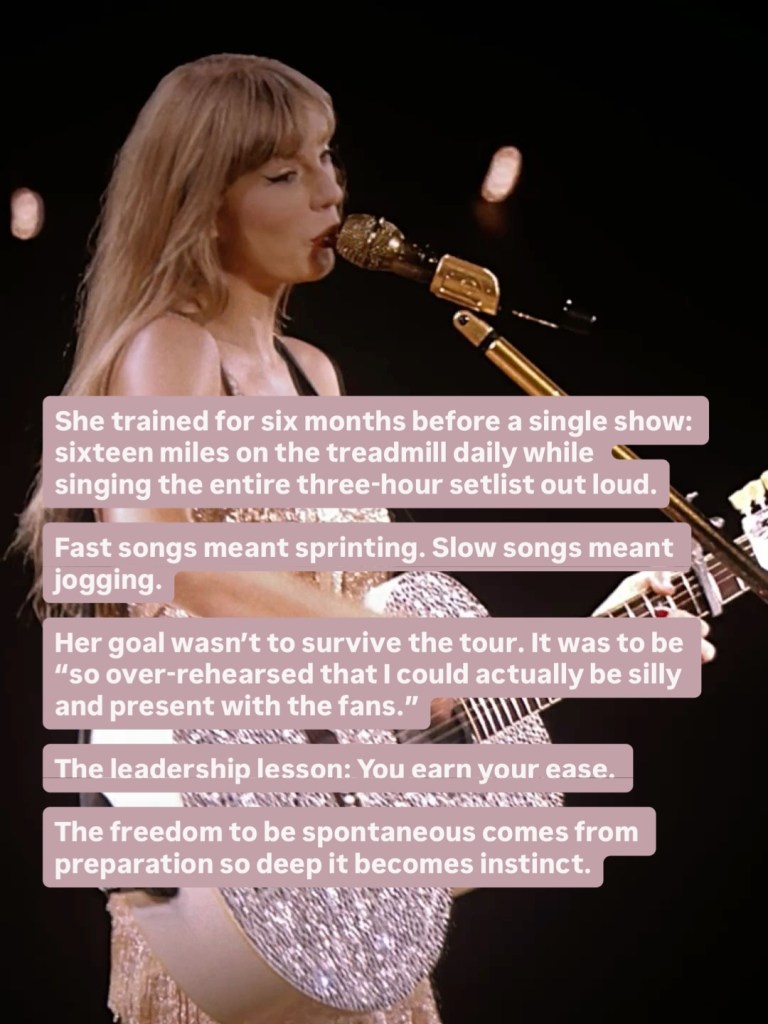
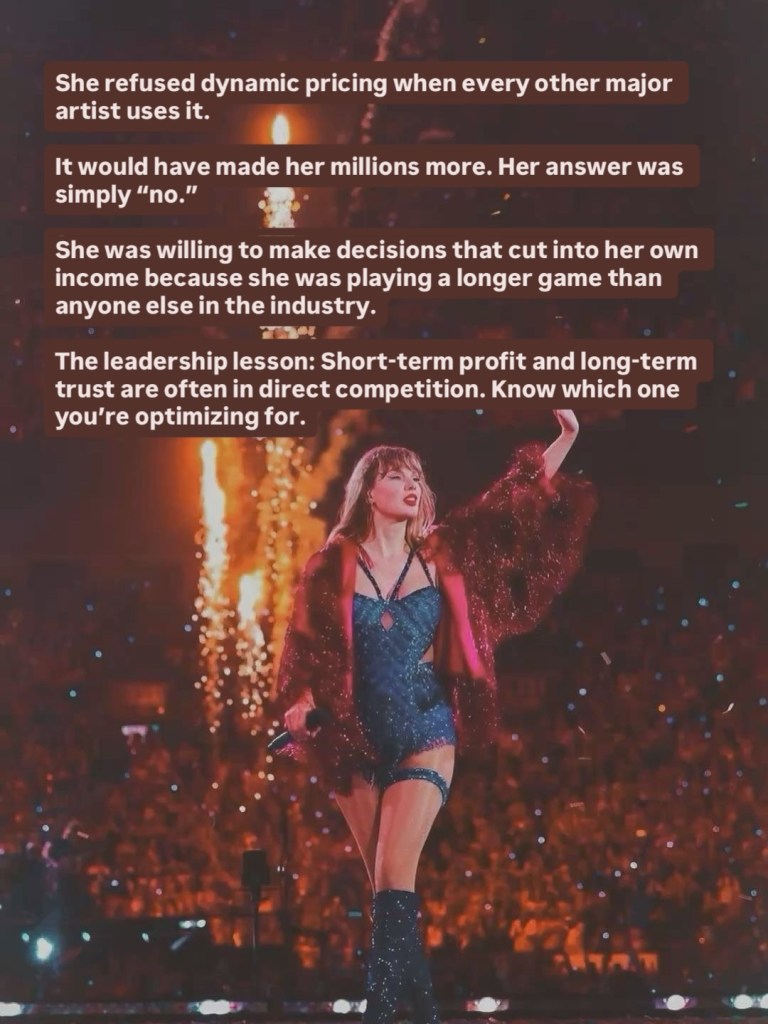
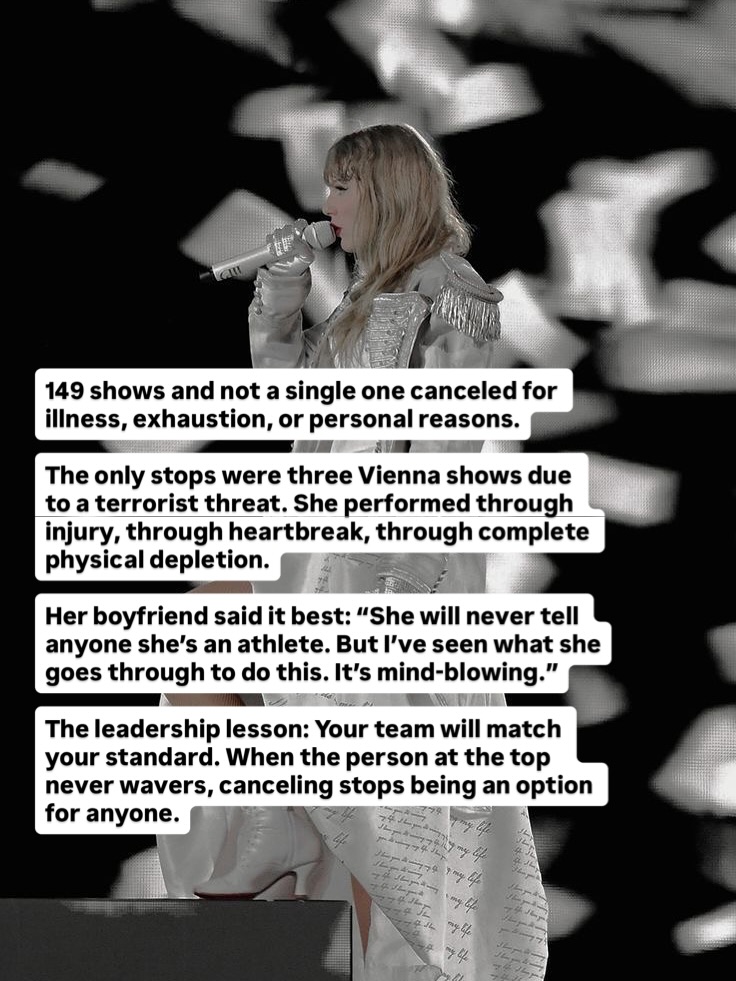
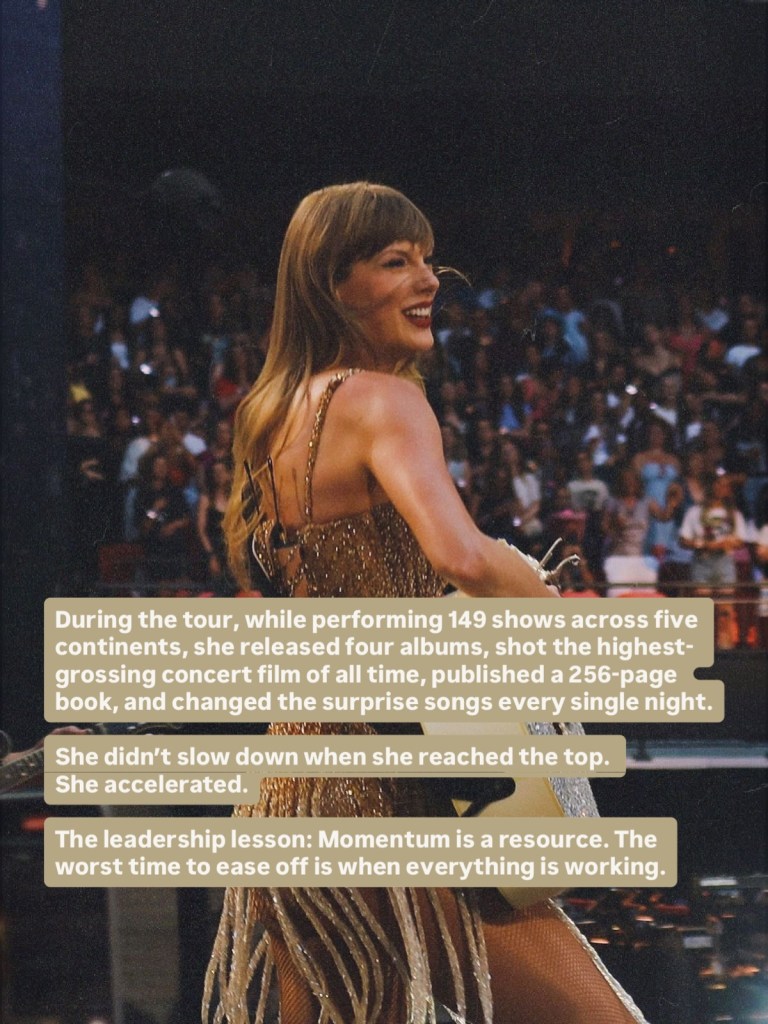
The Discipline Behind the Glitter
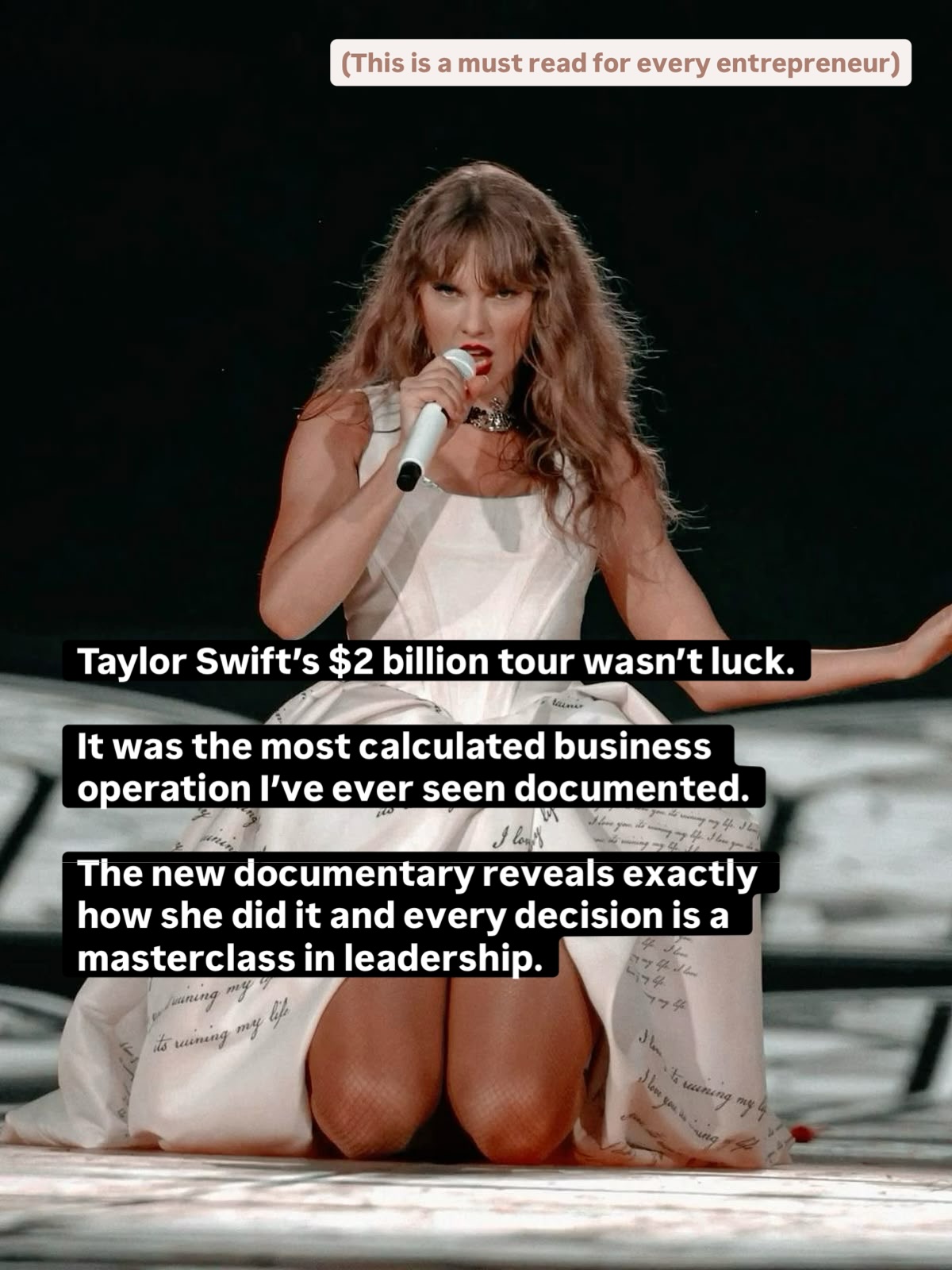
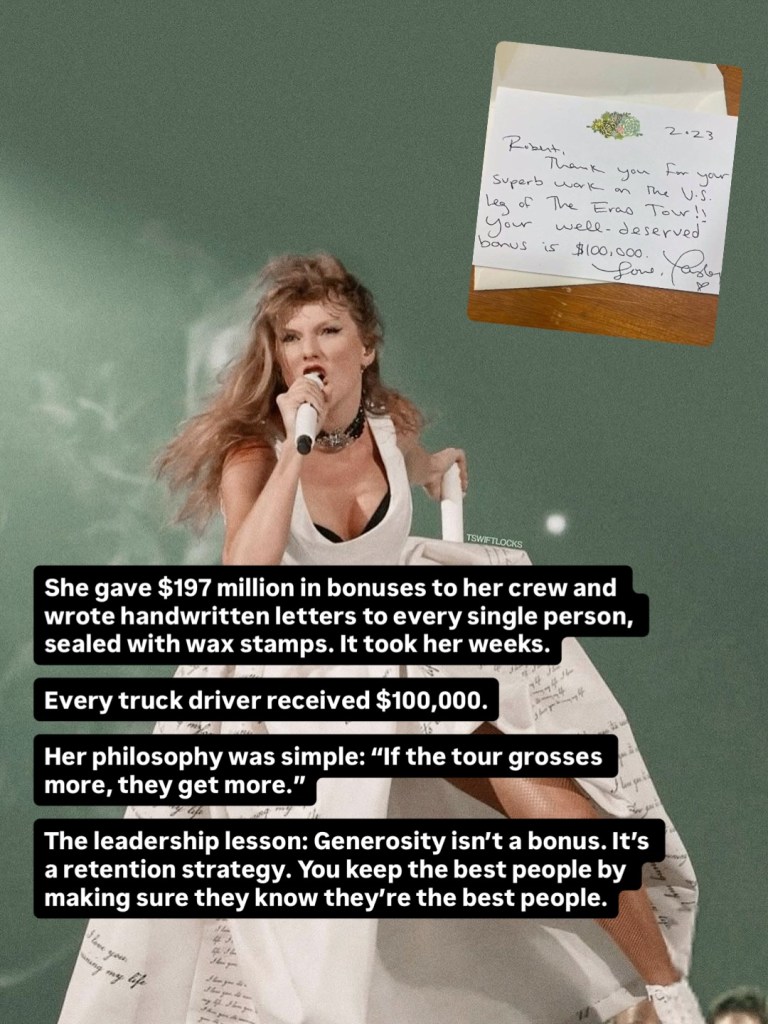
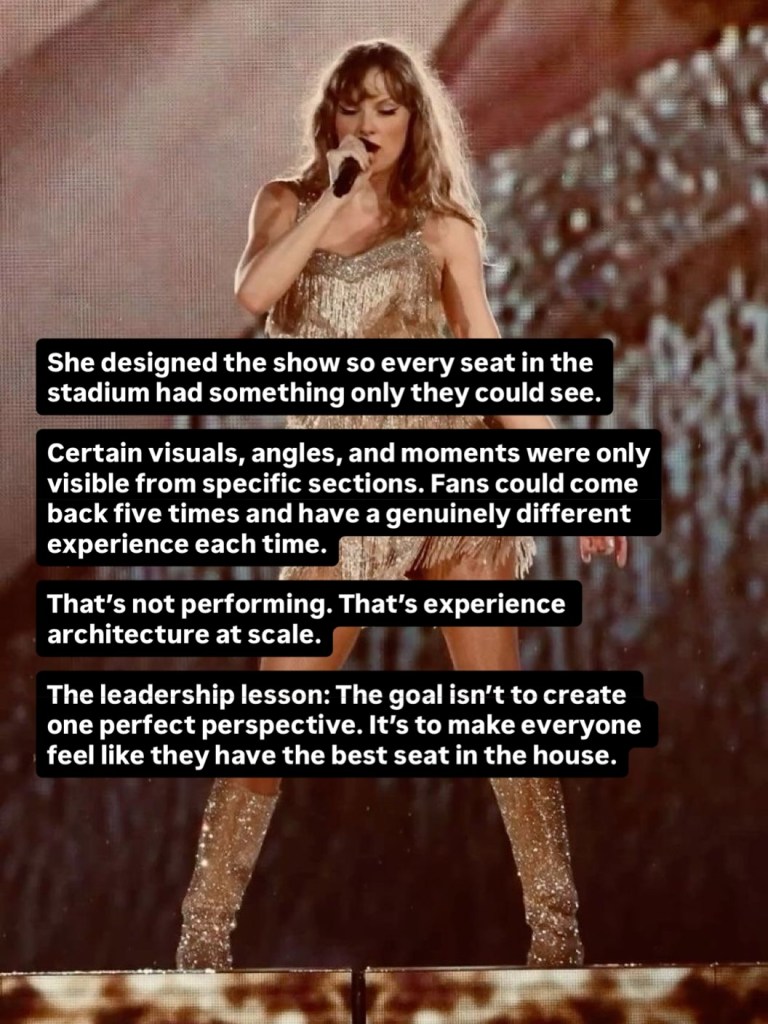
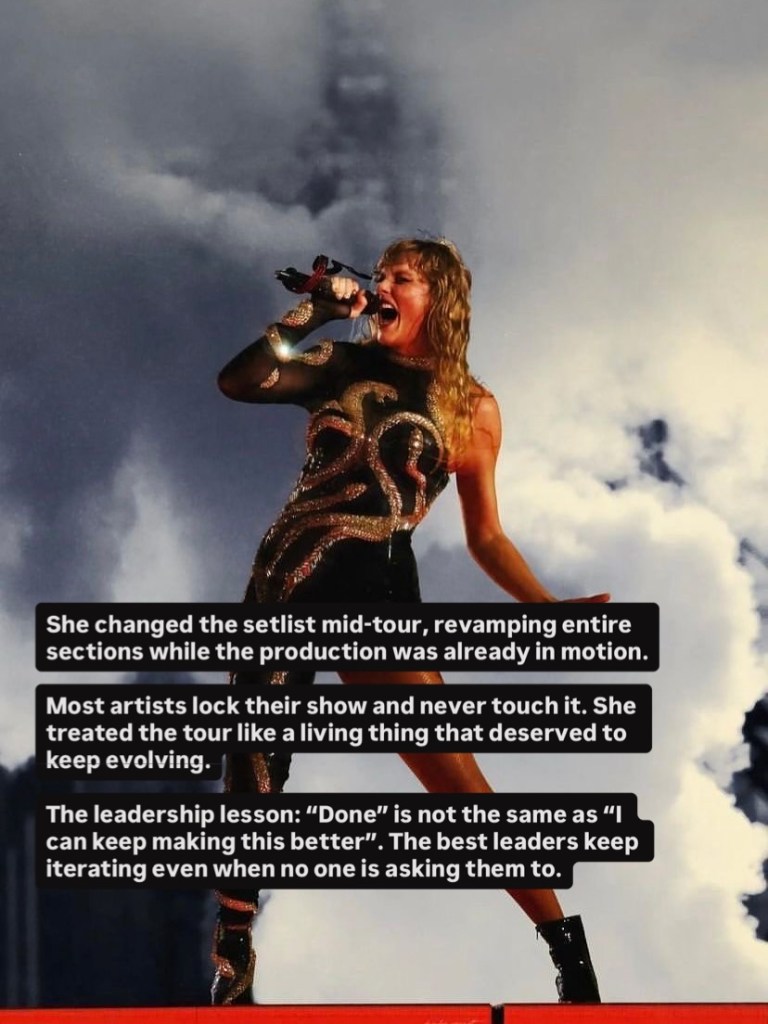
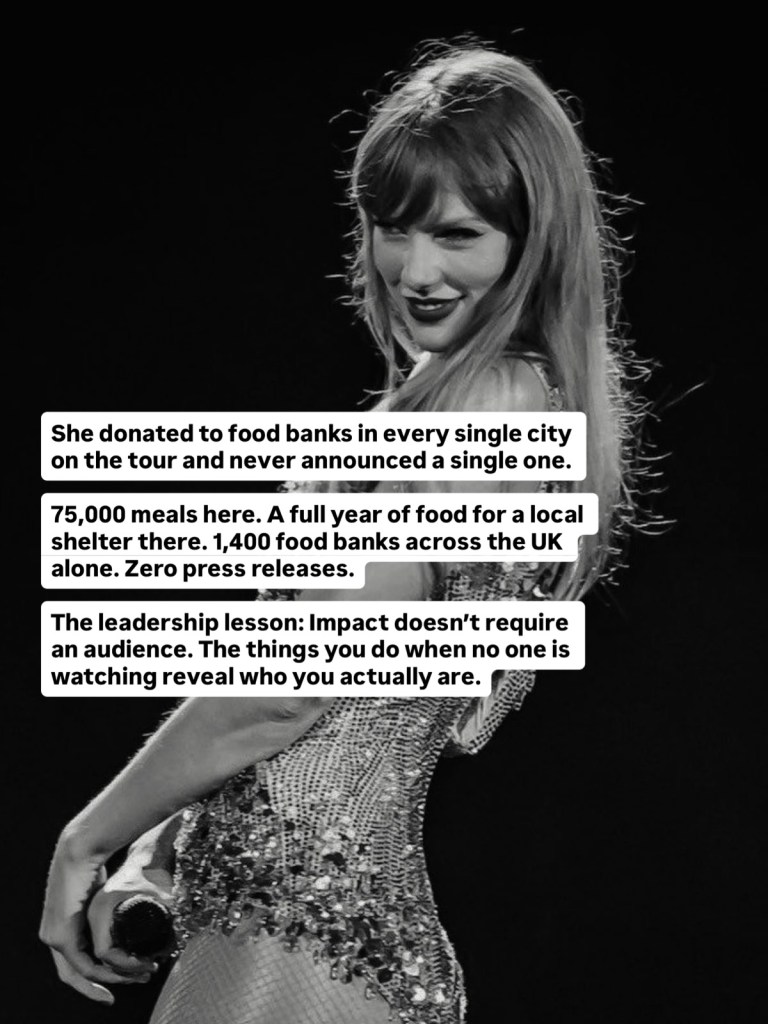
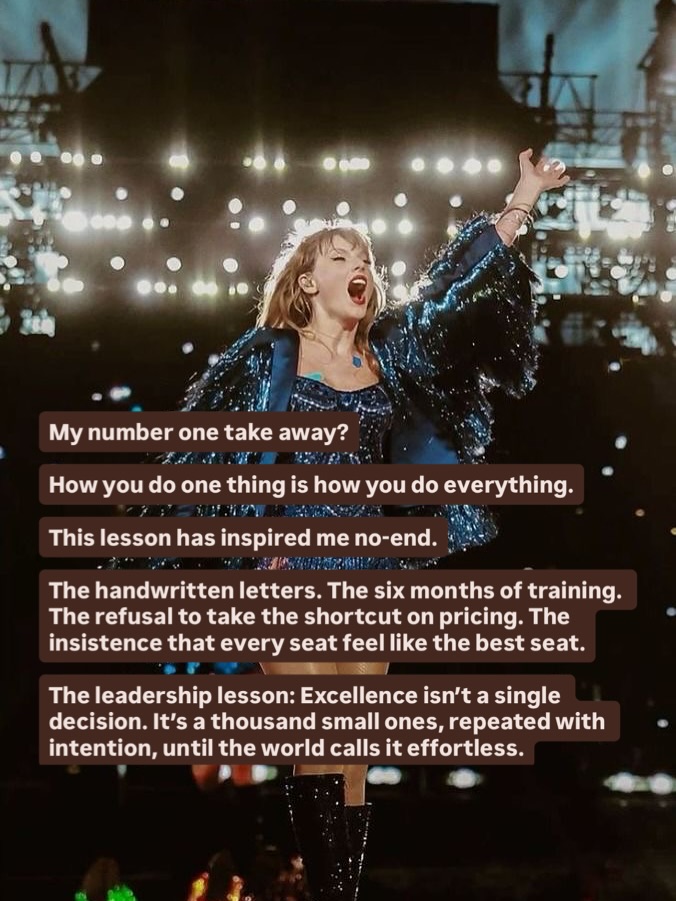
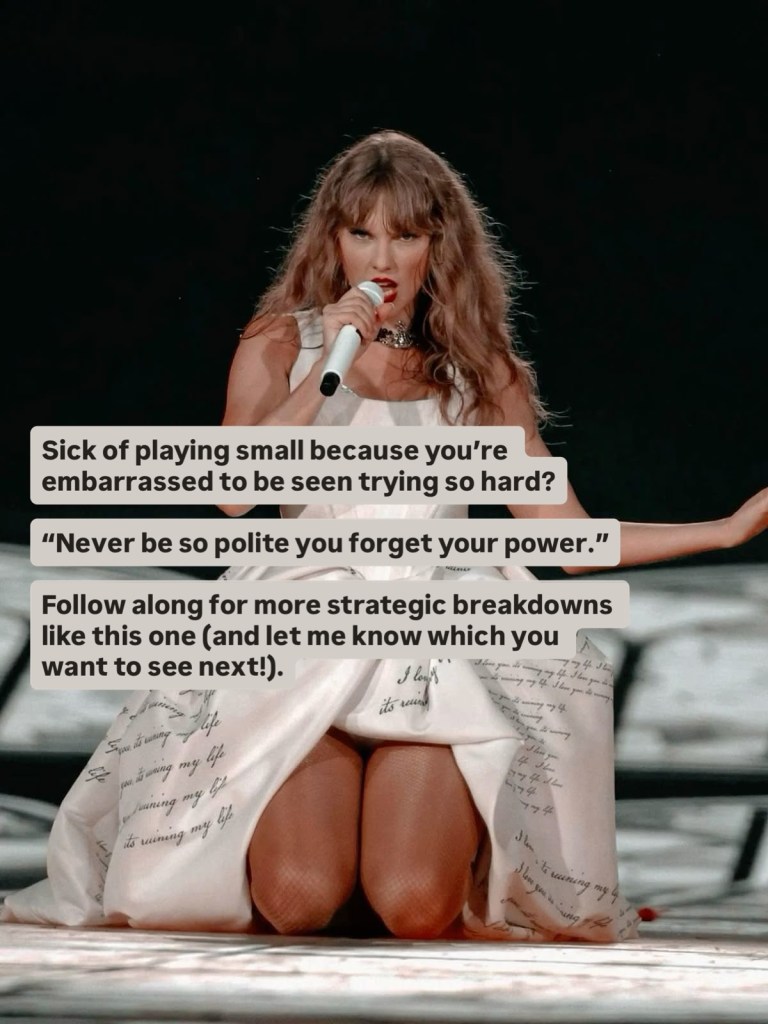
It’s easy to look at a $2 billion tour and call it talent, timing, or luck. But when you look closer—really look—you see something else entirely. You see preparation so intense it borders on obsession. Decisions made months, even years, in advance. A relentless respect for craft, people, and the long game. What looks effortless from the outside is actually the result of precision, discipline, and deeply intentional leadership. This carousel isn’t about music or fame. It’s about what sustainable excellence actually looks like when no one is watching—and why that mindset applies far beyond a stage. Thanks Natalie for this



Christmas was Holy, Not Perfect

Christmas wasn’t calm or quiet, and it certainly wasn’t picture-perfect. It was messy, chaotic, and real—Mary with a newborn in a crowded, cold barn, surrounded by animals and strangers. Maybe that’s the point: the most extraordinary moments often arrive in the midst of disorder, reminding us that hope and love don’t need perfection to shine. Loved this post from Insta.









6 Storytelling Techniques
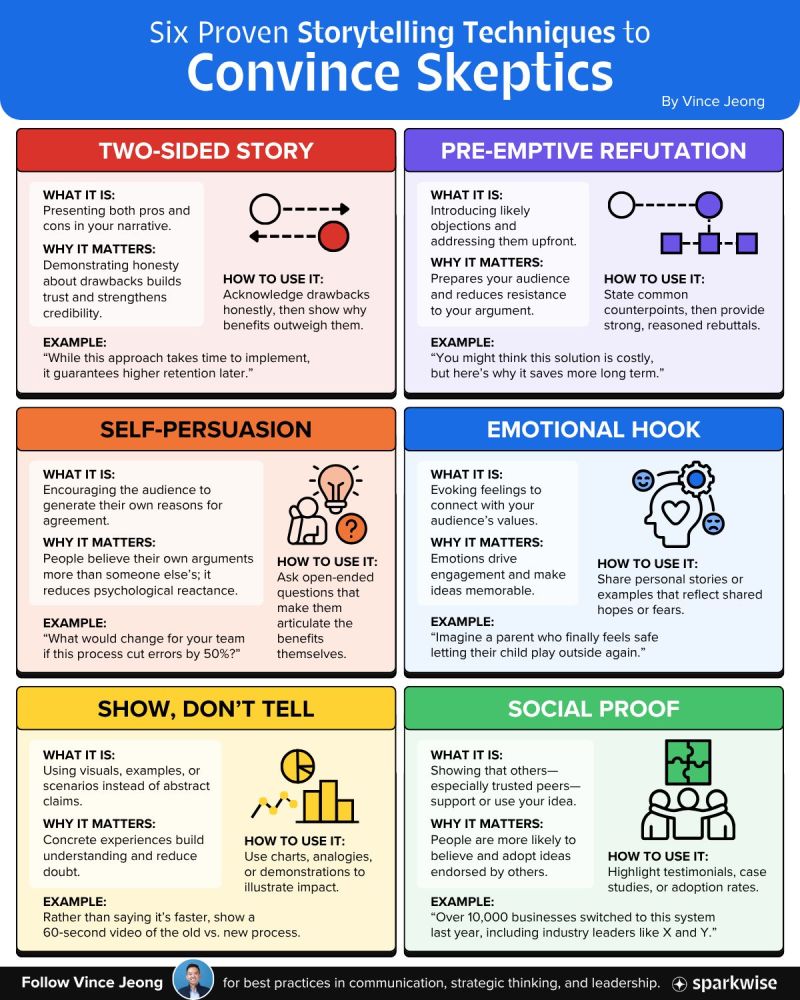
Face pushback on your ideas at work?
6 storytelling techniques that persuade:
1. 𝐓𝐰𝐨-𝐒𝐢𝐝𝐞𝐝 𝐒𝐭𝐨𝐫𝐲
Present both pros and cons upfront.
→ Acknowledge the drawbacks honestly
→ Show why benefits outweigh them
→ Build trust through transparency
You’re more credible
when you seem balanced.
2. 𝐏𝐫𝐞-𝐞𝐦𝐩𝐭𝐢𝐯𝐞 𝐑𝐞𝐟𝐮𝐭𝐚𝐭𝐢𝐨𝐧
Address objections before they’re raised.
→ State common counterpoints first
→ Provide strong, reasoned rebuttals
→ Reduce resistance before it starts
You control the narrative
when you lead with their concerns.
3. 𝐒𝐞𝐥𝐟-𝐏𝐞𝐫𝐬𝐮𝐚𝐬𝐢𝐨𝐧
Let them convince themselves.
→ Ask open-ended questions
→ Guide them to articulate benefits
→ Watch psychological reactance fade
People believe their own arguments more
than anything you could say.
4. 𝐄𝐦𝐨𝐭𝐢𝐨𝐧𝐚𝐥 𝐇𝐨𝐨𝐤
Connect feelings to facts.
→ Share personal stories that resonate
→ Use examples reflecting shared fears
→ Make abstract ideas feel real
Logic tells, but emotion sells.
Even to skeptics.
5. 𝐒𝐡𝐨𝐰, 𝐃𝐨𝐧’𝐭 𝐓𝐞𝐥𝐥
Replace claims with evidence.
→ Use visuals, charts, demonstrations
→ Present concrete examples
→ Make impact impossible to ignore
One proven example beats
ten theoretical explanations.
6. 𝐒𝐨𝐜𝐢𝐚𝐥 𝐏𝐫𝐨𝐨𝐟
Leverage peer influence.
→ Highlight trusted adopters
→ Share testimonials and case studies
→ Show industry leaders using it
Skeptics follow when others they respect
have already moved.
Which technique will you try first?
Strategic Planning
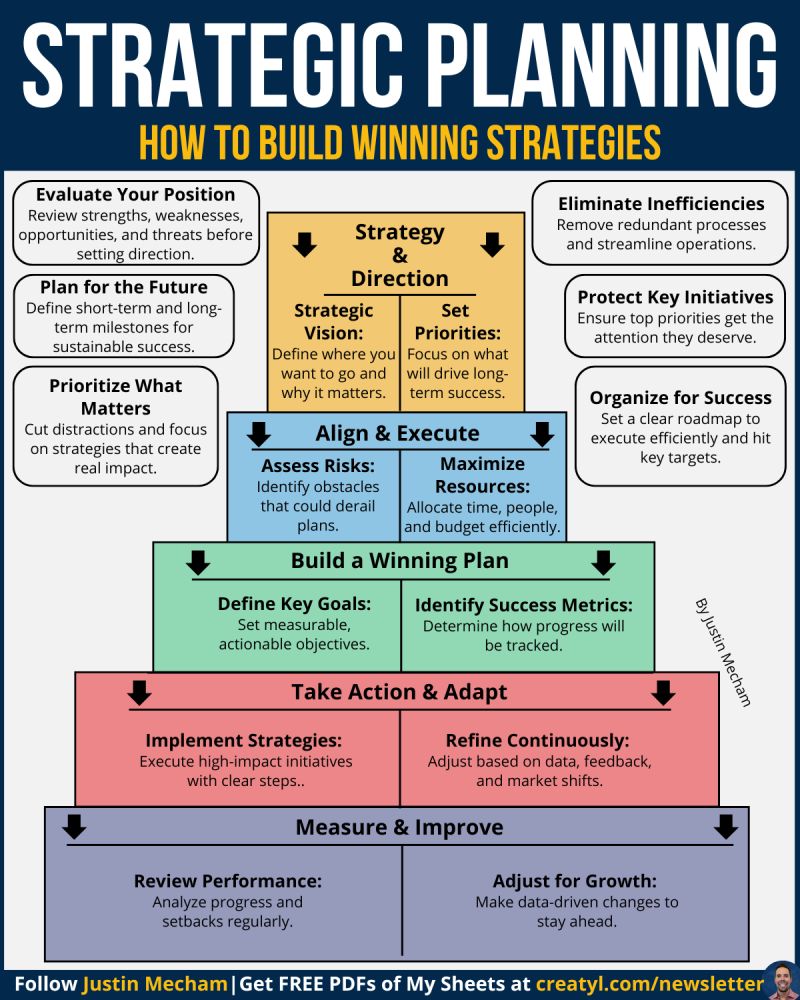
Most “strategies” are wish lists—
Here’s how to build choices, not chores:
Winning strategies aren’t complicated.
They’re clear, deliberate, and built to last.
Start with direction:
🟨 Know exactly where you’re going—and why
🟨 Cut what doesn’t move you forward
Set yourself up to act:
🟦 Name the risks before they name you
🟦 Spend people, time, and money where it counts
Build a plan worth following:
🟩 Set goals you can measure
🟩 Decide exactly how you’ll track progress
Keep it alive:
🟥 Take steps that matter now
🟥 Adjust fast when reality changes
Most plans are only good on paper.
The best ones win because they
adapt without losing focus.
If you get this right, you stop “managing”
and start moving.
You make fewer decisions—but better ones.
You trade busywork for real wins.
And every move you make builds on the last.
How to Give Feedback?
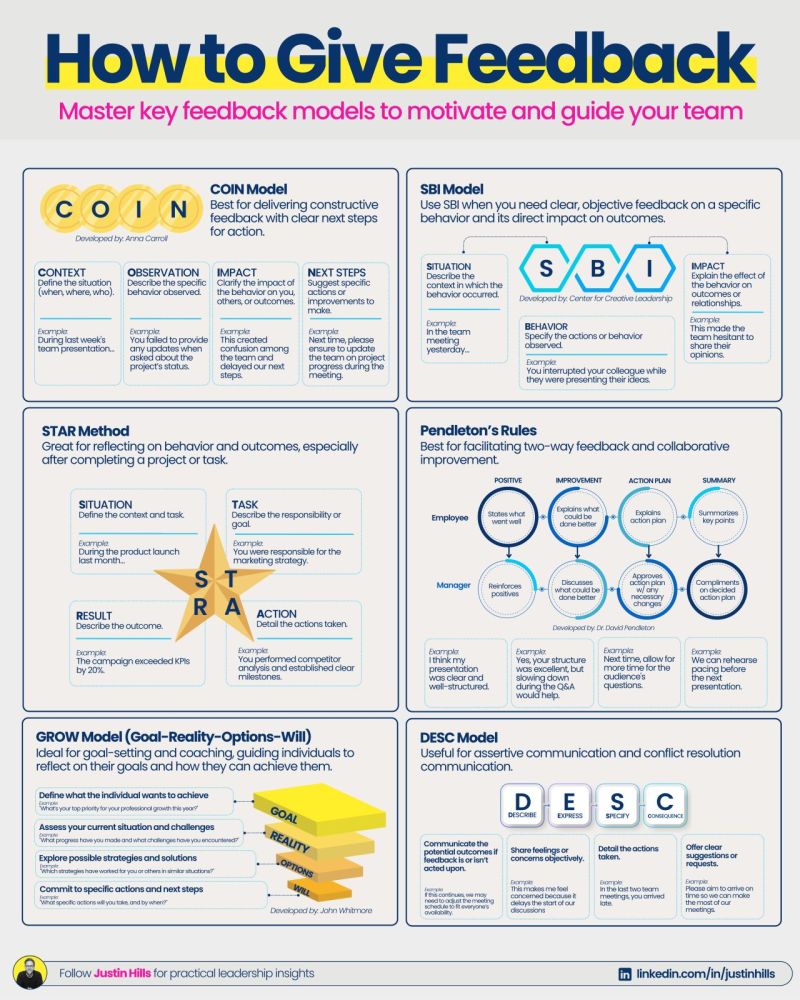
Many managers delay tough feedback.
Not from neglect, but discomfort.
Credits to Justin Hills, make sure to follow!
_____
These quiet fears shape how feedback
is given or not.
→ Fear of emotional reactions
→ Concern about conflict
→ Doubts about whether it will work
This hesitation is common
but it costs teams clarity, growth, and trust.
Yet research in the Journal of Applied Psychology shows:
Frequent, constructive feedback improves performance 12.5%.
Better performance boosts productivity and profitability.
Feedback doesn’t have to feel risky.
With structure, it becomes simple and constructive.
Here are 𝟲 𝗽𝗿𝗼𝘃𝗲𝗻 𝗺𝗼𝗱𝗲𝗹𝘀 𝘁𝗼 𝗺𝗮𝗸𝗲 𝗳𝗲𝗲𝗱𝗯𝗮𝗰𝗸
𝗰𝗹𝗲𝗮𝗿, 𝗮𝗰𝘁𝗶𝗼𝗻𝗮𝗯𝗹𝗲, 𝗮𝗻𝗱 𝘀𝗮𝗳𝗲:
1️⃣ 𝗖𝗢𝗜𝗡 𝗠𝗼𝗱𝗲𝗹 Best for coaching and development.
→ Context: Name when and where it happened.
→ Observation: Share what was seen, stay factual.
✅ Keeps feedback factual and clear
✅ Ends with next steps for improvement
2️⃣ 𝗦𝗧𝗔𝗥 𝗠𝗼𝗱𝗲𝗹 Perfect for reviews or recognition.
→ Situation: Set the context of the event.
→ Task: Define what was expected.
✅ Reinforces what worked well
✅ Builds confidence through specific examples
3️⃣ 𝗚𝗥𝗢𝗪 𝗠𝗼𝗱𝗲𝗹 Helps turn feedback into clear action.
→ Goal: Define what needs to be achieved
→ Reality: Outline what’s happening now
✅ Shows the gap between now and future success
✅ Creates a simple path from feedback to action
4️⃣ 𝗦𝗕𝗜 𝗠𝗼𝗱𝗲𝗹 Perfect for short, specific feedback moments.
→ Situation: Pinpoint the event or context
→ Behavior: Describe the action observed
✅ Makes feedback easy to share often
✅ Removes judgment and confusion
5️⃣ 𝗣𝗲𝗻𝗱𝗹𝗲𝘁𝗼𝗻’𝘀 𝗥𝘂𝗹𝗲𝘀 Great for balanced, two-way feedback.
→ Positives first: Start with what worked well
→ Invite input: Ask what could improve
✅ Encourages dialogue and shared ownership
✅ Makes feedback feel safe and collaborative
6️⃣ 𝗗𝗘𝗦𝗖 𝗠𝗼𝗱𝗲𝗹 Ideal for assertive or tense conversations.
→ Describe: Name what occurred clearly
→ Express: Share the impact it had
✅ Balances clarity with empathy
✅ Concludes with agreed-upon solutions
Clear feedback builds confidence and trust.
It turns tension into coaching and doubt into growth.
The Quiet Power of Small Things
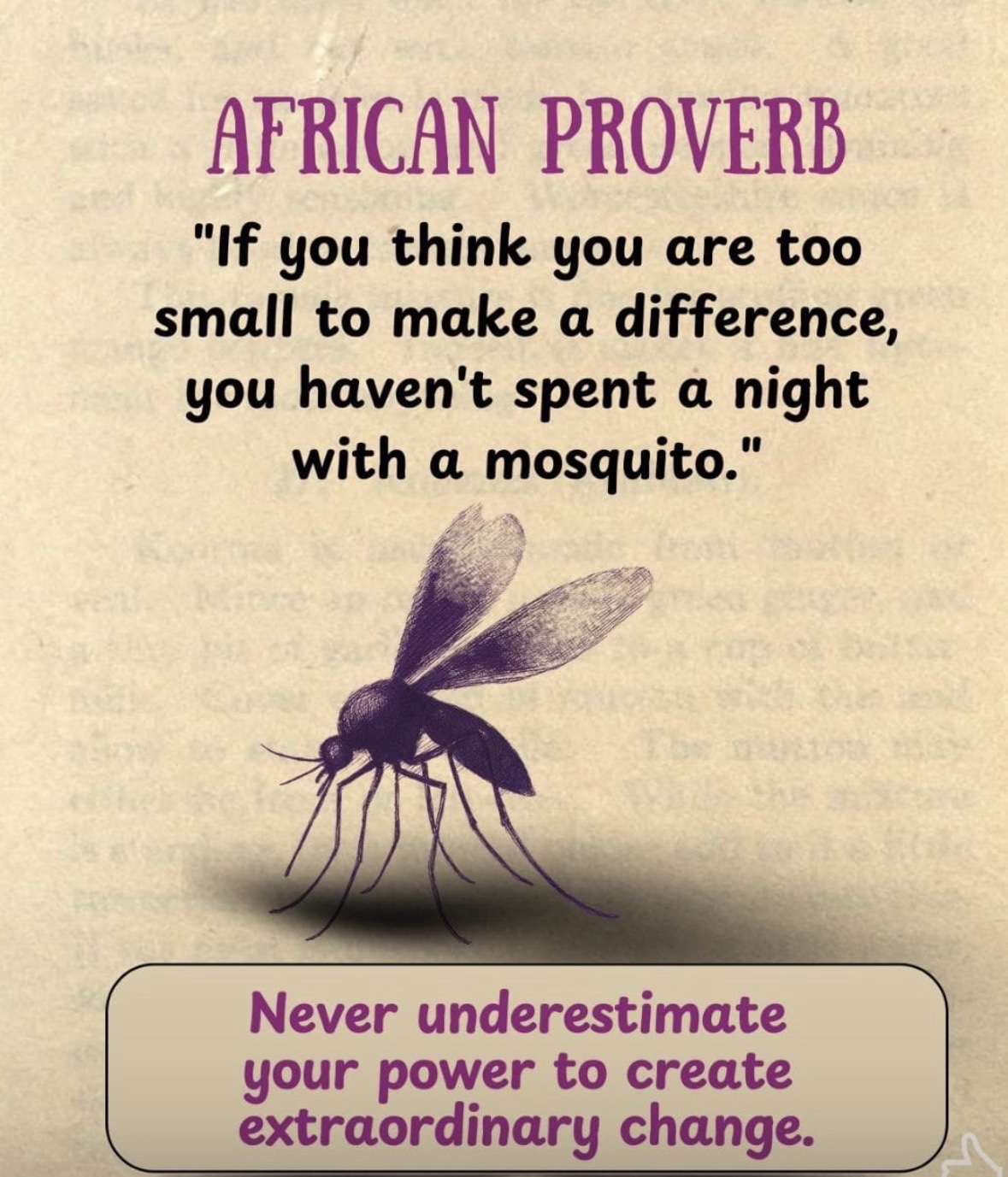
There’s a reason that quote sticks with people. It sounds almost playful at first, maybe even a little funny. A mosquito? Really? But anyone who’s ever spent a sleepless night swatting at the air knows exactly what it’s pointing to. Something tiny, something easy to dismiss, can completely change how a night unfolds.
We grow up believing that impact belongs to the loud, the large, the obvious. The people with titles. The ones with platforms. The ones who seem to enter a room already carrying influence with them. Somewhere along the way, many of us quietly decide that unless we’re operating at that scale, our contribution doesn’t really count.
But life doesn’t actually work that way.
Most change doesn’t arrive with a drumroll. It creeps in through small decisions, repeated actions, and moments that don’t feel historic while they’re happening. A single conversation that shifts how someone sees themselves. One honest piece of feedback that nudges a team in a better direction. A quiet refusal to accept “this is just how things are.”
Think about the people who’ve left a mark on you. Chances are, they weren’t trying to be extraordinary at the time. They were present. They listened. They showed up when it mattered. They said something simple at the right moment. Their influence didn’t come from size; it came from intention.
The mosquito metaphor works because it’s uncomfortable in the best way. It reminds us that power isn’t always about force. Sometimes it’s about persistence. About being impossible to ignore, not because you’re shouting, but because you’re consistent. Because you keep showing up in the same small, deliberate way.
In work, this is especially easy to forget. We wait for permission, for seniority, for the “right time” to speak up. We assume that strategy is set elsewhere and that our role is just to execute. But culture is shaped in the everyday. In how you run a meeting. In whether you give credit or take it. In whether you choose curiosity over cynicism.
Small actions compound. They always have. The problem is that compounding is invisible at first. On day one, it looks like nothing. On day ten, still nothing. Then one day, without much warning, you realize the tone has shifted. The trust has grown. The direction has changed. And suddenly, that “small” thing doesn’t feel small at all.
The same is true outside of work. Being kind when it would be easier to be indifferent. Choosing patience when frustration is justified. Standing up for something quietly but firmly, even when it would be simpler to stay silent. These moments don’t make headlines, but they shape lives.
We often underestimate ourselves because we’re measuring our impact with the wrong ruler. We compare our behind-the-scenes to someone else’s highlight reel. We forget that scale is not the same as significance. A mosquito doesn’t need to be big to matter. It just needs to exist, persist, and do what it does.
So if you’ve ever felt too small, too early, too insignificant to matter, take this as a gentle correction. Your voice counts. Your choices ripple. Your presence changes rooms, even when you don’t notice it happening.
Extraordinary change doesn’t always come from extraordinary people. More often, it comes from ordinary people who stop underestimating the power they already have—and use it, one small moment at a time.
How to Build Passionate Teams?
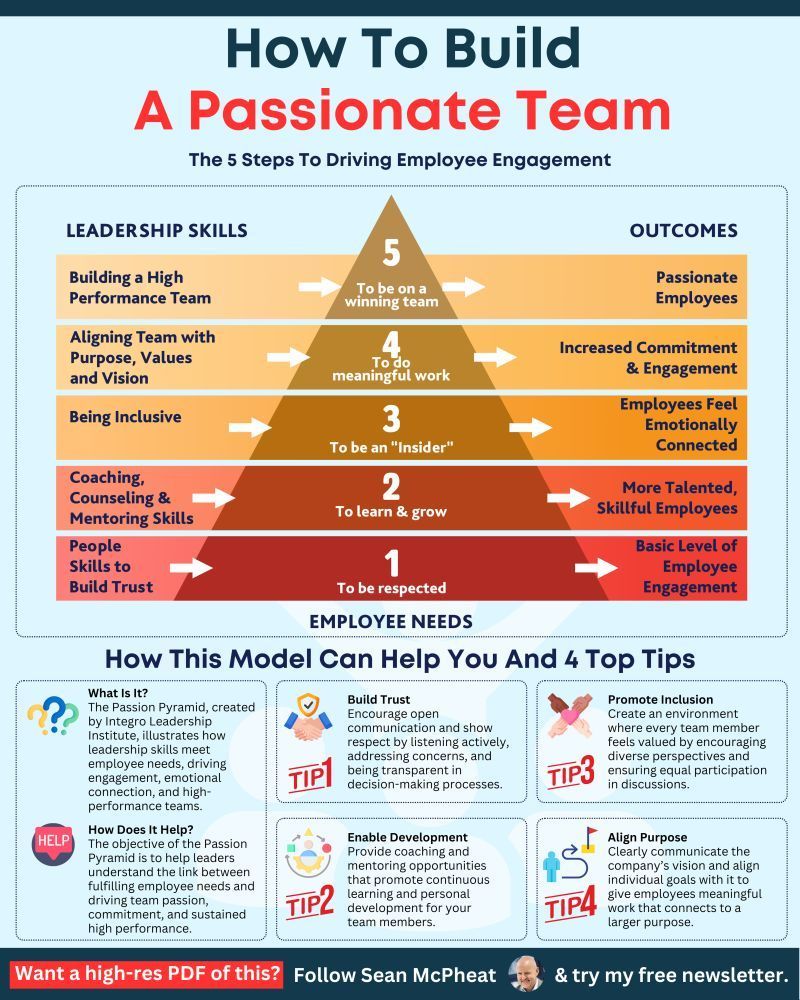
Want a team that’s passionate & engaged?
Here’s how to achieve that ⬇️
High engagement doesn’t start with perks
or ping pong tables.
It starts with how leaders meet the real
needs of their team.
Enter the Passion Pyramid, a 5-step model
that shows the link between leadership skills,
employee needs, and lasting engagement.
Each level builds on the one below:
1. People Skills to Build Trust
Employees need to feel respected.
When trust is missing, so is motivation.
2. Coaching, Counselling & Mentoring
People stay where they grow.
Support their development with real, ongoing guidance.
3. Inclusion
Everyone wants to feel like an insider.
That means listening, involving, and valuing all voices.
4. Purpose, Values & Vision
Meaningful work drives commitment.
Help people connect what they do to why it matters.
5. Building a High-Performance Team
Winning teams create energy.
When people feel part of something successful, they go all in.
Each step isn’t a one-off.
It’s a habit. A daily investment in your team’s experience.
And when you consistently meet these needs?
↳ Passionate employees
↳ Stronger emotional connection
↳ Increased skill and loyalty
↳ A high-performance culture people want to be part of
But skip the foundation, i.e trust, growth and belonging,
and you’ll build on unstable ground.
So ask yourself:
Where in this pyramid are you strong?
Where do you need to level up?
🧠 Remember: You don’t just build engagement.
You earn it, step by step.
What step do you think most teams struggle with?
Critical Thinking Skills
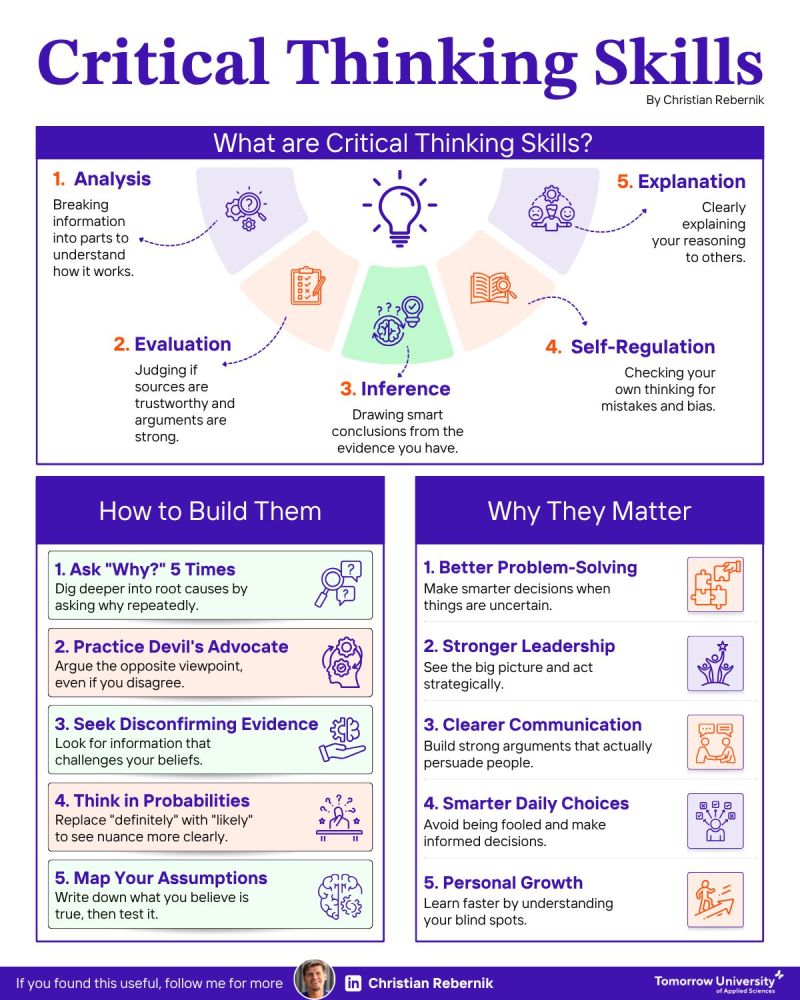
Most people think critical thinking means “being smart.”
But it has nothing to do with your IQ.
Credits to Christian Rebernik, make sure to follow!
_____
It’s about using specific tools in your mind.
Tools that help you:
🧠 Handle the unknown
🧠 Spot hidden assumptions
🧠 Make better choices
These 5 skills form the foundation:
1. Analysis
↳ Breaking information into parts to see how it works.
✅ Spot the mechanics behind success
✅ Identify what truly drives results
✅ Separate noise from signal
2. Evaluation
↳ Judging whether sources are trustworthy.
✅ Protect yourself from misinformation
✅ Filter out bad advice quickly
✅ Recognize credible insights
3. Inference
↳ Drawing conclusions from the evidence you have.
✅ Anticipate likely outcomes
✅ Turn incomplete data into action
✅ Make connections others miss
4. Self-Regulation
↳ Checking your own thinking for mistakes and bias.
✅ Course-correct before it’s too late
✅ Stay humble and accurate
✅ Avoid costly blind spots
5. Explanation
↳ Clearly laying out your reasoning so others understand.
✅ Build trust through transparency
✅ Lead with logic, not authority
✅ Win buy-in for your ideas
Want to build these skills?
Try this:
Take your next big decision.
Write down what you assume is true.
Then actively look for evidence that proves you wrong.
This rewires how you think.
Most people defend their first idea.
Strong thinkers test it.
Every bad decision has warning signs.
This practice helps you see them.
 Kenrick Vaz