The Distance You Don’t See

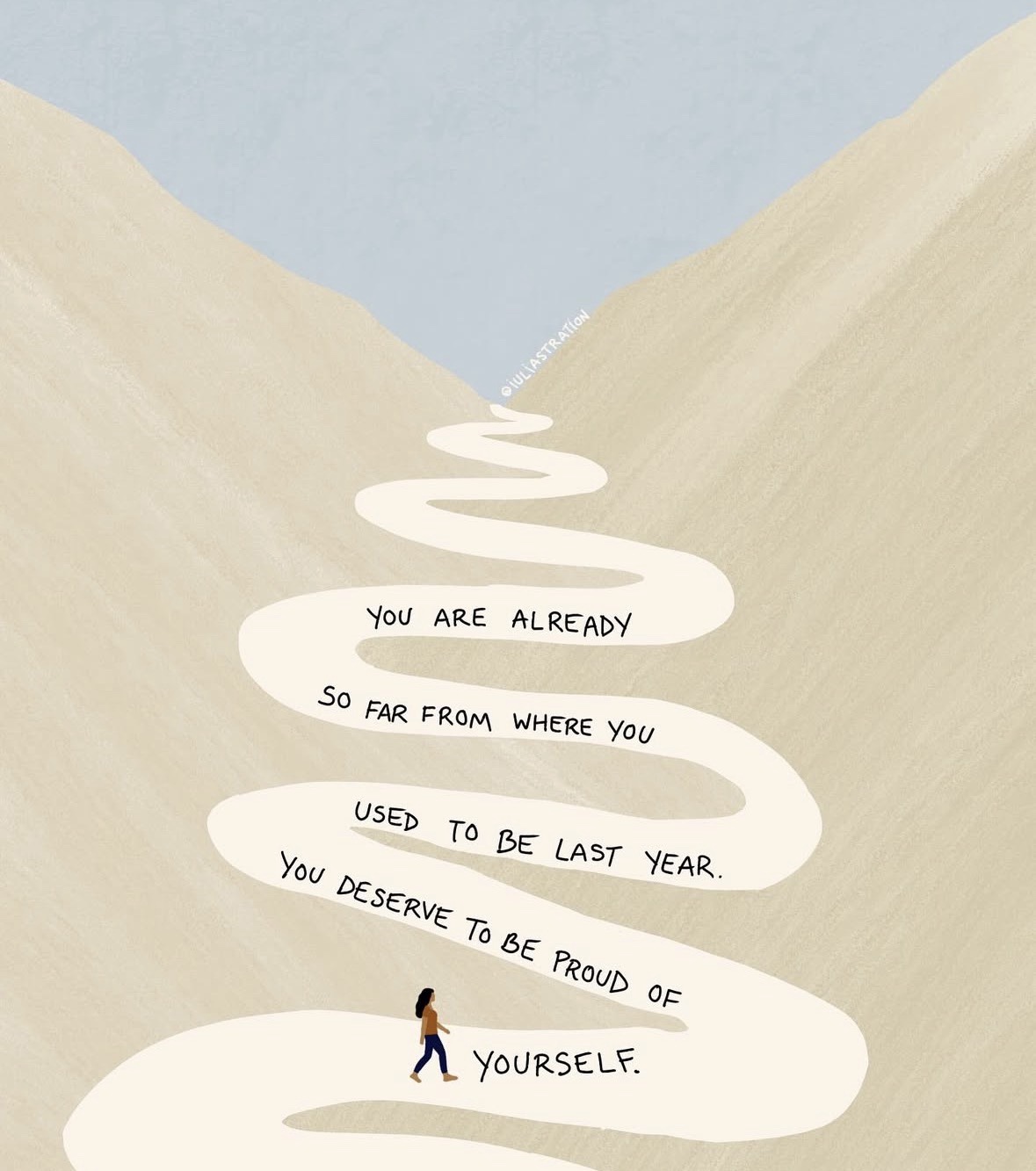
We don’t always notice how far we’ve come because progress rarely makes noise. It doesn’t announce itself with confetti or trumpets. It shows up quietly — in the way you handle things that once broke you, in the calm that’s replaced chaos, in the peace you’ve earned one hard day at a time.

A year ago, you might have doubted what you’re now doing with ease. You might have felt stuck in a place that today feels like a lifetime away. Growth is funny that way — it doesn’t happen in one big leap but in countless little steps that don’t look like much until you glance back and realize you’ve climbed an entire mountain.

So take a breath. You’ve done more than survive — you’ve adapted, learned, and evolved. You’ve turned uncertainty into strength, pain into perspective, and hesitation into motion. Maybe you don’t give yourself enough credit for that.

You don’t need to have everything figured out to be proud of yourself. Pride isn’t only for the finish line — it belongs in the middle of the race too. It’s okay to pause and say, “I’ve come a long way,” even if you’re still on the road.

Because you have. You’re already so far from where you used to be. And that, in itself, is worth celebrating.

Energy vs Time

You don’t need more hours in your day.
You need fewer energy leaks in your life.

The burnout epidemic?
It’s not caused by lack of time —
👉 It’s caused by mismanaged energy.

And the smartest leaders in 2025 are no longer asking:
“How do I manage my time better?”

They’re asking:
“How do I protect my energy at all costs?”

What time management gets you:
↳ Fills the calendar
↳ Prioritizes tasks
↳ Measures hours worked
↳ Can lead to burnout
↳ Looks busy

What energy management creates:
↳ Protects your focus
↳ Prioritizes recovery + clarity
↳ Measures impact and presence
↳ Enables sustainability
↳ Feels effective

⚠️ Because looking productive ≠ being effective.

Here’s the real problem:
“You’re not burned out because of too little time…
You’re burned out because of too many energy leaks.”

Leaky boundaries.
Too many Zooms.
Saying “yes” when you meant “not today.”

This isn’t a calendar problem —
It’s a capacity problem.

Want to be a more impactful leader?
Manage the fuel, not just the clock.
Here’s what that looks like:
✔️ Fewer meetings, more thinking time
✔️ Saying NO with clarity, not guilt
✔️ Deep work over shallow tasks
✔️ Rest as a strategy, not a reward
✔️ Protecting your zone of genius

This isn’t slacking.
It’s sustainable leadership.
And it’s what keeps the best performing at their best.

The ROI? Game-changing.

Leaders who manage energy—not just time—report:
✅ Better decision-making
✅ More creative thinking
✅ Higher-quality execution
✅ And… they don’t crash every quarter

Time hits a limit.
But energy? Energy multiplies.

What’s one way you’re protecting your energy this week?

The Turtle Theory

There’s something quietly powerful about turtles. They don’t rush, they don’t compete, they don’t overthink the waves. They move with this calm certainty that’s almost poetic—one steady stroke at a time. While everything around them shifts—the tides, the currents, the noise—they just keep going.

We live in a world obsessed with speed. Everyone’s sprinting somewhere, chasing something, counting milestones and measuring moments in metrics. But turtles? They remind us that pace isn’t progress. Progress is about direction, not velocity. It’s about showing up again tomorrow, even if today felt slow.

Some days you’ll glide. Some days you’ll crawl. There’ll be waves that push you back and days that make you question if you’re even moving at all. But the turtle teaches us the quiet art of patience—the kind that doesn’t demand instant results, the kind that trusts the process even when the shore isn’t yet in sight.

Because that’s how real growth happens. Not in leaps, but in inches. Not through panic, but through presence.

You don’t have to sprint. You just have to keep going. Slow progress is still progress—and peace, the kind that comes from patience, will always outlast pressure.

Words That Work

One phrase can shut someone down—

Another can open the door:

Small shifts in what we say can
change the tone of any conversation.

At work, even simple phrases can make you
more collaborative, thoughtful, and clear.

What happens when we use
the wrong words at work?

🚫 Work feels harder than it should
🚫 Small issues become big ones
🚫 Silence replaces honesty
🚫 Stress spreads quietly
🚫 Problems get ignored
🚫 People shut down
🚫 Ideas go unsaid
🚫 Clarity gets lost
🚫 Morale takes a hit
🚫 Trust breaks down
🚫 Decisions get delayed
🚫 Good employees leave
🚫 Feedback turns into blame
🚫 Collaboration turns into conflict
🚫 Teams stop talking—and start guessing

Use my sheet for success.

Your words shape the way people see you.

Every phrase is a chance to build real trust.

Your next move?

Start with one better phrase today.

The Johari Window

Think you know yourself well?

This will tell you otherwise ⬇️

Most people don’t realise they’re sitting on untapped strengths.

The Johari Window helps you and your team, see what’s hidden, what’s shared, and what’s missing.

It divides insight into 4 areas:

Open:
What you know about yourself and others see too.

Hidden:
What you know, but keep private.

Blind Spot:
What others see but you don’t.

Unknown:
What no one sees yet not even you.

Why does this matter?

The Johari Window helps people understand themselves and each other better.

It encourages open conversations, which builds trust across teams and makes communication a lot smoother.

When feedback becomes a normal part of how you work, it’s easier to grow, improve, and support each other.

It’s not just about fixing problems, it’s about unlocking potential and creating stronger, more connected teams.

Ask yourself:

What do I keep hidden from others?
What feedback surprised me the most?
What strengths do others consistently notice?
What could I achieve if I explored my unknown areas?

Want to use it with your team?

Here’s how:

1. Seek feedback to uncover blind spots.
2. Share insights to reduce your hidden area.
3. Encourage open dialogue within your team.
4. Take on new challenges to explore your unknown area.
5. Build trust through openness and transparency.

I’ve used the Johari Window in coaching sessions, team development workshops, and leadership programmes for years and it never fails to reveal something powerful.

Whether it’s a strength someone didn’t know they had, or a blind spot that’s been quietly derailing progress, this model helps surface what’s been hidden in plain sight.

When teams use this tool together, it transforms how they communicate.

Defensiveness gives way to curiosity.
Assumptions are replaced with clarity.

And people start to understand not just how they show up but how they’re experienced by others.

That shift alone builds deeper trust, stronger collaboration, and a culture where feedback becomes fuel, not fear.

🧠 Remember; Self-awareness is the foundation of emotional intelligence, trust, and leadership.

What quadrant do you need to work on most?

Threading the Needle

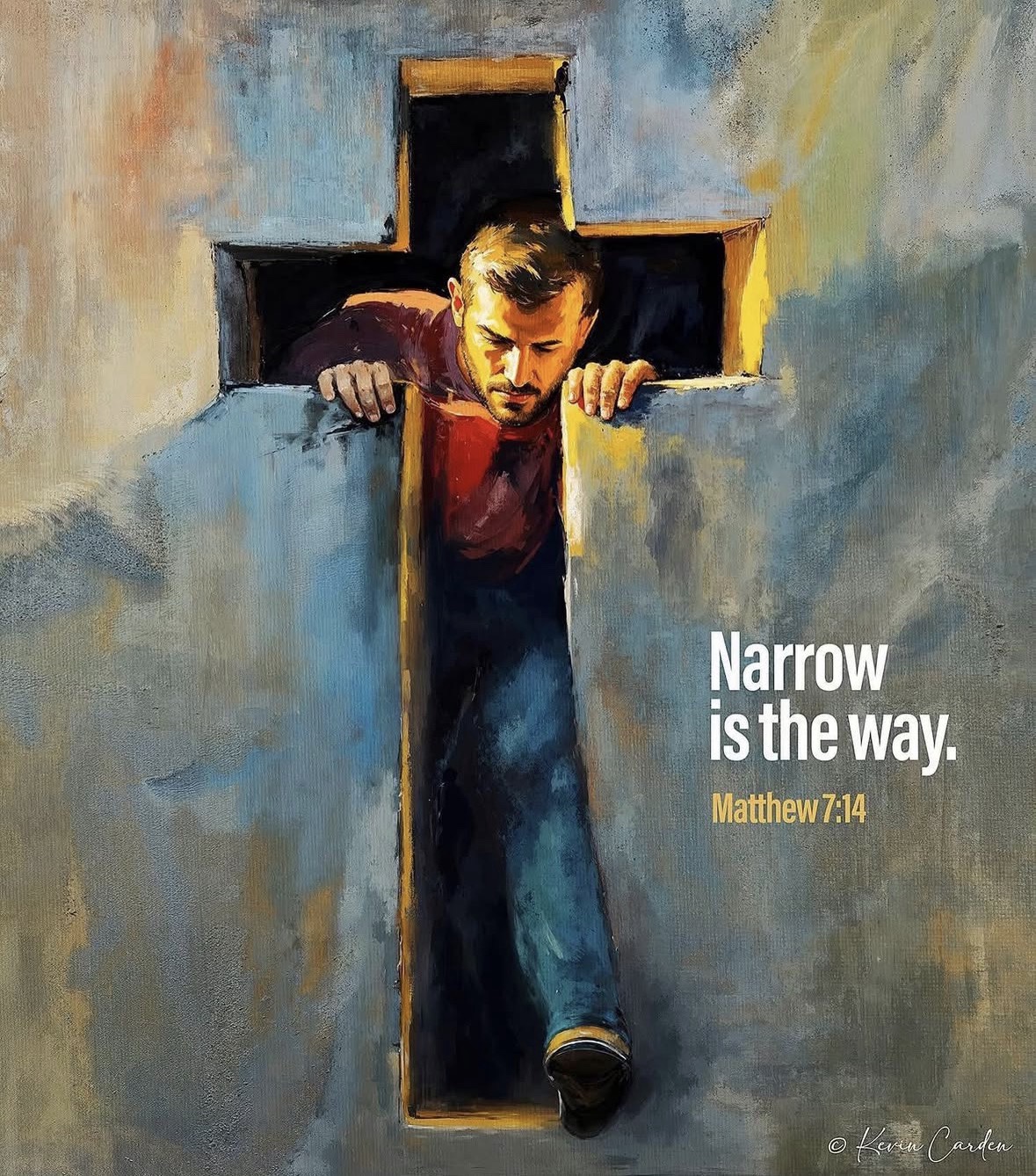
There’s something about a narrow path that immediately makes you slow down. You can’t rush it. You can’t stroll carelessly. You place your steps with intention, aware of every shift in the ground, every bend that hides what’s next. It’s uncomfortable sometimes, even frustrating, but it also pulls a deeper focus out of you—one you didn’t know you still had.

Matthew 7:14 speaks to that idea in a way that doesn’t shout, but quietly nudges: the way that leads to life isn’t the wide, obvious one where everyone’s walking in the same direction. It’s the slender trail you almost miss unless you’re actually paying attention. And that’s rarely the path that feels easiest.

We live in a world built on shortcuts and hacks—quick wins, instant answers, and the pressure to keep up with everyone else’s highlight reel. The broad road is tempting because it looks efficient. It promises less resistance. But the narrow path asks you to choose differently. To think before you respond. To say no when it would be easier to say yes. To hold your values even when they don’t trend. To remain kind when frustration is louder. To pick integrity over convenience, even when no one’s watching.

And somehow, along that tight, winding journey, something shifts. You start noticing things you’d never have seen sprinting down the wide road—the small victories, the invisible growth, the habits that stick, the peace that doesn’t depend on applause or comparison. The narrow way has a way of refining you, not by force, but by friction, by choices made one quiet moment at a time.

The funny thing is, the narrow path isn’t glamorous. There’s no big sign pointing to it, no crowd cheering you on, no shortcuts offered. But it tends to be the path where you meet the truest version of yourself. The one that knows what matters, what doesn’t, and what’s worth protecting. And maybe that’s the whole point: the path isn’t narrow to punish—it’s narrow to focus.

Every day brings a fork in the road, even in the smallest ways. Do you respond with patience or react out of habit? Do you carry envy or practice gratitude? Do you take the easy exit or stay aligned with who you’re trying to become? You’re not going to get it right every time, but awareness itself is already part of walking that narrower trail.

Maybe that’s why the verse doesn’t tell you to sprint, conquer, or perfect anything. It simply points you toward the way that leads to life—real life, deeper life, the kind that doesn’t crumble when the noise gets loud. Sometimes all you need is that reminder tucked in your pocket: the right path isn’t always the most crowded one.

And somehow, in choosing that quieter, more intentional way—even when it feels slow or unseen—you start to notice it opening up: not outward, but inward. More clarity. More peace. More purpose. A life that feels lighter because it’s carried with intention, not with the weight of everything the wide road demands.

The way is narrow. But maybe that’s exactly why it leads somewhere worth going.

Where the Noise Can’t Find You

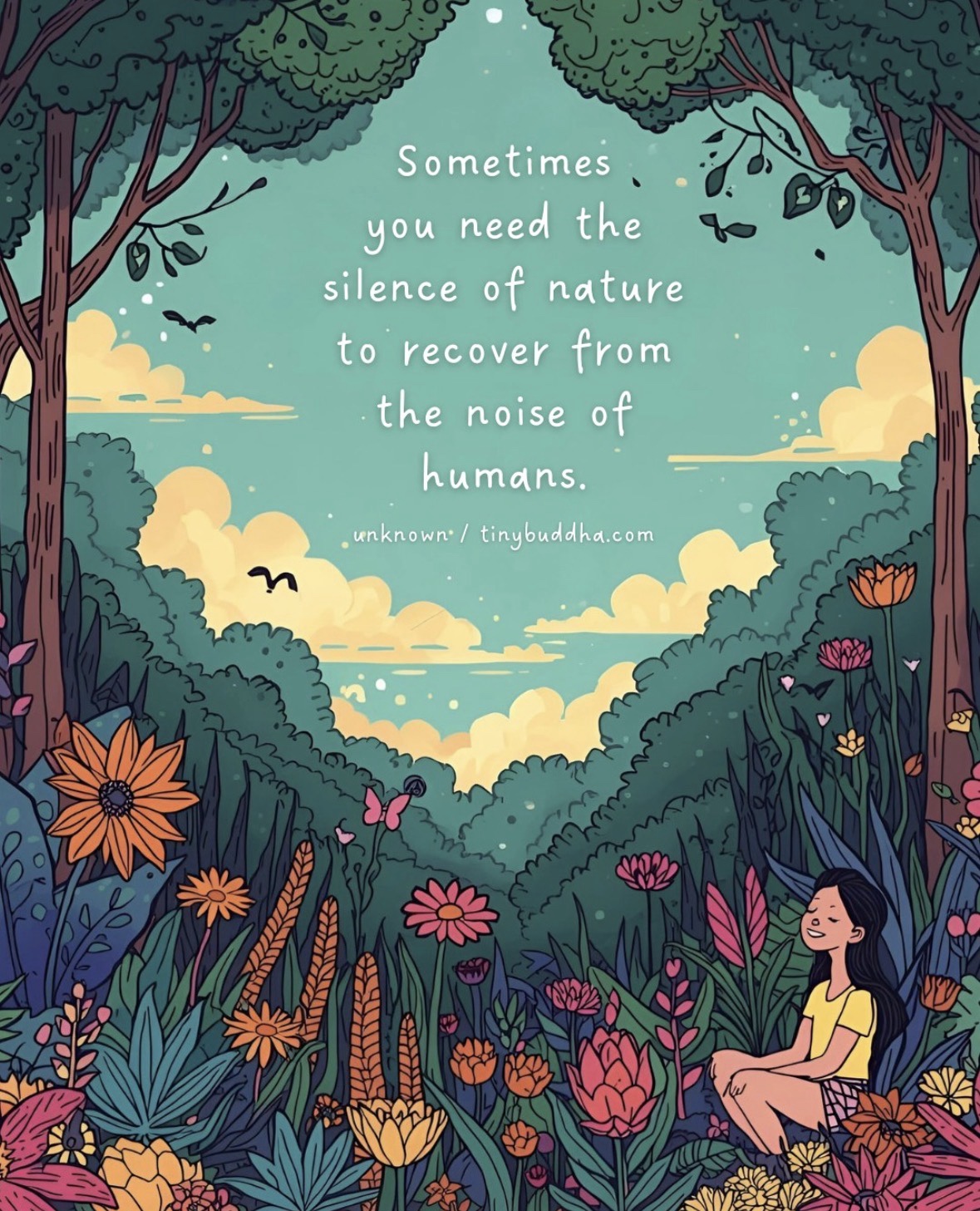
Every now and then, life gets so loud that you don’t realize how tightly you’ve been holding your shoulders until you step away from all of it. Not far, not dramatically, not with a grand proclamation about taking a break—just far enough to hear something other than people. Far enough to remember what quiet actually feels like.

It’s strange, isn’t it? How the world can spin with opinions, requests, expectations, and conversations that never seem to end. Even the kind people, the well-meaning people, can fill your head with more sound than you’re built to hold. And then one day, without planning it, you find yourself standing somewhere where none of that reaches you. A place where the trees don’t ask anything of you, the sky has nothing to discuss, and the wind speaks only in whispers that ask for nothing in return.

That’s when you realize how healing it is to be somewhere that doesn’t want your attention, your answers, or your energy. Nature doesn’t demand you show up cheerful or productive. It doesn’t care if you’re tired, annoyed, overwhelmed, or simply fed up with every little thing. It just lets you be exactly who you are in that moment—no explanations necessary.

The silence there isn’t empty. It’s the kind of silence that puts the pieces back where they belong. The kind that rinses off the residue of everyone else’s voices. The kind that lets you feel your own thoughts without interruption, like finding a forgotten radio station that’s been playing your favorite song the whole time—you just couldn’t hear it over the static.

And here’s the secret: you don’t need a mountain retreat or a forest that takes hours to reach. Sometimes it’s a neighborhood walk just after sunrise. Sometimes it’s a quiet park bench tucked behind a playground. Sometimes it’s sitting in your car for ten extra minutes before going home. Anywhere the world softens enough for you to breathe differently.

Because the truth is simple: sometimes you need the silence of nature to recover from the noise of humans. Not because people are bad, but because your mind deserves a moment that belongs only to you. And in those small pockets of quiet, you reconnect with a version of yourself that gets lost in the rush of everything else.

Stay long enough, and the noise won’t feel as heavy when you return. Stay long enough, and you remember that peace doesn’t disappear—you just forget where to look.

What to say when someone insults you

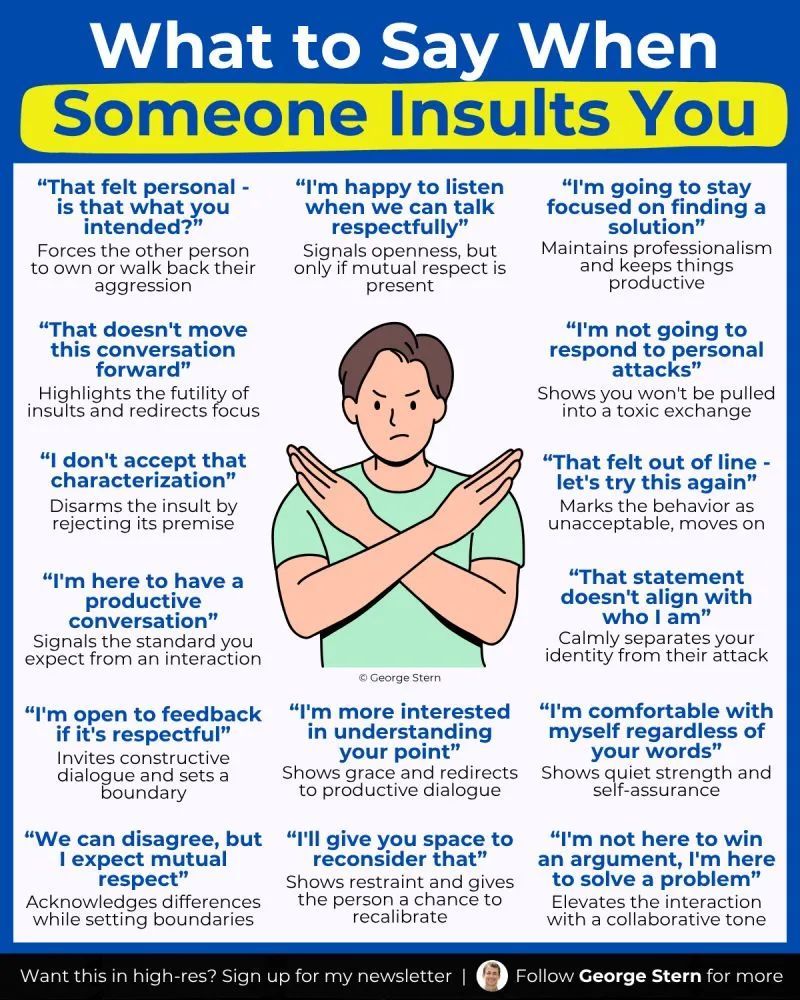
What to say when someone insults you:

These phrases help you take control,

While staying calm and respectful:

1) “That felt personal – is that what you intended?”
Forces the other person to own or walk back their aggression

2) “I’m happy to listen when we can talk respectfully”
Signals openness, but only if mutual respect is present

3) “I’m going to stay focused on finding a solution”
Maintains professionalism and keeps things productive

4) “That doesn’t move this conversation forward”
Highlights the futility of insults and redirects focus

5) “I’m not going to respond to personal attacks”
Shows you won’t be pulled into a toxic exchange

6) “I don’t accept that characterization”
Disarms the insult by rejecting its premise

7) “That felt out of line – let’s try this another way”
Clearly marks the behavior as unacceptable, then moves on

8) “I’m here to have a productive conversation”
Signals the standard you expect from the interaction

9) “That statement doesn’t align with who I am”
Calmly separates your identity from their attack

10) “I’m open to feedback if it’s respectful”
Invites constructive dialogue and sets a boundary

11) “I’m more interested in understanding your point”
Shows grace and redirects towards productive dialogue

12) “I’m comfortable with myself regardless of your words”
Shows quiet strength and self‑assurance

13) “We can disagree, but I expect mutual respect”
Acknowledges differences while setting boundaries

14) “I’ll give you space to reconsider that”
Shows restraint and gives the person a chance to recalibrate

15) “I’m not here to win an argument, I’m here to solve a problem”
Elevates the interaction and sets a collaborative tone


All too often, people respond to insults with insults.

Or just as bad: they say nothing, and let the behavior continue.

But there’s another way.

Use this sheet to help.

Any other responses you’d add?

Weekend on Fast-Forward: Music, Animals & a Little Magic

Some weekends feel slow and lazy. And then there are weekends like this one—where you blink and suddenly it’s Sunday night, your feet hurt in the best way, and your camera roll looks like three different people lived your weekend for you.

It kicked off on Friday with Maroon 5 absolutely owning the stage. There’s something about hearing the songs you’ve belted out in the car actually live, surrounded by thousands of people singing the same words with the same chaos-level energy. It’s loud, it’s electric, and for a couple of hours you forget every to-do list in your life. Adam Levine hits one note and suddenly you’re 18 again.


Saturday switched gears completely. The Dallas Zoo is always fun, but it hits different when you go in weekend mode—cold brew in hand, wandering from one habitat to the next like you’ve been temporarily adopted by the animals. Kids laughing, random animal facts you didn’t know you needed, and that sweet spot of sunshine that makes the whole place feel like an outdoor escape. Even the flamingos were vibing.


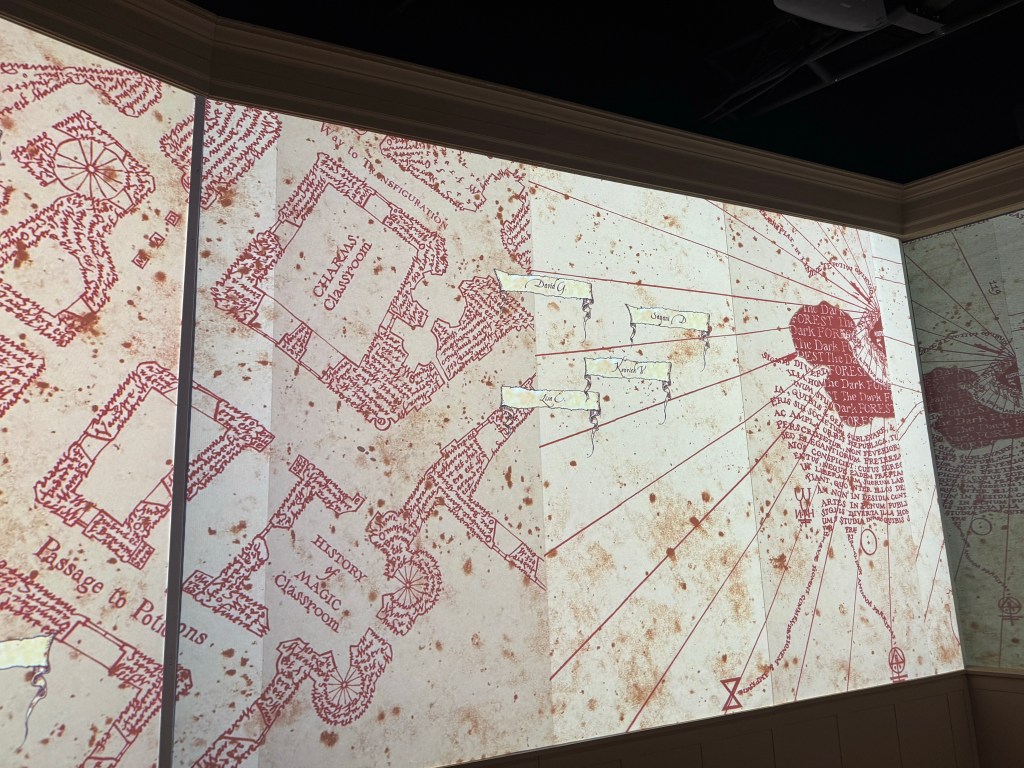
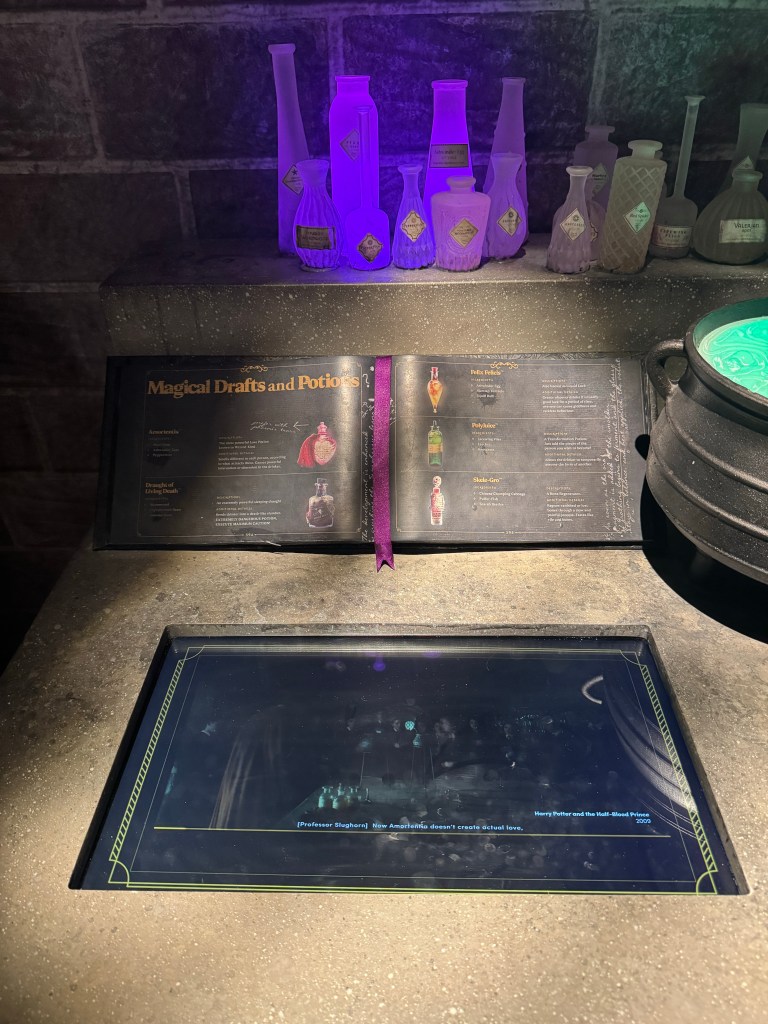
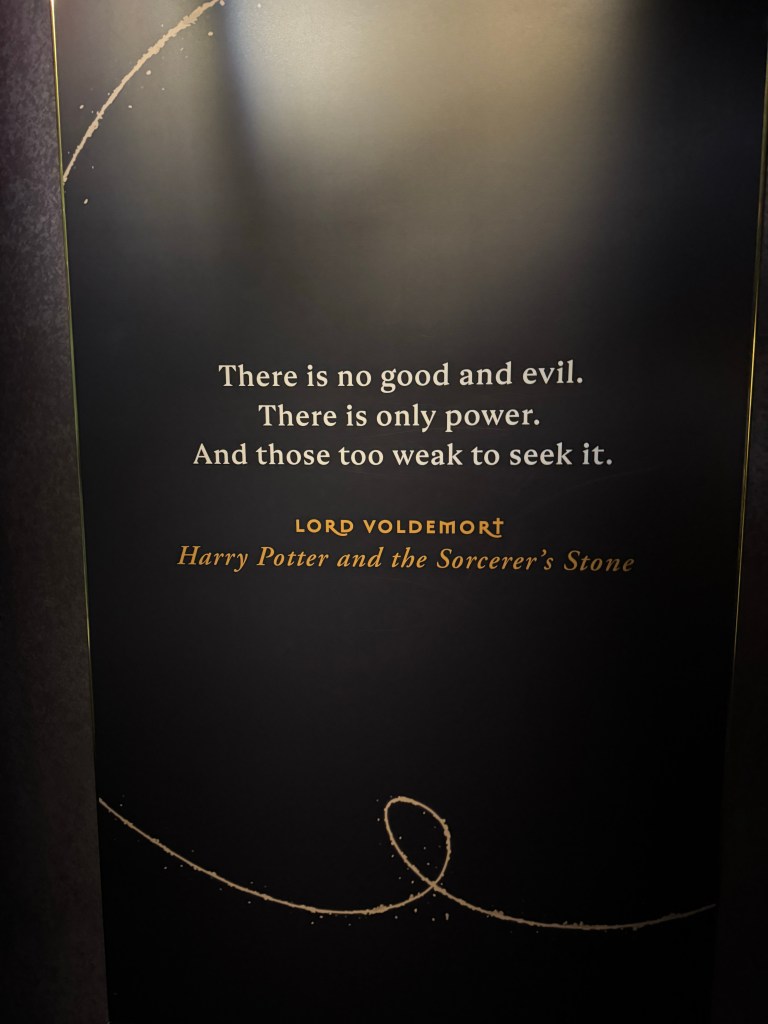
And then came Sunday—the final chapter with a touch of magic. The Harry Potter exhibit in Dallas is like stepping straight into the pages you grew up reading. You walk in and instantly feel that old familiar excitement, like Hogwarts might actually send you a late acceptance letter. Wands, robes, potions, little details everywhere… it’s immersive enough that even if you’re not a die-hard fan, you leave feeling like you’ve brushed against something enchanted.


By the time Sunday night rolled around, it felt like I’d squeezed a week’s worth of moments into three days—music that shook the walls, a zoo that slowed things down, and a world of magic that brought the kid in me right back up to the surface. Busy? Absolutely. Worth it? Every second.

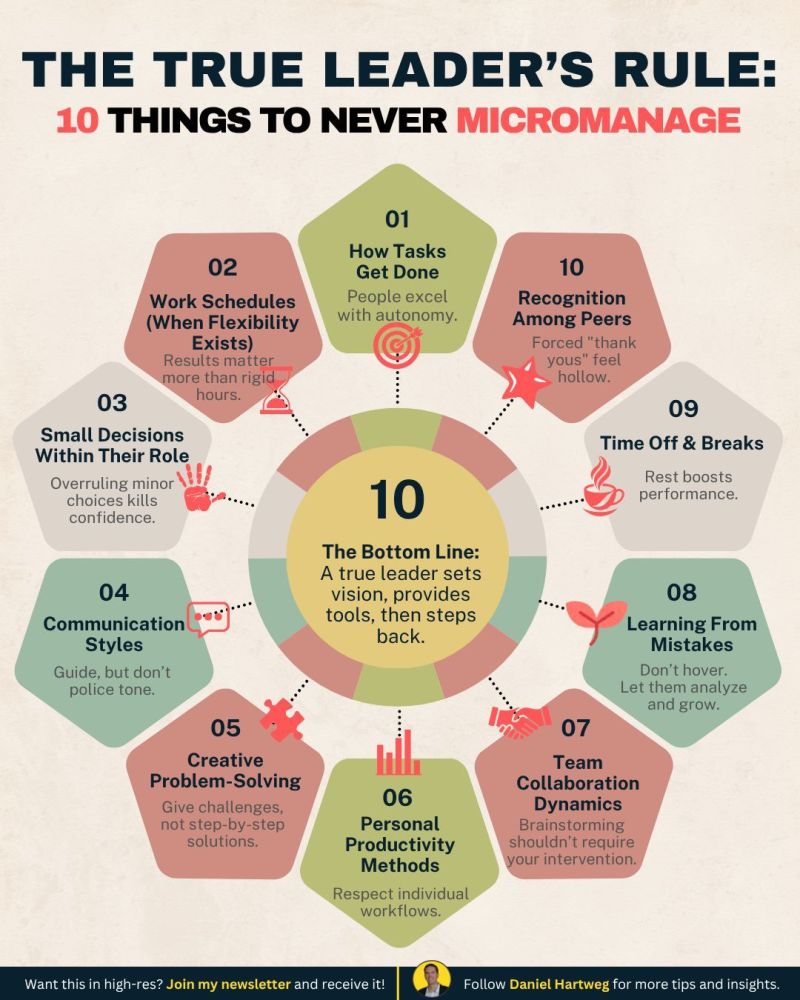
10 Things To Never Micromanage

I know it’s hard to let go.

You care. You want things done right.

But if you’re constantly hovering, second-guessing,
or “fixing” everything—

You’re not leading.

You’re slowly suffocating your team.

Here are 10 things real leaders let go of so their people can rise:

1/ How tasks get done
→ Focus on results, not replicas of your method.

2/ When they work
→ Trust grown adults to manage their own time.

3/ Every small decision
→ If you trust them enough to hire, trust them to choose.

4/ Their communication style
→ People thrive when they speak like humans, not corporate robots.

5/ Creative solutions
→ Innovation can’t breathe under a microscope.

6/ Their productivity habits
→ What works for you isn’t one-size-fits-all.

7/ Team dynamics
→ Step back and let collaboration grow naturally.

8/ Mistakes
→ Errors don’t mean incompetence. They mean growth.

9/ Time off
→ Rest isn’t laziness. It’s how people come back stronger.

10/ Recognition
→ A forced “good job” means nothing. Sincere appreciation sticks.

🔥 The hard truth: Micromanagement is your failure—not theirs.

Great leaders set the vision, then get out of the way.

✨ If you’ve ever had a leader who trusted you, you know how powerful that is.

Let’s normalize that kind of leadership.