
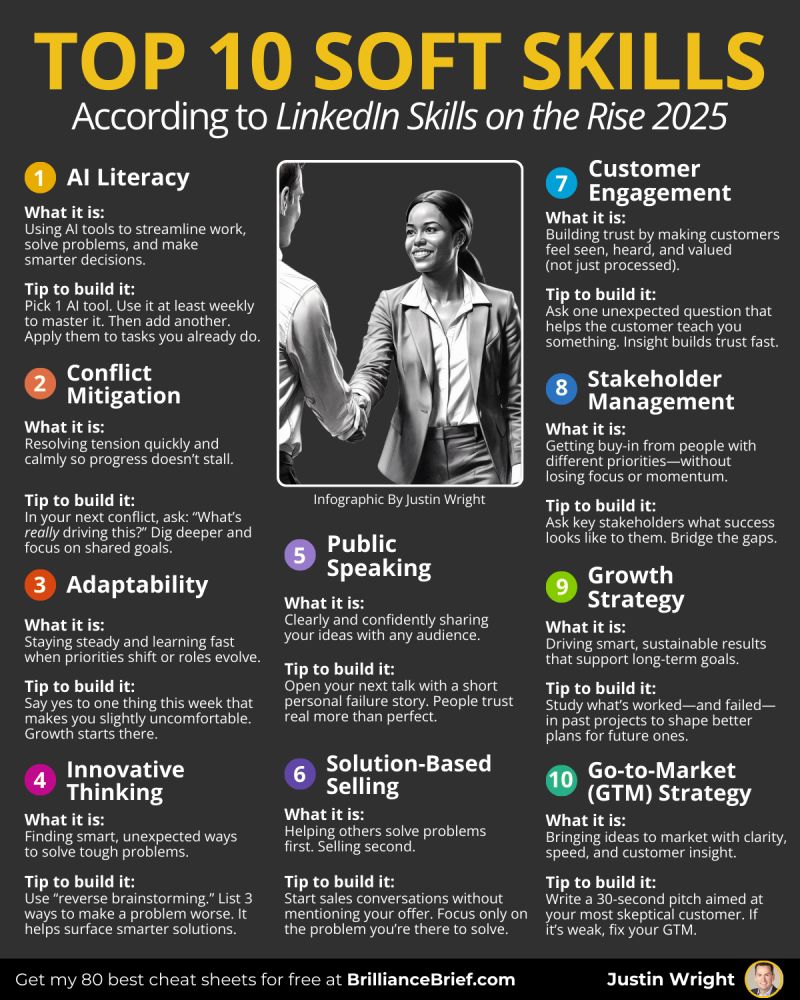
The skills employers want most aren’t what you think.
LinkedIn released its Skills on the Rise 2025 report.
The results are eye-opening.
The data says by 2030, 70% of the skills
used in most jobs will change.
And of the 15 fastest-growing skills employers want,
10 are soft skills.
The top spot? AI Literacy.
But it’s not what you might think:
It’s not coding AI.
It’s not data science.
It’s not building models.
It’s about knowing how to use AI strategically
to solve problems and make better decisions.
The other top skills show a clear pattern:
→ Adaptability
→ Public Speaking
→ Conflict Mitigation
→ Innovative Thinking
Employers aren’t just hiring for technical skills.
They want people who can:
→ Adapt when plans change
→ Communicate ideas clearly
→ Navigate tough conversations
→ Build strong work relationships
→ Think creatively about challenges
As work becomes more digital, remote, and AI-driven,
the human element is even more valuable.
The skills that will future-proof your career
are the ones only humans have.
The best move you can make?
Build one of these soft skills. Then another.
Because they’ll still matter long after
today’s technical skills become old news.
The Things That Truly Impress

Somewhere along the way, the world started measuring worth in the wrong currency. We began equating success with paychecks, prestige, and polished profiles. The bigger the car, the fancier the title, the louder the applause. But if you’ve lived long enough, you start to notice that the people who leave the deepest mark aren’t always the ones with the biggest résumés — they’re the ones with the biggest hearts.
Money can buy comfort, but it can’t buy class. Power can command attention, but it can’t earn respect. Degrees can open doors, but they can’t open minds. And looks — well, they fade faster than we’d like to admit. What really stays is the quiet strength of character, the kind of person who helps when no one’s watching, who keeps promises even when it’s inconvenient, who treats everyone with the same respect — from the CEO to the janitor.
Generosity, integrity, humility, and kindness might sound old-fashioned in a world obsessed with the next big thing, but they never go out of style. Generosity isn’t just about giving money — it’s about giving time, attention, and empathy. Integrity isn’t about perfection — it’s about doing what’s right even when no one will notice. Humility isn’t weakness — it’s wisdom that comes from knowing we’re all still learning. And kindness — it’s the quiet superpower that has the ability to soften hearts and shift entire days.
The truth is, real depth doesn’t shine under a spotlight. It’s revealed in small moments — in how someone talks to a waiter, listens without interrupting, or admits when they’re wrong. Those moments tell you everything degrees and status never will.
So the next time you find yourself impressed by someone, look a little closer. Beyond the suits, the cars, and the social feeds, ask yourself: how do they treat people when there’s nothing to gain? Because in the end, that’s what defines real success — not what you have, but who you are when no one’s watching.
And those who live with generosity, integrity, humility, and kindness? They don’t just impress — they inspire.
Kindness

No matter your title or salary — be kind.
And I’m not talking about fake “kindness,”
the kind you often spot in workplaces.
True kindness isn’t about:
❌ Flattering people.
❌ Smiling all the time.
❌ Making big promises.
Kindness runs much deeper than that.
It’s about:
✅ Being honest.
✅ Truly listening.
✅ Acting with empathy.
✅ Offering real support.
✅ Giving specific praise.
✅ Standing up for others.
✅ Celebrating others’ wins.
✅ Remembering the details.
Kindness is a gift that costs nothing,
but it’s priceless to those who receive it.
Start practicing these acts of kindness,
and your team will follow your lead.
Simple gestures create big changes.
♻️ Kindness is contagious — let’s spread it throughout our networks and build kinder workplaces.
How to know when Termination is right

Want to lose your top talent fast?
Keep protecting the wrong person:
Nothing drags down great people like
watching low standards stay in place.
They won’t complain.
They’ll disengage.
And then they’ll leave.
Not because the job was too hard—
But because it became too unfair.
Here’s what you risk by
keeping the wrong person:
🟥 Repeated mistakes
🟥 Declining team morale
🟥 Resistance to feedback
🟥 Conflict that never stops
🟥 Excuses instead of effort
🟥 Missed goals and deadlines
🟥 Lost time, trust, and momentum
If you’ve given support—
Set clear expectations—
And nothing changes—
It’s time to make the call.
Because leadership isn’t
just about who you grow.
It’s about who you let go.
Not out of punishment.
Out of respect for everyone else.
Your team sees everything.
Letting go isn’t being harsh.
It’s being responsible.
It’s protecting your culture.
It’s clearing space for someone who will rise to it.
And sometimes –
That’s the strongest move you’ll ever make.
Leading By Serving

Great leaders don’t rise “above”—
They rise “with”, here’s why:
Real leadership isn’t about getting ahead,
it’s about showing up differently.
You can lead by power—
or by purpose.
The traditional leader:
🔸 Measures success by output
🔸 Prioritizes personal wins
🔸 Dictates from the top
The servant leader:
🔹 Guides from within
🔹 Prioritizes people and growth
🔹 Measures success by development
One pushes, while
the other builds.
What does servant leadership look like?
🟣 Giving tools—not just tasks
🟣 Speaking last, listening first
🟣 Supporting well-being and performance
🟣 Having space for ownership, not obedience
It’s not about giving up authority,
it’s about using it differently.
To grow people.
To grow trust.
9 Toxic Time Wasters

Your best people are drowning in time-wasting habits.
(And nobody talks about it.)
We’ve all seen these 9 toxic behaviors.
They sneak into every workplace.
They steal hours from your best performers.
Yet we pretend they’re normal.
Time to call them out:
1. The Drop-By Disruptor
“Got a quick sec?” turns into 30 minutes.
Your focus? Gone.
2. The Meeting Maximalist
Books an hour to discuss a 5-minute topic.
Everyone suffers.
3. The Deadline Dodger
Always needs “just one more day.”
Projects stall.
4. The Scope Sneaker
“While we’re at it, can we add…”
Small extras become big delays.
5. The Draft Drowner
Won’t ship until it’s perfect.
Spoiler: It never is.
6. The CC Machine
Loops everyone into everything.
Inbox chaos follows.
7. The Thread Extender
Turns simple questions into email novels.
Clarity dies.
8. The Sign-Off Seeker
Needs approval for tiny decisions.
Progress crawls.
9. The Time Block Bulldozer
“Can I grab a few minutes?”
There goes your morning.
These aren’t bad people.
They’re good people with bad habits.
And you can fix this with simple boundaries:
→ Protect focus time like gold
→ Set office hours for questions
→ Say who decides what upfront
→ Keep email threads under 5 replies
→ Ship “version one” fast, improve later
→ Make 30-minute meetings the default
The secret? Start with yourself.
When you respect time, your team will too.
When you keep meetings short, others follow.
When you ship work fast, perfection fades.
Remember: Every “quick question” distraction
costs 23 minutes of focus.
Your team’s time is their most valuable asset.
Protect it fiercely.
The Permission You Never Needed

Somewhere along the way, we started shrinking our dreams to fit into the comfort zones others built for us. Parents, teachers, bosses, even friends — most of them mean well. They want us to be safe, stable, secure. But “safe” can sometimes become a quiet cage, wrapped in good intentions.
You are allowed to want more. More than what you were told is realistic. More than what fits neatly into someone else’s idea of success. You are allowed to outgrow the expectations that once defined you. You are allowed to dream so big that it scares even you a little.
Because here’s the truth — every dream that ever changed the world started as something too big for someone else’s imagination. If everyone around you completely understands your dream, it’s probably not big enough yet.
The hardest part isn’t dreaming big; it’s believing you deserve to. Especially when people around you seem content with “good enough.” You start to wonder if you’re being ungrateful, or unreasonable. You’re not. Wanting more from life doesn’t mean you don’t appreciate what you already have — it means you’re alive enough to imagine what else could be.
Sometimes, the people who love you the most will be the ones who unintentionally limit you the most. They’ll try to protect you from disappointment, failure, or heartbreak. But protection can look a lot like permission to stop trying. You don’t need that kind of permission anymore.
You can chase what sets your heart on fire. You can rewrite your story. You can be the first in your family, your circle, your town to do something different. You can walk away from “secure” to chase something more meaningful. And if you fail, so what? You’ll fail on your own terms — not while living someone else’s version of your life.
Dream bigger than the life others imagined for you. Because one day, someone will look at you and realize that their own dreams just got a little bigger too — simply because you dared to go first.
Saying No

If your day is full of other people’s tasks—
Learn to say this one word:
Saying “yes” to everything
is the fastest path to burnout.
But saying “no” doesn’t mean
you’re difficult.
It means you’re clear.
Here are some ways to set boundaries—
without burning bridges:
🟨 Overloaded already?
• Acknowledge the request.
• Clarify your limits.
• Propose a trade-off.
💬 “I want to help, but I’m at capacity.
Let’s see what can shift so I can do this well.”
🟦 Manager asks during family time?
• Be upfront.
• Offer a plan B.
• Show you’ll still follow through.
💬 “I have a commitment but I can
jump in first thing tomorrow.”
🟨 Teammate dumps their work on you?
• Define roles.
• Support—without rescuing.
💬 “This is yours to own,
but I can help you get started.”
🟦 Dragged into meetings you don’t need to be in?
• Step back.
• Offer async support.
💬 “To stay focused, I’ll sit this one out.
But happy to review notes after.”
You don’t owe everyone a yes.
You owe them your best work.
Overwork is not a badge of honor.
Your boundaries teach people how to treat you.
And they start with one clear no.
Workplace Control – Focus on What Matters

The ONLY reason we feel overwhelmed:
We spend too much energy on things we can’t control.
Success isn’t about doing more.
It’s about focusing on what actually matters.
In your career, there are 3 areas you should be aware of:
1/ What’s in your control:
↳ The actions you take.
↳ The boundaries you set.
↳ The mindset you maintain.
2/ What’s in your influence:
↳ The team culture you help create.
↳ The way you collaborate with others.
↳ How you provide and receive feedback.
3/ What’s out of your control:
↳ Company-wide decisions and leadership shifts.
↳ Other people’s opinions, actions, and reactions.
↳ The economy, market trends, and external factors.
When we focus on things outside our control,
we burn out.
When we focus on what we can control,
we move forward.
Control what you can.
Let go of what you can’t.
That’s how you grow.
The Multiplication Effect of a Good Heart
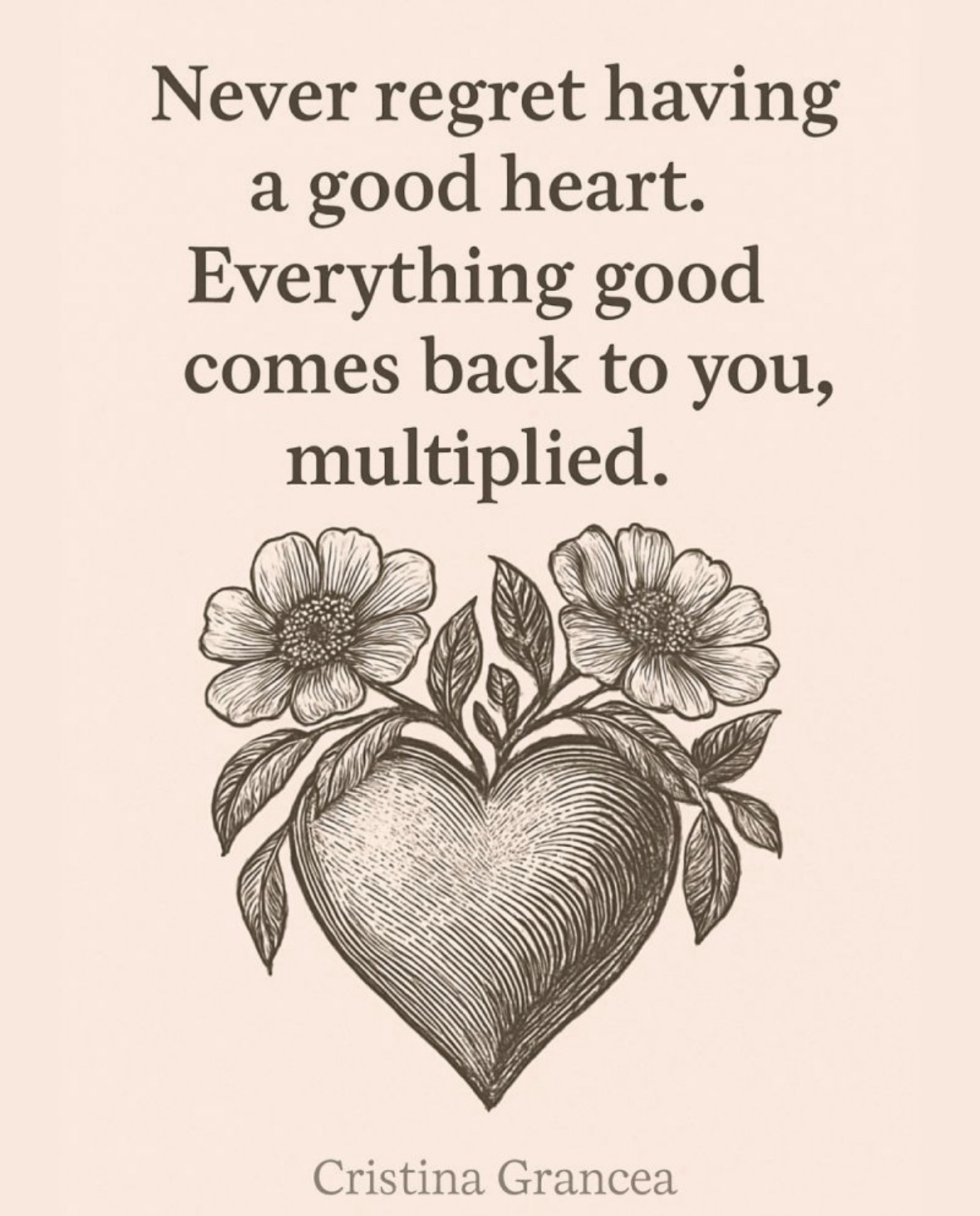
I’ve come to believe that one of the most underrated strengths you can have in this world is a good heart. Not the kind that keeps score, not the kind that helps expecting something in return, but the kind that quietly chooses kindness even when it goes unnoticed.
We live in a time where it’s easy to get cynical, to believe that being too generous or too forgiving makes you weak. People will tell you to toughen up, to stop giving so much of yourself, to protect your energy by putting walls around your compassion. And yes, you do need boundaries. You can’t pour endlessly from an empty cup. But having a good heart isn’t about being naïve—it’s about believing that what you give out eventually comes back, often in ways you couldn’t have planned.
Think about it: every smile you offer, every time you listen without judgment, every small act of generosity plants a seed. You don’t always see the harvest immediately, but over time, life has this funny way of multiplying it and sending it back your way. It might not even come from the same person or situation—it could show up as unexpected support when you need it most, an opportunity that feels too good to be true, or even just peace of mind that money and titles can’t buy.
The truth is, regret usually comes from the times we held back, not the times we showed up with love. Rarely do people look back and wish they had been colder, harsher, or less forgiving. Most often, they wish they had been braver in their softness. A good heart may not shield you from hurt, but it will always align you with what matters most: connection, trust, and joy.
So don’t let anyone convince you that kindness is a liability. In a world that constantly pushes for self-interest and competition, a good heart is a rebellion, a quiet kind of strength. And when you live with that, you’re never really losing. Everything good comes back to you—sometimes slowly, sometimes all at once—but always multiplied.
 Kenrick Vaz