

What Shape Are Your Skills?
Forget fuzzy personality quizzes.
This one can shape your entire career trajectory.
After coaching 100s of professionals into their
dream roles, here’s what I’ve learned:
The way your skills are shaped…
➟ Your depth in some areas
➟ Your range in others
➟ How you focus and lead
…offers powerful insight.
Not into what you should do.
But into what’s already working.
And where you might want to grow next.
Here’s a framework that helps you see it more clearly:
T-Shaped
✅ Broad knowledge
✅ Deep expertise in one area
➡️ Great collaborator, but may hit a ceiling
without leadership depth
M-Shaped
✅ Multiple deep specialties
✅ Spans several disciplines
➡️ Built for systems thinking and leading in complexity
V-Shaped
✅ Deep core strength
✅ Adjacent versatility
➡️ Ideal for pivots and stepping into new challenges
E-Shaped
✅ Creativity + collaboration + communication
✅ Grounded in execution
➡️ Perfect in client-facing and creative roles,
but can plateau without strategic growth
I-Shaped
✅ Deep focus in one area
✅ Specialist status
➡️ Highly trusted (often overlooked for leadership)
X-Shaped
✅ Strategic range
✅ Deep domain + leadership strength
➡️ Think executive-level impact. Rare. In demand.
No shape is better.
But some shapes move faster,
depending on where you want to go.
The key?
Grow into your next shape with purpose. Not by accident.
So…
What shape are you today?
What shape are you stretching into?
Untangling Yourself from Other People’s Opinions

One of the hardest but healthiest things you can ever learn is to take nothing personally. It sounds simple, but it’s a lifelong practice. Every time someone criticizes you, ignores you, compliments you, misunderstands you, or even celebrates you, your mind wants to turn it into a statement about your worth. It’s human. We’re wired to read meaning into everything. But not everything is about you—and the sooner you can make peace with that, the lighter life feels.
Most of the time, people’s reactions are a mirror of their own inner world. Their stress, their beliefs, their habits, their fears, their experiences—those are the things shaping their words and actions. You just happen to be the closest canvas. When someone lashes out, it’s usually not a deep analysis of who you are. It’s a burst of their own frustration. When someone praises you, it’s still about their own values, hopes, and preferences. Recognizing this isn’t cold or detached; it’s freeing.
Taking nothing personally doesn’t mean you don’t care or that you stop showing up with heart. It means you stop letting your self-worth get hijacked by someone else’s mood or opinion. It’s the difference between walking through life as a sponge—soaking up everyone else’s energy—and walking as yourself, steady and self-contained. Imagine how much energy you’d reclaim if you stopped replaying every comment in your head, stopped rewriting every interaction, stopped reading between the lines of every text. That’s the gift of this habit.
This shift creates space for compassion. When you stop making everything about you, you can see others more clearly. You can recognize pain beneath anger, insecurity beneath arrogance, confusion beneath coldness. Instead of taking offense, you start to understand. Instead of closing off, you stay open. And when you do need to respond, you respond from clarity, not ego.
Learning to take nothing personally is like building an invisible boundary that protects your peace. It doesn’t make you untouchable, it just makes you more anchored. You still listen, still learn, still grow. But you’re no longer at the mercy of every gust of someone else’s weather. You begin to trust your own inner climate instead.
8 Ways To Get Things Done

The science of how to get yourself unstuck.
Motivation is a myth…
❌ It doesn’t build long-term habits
❌ It tricks you into waiting
❌ It comes and goes
The truth? Progress is built on habits.
✅ Show up daily
✅ Build momentum
✅ Create lasting change
We’ve all had moments when we need to
get things done but we just don’t feel like it.
That’s when neuroscience and psychology help.
Use these 8 science-backed ways to get
yourself going again:
1. Break tasks into tiny steps.
↳ Break your work into pieces that take less time.
2. Visualize the end result.
↳ Close your eyes and picture the task completed.
3. Change your environment.
↳ A change of scenery can reset your mind.
4. Focus on just starting.
↳ Tell yourself to begin for just 5 minutes.
5. Use visual reminders.
↳ Use progress bars to track small wins.
6. Reward yourself after small wins.
↳ Reward yourself after finishing a small task.
7. Try the 5-4-3-2-1 technique.
↳ Count down from 5 and then take action.
8. Reframe your thinking.
↳ Shift your mindset from “I have to” to “I get to.”
It’s not about grand gestures or heroic efforts.
It’s about showing up even when motivation fades.
That’s how real change happens.
That’s how you get things done.
Start small. Build momentum as you go.
You can do it 💪
A Postcard From Your Future Self
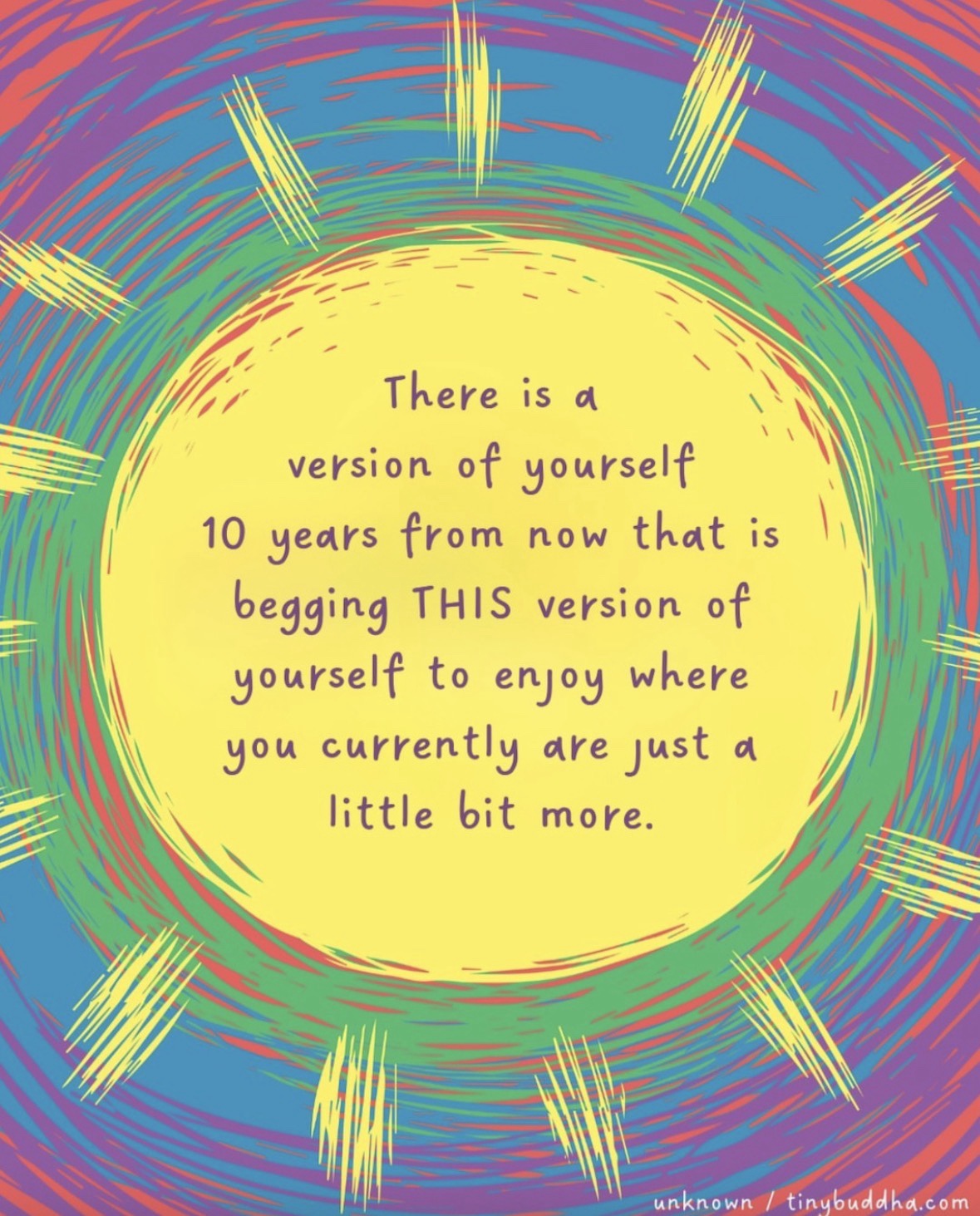
There’s a version of you, ten years from now, who’s looking back at today with a kind of wistful tenderness. They’re sitting somewhere in the future—maybe at a desk, maybe on a porch, maybe in a completely different life—thinking about the person you are right now. And if they could send you a postcard, if they could shout across time, they’d probably say something simple and a little desperate: please slow down and enjoy this moment a little more.
We spend so much time sprinting toward the next milestone, the next raise, the next level, the next version of ourselves that we forget the quiet magic of right now. We assume happiness is always waiting just beyond the next accomplishment, the next transformation, the next reinvention. But the future you already knows—this version of you, the one you are today, is the one they’ll miss the most.
Think about all the things you have today that you once prayed for. The friends, the home, the job, the small rituals, the freedom, the quiet mornings. Remember how hard you worked to get here. Remember the nights you wondered if it would ever feel like this. Now you’re living it. And yet, like we always do, you’re probably looking past it, already scanning the horizon for what’s next.
Your future self wants you to stop doing that. They want you to take a breath and notice how the light falls through your window, how your coffee tastes this morning, how the people you love sound when they laugh. They want you to celebrate the small wins, to take the walk without your phone, to write the journal entry, to make the call you’ve been putting off. They want you to remember that life isn’t a checklist. It’s a series of moments—this one included—that you’ll never get back.
And maybe the most radical thing you can do today is listen to them. Maybe you pause for a second and actually feel where you are. Not just notice it, but feel it. The weight of the chair you’re sitting on. The smell of the air. The quiet pulse of being alive. Because when you do that, even briefly, you’re not just living—you’re creating a memory your future self will treasure.
Someday, that version of you will look back and smile at the way you stopped, even for a heartbeat, to appreciate your life as it was. And you’ll be glad you didn’t let this version of you slip by unnoticed.
How to Reduce Stress
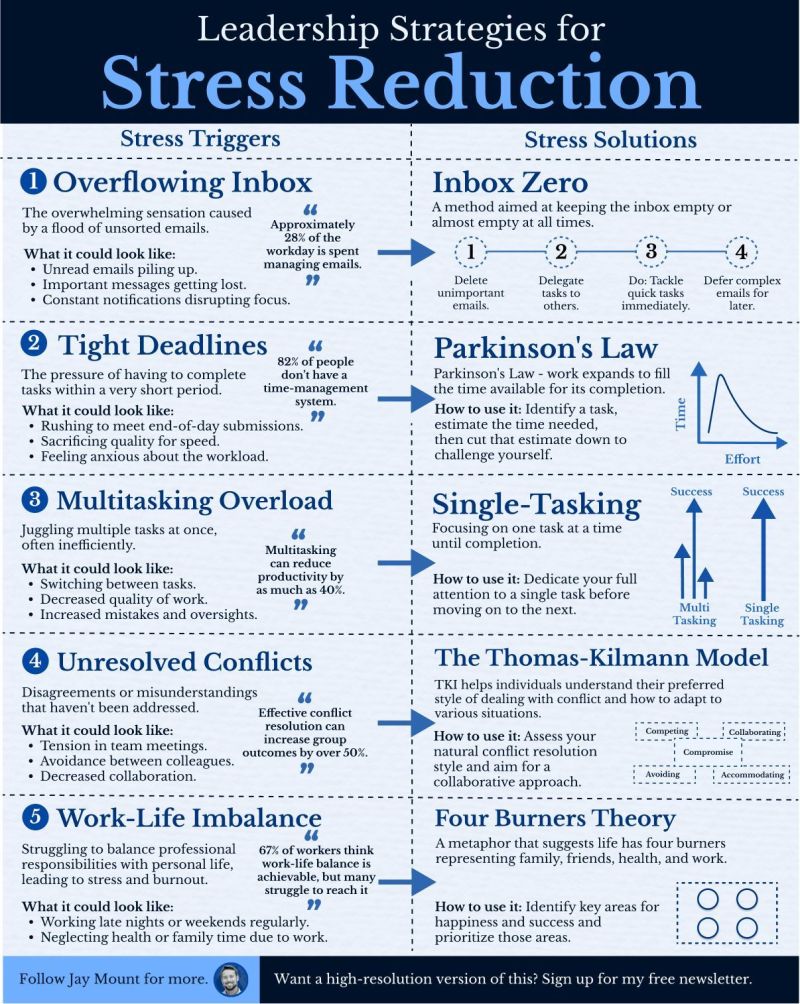
Burnout doesn’t always look dramatic. Sometimes it’s just slowly losing clarity.
You’re not broken—you’re just overloaded.
From endless inboxes to context-switching all day,
most leaders are forced to carry more without ever
being taught how to carry better.
Here are 5 stress signals—and the energy-protecting systems that help:
1. 📥 Inbox Avalanche?
Try: Inbox Zero
➤ Delete what doesn’t matter
➤ Delegate what you shouldn’t own
➤ Triage quick tasks, defer the rest
A clear inbox = a lighter mind.
2. ⏱ Drowning in Deadlines?
Try: Parkinson’s Law
➤ Give yourself less time
➤ Force clarity by racing the clock
Effort expands to fill time—cut it on purpose.
3. 🔀 Constantly switching gears?
Try: Single-tasking
➤ Focus fully
➤ Finish before jumping
Multitasking drains energy invisibly. Focus protects it.
4. 🤝 Team tension in the air?
Try: Thomas-Kilmann Conflict Styles
➤ Identify your default mode (avoid, compete, etc.)
➤ Shift toward collaboration
High-performing teams talk about what’s hard.
5. 🔥 Burners all on high?
Try: The Four Burners Theory
➤ You have 4: Work, Health, Family, Friends
➤ You can’t max them all—choose consciously
Energy is finite. Prioritize what matters most.
The Reframe:
Leadership isn’t about eliminating pressure.
It’s about protecting the power source: you.
Build Appreciation At Work

Appreciation isn’t a bonus—
It’s a must:
When people feel valued, they do their best.
Here’s what happens when appreciation is missing:
❌ More people quitting
❌ Poor engagement
❌ Fewer new ideas
❌ Less teamwork
❌ More burnout
❌ Low morale
But when people feel appreciated:
✅ Retention goes up
✅ Teams work better together
✅ People take pride in their work
✅ Productivity improves naturally
✅ Success becomes a shared goal
Why it matters:
81% of employees say they work harder
when they feel appreciated.
[Source: Glassdoor]
When appreciation is part of the culture—
People don’t just show up.
They show up with a purpose.
7 Rules for Saving Money
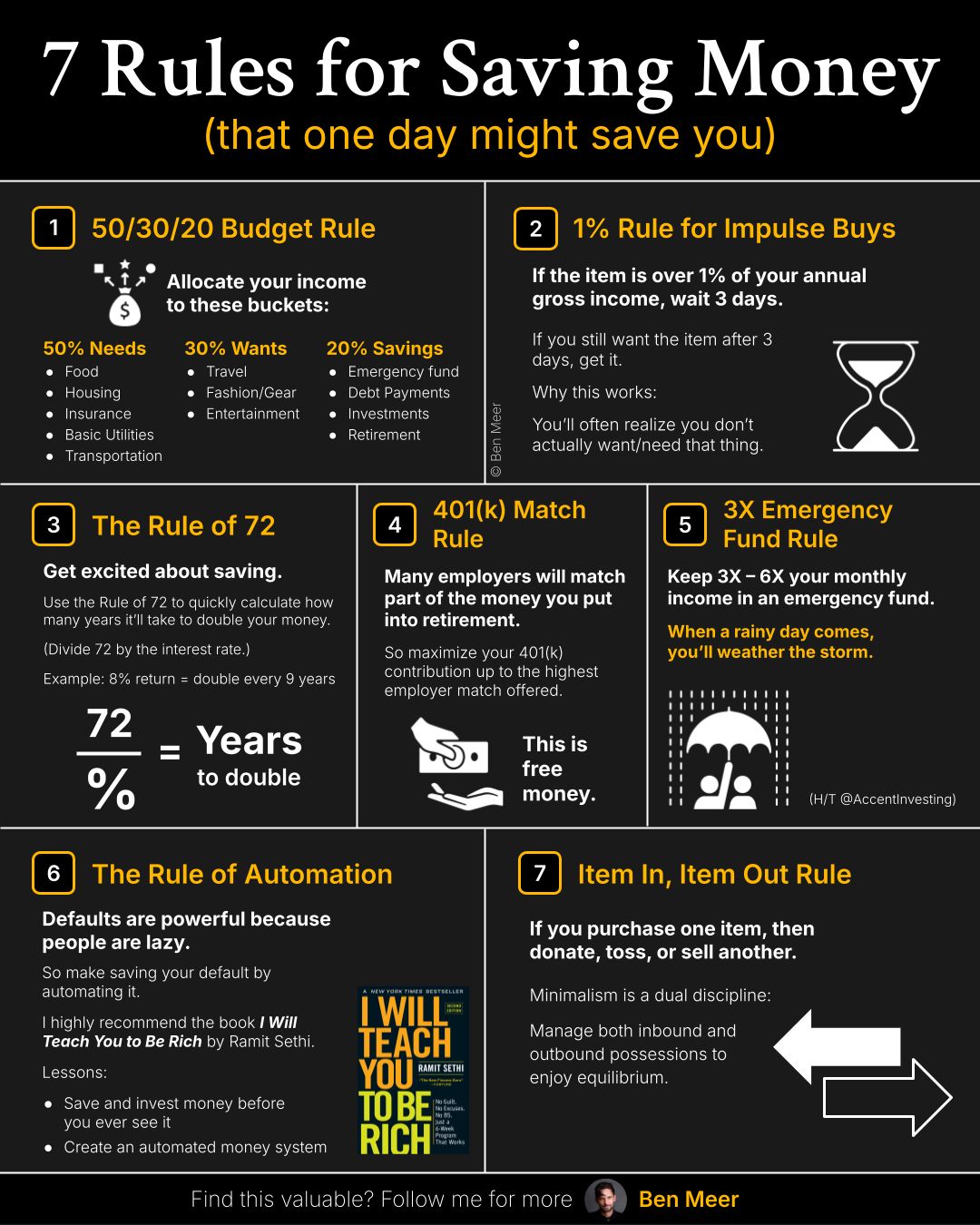
1. 50/30/20 Budget Rule
↳ Split your income wisely: 50% for essentials, 30% for desires, and 20% for savings.
↳ This balance keeps you grounded while leaving room for growth.
2. 1% Rule for Impulse Buys
↳ Wait 3 days if you want to buy something greater than 1% of your yearly earnings.
↳ This cooling-off period helps you avoid buyer’s remorse.
3. The Rule of 72
↳ Calculate how fast your money grows by dividing 72 by your interest rate.
↳ Knowing how fast your money doubles will motivate you to save more.
4. 401(k) Match Rule
↳ Take advantage of your employer’s retirement match (it’s free money).
↳ Every dollar matched is a step closer to financial freedom.
5. 3X Emergency Fund Rule
↳ Stash away 3 to 6 times your monthly expenses for unexpected events.
↳ This safety net ensures you’re ready for any surprises.
6. The Rule of Automation
↳ Set up automatic transfers from checking to savings accounts.
↳ Effortless savings lead to automatic money growth.
7. Item In, Item Out Rule
↳ Buy something new? Let go of something old.
↳ This minimalist approach keeps your finances (and spaces) in harmony.
What’s your favorite money-saving tip?
What Makes A Great Strategy?

Most strategies fail before they even start.
Because what people think strategy is…
isn’t what strategy actually is.
I’ve watched brilliant founders create 100-slide decks
filled with buzzwords and vision statements.
They talk about “beating the competition” and
“dominating the market.”
Then 6 months later? Nothing has changed.
Here’s the truth about real strategy:
What Strategy ISN’T:
❌ A pretty deck that sits on a shelf
❌ Copying what your competitors do (but “better”)
❌ Big goals without tough choices
❌ Trying to be everything to everyone
What Strategy ACTUALLY IS:
✅ Choosing what NOT to do (this one hurts)
✅ Being different, not better
✅ Making trade-offs that make you sweat
✅ Solving problems others don’t see yet
The best strategy I ever saw?
A founder who shut down 3 profitable product lines
to focus on just one.
His board thought he was crazy.
His team was terrified.
Even his wife questioned it.
But he knew:
Strategy is about putting all your chips on a few big bets.
Not hedging. Not playing it safe. Going all in.
18 months later?
That one product line did 10x the revenue of
all 3 combined.
Save this.
Share it with your team.
Use it in your next strategic planning session.
Here’s my test for a real strategy:
→ Can your newest employee explain it in 30 seconds?
→ Does it force you to say “no” to good opportunities?
→ Does it create rules your competition can’t follow?
If not, you don’t have a strategy.
You have a wish list.
Most leaders want strategy to be comfortable.
But real strategy should make you uncomfortable.
It’s not about having all the answers.
It’s about testing small, learning fast,
then going all in when you find what works.
Your turn: Agree? Disagree? What makes a great strategy?
How to Set Boundaries

Boundaries Aren’t About Saying No to Everything:
If you’re constantly overworked, overwhelmed, and undervalued, your boundaries may be ignored.
Here’s the truth:
Healthy boundaries don’t push people away.
They empower you to show up at your best.
Here’s how to protect your time & energy:
1) Communicate with Confidence:
↳ Express your limits without hesitation or apology.
2) Establish Work-Life Separation:
↳ Set defined work hours and stick to them to avoid burnout.
3) Master the Art of Saying NoL
↳ If it doesn’t align with your priorities, decline without guilt.
4) Set Expectations Early:
↳ Be upfront about your limits to prevent misunderstandings.
5) Document Agreements:
↳ Keep records of responsibilities and deadlines to ensure accountability.
6) Protect Your Personal Space:
↳ Maintain separation between work and personal life for mental well-being.
7) Enforce Boundaries Firmly:
↳ If someone repeatedly crosses the line, address it immediately.
8) Pause Before Committing:
↳ Take a moment before saying yes; don’t overextend yourself.
9) Lead by Example:
↳ Respect others’ boundaries to reinforce your own importance.
10) Clarify Your Priorities:
↳ Know what matters most so you can protect your time and energy.
Remember:
The boundaries you allow will define the balance you live.
Running the CEO of Me, Inc.

Somewhere along the way, it hit me: my life is the most important company I’ll ever run.
For years, though, I managed it like an accidental entrepreneur — winging it, saying yes to everything, hoping things would just work themselves out.
But here’s what I’ve learned the hard way:
Every relationship in my life is either an asset or a liability.
Every habit I keep is either an employee or a saboteur.
Every thought I entertain is either a strategic advisor or a toxic board member.
When I finally started treating my life like the company it is, things shifted. Here’s how I began:
1. My Vision & Strategy
I sat down and actually thought about where I wanted to be in one year, five years, and ten. I got honest about which people in my circle truly elevated me. I mapped out milestones — not a perfect plan, but a direction. For the first time, my “business plan” for life felt real.
2. My Firing Round
This was brutal but necessary. I cut ties with energy-draining relationships. I eliminated habits that gave me poor returns. And I started dismissing negative thoughts that wasted my mental resources. Each step felt like freeing up budget and bandwidth in my company.
3. My Hiring Process
I became much more intentional about who gets my time. I added habits that fuel growth instead of drain it. And I chose thoughts that support my vision rather than sabotage it. Slowly, my life started to feel like a healthy, thriving organization.
4. My Promotion Strategy
I doubled down on the people who bring out my best. I strengthened habits that actually produce results. And I amplified the thoughts that push me forward instead of hold me back. That’s when I started to feel real momentum.
What I’ve realized is this: the best CEOs aren’t afraid to make hard decisions. And neither can I be.
My time, my energy, and my talents are the most valuable assets I own. It’s on me to protect them.
I’m still figuring it out — some days I slip back into being an accidental entrepreneur. But the more I run my life like the CEO of “Me, Inc.,” the more intentional it becomes, and the better my returns.
 Kenrick Vaz