

How to beat procrastination
I’m gonna ask you 6 questions — ready?
You just need to answer “yes” or “no.”
When your answer is “yes,” you’ll find out what to do :)
Let’s dive in!
1. Do you avoid starting tasks because you’re worried they won’t be perfect?
If so, consider this:
→ Aim for “good enough” instead of perfection
→ Break the task into small chunks
→ Celebrate finishing each one
I used to be a bit of a perfectionist myself.
So don’t worry — you’re not alone.
2. Do you put things off because you’re not good at focusing on the details?
If so, consider this:
→ Break your big ideas into smaller, manageable steps
→ Make a to-do list and tick off each little task as you go
3. Do you resist doing things on a schedule because you don’t like being told what to do?
If so, consider this:
→ Create a schedule that works for you and stick to it
You just need to set your own deadlines to keep things moving.
4. Do you delay tasks because you’re scared of change?
Or maybe because you’re stepping out of your comfort zone?
If so, consider this:
→ Start with easy tasks to build confidence
→ Gradually tackle bigger things as you get more comfortable
We don’t need confidence to start.
We just need to start — then confidence will come.
Right?
5. Do you procrastinate because you like the rush of working under pressure?
If so, consider this:
→ Plan ahead
→ And set mini-deadlines
Why?
Because you wanna avoid last-minute panic.
You just need to create a routine that includes:
→ Planning
→ Time for breaks
I personally take 10 breaks a day.
And they’re all on my calendar — even if they only last 5-10 minutes.
6. Do you take on too much and then struggle to get started or finish anything?
If so, consider this:
→ Prioritize your tasks
→ Tackle them one at a time
→ And say no when necessary
That’s why focus matters.
That’s it.
This is how we can stop procrastinating.
Of course, the number one antidote is always my friend, Mrs. Discipline.
Agree?
“Let’s build a world where everyone belongs through the power of wellbeing!”
13 Brutal Truths Your Manager Needs To Know

When good employees leave, it’s often your fault.
Here’s what managers need to understand:
1. If top talent is quitting, look at your management style.
↳ People leave managers, not jobs.
↳ Leadership determines loyalty.
2. Employees want to grow.
↳ Without opportunities, they’ll outgrow your company.
↳ Development isn’t a perk—it’s an expectation.
3. Happy employees = Happy customers.
↳ Positive teams create positive experiences.
↳ Morale drives customer satisfaction.
4. Toxic work culture drives people away.
↳ Negativity doesn’t stay contained—it spreads.
↳ A toxic environment affects clients, too.
5. Trust is key for remote work.
↳ Micromanagement destroys trust.
↳ Autonomy strengthens accountability.
6. Be open to feedback.
↳ Criticism fuels growth.
↳ Closed ears lead to stagnant leadership.
7. Actions speak louder than words.
↳ Consistency builds credibility.
↳ Empty promises break trust.
8. Underpaying employees is a bad idea.
↳ Cutting costs now means losing talent later.
↳ Fair pay attracts and retains the best.
9. Micromanaging hurts performance.
↳ Creativity thrives with freedom.
↳ Over-control stifles potential.
10. Focus on employee growth.
↳ Investing in people is investing in results.
↳ Growth prevents turnover.
11. Fearful leadership leads to poor results.
↳ Fear crushes innovation.
↳ Empowered teams create impact.
12. Pay fairly or lose talent.
↳ Competitive pay keeps top performers.
↳ Other companies won’t hesitate to offer more.
13. Neglecting work-life balance harms productivity.
↳ Burnout kills creativity and efficiency.
↳ Healthy balance leads to sustained success.
Remember:
Employees don’t just quit companies.
They quit bad management.
The best leaders:
✔️ Inspire growth
✔️ Build trust
✔️ Reward fairly
Why Good People Can’t Thrive in Toxic Systems

We often tell individuals to take responsibility for their health—mentally, emotionally, physically. And that’s good advice… to a point. But what happens when the environment around you is the very thing making you unwell?
“A healthy person in an unhealthy system will eventually become unhealthy.”
Read that again. Let it sink in.
The Petri Dish Effect
Imagine placing a healthy plant into toxic soil. No matter how strong or vibrant that plant once was, it will eventually wither. Not because it’s weak, but because its environment is incompatible with life.
The same happens to people. You can have the right mindset, the right intentions, the right tools. But if you’re operating in a system filled with dysfunction—be it a toxic workplace, a controlling relationship, a broken institution—it will slowly erode your well-being.
This isn’t about blaming the system for everything. It’s about recognizing the system’s influence, and giving yourself the grace to walk away when survival turns into self-betrayal.
Signs You’re in an Unhealthy System
- You constantly question your worth, even when you know you’re doing your best
- You feel drained—not just tired, but soul-exhausted
- Speaking up is punished, not encouraged
- Blame is weaponized, and accountability is rare
- Growth is stifled by politics, fear, or ego
- You have to shrink, mask, or dull yourself just to “fit in”
Even the healthiest mind can’t flourish in this kind of space for long. Mental health is not a solo sport—it’s a collective environment.
It’s Not Just You—It’s the System
When people burn out, we’re quick to hand them breathing techniques and meditation apps. But if the system causing their burnout remains untouched, we’re offering bandages for a bullet wound.
Healthy individuals don’t just need personal tools—they need healthy systems:
- Workplaces that value people over productivity
- Families that foster open communication
- Communities that honor boundaries and celebrate growth
No amount of personal resilience can fully protect you from a consistently toxic environment. Even the strongest swimmers can drown in poisoned water.
Change the System or Change Your Proximity
If you’re in an unhealthy environment right now, ask yourself:
- Is this system open to change?
- Can I influence it from where I stand?
- Is my staying here a service to my soul, or a slow self-erasure?
Sometimes you can lead change. Other times, the healthiest thing you can do is leave. Not out of weakness, but out of wisdom.
Protect Your Health by Choosing Your Habitat
You weren’t meant to just survive in spaces that slowly dim your light. You were meant to thrive. And thriving often requires more than inner work—it demands outer alignment.
So if you’re feeling off, don’t just look inward. Look around you.
And remember:
Even the strongest seed won’t grow in poisoned soil.
Choose your ground wisely.
10 Career Lies

Success isn’t about working harder. It’s about working smarter.
Most people get stuck in their careers because they believe the wrong things. Here’s the reality check:
Hard work alone leads to success.
→ Results only matter if the right people see them. Visibility beats effort.
Loyalty will be rewarded.
→ Companies prioritize profits, not people. Negotiate for what you’re worth.
Job titles define your value.
→ Skills and impact matter more than any title on LinkedIn.
Your boss always knows best.
→ Leadership is flawed. Question bad decisions. Push for better ones.
Networking is optional.
→ The best jobs go to people who know people. Relationships open doors.
Burnout means you’re working hard.
→ Burnout means you’re working inefficiently. Rest is a strategy, not a weakness.
Asking for a raise is selfish.
→ Companies won’t offer more unless you ask. You don’t get what you deserve, you get what you negotiate.
Comfort means you’ve made it.
→ Comfort is stagnation in disguise. If you’re not growing, you’re falling behind.
Perfection is the goal.
→ Perfect is the enemy of progress. Done is better than perfect.
Someone will eventually recognize your value.
→ No one is coming to save your career. Own your path. Make moves before you’re forced to.
10 Uncomfortable Truths Every Manager Should Read
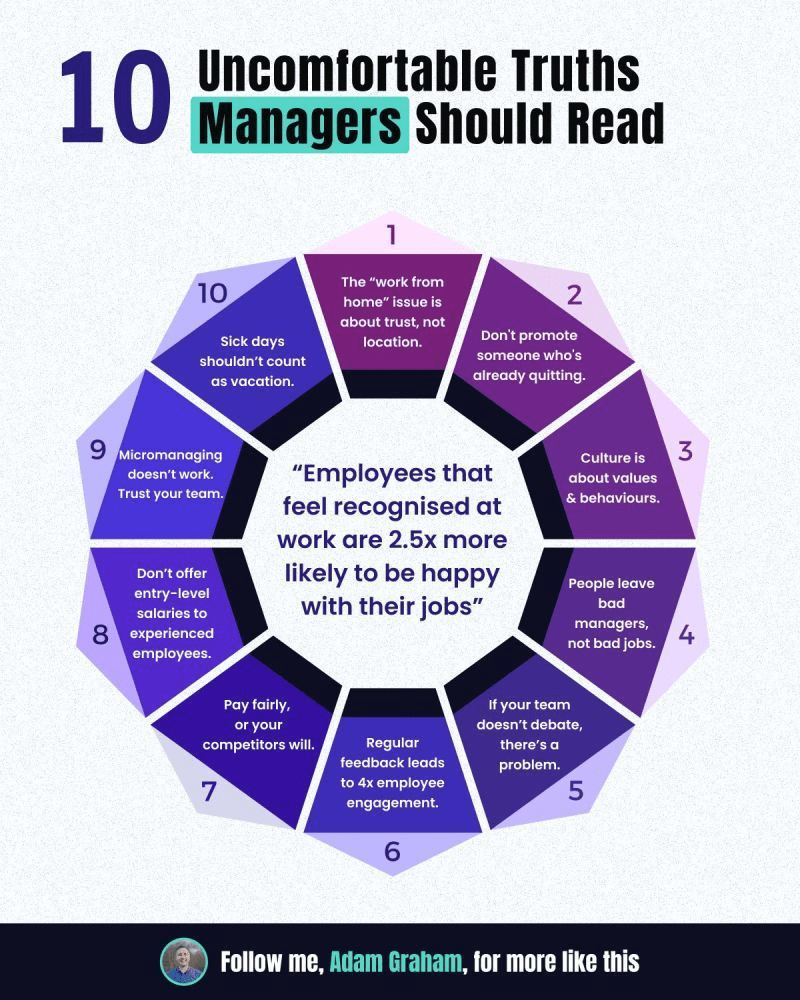
1. The “work from home” issue isn’t about location; it’s about trust.
2. The worst time to offer someone a promotion is when their notice has already been handed in.
3. Culture extends beyond bean bags and free beer. It’s about values and behaviour.
4. Employees don’t just leave bad jobs; they leave bad managers.
5. If your team hesitates to say “I don’t know” or simply disagree with you, it’s time to address those glaring issues.
6. Regularly giving feedback leads to 4x better employee engagement.
7. Pay employees what they’re worth. Otherwise, your competitors will.
8. An “entry-level” role that requires years of experience is not entry-level. You’re simply shortchanging experienced workers with a lower salary.
9. Micromanagement does not work. Trust your team and give them autonomy.
10. Sick days or family emergencies shouldn’t count as annual leave, be empathetic and let them prioritise health.
Your Circle is Your Power

Some people build you up behind your back.
Others tear you down.
Life is too short for the second kind.
You deserve to surround yourself with people who:
Genuinely want you to succeed
Challenge you constructively
Empower you to take risks
Celebrate your successes
Listen without judgement
Believe in your potential
Bring out the best in you
Encourage your growth
Offer honest feedback
Support your dreams
Stand up for you
Lift you up
It’s ok to let go of those who:
Gossip
Create drama
Are naysayers
Spread negativity
Drain your energy
Dismiss your goals
Constantly criticize
Make you feel small
Question your worth
Cross your boundaries
Undermine your confidence
Downplay your achievements
Surround yourself with those who lift you higher.
Find the courage to distance yourself from the rest.
Are you reliable?

Reliability is a foundational quality that sets the best team players apart. 🤝
Andre Durand said, “If you look at the essence of trust, it’s a one-to-one ratio between say and do.”
Individuals who clearly express this issue demonstrate to the company that following through is essential. 🔄
Some people, if they say they are going to do something, are like “money in the bank.” We don’t have to think about that anymore.
With other people, we know we have to keep their to-do lists on our to-do list. If this is how most people in an organization operate, the business will be slower.
Reliability also goes to the heart of what it means to be a team player. It removes the hierarchy and acknowledges that everyone relies on one another to achieve a goal.
Paula Long captures the spirit of this idea. “I like to say that we’re all subcontractors to one another. It’s about accountability and respecting each other’s time.”
I would build on that and add three ideas:
✅ Treating each colleague as an “internal customer” and thinking as if they will have to answer the question “How likely are you to recommend me to others?”
✅ Over-communicating and following up proactively, especially when we are struggling and in danger of not meeting a goal. It helps to build trust and transparency.
✅ Whenever possible, overdeliver, even a tiny detail like extra thorough documentation or a 1:1 short call to anticipate the results. And in doubt, underpromise (but not too much)
What is reliability for you?
What Will You Stop Chasing This Week?
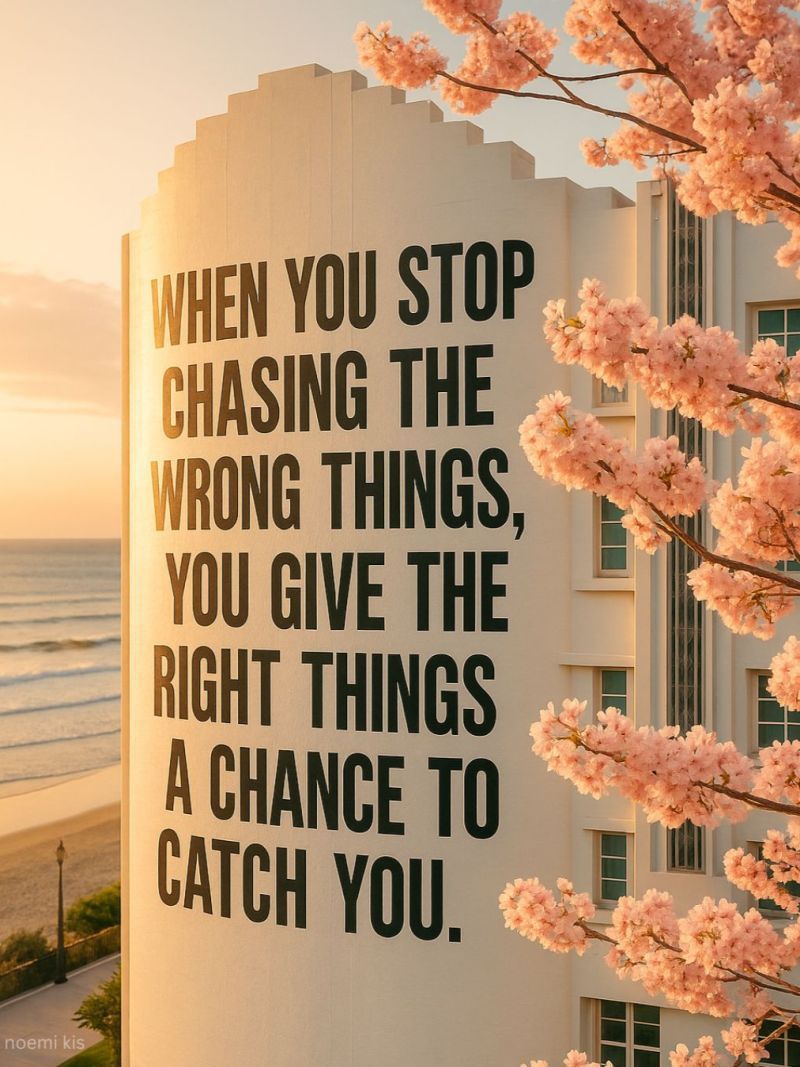
Stop chasing what’s running away from you.
Start noticing what’s walking toward you.
Most people have it backwards.
They exhaust themselves pursuing:
↳ Jobs that don’t respond to applications
↳ People who barely text back
↳ Opportunities that keep saying “maybe”
Meanwhile, they ignore what’s already working.
Here’s how to change that 👇
This week, audit your energy:
1/ List what you’re currently chasing
↳ Which conversations drain you?
↳ Which opportunities require constant follow-up?
↳ Which people make you question your worth?
2/ List what’s already flowing
↳ Which clients refer you without asking?
↳ Which skills do people compliment naturally?
↳ Which conversations energize you?
Then make the shift:
Stop: Sending emails to uninterested prospects
Start: Creating content for engaged audience
Stop: Chasing people who ghost you
Start: Spending time with the ones who show up
Signs you’re on the right track:
→ Conversations flow naturally
→ People seek your opinion
→ Opportunities multiply without force
Your next breakthrough isn’t in what you’re chasing.
It’s in what you’ve been overlooking.
PS: What will you stop chasing this week?
Personality Types

20 Benefits of Understanding Personality Types
(that every leader should know)
For Your Team:
• Enhanced brainstorming sessions
• Better team problem-solving
• Easier resolution of conflicts
• Fewer misunderstandings
• Stronger team cohesion
• Efficient task allocation
• Better communication
• Tailored development
• Higher engagement
• Lower stress levels
For You:
• Sharper intuition
• Stronger influence
• Improved empathy
• Increased resilience
• Greater adaptability
• Deeper connections
• Increased confidence
• Better self-awareness
• Clearer communication
• Improved decision-making
All great leaders know:
Understanding your team is key to success.
And why is so important?
It shows how each team member:
➟ Thinks & processes information
➟ Interacts & communicates
➟ Handles conflict & stress
With these insights, you can:
➟ Improve team synergy
➟ Tailor your leadership style
➟ Increase overall productivity
What is Leadership?
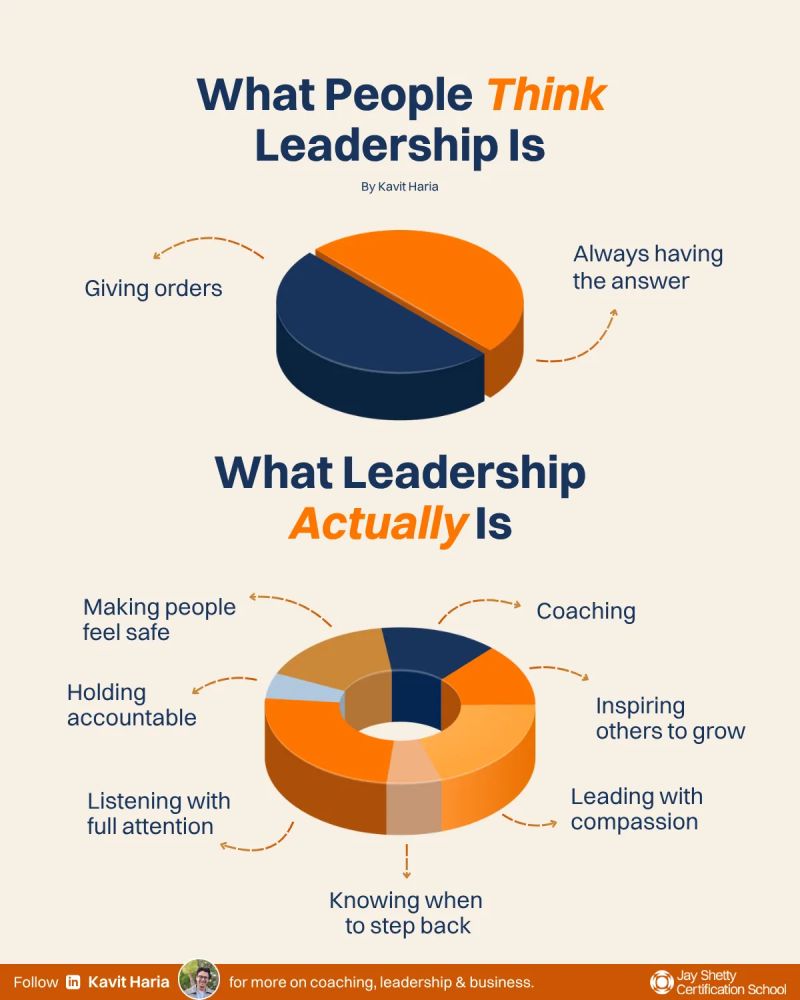
Most people have it backward.
They think leadership is about being in charge.
(It’s not.)
Thinking it’s all about telling others what to do.
Real leadership? It’s about putting others first.
Look at the best leaders you know.
They don’t hog the spotlight.
They shine it on their team.
They don’t have all the answers.
They ask the right questions.
True leadership is:
1/ Coaching, not commanding.
↳ Guide your team to find their own solutions.
2/ Celebrating others’ wins.
↳ Their success is your success.
3/ Listening with full attention.
↳ Really hearing what’s not being said.
4/ Creating psychological safety.
↳ Where mistakes become lessons, not failures.
5/ Leading with compassion.
↳ Understanding that everyone’s fighting a battle.
6/ Knowing when to step back.
↳ Letting your team own their victories.
The irony?
When you stop trying to be the hero,
you become the leader everyone needs.
Because great leaders don’t create followers.
They create more leaders.
Your title might make you a boss.
But your actions make you a leader.
Choose wisely.
 Kenrick Vaz