What’s New in Storybook 9

1. Storybook Test: A Complete Component Testing Suite

2. Significantly Lighter & Faster

3. Stories as Testable Units

4. Tag-Based Organization & Globals

5. Framework Support & Upgrades


Why It Matters

  • Developers gain a unified toolchain for visual, accessibility, interaction, and coverage testing—all within the component workspace.
  • Dramatically improved performance and developer experience thanks to a leaner structure and faster environment medium.com+5medium.com+5storybook.js.org+5.
  • Makes collaboration smoother: UX designers, frontend devs, and QA can share consistent previews with tags, globals, and auto-generated tests.

What to Do Next


Bottom line: Storybook 9 is no longer just a playground—it’s now a compact, powerful component development and testing platform, built for the modern web.
Periodic Table of Emotional Intelligence

Ever met a brilliant jerk at work?

That’s a lack of emotional intelligence ⬇️

Most people think emotional intelligence means being nice.
It doesn’t.
It means being aware, intentional and real.

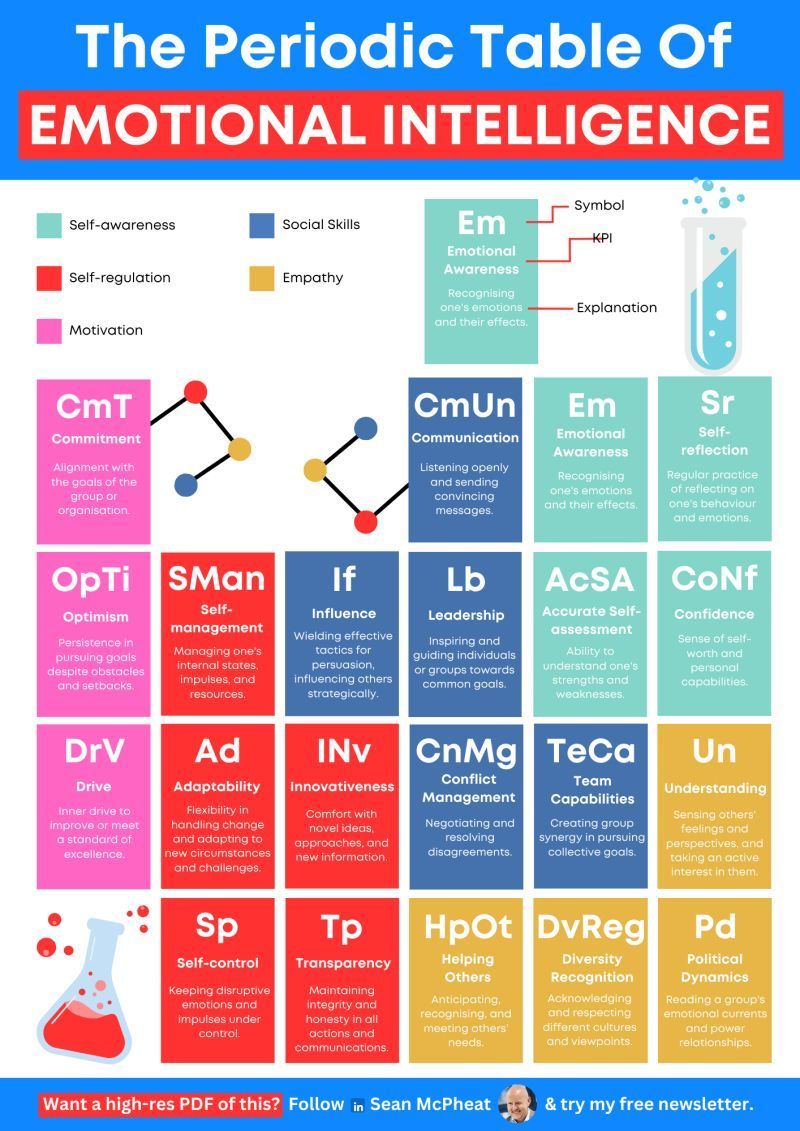
This periodic table breaks EQ into 5 powerful pillars:

→ Self-awareness
Understanding your feelings, reactions, and patterns.

→ Self-regulation
Managing emotions before they manage you.

→ Motivation
Staying focused on goals with purpose and resilience.

→ Empathy
Seeing beyond your own view to understand others.

→ Social Skills
Building trust, influence, and healthy relationships.

Here are a few key elements from the table:

→ Em – Emotional Awareness
Recognising your emotions and their impact.

→ Sr – Self-reflection
Regularly assessing your behaviour and mindset.

→ Sp – Self-control
Keeping disruptive emotions in check.

→ Ad – Adaptability
Adjusting calmly to change and challenge.

→ OpTi – Optimism
Staying persistent despite setbacks.

→ Lb – Leadership
Inspiring others with vision and clarity.

→ Un – Understanding
Sensing emotions and perspectives beyond your own.

→ CnMg – Conflict Management
Navigating tough conversations without damage.

→ Tp – Transparency
Staying honest and open in communication.

→ HpOt – Helping Others
Recognising and responding to needs in the moment.

Emotional intelligence affects everything:

→ Your ability to lead
→ Your influence with others
→ Your team’s trust and culture
→ And your long-term success

You can’t develop high-performing teams, without high emotional awareness.

And the best part?
Unlike IQ, EQ can be learned!

Atomic Habits

Small daily habits can change your life –

Here’s how to master them this year:

I just re-read my favorite productivity book, Atomic Habits by James Clear. 

If you haven’t read it, you should.

But if you don’t have time right now, 

Or just need a refresher,

Or want a primer before diving in,

This sheet covers the highlights you’ll need.

James outlines the transformational power of atomic habits:

↳Small steps

↳Easy to execute

↳Dramatically impactful

By setting up simple systems,

And using the power of compounding results,

You can not only achieve tremendous things by this time next year,

But you can actually become an entirely different person.

And there’s no better time to start than right now.

Shine

🕯️Dimming others…
doesn’t brighten your own light.

I’ve seen it too many times:

A leader feels threatened—
So they downplay others to look stronger.

Or they take credit for work they didn’t do.
It never ends well.

People notice.
Teams lose trust.
Culture erodes.

And eventually… that leader ends up isolated.

Strong leaders elevate others. Period.
They light up the room by sparking more candles.

Let the work speak. Let your people shine.
That’s what real leadership looks like.

It’s a quiet EQ test:
Can you stay confident without tearing others down?

How to Create High-Performance Teams

Politeness is the poison of collaboration. (Not joking)

Teams become dysfunctional from a lack of blunt honesty.

Teams thrive and grow when people feel empowered to give honest (fair) feedback.

A lack of honest feedback leads to a…

– Lack of planning
– Lack of support for team culture
– Lack of resources
– Lack of clarity
– Lack of mutual accountability

This causes teams to avoid expressing honest opinions, challenging ideas, or providing critical feedback.

True collaboration requires open, candid dialogue where members feel comfortable sharing their ideas, even if it means confronting difficult issues.

In this Fuel Your Growth Cheat Sheet, we explore 5 models to build dynamic teams and scale your organization for success.

1. Scrum Principles
2. The GROW Model
3. The Rocket Model™
4. The Clear Model
5. Belbin’s Team Model

Is your team dysfunctional?

Avoid Procrastinating Decisions

Perfect leaves you poor.

Action makes you rich.

Want to be successful?

You certainly don’t need to be the smartest.
You just need to act fast.

We’ve all been there:
❌ Rewriting a message 10 times.
❌ Second-guessing good ideas into silence.
❌ Endless pros/cons lists instead of just testing.

The truth is:
You learn more in 3 days of doing,
Than 3 months of thinking.

Overthinking costs you twice:
First in time lost.
Then in opportunities missed.

Break free today:

1/ Put a price on your time
↳ Every minute thinking is a dollar burned.

2/ Choose speed over perfection
↳ Ship at 80% and improve live.

3/ Takes under 2 minutes? Do it now
↳ Clear your mind of the clutter.

What’s one thing you’ll stop overthinking today? 👇

Beautifully Flawed

We often believe that to inspire others, we must first become polished, perfect, and problem-free — like a success story already written, neatly edited, and ready for publishing.

But that’s a myth.
In fact, the opposite is true.

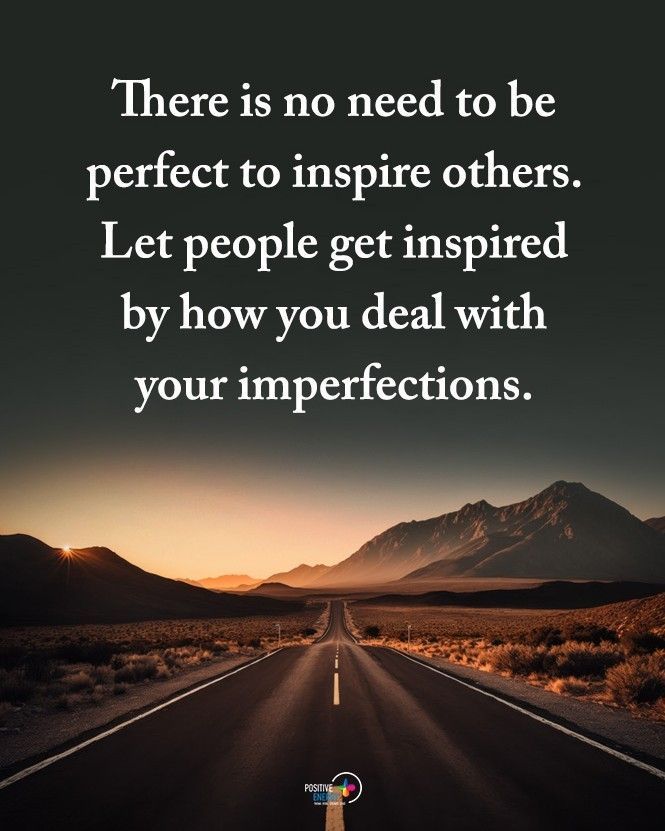
“You don’t need to be perfect to inspire others. Let them be inspired by your imperfection and how you handle it.”

This idea hits deep — because we’re all living a version of “in-progress.” Behind every LinkedIn headline or Instagram post is a person figuring it out as they go. And that’s where the real magic lies.


The Lie of Perfection

Perfection is paralyzing.
It tells us to wait until the timing is right, the voice is confident, the story is complete. But life doesn’t work that way. And neither does impact.

When you share your story — with its dents, doubts, and detours — you give people permission to be real.

  • The junior developer struggling with imposter syndrome sees you navigating a tough sprint with honesty.
  • The new parent trying to balance work and life sees your messy calendar and your willingness to laugh through it.
  • The young student sees you fail forward, regroup, and try again.

That’s not weakness. That’s leadership in its rawest, most human form.


Inspiration Doesn’t Come from Control — It Comes from Courage

People don’t need your perfection.
They need your courage to show up anyway.

To say:

  • “I don’t have all the answers, but I’m learning.”
  • “This didn’t go as planned — here’s what I’m doing differently.”
  • “I messed up. And I’m owning it.”

It’s those moments that build bridges. That build trust. That inspire someone to take one more step — not because they’re sure, but because they saw you do it unsure.


Your Imperfections Are Your Power

Think of the people who’ve inspired you the most — the ones who stayed with you long after their words faded.

Chances are, they weren’t perfect.

They were real.

They were vulnerable.

They were authentic enough to admit the struggle, and resilient enough to keep moving through it.

That’s who we remember.
That’s who we follow.


So, What Now?

Here’s a simple challenge:
Share one story this week that isn’t fully polished. Something you’re figuring out. Something that felt hard but taught you something.

You don’t need to teach a lesson. Just tell the truth.

And maybe — just maybe — someone else will read it and whisper:

“If they can try, maybe I can too.”

6 Secrets to Improving Your Executive Presence

The best leaders don’t dominate conversations.

They direct them with intention.🔥


Most people think executive presence is about having the loudest voice in the room.

It’s not.

The best leaders are calm, focused and intentional. 💪


If you want to look and lead like a CEO, start here:👇
(Even if you’re not an executive… yet)

✅ Speak With Purpose, Not Volume
↳ Don’t ramble just to fill silence
↳ Say less, mean more

✅ Use Your Space With Confidence
↳ Don’t shrink into corners or slouch into chairs
↳ Stand tall, walk with intention, take your seat like you belong (because you do)

✅ Make Decisions, Even If You’re Unsure
↳ CEOs rarely have perfect info
↳ But they move forward anyway
↳ Progress beats perfection

✅ Stand and Sit With Good Posture
↳ Straight spine, shoulders back, eyes up
↳ It shows you’re ready, not rattled

✅ Listen More, Talk Less
↳ Great leaders don’t just speak well, they listen well
↳ You learn more by letting others talk

✅ Stay Calm In Tough Moments
↳ People take their cues from you
↳ If you panic, they panic
↳ If you stay grounded, they will too

Executive presence isn’t about a title.
It’s about behavior.🔥


Act like a leader, and people will start to see you as one.

Are you acting like a CEO❓

6 Powerful Japanese Techniques

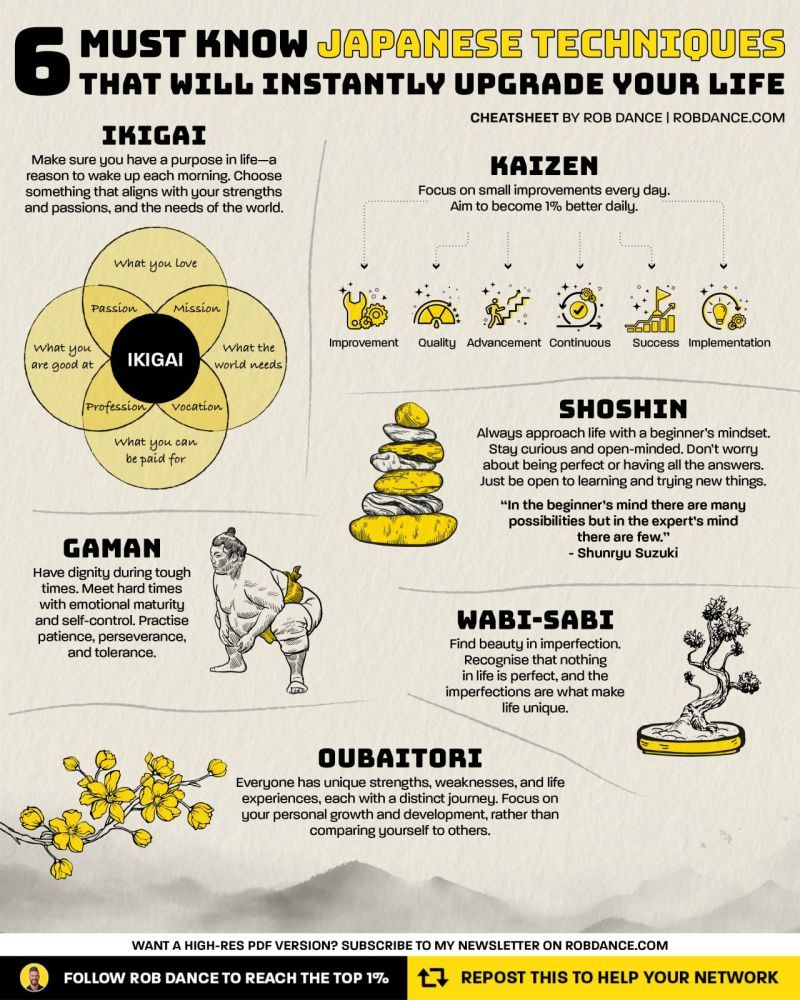
6 powerful science-based techniques that are helping me in 2025

(A quick guide to upgrading your life)

If you are serious about achieving your full potential,

You need to be aware of these 6 powerful techniques:

Ikigai
↳ Make sure you have a purpose in life—a reason to wake up each morning.
Choose something that aligns with your strengths and passions, and the needs of the world.

Kaizen
↳ Focus on small improvements every day. Aim to become 1% better daily.

Shoshin
↳ Always approach life with a beginner’s mindset. Stay curious and open-minded. Don’t worry about being perfect or having all the answers. Just be open to learning and trying new things.

Wabi-sabi
↳ Find beauty in imperfection. Recognise that nothing in life is perfect, and the imperfections are what make life unique.

Gaman
↳ Have dignity during tough times. Meet hard times with emotional maturity and self-control. Practise patience, perseverance, and tolerance.

Oubaitori
↳ Everyone has unique strengths, weaknesses, and life experiences, each with a distinct journey. Focus on your personal growth and development, rather than comparing yourself to others.

Start integrating these techniques into your daily life,
And watch how they transform your mindset and growth.

Respect First, Titles Later

In a world wired to celebrate titles, accolades, and LinkedIn bios, one simple idea caught my attention on a recent scroll:

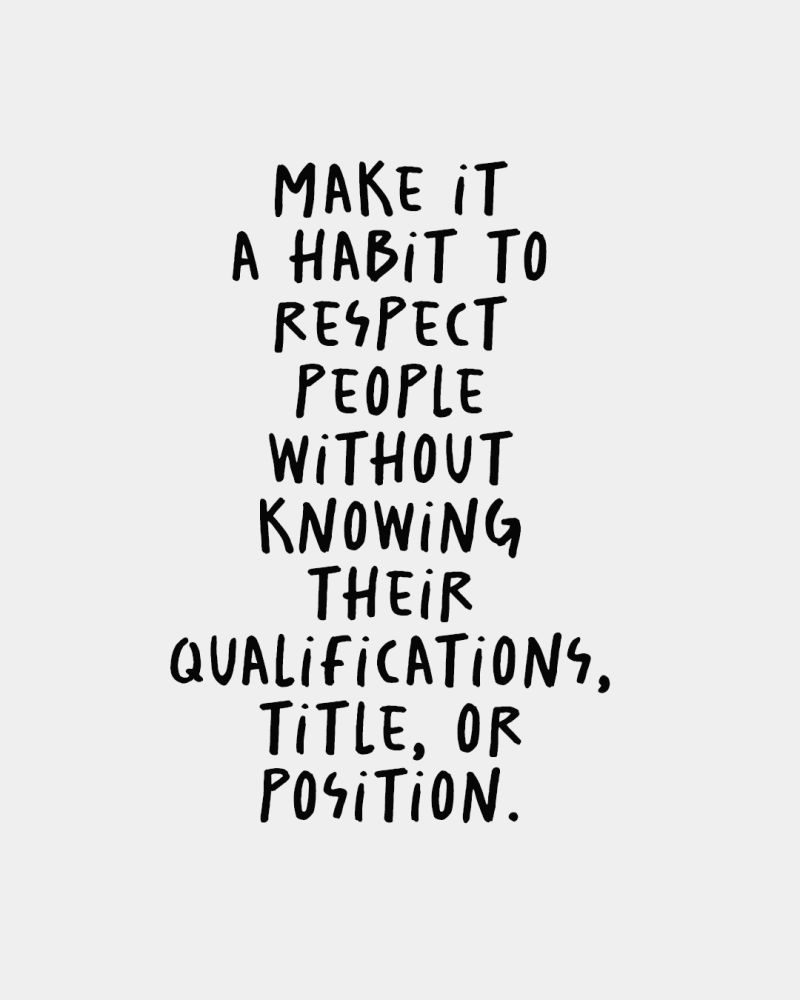
“Make it a habit to respect people without knowing their title, position, or qualifications.”

It hit me. Not because it’s revolutionary — but because it’s quietly radical in today’s world.

We live in times where the first instinct is to Google someone, check their role, count mutual connections, and silently weigh their relevance. But what if we rewired that? What if we practiced respect without prerequisites?


Why It Matters

At its core, this mindset flips the script from transactional to human. It says:

  • You matter, not because of your badge, but because you’re here.
  • Your voice counts, even if it doesn’t come with a C-suite title.
  • I’ll listen before I judge.

When you build a culture around this — in your team, family, or classroom — something beautiful happens. People start showing up as themselves, not their resumes. Collaboration becomes easier. Ideas get bolder. Silos break. And most importantly, trust builds itself.


The Habit in Action

Here’s what this habit might look like in real life:

  • Greeting the intern like you greet the CEO.
  • Taking time to understand someone’s idea before evaluating their experience.
  • Creating space in meetings for quieter voices, not just louder titles.
  • Not assuming someone’s capability (or lack of it) based on their LinkedIn summary.

For Leaders, This Is Everything

Respecting people without filtering them through position or qualifications is not just kindness. It’s leadership.

Because the best leaders don’t wait to respect — they lead with it.

They create rooms where a janitor, a junior developer, or a global VP are all treated with dignity. They know that innovation doesn’t only wear formal shoes.


A Simple Practice to Try

This week, try this:
Walk into your next interaction — be it with a colleague, barista, delivery partner, or security guard — and greet them with the same level of curiosity and warmth you’d offer a VIP.

No filters. No assumptions. Just respect.

You’ll be amazed at what that unlocks.