
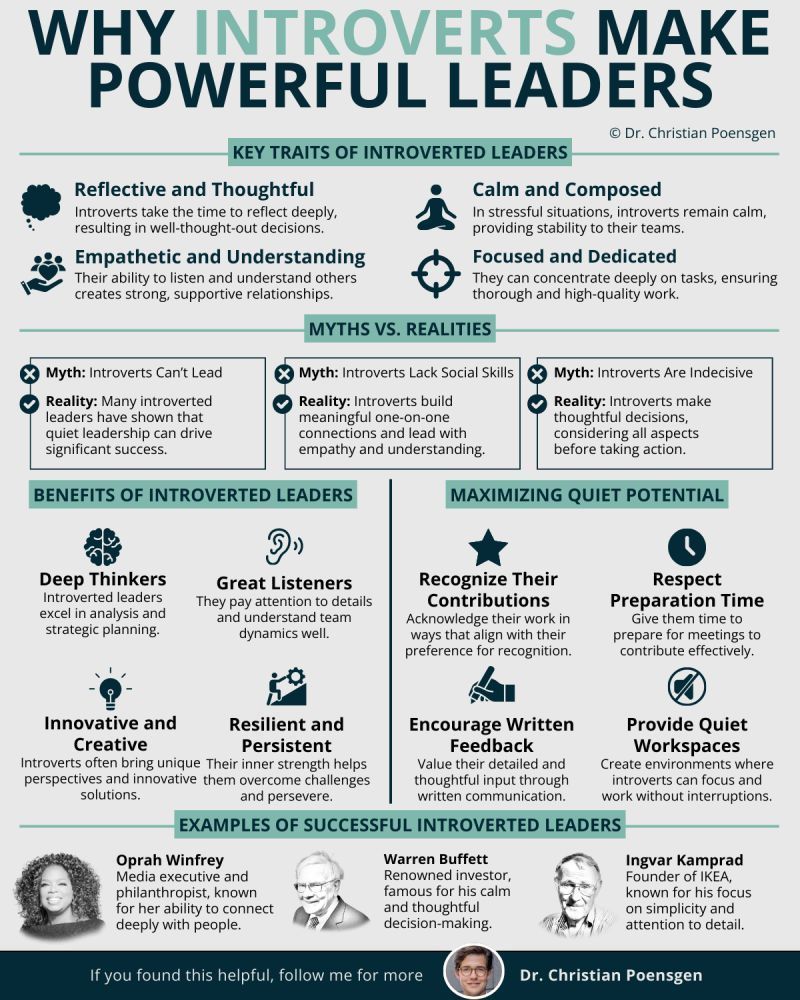
The leadership myth nobody talks about:
Most people assume all great leaders are extroverts.
But that couldn’t be further from the truth.
Quiet leaders aren’t just effective.
They’re often exceptional.
Yet their potential is still clouded by persistent myths that I’ve witnessed throughout my career.
Here are three myths that need to be shattered:
❌ 1. “Introverts can’t lead.”
✅ Truth: Many of history’s most influential leaders were introverts.
Oprah, Buffett, and Kamprad changed industries by being calm and grounded, not loud.
❌ 2: “Introverts lack social skills.”
✅ Truth: Introversion and shyness are completely different traits.
Introverts often excel at deep listening and one-on-one connections, the foundation of authentic leadership.
❌ 3. “Introverts are indecisive.”
✅ Truth: Thoughtfulness isn’t indecision.
Introverted leaders process thoroughly before acting, often making more calculated decisions.
Here’s what sets exceptional introverted leaders apart:
↳ Empathy: They listen more than they speak
↳ Calm: They provide stability in times of chaos
↳ Stillness: They create space for others’ ideas to shine
Great leadership comes in many forms.
And often, the most powerful one is less noisy.
Introverted leaders may speak softly.
But their impact echoes loudly.
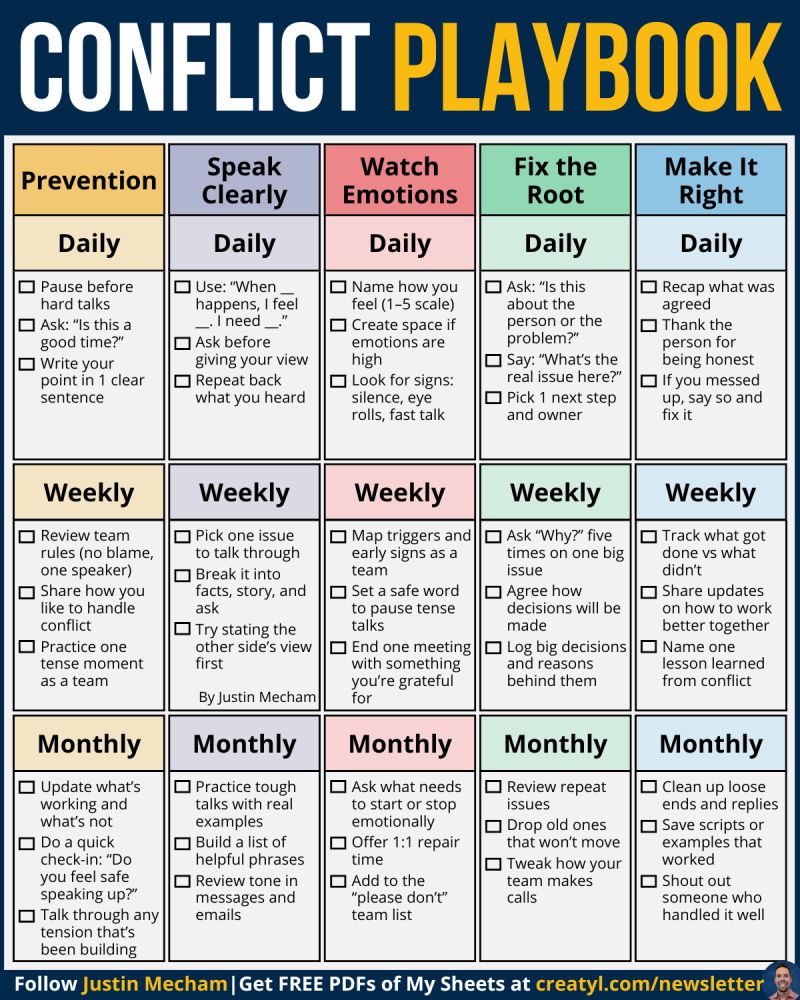
Conflict Playbook
Conflict isn’t the problem—
Avoiding it is:
Most people fear conflict
because they think it breaks trust.
But handled right, it builds it…
1️⃣ Prevent it before it starts
• Pause before hard talks.
• Ask, “Is this a good time?”
• Write what you need to say in one clear sentence.
2️⃣ Speak clearly, not sharply
• Use: “When this happens, I feel ___ because ___.”
• Ask before sharing your view.
• Repeat what you heard.
3️⃣ Watch emotions early
• Name what you feel (1–5 scale).
• If tension rises, pause.
• Look for signs — fast talk, silence, or eye rolls.
4️⃣ Fix the real issue
• Ask, “Is this about the person or the problem?”
• Then, “What’s the real issue here?”
• Pick one next step and who owns it.
5️⃣ Make it right
• Recap what was agreed.
• Thank them for honesty.
• If you messed up — say it and fix it fast.
🔸Weekly habits that help:
• Review how conflict went.
• Pick one way to do it better.
• End with gratitude.
🔸Monthly reset:
• Note what’s working.
• Drop what’s not.
• Thank someone who handled it well.
🔸Try this today:
• Write your point in one line.
• Use “I feel…” not blame.
• End with one clear next step.
Conflict isn’t a setback—
It’s feedback.
When you address it with clarity and care,
you don’t just fix the issue—
You strengthen the culture that
makes your team unstoppable.
The Truth About Emotions
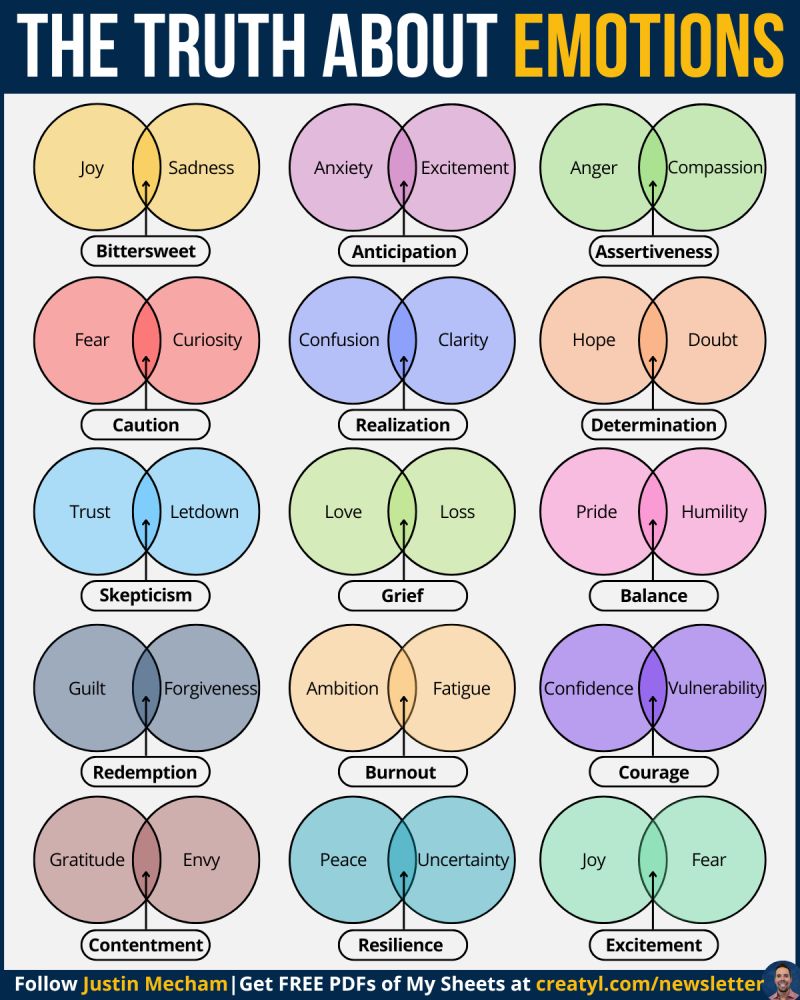
You’re not “too emotional”—
You’re carrying two realities at once:
Most people try to control what they feel.
But emotions were never meant to be caged.
They’re not flaws to fix—
They’re data.
They’re how your body and brain
speak truth before words do.
Look closer and you’ll find your most
powerful traits aren’t pure—
they’re layered.
For example:
🟠 Joy + Sadness = Bittersweet
🟡 Anger + Compassion = Assertiveness
🟡 Hope + Doubt = Determination
🟠 Confidence + Vulnerability = Courage
🟡 Peace + Uncertainty = Resilience
This mix? That’s not a malfunction.
That’s your wisdom forming in real time.
It’s how you learn what matters—
what hurts, what heals, what’s next.
And once you can name it,
you can work with it.
Self-awareness starts where judgment ends.
Feel first. Then listen.
That’s how emotion turns into wisdom.
The Score Isn’t the Story

I love this reminder because it clears up something we all mix up at some point: losing and failing are not the same thing.
They can look similar from the outside, sure. Both can come with disappointment. Both can sting. Both can make you question yourself for a minute. But deep down, they’re completely different experiences.
Losing reflects the score.
It’s the outcome. The result. The final number on the board. The “you didn’t get it this time” moment.
But failing reflects our attitude.
It’s what happens inside us when the score doesn’t go our way.
And that’s where everything changes.
Because losing is sometimes unavoidable. You can prepare, practice, show up early, give it your best… and still lose. Someone else may simply be better that day. The timing might not work out. The conditions might not be in your favor. Life might just life.
That’s not failure. That’s reality.
Failure is what happens when we let a loss take something bigger from us.
When losing turns into bitterness.
When it turns into blame.
When it turns into excuses.
When it turns into “I’m done.”
When it turns into “I knew I wasn’t good enough anyway.”
That’s failing.
Not because the result was bad… but because our mindset collapsed under it.
And if we’re being honest, a lot of us don’t fear losing as much as we fear what losing means. We fear embarrassment. We fear being judged. We fear looking like we tried and still didn’t win. We fear feeling behind. We fear feeling like we wasted time.
But a loss doesn’t mean you’re behind. It doesn’t mean you’re weak. It doesn’t mean you’re not talented. It doesn’t mean you’re not capable.
It just means you didn’t win that round.
And honestly, some rounds are designed to teach you, not reward you.
Sometimes you lose and it reveals what you need to work on. Sometimes you lose and it exposes a blind spot. Sometimes you lose and it humbles you just enough to keep you hungry. Sometimes you lose and it forces you to build resilience, patience, and grit—things that winning doesn’t always teach.
Winning feels amazing, no doubt.
But losing… losing builds depth.
And the truth is, the people we admire most aren’t the ones who never lost.
They’re the ones who lost and still stayed respectful.
Lost and stayed disciplined.
Lost and stayed committed.
Lost and stayed hungry.
Lost and stayed kind.
Lost and came back better.
That’s the difference.
You can lose a game and still be proud of yourself.
You can lose a job opportunity and still believe in your value.
You can lose momentum and still rebuild it.
You can lose your way for a while and still find your way back.
Because failing isn’t falling down.
Failing is refusing to get back up with the right spirit.
It’s choosing to carry a loss like a label instead of treating it like a lesson.
And that’s why attitude matters so much.
Attitude is what decides if a setback becomes a story of growth or a story of defeat.
Two people can experience the exact same loss.
One person says, “This is proof I’m not meant for it.”
The other says, “This is proof I need to sharpen my skills.”
One person shuts down.
The other person studies.
One person gets bitter.
The other person gets better.
Same loss. Different attitude.
And the beautiful part is this: you don’t always control the score.
But you almost always control your response.
You control whether you learn.
You control whether you keep showing up.
You control whether you stay humble.
You control whether you keep your integrity intact.
You control whether you let the moment make you smaller or stronger.
So if you’re in a season where you’ve been taking some L’s lately—quiet ones, public ones, painful ones—don’t let the scoreboard mess with your identity.
You didn’t fail.
You lost.
There’s a difference.
And as long as you keep your attitude clean, your effort honest, and your heart in it… you’re still winning in the ways that matter most.
Because the score ends the game.
But your mindset decides your future.
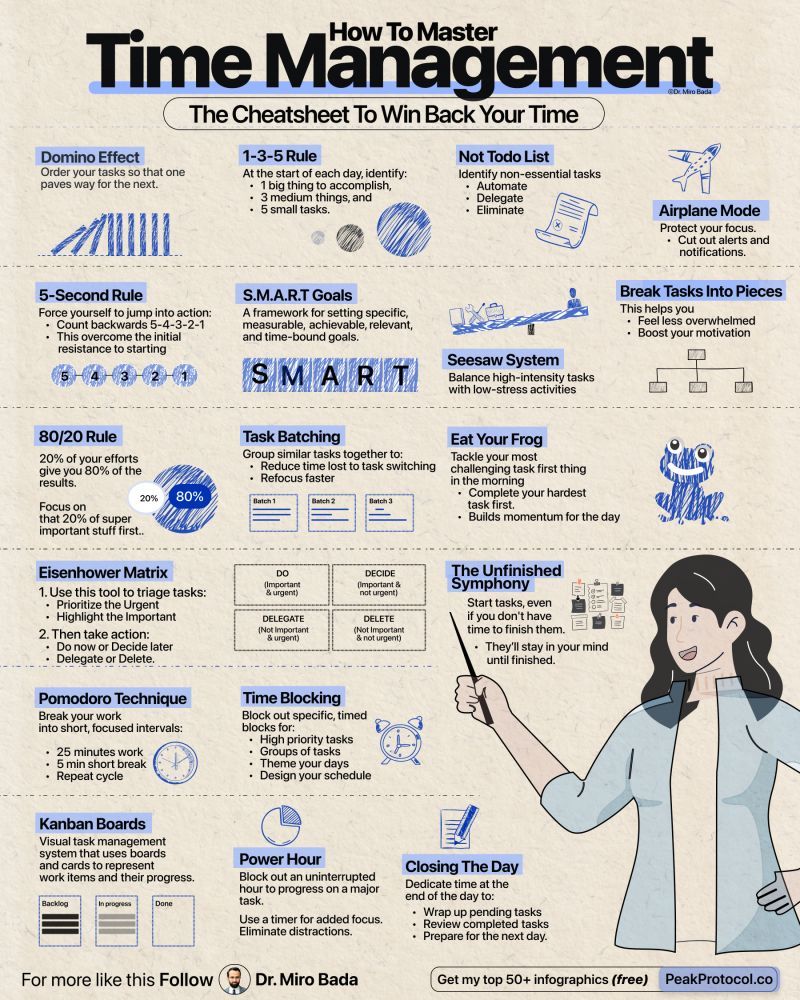
Master Time Management
Procrastination isn’t the enemy. Poor systems are.
18 game-changing productivity habits I learned in the ER.
As a doctor turned entrepreneur, I discovered that:
↳ Procrastination isn’t a weakness.
↳ It’s just a sign that your systems need an upgrade.
Steal my pressure-tested toolkit:
1) Follow the Domino Effect
↳ Order your tasks so that one paves way for the next.
(Just like our ER trauma protocols)
2) 1-3-5 Method
↳ Plan 1 big task, 3 medium tasks, and 5 small tasks.
3) Eisenhower Matrix
↳ Prioritize tasks based on their urgency and importance.
↳ Plan: Do it now, Delay, Delegate, or Delete.
4) ABCDE
↳ Prioritize your tasks into five categories, from most important (A) to least important (E).
5) 80/20 Rule (Pareto Principle)
↳ Focus on the 20% of tasks that yield 80% of the results.
(This saved countless lives in critical care)
6) Time Blocking
↳ Schedule a set block of time for each planned activity.
7) Task Batching
↳ Group similar tasks together.
8) Kanban boards
↳ Create 3 boards: ‘To Do’ > ‘In Progress’ > ‘Done’.
↳ Move tasks from one board to the next.
These aren’t just theoretical tools.
I’ve tested them in life-or-death situations.
Now I use them to run multiple businesses.
9) 3-3-3 Rule
↳ Every day, do 3 hours of deep work, 3 smaller tasks, and 3 maintenance activities.
10) 2-day rule
↳ Don’t miss 2 days in a row without taking action.
11) Pomodoro Technique
↳ Work for 25 minutes with 5-minute breaks in between.
↳ Do this 4x, then take a longer break.
12) Use Airplane and Silent modes
↳ Cut out alerts and notifications.
13) 2-minute rule
↳ If it takes less than 2 minutes, do it now.
14) 5 Second Rule
↳ Count backwards from five, then start immediately.
15) Avoid Multitasking
↳ Attention residue steals your focus.
16) OHIO rule
↳ Only Handle It Once
17) Seesaw System
↳ Balance high-intensity tasks with low-stress activities
18) Shutdown Ritual
↳ Conclude your workday with a consistent routine to signal the end of work and begin rest.
P.S.
These aren’t just productivity hacks.
They’re survival tools from 18+ years in medicine and business.
What’s your favorite productivity habit?
Path to Self Belief
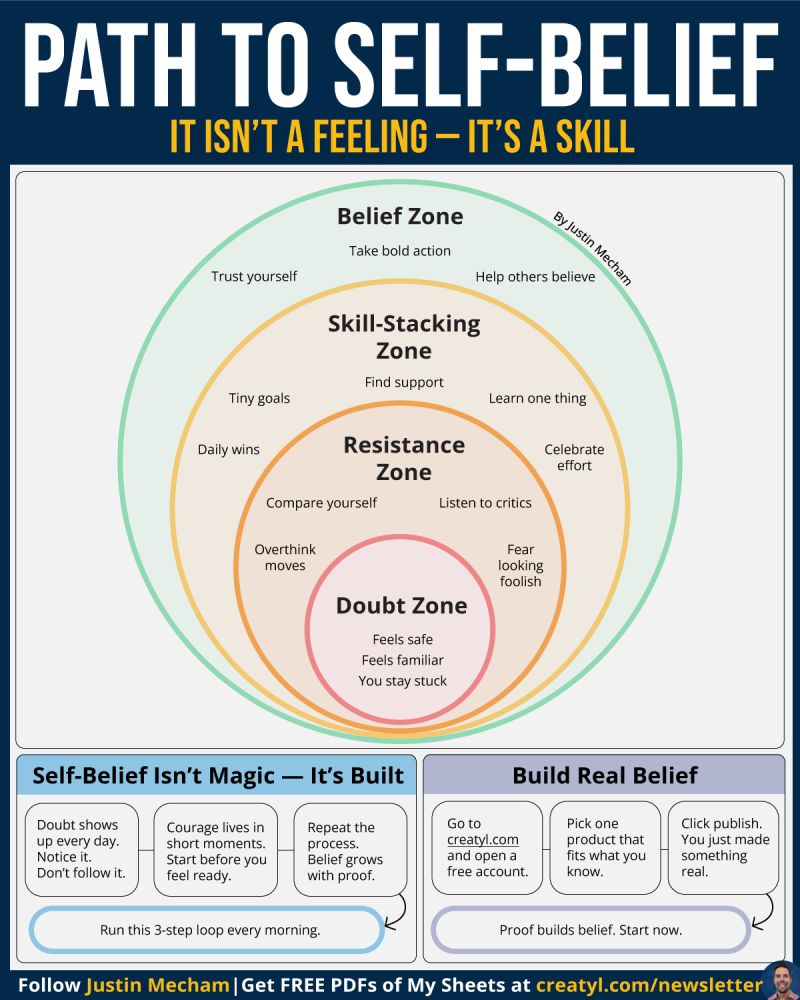
Self-belief isn’t something you feel—
It’s something you build:
And most people build it backwards.
They wait until they “feel ready.”
They chase confidence like it’s a finish line.
But belief doesn’t show up first.
Proof does.
Here’s what the path really looks like:
🔴 Doubt Zone
• Feels safe, but keeps you stuck
• You overthink, compare, and feel foolish
🟠 Resistance Zone
• Critics get loud
• You celebrate effort, but progress feels slow
🟡 Skill-Stacking Zone
• Small wins stack
• You learn one thing at a time
• Support makes belief grow
🟢 Belief Zone
• You take bold action
• Trust yourself
• Help others believe too
🔁 The Loop That Builds Belief
• Notice doubt — don’t follow it
• Act before you feel ready
• Repeat. Belief grows with proof
Every action is proof.
And proof builds belief.
You don’t need to wait to believe.
You need to move.
Powerful ChatGPT Prompts
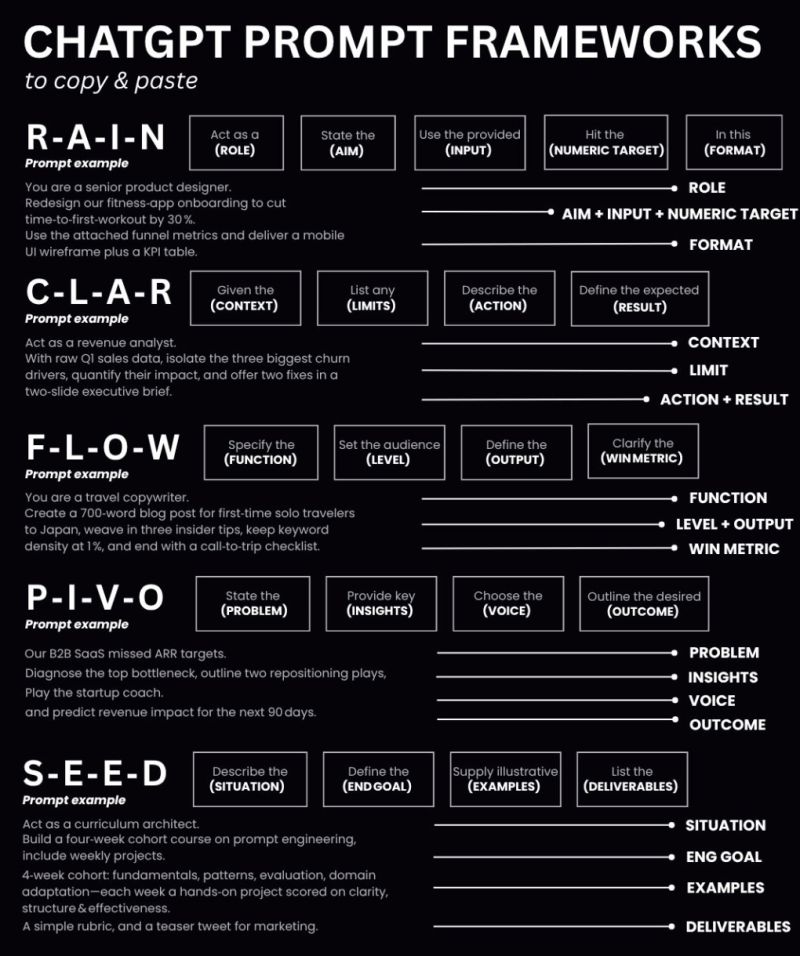
Never underestimate the power of good prompts.
Here are 5 frameworks to copy and paste 🧵 ↓
1 ‐ R‐A‐I‐N
☑ Act as a (ROLE)
☑ State the (AIM)
☑ Use the provided (INPUT)
☑ Hit the (NUMERIC TARGET)
☑ In this (FORMAT)
Example:
☑ ROLE: Senior product designer
☑ AIM: Redesign our fitness‐app onboarding to cut time‐to‐first‐workout by 30 %
☑ INPUT: Attached funnel metrics
☑ NUMERIC TARGET: 30 % improvement
☑ FORMAT: Mobile UI wireframe + KPI table
2 ‐ C‐L‐A‐R
☑ Given the (CONTEXT)
☑ List any (LIMITS)
☑ Describe the (ACTION)
☑ Define the expected (RESULT)
Example:
☑ CONTEXT: Raw Q1 sales data
☑ LIMITS: Focus on the 3 biggest churn drivers
☑ ACTION: Quantify impact & propose 2 fixes
☑ RESULT: Two‐slide executive brief
3 ‐ F‐L‐O‐W
☑ Specify the (FUNCTION)
☑ Set the audience (LEVEL)
☑ Define the (OUTPUT)
☑ Clarify the (WIN METRIC)
Example:
☑ FUNCTION: Travel copywriter
☑ LEVEL: First‐time solo travelers to Japan
☑ OUTPUT: 700‐word blog post
☑ WIN METRIC: 1 % keyword density + call‐to‐trip checklist
4 ‐ P‐I‐V‐O
☑ State the (PROBLEM)
☑ Provide key (INSIGHTS)
☑ Choose the (VOICE)
☑ Outline the desired (OUTCOME)
Example:
☑ PROBLEM: B2B SaaS missed ARR targets
☑ INSIGHTS: Diagnose bottleneck & reposition
☑ VOICE: Startup coach
☑ OUTCOME: Two plays + 90‐day revenue forecast
5 ‐ S‐E‐E‐D
☑ Describe the (SITUATION)
☑ Define the (ENDGOAL)
☑ Supply illustrative (EXAMPLES)
☑ List the (DELIVERABLES)
Example:
☑ SITUATION: Build a 4‐week prompt‐engineering cohort
☑ ENDGOAL: Fundamentals → domain adaptation
☑ EXAMPLES: Weekly hands‐on projects
☑ DELIVERABLES: Rubric + teaser tweet
Borrowed Tomorrows, Lived Todays
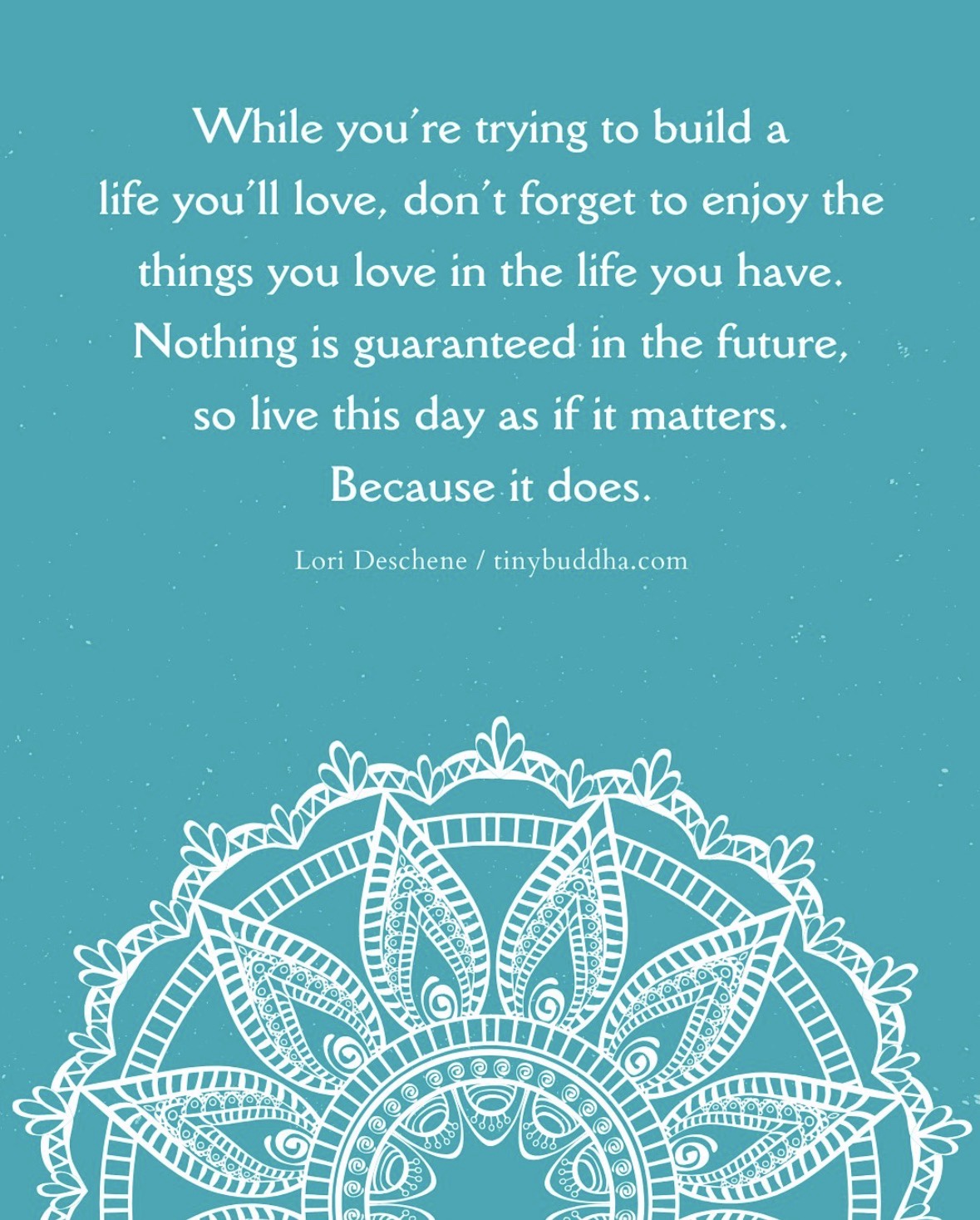
I love ambition. I love goals. I love the idea of building a life that feels aligned, peaceful, exciting, and mine. The kind of life you wake up into and think, “Yeah… this is it.”
But here’s the part we don’t talk about enough.
Sometimes while we’re busy building that future, we forget to actually live inside the present.
We treat “today” like it’s just the waiting room.
Like it’s a rough draft that doesn’t count.
Like it’s something to endure until we finally arrive at the version of life that’s “better.”
And I get it. Because the future feels clean. It feels controllable. It feels like hope. The future is where we place our big wins, our glow-ups, our breakthroughs, our peace. It’s where we imagine the perfect morning routine, the perfect job, the perfect body, the perfect bank balance, the perfect everything.
The future is where we promise ourselves we’ll finally breathe.
But life doesn’t happen in the future.
Life happens in the ordinary moments we keep postponing.
The coffee that’s still warm.
The music that hits the right nerve.
The laugh that sneaks up on you.
The way the sun looks through the window for five seconds and you don’t know why, but it makes you feel something.
The quiet after a long day when you finally sit down.
The people you love being right there… in the same room… alive, present, and real.
And somehow, we rush past it.
Because we’re focused on building.
Building a career.
Building a reputation.
Building a savings account.
Building a family.
Building confidence.
Building discipline.
Building the next chapter.
And again — building is good. It’s responsible. It’s admirable.
But there’s a difference between building a life you’ll love…
…and forgetting to enjoy the things you love in the life you already have.
That’s where the danger is.
Because the mind is a tricky thing. It’s always negotiating happiness.
It says:
“Once I get that promotion, I’ll relax.”
“Once I lose the weight, I’ll feel confident.”
“Once the house is bigger, life will feel calmer.”
“Once the kids are older, I’ll have time.”
“Once I finish this project, I’ll finally enjoy my weekends.”
“Once I hit that number, I’ll stop worrying.”
But the finish line keeps moving.
And the scariest part?
We don’t always notice.
We just keep pushing.
We keep upgrading.
We keep grinding.
We keep chasing the next milestone.
We keep telling ourselves that joy is something we’ll “earn” later.
But later isn’t guaranteed.
That’s not pessimism. That’s just reality.
Nothing is guaranteed in the future.
Not the time.
Not the health.
Not the people.
Not the opportunities.
Not the energy.
Not even the version of you that you assume will always be around.
And I don’t say that to be dramatic.
I say it because it’s the truth that wakes you up.
The truth that reminds you: this day matters.
Not because it’s perfect.
Not because everything is going your way.
Not because you’ve “made it.”
But because you’re here.
You have breath in your lungs.
You have some kind of chance to experience something real.
Even if the day is messy.
Even if you’re tired.
Even if you’re still figuring it out.
There’s still something sacred about today.
And sometimes the most mature, powerful thing you can do is stop treating your current life like it’s a placeholder.
You’re not on pause.
You’re not “almost living.”
You’re living right now.
Even in the middle of the struggle.
Even in the middle of the rebuilding.
Even in the middle of the uncertainty.
So maybe the question isn’t just, “How do I build a life I’ll love?”
Maybe it’s also:
“How do I love parts of the life I’m building while I’m building it?”
Because you can want more and still be grateful.
You can chase growth and still enjoy the moment.
You can be ambitious without being absent.
You can be in motion without missing your own life.
And it doesn’t require a massive change.
It’s small things.
It’s letting yourself celebrate the tiny wins instead of dismissing them.
It’s calling the friend back instead of saying “later.”
It’s taking the picture.
It’s eating the meal slowly.
It’s going for the drive.
It’s watching your kid do something ordinary and realizing it won’t be ordinary forever.
It’s stepping outside for five minutes and letting the air remind you you’re alive.
It’s resting without guilt.
It’s laughing without checking the time.
It’s being fully present with the people you love, even if you only have ten minutes.
Because those moments aren’t “extra.”
They’re the whole point.
I think we forget that.
We forget that the life we’re trying to build is made up of days like this one.
Not the perfect someday.
Not the highlight reel.
Not the big announcement.
Just regular days.
And if we don’t learn to live the regular days, the future won’t magically fix it.
You can reach the dream and still feel empty if you trained your mind to always be elsewhere.
That’s why enjoying what you love today is not laziness.
It’s wisdom.
It’s emotional intelligence.
It’s remembering that life is not a guarantee, it’s a gift.
And gifts aren’t meant to be left unopened while you plan for a better one.
So yes, keep building.
Keep dreaming.
Keep planning.
Keep leveling up.
Keep doing the hard work.
Keep showing up.
But don’t forget to look around while you’re doing it.
Don’t forget to enjoy the things you already love.
Because this day matters.
Not because it’s the best day.
But because it’s yours.
And you’re here.
And that’s enough reason to live it like it counts.
The 7 Traits of Doers
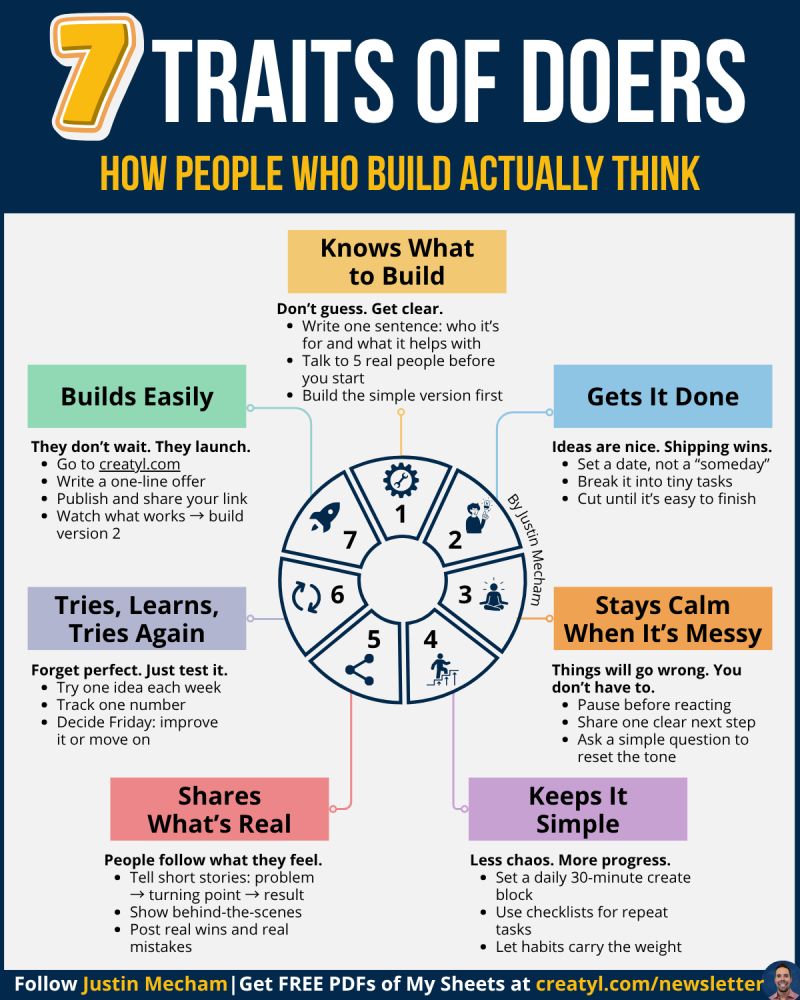
Most people wait for clarity—
Doers create it by moving:
Most people wait for perfect.
Doers build—
Even when it’s messy.
Here’s how they think:
1️⃣ Knows what to build
🔹 Don’t guess — get clear.
🔸 Write one sentence: who it’s for and for what.
🔹 Talk to 5 people, build the simple version first.
2️⃣ Gets it done
🔸 Ideas don’t count — shipping does.
🔹 Set a date, not “someday.”
🔸 Break it small, finish it fast.
3️⃣ Stays calm when it’s messy
🔹 Things will go wrong — you don’t have to.
🔸 Pause, name the next step, reset the tone.
4️⃣ Keeps it simple
🔸 Less chaos, more progress.
🔹 Use short checklists and habits that carry the weight.
5️⃣ Shares what’s real
🔹 People follow what feels true.
🔸 Tell short stories — problem, turning point, result.
6️⃣ Tries, learns, tries again
🔸 Forget perfect, test one idea a week.
🔹 Track one number, improve or move on.
7️⃣ Builds easily
🔹 Go to creatly. com.
🔸 Write one line, publish your link, and launch.
Use my sheet to follow each step—
And start thinking like a builder,
not a planner.
You don’t become a builder
by talking about ideas.
You become one by testing them—
Again and again.
The Danger of Assumptions
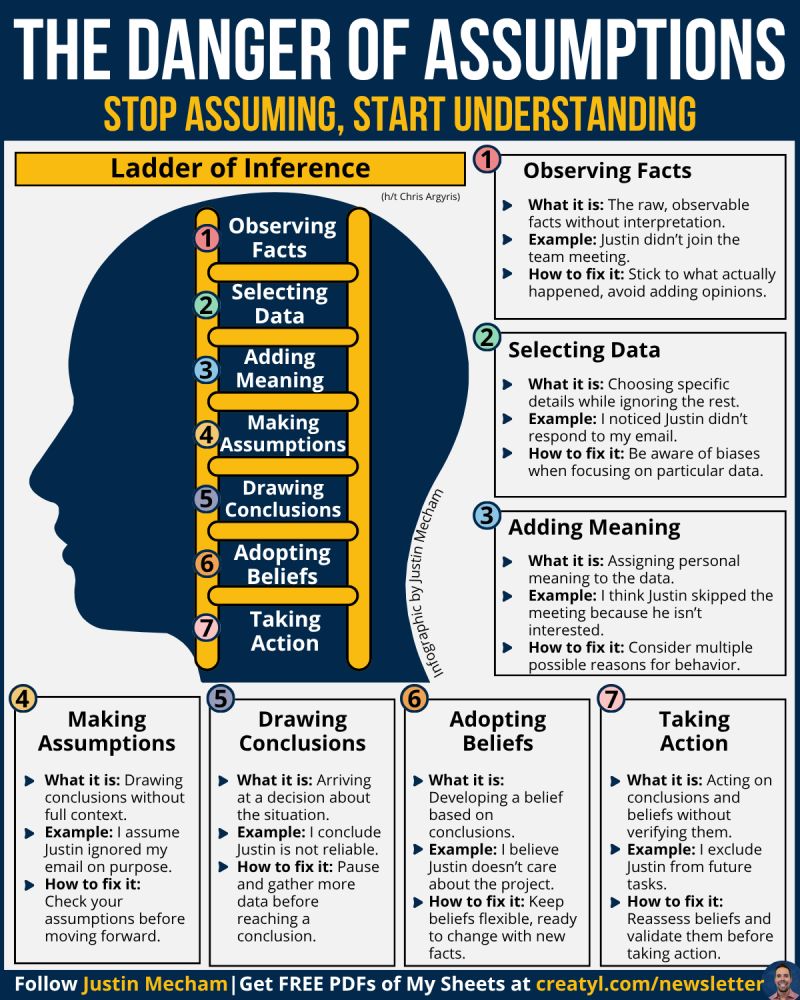
The danger isn’t what happened—
It’s what we assumed about it:
Here’s how the ladder
of inference traps us:
1️⃣ Fact → Someone misses a meeting.
2️⃣ Detail → They didn’t answer my email.
3️⃣ Meaning → They must not care.
4️⃣ Assumption → They ignored me on purpose.
5️⃣ Conclusion → They’re unreliable.
6️⃣ Belief → They’re not committed.
7️⃣ Action → I exclude them from future work.
The problem?
At every step, the truth
drifts further from reality.
Fix it:
• Stick to facts, not opinions.
• Pause before assuming intent.
• Stay open to new information.
• Check beliefs before acting.
Use my sheet to see how to catch
yourself before assumptions cost trust.
Check the facts before you move.
 Kenrick Vaz