
The Romans Hacked Productivity 2000 Years Ago
Modern “hacks” make you weaker.
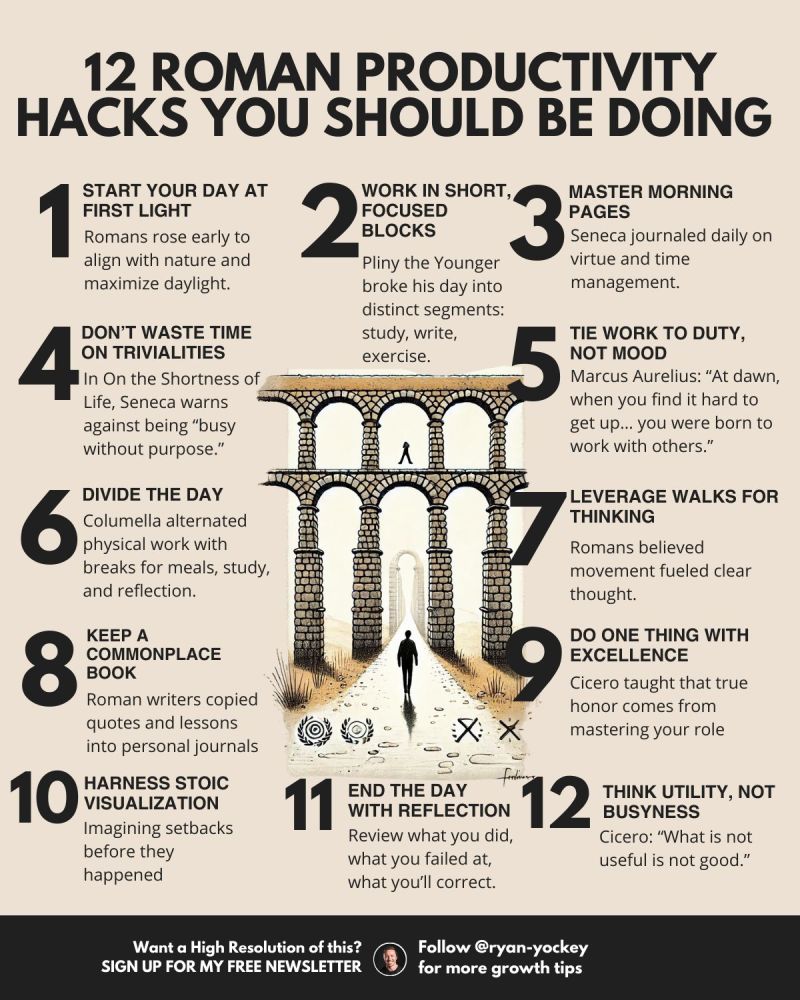
12 Roman Productivity Hacks You Should Be Doing
The Romans built roads, aqueducts, and empires — but their real productivity secret was discipline. These 12 habits still outperform any modern app.
1. Start Your Day at First Light
→ Marcus Aurelius wrote about resisting the urge to stay in bed. Romans rose early to align with nature and maximize daylight.
2. Work in Short, Focused Blocks
→ Pliny the Younger broke his day into distinct segments: study, write, exercise, estate management. They believed in focused sprints, not endless grind.
3. Master Morning Pages
→ Seneca journaled daily on virtue and time management. Writing at dawn clarified his priorities and mindset.
4. Don’t Waste Time on Trivialities
→ In On the Shortness of Life, Seneca warns against being “busy without purpose.” Cut distractions, focus on essentials.
5. Tie Work to Duty, Not Mood
→ Marcus Aurelius: “At dawn, when you find it hard to get up… you were born to work with others.” For Romans, productivity was duty > desire.
6. Divide the Day (Think Pomodoro, 2,000 Years Ago)
→ Columella recommended alternating physical work with breaks for meals, study, and reflection. Structured rhythms boosted output.
7. Leverage Walks for Thinking
→ Cicero composed speeches while walking. Romans believed movement fueled clear thought.
8. Keep a Commonplace Book
→ Roman writers copied quotes, notes, and lessons into personal journals — an ancient version of a second brain.
9. Do One Thing with Excellence
→ Cicero taught that true honor comes from mastering your role — not scattering energy across trivial pursuits.
10. Harness Stoic Visualization
→ Romans practiced premeditatio malorum — imagining setbacks before they happened — to work with calm focus instead of anxiety.
11. End the Day with Reflection
→ Seneca’s nightly routine: review what you did, what you failed at, what you’ll correct tomorrow. A built-in feedback loop.
12. Think Utility, Not Busyness
→ Cicero: “What is not useful is not good.” For Romans, productivity was measured by impact, not hours worked.
These hacks pull directly from Seneca, Marcus Aurelius, Cicero, Pliny, and Columella.
The Romans built aqueducts, armies, and empires without Notion, Slack, or AI.
Their secret wasn’t tools — it was discipline.
Adopt even one of their habits, and you’ll outpace 99% of people still chasing “productivity hacks.”
6 Thinking Hats
If your meetings feel like chaos disguised as collaboration…
Try this.
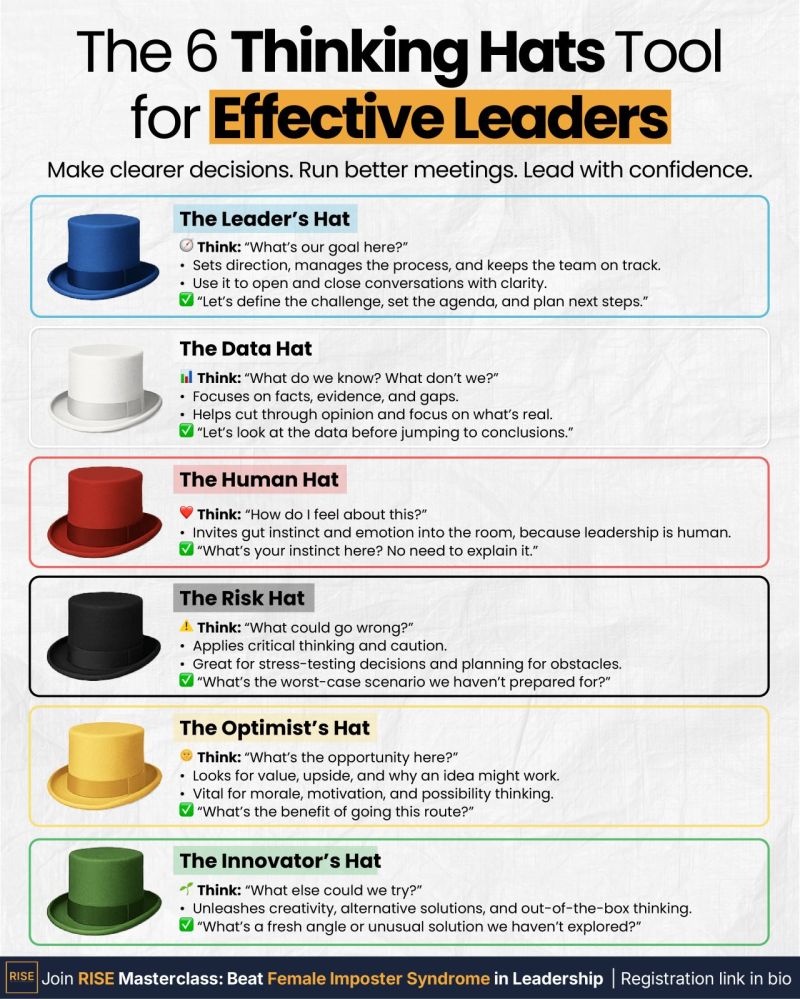
One of the simplest leadership tools I know is the 6 Thinking Hats.
It transforms messy discussions into sharp decisions by giving structure to how people think — not just what they say.
Here’s how it works:
🟦 Blue Hat — Lead the process. Set the tone. Define the goal.
⬜ White Hat — Stick to the facts. Data, not opinions.
🟥 Red Hat — Name the gut feeling. Emotions have a seat at the table.
⬛ Black Hat — Spot the risks. Stress-test the decision.
🟨 Yellow Hat — Look for the upside. Fuel optimism and energy.
🟩 Green Hat — Generate ideas. Explore what hasn’t been tried yet.
The best leaders don’t just run meetings; they lead the thinking.
Breathe
Most of what feels personal— Isn’t personal at all:
Is it how someone’s voice lands?
Maybe praise going to someone else? Or not getting included at all?
Whatever might be, they can all hit hard— But your reaction decides what happens next.
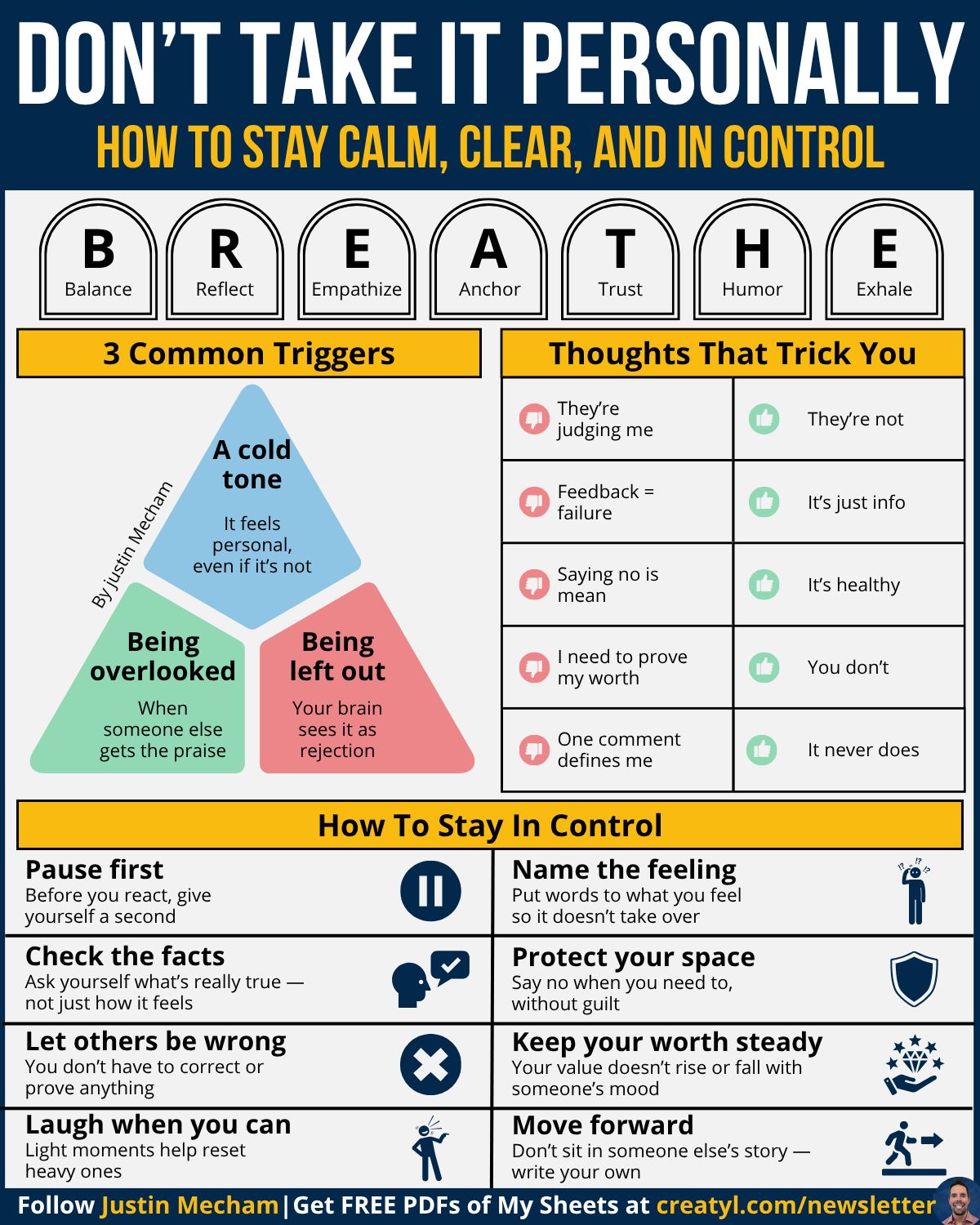
Use the BREATHE model to reset:
🟥 Balance before reacting
🟨 Reflect instead of assuming
⬜ Empathize with their side
🟩 Anchor to what’s true
🟧 Trust your worth
🟪 Humor to lighten the moment
🟦 Exhale and let it go
The truth?
You’re not being judged, feedback isn’t failure. And saying no is healthy (and necessary)
Here are 3 common triggers to watch for:
🔺A cold tone— Feels personal, even if it’s not
🔺Being overlooked— When someone else gets the praise
🔺Being left out— Your brain sees it as rejection
The calmer you stay, the clearer you think.
The clearer you think, the stronger you lead.
Emotional control isn’t coldness, it’s clarity under pressure. And clarity always leads better than impulse.
Life Isn’t Either/Or. It’s BOTH!
There’s a quiet relief that comes when you finally stop trying to categorize life into neat little boxes. Good or bad. Happy or sad. Strong or struggling. We spend so much time asking ourselves which one it is, as if life owes us a single, clean answer. But it rarely does. Most days don’t arrive labeled. They arrive mixed.
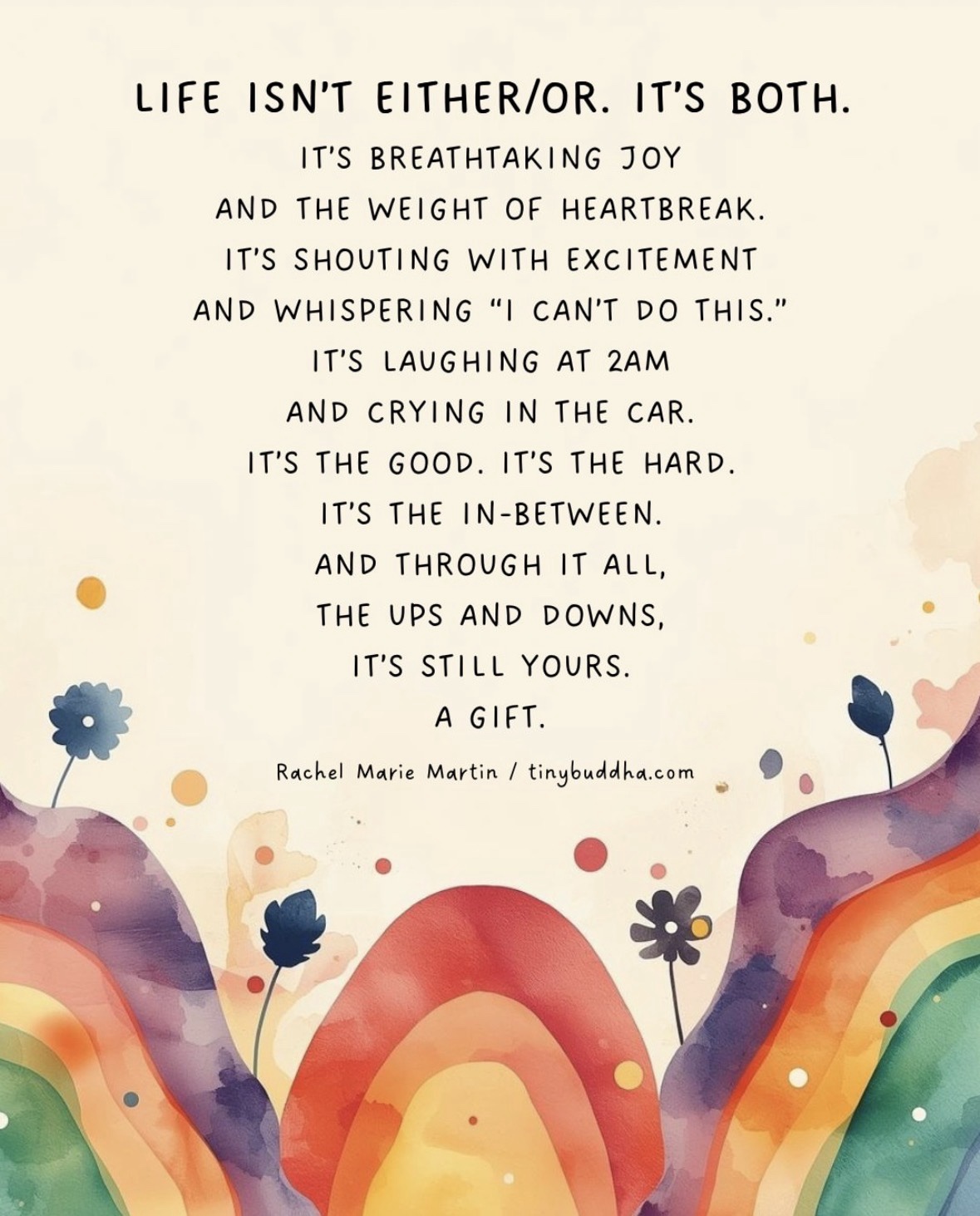
Life isn’t either/or. It’s both.
It’s the kind of joy that catches you off guard—the kind that shows up in small, ordinary moments and somehow feels enormous. A laugh that comes from deep in your chest. A look from someone you love that says more than words ever could. A sudden awareness that, right now, things are okay. Maybe even beautiful.
And then, sometimes in the very same breath, it’s the weight of heartbreak. The ache you carry quietly. The disappointment you didn’t see coming. The loss that changes the way you look at everything afterward. Not the dramatic kind that demands attention, but the heavy, private kind that settles in and stays.
It’s shouting with excitement when something finally works out. When the news is good. When the plan comes together. When you feel proud of yourself for a moment and allow it. And it’s also whispering “I can’t do this” when the noise fades, when you’re alone with your thoughts, when confidence slips through your fingers and doubt takes its place.
Life is laughing at 2am for reasons that make no sense in the morning. The kind of laughter that feels reckless and freeing, where time doesn’t matter and responsibilities feel far away. And it’s crying in the car with the radio turned down low, letting the tears come because holding them back feels harder than letting them fall.
It’s the good. And it’s the hard.
We’re often taught—subtly, sometimes loudly—that we should choose one. That if we’re grateful, we shouldn’t feel sad. That if we’re successful, we shouldn’t feel tired. That if we’re blessed, we shouldn’t feel overwhelmed. But that logic doesn’t hold up in real life. Gratitude and grief can sit at the same table. Strength and exhaustion can share the same body. Love can exist alongside frustration without canceling it out.
The in-between is where most of life actually happens. Not in the highlight reels or the breakdown moments, but in the ordinary spaces where emotions overlap. Where you’re doing your best, even when your best feels messy. Where you’re growing, even when it feels uncomfortable. Where you’re learning that two opposite feelings can be true at the same time—and that doesn’t mean you’re doing anything wrong.
There’s something deeply human about that tension. About holding joy in one hand and pain in the other and realizing you don’t have to drop either. You can celebrate and still ache. You can hope and still be afraid. You can move forward without having everything figured out.
And through it all—the ups and the downs, the laughter and the tears, the confidence and the doubt—it’s still yours.
Your life. Your story. Your days, unfolding exactly as they are.
That doesn’t mean every moment is easy or fair or understandable. But it does mean that even the hard parts are part of the gift. Not because pain is good, but because it shapes you. It deepens your empathy. It teaches you to notice the small joys more carefully. It reminds you that feeling deeply—both the light and the heavy—is a sign that you’re alive and engaged with your own life.
Maybe the goal isn’t to eliminate the hard or cling desperately to the good. Maybe the goal is to make room for all of it. To stop fighting the fact that life is layered. To stop apologizing for feeling too much or not enough. To accept that the beauty of this gift lies in its complexity.
Life isn’t asking you to choose a side. It’s inviting you to show up fully—to laugh when it’s time to laugh, to cry when it’s time to cry, and to trust that even in the in-between, you’re still exactly where you’re meant to be.
Life isn’t either/or.
It’s both.
Eat That Frog
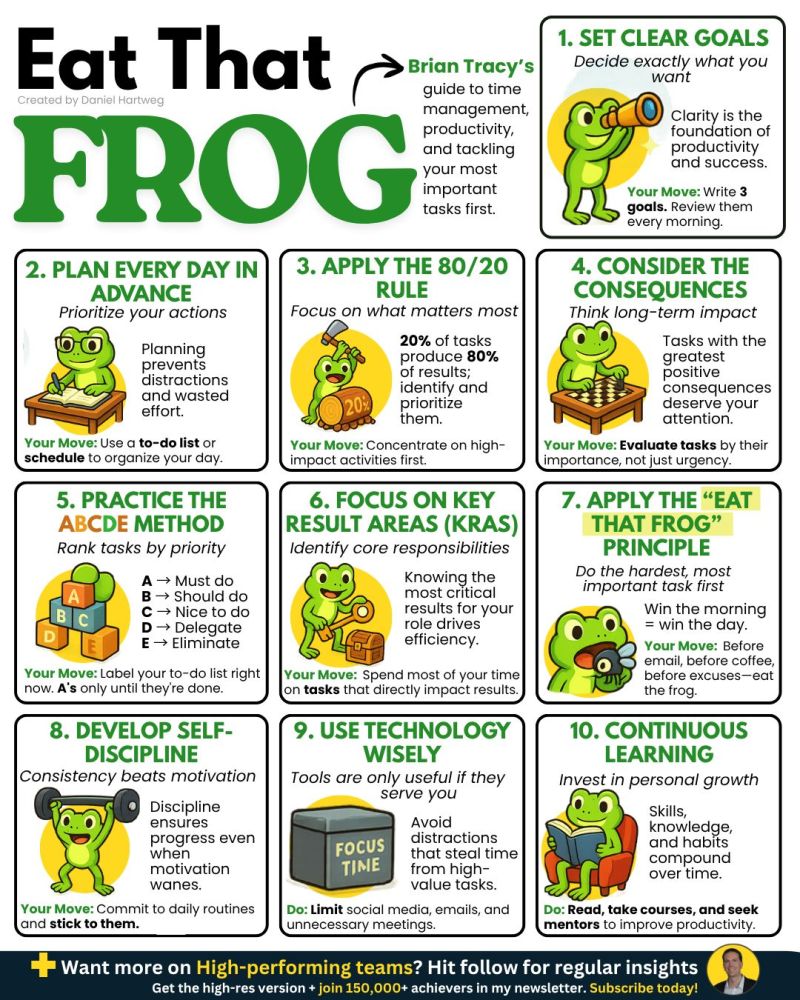
Everything changed the day I finally ate the frog.
Let me explain.
Every morning, I’d open my laptop and do the easy stuff first:
→ Organize files (felt accomplished)
→ Check emails (felt productive)
→ Attend meetings (felt busy)
Then I discovered Brian Tracy’s Eat That Frog principle: tackle your hardest, most important task first.
I tried it for 30 days:
↳ Day 1: Sent the email I’d been avoiding
↳ Day 14: Had the tough conversation with my team
↳ Day 30: Launched the initiative that got me promoted
It won’t feel good at first.
But once it’s done? You own the day.
Most people never eat the frog—they stay busy, exhausted, and stuck.
Here are Brian Tracy’s 10 Power Principles that changed everything for me:
1. SET CRYSTAL-CLEAR GOALS
↳ Vague dreams stay dreams. Specific goals become reality.
↳ Write 3 goals. Review them every morning.
2. PLAN YOUR DAY LIKE A PRO
↳ Planning crushes chaos before it crushes you.
↳ Spend 10 minutes tonight mapping tomorrow’s wins.
3. MASTER THE 80/20 RULE
↳ 20% of your efforts create 80% of your results.
↳ Circle the 2 tasks that will move the needle most.
4. THINK CONSEQUENCES, NOT URGENCY
↳ The most important tasks have the biggest future payoff.
↳ Long-term thinking beats short-term firefighting.
5. USE THE ABCDE METHOD
↳ A = Critical | B = Important | C = Nice to have | D = Delegate | E = Eliminate
↳ Label your to-do list right now. A’s only until they’re done.
6. DOMINATE YOUR KEY RESULT AREAS
↳ Know the 3-5 things that define success in your role.
↳ List your core responsibilities. Protect 70% of your time for them.
7. EAT THAT FROG FIRST THING
↳ Tackle your ugliest, hardest task at dawn.
↳ Before email, before coffee, before excuses, eat the frog.
8. BUILD IRON-CLAD SELF-DISCIPLINE
↳ Habits beat heroics. Systems beat self-help.
↳ Pick ONE daily non-negotiable and guard it for 30 days.
9. TAME YOUR TECH (OR IT WILL TAME YOU)
↳ Notifications don’t care about your dreams.
↳ Turn off alerts. Batch emails. Schedule social media like meetings.
10. NEVER STOP SHARPENING THE SAW
↳ The best investment is in yourself.
↳ Read 20 pages daily. Find 1 mentor. Take 1 course this quarter.
Ask yourself: “What’s my frog today?”
Then eat it. First. No mercy.
The task you’re avoiding right now? That’s probably the one that will change everything.
How To Have Hard, High-Growth Conversations
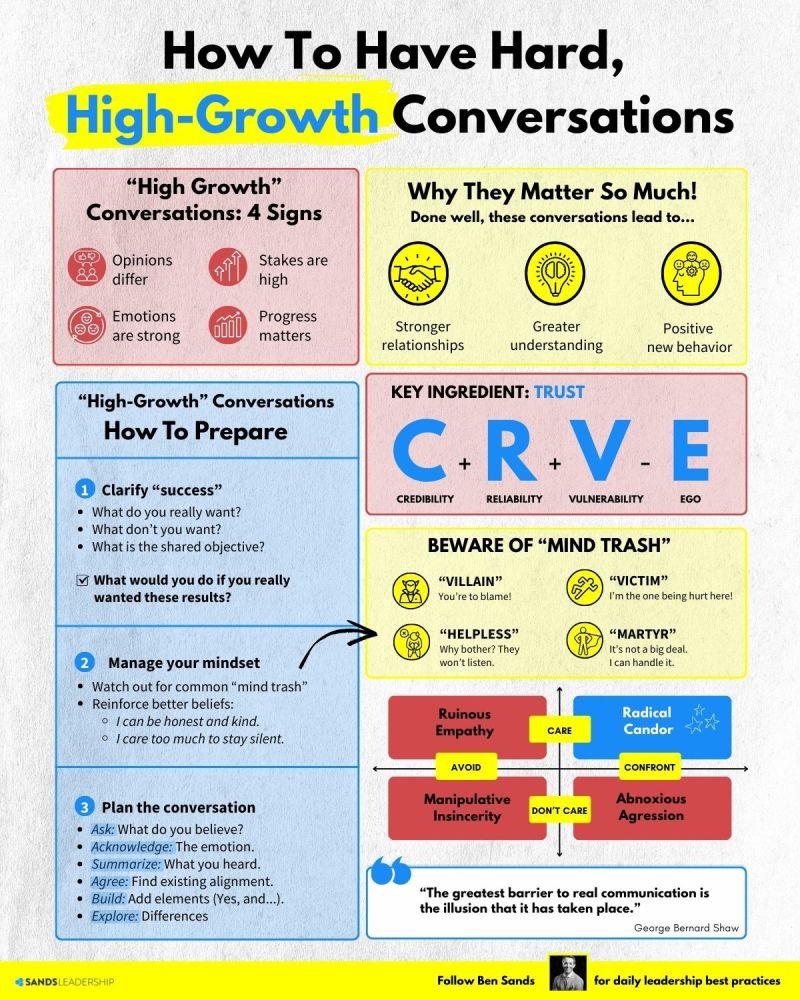
If you want your team to grow fast and strong,
master this 👇
It’s not a tactic.
It’s not a tool.
It’s a conversation—the one you’ve been avoiding.
I call them High Growth Conversations—
because they create the alignment, clarity,
and accountability your team needs to grow quickly without breaking down.
You’ll know one by these four signs:
➡️ Differing opinions
➡️ High stakes
➡️ Strong emotions
➡️ Progress matters
Most leaders avoid them.
The best ones don’t.
So what does a great “HGC” look like?
It’s not about:
❌ Winning the argument
❌ Being right
❌ Avoiding discomfort
Done well, these conversations:
✅ Strengthen relationships
✅ Increase understanding
✅ Drive meaningful behavior change
If there’s an important conversation you need to have,
here’s how to prepare:
1️⃣ Clarify what “success” looks like.
→ What do I want?
→ What don’t I want?
→ What outcome works for both of us?
2️⃣ Manage your mindset.
→ Watch out for common “mind trash”
“It’s their fault”
“I’m the one being hurt”
“Why bother, nothing will change.”
→ Reinforce beliefs that lead to great outcomes:
“I can be honest and kind.”
“I care too much to stay silent.”
3️⃣ Go in with a plan. (Don’t wing it!)
→ Start with facts
→ Share the story you’re telling yourself
→ Ask, listen, and align
Remember, trust is the foundation:
Credibility +
Reliability +
Vulnerability –
Ego
The more you’ve built, the better these conversations go.
If there’s a conversation you’ve been avoiding—
now’s the time to have it.
Ikigai for Business
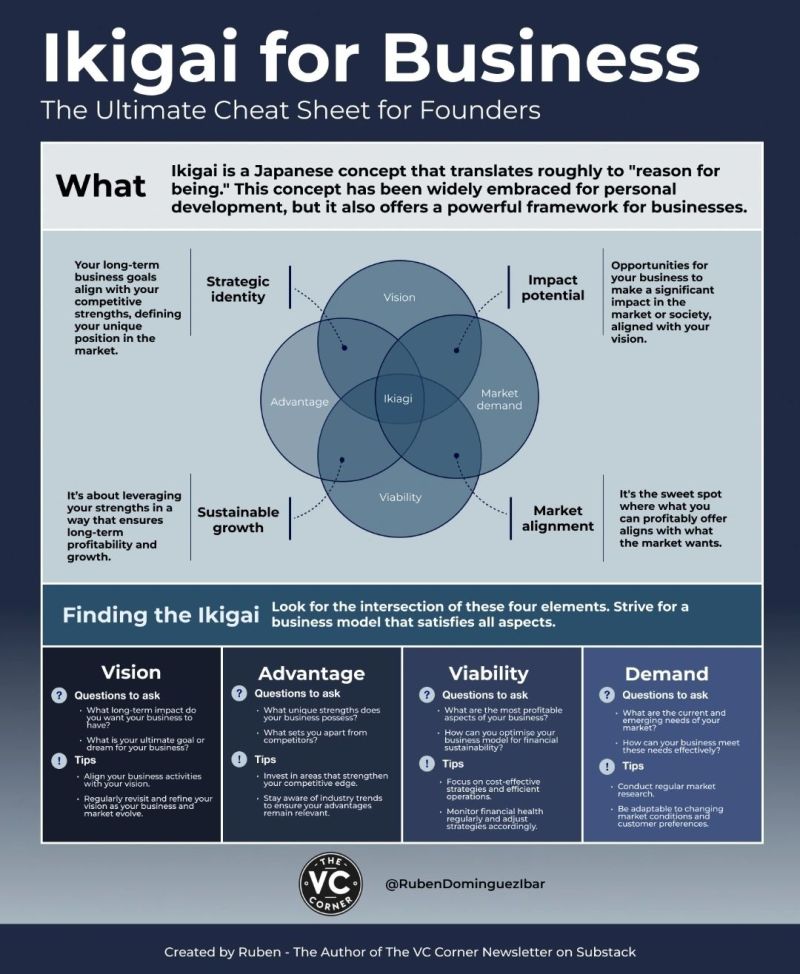
Most startups fail because they chase the wrong thing 👇
Too much passion, not enough market.
Too much vision, not enough cash.
Too much hustle, not enough focus.
The solution?
A 1,000-year-old Japanese idea called Ikigai — or “reason for being.” 💡
Apply it to your startup and it becomes a cheat code for building something that lasts.
Here’s how:
▫️ Vision + Advantage = Strategic Focus
Do what you love — and do it better than anyone else.
▫️ Advantage + Viability = Sustainable Growth
Build on your strengths — and make sure they pay the bills.
▫️ Viability + Market Demand = Product-Market Fit
Give the market what it wants — in a way that scales.
▫️ Market Demand + Vision = Impact
Solve problems you actually care about — and that the world values.
🎯 Right in the middle? Your Business Ikigai.
It’s the intersection of what you’re good at, what the world wants, what pays, and what drives you.
The result:
✅ A business that’s sustainable
✅ A mission that’s inspiring
✅ A strategy that actually works
The Wisdom That Only Time Hands You
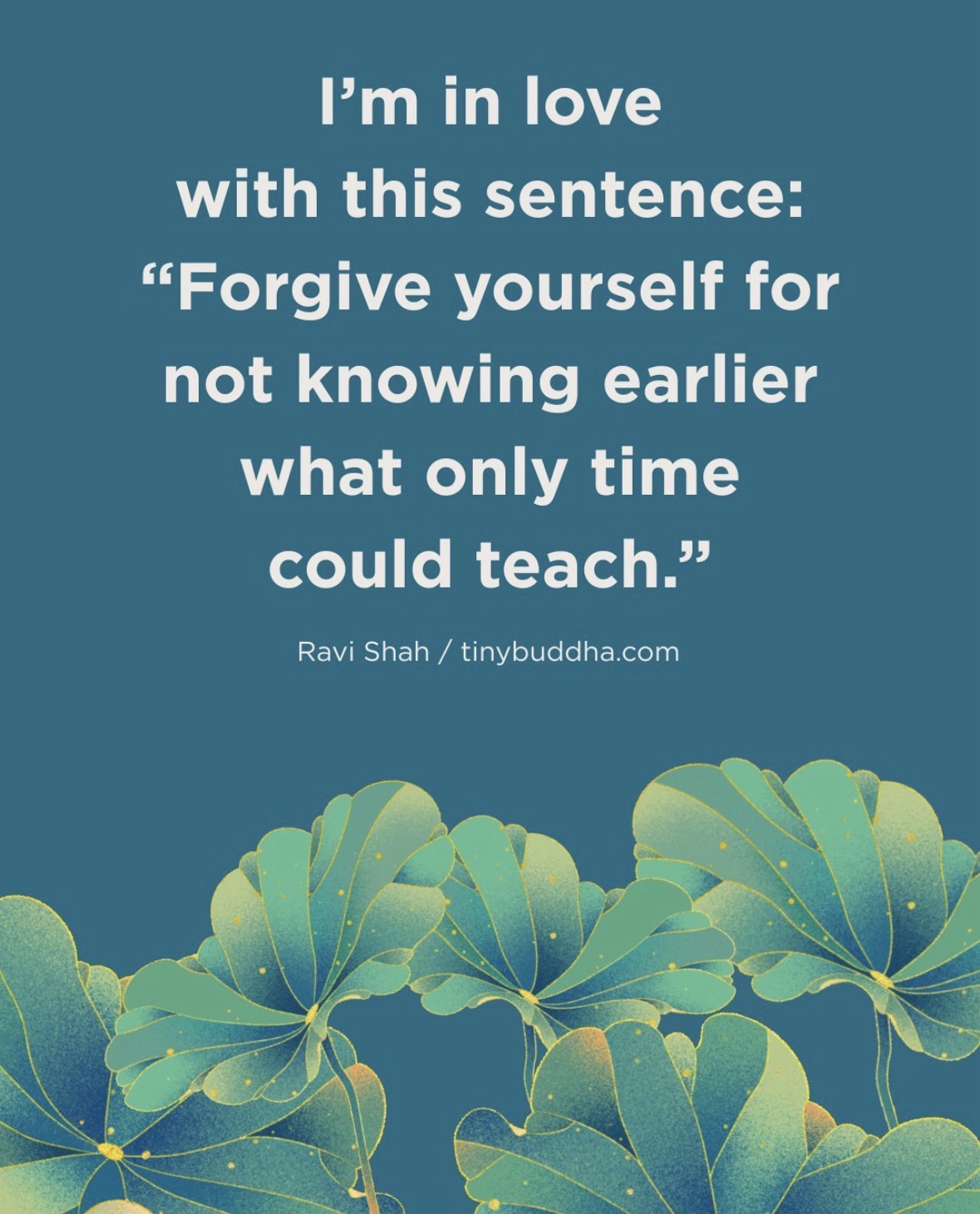
I keep coming back to this line, letting it sit with me longer than most words usually do:
“Forgive yourself for not knowing earlier what only time could teach.”
There’s something disarming about it. Gentle, but honest. Comforting, yet quietly challenging. It feels like an invitation to stop replaying old scenes in your head and finally loosen the grip on the version of yourself that didn’t have the answers yet.
We’re incredibly hard on our past selves. We look back with today’s clarity and wonder how we missed the signs, made that choice, trusted that person, stayed too long, or walked away too early. We judge ourselves as if we had access to the same insight back then that we do now. But we didn’t. That wisdom didn’t exist yet. It was still being formed, slowly, through living.
Time is a strange teacher. It doesn’t hand out lessons neatly or announce when class is in session. It teaches through repetition, discomfort, trial, and sometimes heartbreak. It teaches through moments we’d rather forget and choices we wish we could redo. And only after enough of those moments does understanding begin to settle in.
What we often call “mistakes” are really just steps taken without the benefit of hindsight. You didn’t fail to see clearly; clarity hadn’t arrived yet. You weren’t careless; you were learning. You weren’t weak; you were becoming.
There’s a quiet relief in allowing yourself that grace. In recognizing that the person you were did the best they could with the tools they had at the time. Growth isn’t about erasing the past. It’s about integrating it—letting it inform you without letting it define you.
Forgiveness, in this sense, isn’t dramatic or loud. It’s subtle. It shows up when you stop cringing at old memories and instead nod at them, acknowledging what they gave you. It’s choosing to say, “I understand why you did that,” rather than, “I should’ve known better.”
Because knowing better is often the result, not the starting point.
Time doesn’t just teach us what to do differently; it teaches us compassion. For others, yes—but especially for ourselves. It softens the sharp edges of regret and turns them into something more useful: perspective.
So if you’re carrying around guilt for lessons learned late, pause for a moment. Consider what it took for you to learn them at all. The patience of days, the accumulation of experiences, the courage to keep going even when things didn’t make sense.
You are not behind. You are not late. You are exactly where someone who has lived, learned, and grown would be.
And maybe the real wisdom isn’t just in what time teaches us—but in finally forgiving ourselves for needing time to learn it.
Conflict Resolution
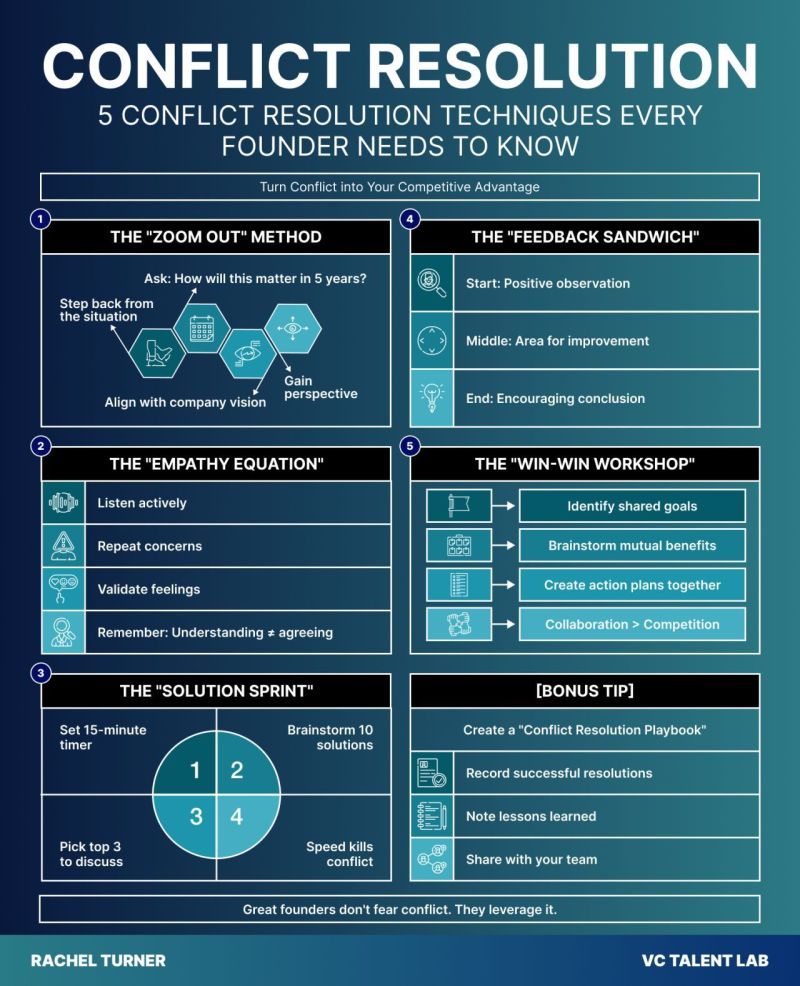
Most founders wait too long to have the hard conversation. And by the time they do… it’s no longer about the problem.
It’s about the resentment that’s built up around it.
At VC Talent Lab, I see it all the time:
– Co-founders dancing around real disagreements
– Exec teams aligned on paper but tense in the room
– High-performers quietly quitting in meetings no one talks about
The root issue?
Not vision. Not values.
Unresolved conflict.
And not because founders don’t care…but because they’ve never been taught how to work through it, not around it.
That’s why we created this:
5 conflict resolution techniques every founder should have in their back pocket.
(Plus a bonus tip I wish more teams used.)
Here’s what I’d ask you:
Which of these would’ve saved you a week… or a key hire?
Ask Questions
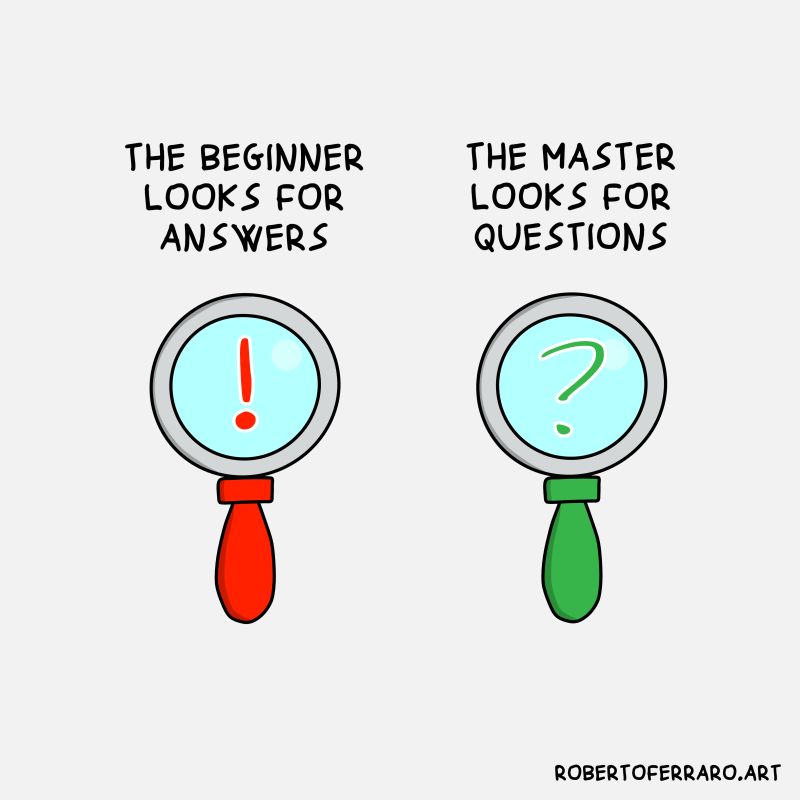
We’re obsessed with finding the right answers.
Early in my career, I was great at making lists of things to do, and not so great at asking questions.
I was too focused on output and not enough on growth.
Then I started a simple reflection habit, with three simple areas:
What did we do right? The wins
It’s so easy to focus first on what broke, and I now make a conscious effort to ask myself and the team what went well. It’s about identifying strengths we can build on and celebrating small wins.
What can I do better? The growth opportunities
This is my antidote to getting defensive. I try to ask this with genuine curiosity, and sometimes “doing better” becomes eliminate or simplify. I was doing so much out of habit, not necessity.
What is in my power to act on? Where I have agency
This is crucial for me. It gets me out of complaining or waiting for someone else to “save me”. It forces me to identify my very next step, no matter how small, and I’m no longer stuck.
And after experimenting for a while, I’ve added another daily favourite question: If today were my last day on earth, would I be content with what I did?
It’s a powerful filter.
How much of our stress comes from worrying about things outside of our control vs. focusing on what’s in our power to act on?
 Kenrick Vaz