
Real leaders do not overpower conversations.
They orchestrate them.
They set the tone,
guide the flow,
and leave people feeling bigger, not smaller.
I learned this the hard way.
After years of trying to dominate discussions,
I realised the best leaders don’t need to speak a lot.
They simply know exactly when to.
These 7 conversation cues are your toolkit for leading with confidence
in any setting, at any level:
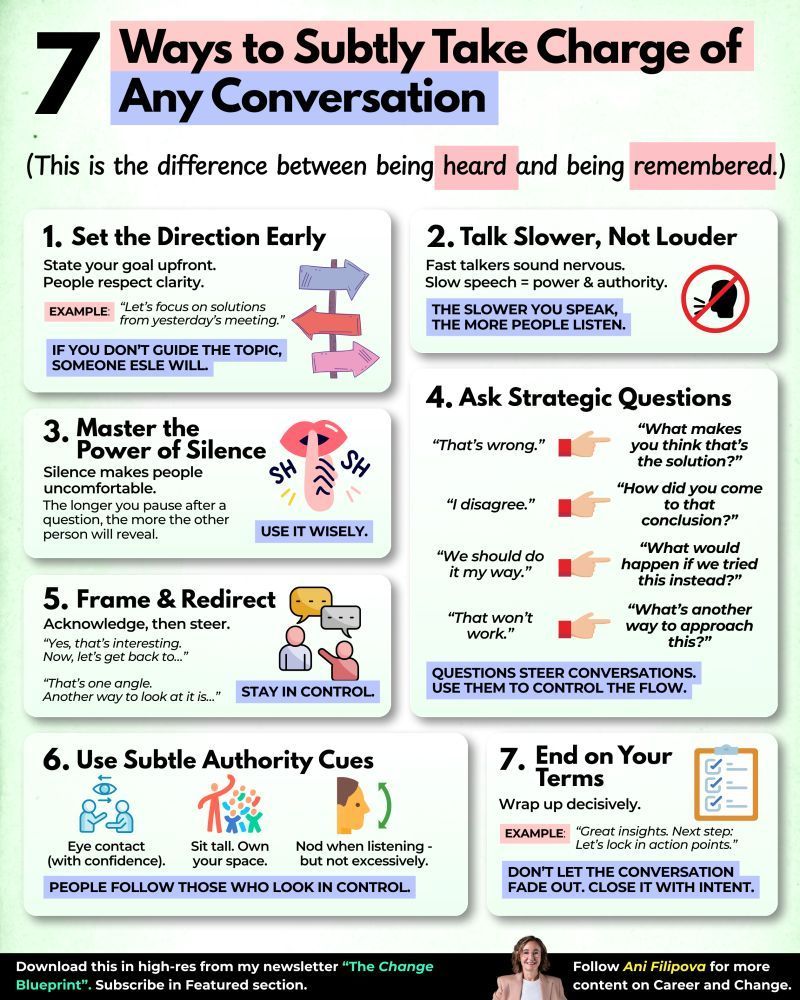
1. State the goal upfront; set the direction early.
Say: “We are going to talk about the solutions from yesterday’s meeting.”
2. Talk slower, not louder
Fast talkers sound nervous.
Slow speech = power & control.
3. Master the Power of Silence
Silence makes people uncomfortable.
It forces them to fill the gap.
4. Ask Strategic Questions
❌ “That’s wrong.”
✅ “What makes you think that’s the solution?”
❌ “I disagree.”
✅ “How did you come to that conclusion?”
❌ “We should do it my way.”
✅ “What would happen if we tried this instead?”
❌ “That won’t work.”
✅ “What’s another way to approach this?”
5. Frame & Redirect
When the conversation drifts, acknowledge, then steer.
✔ “Yes, that’s interesting. Now, let’s get back to…”
✔ “That’s one way to look at it. Another angle is…”
6. Use Subtle Authority Cues
Keep eye contact (with confidence).
Sit tall. Own your space.
Nod sparingly.
7. End on Your Terms
Say: “Great discussion. Next step: Let’s lock in action points.”
Control the ending – control the outcome.
Master these 7 moves?
You will own every room you enter.
Without saying a word more than necessary.
💬 Which conversation habit undermines your authority most? Mine was talking too fast when nervous.
Between Fresh Starts and Soft Landings
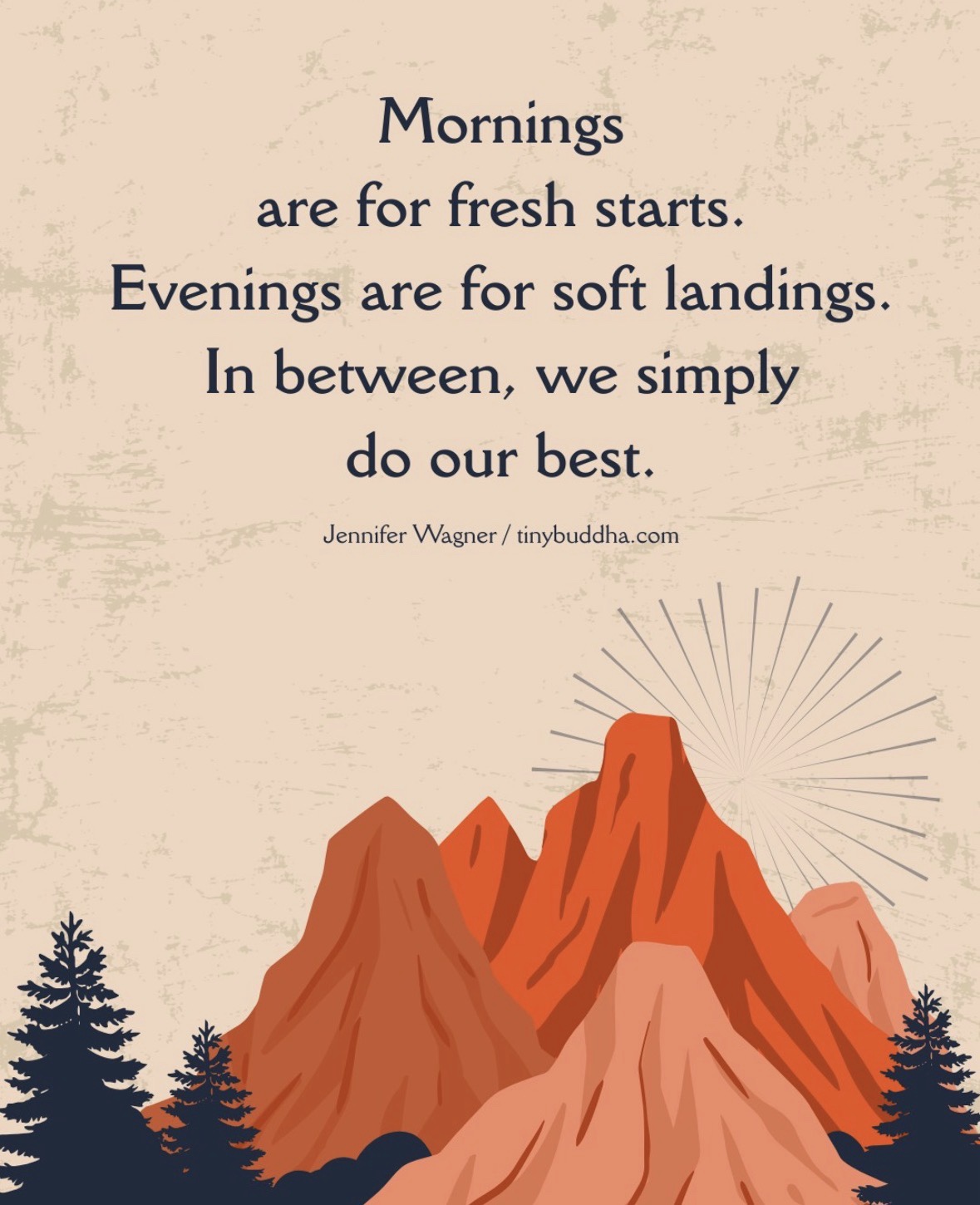
Mornings feel like permission. Permission to begin again, to believe that whatever happened yesterday doesn’t get a full vote today. There’s something quietly powerful about that first stretch, the first sip of coffee, the first moment you realize the day hasn’t asked anything of you yet. It’s a clean page, even if your mind is already crowded. Even if you’re tired. Even if you know the to-do list is long. A morning doesn’t promise ease, but it offers possibility—and sometimes that’s enough to get you moving.
Evenings, on the other hand, feel like grace. They don’t ask you to start. They ask you to arrive. To come back to yourself after being scattered across meetings, messages, traffic, responsibilities, expectations. Evenings soften the sharp edges of the day. The light dims, the noise lowers, and suddenly the world feels less demanding. You don’t have to prove anything at night. You just have to land.
And then there’s everything in between.
The middle of the day is rarely poetic. It’s where real life lives. It’s where intentions meet interruptions. Where plans get adjusted. Where patience is tested. Where you’re doing your best while also wondering if your best is enough. This is where emails pile up, where conversations are half-finished, where you juggle more than you expected to carry. The middle is messy, unscripted, and often unnoticed—but it’s also where most of your life actually happens.
We tend to romanticize beginnings and endings. Fresh starts get the quotes. Soft landings get the sighs of relief. But the middle? The middle doesn’t get much love. It’s not clean. It’s not conclusive. It’s just effort. Showing up again and again, even when motivation dips. Choosing kindness when you’re tired. Making progress that’s invisible to everyone but you.
Some days, doing your best looks impressive. You check things off, you hit your stride, you feel capable and confident. Other days, doing your best means getting through without quitting. It means answering one email when you wanted to answer none. It means being present for someone else even when you’re running low. It means letting “good enough” be good enough.
There’s a quiet dignity in that kind of effort. The kind that doesn’t announce itself. The kind that won’t be framed or applauded. The kind that simply keeps going.
Mornings remind us that we can begin. Evenings remind us that we can rest. The space between teaches us how to endure, adapt, and grow. It teaches us that life isn’t lived in perfect arcs but in small, repeated choices. To try again. To pause when needed. To forgive ourselves for not being everything at once.
If you’re in a season where the days feel heavy, it helps to remember that you’re allowed to take them in parts. You don’t have to conquer the whole day at 9 a.m. You just have to take the next step. You don’t have to have it all figured out by evening. You just have to make it home—physically, emotionally, spiritually.
There’s beauty in a morning that invites hope. There’s beauty in an evening that offers peace. But there’s a deeper beauty in the middle, where you’re learning who you are when things aren’t perfectly aligned. When you’re tired but still kind. When you’re unsure but still willing. When you’re stretched but still standing.
So if today felt ordinary, or chaotic, or unfinished, that doesn’t mean it lacked meaning. It means you were living it. You were navigating the in-between, doing your best with what you had, where you were. And that counts for more than we often admit.
Tomorrow will bring another fresh start. Tonight will offer another soft landing. And in between, you’ll show up again—not perfectly, but sincerely. That’s the rhythm. That’s the work. That’s the life.
Delegate like a Fortune 500 CEO
Delegate like a Fortune 500 CEO.
Leaders don’t fail by doing too less.
They fail from doing too much.
Leadership ≠ Control
Leaders who confuse leadership with control:
– face burnout.
– become the bottleneck in daily operations.
– miss opportunities.
If delegation makes you anxious,
you’re not alone.
But avoiding it is costing you time, trust, and growth.
Here’s how to delegate like a Fortune 500 CEO:
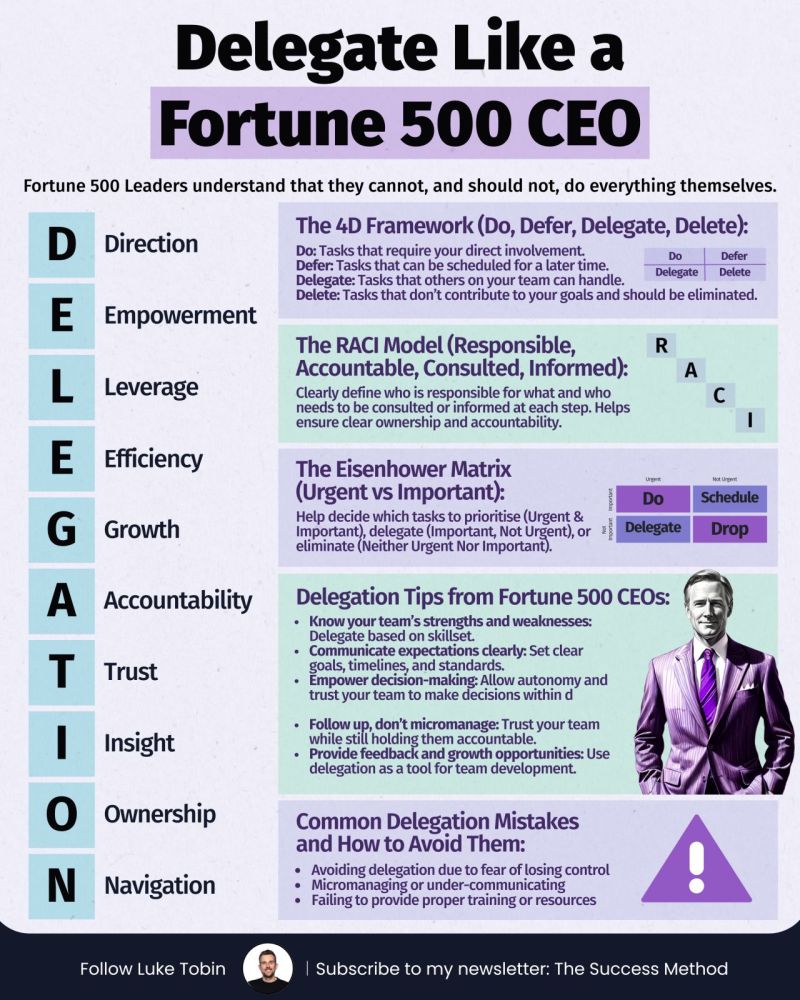
The 4D Framework:
↳ Sort everything:
Do what matters.
Defer what can wait.
Delegate what others can own
Delete what drags you down.
The RACI Model:
↳ Clarify ownership by defining who is:
– Responsible
– Accountable
– Consulted
– Informed.
Eisenhower Matrix:
↳ Prioritise like a strategist:
Urgent + Important? Do it now.
Important, Not Urgent? Delegate.
Neither? Delete.
Fortune 500 Delegation Habits:
1. Know your team’s strengths.
2. Set clear goals and timelines.
3. Empower decisions within boundaries.
4. Follow up, don’t micromanage.
5. Give feedback and room to grow.
Avoid these traps:
– Clinging to control.
– Micromanaging or ghosting after assigning.
– Skipping training and clarity.
Here’s the truth:
You weren’t meant to do it all alone.
Delegation is a skill and a superpower.
It isn’t about giving up control,
it’s about creating capacity.
For growth.
For strategy.
For leadership.
You don’t rise to the top by doing it all.
You rise by knowing what only you should do.
6 Secrets To Improving Your Executive Presence
The best leaders don’t dominate conversations.
They direct them with intention.🔥
Most people think executive presence is about having the loudest voice in the room.
It’s not.
The best leaders are calm, focused and intentional. 💪
If you want to look and lead like a CEO, start here:👇
(Even if you’re not an executive… yet)
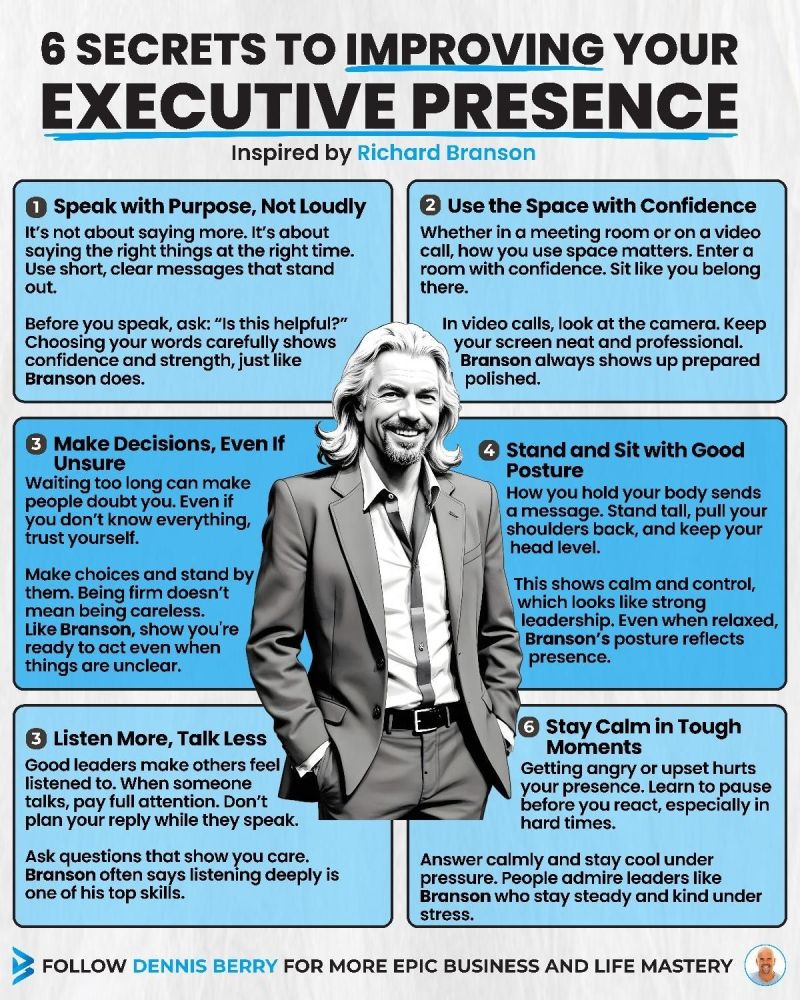
✅ Speak With Purpose, Not Volume
↳ Don’t ramble just to fill silence
↳ Say less, mean more
✅ Use Your Space With Confidence
↳ Don’t shrink into corners or slouch into chairs
↳ Stand tall, walk with intention, take your seat like you belong (because you do)
✅ Make Decisions, Even If You’re Unsure
↳ CEOs rarely have perfect info
↳ But they move forward anyway
↳ Progress beats perfection
✅ Stand and Sit With Good Posture
↳ Straight spine, shoulders back, eyes up
↳ It shows you’re ready, not rattled
✅ Listen More, Talk Less
↳ Great leaders don’t just speak well, they listen well
↳ You learn more by letting others talk
✅ Stay Calm In Tough Moments
↳ People take their cues from you
↳ If you panic, they panic
↳ If you stay grounded, they will too
Executive presence isn’t about a title.
It’s about behavior.🔥
Act like a leader, and people will start to see you as one.
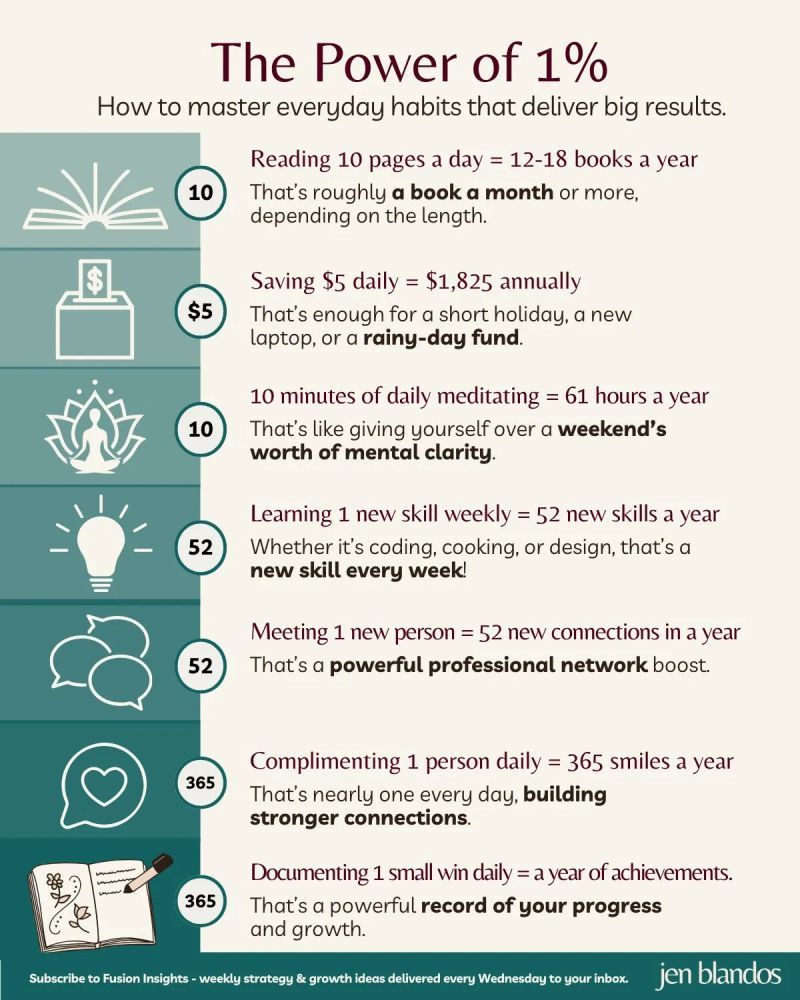
The Power of 1%
The most successful people aren’t extreme.
They’re just consistent.
Most people overestimate what they can do in a week.
And wildly underestimate what they can do in a year.
For me, that consistency has been fitness.
I’ve committed to 30-60 minutes of movement every day, whether it’s the gym, lifting weights, pilates, or walking around the lake with my dog.
It’s now so ingrained, it’s always an easy yes.
And through my breast cancer journey this year, that habit carried me, physically and mentally.
Here’s what 1% better really looks like:
↳ Reading 10 pages daily = 12–18 books a year
↳ Saving $5 daily = $1,825 saved
↳ 10 minutes of meditation = 61 hours of clarity
↳ Learning 1 skill weekly = 52 new skills
↳ Meeting 1 new person weekly = 52 new connections
↳ Complimenting 1 person daily = 365 smiles
↳ Documenting 1 small win daily = a year of progress
I created this visual as a reminder that:
Real change doesn’t come from big leaps.
It comes from small, repeatable steps – done consistently.
It’s not as complicated as you think.
You just need to commit – and follow through.
The Moment Your Feet Leave the Ground

There’s a very specific kind of fear that shows up right before change. It’s not loud panic. It’s quieter than that. It’s the hesitation that says, What if this doesn’t work? The pause that keeps you standing at the edge, convincing yourself that waiting a little longer is the responsible thing to do.
Most of us know that feeling well.
It shows up when you’re thinking about leaving a job that no longer fits, even though it still pays the bills. When you’re considering having a hard conversation you’ve been rehearsing in your head for months. When you feel the pull to start something new—a project, a habit, a relationship, a version of yourself—but can’t quite bring yourself to move.
Fear has a way of dressing itself up as logic. It tells you you’re being practical. That you’re being patient. That now isn’t the right time. And sometimes, yes, waiting is wise. But other times, waiting is just fear wearing a very convincing disguise.
The truth is, the scariest jumps usually feel scary because they matter.
If it didn’t matter, there wouldn’t be fear. You wouldn’t feel that tightness in your chest or that loop of overthinking in your head. You’d just do it and move on. Fear often shows up at the doorway of growth, not because you’re about to fail, but because you’re about to change.
What rarely gets talked about is what happens when you don’t jump.
At first, nothing dramatic. Life keeps going. You tell yourself you’ll revisit the idea later. Weeks turn into months. Months turn into years. And slowly, that edge you once stood on starts to fade from view. Not because the opportunity disappeared, but because you adjusted to staying put.
Staying feels safe in the short term. It’s familiar. Predictable. You know how to survive here. But over time, staying comes with a quieter cost. Regret doesn’t usually hit all at once—it accumulates. It’s the nagging thought of I wonder what would have happened if I tried. It’s the low-grade dissatisfaction that creeps in when you realize you’re repeating the same year over and over, just with different dates on the calendar.
Jumping doesn’t guarantee success. That part is important to say out loud. You can jump and still stumble. You can jump and realize you misjudged something. You can jump and have to course-correct midair.
But here’s the difference: when you jump, you’re moving. When you don’t, you’re frozen.
Movement creates options. Momentum creates learning. Even a “failed” jump teaches you more than standing still ever will. You learn what you’re capable of. You learn what doesn’t work. You learn that you can survive uncertainty, which is a lesson that quietly changes everything.
Most people who look back on their lives don’t regret the jumps they took. They regret the ones they talked themselves out of. The call they didn’t make. The risk they delayed until it felt safe—and never did. The version of themselves they kept postponing.
Fear doesn’t go away before you jump. That’s another lie we often wait for. Confidence rarely arrives first. It usually shows up after action, not before it. You don’t jump because you’re fearless. You jump because you decide that staying stuck is scarier than trying.
And yes, your legs might shake. Your voice might crack. You might not feel ready. But readiness is overrated. Most meaningful things in life are done slightly unprepared.
Jumping doesn’t have to mean blowing up your entire life overnight. Sometimes it’s a small step that still feels terrifying because it breaks inertia. Sending the email. Signing up. Saying no. Saying yes. Admitting the truth. Starting before you feel qualified.
Those small jumps add up. They change how you see yourself. You stop identifying as someone who waits and start becoming someone who moves.
If you’re standing at an edge right now, feeling that familiar fear, pay attention. Ask yourself whether this fear is protecting you—or imprisoning you. Ask yourself what staying will cost you a year from now. Five years from now.
Because the real danger isn’t falling. It’s building a life so comfortable and constrained that you never leave the ground at all.
When it feels scary to jump, that’s often the sign.
That’s when you jump.
10 Silent Culture Killers

High-EQ leaders make their people the priority.
10 silent culture killers every leader needs to know:
1. When you don’t communicate or give feedback.
2. When you haven’t set clear job expectations.
3. When you promote the wrong people.
4. When you hold too many meetings.
5. When you fail to support growth.
6. When you let toxic managers stay.
7. When you allow micromanagement.
8. When you don’t manage workloads well.
9. When you allow favoritism in the workplace.
10. When you don’t pay people what they’re worth.
If you care more about your profits than your people,
you’ll eventually have neither.
Business is positive-sum.
They win. You win.
Repeat.
A Key to Conflict
I remember when a comment from a colleague made me feel attacked.
My first reaction was almost the classic “fight or flight”.
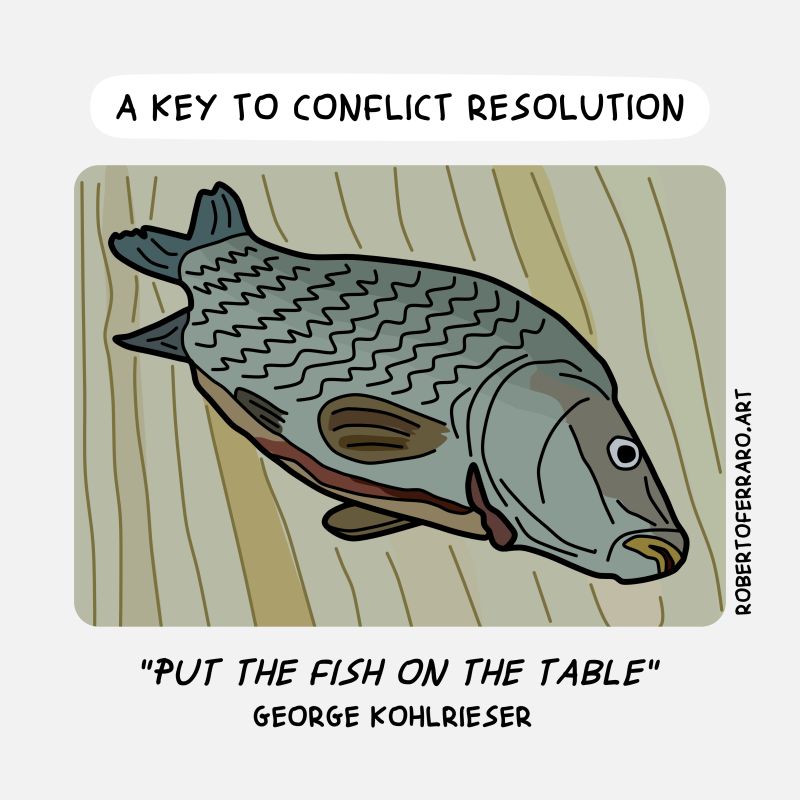
Then, instead of becoming a hostage, I remembered a metaphor: to “put the fish on the table.”
It’s a messy, smelly job, and no one wants to do it. However, if you don’t clean it, the fish will just stay there and rot, and everything will worsen.
So, I took a breath and asked the person to have a chat after the meeting. I put the fish on the table, saying something like, “When you said X, I felt Y. Can we talk about it?”
At first it was uncomfortable, but it was worth it. We clarified the intention, the impact, and the misunderstanding.
Our conversation wasn’t simply about that comment; it was instead about how we could work together.
And now our professional relationship is much stronger because we chose to have that conversation, and we trust that we’ll raise any future issue with the same transparency.
Conflict itself isn’t the problem, avoiding conflict is. The “messy” part is where trust is built.
And in reality, we have these conversations because we care, and respect the person, and that’s why it is important to put the fish on the table.
The “fish on the table” metaphor that helped me so much comes from the incredible work of the dear George Kohlrieser, a professor at IMD.
When was the last time that addressing a conflict actually improved a relationship for you?
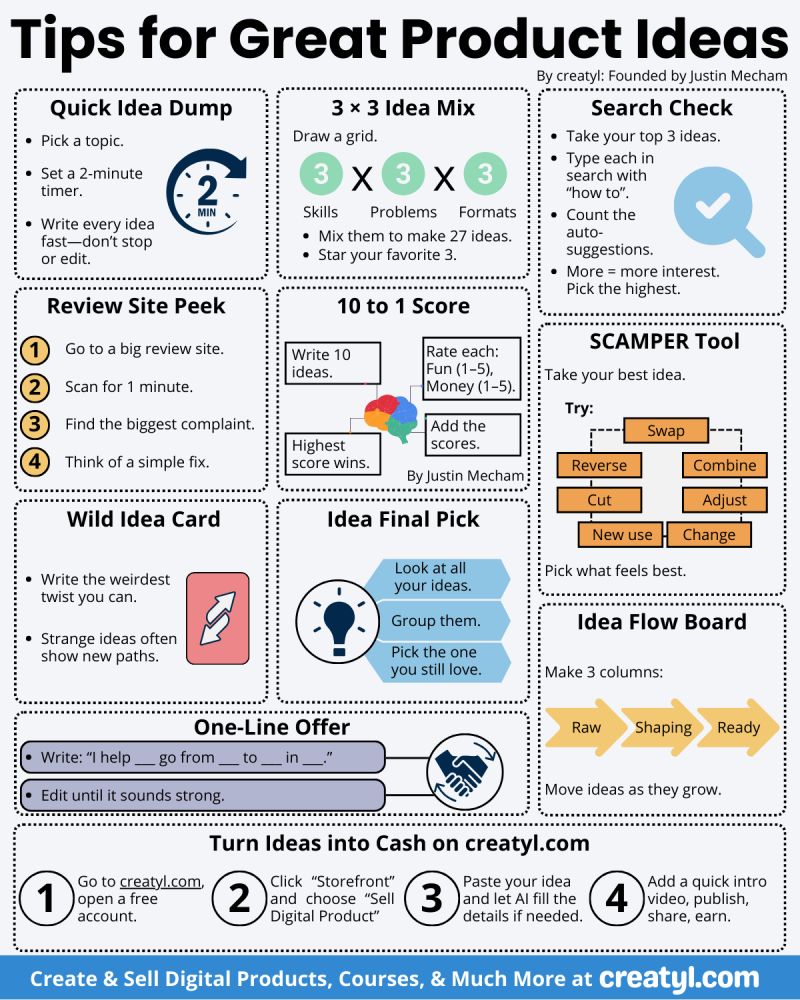
Tips for Great Product Ideas
Great ideas aren’t found—
They’re shaped step by step:
You don’t need
a “perfect” spark—
Just a system to test
and shape what works.
Here’s how top creators do it:
🟪Dump fast
• Set a 2-minute timer.
• Write every idea without stopping.
🟦Mix & match
• List 3 skills × 3 problems
× 3 formats = 27 new angles.
🟩Check interest
• Search your top 3 ideas.
• If people are already asking, go for it.
🟨Score it
• Rate 10 ideas by fun + money.
• The highest score wins.
🟧Test the twist
• Weird ideas often lead
to the best paths.
🟥Shape & refine
• Group your list.
• Pick the one you still love.
• Make it stronger.
🟫Write the offer
• “I help ___ go from ___ to ___ in ___.”
• Keep it simple, then polish.
‼️Final step:
• Move it to your board
• Raw → Shaping → Ready.
Use our sheet to get the full system
and start turning ideas into products today.
The best products don’t start perfect—
They start proven, shaped,
and ready to sell.
When You Let Gravity Do the Work
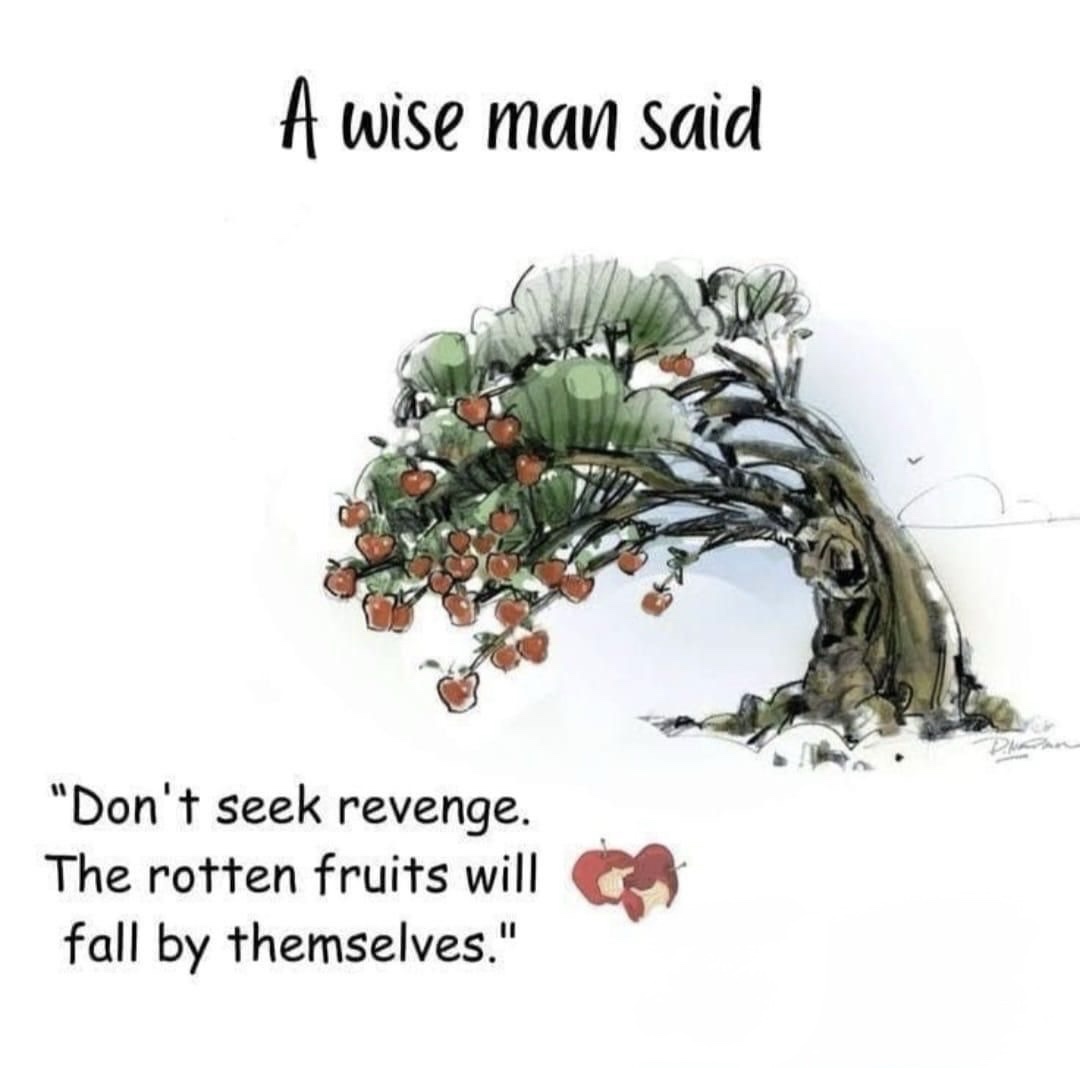
A wise man once said, “Don’t seek revenge. The rotten fruits will fall by themselves.”
It sounds simple, almost too calm for a world that constantly nudges us to react, respond, and retaliate. But the older I get, the more this line feels less like a quote and more like a quiet survival strategy.
We’re taught—subtly, sometimes loudly—that if someone wrongs us, we must do something about it. Say something sharp. Prove a point. Even the score. There’s a strange pressure to show that we weren’t weak, that we noticed, that we won’t let it slide. Revenge, in many ways, is marketed as self-respect.
But real life doesn’t work like movies. Revenge rarely delivers closure. It delivers noise. It keeps the wound open longer than it needs to be.
The idea of “rotten fruits falling on their own” assumes something radical: that time, truth, and gravity are far more effective than our interference. Rotten fruit doesn’t need to be yanked off the branch. It reveals itself. It softens, smells, weighs itself down, and eventually drops—often when no one is even paying attention.
People, situations, behaviors—they work the same way.
When someone acts out of jealousy, ego, insecurity, or deceit, it may look like they’re getting away with it. For a while. From the outside, it can feel deeply unfair. You’re left holding your silence while they seem to collect wins. That’s usually the moment when revenge feels tempting. Not because you’re cruel, but because you want balance restored.
But here’s the uncomfortable truth: most consequences don’t arrive dramatically. They arrive quietly.
The person who lies often has to keep lying. The one who manipulates has to keep track of too many versions of themselves. The one who burns bridges eventually runs out of places to stand. None of that requires your involvement. In fact, your involvement often delays the natural fallout.
Revenge pulls you into the same soil that produced the rot in the first place.
There’s also a hidden cost we don’t talk about enough: attention. When you seek revenge, you keep giving mental space to someone who already took enough from you. You replay conversations. You imagine scenarios. You draft responses in your head that will never be sent. That energy doesn’t punish them—it drains you.
Choosing not to retaliate isn’t weakness. It’s restraint. And restraint is a form of power that doesn’t announce itself.
There’s a deep confidence in saying, “I don’t need to prove anything. I don’t need to explain myself to someone committed to misunderstanding me. I don’t need to fight a battle that time is already winning on my behalf.”
This doesn’t mean pretending nothing hurt. It doesn’t mean suppressing anger or bypassing healing. It means processing your emotions honestly, but not turning them into weapons. It means deciding that your peace is more valuable than temporary satisfaction.
One of the hardest parts of this approach is patience. Rotten fruit doesn’t fall on your schedule. Sometimes it hangs there longer than you think it should. Sometimes people applaud it, unaware of the decay beneath the surface. That’s the real test—not whether you believe the fruit will fall, but whether you can live well while it’s still hanging.
And here’s the part that rarely gets mentioned: sometimes the fruit falls, and you’re no longer even around to notice. You’ve moved on. You’ve grown. You’ve found better things to carry. That’s not avoidance—that’s progress.
Life has a way of evening things out, but not always in ways that satisfy our ego. The outcome may not look like justice in bold letters. It may look like distance. Irrelevance. A quiet realization on their part that something keeps going wrong, over and over again.
Meanwhile, your job isn’t to watch the tree. Your job is to tend your own ground.
Protect your character. Protect your time. Protect your capacity to stay soft in a world that rewards hardness. Not every offense deserves a response. Not every slight deserves your voice. Some things deserve only your absence.
When you stop reaching for revenge, you create space for something better—clarity, freedom, and a lighter heart. And eventually, without your help, gravity does what it always does.
The rotten fruits fall.
You don’t have to be standing underneath them.
 Kenrick Vaz