
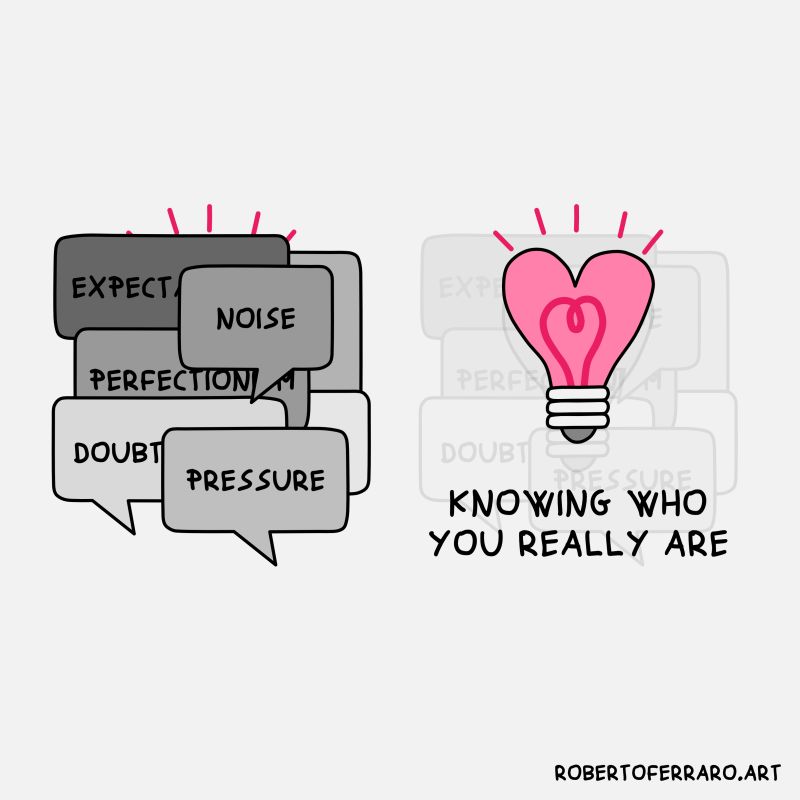
I recently discovered a children’s book from 1946: “The Bear That Wasn’t.”
A bear hibernates, and a factory gets built over his cave.
When he wakes up, everyone, from the foreman to the CEO tells him, “You’re not a bear. You’re a silly man who needs a shave and wears a fur coat.”
He’s so overwhelmed by their certainty that he starts to believe them.
He gets a job on the factory floor, and feels miserable. He forgets he’s a bear.
Until one day he decides to get back to the cave, and re-discovers that he’s a bear.
This story has a beautiful analogy because I had moments in my life where I felt like that bear.
The factory is a metaphor for all the expectations: what a leader should look like, how a manager should act, the unspoken rules.
You start performing the role of the “silly person in a fur coat” because everyone expects it.
But leading from that place is not sustainable, it’s exhausting, and everyone can feel the disconnect.
The challenge isn’t meeting every expectation. It’s knowing who you are, knowing your own values and acting in line with them, even when it’s loud outside.
What is a question that helps you remember who you are?
Rewire Your Brain
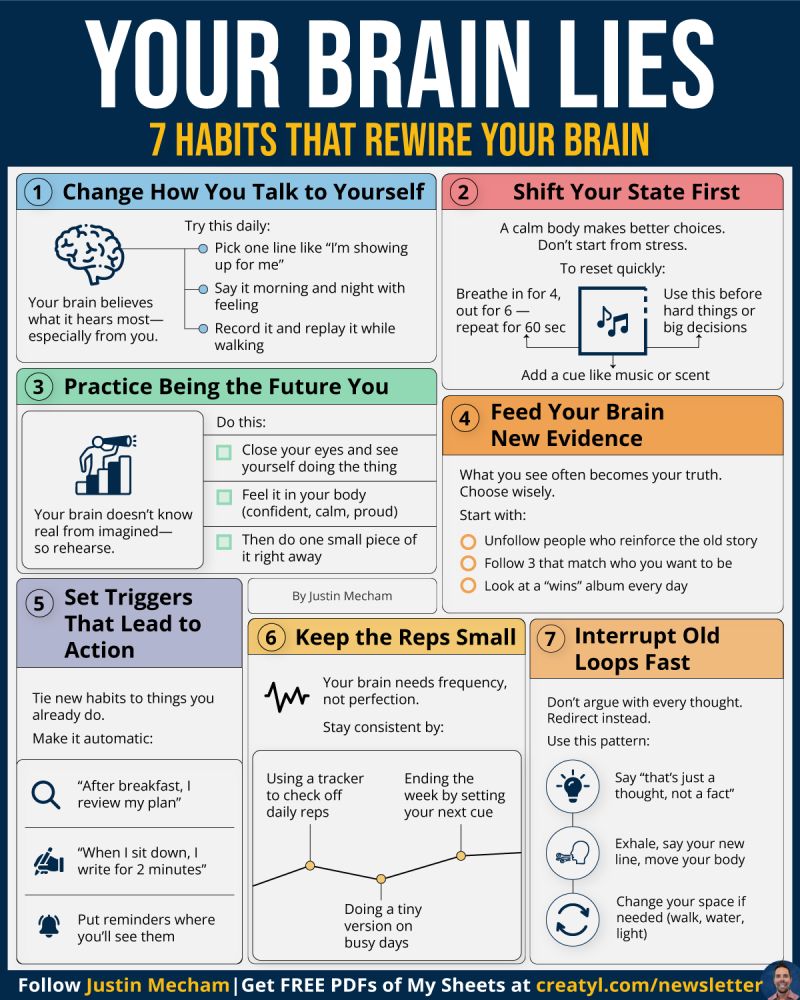
Your brain lies to you every day—
And you believe it:
But you can retrain it—
By feeding it better habits:
🟦 Talk Better to Yourself:
Say one helpful line daily.
Morning, night, and on walks.
🟥 Shift Before You Act:
Calm your body first.
Use breathing, music, or scent.
🟩 Practice Being the Future You:
See it in your mind.
Then do one tiny piece now.
🟧 Give Your Brain New Proof:
Unfollow doubt.
Feed it small wins and new stories.
🟪 Set Simple Triggers:
Tie habits to stuff you already do.
Make it automatic.
🟨 Keep It Small:
One checkbox is enough.
Reps > perfect plans.
🟫 Interrupt Old Loops Fast:
Say “just a thought.”
Move your body. Shift your space.
Use my sheet to pick one habit—
Try it for 7 days and track your change.
Your brain will believe whatever it hears most.
Make sure what it hears helps you grow—
Not hold you back.
5 Mental Health Acronyms
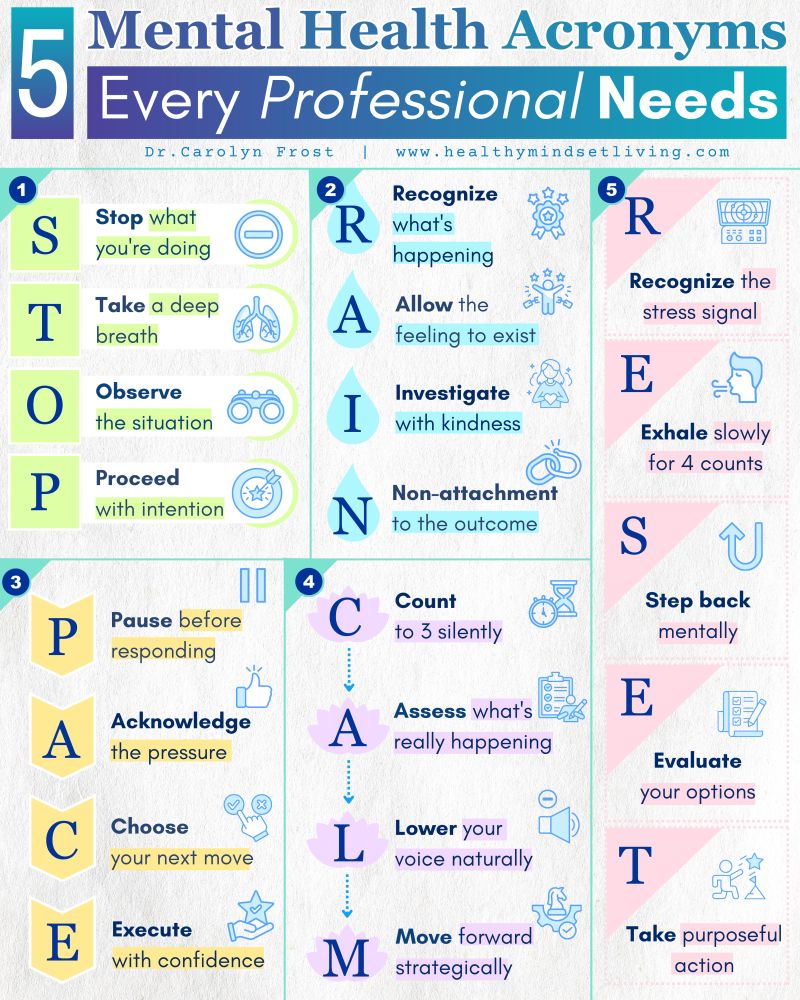
Your stress response is sabotaging your success.
These 5 tools will save your career 👇🏼
I used to think “staying calm” was a personality trait.
Then I learned it’s actually a skill.
Here are the 5 tools that changed everything:
🛑 S.T.O.P.
Stop what you’re doing
Take a deep breath
Observe the situation
Proceed with intention
🌧️ R.A.I.N.
Recognize what’s happening
Allow the feeling to exist
Investigate with kindness
Non-attachment to the outcome
⚡ P.A.C.E.
Pause before responding
Acknowledge the pressure
Choose your next move
Execute with confidence
😌 C.A.L.M.
Count to 3 silently
Assess what’s really happening
Lower your voice naturally
Move forward strategically
🔄 R.E.S.E.T.
Recognize the stress signal
Exhale slowly for 4 counts
Step back mentally
Evaluate your options
Take purposeful action
Come back to this when life gets chaotic.
These frameworks are your emergency toolkit ✨
Which tool will you try first this week?
Noise From the Cheap Seats
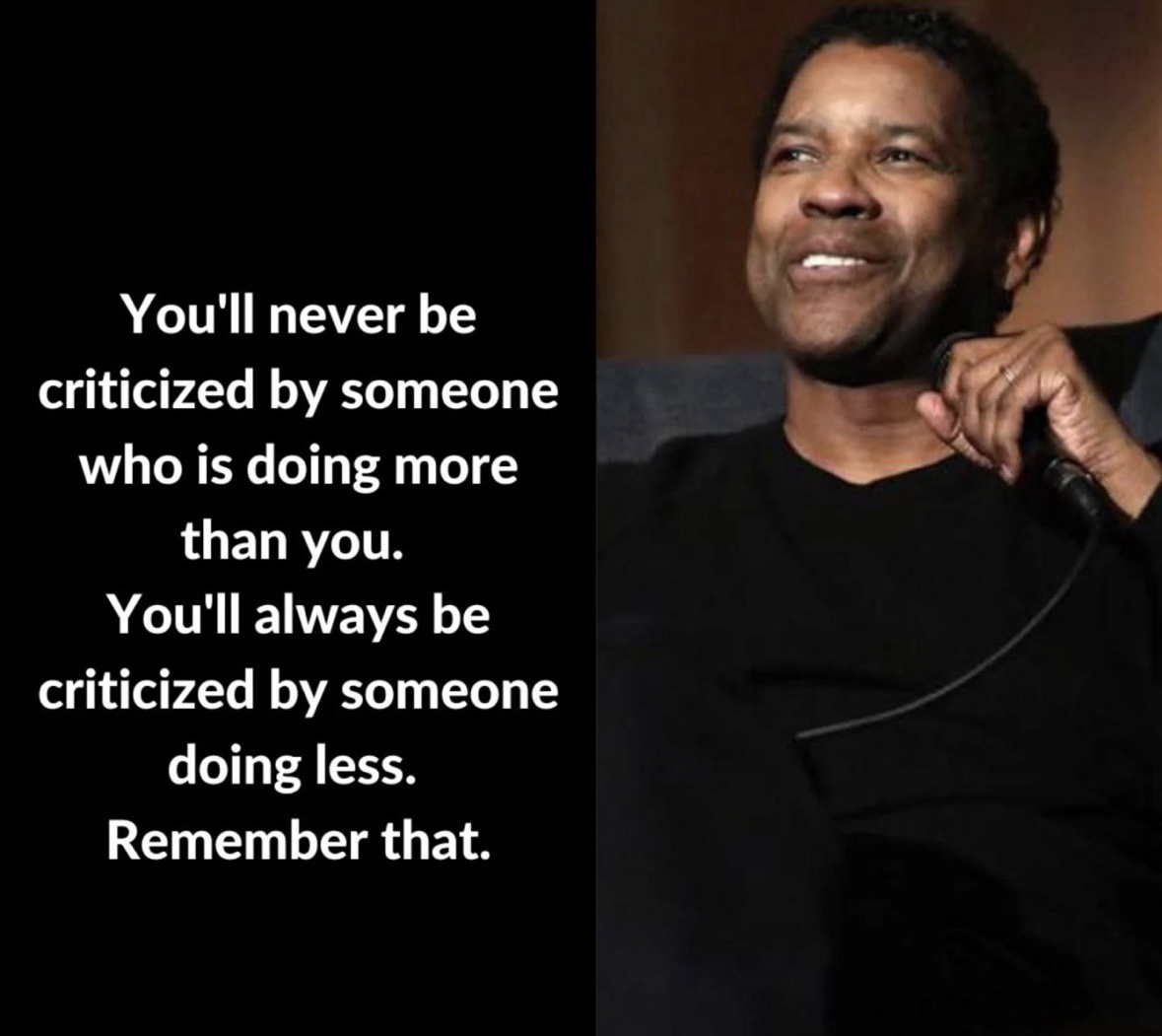
There’s a quote that floats around a lot: You’ll never be criticized by someone who is doing more than you. You’ll always be criticized by someone doing less. I’ve seen it attributed to famous names, but honestly, I don’t know if any of them actually said it. What I do know is this—whether the quote is authentic or not, the experience behind it feels painfully real.
If you’ve ever tried to build something—anything—you’ve probably felt this. A new habit. A creative project. A career move. A boundary. Growth has a way of inviting commentary. Not thoughtful feedback. Not guidance from people who’ve walked the road ahead of you. Just noise. Side remarks. Raised eyebrows. Subtle digs dressed up as “concern” or “just being honest.”
What’s interesting is where that noise usually comes from.
It rarely comes from people who are stretching themselves, risking failure, or living at the edge of their comfort zone. Those people are too busy doing the work. They’re too familiar with doubt to weaponize it against someone else. They know how fragile momentum can be, how hard it is just to show up again after a bad day.
The criticism usually comes from the sidelines. From people who haven’t moved in a while. From people who are watching instead of trying. From people who are unsettled by movement because it highlights their own stillness.
And here’s the uncomfortable part: their criticism isn’t really about you.
It’s about what your effort exposes.
When you decide to try, you break an unspoken agreement. The agreement that says, We’re all staying right here. Your growth becomes a mirror. And mirrors are not kind to avoidance. So instead of asking themselves hard questions, it’s easier to question you. Your motives. Your timing. Your confidence. Your ability.
“Who do you think you are?”
“Why now?”
“Do you really think this will work?”
Those questions sound like skepticism, but they’re often fear wearing a different face.
The tricky thing is that criticism can still sting, even when it’s unfair. Words land. Tone lingers. And if you’re already pushing against your own self-doubt, outside doubt can feel like confirmation. That’s usually when people shrink back, quiet down, or slow their pace—not because they were wrong, but because the noise got loud enough to distract them from their own direction.
But here’s something worth remembering: silence from critics doesn’t mean you’re doing great, and criticism doesn’t mean you’re doing something wrong. Sometimes it simply means you’re visible. And visibility always invites opinions.
People who are doing more than you don’t tend to criticize in careless ways. If they speak at all, it’s usually with context. With empathy. With an understanding of the weight of effort. They might challenge you, but it feels different. It feels constructive, grounded, earned. It comes from experience, not insecurity.
Everyone else? That’s just commentary.
You don’t need to absorb every opinion that reaches you. You don’t need to defend every choice or explain every step. Not everyone deserves a front-row seat to your process. Especially those who aren’t willing to risk anything themselves.
This doesn’t mean you’re above feedback or immune to being wrong. Growth still requires humility. But there’s a difference between learning from people who are walking ahead of you and being distracted by people who are sitting still.
So when criticism shows up, pause before reacting. Ask where it’s coming from. Ask whether it’s rooted in experience or discomfort. Ask whether it’s helping you move forward or quietly trying to pull you back.
Most of the time, the loudest voices aren’t the most credible ones. They’re just echoes from the cheap seats.
Keep doing the work. Keep moving. Let your progress speak louder than commentary ever could.
You Can Be Kind and Still
I used to think being kind meant saying yes to everything.
Never disappointing anyone.
Putting everyone else’s needs before my own.
I was wrong.
Kindness isn’t weakness disguised as virtue.
Real kindness requires backbone.
It means caring enough to have difficult conversations.
It means protecting your energy so you can
show up fully for what matters.
It means saying no to good things so you can
say yes to great ones.
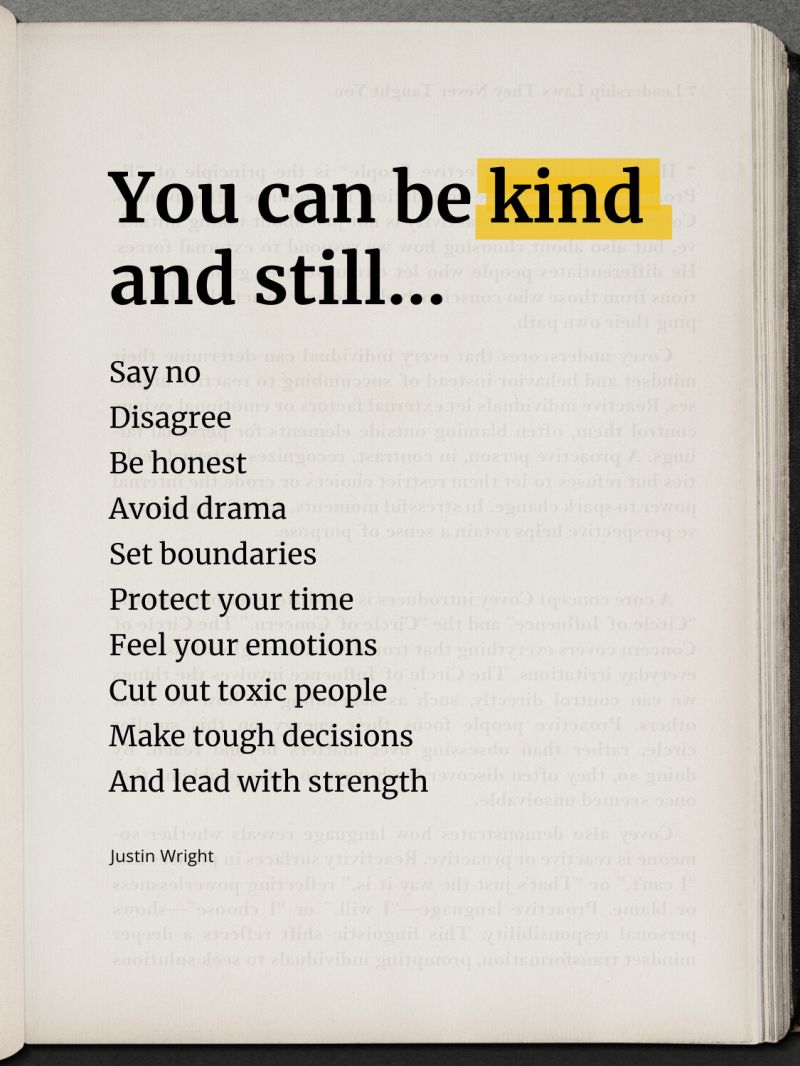
I’ve learned that you can be kind AND:
➟ Set firm boundaries
➟ Disagree with your boss
➟ Prioritize your mental health
➟ Walk away from toxic relationships
➟ Make decisions others don’t understand
The kindest thing you can do for yourself?
✅ Stop apologizing for protecting your peace.
✅ Stop feeling guilty for choosing your growth.
✅ Stop shrinking to make others comfortable.
Because…
When you act from a place of strength, not depletion.
When you lead with intention, not obligation.
When you choose respect over being liked.
That’s when your kindness becomes powerful.
That’s when it creates real impact.
The world doesn’t need more people-pleasers.
It needs more people who are kind enough to show up
as their authentic, boundaried, whole selves.
Be kind.
Be strong.
Be unapologetic about it.
The right people will respect you for it.
And the wrong people?
They’ll show themselves out.
Emotional Intelligence
Most leaders aren’t toxic.
They’re just using outdated language that shuts people down instead of lifting them up.
The difference between a burned-out team and a thriving one?
It’s the words you say every day.
Here’s how emotionally intelligent leaders create cultures where people stay, grow, and win:
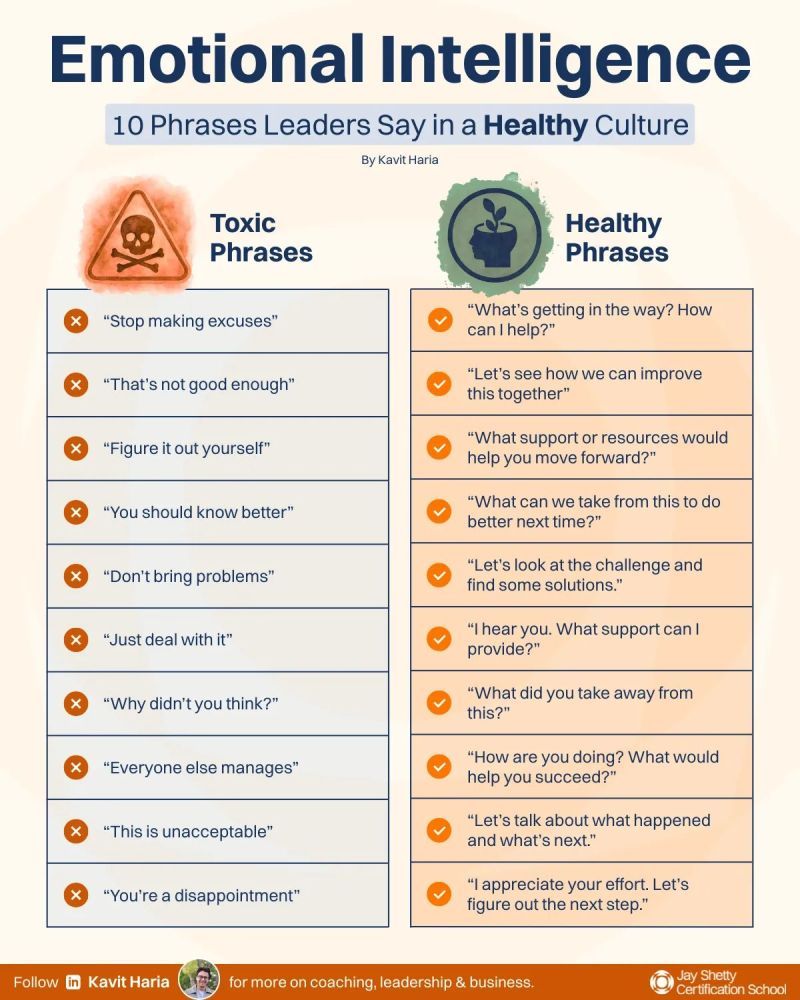
💡 Instead of saying “Stop making excuses”
→ Try: “What’s blocking you?”
→ Opens dialogue instead of shutting them down
💡 Instead of saying “Figure it out yourself”
→ Try: “I believe in your ability”
→ Shows confidence while offering support
💡 Instead of saying “You should know better”
→ Try: “What did this teach us?”
→ Turns mistakes into team learning
💡 Instead of saying “Just deal with it”
→ Try: “I hear you. I’m here.”
→ Validates feelings before problem-solving
💡 Instead of saying “Everyone else manages”
→ Try: “Your wellbeing matters”
→ Acknowledges each person’s unique situation
💡 Instead of saying “You disappointed me”
→ Try: “I appreciate your effort”
→ Recognizes effort before addressing results
See the pattern?
One approach creates walls.
The other builds bridges.
Emotionally intelligent leaders can spot the difference.
Small phrases. Massive impact.
Because people don’t follow titles.
They follow leaders who make them feel seen, heard, and supported.
10 Things No One Tells You About Being a Leader
Leadership isn’t just strategy.
It’s humanity.
You’ll think the job is about metrics and meetings.
But what no one tells you is this:
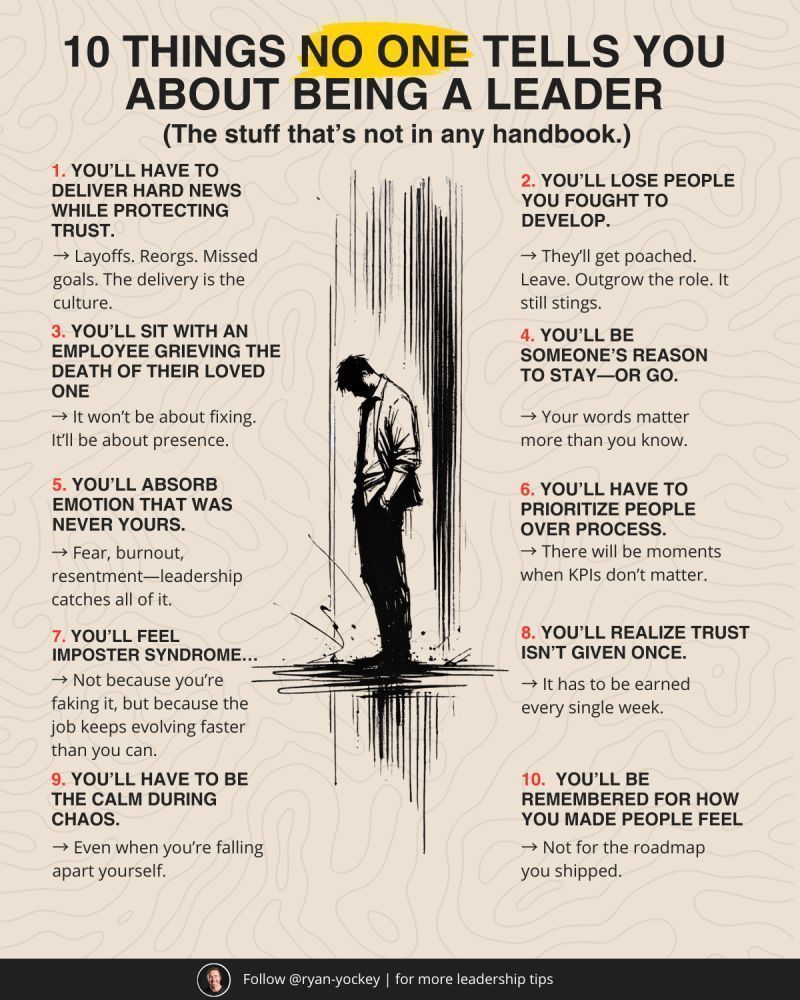
1️⃣ You’ll have to deliver hard news while protecting trust.
→ Layoffs. Reorgs. Missed goals. The delivery is the culture.
2️⃣ You’ll lose people you fought to develop.
→ They’ll get poached. Leave. Outgrow the role. It still stings.
3️⃣ You’ll sit with an employee grieving the death of their parent—
and have no idea what to say.
→ It won’t be about fixing. It’ll be about presence.
4️⃣ You’ll be someone’s reason to stay—or go.
→ Your words matter more than you know.
5️⃣ You’ll absorb emotion that was never yours.
→ Fear, burnout, resentment—leadership catches all of it.
6️⃣ You’ll have to prioritize people over process.
→ There will be moments when KPIs don’t matter.
7️⃣ You’ll feel imposter syndrome…
→ Not because you’re faking it, but because the job keeps evolving faster than you can.
8️⃣ You’ll realize trust isn’t given once.
→ It has to be earned every single week.
9️⃣ You’ll have to be the calm during chaos.
→ Even when you’re falling apart yourself.
🔟 You’ll be remembered for how you made people feel—
→ Not for the roadmap you shipped.
This is the part of leadership no one talks about.
But it’s the part that shapes everything.
The Weight You Were Never Meant to Carry
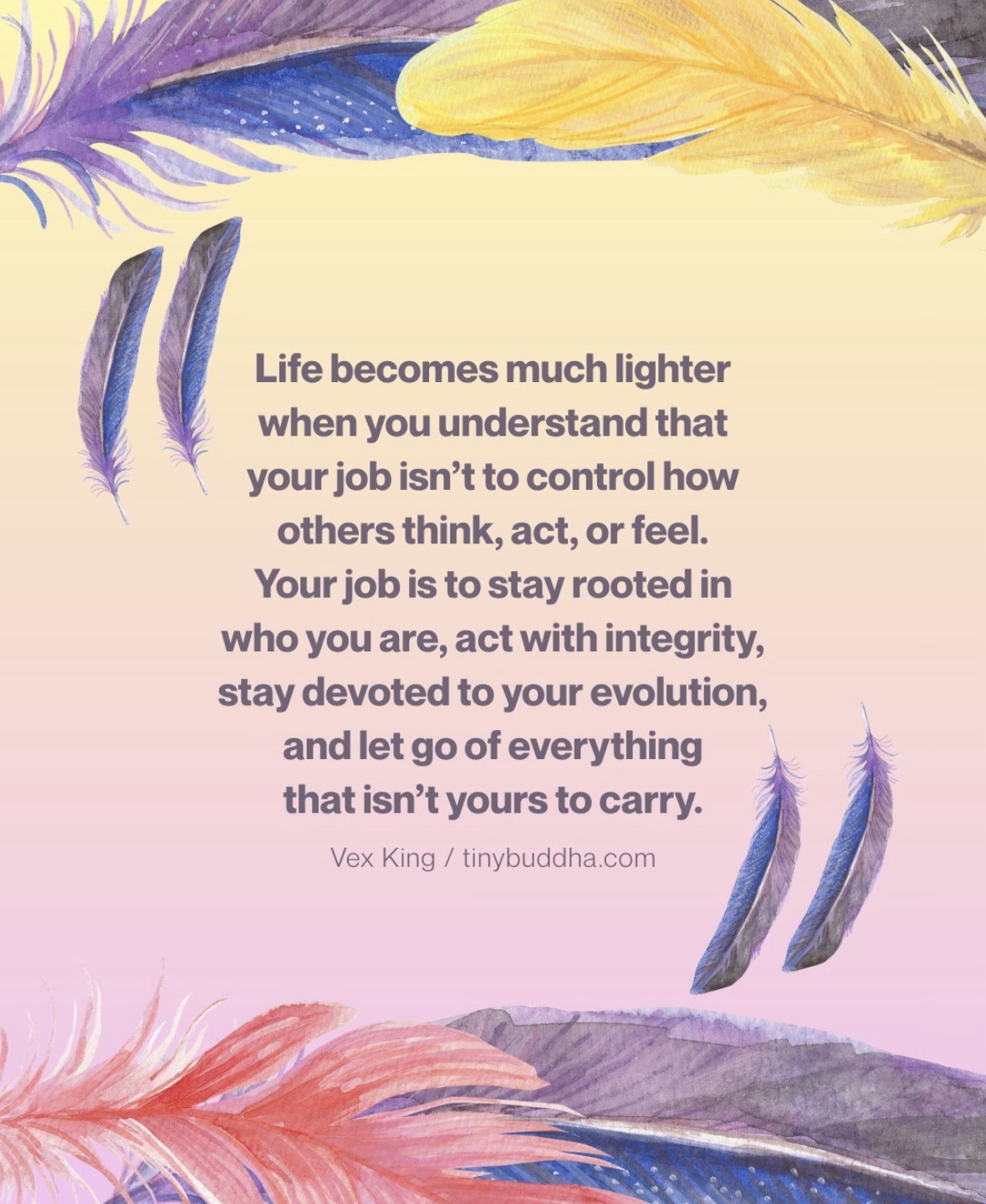
There’s a quiet shift that happens when you finally understand this: your life gets lighter the moment you stop trying to manage other people’s thoughts, reactions, and emotions.
Most of us don’t even realize how much weight we’re carrying. We replay conversations in our heads, tweak our words to land a certain way, soften our truth so it won’t upset someone, or harden it so we won’t look weak. We read into silences. We overexplain. We take responsibility for moods that were never ours to begin with. And slowly, without meaning to, we confuse control with care.
At some point, though, you notice how exhausting that is.
You realize how much energy goes into predicting reactions instead of listening to your own voice. How much time is spent trying to be understood instead of being honest. How often you adjust yourself to fit into spaces that were never designed to hold the real you.
And that’s usually where the shift begins.
Life becomes simpler—not easier, but simpler—when you accept a hard truth: you cannot control how others think, act, or feel. You never could. Even when you did everything “right,” people still interpreted it through their own wounds, fears, and expectations. Their reactions were never a clean reflection of your intentions.
Once that sinks in, something loosens inside you.
You stop rehearsing explanations that no one asked for. You stop carrying guilt for someone else’s discomfort. You stop mistaking their disappointment for your failure. You begin to see the line—clearer than before—between what is yours to own and what is not.
What is yours is simpler, but far more meaningful.
Your job is to stay rooted in who you are. Not the version that wins approval, but the one that feels steady when no one is clapping. The one that can sit with discomfort without abandoning itself. The one that knows its values and doesn’t bargain with them for temporary peace.
Your job is to act with integrity, even when it costs you convenience or popularity. Integrity isn’t loud. It doesn’t need defending. It’s quiet consistency. It’s doing the right thing when no one is watching—and also when everyone is misunderstanding you.
Your job is to stay devoted to your evolution. Not in a frantic, self-improvement way, but in a patient, honest one. Growth doesn’t always look impressive. Sometimes it looks like unlearning. Sometimes it looks like choosing rest instead of proving your worth. Sometimes it looks like saying no without a detailed explanation.
And maybe the hardest part of all: your job is to let go of everything that isn’t yours to carry.
Other people’s expectations.
Other people’s timelines.
Other people’s emotional reactions.
Other people’s need for you to stay the same so they don’t have to adjust.
Letting go doesn’t mean you stop caring. It means you stop confusing responsibility with attachment. You can care deeply without carrying what doesn’t belong to you. You can show up with kindness without sacrificing your center. You can listen without absorbing.
When you live this way, something subtle but powerful happens. Your energy stops leaking. Your decisions become clearer. You respond instead of react. You feel less scattered, less defensive, less desperate to be seen a certain way.
You start moving through life with a different posture—not rigid, not withdrawn, but grounded.
People may still misunderstand you. Some will project. Some will resist the version of you that no longer bends the way it used to. That’s okay. That’s part of the cost of living honestly.
But here’s the quiet reward: you’ll feel more like yourself than you ever have.
And that feeling—the lightness, the steadiness, the inner alignment—is worth far more than the approval you had to give up to get it.
You were never meant to carry everyone else’s weight. You were meant to walk your own path with clarity, integrity, and the freedom that comes from knowing exactly what is—and isn’t—yours to hold.
7 Client Touchpoints
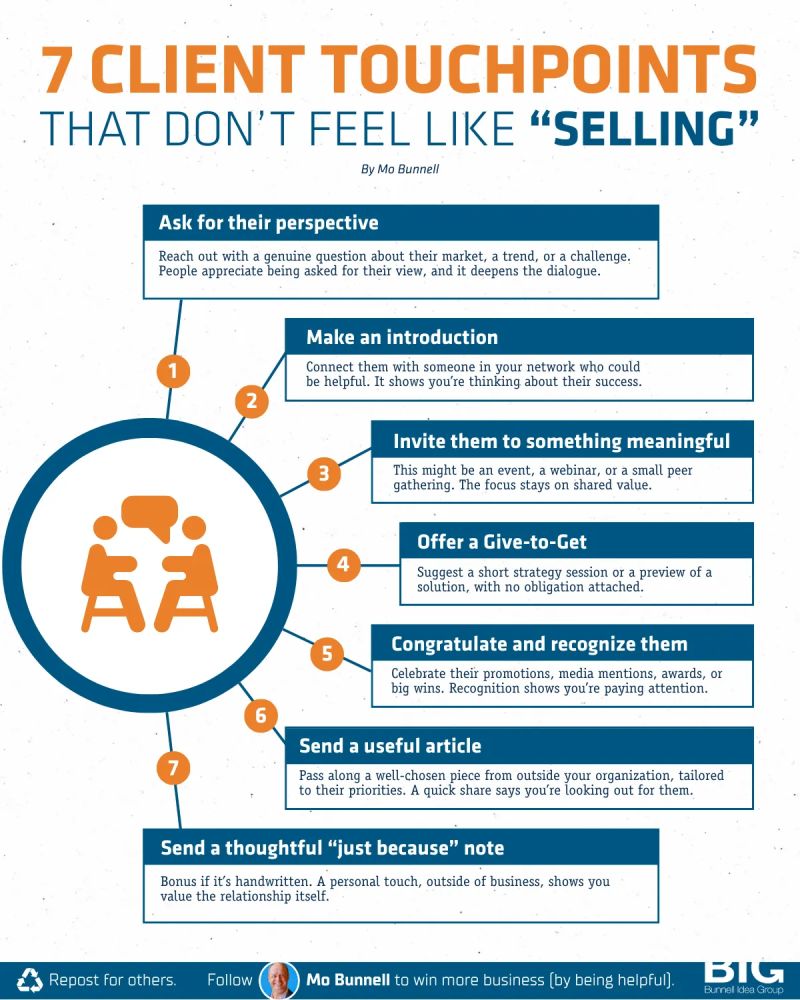
Client touchpoints shouldn’t feel pushy.
They should feel like what they really are:
Building real relationships.
But many client-facing professionals hesitate to follow
up, worried they’ll seem self-serving.
But here’s the shift:
When your touchpoints come from generosity, following
up feels:
✅ Natural
✅ Helpful
✅ Human
Need to follow up with a client soon?
Here are 7 of my favorite trust-building touchpoints that
don’t feel like “selling”:
1. Ask for their perspective
→ “What shifts are you seeing in your market?”
→ Let their insights guide your next step
→ People love being asked what they think
2. Make an introduction
→ Connect them to someone who can help
→ Be specific about the value on both sides
→ Follow up later to see how it went
3. Invite them to something meaningful
→ A small dinner with peers they’ll enjoy
→ A virtual panel on a topic they care about
→ No pitch. Just people they’d want to meet
4. Offer a Give-to-Get
→ “Want to spend 30 minutes tackling that challenge?”
→ Share helpful ideas, no strings attached
→ Let value lead to the next conversation
5. Congratulate and recognize them
→ Repost their big news with a kind comment
→ Mail a handwritten note (or flowers!)
→ Celebrate the personal wins too
6. Send a helpful article
→ Share something outside your company blog
→ Add a quick note: “Thought of you when I read this.”
→ Make it clear you’re thinking of them
7. Send a thoughtful “just because” note
→ “What you said in that meeting stuck with me.”
→ Mention their new puppy or kid’s graduation
→ Yes, snail mail is still magic
In the end, it’s not about being remembered.
It’s about being helpful.
When you show up generously, without pressure, you’re
not just keeping in touch.
You’re building something real.
Pick one. Try it this week.
Let me know how it goes.
7 Traits of Doers
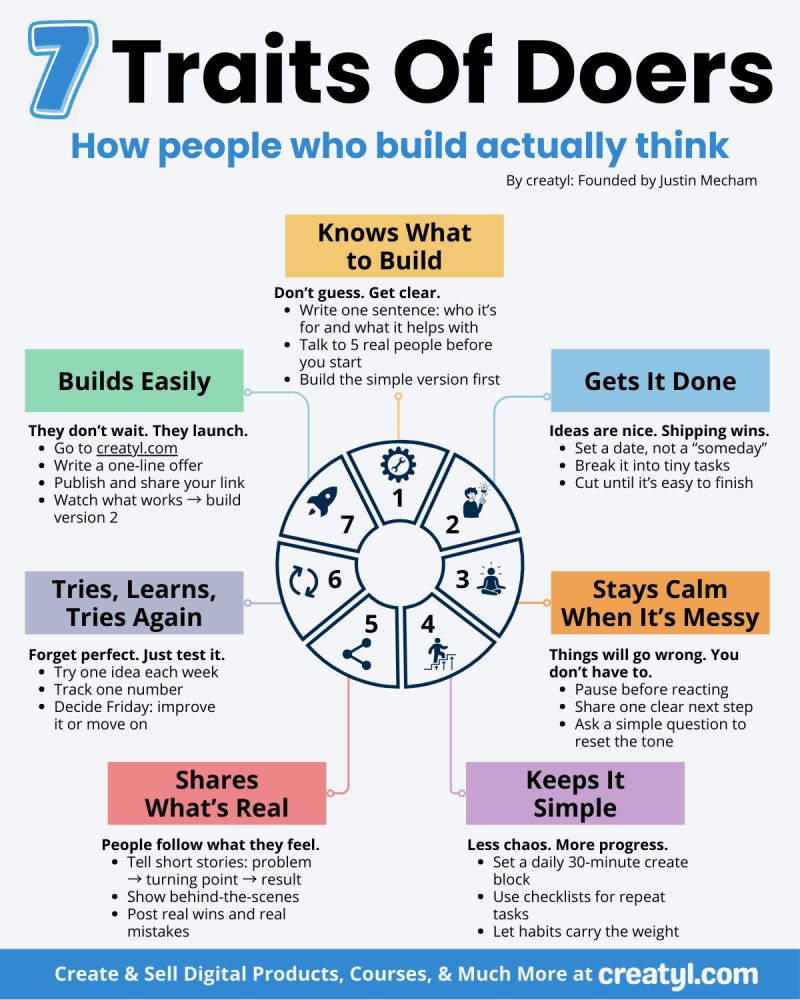
The fastest way to fail is to wait—
The fastest way to win is to do:
Here are 7 traits that set doers apart:
1️⃣ Clarity First
They know what to build.
One sentence, one person, one problem.
2️⃣ Action Over Ideas
They get it done.
Set a date, cut the fluff, ship it.
3️⃣ Steady Under Pressure
When it gets messy, they stay calm.
Pause, pick one step, reset the tone.
4️⃣ Keep It Simple
Less chaos = more progress.
Small blocks, clear lists, strong habits.
5️⃣ Share the Real Stuff
They don’t fake it.
Wins and mistakes both get posted.
6️⃣ Test, Don’t Wait
Every week is an experiment.
Improve it or move on.
7️⃣ Build Fast
They launch small.
Learn from version 1, grow from there.
Use our sheet to see
how to apply these 7 traits—
And start acting like a doer.
Doers don’t wait for permission.
They test, learn, and keep going.
That’s why they win.
 Kenrick Vaz