
The résumé gets you in the room—
What you say next gets you the job:
Most interviews are lost
before they even start—
Not because you aren’t qualified.
But because of what you say…
and what you don’t.
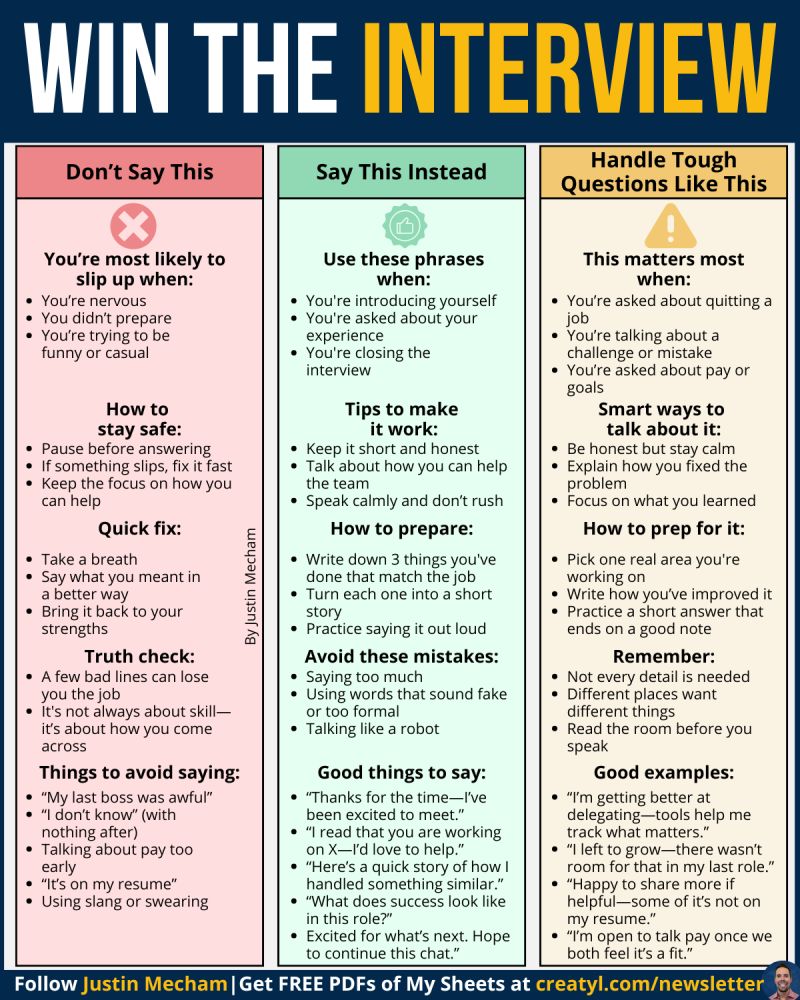
Common slip-ups:
🟨Talking too much
🟧Rushing through answers
🟨Bad-mouthing a past boss
🟧Sounding fake or too formal
🟨Saying “I don’t know” with nothing after
Here’s what to say instead:
💬 Talk about how you can help the team
💬 Share one short, specific story
💬 Speak calmly and don’t rush
💬 Keep it short and honest
The right answers can shift
the whole conversation in your favor.
They can make you memorable
long after you leave the room.
They can turn a “maybe”
into a “When can you start?”
Appreciation Culture

People who feel valued give more than expected.
That’s why great CEOs prioritize their culture.
Because they know:
A valued team doesn’t just work harder.
They think like owners.
They solve problems before you see them.
They stay through the tough times.
Yet recognition is still one of the most underused leadership tools.
It doesn’t cost millions.
It doesn’t take hours.
It just takes intention.
12 simple ways to build a culture where people feel truly valued:
📢 Team Shout-Out
Praise great work publicly. Let everyone see what excellence looks like.
⏳ Time Back Reward
Finished a big project? Let them leave early. Time is the ultimate currency.
📚 Learning Opportunity
Invest in their growth. The ROI on development always pays off.
☕ Favorite Snack Surprise
Small gestures create big loyalty. Know what fuels your team.
📈 Career Growth Talk
Show them their future. People stay where they see a path.
🙏 Daily Thank You’s
Make gratitude a habit. What gets recognized gets repeated.
🎂 Birthday Celebration
Remember they’re human. Personal touches build real connections.
🕊 Let Them Lead
Trust them with decisions. Autonomy breeds ownership.
📱 Social Media Share
Celebrate wins publicly. Recognition amplifies when it’s visible.
💬 One-on-One Chat
Ask how they’re really doing. Caring conversations change cultures.
🎉 Goal Celebration
Hit a milestone? Celebrate it. Success should feel like success.
✍ Handwritten Thank You
In a digital world, handwritten stands out. Make it personal.
Save this list.
Share it with your leadership team.
Make it part of your operating rhythm.
Because the truth is:
Companies with great cultures don’t happen by accident.
They’re built with intention.
What recognition practice has worked best for your team?
Share below. Let’s learn from each other.
7 Styles of Thinking
92% of people think in just one or two ways.
That’s why they get stuck in the same problems.
Credits to Natan Mohart, make sure to follow!
_____
The smartest?
They switch between 7 thinking styles — and win.
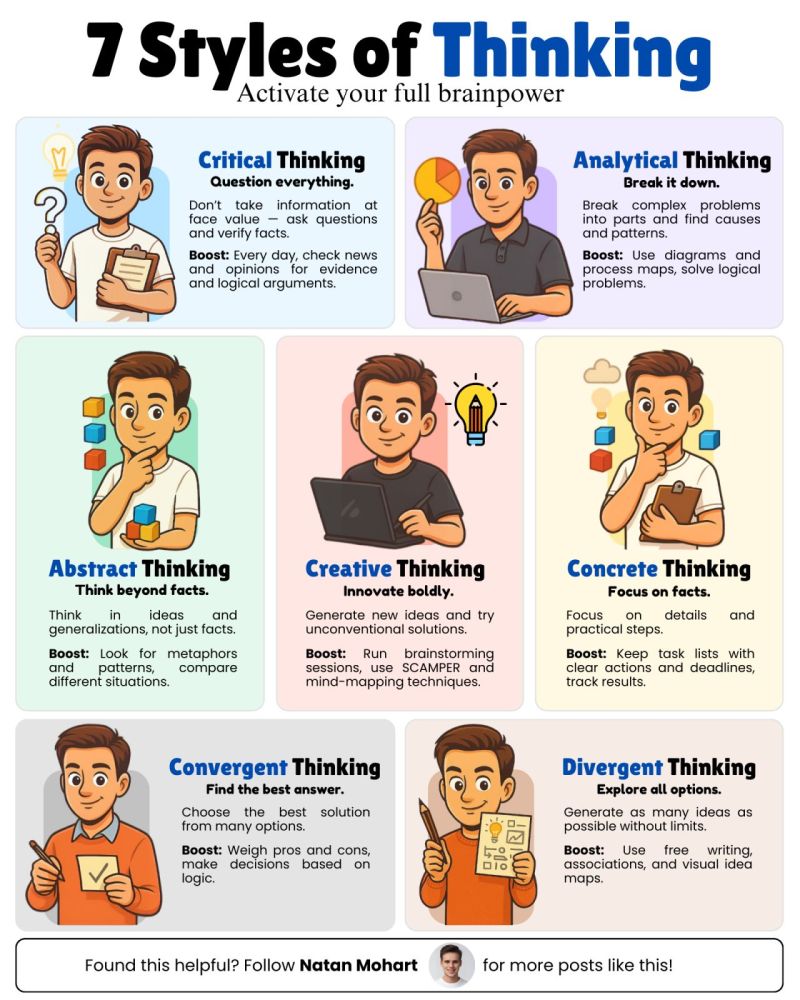
1. Critical Thinking
Don’t take words at face value. Break them down like a detective at a crime scene.
🚀𝗕𝗼𝗼𝘀𝘁: Fact-check news and opinions daily. Hunt for evidence and logical flaws.
2. Analytical Thinking
Break complex problems into parts. Spot causes and patterns.
🚀𝗕𝗼𝗼𝘀𝘁: Map processes, solve puzzles, visualize data.
3. Abstract Thinking
Look for big ideas and hidden connections behind the details.
🚀𝗕𝗼𝗼𝘀𝘁: Use metaphors and analogies. Spot surprising parallels.
4. Creative Thinking
Generate wild ideas without self-censoring.
🚀𝗕𝗼𝗼𝘀𝘁: Brainstorm freely, try SCAMPER, mind maps, random associations.
5. Concrete Thinking
Focus on details and actions, not just theories.
🚀𝗕𝗼𝗼𝘀𝘁: Make task lists, set deadlines, track progress.
6. Convergent Thinking
Narrow options to the one that makes the most sense.
🚀𝗕𝗼𝗼𝘀𝘁: Compare pros and cons. Trust facts and logic.
7. Divergent Thinking
Generate tons of ideas, way beyond the obvious.
🚀𝗕𝗼𝗼𝘀𝘁: Free write, sketch ideas, don’t stop at the first thought.
💬 Imagine you could only keep 2 of these 7 thinking styles.
Which ones would you choose to survive in the world of ideas? 🤔
The Weight You Were Never Meant to Carry

Somewhere along the way, many of us quietly take on a role we were never officially given. Fixer. Stabilizer. The one who makes things better. If someone is struggling, you feel it’s your responsibility to step in. If something is broken, you instinctively reach for the tools. And if people around you are hurting, you carry that weight like it’s yours to hold.
It usually doesn’t come from ego. It comes from care. From empathy. From the belief that if you don’t help, things might fall apart. So you show up. You listen. You advise. You absorb. And over time, without realizing it, you start confusing compassion with obligation.
The problem is not that you want to help. That part is beautiful. The problem is the silent expectation you place on yourself to make everything okay for everyone. That’s a pressure no one is built to withstand. Not long term. Not without cost.
When you try to fix everything, you slowly disappear from your own life. Your needs get postponed. Your rest gets negotiated. Your emotions get minimized because someone else’s pain feels louder or more urgent. You tell yourself you’ll focus on yourself later, once things calm down, once people are okay, once the chaos settles. But there is always another fire. Another situation. Another person who needs you.
At some point, exhaustion creeps in. Not the kind sleep fixes, but the deeper kind. The kind that comes from constantly being emotionally “on.” From carrying responsibility that was never actually yours. From believing that if someone is unhappy, you somehow failed.
Here’s the truth we resist: you cannot save people from their own journeys. You can support them. Walk alongside them. Care deeply. But you cannot do the inner work for them. And trying to will only drain you and, ironically, help less than you think.
There is a difference between being helpful and being responsible for outcomes you don’t control. You don’t control how others heal. You don’t control their choices, their timing, or their willingness to change. You don’t control how life unfolds for them. Acting as if you do is not kindness; it’s self-erasure.
Setting that weight down doesn’t mean you stop caring. It means you start caring sustainably. It means recognizing the small circle of things that are actually in your control: your actions, your boundaries, your energy, your well-being. It means asking yourself a simple but uncomfortable question: what do I need right now, and why have I been ignoring it?
Sometimes what you need is rest without guilt. Sometimes it’s distance. Sometimes it’s saying, “I can’t hold this for you.” Sometimes it’s letting people experience the consequences that lead to their growth. None of that makes you selfish. It makes you honest.
There is a quiet strength in choosing not to carry what was never yours. In trusting that others are more resilient than you fear. In allowing yourself to be human instead of endlessly capable. When you focus on what you can truly control, you become steadier, clearer, and more present. Ironically, that’s when your support becomes most meaningful.
You don’t have to fix the world today. Or anyone in it. You’re allowed to pause. To breathe. To tend to your own life with the same care you so freely offer others. Set the weight down, even if just for a moment. You were never meant to carry it all.
Control Conflict
You don’t have to win the argument—
You just need to keep your peace:
Disrespect doesn’t need to escalate,
it needs to be handled clearly.
The goal isn’t to get the last word.
It’s to stay steady and stay in control.
Here’s how to respond when
respect breaks down:
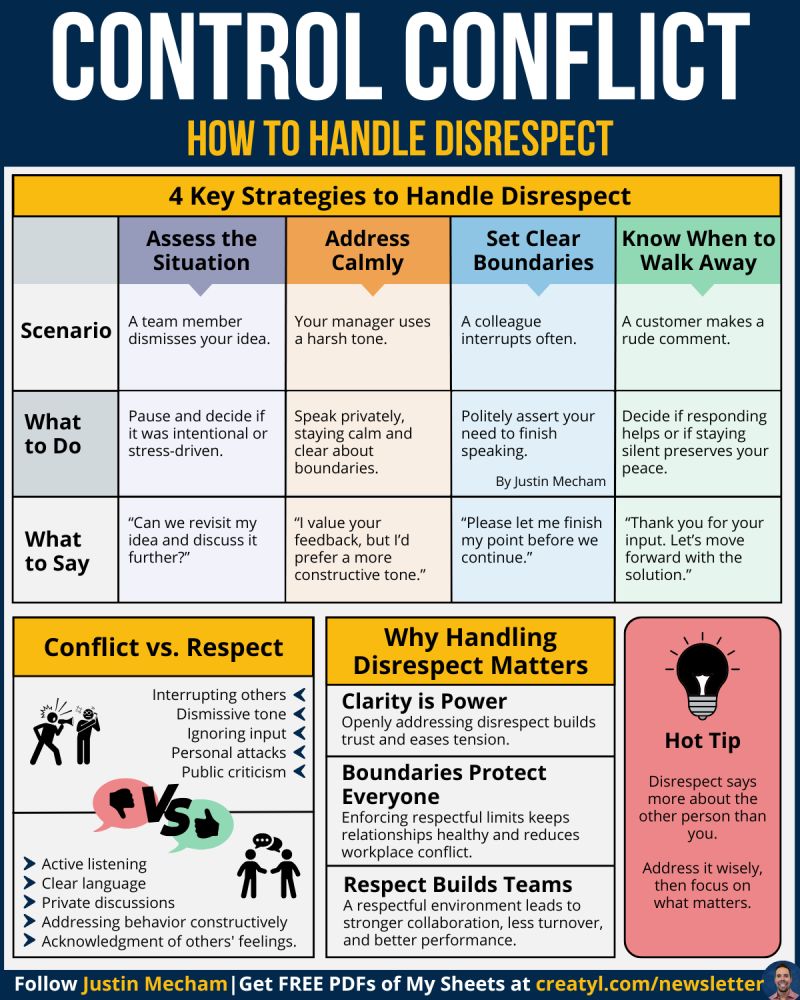
🟣 Assess the situation
Pause and ask: was it stress,
or was it personal?
🟠 Address calmly
Speak privately.
Keep it clear and steady.
🔵 Set boundaries
Let them know what you need to
continue respectfully.
🟢 Know when to walk away
Not every comment deserves
your energy.
Keep in mind:
⚠️Disrespect shows up as ignoring,
interrupting, or cutting down.
☑️Respect sounds like clarity, calm,
and follow-through.
People remember how you
react more than what you say.
Holding your ground doesn’t
mean raising your voice.
It means deciding who gets your energy—
And who doesn’t.
Say No Without Guilt
Turn uncomfortable no’s into power moves.
10 scripts for respect without confrontation:
Every day you face the choice…
Cave to pressure or protect your priorities.
But saying no doesn’t have to feel uncomfortable.
These scripts transform boundary-setting into your greatest strength:
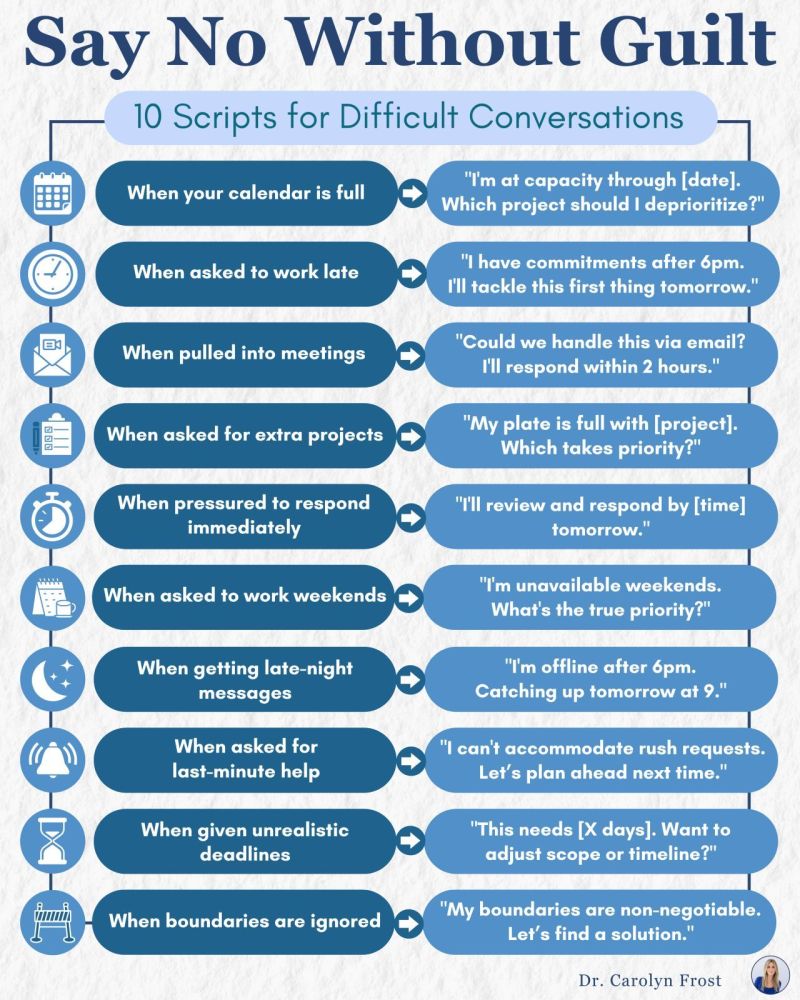
1. “I’m at capacity through [date]. Which project should I de-prioritize?”
↳ Puts the decision back where it belongs – no conflict needed
2. “Could we handle this via email? I’ll respond within 2 hours.”
↳ Maintains control while showing clear commitment
3. “My plate is full with [project]. Which takes priority?”
↳ Turns overwhelm into strategic conversation
4. “I have commitments after 6pm. I’ll tackle this first thing tomorrow.”
↳ Sets expectations without needing to explain
5. “I’ll review and respond by [time] tomorrow.”
↳ Creates space without creating tension
6. “I’m unavailable weekends. What’s the true priority?”
↳ Clear, professional, impossible to argue with
7. “I’m offline after 6pm. Catching up tomorrow at 9.”
↳ Simple boundaries that command respect
8. “I can’t accommodate rush requests. Let’s plan ahead next time.”
↳ Teaches others how to work with you effectively
9. “This needs [X days]. Want to adjust scope or timeline?”
↳ Offers solutions while holding firm
10. “My boundaries are non-negotiable. Let’s find a solution.”
↳ Your power move when everything else fails
Your time is valuable.
Your boundaries are non-negotiable.
Decisions Made Easy
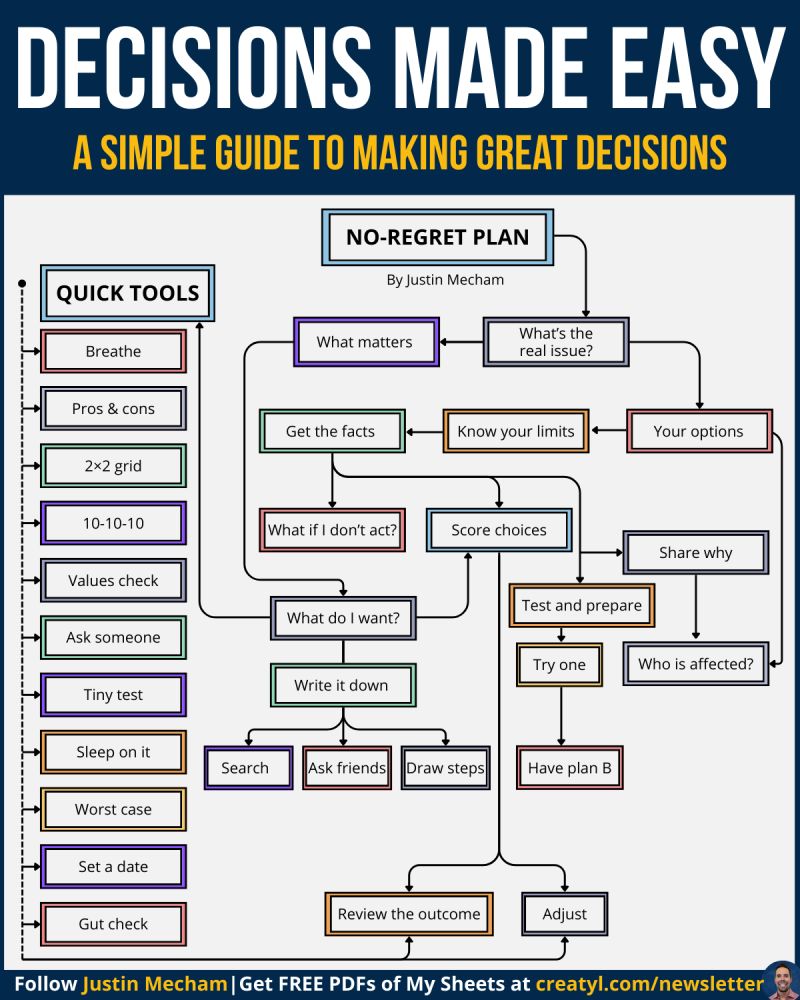
More options won’t save you—
But this will:
Most bad decisions don’t
come from lack of options—
They come from skipping the process.
A smart decision starts with clarity:
1️⃣ Pinpoint the real issue
2️⃣ Decide what matters most
3️⃣ Get the facts that actually matter
4️⃣ Know your limits before you choose
5️⃣ Map your options and what each could mean
Then stress-test your choice:
☑️ Use a quick pros & cons
☑️ Try the 10-10-10 rule
☑️ Run a tiny test before going all in
☑️ Imagine how to handle the worst case
☑️ Sleep on it before locking it in
The goal isn’t to overthink—
It’s to act with confidence
and avoid “what if” regret.
My sheet walks you through
the full step-by-step process.
Clarity is built, not found.
Issue → facts → limits → options → test.
Borrowed Time, Borrowed Worry
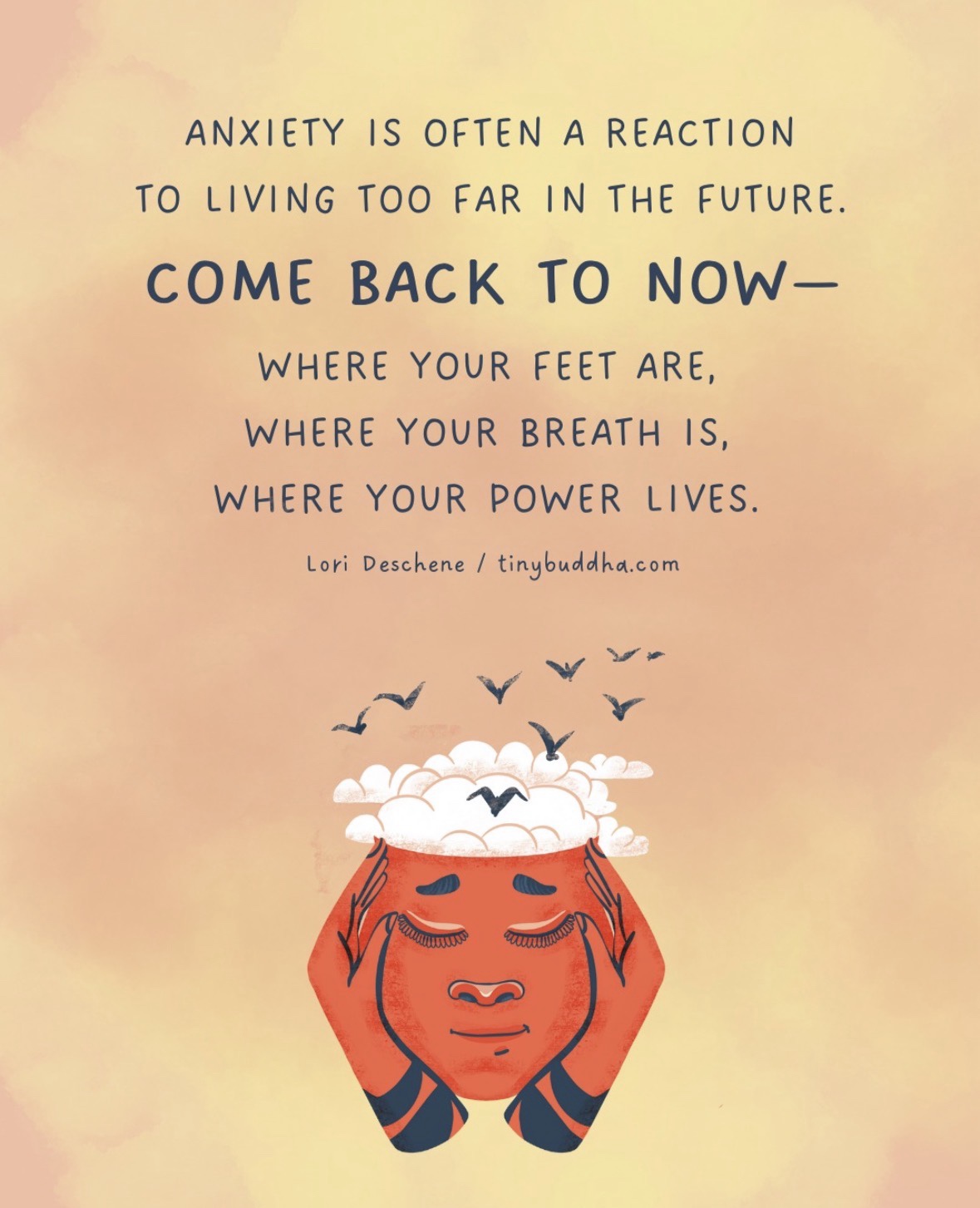
Anxiety has a funny way of convincing us that the future is already happening. Not next week. Not next year. Right now. It pulls tomorrow into today and asks us to carry it all at once—the conversations that haven’t happened, the mistakes that haven’t been made, the outcomes that haven’t arrived. And then we wonder why our chest feels tight, why our mind won’t slow down, why rest feels out of reach.
Most of the time, anxiety isn’t about what’s happening. It’s about what might happen. It’s the brain sprinting ahead, trying to protect us by predicting every possible scenario. Useful in small doses. Exhausting when it becomes a way of living.
The strange thing is this: the future has no weight on its own. We give it weight by dragging it into the present. We replay imagined failures as if they’re memories. We rehearse worst-case scenarios as if preparation alone can prevent pain. Somewhere along the way, “being responsible” turns into “being perpetually on edge.”
The present moment, on the other hand, is almost always quieter than we expect. Look around. Right now, your feet are likely on solid ground. Your breath is still showing up for you, without being asked. Your body is doing an incredible amount of work just to keep you here. This moment may not be perfect, but it’s usually survivable. Often, it’s even okay.
Coming back to now isn’t about pretending the future doesn’t matter. It does. Planning has its place. Dreams need direction. Responsibilities don’t disappear just because we take a breath. But there’s a difference between visiting the future and moving in.
When anxiety spikes, it’s often a signal that we’ve overstayed our welcome somewhere that doesn’t yet exist.
Power doesn’t live in ten different versions of tomorrow. It lives here. In what you can do next. In the choice to pause before reacting. In the ability to ground yourself in what’s real instead of what’s imagined. You don’t need to solve your entire life today. You just need to stay present for it.
There’s something deeply human about needing reminders like this. To unclench the jaw. To drop the shoulders. To notice the inhale, then the exhale. These small acts aren’t insignificant. They’re anchors. They pull us back from spirals and return us to solid ground.
The world often rewards urgency. Faster answers. Quicker decisions. Constant anticipation. But your nervous system doesn’t thrive there. It thrives in safety, rhythm, and now. When you meet the present moment fully, you’re not falling behind. You’re actually catching up—to yourself.
So if today feels heavy, ask yourself a gentle question: am I reacting to what’s happening, or to what I’m afraid might happen? If it’s the latter, that’s your cue to come home. Back to your breath. Back to your body. Back to the only place where you can actually do something.
The future will arrive when it’s ready. It always does. Until then, this moment is enough. This breath is enough. And you, right here, are more capable than your anxious thoughts would have you believe.
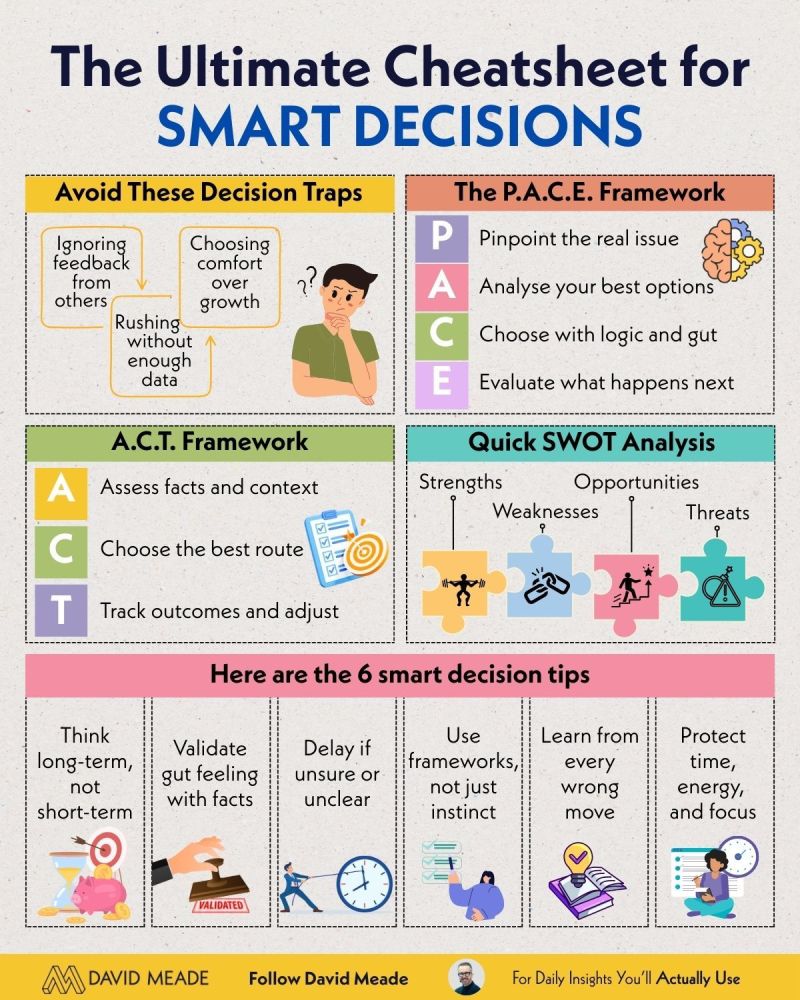
Smart Decisions
There are a lot of habits I’m working on improving.
Better sleep.
Better food.
Better fitness.
But above all else, it is better decision-making.
In my keynotes, I remind clients that decisions are the “oxygen of high-performing teams”.
When decisions slow down, businesses slow. Some die.
Decide to improve your choices today.
Start here:
1: Pinpoint the real issue
↳ Cut through the noise and identify what truly matters.
↳ Ask “What problem am I actually trying to solve?”
2: Analyse your best options
↳ Consider alternatives beyond the obvious choices.
↳ Use a quick SWOT for each option
3: Choose with logic and gut
↳ Balance data-driven thinking with intuition.
↳ Validate your gut feeling with facts before deciding.
4: Evaluate what happens next
↳ Consider the long-term implications, not just immediate results.
↳ Ask “What’s the second-order consequence of this choice?”
Avoid These Decision Traps:
Ignoring feedback from others
↳ Seek diverse perspectives to challenge your thinking.
↳ The best decisions rarely happen in isolation.
Choosing comfort over growth
↳ The right decision isn’t always the easy one.
↳ Growth happens at the edge of your comfort zone.
Rushing without enough data
↳ Delay if you’re unsure or the picture is unclear.
↳ But remember: perfect information rarely exists.
Follow these golden rules:
Think long-term, not short-term
↳ Most regrets come from short-sighted choices.
Use frameworks, not just instinct
↳ Systematic thinking beats random guesswork.
Learn from every wrong move
↳ Failed decisions are only failures if you don’t learn from them.
Protect your time, energy, and focus
↳ These are your most valuable resources for making good choices.
What’s your best decision-making tip?
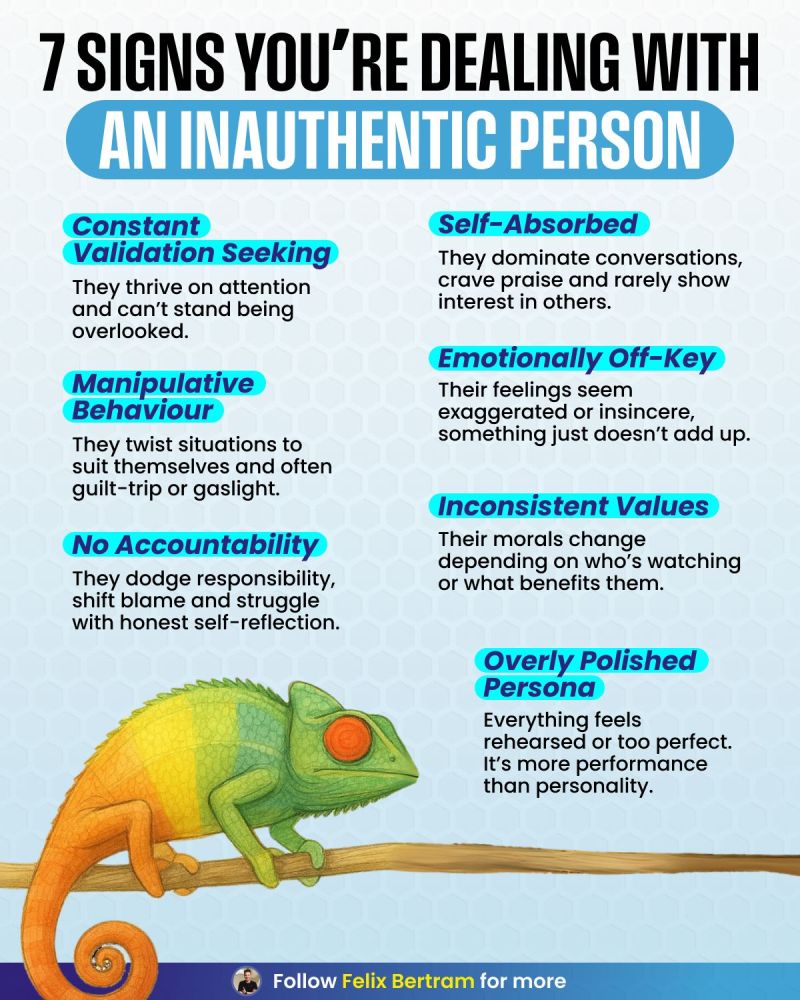
7 Signs You’re Dealing With An Inauthentic Person
Growth filters out fake people.
Their mask slips the moment you rise.
Credits to Felix Bertram, make sure to follow!
_____
People around you will always praise your success.
The problem is, there are very few who mean it.
For them, your achievements feel like a threat.
And if you don’t catch it quickly,
they’ll do what it takes to keep you small.
It’s not always obvious when someone is fake.
But here are 7 signs to look out for:
1. Self-absorbed
↳ They control every conversation they’re in.
↳ They crave praise but show little interest in you.
2. Emotionally off-key
↳ Their feelings are exaggerated or insincere.
↳ Something feels off whenever they speak.
3. No accountability
↳ They dodge responsibility.
↳ Honest self-reflection is a struggle for them.
4. Constant validation seeking
↳ They thrive on attention.
↳ They struggle when someone else is in the spotlight.
5. Manipulative behaviour
↳ They twist situations to suit themselves.
↳ Often they’ll guilt-trip or gaslight you.
6. Inconsistent values
↳ Their morals change depending on who they’re with.
↳ Or they’ll change if it benefits them.
7. Overly polished persona
↳ Everything feels rehearsed or too perfect.
↳ Their interactions feel like a performance.
Spotting these signs is the start.
But when all else fails, trust your instincts.
You know best whenever something feels off.
Which one of these signs do you notice quickest?
 Kenrick Vaz