The Strongest People

We grow up thinking strength is about holding everything together with steady hands and a stiff spine. We’re taught that the toughest people are the ones who never crack, never cry, never let their knees hit the ground. But life has a way of rewiring that definition. It breaks through the armor in the places we swore were unshakeable, and suddenly strength starts looking a lot more like surrender than control.

There are moments when the weight gets so heavy you have no choice but to fall. And maybe that’s the point. Falling isn’t failure; it’s the door that finally opens when stubbornness exhausts itself. There’s something sacred about the moment you let your knees touch the floor—not in defeat, but in release. It’s the space where pride steps aside and Heaven steps in, quietly catching the tears you couldn’t hold back anymore.

People don’t rise because they’ve mastered the art of being unbroken. They rise because mercy meets them where everything fell apart. They rise because grace knows how to gather ashes and turn them into something that can stand again. And every time they get back up, it’s not because they’ve toughened up—it’s because they’ve learned who truly carries them.

Real strength has never been about pretending you’re okay. It’s about knowing exactly where to run when you’re not. It’s about trusting that the One who shaped your heart knows how to mend it. It’s about understanding that resilience isn’t built in silence and self-reliance, but in the courage to collapse into divine hands that don’t condemn weakness—they dignify it.

So if you’re kneeling today, don’t mistake it for a setback. Sometimes the ground is exactly where renewal begins. Sometimes the bravest thing you can do is fall, cry, breathe, and let Heaven lift you again. Strength is not the absence of breaking. It’s the miracle that happens after.
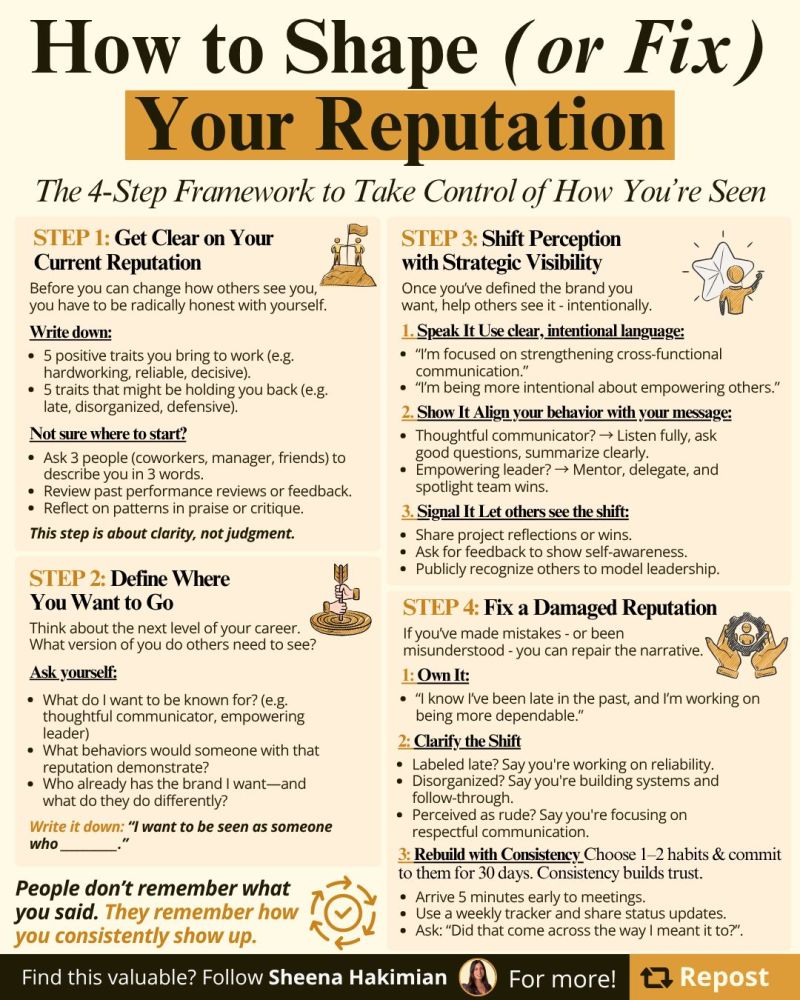
How to Fix your Reputation

The #1 reason people get overlooked at work?

Their reputation doesn’t match their potential.

Early in my career, I was shy.
I had ideas, but I rarely spoke up.

I assumed my work would speak for itself.
It didn’t.

I wasn’t seen as strategic or leadership-ready.
Not because I wasn’t capable, but because I wasn’t visible.

That’s when I realized: Your reputation is your personal brand.
And if you don’t shape it, someone else will.

Here’s the exact 4-step process I used to shape my reputation:

1️⃣ Get clear on your current reputation
↳ Write down 5 of your positive and negative traits. Be radically honest.
↳ Ask 3 people to describe you in 3 words.

2️⃣ Define where you want to go
↳ What do you want to be known for? (Thoughtful communicator? Empowering leader?)
↳ And what does that version of you do differently?

3️⃣ Shift others’ perceptions strategically
↳ Say it → “I’m being more intentional about cross-functional leadership.”
↳ Show it → Coach, actively listen, do what you say you are going to do.

4️⃣ Fix what needs to be repaired
↳ Always late? Unreliable? Defensive?
↳ Own it. Say what you’re working on. Be consistent.

Reputations aren’t set in stone.
They’re shaped by how you consistently show up.

What’s one trait you want to be known for this year? Let me know in the comments! (I want to be known as a great storyteller!).

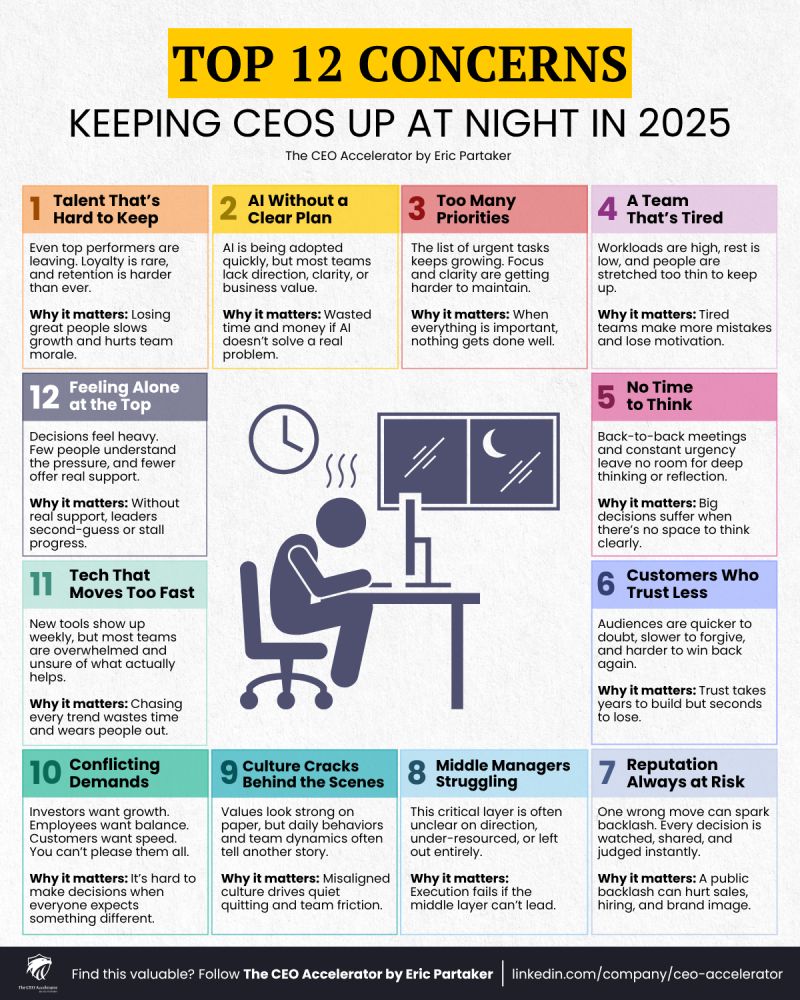
12 challenges every CEO faces in 2025

(And how to turn them into opportunities)

1. Talent That’s Hard to Keep
↳ Top performers have more options than ever
↳ Build a culture worth staying for

2. AI Without a Clear Plan
↳ Teams need clarity on AI’s role and value
↳ Start small, measure impact, scale smart

3. Too Many Priorities
↳ Focus diluted across competing initiatives
↳ Master the art of strategic saying “no”

4. A Team That’s Tired
↳ High workloads affecting performance
↳ Rest isn’t weakness—it’s strategic fuel

5. No Time to Think
↳ Reactive mode replacing strategic planning
↳ Block thinking time like you block meetings

6. Customers Who Trust Less
↳ Higher expectations, lower patience
↳ Transparency and consistency rebuild trust

7. Reputation Always at Risk
↳ Every decision under public scrutiny
↳ Lead with values, communicate with clarity

8. Middle Managers Struggling
↳ Caught between strategy and execution
↳ Invest in their growth—they’re your multipliers

9. Culture Cracks Behind the Scenes
↳ Misalignment between values and behaviors
↳ Address issues early, model what matters

10. Conflicting Demands
↳ Stakeholders pulling in different directions
↳ Find the win-wins, communicate trade-offs

11. Tech That Moves Too Fast
↳ Pressure to adopt every new solution
↳ Choose tools that solve real problems

12. Feeling Alone at the Top
↳ The weight of leadership can isolate
↳ Build your support network—peers get it

Great companies aren’t built by avoiding challenges.
They’re built by facing them head-on.

Where does your company stand?
🟢 0-3: Strong foundation, keep building
🟡 4-6: Time to strengthen weak spots
🟠 7-9: Major adjustments needed now
🔴 10-12: Full transformation required

The truth?
Every successful CEO has faced most of these.

The difference is what you do next.

Which challenges resonate most with you?

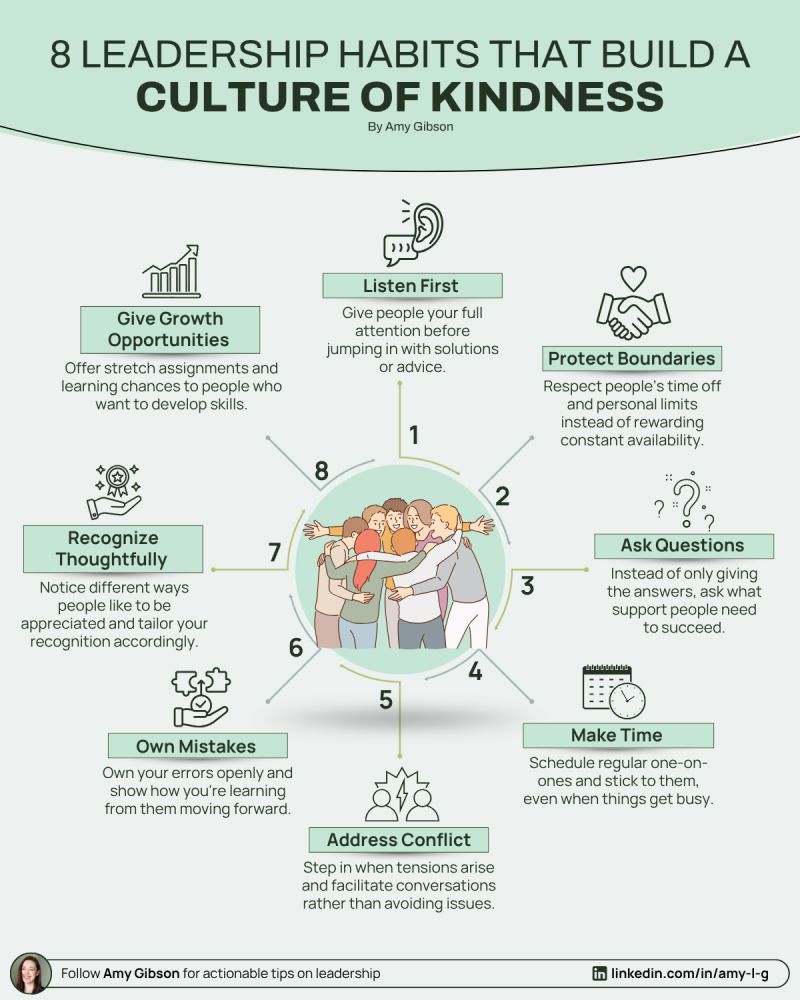
8 Leadership Habits That Build A Culture Of Kindness

The best leaders I know share one thing in common:

They’ve recognized that kindness isn’t “soft”.

It’s the strongest kind of leadership.

Because culture isn’t built in meetings.
It’s built in moments.

Those small interactions that happen between
the big decisions.

The way you respond when someone
makes a mistake.

How you handle conflict when tensions rise.

Whether you really listen or just wait for your turn to talk.

Here are 8 habits that build a culture of kindness
at work:

✦ Listen first, solve second
✦ Protect boundaries instead of rewarding burnout
✦ Ask questions rather than giving all the answers
✦ Make time for people, even when you’re busy
✦ Address conflict instead of hoping it goes away
✦ Own your mistakes openly and learn from them
✦ Recognize people in ways that matter to them
✦ Give growth opportunities to those who want them

None of these require budget approval or a new policy.

They just require intention.

Because people may forget the decisions you made.

But they’ll never forget how you made them feel.

And that’s the real power of leading with kindness.

When the Mind Gets Loud

There’s a moment we all hit—a point where the noise in our own head gets so intense that we start believing it’s who we are. Every doubtful whisper, every replayed mistake, every imagined disaster becomes this giant monologue dictating how we feel, how we act, how we show up. And somewhere along the way, we start thinking the only way to be okay is to “fix” every thought that passes through. But that’s not how the mind works. And honestly, that’s not how peace works either.

You don’t have to control your thoughts. You just have to stop letting them run the entire show.

Thoughts are like weather: constantly shifting, rarely predictable, often dramatic, and completely incapable of staying still. Some days your head is a clear sky. Other days it’s a tornado. And neither state says anything about your worth or your direction. It just means you’re human. Your brain is doing what brains do—throwing ideas, fears, jokes, memories, and anxieties at you like one of those T-shirt cannons at a basketball game.

The trick is realizing you don’t need to catch everything it fires.

Most of our mental stress isn’t from the thought itself—it’s from the meaning we attach to it. A worry pops up, and instead of letting it float by, we wrestle with it. We analyze it. We catastrophize it. We give it power simply because it appeared. But a thought is just a thought until you give it a throne. And when you stop handing it the crown, something shifts. You start remembering that you’re not the storm—you’re the sky holding it.

You can let a thought pass without arguing with it.

You can feel anxious without assuming danger.

You can hear the old “you’re not enough” tape and not treat it like truth.

This isn’t suppression. It’s awareness. It’s the quiet confidence of knowing that not every internal voice deserves a microphone. Some can stay in the back row where they belong.

And once you stop trying to control every thought, something unexpected happens: the mind softens. The volume lowers. The grip loosens. You create just enough space between you and the noise to breathe again. You start walking through your day with a little more steadiness. You begin to trust that a passing thought doesn’t have the power to ruin the moment unless you hand it that authority.

Maybe that’s the real win—not forcing yourself to think “better,” but giving yourself permission to stop being bullied by whatever pops into your head.

You don’t need to be the perfect thinker. You just need to be the one in charge of the remote.

Turn Skills To Cash

People pay for clarity—

Not perfection:

Most skills don’t need reinvention.

They just need a better way to start.

The PLAN Model:
Helps you spot what people actually want to buy.

The SALE Test:
Helps you check demand—before you build.

Here’s how it works:

PLAN to find what sells:
🟥 Pick one clear problem
🟦 Listen for repeat complaints
🟨 Arrange a few fast solutions
🟩 Narrow it down to what people want now

SALE to test if it’s worth building:
🟨 Share a rough version
🟥 Ask if they’d pay
🟩 Look how they react
🟦 Expand if they say yes

There’s more inside the full sheet—

Like how to run a quick VALUE
check before launch.

Make something real—

But test it first before you
waste time building the wrong thing.

Test smart.

Move fast.

Turn your skills into something
people will pay for.

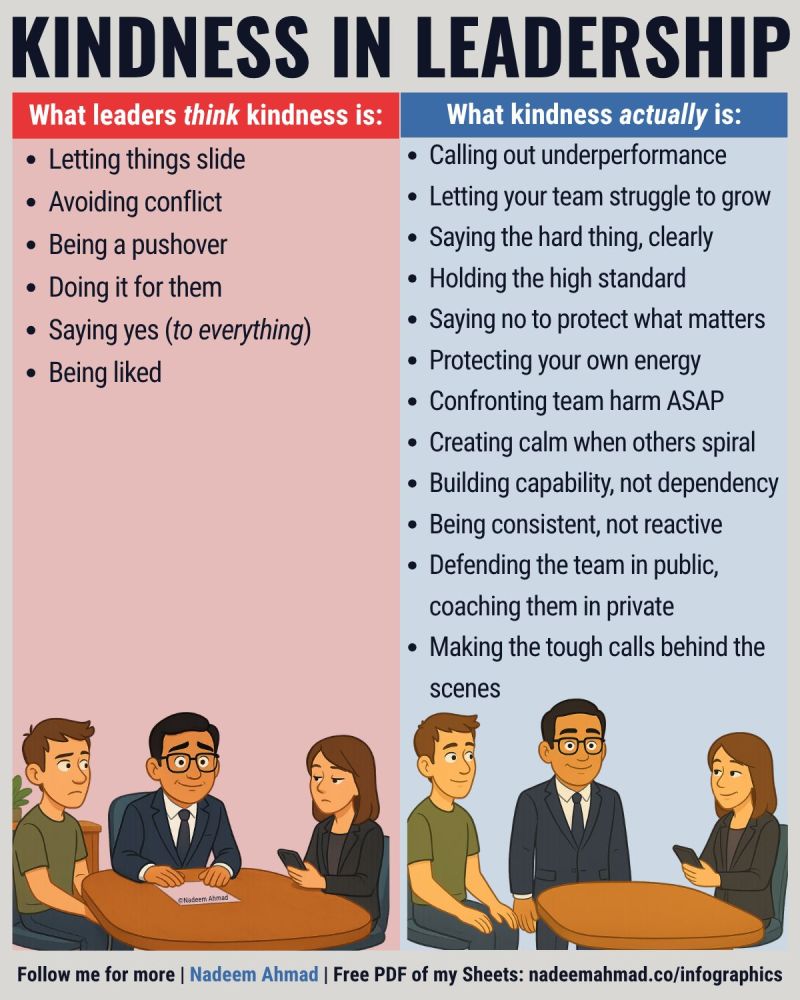
Kindness in Leadership

Kindness in leadership often gets misunderstood.

Especially when it’s done right.

You’re told:

“Just be a kind leader.”

Like that’s obvious. Or that simple.

🙄 🙄 🙄

What no one tells you is:

Kindness hurts sometimes.

Because people don’t see what it actually feels like to:

❌ Give honest feedback and watch their face fall
❌ Say no when everyone wants yes
❌ Hold someone accountable and then carry the weight of it afterward

They don’t see the guilt that hits after a tough conversation.

Or the loneliness that comes with doing what’s right instead of what’s easy.

🤔 Or the pressure of protecting the mission 𝘢𝘯𝘥 your people at the same time.

They don’t feel the tension of caring deeply…and still saying, “This job wasn’t done right.”

But here’s the reality:

Kindness in leadership isn’t about being soft.
It’s about staying 𝘀𝗼𝗹𝗶𝗱.

It doesn’t mean you have to be too nice.
But you do have to be very clear.

Because real kindness is:
→ Giving people truth instead of comfort
→ Saying no to protect what matters most
→ Holding the standard when it would be easier not to

🧨 The Hard Truth:
Kindness in leadership isn’t about how you feel.
It’s about what your team becomes because of you.

Being kind will cost you comfort.
But it will earn you trust.

❓What’s the hardest part of leading with kindness?

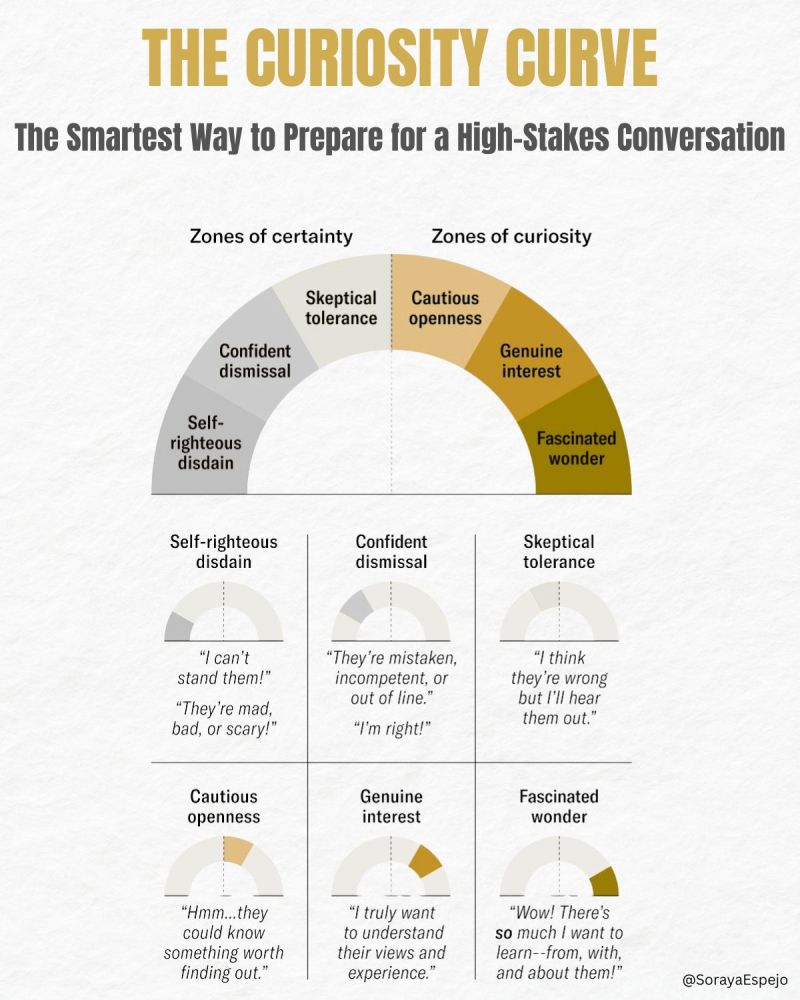
The Curiosity Curve

Most leaders enter tough conversations armed with talking points.
The best ones enter with curiosity.

That small shift?
It changes everything.


👉 Harvard Business Review says the real power in high-stakes dialogue isn’t about persuasion — it’s about inquiry.


✅ That’s where the “Curiosity Check” comes in.
Before your next tough conversation, take 3 minutes and ask:

1️⃣ Am I open to discovering something new?
2️⃣ What assumptions might I be wrong about?
3️⃣ What question could create mutual learning?


💡 When leaders swap control for curiosity, here’s what happens:
• Stronger alignment
• Smarter decisions
• Shared outcomes that actually stick


🎯 Your edge isn’t your script —
It’s your capacity to listen, explore, and adapt.

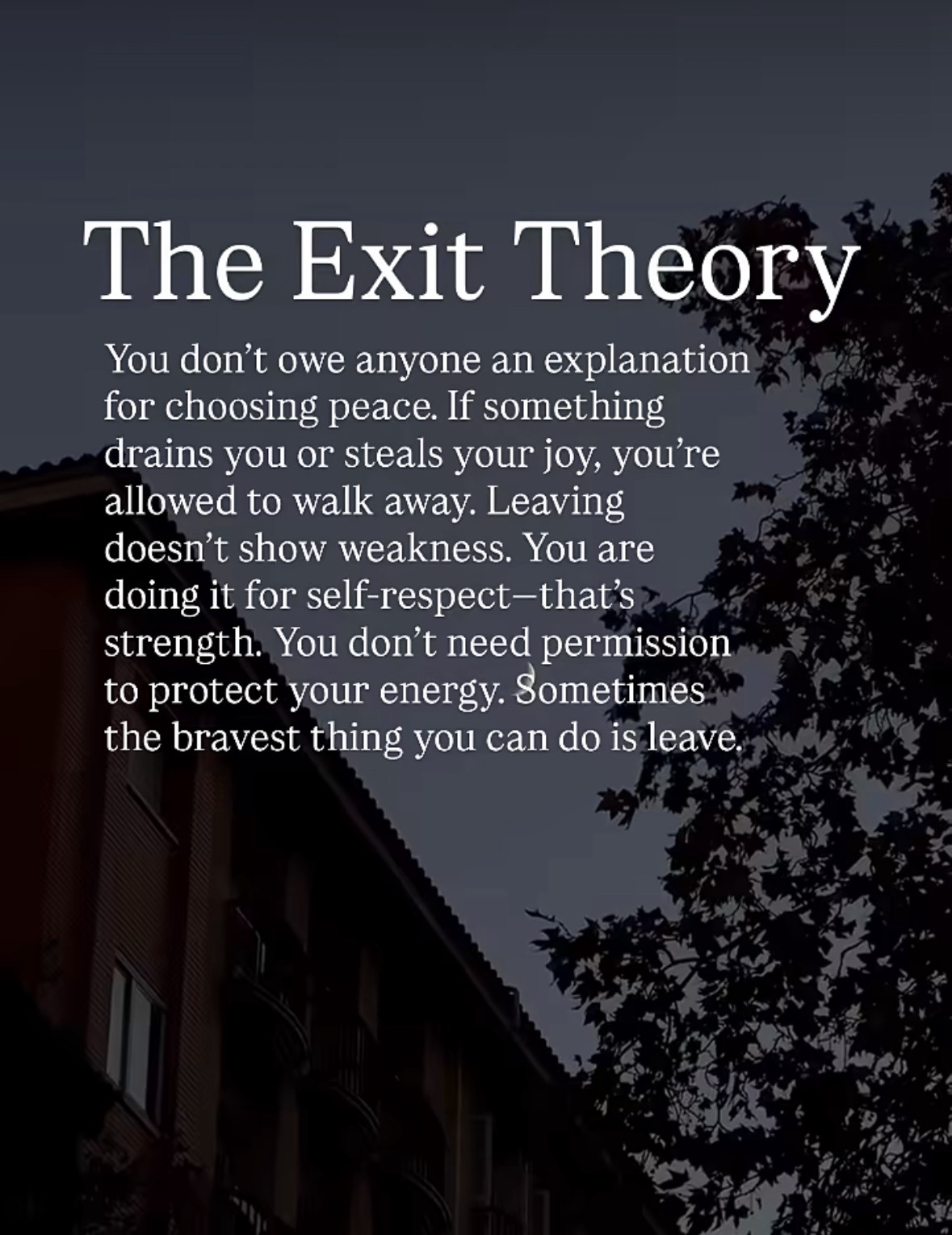
The Exit Theory

There’s a strange pressure we put on ourselves to stay—stay in conversations that leave us uneasy, stay in situations where we feel small, stay in rhythms that drain us even when we know better. Maybe it’s habit. Maybe it’s guilt. Maybe it’s that quiet fear that someone will ask, “Why are you leaving?” and we won’t have a tidy answer ready.

But here’s the truth most people learn the hard way: you don’t owe anyone an explanation for choosing peace. Not a paragraph, not a speech, not even a sentence. Peace doesn’t need justification. It’s a direction, not a debate.

There comes a point when something that once fit you starts to feel heavy. A friendship that used to lift you now feels like work. A workplace that once excited you now takes more than it gives. A routine you relied on starts to chip away at your joy. And the moment you feel that shift—even if it’s subtle—that’s your internal compass nudging you toward the exit.

Walking away has been painted as quitting, as giving up, as not trying hard enough. But leaving can also be the most powerful act of self-respect. It takes strength to say, “I’m done explaining why this hurts me.” It takes clarity to say, “My peace matters more than keeping this going.” It takes courage to step into the unknown when staying would be so much easier.

Because staying is familiar. But familiar doesn’t mean right.

The Exit Theory is simple: if it drains you, dims you, or makes you betray yourself, you’re allowed to leave. Full stop. You don’t need permission. You don’t need validation. You don’t need to wait until you’re exhausted or broken or resentful. You can choose yourself long before the breaking point.

Sometimes you walk away quietly, without drama. Sometimes you walk away shaking, unsure but determined. Sometimes you walk away after giving too many chances. And sometimes you walk away the very moment you realize your joy has been shrinking to fit a space that was never meant for you.

Leaving isn’t weakness. It’s wisdom. It’s the awareness that your energy is finite and precious. It’s understanding that peace isn’t something you stumble upon—it’s something you protect. And sometimes the bravest thing you’ll ever do is close the door on something that no longer honors who you are becoming.

So if you’re standing at the threshold, hand on the handle, heart uncertain but hopeful, remember this: exits aren’t failures. They’re openings. They’re the first step toward the life that fits you better. And you’re allowed to take that step—without apology, without explanation, without guilt.

Just take it. Your peace will meet you on the other side.

Quiet People Are Powerful

You’re overlooking your most powerful people –

The quiet ones:

It’s time to rethink what strengths they have.

Quiet people bring:

🔹 Listening that drives action
🔹 Humble leadership
🔹 Critical thinking
🔹 Deep focus
🔹 Mindful decisions
🔹 Calm under pressure
🔹 Innovation through reflection

And still—

They’re often misunderstood or overlooked.

Here’s what most people miss:

Quiet people aren’t disengaged.
They’re processing, observing, and solving.

Here’s what they need to thrive:

✅ Small meetings
✅ Flexible work options
✅ Trust in their autonomy
✅ Opportunities that match their strengths
✅ Written communication
✅ Clear expectations
✅ Quiet spaces

Quiet isn’t something to fix.

It’s something to:
recognize, value, and support.

Because the best teams aren’t the loudest.

They’re the ones who make space
for every voice to lead.

And sometimes—

The quietest voice in the room
is the one carrying the breakthrough.

It just needs a little room to speak.

And someone wise enough to listen.