
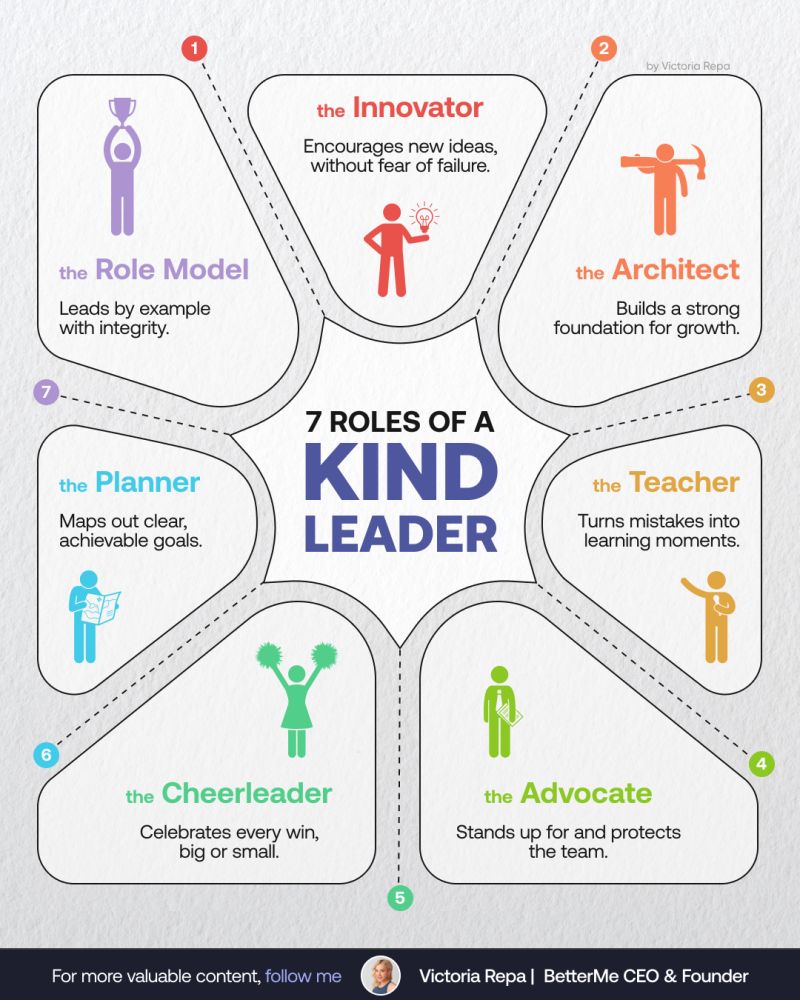
A kind leader is one who wears many hats.
Not just the “be nice” hat.
Here are 7 essential roles that define their positive impact on a team:
1/ The Planner
↳ They map out clear, achievable goals, ensuring the team knows the direction and destination.
2/ The Architect
↳ They build a strong foundation for growth, creating an environment where everyone can thrive.
3/ The Advocate
↳ They stand up for their team, protecting them and ensuring they feel valued and heard.
4/ The Teacher
↳ They see mistakes not as failures but as opportunities to grow and learn together.
5/ The Cheerleader
↳ They celebrate every win (big or small) because every step forward matters.
6/ The Innovator
↳ They foster a culture of creativity, encouraging bold ideas without fear of failure.
7/ The Role Model
↳ They lead by example, inspiring their team by practicing what they preach.
Kindness isn’t just a “soft” skill.
It’s a powerful leadership tool that creates a thriving workplace culture.
A truly kind leader carries kindness into every role they play.
If you’ve found a leader like this,
you’ve found someone worth following.
The OGSTM Framework

90% of strategies fail.
Here’s how to fix that:
One of the biggest problems is execution.
But before you start, you need to know what to execute.
There is a great tool that can help with this:
The OGSTM Framework.
OGSTM is a comprehensive strategy model that:
Helps transform vision and purpose into executable results.
It starts with 2 overarching aspects:
Vision & Purpose.
A) Vision is the inspiring future state your organization aspires to create.
B) Purpose is the fundamental reason your organization exists beyond making profit.
Then there are 4 critical components of success:
1. Strategies
Have clear strategies defined at all company levels.
Shape long-term direction aligned with vision.
Make right strategic choices driven by data.
2. Goals
Set SMART goals supporting strategy:
Specific, Measurable, Attainable, Relevant, Time-bound
Create aligned objectives based on your vision.
3. Tactics
Assign actionable steps.
Create stakeholder accountability.
Break down strategies into practical actions.
4. Measures
Select and track relevant KPIs.
Ensure continuous improvement.
Maintain strategic alignment.
Take advantage of this concept:
Ensure that your strategy becomes a success!
P.S. What is your strategic approach?
The Curiosity Theory

Maybe the goal was never to be endlessly happy. Maybe that was never the finish line. Happiness comes and goes like weather — warm one minute, overcast the next. Trying to hold onto it forever is like trying to keep sunlight in your hands. It slips through no matter how tightly you try to grasp it.
But curiosity? That’s something different. Curiosity isn’t a state you chase — it’s a way you move through the world. It’s lighter, freer, less demanding. It doesn’t insist that everything be perfect. It just asks you to stay open.
There’s something beautifully human about looking at your own life and thinking, “Huh… how strange that I’m here.” Strange that you exist at all. Strange that out of all the timelines and all the possibilities, you ended up in this exact moment reading these exact words, with your own soundtrack of thoughts playing quietly in the background.
Maybe the real magic is in noticing that. In paying attention to the tiny details that usually slip past — the way someone laughs when they’re truly amused, the way your coffee smells on a sleepy morning, the sky changing shades no matter how busy your day gets. Curiosity turns ordinary moments into reminders that you’re alive, breathing, present. It’s less about the pursuit of joy and more about the act of seeing.
You don’t have to be happy all the time to live a meaningful life. You just have to stay awake to it. Keep asking questions, even the small ones. Keep wondering why something moved you. Keep being surprised that you get another chance every day to discover something new, even if it’s just a slightly better version of yourself.
Life doesn’t need to be perfect to be interesting. It just needs your attention sometimes. A little openness. A little wonder. A little curiosity about what might happen if you take one more step, or try one more time, or simply breathe and look around.
So maybe the goal isn’t endless happiness. Maybe the goal is to stay curious — to keep noticing, keep learning, keep being amazed that in a universe this vast, you get to be here at all.
How To Delegate

The top leaders delegate, here’s how they do it:
Here are 6 proven techniques to master the art of delegation.
Delegation isn’t about offloading work; it’s about amplifying your effectiveness.
Let’s uncover powerful ways to delegate effectively:
Not sure who to delegate to?
➟ Use the Skill-Will Matrix.
➟ Match tasks with team members based on their skill levels and motivation.
Overwhelmed by micromanaging?
➟ Adopt the RACI Framework.
➟ Clearly define roles and responsibilities to streamline delegation.
Worried about losing control?
➟ Implement Check-in Meetings.
➟ Schedule regular updates to stay informed without micromanaging.
Confused about what to delegate?
➟ Apply the Decision Matrix.
➟ Categorize tasks by importance and urgency to decide what to delegate.
Need to ensure accountability?
➟ Use SMART Goals.
➟ Set specific, measurable, achievable, relevant, and time-bound goals for delegated tasks.
Want to maintain high standards?
➟ Establish Clear Guidelines.
➟ Provide detailed instructions and expected outcomes to ensure quality.
Remember,
Mastering delegation empowers your team and frees up your time for strategic thinking.
“Great things in business are never done by one person. They’re done by a team of people.”
— Steve Jobs”
Introverted leaders can be quiet,but their impact is loud

Many think leadership is all about being outgoing.
That’s far from the truth.
Introverts can make powerful leaders.
Yet, there are still myths surrounding them.
Myths such as:
1. ‘Introverts can’t lead.’
↳ Reality: Some of the world’s best leaders are introverts.
2. ‘Introverts lack social skills.’
↳ Reality: Introversion does not mean being shy.
3. ‘Introverts are indecisive.’
↳ Reality: You can be both thoughtful and decisive.
Just look around, and you’ll notice:
▸ The power of empathy.
▸ The power of silence.
▸ The power of calm.
Introverted leaders can become unstoppable.
It’s time to understand leadership comes in many forms.
And that, sometimes, is just quieter.
Master the Art of Feedback
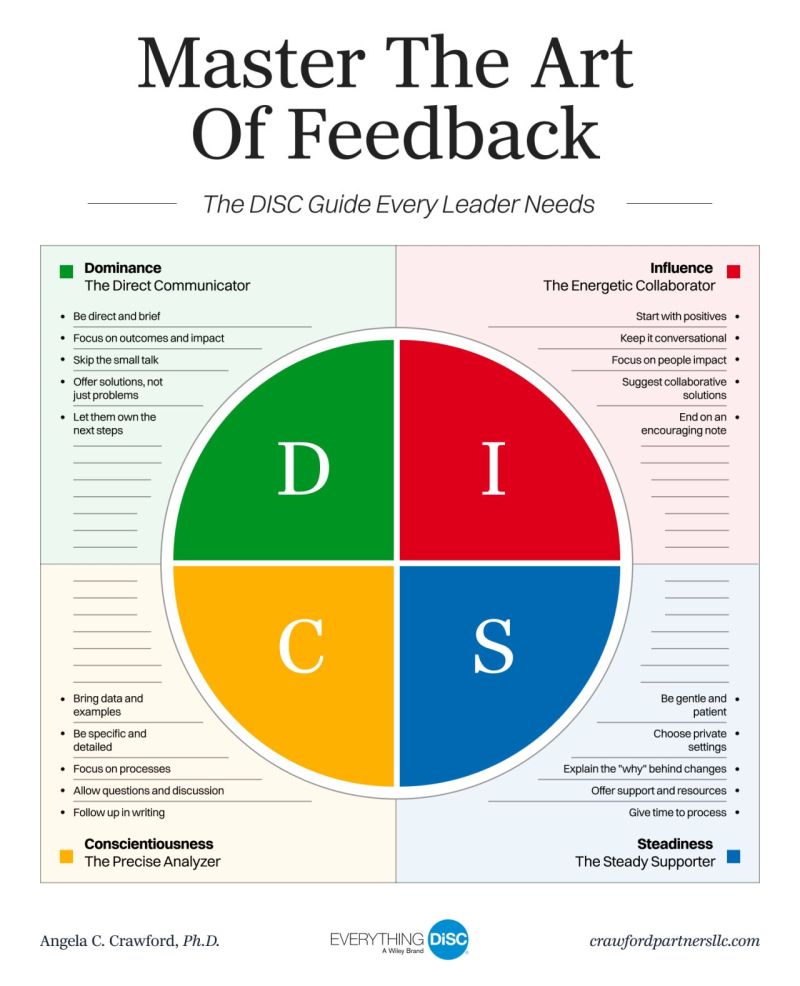
I’ve learned that personality type determines feedback success.
The DISC framework transforms how your message lands.
Here’s how to give feedback that drives real change:
For D (Dominance) personalities:
→ Cut to the chase – they hate fluff
→ Focus on business impact
→ Let them propose solutions
Result: They’ll take immediate action
For I (Influence) personalities:
→ Start with what’s working well
→ Keep the energy positive
→ Connect feedback to team success
Result: They’ll enthusiastically improve
For S (Steadiness) personalities:
→ Create a safe, private space
→ Explain how changes help the team
→ Offer ongoing support
Result: They’ll make lasting changes
For C (Conscientiousness) personalities:
→ Bring specific examples and data
→ Focus on process improvements
→ Give them time to analyze
Result: They’ll perfect the solution
The secret? Match your delivery to their style.
When leaders master this, team performance soars.
What’s your biggest challenge when giving feedback?
The GPS Theory – Recalculating Without Shame

It’s funny how the little things we use every day end up teaching us the biggest lessons. Take a GPS. You miss a turn, and what does it do? It doesn’t sigh dramatically, flash a warning, or play a disappointed “I told you so.” It just pauses for a second, thinks, and quietly offers you another route. No accusation, no drama — just the next best step from where you are right now.
If only we treated ourselves the same way.
Most of us carry this invisible scoreboard around, where every wrong turn feels like a failure stamped in permanent ink. Miss a deadline? Off track. Change a plan? Messed up. Slow down? Falling behind. It’s wild, because when you think about it, missing a turn has never stopped anyone from reaching the destination. All it does is change the journey a bit — maybe you end up taking a road you didn’t expect, maybe it adds a few minutes, maybe you even discover something along the way that you would’ve otherwise missed.
But the destination? It’s still there. Waiting.
The truth is, life rarely moves in a straight line. You’ll take detours you didn’t plan for and some you didn’t want. You’ll have moments where you’re sure you’ve gone too far off course to fix anything. You’ll rerun decisions in your head and wonder why you didn’t see the signs sooner. And yet, every single time, life hands you a quiet little prompt: “Recalculating.”
There’s something comforting about that. No matter how many wrong turns you take, there’s always another way forward. It may not be the shortest route, it may not be the smoothest, and it may not look anything like what you once imagined — but it will still move you closer to who you want to be.
We forget that progress isn’t measured by how perfectly we follow the original plan. It’s measured by how we keep going even when the path changes on us. Sometimes the real growth happens in the messy middle — the detours, the backtracking, the moments you have to stop to catch your breath and rethink your direction. Those aren’t signs of failure. They’re proof that you’re trying, that you care enough to pick a new route instead of giving up.
So the next time you miss a turn in your life — a plan that falls apart, a goal you didn’t hit, a version of yourself you’re struggling to live up to — remember your GPS. No judgment. No panic. Just an update: here’s where you are, and here’s the next step you can take.
Keep moving, keep choosing, keep adjusting. Your path may twist and change, but your destination hasn’t gone anywhere. And the beautiful part is, neither have you.
The Art of Influence
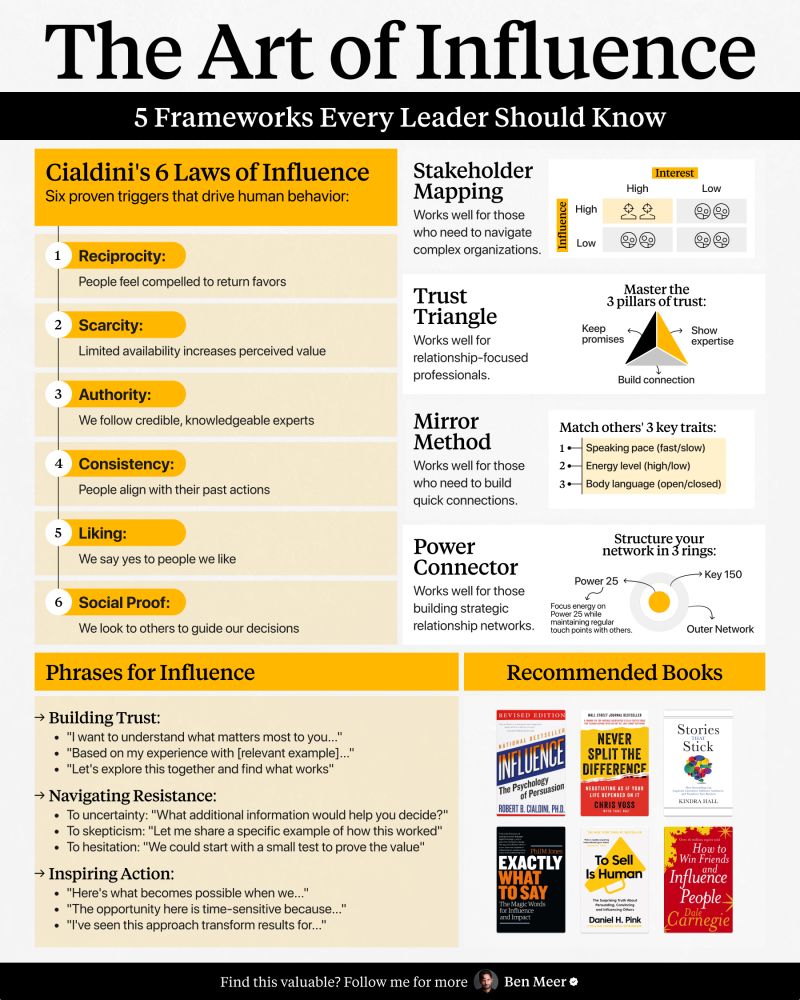
Real influence isn’t about pulling rank or demanding compliance.
It’s about:
• Understanding human psychology
• Building genuine connections that inspire action.
Here are 5 frameworks that separate truly influential leaders from the rest:
1. Cialdini’s 6 Laws of Influence: The foundation of ethical persuasion. Master reciprocity, scarcity, and authority to guide decisions without manipulation.
2. Stakeholder Mapping: Know your audience. High-interest, high-influence stakeholders get different treatment than low-interest ones.
3. Trust Triangle: The secret sauce of leadership. Keep promises, show expertise, and build genuine connections.
4. Power Connector Framework: “Your network is your net worth.” Structure relationships in strategic rings for maximum impact.
5. Mirror Method: Instant rapport builder. Match speaking pace, energy levels, and body language to create connection.
The best part? These aren’t manipulation tactics.
They’re systems for creating genuine value and building relationships that benefit everyone involved.
True influence comes from serving others, not controlling them.
Which technique resonates most with your leadership style?
8 Costly Leadership Mistakes

The good news? Your company is growing.
The challenge? Your team is growing.
Here are 8 common growth challenges
and how great leaders handle them:
1. Scaling your team without solid systems
↳ As teams get bigger, the old ways of working
often don’t work anymore
✅ Solution:
Review your systems, remove what’s no longer working,
and create new, simple guidelines for the team
2. Hiring people without culture alignment
↳ Skills can be taught. Values can’t.
↳ One toxic hire can poison your entire team
✅ Solution: Hire for values first, skills second
3. Lacking clear roles in the team
↳ Confusion leads to frustration and more mistakes
✅ Solution:
Define responsibilities early and update them often
4. Micromanaging your team
↳ You hired them for a reason. Trust them to do their job
✅ Solution: Set expectations, then step back
5. Burning out your top performers
↳ Even your best people have limits.
Protect them from burnout.
✅ Solution: Distribute the workload across the team
6. Lacking clear communication channels
↳ Information gaps lead to assumptions, and mistakes
✅ Solution: Establish open feedback channels
7. Avoiding hard conversations
↳ Small issues grow into bigger problems over time
✅ Solution: Address issues early. Be kind but clear
8. Neglecting your team’s development
↳ Growth isn’t just about hitting targets,
it’s about learning together.
✅ Solution: Invest in your people. They’re your future
Look at your team right now:
Which of these mistakes feels familiar?
Which one needs your attention first?
The sooner you spot them, the sooner you can fix them.
Remember:
Your company’s growth isn’t just about getting bigger.
It’s about getting better.
Cycle of Critical Thinking

Most people believe they’re great thinkers.
(But studies show only 1 in 10 actually are.
Critical thinking isn’t about being smart.
It’s about using a smarter process.
So what is critical thinking?
It’s how you:
➟ Examine information from all angles
➟ Question what you read and hear
➟ Find the truth (not just any answer)
Why does it matter?
Because poor thinking leads to poor decisions.
And poor decisions lead to poor results.
Use this 5-stage cycle to build stronger thinking:
1. GATHER EVIDENCE
Verify before you trust.
Check dates and sources.
Ask: Where did this come from?
2. CHALLENGE ASSUMPTIONS
Question what seems obvious.
Spot your hidden beliefs.
Ask: What if I’m wrong?
3. EXPLORE PERSPECTIVES
Get out of your bubble.
See different sides.
Ask: Who disagrees with this?
4. GENERATE ALTERNATIVES
Think beyond your default.
Mix ideas together.
Ask: What else could work?
5. MAP IMPLICATIONS
Think ahead.
Trace ripple effects.
Ask: What happens next?
The key? Don’t stop at step 1.
Strong thinkers cycle through all 5.
Sometimes you loop back.
That’s not indecision.
That’s wisdom.
In a world full of hot takes and quick opinions,
this is how you stay clear-headed.
Save it.
Share it.
Use it.
Because the quality of your thinking shapes
the quality of your life.
 Kenrick Vaz