

Simple truth about leadership no one tells you.
When we think about great leaders,
we often focus on what they create.
But Einstein reveals a deeper insight:
The true power of leadership lies in what you clear away.
Think about it…
🔍 From Clutter to Clarity
↳ Strong leaders don’t just pile on more processes
↳ They remove the noise that blocks their team’s success
↳ They make the complex feel achievable
🌟 From Chaos to Connection
↳ Real leaders don’t avoid conflicts
↳ They clear the air and build understanding
↳ They help people see common ground
💡 From Roadblocks to Results
↳ Great leaders don’t just solve problems
↳ They remove the barriers holding people back
↳ They create space for innovation to happen
Here’s what this looks like in practice:
• Instead of adding more meetings, they eliminate
unnecessary ones
• Instead of creating new rules, they remove
outdated ones
• Instead of more reports, they focus on
meaningful metrics
• Instead of more layers, they build direct
connections
This changes everything:
Leadership isn’t about having all the answers.
It’s about clearing the path so others can find them.
It’s not about doing more.
It’s about making room for what matters.
It’s not about control.
It’s about creating possibility.
Want to be a better leader?
Start by asking:
“What can I remove today that’s standing
in my team’s way?”
What will you clear away today?
HOW TO NEGOTIATE

Negotiation is the highest ROI skill.
Learn from the best colleges in the world:
𝘠𝘰𝘶 𝘥𝘰𝘯’𝘵 𝘨𝘦𝘵 𝘸𝘩𝘢𝘵 𝘺𝘰𝘶 𝘥𝘦𝘴𝘦𝘳𝘷𝘦.
𝘠𝘰𝘶 𝘨𝘦𝘵 𝘸𝘩𝘢𝘵 𝘺𝘰𝘶 𝘯𝘦𝘨𝘰𝘵𝘪𝘢𝘵𝘦.
– 𝘋𝘳. 𝘊𝘩𝘦𝘴𝘵𝘦𝘳 𝘓. 𝘒𝘢𝘳𝘳𝘢𝘴𝘴
10 Hats You Wear As A Leader
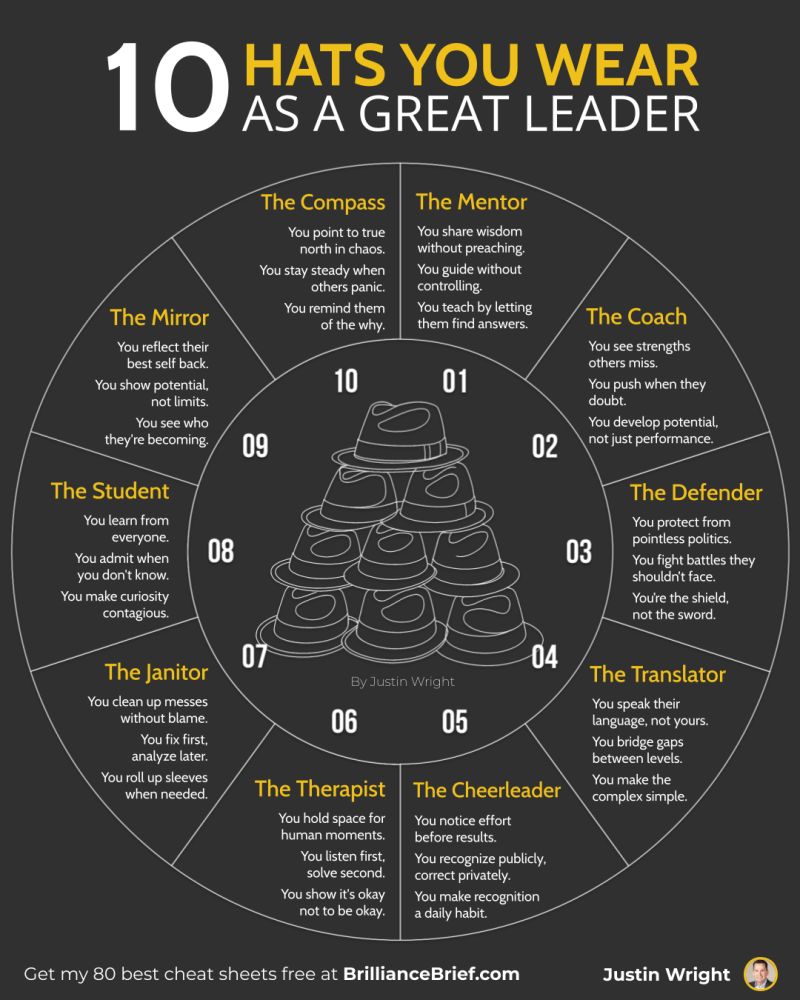
Bad leaders think they wear a crown.
Good leaders wear a hat.
Great leaders?
They wear 10.
Because your team doesn’t need just one kind of support.
They need the right kind. At the right time.
That’s what great leaders understand.
They don’t cling to one identity.
They adapt.
They serve.
They know when to wear:
1/ The Mentor
➟ Share wisdom without preaching
➟ Guide, don’t control
➟ Help them find their own answers
2/ The Coach
➟ Spot potential before they do
➟ Push when they hesitate
➟ Invest in their growth
3/ The Defender
➟ Shield them from politics
➟ Fight the battles they shouldn’t have to
➟ Protect without hovering
4/ The Translator
➟ Speak their language, not yours
➟ Bridge gaps between levels
➟ Simplify the complex
5/ The Cheerleader
➟ Spot the effort before the result
➟ Recognize in public, correct in private
➟ Make appreciation your daily habit
6/ The Therapist
➟ Hold space for human moments
➟ Listen before solving
➟ Show it’s okay not to be okay
7/ The Janitor
➟ Clean up the mess without blame
➟ Fix first, debrief later
➟ Roll up sleeves when needed
8/ The Student
➟ Learn from everyone
➟ Admit when you don’t know
➟ Make curiosity contagious
9/ The Mirror
➟ Reflect their best self back
➟ Show potential, not limits
➟ See who they’re becoming
10/ The Compass
➟ Point to true north in chaos
➟ Stay steady when others panic
➟ Remind them of the why
Leadership isn’t a rank or role.
It’s how you treat people.
Your service. Your support.
You don’t need a promotion.
You don’t need permission.
You don’t even need a title.
Just the courage to step up.
And serve.
Because the best leaders aren’t wearing a crown.
They’re switching hats.
One at a time.
Exactly when their team needs it most.
12 simple phrases for instant respect
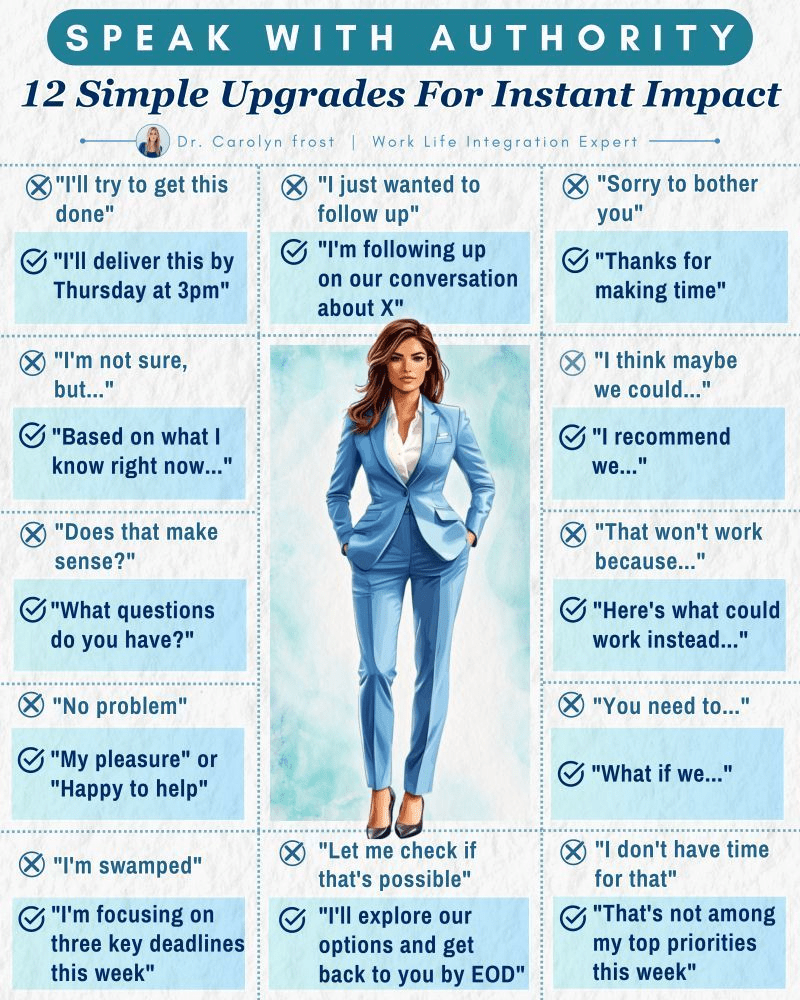
I used to soften everything I said.
Just to sound nice, not too much, not too assertive.
Turns out, it just made me sound unsure.
These 12 tiny phrase shifts can change everything ✨
(Hint: Write out your 3 favorite – use them often)
1) “I’ll deliver this by Thursday at 3pm”
❌ “I’ll try to get this done”
↳ Shows you’re reliable, not uncertain
2) “I’m following up on our conversation about X”
❌ “I just wanted to follow up”
↳ Gets straight to the point
3) “Thanks for making time”
❌ “Sorry to bother you”
↳ Shows confidence instead of doubt
4) “Based on what I know right now…”
❌ “I’m not sure, but…”
↳ Sounds knowledgeable despite limits
5) “I recommend we…”
❌ “I think maybe we could…”
↳ Shows you’re decisive
6) “What questions do you have?”
❌ “Does that make sense?”
↳ Opens the door for clarity
7) “Here’s what could work instead…”
❌ “That won’t work because…”
↳ Focuses on solutions not problems
8) “My pleasure” or “Happy to help”
❌ “No problem”
↳ Shows you wanted to help
9) “I’m focusing on three key deadlines this week”
❌ “I’m swamped”
↳ Shows you manage your time well
10) “I’ll explore our options and get back to you by EOD”
❌ “Let me check if that’s possible”
↳ Takes charge of finding answers
11) “What if we…”
❌ “You need to…”
↳ Invites teamwork instead of demands
12) “That’s not among my top priorities this week”
❌ “I don’t have time for that”
↳ Shows you make choices, not excuses
Speak like you belong at the table.
Because you do ⚡️
More Than Enough: A Reminder You Didn’t Know You Needed Today

We carry so much more than we show.
The quiet fears. The weight of the past. The sting of mistakes. The scars from things that hurt us more than we ever admitted out loud.
And sometimes, in the middle of the noise, the pressure, and the self-doubt… we forget.
We forget who we are.
We forget what we’ve overcome.
We forget that we are so much more than our lowest moments.
So, in case no one told you today:
🌟 You’re more than your fears.
Fear may speak loudly, but it doesn’t define your courage. Every step you take despite it? That’s bravery.
🌟 You’re more than your past.
What happened to you isn’t the end of your story. It’s a chapter. Not your title. You get to write what comes next.
🌟 You’re more than your mistakes.
We all fall short. But you are not your worst decision. You are the lesson, the learning, the comeback.
🌟 You’re more than what hurt you.
Pain shaped part of you—but it did not break you. You’re still here. Still rising. And that is strength.
You are a masterpiece in motion.
Still becoming. Still unfolding.
Still more than enough—even on the days you don’t feel like it.
So give yourself some grace today.
And if you’re looking for a sign to keep going—this is it!
Why Your Next Move Beats Your Last Mistake

Mistakes happen. Some small, some seismic. But here’s the truth no one says enough: your next move matters more than your last mistake.
It’s easy to get stuck in the loop of regret—replaying what went wrong, what could’ve been, or what you should have done. But growth doesn’t live there. Growth lives in the next step. In the decision you make after the fall. In how you rise, not in how you stumbled.
Whether it was a misstep in your career, a fractured relationship, a missed opportunity, or a poor choice—you are not the sum of your mistakes. You’re the product of your response to them.
Every moment gives you the power to pivot.
✅ Learn from the past, but don’t pitch a tent there.
✅ Own your mistake, but don’t let it own your story.
✅ Most importantly, move. Forward. Intentionally.
Because the people who grow, evolve, and win aren’t mistake-free—they’re simply not mistake-bound. They know redemption lives in the next move.
So take a breath, recalibrate, and make it count.
Your future isn’t asking for a perfect past.
It’s waiting for a powerful next step!
12 public speaking secrets
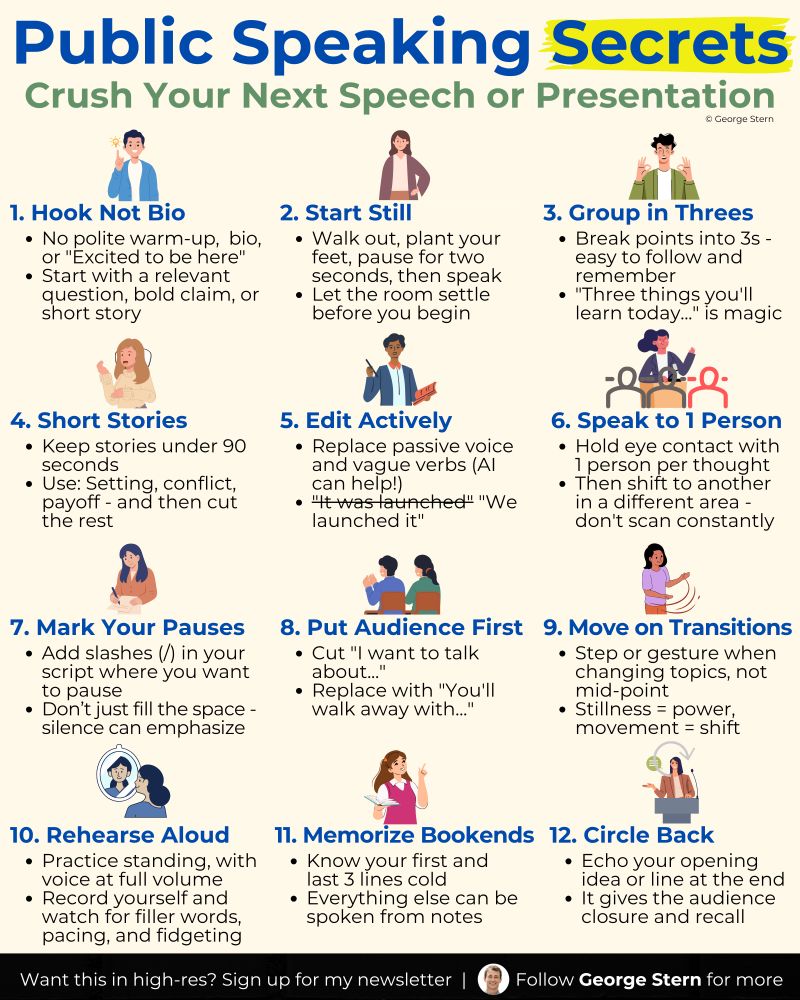
Crush your next speech or presentation:
1. Hook Not Bio
↳No polite warm-up, bio, or “I’m excited to be here”
↳Replace with a relevant question, bold claim, or short story
2. Start Still
↳Walk out, plant your feet, pause for two seconds, then speak
↳Let the room settle before you begin
3. Group in Threes
↳Break points into 3s – easy to follow and remember
↳”Three things you’ll learn today…” is magic
4. Short Stories
↳Keep stories under 90 seconds
↳Setting, conflict, payoff – cut the rest
5. Edit Actively
↳Replace passive voice and vague verbs (AI can help!)
↳”It was launched” becomes “We launched it”
6. Speak to One Person
↳Hold eye contact with one person per thought
↳Then shift to another in a different area – don’t scan constantly
7. Mark Your Pauses
↳Add slashes (/) in your script where you want to pause
Use silence to emphasize, not just fill
8. Move on Transitions
↳Step or gesture when changing topics, not mid-point
↳Stillness = power, movement = shift
9. Put Audience First
↳Cut “I want to talk about…”
↳Replace with “You’ll walk away with…”
10. Rehearse Out Loud
↳Practice standing, with gestures and voice at full volume
↳Record yourself and watch for filler words, pacing, and fidgeting
11. Memorize the Bookends
↳Know your first and last 3 lines cold
↳Everything else can be spoken from notes
12. Circle Back
↳Echo your opening idea or line at the end
↳It gives the audience closure and recall
Strong speakers aren’t born.
They use these secrets, and –
As cliche as it sounds –
Practice, practice, practice.
If you already love public speaking,
Use these to become even more of an expert.
If, like 75% of people, it’s one of your greatest fears,
Use these and push yourself to start – even if small:
↳An internal presentation to your team
↳A toast at a family dinner
↳A question or comment at a conference
You’ve got this!
Persuasion isn’t about manipulation.

It’s about influence. YOUR influence.
Some people have a way of making you say “YES” before you even realize it.
What’s their secret?
Persuasion is a skill, not a gift.
And the best persuaders follow habits that make them impossible to ignore.
Here are 7 habits you can start using today:
🔹 1. They Lead with Questions
Instead of pushing their point, they make you think it’s your idea.
👉 Example: “What would happen if you kept doing things the old way?”
🔹 2. They Master the Power of the Pause
Silence makes people uncomfortable. A well-placed pause forces attention and gives your words weight.
🔹 3. They Speak in Stories, Not Just Facts
People forget statistics but remember emotions. Wrap your key point in a story and watch it stick.
👉 Example: “Steve Jobs didn’t just launch the iPhone. He told a story about a world without buttons.”
🔹 4. They Mirror & Match
Great persuaders subtly reflect the tone, body language, and energy of their audience—building instant trust.
🔹 5. They Create Urgency
Persuasion thrives on timing. The best persuaders make you feel like now is the moment to act.
👉 Example: “This opportunity won’t be here in six months. The window is closing.”
🔹 6. They Use the Power of “Because”
Studies show people are far more likely to comply when given a reason—even if it’s simple.
👉 Example: “Could I skip ahead in line? I’m in a rush because I have a flight to catch.”
🔹 7. They Make Saying “Yes” Easy
The easier you make it to agree, the more likely people will. Offer small, low-risk steps first.
👉 Example: “Would you be open to a quick chat to explore ideas?” (instead of “Let’s partner up.”)
The Power of Gentle Giants

In a world that often glorifies aggression, hustle, and dominance, gentleness is underrated—misunderstood even. We’re taught to speak louder, push harder, and stand firmer to be taken seriously. But the strongest people aren’t always the loudest. They’re often the ones who carry immense power—yet never use it to wound.
Gentleness doesn’t mean you’re not strong.
It simply means your strength doesn’t harm others.
Think of the lion who doesn’t roar when it could, the hand that holds back when it’s capable of crushing, the leader who listens instead of yelling. That’s gentleness in action—power under control.
Gentleness is not about being passive or weak. It’s an active choice to approach people, problems, and pain with empathy and intentionality. It’s strength with emotional intelligence. Strength that lifts rather than tears down.
In relationships, in leadership, in parenting—gentleness is the silent force that builds trust, safety, and love. It’s the trait of those who are strong enough to remain calm in chaos, firm in values, and kind in conflict.
So the next time you’re tempted to prove your strength, try being gentle instead.
Because the world doesn’t need more power.
It needs more power that doesn’t harm!
Stay Calm, Stay Strong
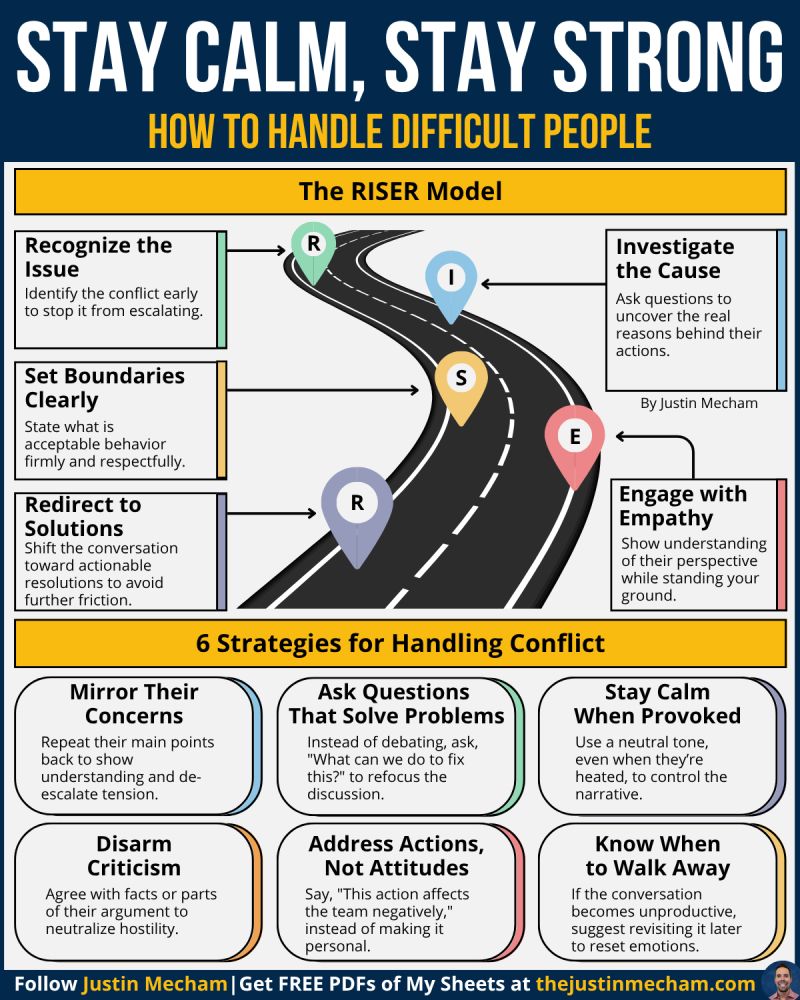
Losing your cool?
Then you’re losing your power:
Staying calm isn’t passive.
It’s a leadership move.
In tough moments, calm becomes your
greatest competitive advantage.
When emotions run high—
the calmest voice carries the most weight.
It doesn’t mean you agree.
It means you choose peace over proving a point.
You don’t have to match their energy.
You can protect yours.
Staying calm protects:
🟪 Your influence
🟪 Your boundaries
🟪 Your mental health
🟪 Focus on what matters
🟪 Respect in the moment
🟪 Innovation under pressure
🟪 Problem-solving power
🟪 Clear decision-making
🟪 Direction in chaos
🟪 Long-term trust
🟪 Your values
But calm doesn’t mean silent.
It means staying steady—while still speaking up.
Use my sheet to stay calm under pressure.
You don’t need to win the argument.
You’re winning by staying calm.
 Kenrick Vaz