8 Micro-Habits to Improve Communication 

Want to be a better communicator? 

Start with these 8 micro-habits ⬇️

Communication isn’t just about talking;

it’s about being understood.

Here are 8 micro-habits that can instantly 

improve the way you communicate:

1. Listen More Than You Speak

Follow the 80/20 rule: listen 80%, speak 20%.

Summarise what the other person said to show understanding.

Research: Active listening improves workplace relationships by 33%.

2. Ask Open-Ended Questions

Use questions like “What do you think?” to encourage deeper dialogue.

Follow up with “Tell me more” to dig deeper.

Research: Open-ended questions improve clarity and collaboration by 28%.

3. Pause Before Responding

Take 3 seconds to reflect before answering.

Avoid impulsive reactions in tough conversations.

Research: Pausing improves clarity and reduces misunderstandings by 20%.

4. Be Clear and Concise

Use simple, direct language.

Break complex ideas into small, actionable steps.

Research: Concise communication increases retention by 40%.

5. Practice Non-Verbal Awareness

Pay attention to body language and tone.

Mirror positive body language subtly to build rapport.

Research: Non-verbal cues account for 55% of communication effectiveness.

6. Schedule Daily ‘Alignment’ Check-Ins

Have short daily updates to align on tasks.

Use 5-10 minutes to clarify goals and remove blockers.

Research: Daily check-ins reduce team miscommunication by 25%.

7. Write With Intention

Re-read emails before sending.

Use bullet points for clarity in long messages.

Research: Clear written communication increases productivity by 30%.

8. Ask for Feedback on Your Communication

Regularly ask, “Was I clear in what I said?”

Implement small changes to improve over time.

Research: Leaders who seek feedback improve team relationships by 27%.

🧠 Remember:

The way you communicate shapes the way 

people perceive you. Small changes = big impact.

The Quiet Glow

We often mistake confidence for volume.

The booming voice in a meeting. The bold outfit. The person who always has something to say. And while those might look like confidence, the truth is — real confidence rarely shouts.

It hums.

It doesn’t need to prove itself, because it knows who it is.

Confidence is that quiet glow. The calm energy of someone who’s walked through self-doubt, asked the hard questions, and come out the other side with one simple truth: “I know who I am, and I’m good with it.”

No spotlight needed.

No grand gestures.

Just presence. Clarity. And peace.

This kind of confidence doesn’t compete or compare. It doesn’t try to fit in or stand out. It simply is. And in a world constantly telling us to be more, do more, and post more, that kind of quiet self-assurance is radical.

It’s found in small things —

A person choosing rest over hustle.

Someone listening more than they speak.

The courage to say no.

The wisdom to say yes to the right things.

So the next time you find yourself trying to be louder to feel more confident, pause.

Ask yourself:

“Do I know who I am?”

“And am I okay with that?”

Because that’s where real confidence begins — not with noise, but with knowing.

With a quiet glow that doesn’t need the world’s approval to shine.

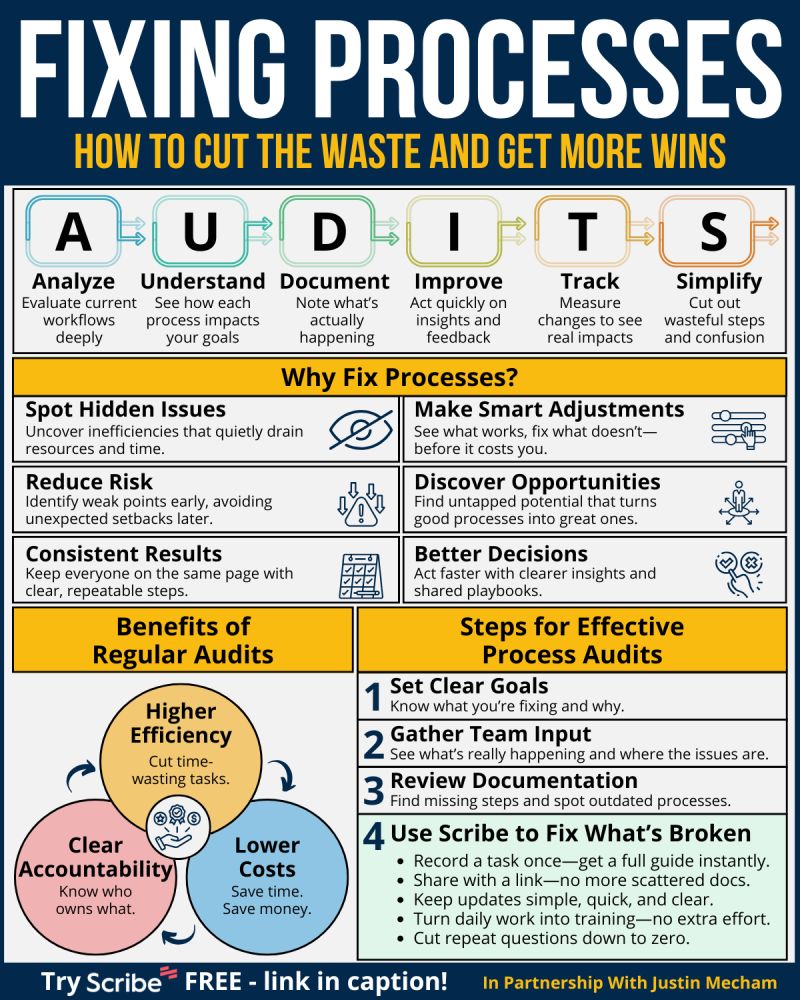
Fixing Processes

The problem isn’t the people –

It’s the process they’re following:

Most teams don’t audit their workflows.

Then wonder why things keep breaking.

That’s why I use Scribe.

Scribe captures every click and
keystroke as you work.

Then auto-generates a step-by-step guide
complete with screenshots and
text of your process.

It helps create clear, repeatable
steps that actually work.

No more wasted time.

No more guessing.

No more digging through old docs.

Here’s how I run quick process audits:

🔎 Analyze what’s really happening
🧠 Understand how it impacts the goal
📄 Document what’s being done, not what should be
⚡ Improve what’s broken and cut wasted steps
📊 Track the changes that matter
🧹 Simplify everything my team repeats

Then I use Scribe to put it all into motion:

✅ Record a task once
—Get a full step-by-step guide

✅ Share it with a link
—Cut the clutter and back-and-forth

✅ Edit it anytime
—No starting over

✅ Help teams self-serve
—And move faster

✅ Keep processes running
—Even when I’m not there

Today, we spend less time explaining
—and more time executing.

Clear processes = better execution.

Audits help you find the problem.

Scribe helps you fix it—fast.

Managing Change

Change isn’t a threat –

It’s an invitation to grow:

Many people resist change because it feels risky.

But staying the same can be the biggest risk of all.

Research shows that organizations who

adapt quickly are more likely to stay

ahead of their competition.

When you manage change well, you unlock:

🟢 Faster innovation

🟢 Stronger leadership

🟢 Increased adaptability

🟢 Clearer communication

🟢 Higher employee engagement

🟢 Better decision-making

🟢 Improved teamwork

🟢 Greater resilience

Change is inevitable –

Resistance doesn’t stop it, it only slows you down.

Use my sheet for managing change. 

With the right approach you can:

• Celebrate every win

• Listen for early input

• Explain the “why” clearly

• Break it down into small steps

• Show empathy through challenges

The unknown feels heavy until action begins.

Start small. 

Explain clearly. 

Stay human.

Change is your chance to evolve.

Unrehearsed & Loved

There’s a moment in every true friendship when something quietly shifts.

You stop rehearsing.

You stop filtering.

You stop worrying if you’re too much or not enough.

You just… are.

Tired. Messy. Healing.

And still—so deeply loved.

That’s the kind of friendship that doesn’t ask you to perform. It welcomes the version of you that forgot to pretend. The one who cries at silly things, who’s still figuring stuff out, who sometimes disappears but always comes back with a heart full of care.

It’s rare. It’s precious. And when you find it, you’ll know.

Because there’s no better feeling than being seen for your whole self—and embraced anyway.

Here’s to friendships that feel like exhaling!

Hippo Leadership

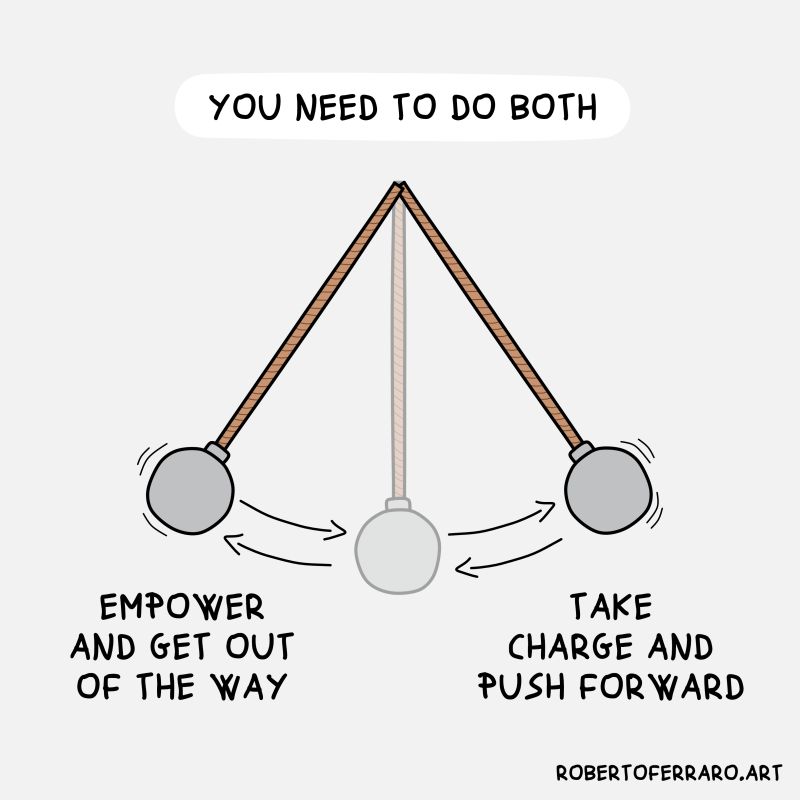
Hippo leadership: know when to surface and when to submerge 🦛

Leaders and teams struggle when confined to modes of ‘exercising authority’ or ‘being flat.’ 🤔

Teams ruled by overbearing leaders don’t generate innovative, creative thinking.

Teams in ‘flat’ mode suffer from indecisive leadership, poor coordination, and ineffective execution.

Think of the hippopotamus: it knows when to emerge and exert dominance, and when to recede, leaving only its eyes visible. 💡

🌟 Meetings offer a prime opportunity for leaders to shift power modes. How?

Ensure a psychologically safe environment for people to speak up.

Revisit our mindset: sharing power does not diminish our authority.

Conduct self and team analysis: assess personal habits and the team’s norms.

Inform everyone when to engage in divergent thinking and when to shift to convergent thinking.

Set clear expectations: signal the working modes before meetings. Define shifts and use rituals to mark transitions.

Use effective body language. Nonverbal behavior can reinforce or undermine your message. Read the room and know when to shift from command and control to empowerment.

Leave, or avoid entering, the room. If everyone waits for your opinion, authority alone can squelch debate and create awkward silences. Retake charge to end the discussion, make a decision, and act.

7 Habits of Highly Persuasive People

Persuasion isn’t about manipulation.

It’s about influence. YOUR influence.

Persuasion isn’t about manipulation.

It’s about influence. YOUR influence.

Some people have a way of making you say “YES” before you even realize it.

What’s their secret? 

Persuasion is a skill, not a gift. 

And the best persuaders follow habits that make them impossible to ignore.

Here are 7 habits you can start using today:

🔹 1. They Lead with Questions

Instead of pushing their point, they make you think it’s your idea.

👉 Example: “What would happen if you kept doing things the old way?”

🔹 2. They Master the Power of the Pause

Silence makes people uncomfortable. A well-placed pause forces attention and gives your words weight.

🔹 3. They Speak in Stories, Not Just Facts

People forget statistics but remember emotions. Wrap your key point in a story and watch it stick.

👉 Example: “Steve Jobs didn’t just launch the iPhone. He told a story about a world without buttons.”

🔹 4. They Mirror & Match

Great persuaders subtly reflect the tone, body language, and energy of their audience—building instant trust.

🔹 5. They Create Urgency

Persuasion thrives on timing. The best persuaders make you feel like now is the moment to act.

👉 Example: “This opportunity won’t be here in six months. The window is closing.”

🔹 6. They Use the Power of “Because”

Studies show people are far more likely to comply when given a reason—even if it’s simple.

👉 Example: “Could I skip ahead in line? I’m in a rush because I have a flight to catch.”

🔹 7. They Make Saying “Yes” Easy

The easier you make it to agree, the more likely people will. Offer small, low-risk steps first.

👉 Example: “Would you be open to a quick chat to explore ideas?” (instead of “Let’s partner up.”)

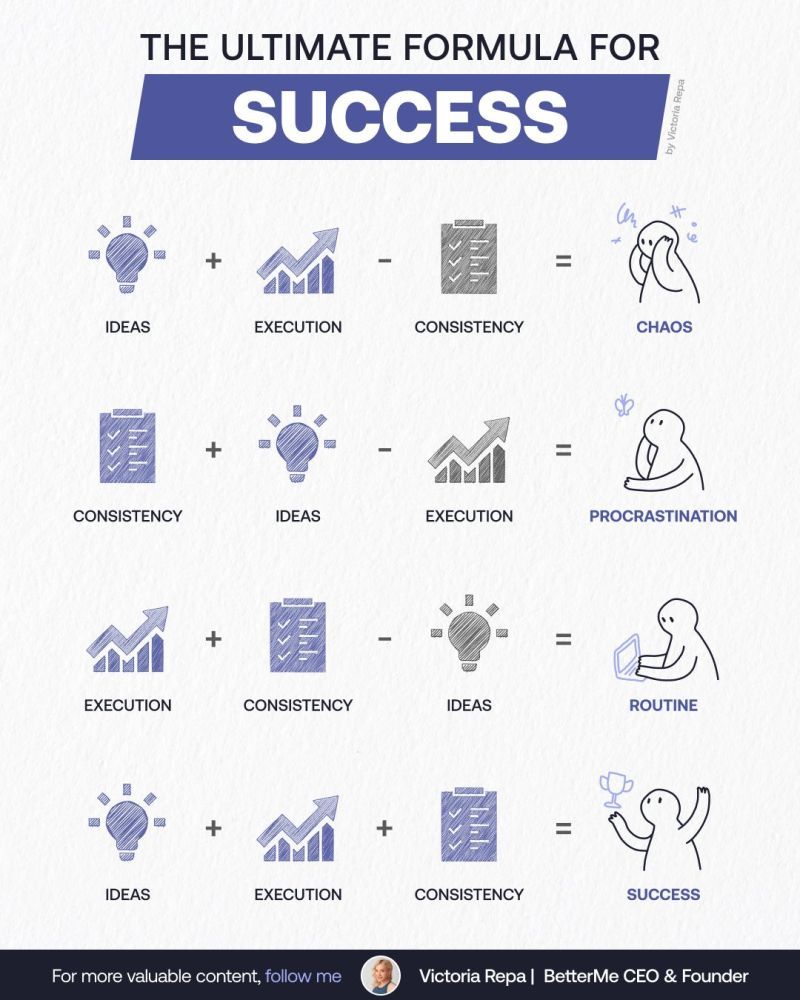
The Ultimate Formula for Success

The only Success Formula you need:

Ideas + Execution + Consistency = Success

All 3 components will lead you to success.
But remove one of them, and you’ll fail.

↳ Without Ideas:

Sticking to the same old routines without seeking new ideas or innovative solutions can lead to stagnation and missed opportunities.

↳ Without Execution:

Without execution, even the best ideas remain mere concepts, and success remains out of reach. Delaying action can hinder progress and prevent you from reaching your goals.

↳ Without Consistency:

Starting and stopping frequently or lacking a steady pace of progress can result in lost momentum and hinder your ability to achieve significant results.

👇 So it’s crucial to support all 3 parts of this formula:

1) Ideas:

Foster creativity through brainstorming, research, and exposure to diverse perspectives.

2) Execution:

Develop a bias towards action, break tasks into manageable steps, and learn from failures to iterate and improve.

3) Consistency:

Establish routines, set achievable goals, and stay focused on long-term progress rather than short-term results.

Success isn’t just about good ideas, effective execution, or consistency.

It’s about blending all three into your strategy.

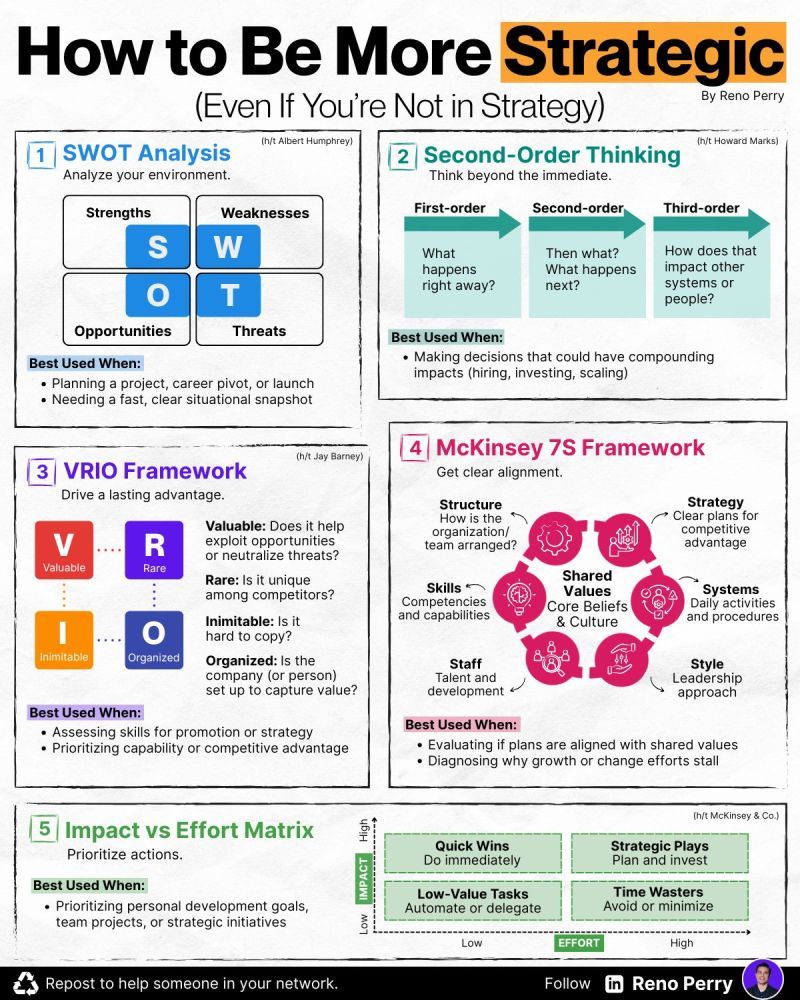
How to be More Strategic

I wish I could tell you, “The smartest decisions
I’ve made came from instinct.”

But that would be a lie.

They came from having the right tool.
At the right moment.

No one has all the answers.
And being strategic isn’t about pretending to.

It’s about knowing how to think for the most impact.

Here are 5 models I use to think more strategically:

🧠 SWOT Analysis
See what’s working.
Spot what’s holding you back.
➟ Use before: big moves or career pivots.

🔁 Second-Order Thinking
Think past the obvious.
Spot long-term impact early.
➟ Use when: decisions have ripple effects.

🛠 VRIO Framework
Find your edge.
Identify what sets you apart.
➟ Use to: pitch your value or prioritize strengths.

📐 McKinsey 7S
Fix what’s out of sync.
Align how you strategize, plan and act.
➟ Use when: progress stalls or things out of sync.

🎯 Impact vs Effort Matrix
Work smarter, not harder.
Focus where results are most impactful.
➟ Use when: you’re overloaded or stuck.

Being strategic isn’t about knowing everything.

It’s about knowing how to think when it counts.

How to Master Public Speaking

The best public speakers aren’t naturals. 

They’re cheaters.

And I stole their playbook:

After studying the world’s best, 

I discovered their formula:

A cheat-code of tiny habits 

that win over any audience.

The secret isn’t always in what they say. 

It’s in what they do.

Here are the 8 quiet traits of world-class speakers:

1/ Entering The Room 

↳ No rushing – slow, deliberate movements to inspire confidence. 

↳ Calmness shows you’ve done it before.

2/ Managing Your Hands 

↳ Use them to create energy. 

↳ Hold hands together loosely at belly button level when not using them.

3/ Starting Your Presentation 

↳ Open strong to get people hooked – surprising stat, emotional story. 

↳ Read the room – change the energy when people start checking phone.

4/ Creating Slides 

↳ Use your presentation merely as a visual aid. 

↳ Put no more than 10 words per slide.

5/ Tech Issues 

↳ Be ready for unexpected situations – prepare a backup. 

↳ Have a joke ready like: “Looks like Zoom is staging a rebellion!”

6/ Presenting Data 

↳ Prepare stories early on to discuss raw data. 

↳ Eg. “That’s like filling Madison Square Garden three times over.”

7/ Delivering Your Key Point 

↳ After making a point, pause. Let it land. 

↳ People remember what they sit with.

8/ Answering Questions 

↳ No “um,” “like,” or “you know.” They weaken your words. 

↳ Prepare likely & tricky questions beforehand.

BONUS: Handling Interruptions 

↳ Redirect interruptions with “Let’s address that during Q&A.” 

↳ Every interruption weakens your momentum.

The secret? 

Slow down – move and speak 10% slower than you would naturally.

Calmness makes you confident.