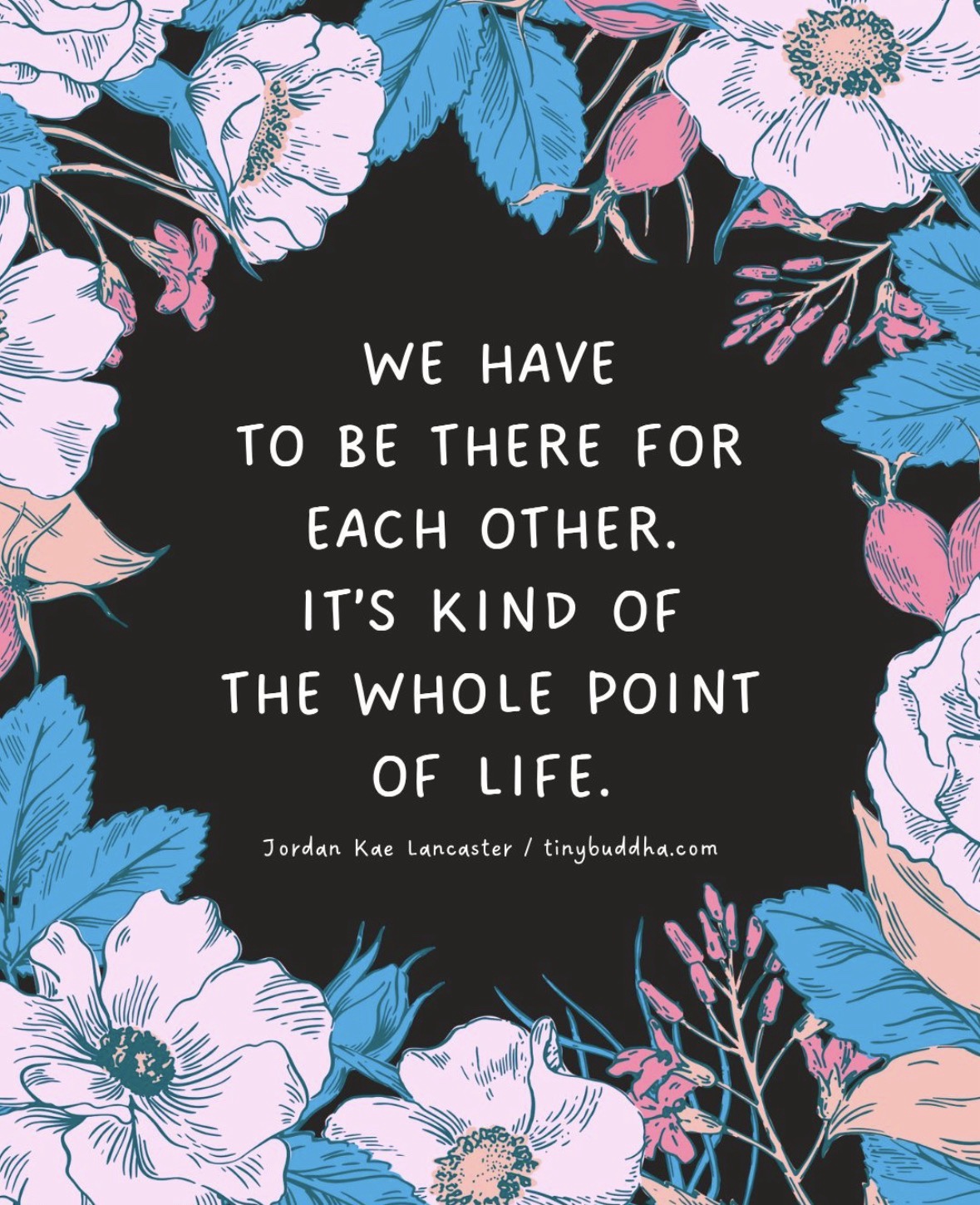
The Whole Point

Some truths are so simple, they almost feel too obvious to say out loud. And yet, they are the ones we most often forget.

We have to be there for each other.

That’s it.

That’s the lesson.

That’s the assignment.

That’s the whole point of life.

Not the job title. Not the status. Not the number in your bank account. Not how perfect your house looks, how busy your schedule is, or how impressive your life appears from the outside.

When everything is stripped down to what actually matters, it always comes back to people.

It comes back to the friend who sat with you when you didn’t know what to say.

The family member who checked in at just the right moment.

The stranger who showed unexpected kindness on a day that felt too heavy.

The coworker who noticed you were overwhelmed and quietly stepped in.

The person who stayed.

That’s what we remember.

Life has a strange way of making us chase things that feel urgent but aren’t always important. We get caught up in deadlines, goals, errands, plans, responsibilities, notifications, and all the noise that makes up modern life. Days blur into weeks, and before we know it, we’ve spent so much energy trying to “keep up” that we forget what we’re actually here for.

And maybe what we’re here for isn’t nearly as complicated as we make it.

Maybe it’s simply this: to love well, to show up, to notice, to care.

To be there.

Not in some grand, dramatic, movie-scene kind of way all the time. Most of the time, being there looks much smaller than that. It looks like answering the phone. Sending the text. Making the visit. Sitting in silence. Offering help without waiting to be asked. Remembering someone’s hard week. Praying for them. Listening without trying to fix everything.

Real presence is powerful because it tells someone, “You don’t have to carry this alone.”

And honestly, that can change everything.

We live in a world that celebrates independence. Being strong. Being self-made. Handling it all. But the truth is, none of us were built to do life alone. We need each other more than we like to admit.

We need people in our corner when life is joyful, and even more when life is hard.

We need someone to celebrate with when the prayers are answered.

We need someone to sit beside us when they’re not.

We need someone who can laugh with us when we’ve taken life too seriously.

We need someone who can remind us who we are when we forget.

And the beautiful part is this: while we all need that kind of support, we also all have the ability to be that for someone else.

You don’t need to have all the answers.

You don’t need to be rich, influential, or endlessly available.

You don’t need the perfect words.

You just need a willing heart.

Sometimes the people around us aren’t asking for solutions. They’re asking for presence. They’re asking to be seen. To be remembered. To know they matter. To know someone cares enough to stop and notice.

That kind of love is never wasted.

In fact, it’s often the quietest acts of care that leave the deepest mark.

A message that says, “Thinking of you.”

A meal dropped off after a hard week.

A ride offered without hesitation.

A hand held in a hospital room.

A patient conversation with a tired spouse.

A few extra minutes with your child when your mind is elsewhere.

A kind word when someone is clearly fighting a battle you can’t see.

These moments don’t always look big. But they are big.

Because at the end of the day, people rarely remember every detail of what you achieved. They remember how you made them feel. They remember whether you were present. They remember whether you made their world feel a little lighter, a little safer, a little less lonely.

And that’s a legacy worth building.

The older I get, the more I realize that life isn’t about collecting accomplishments as much as it is about creating connection. Yes, work matters. Goals matter. Growth matters. But if success costs us our compassion, then we’ve missed something essential.

What good is a full calendar if no one feels your presence?

What good is a polished life if the people closest to you feel unseen?

What good is being admired by many if you’re unavailable to the few who truly matter?

Being there for each other is not a side note to life. It is life.

It’s in the way we choose patience over irritation.

Compassion over convenience.

Attention over distraction.

Love over ego.

And maybe that’s why the smallest acts of goodness feel so sacred. Because deep down, we know they point us back to what’s real.

We are not here just to build lives for ourselves.

We are here to help carry one another through.

To remind each other that even in pain, there is still love.

Even in grief, there is still comfort.

Even in exhaustion, there is still kindness.

Even in a world that can feel cold and rushed, there are still people willing to stop, reach out, and say, “I’m here.”

Maybe that’s the invitation today.

Not to overcomplicate life.

Not to wait for the perfect moment.

Not to assume someone else will do it.

Just to be there.

Check on the friend.

Call your parents.

Sit a little longer with your spouse.

Put the phone down and really listen.

Encourage someone who looks tired.

Forgive faster.

Love louder.

Show up.

Because in the end, when the noise fades and the list of unfinished tasks no longer matters, what will remain is this:

Who did you love?

Who did you help?

Who felt less alone because you were in their life?

That’s not a small thing.

That’s everything!
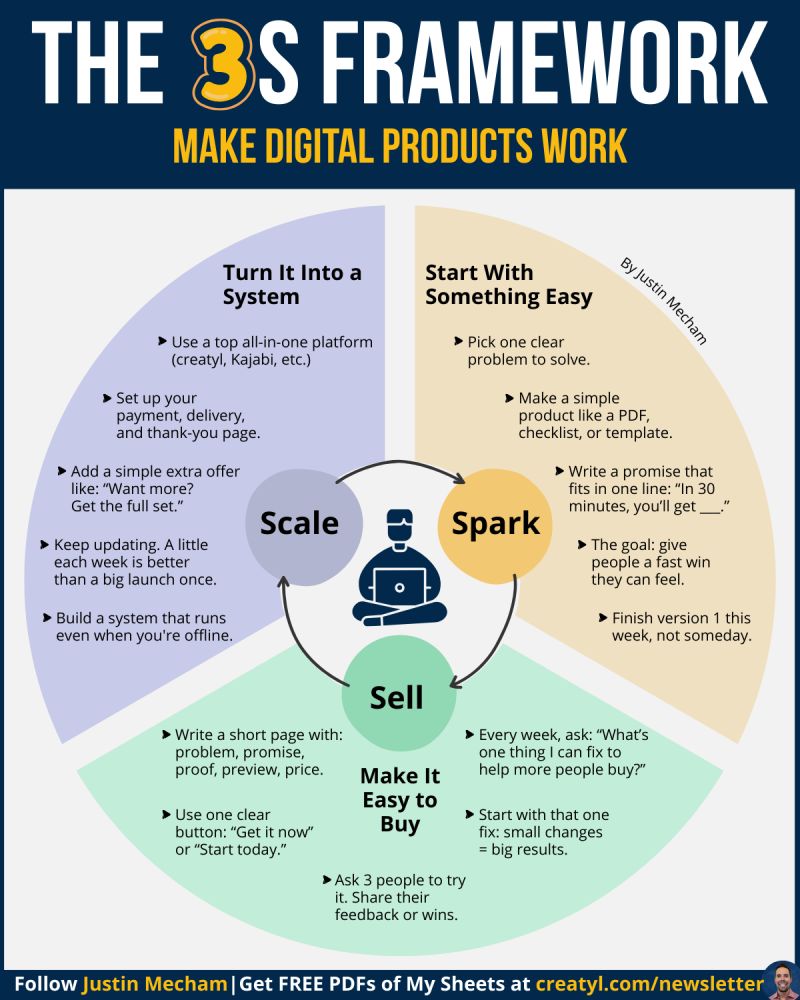
The 3 S Framework

Most digital products fail for one reason.

They skip this:

Planning felt productive.

It felt safe.
It felt smart.

But nothing changed until I actually took action.

Proof only shows up after action.
Not before.

That’s why I use my 3S Framework.
It forces movement first.

Not more thinking.
Not more prep.

Here’s how it works.

🟡 Spark
— Start simple on purpose.
— Pick one problem people already complain about.
— Make something small that fixes it fast.
— Write one promise a real person understands.
— Ship version one this week.

🟢 Sell
— Make buying feel obvious.
— One short page.
— One clear price.
— One clear button.
— Ask three people to try it.
— Listen. Adjust one thing.

🟣 Scale
— Remove repeat work.
— Set up pay, delivery, and follow-up once.
— Add a small next step for buyers.
— Update a little each week.
— Let it run without you watching.

🔜 Here’s the shift that matters.
• Small digital products lower fear.
• Selling early creates clarity.
• Systems turn effort into results.

If you’re stuck, don’t plan more.

Start something small.

Sell it simply.

Then build more of what works.

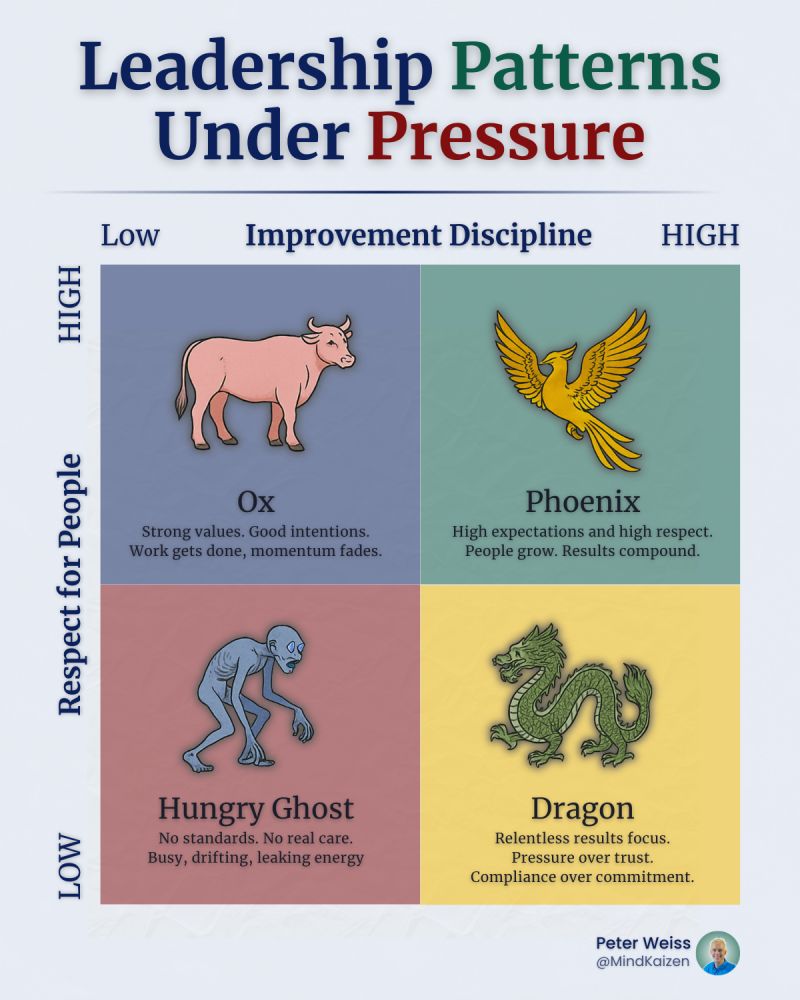
Leadership Patterns Under Pressure

Your best people aren’t quitting their job.

They’re quitting your leadership pattern.

You hire great people.
Set clear goals.
Care about the work.

And somehow, six months later,
the best ones are already looking for the exit.

This is a pattern I see across organizations:

🐂 Ox
Strong values. Good intentions.
People care, but improvement slows.
Work gets done, yet momentum fades.

🐉 Dragon
Relentless focus on results.
Pressure replaces trust.
People comply, but don’t commit.

👻 Hungry Ghost
No clear standards. No real care.
Teams drift. Energy leaks.
Everyone stays busy. Nothing gets better.

🔥 Phoenix
High expectations and high respect.
People grow while results improve.
Progress compounds instead of burning out.

Most leaders don’t choose the wrong quadrant.
They drift there under pressure, urgency, or good intentions.

The hard part isn’t knowing which one is “best.”
It’s noticing where you actually are.

Which one do you recognize most in your organization today?

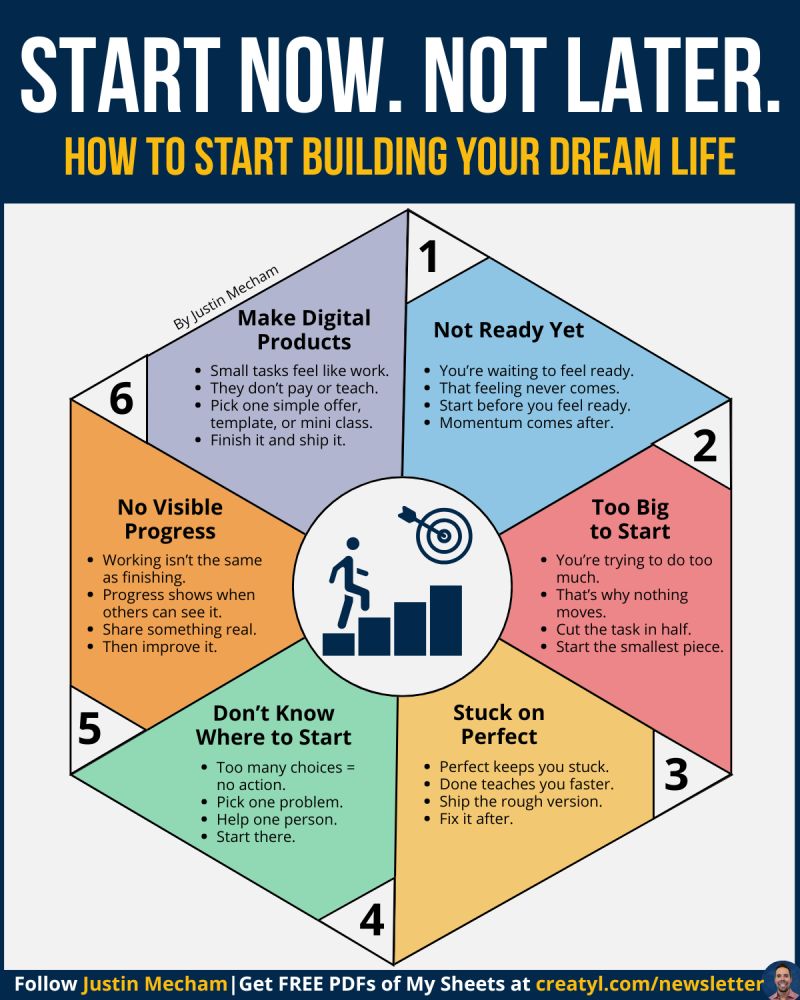
Start Now, Not Later

I thought I needed more time,

What I really needed was to start:

That one truth changed how I work.
And it’s probably what you need too.

Most people don’t need more hours.
They need motion.

I see this pattern everywhere.
Smart people. Good ideas. No output.

Not because they’re lazy.
Because they’re stuck in place.

Here’s what actually slows you down
and how to move past it.

🔵 Not Ready Yet
— You wait to feel ready.
— That feeling never comes.
— Start small. Ready shows up later.

🔴 Too Big to Start
— The idea feels heavy and unclear.
— That’s not fear. That’s size.
— Cut it smaller. Then move.

🟠 Stuck on Perfect
— You keep fixing instead of finishing.
— Perfect delays progress.
— Ship rough. Fix after.

🟢 Don’t Know Where to Start
— Too many options freeze you.
— Pick one problem. Help one person.
— That’s enough to begin.

🟡 No Visible Progress
— You’re busy but nothing is done.
— Work that ships is what counts.
— Drafts stay invisible.

🟣 Nothing That Lasts
— Short wins fade fast.
— Simple digital products compound.
— Build once. Improve over time.

Here’s the part most miss.

Action creates clarity.
Clarity never comes first.

Start before you feel ready.
Finish before you feel proud.

What is stopping you today?

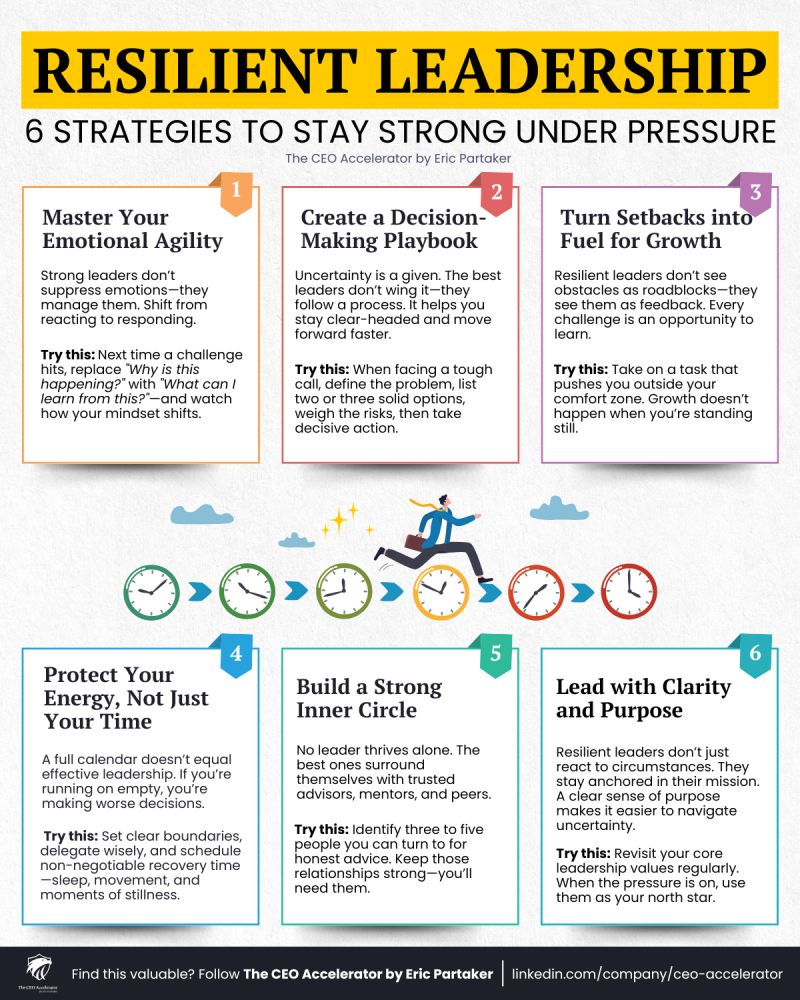
Resilient Leadership

The Harsh Truth:

If you can’t handle pressure, you can’t lead.

70% of leaders struggle to make decisions under pressure.

The other 30%?

They don’t just survive pressure. They thrive in it.

Here’s how you can join the top 30%:

1. Master Your Emotional Agility

Strong leaders don’t suppress emotions,
they manage them.

→ The next time pressure hits, stop asking
“Why is this happening?”

Instead, ask “What is this teaching me?”

That small shift changes everything.

2. Create a Decision-Making Playbook

Pressure magnifies indecision.

The best leaders don’t wing it.

They follow a process that keeps them
clear-headed when everything else is chaotic.

→ When facing a tough call:

• Define the problem.
• List 2–3 solid options.
• Weigh the risks.
• Act fast.

3. Turn Setbacks into Fuel for Growth

The strongest leaders don’t fear failure.
They use it as feedback.

→ Take on challenges outside your comfort zone.

If you’re not growing, you’re falling behind.

4. Protect Your Energy, Not Just Your Time

A packed calendar doesn’t make you a great leader.
Managing your energy does.

→ Set non-negotiable recovery time:
sleep, movement, and stillness.

5. Build a Strong Inner Circle

No leader wins alone.
The best ones build an inner circle of truth-tellers.

→ Identify 3–5 trusted advisors who give you
unfiltered feedback.

6. Lead with Clarity and Purpose

Under pressure, most leaders react.
The best ones stay anchored in their mission.

→ Revisit your leadership values regularly.

When everything is uncertain, your purpose
must be your north star.

Most leaders misunderstand resilience.

It’s not just about:

Toughing it out.
Grinding harder.
Pushing through.

Real resilience?

It’s about making pressure work for you.
Becoming stronger from it.
Being antifragile.

So next time the pressure’s on, ask yourself:

Am I just enduring this?

Or am I adapting, learning, and growing stronger?

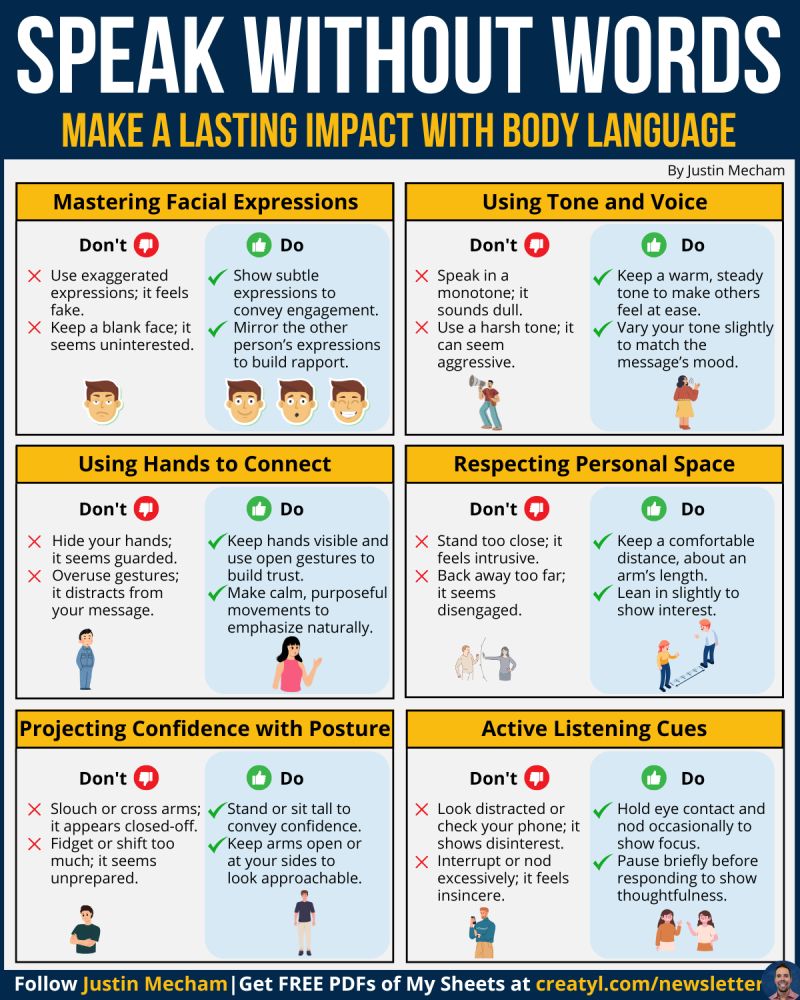
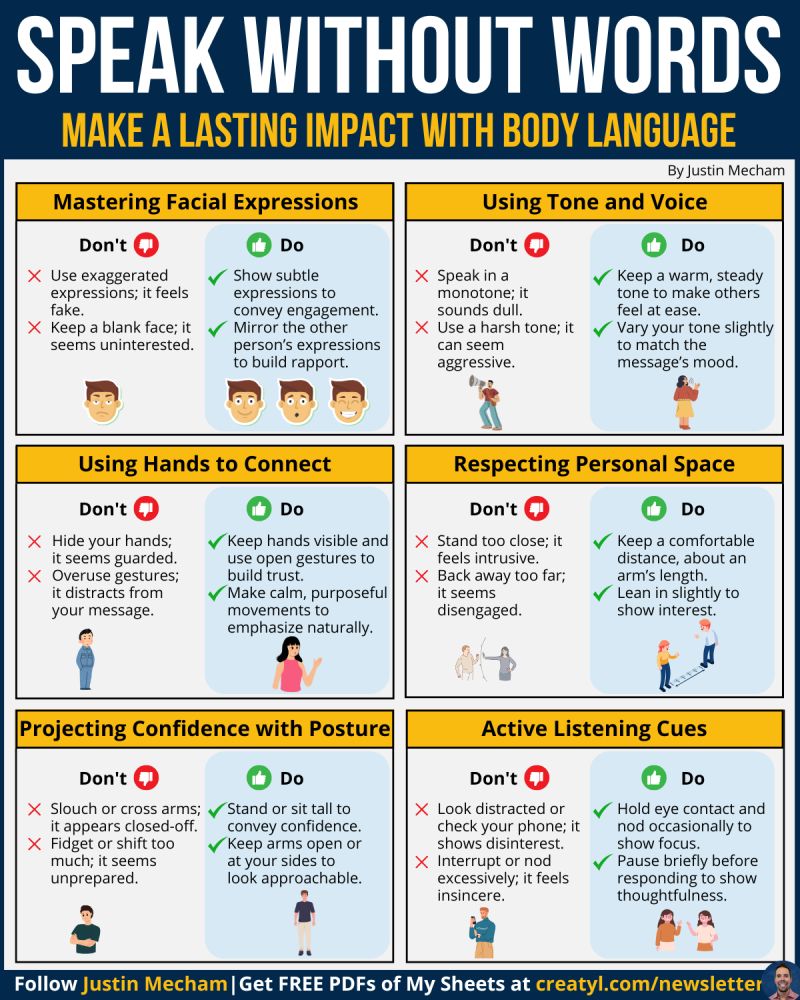
Speak Without Words

Most communication problems

are not word problems:

I learned this the hard way.

I said the right things
and still lost the room.

That is when it clicked.

People feel you
before they hear you.

Your body speaks first.
Your words just confirm it.

Small signals decide trust
in seconds.

Here is what actually matters.

🙂 Your face
— Big reactions feel fake.
— No reaction feels cold.
— Subtle mirroring builds connection.

🎙️ Your voice
— Flat loses attention.
— Sharp creates tension.
— Warm and steady creates safety.

🤲 Your hands
— Hidden feels guarded.
— Wild feels messy.
— Open and calm builds trust.

📏 Your space
— Too close feels pushy.
— Too far feels distant.
— Comfort keeps people engaged.

🧍 Your posture
— Slouching closes you off.
— Fidgeting shows doubt.
— Standing tall signals calm confidence.

👂 Your listening
— Phones break trust fast.
— Forced nodding feels off.
— Eye contact and pauses show respect.

Try this this week 👇
• Slow your movements.
• Lower your voice slightly.
• Keep hands visible.
• Give people space.
• Pause before replying.

You don’t need better words.

You need your body to agree with them.

Speak Without Words

Most communication problems

are not word problems:

I learned this the hard way.

I said the right things
and still lost the room.

That is when it clicked.

People feel you
before they hear you.

Your body speaks first.
Your words just confirm it.

Small signals decide trust
in seconds.

Here is what actually matters.

🙂 Your face
— Big reactions feel fake.
— No reaction feels cold.
— Subtle mirroring builds connection.

🎙️ Your voice
— Flat loses attention.
— Sharp creates tension.
— Warm and steady creates safety.

🤲 Your hands
— Hidden feels guarded.
— Wild feels messy.
— Open and calm builds trust.

📏 Your space
— Too close feels pushy.
— Too far feels distant.
— Comfort keeps people engaged.

🧍 Your posture
— Slouching closes you off.
— Fidgeting shows doubt.
— Standing tall signals calm confidence.

👂 Your listening
— Phones break trust fast.
— Forced nodding feels off.
— Eye contact and pauses show respect.

Try this this week 👇
• Slow your movements.
• Lower your voice slightly.
• Keep hands visible.
• Give people space.
• Pause before replying.

You don’t need better words.

You need your body to agree with them.

Bloom in Your Own Season

There’s something quietly exhausting about comparison.

It sneaks in when you least expect it. You’re scrolling through your phone, looking at someone else’s career, someone else’s family, someone else’s body, someone else’s success, someone else’s confidence. Suddenly, the life you were just living starts to feel smaller. Less impressive. Less enough.

That’s the danger of comparison. It has a way of making you overlook the beauty of what’s already in your hands.

The truth is, comparison doesn’t just steal joy. It steals clarity. It distracts you from your own path by convincing you that someone else’s path is the one that matters more. It makes you question timing, worth, progress, and purpose. It whispers that you’re behind, when maybe you’re just growing differently.

And that difference matters.

Not everyone is meant to live the same story. Not everyone is supposed to shine in the same way, at the same time, or in the same place. Some people bloom early. Some bloom later. Some grow quietly underground for a long time before anyone sees the fruit. That doesn’t make the process less meaningful. It makes it real.

We live in a world that constantly invites us to measure ourselves against other people. Their milestones become our pressure. Their wins become our insecurity. Their highlight reels become the standard we unfairly hold ourselves to. But what we often forget is that we’re usually comparing our behind-the-scenes to someone else’s best angle.

That’s not truth. That’s distortion.

And when you live too long in distortion, you start losing touch with your own purpose.

Your purpose was never meant to look exactly like someone else’s. It was never meant to be copy-pasted from another person’s life. The things that make you different, the pace you move at, the struggles you’ve survived, the lessons you’ve learned, the way you love, the way you think, the way you show up in quiet moments… all of that matters. All of that shapes the reason you are here.

There is beauty in being uniquely you.

Not the polished version. Not the version that has it all figured out. Not the version that looks impressive to everyone else. The real you. The growing you. The trying-you-best-you. The you that keeps showing up even when life feels uncertain. That version deserves grace. That version deserves appreciation.

Sometimes we think purpose has to be loud to be valuable.

We think it has to come with recognition, applause, titles, followers, or some grand visible achievement. But often, purpose is much more personal than that. Sometimes purpose looks like being a safe place for your family. Sometimes it looks like raising a child with love and patience. Sometimes it looks like staying kind in a world that keeps hardening people. Sometimes it looks like choosing integrity when no one is watching. Sometimes it looks like surviving something that should have broken you and still finding a way to smile.

That counts.

A lot more than you think.

The world may celebrate what is flashy, but heaven often honors what is faithful.

And maybe that’s what you need to remember today: your life does not need to look like anyone else’s to be meaningful. You do not need to compete for worth. You do not need to rush to prove that you’re doing enough. You do not need to shrink because someone else is shining. Their light does not cancel yours.

There is room for both.

Actually, there is room for all of us.

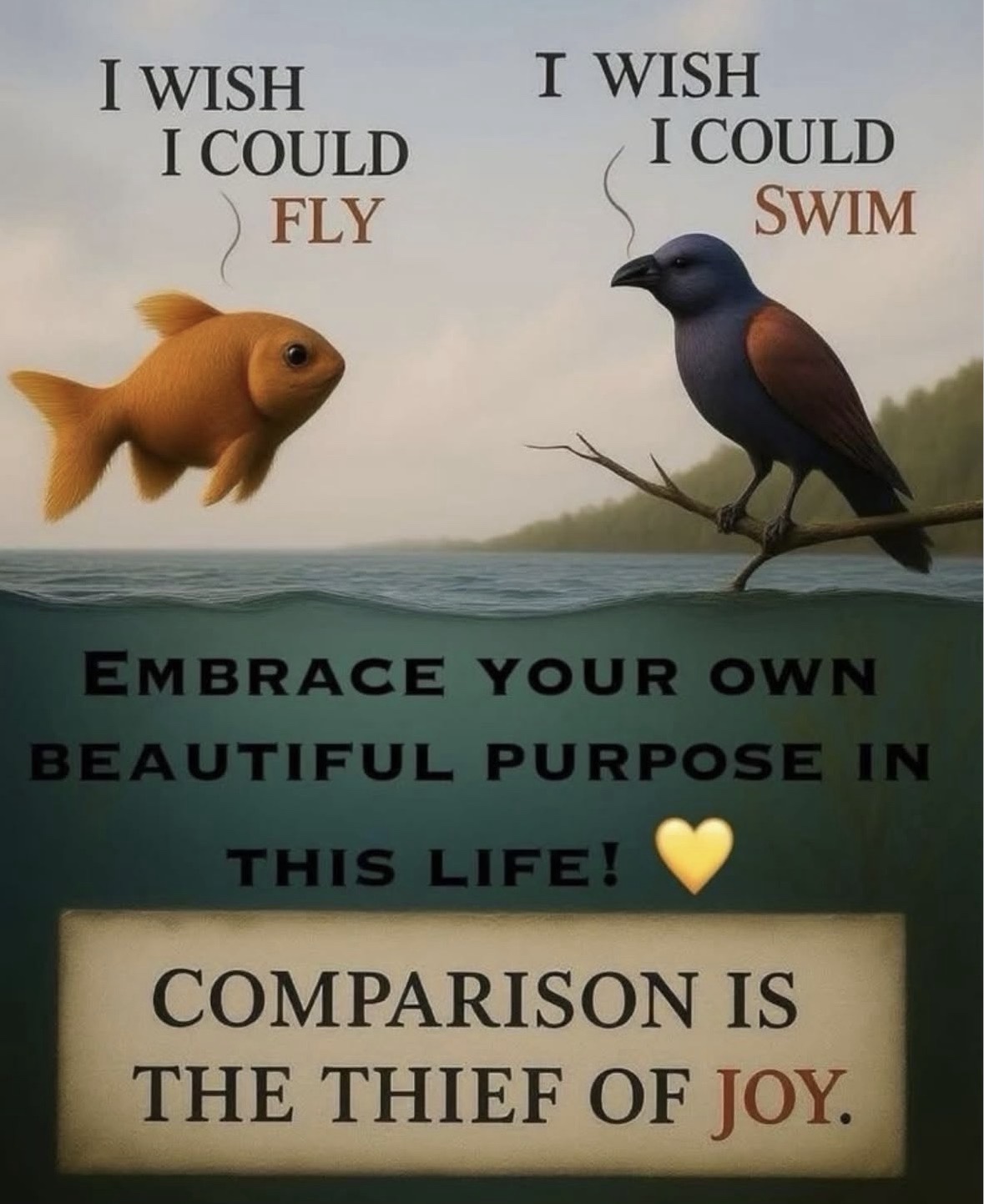
A flower doesn’t waste time wishing it were a tree. The moon doesn’t apologize for not being the sun. The ocean doesn’t compare itself to the sky. Creation itself teaches us this lesson over and over again: beauty is found in purpose, not in imitation.

When you stop comparing, you start noticing.

You notice how far you’ve come.

You notice the strength you’ve built in private.

You notice the prayers that were answered in ways you didn’t expect.

You notice the people who genuinely love you.

You notice the gifts you’ve been downplaying because they came naturally to you.

You notice that your journey has its own kind of magic.

And that’s where joy begins to return.

Because joy doesn’t come from being better than someone else. It comes from being at peace with who you are becoming.

That doesn’t mean you stop growing. It doesn’t mean you stop dreaming. It just means your growth is no longer fueled by insecurity. It’s fueled by intention. By gratitude. By self-respect. By trust that what is meant for you will not miss you.

So if you’ve been feeling behind lately, or overlooked, or unsure if your life is measuring up, hear this clearly: you are not late. You are not less. You are not falling short because your journey looks different.

You are living a life that is being shaped with its own purpose.

Maybe slower.

Maybe quieter.

Maybe less obvious to the world.

But still beautiful.

Still valuable.

Still deeply important.

Embrace your own beautiful purpose in this life.

Stop borrowing standards from people who were never meant to be your blueprint. Stop doubting the goodness of your own road just because it doesn’t look like theirs. Stop dismissing the sacred work happening inside you simply because it isn’t visible yet.

Some of the most meaningful transformations happen in silence.

Keep going.

Keep growing.

Keep trusting.

Keep becoming.

And when comparison tries to creep back in, remind yourself of this simple truth:

You were not created to copy.

You were created to contribute.

In your own way.

In your own time.

With your own story.

And that story is worth celebrating!

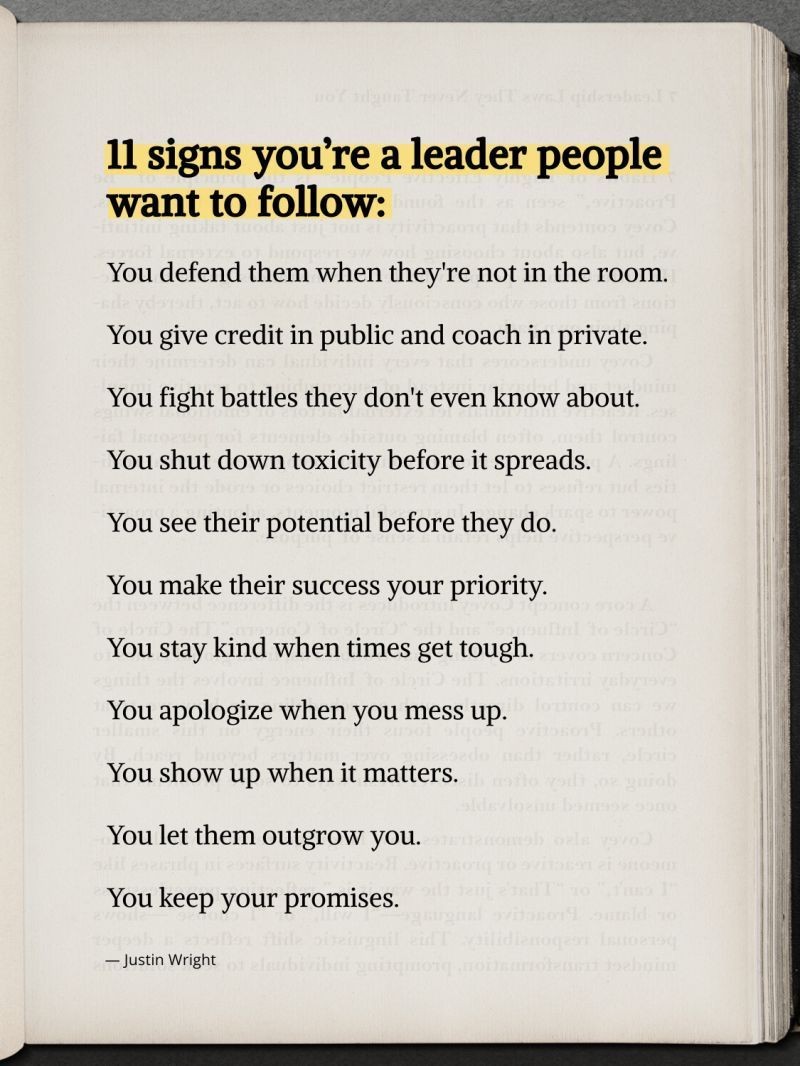
11 Signs You’re A Leader People Want To Follow

Leadership isn’t about your title.
It’s about how you make people feel.

11 signs you’re a leader others (actually) want to follow:

01/ You defend them when they’re not in the room.
02/ You give credit in public and coach in private.
03/ You fight battles they don’t even know about.
04/ You shut down toxicity before it spreads.
05/ You see their potential before they do.
06/ You make their success your priority.
07/ You stay kind when times get tough.
08/ You apologize when you mess up.
09/ You show up when it matters.
10/ You let them outgrow you.
11/ You keep your promises.

I’ve known “leaders” with fancy titles
who made me feel invisible.

And others who led by influence
and changed entire careers.

The difference?

One cared about their position.
The other cared about their people.

Here’s what real leaders know:

Your team’s success is your success.
Their growth is your legacy.
Their trust is what makes you a leader.

Not your title.

Be the leader who makes people believe
in themselves.

That’s the kind of impact that lasts forever.

The Rust You Don’t See

Iron looks invincible.

Strong. Solid. Unshakable.

You can strike it, test it, pressure it, and it still holds its ground. It takes force to bend it. It takes heat to shape it. It takes effort to break it.

And yet, for all its strength, iron has one quiet weakness.

Rust.

Not something from the outside trying to destroy it in one dramatic moment. Not a single blow. Not some massive enemy. Just a slow, silent process from within and around it that, over time, weakens what once seemed unbreakable.

That’s what makes this thought so powerful.

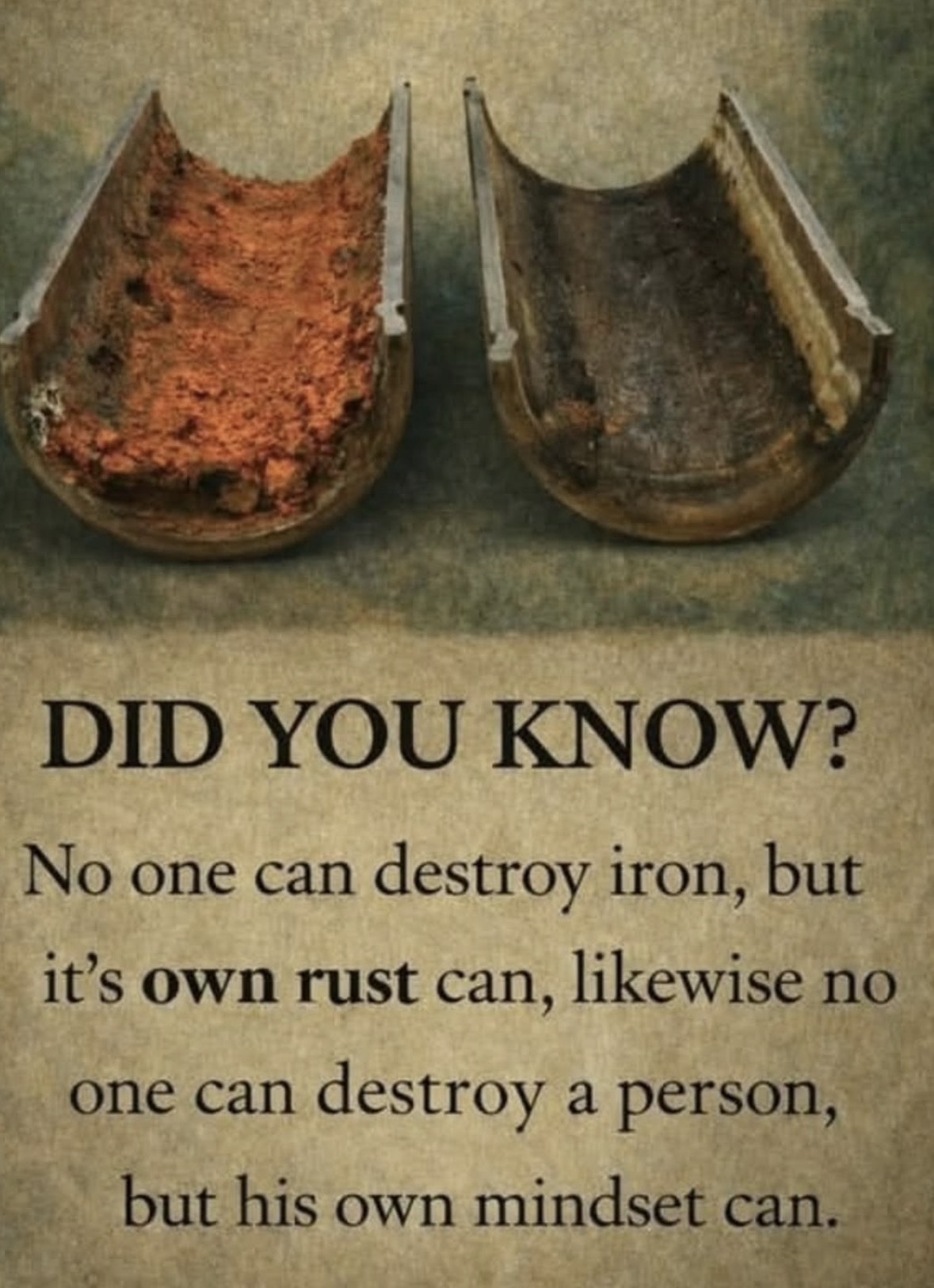
No one can destroy iron, but its own rust can. In the same way, no one can truly destroy a person the way their own mindset can.

That hits hard because it’s true in ways most of us don’t want to admit.

A lot of people spend their lives worrying about external obstacles. The competition. The critics. The failures. The betrayals. The bad luck. The missed opportunities. The people who doubted them. The doors that never opened.

And yes, those things are real. Life can absolutely be unfair. People can hurt you. Circumstances can slow you down. Disappointments can shake you.

But often, the real damage doesn’t come from what happened.

It comes from what you start believing because of what happened.

You fail once, and suddenly your mind whispers, “Maybe I’m not good enough.”

You get rejected, and your thoughts turn it into, “I’m always overlooked.”

You make a mistake, and instead of learning from it, you label yourself as incapable.

You go through heartbreak, loss, or disappointment, and before long, you’re not just carrying pain. You’re carrying a story that says you’re unlucky, unworthy, or destined to keep losing.

That’s the rust.

Not the event itself.

The meaning you let it attach to your identity.

That’s what slowly weakens people.

Not because they aren’t strong, but because even strong people can be worn down by repeated negative thoughts they stop questioning.

Mindset isn’t just about “thinking positive” all the time. It’s not pretending everything is fine when it isn’t. It’s not forcing fake motivation on hard days. And it’s definitely not ignoring real struggles.

Mindset is deeper than that.

It’s the lens you use to interpret your life.

It’s the voice in your head when no one else is around.

It’s the story you tell yourself after a setback.

It’s the difference between “This is hard” and “I can’t do hard things.”

It’s the difference between “I’m learning” and “I’m failing.”

It’s the difference between “This season is painful” and “My life is ruined.”

The world will test you. That part is guaranteed.

But your mindset decides whether the test becomes a lesson or a life sentence.

Think about how many people look successful on the outside but are quietly losing on the inside. They have talent, resources, support, opportunity, maybe even admiration from others. But their thoughts are constantly working against them.

They second-guess every move.

They compare themselves to everyone.

They replay old mistakes.

They expect rejection before they even try.

They talk themselves out of chances they haven’t even taken yet.

They sabotage progress because deep down, they don’t believe they deserve it.

From the outside, they still look like iron.

But inside, the rust has started.

And the scary thing about rust is that it doesn’t always announce itself.

It can sound reasonable.

It can sound like caution.

It can sound like humility.

It can sound like “being realistic.”

But there’s a difference between realism and self-destruction.

Realism says, “This will take work.”

Rust says, “Why bother?”

Realism says, “You’re not there yet.”

Rust says, “You’ll never get there.”

Realism says, “You made a mistake.”

Rust says, “You are the mistake.”

That distinction matters more than most people realize.

Because the way you speak to yourself becomes the way you see yourself.

And the way you see yourself shapes what you attempt, what you tolerate, what you believe you deserve, and how long you keep going when things get hard.

The good news is this: rust can be dealt with.

It can be noticed early.

It can be cleaned off.

It can be prevented.

And the same is true for the mind.

You can catch negative patterns before they become identity.

You can challenge beliefs that were built in pain.

You can replace constant self-criticism with self-awareness.

You can stop assuming every hard season means you’re failing.

You can choose thoughts that strengthen you instead of slowly eating away at you.

That doesn’t happen overnight.

It takes intention.

It takes honesty.

It takes paying attention to the conversations you have with yourself when nobody else can hear them.

Because that inner dialogue is shaping more of your future than you think.

You don’t need a perfect mindset. Nobody has one.

You just need a healthier one.

One that says, “I can grow.”

One that says, “This moment doesn’t define me.”

One that says, “I’ve survived hard things before.”

One that says, “I may not have control over everything, but I do have control over what I feed my mind.”

That last part is huge.

You can’t always control who disappoints you.

You can’t always control what falls apart.

You can’t always control how long a storm lasts.

But you can control whether you let every storm convince you that you were never meant to see sunshine again.

That’s where strength really lives.

Not in pretending you never struggle.

But in refusing to let struggle become your identity.

So protect your mind the way you’d protect anything valuable.

Be careful what you repeat to yourself.

Be careful what voices you let shape you.

Be careful what pain you allow to become permanent truth.

Because most people aren’t destroyed all at once.

They’re slowly worn down by the beliefs they keep feeding.

And just like iron, the greatest threat isn’t always what hits from the outside.

Sometimes it’s what’s quietly forming within!