
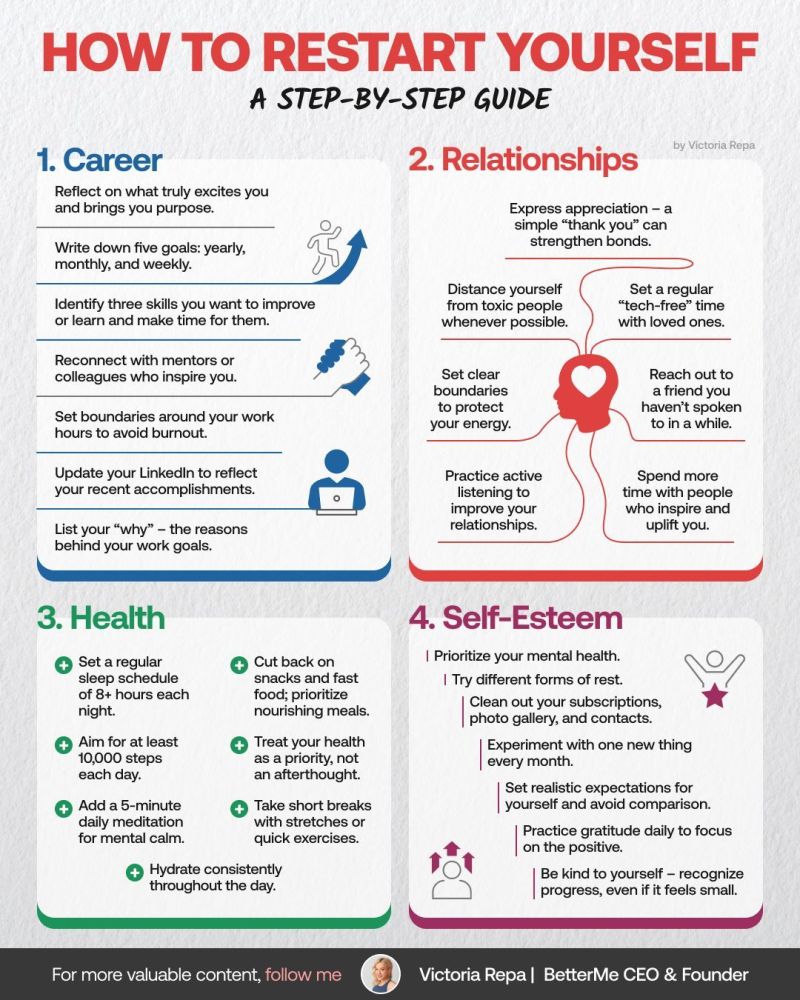
How To Restart Yourself: A Step By Step Guide
Credits to Victoria Repa, make sure to follow!
_____
Feeling stuck and apathetic?
I know that feeling all too well:
↳ Work is fine, but motivation is nowhere to be found.
↳ You don’t feel like you’re growing in life or in your career.
↳ You’re going through the motions, but something’s missing.
That’s a sign — it’s time for a reset.
You don’t need to quit or change everything.
Here’s a step-by-step guide to refresh all areas of your life:
💼 Career:
• Reflect on what truly excites you and brings you purpose.
• Write down five goals: yearly, monthly, and weekly.
• Identify 3 skills you want to improve or learn and make time for them.
• Reconnect with mentors or colleagues who inspire you.
• Set boundaries around your work hours to avoid burnout.
• Update your LinkedIn to reflect your recent accomplishments.
• List your “why”—the reasons behind your work goals.
🤝 Relationships:
• Distance yourself from toxic people whenever possible.
• Set clear boundaries to protect your energy.
• Spend more time with people who inspire and uplift you.
• Reach out to a friend you haven’t spoken to in a while.
• Practice active listening to improve your relationships.
• Express appreciation—“thank you” can strengthen bonds.
• Set regular “tech-free” time with loved ones.
💪 Health:
• Hydrate consistently throughout the day.
• Cut back on snacks and fast food; prioritize nourishing meals.
• Aim for at least 10,000 steps each day.
• Set a regular sleep schedule of 8+ hours each night.
• Add a 5-minute daily meditation for mental calm.
• Take short breaks with stretches or quick exercises.
• Treat your health as a priority, not an afterthought.
⭐️ Self-Esteem:
• Prioritize your mental health.
• Try different forms of rest—explore all seven types.
• Clean out your subscriptions, photo gallery, and contacts.
• Experiment with one new thing every month.
• Set realistic expectations and avoid comparison.
• Practice gratitude daily to focus on the positive.
• Be kind to yourself—recognize progress, even if it’s small.
Start with just one point in one area today,
and build from there.☝️
Every step forward will make your life better.
Even 1% at a time can change everything.
Body Language

Psychologists like Albert Mehrabian and Paul Ekman proved long ago:
— words matter less than tone, gestures, and micro-expressions.
That means — most people reveal their true thoughts without saying a word.
If you know how to read the signals, you understand people on a whole new level.
Here are the Body Language Secrets you need 👇
👀 Eyes – Interest, memories, guilt.
👄 Lips – Thought, frustration, anxiety.
🦶 Feet – Insecurity, escape, readiness to leave.
✋ Hands – Openness, authority, confidence.
Once you notice these cues, you can’t unsee them.
And you’ll never look at conversations the same way again.
Leadership with Maslow

Your team won’t grow—
If they don’t feel safe:
It’s not about perks.
It’s about needs.
Leaders often push for performance…
Before building the foundation.
Start with Maslow’s Hierarchy of Needs
(credit – Abraham Maslow):
It shows us what teams need first
before they can truly perform.
If any level is missing, growth stalls.
Here’s what matters most:
🟧 Physiological needs
Rest. Food. Stability.
Without them, there’s no focus.
🟦 Safety needs
Trust. Job security. Clear expectations.
Without this, there’s fear.
🟩 Love & belonging needs
Connection. Camaraderie. Communication.
Without this, there’s silence.
🟨 Esteem needs
Respect. Recognition. Achievement.
Without this, there’s doubt.
🟪 Self-actualization needs
Purpose. Potential. Growth.
Without this, there’s burnout.
Use my sheet to lead with intention.
Because when people feel supported,
they don’t just work harder—
They think bigger.
They connect deeper.
They lead themselves.
A Night of Harmonies, Memories, and Gratitude

Some concerts entertain you. Others stay with you. The Pentatonix concert we attended—on the very last night of their tour—was firmly in the second category.
Going to a concert with my mother-in-law made the evening even more special. Music has this quiet power to dissolve age gaps and preferences, and Pentatonix proved, once again, that great artistry speaks to everyone in the room. From the moment the lights dimmed, there was a shared sense that this wasn’t just another stop on the tour—it was a celebration, a culmination, and a thank-you to the fans who had followed them all the way to the end.
Pentatonix walked onto the stage to thunderous applause, and it was clear they felt it too. There was an energy in the room that felt different—looser, warmer, more emotional. You could sense that this final show carried extra meaning for them, and they poured every ounce of it into the performance. Every harmony was tight, every beat perfectly timed, every note delivered with joy and intention.
What continues to amaze me about Pentatonix is how they fill an entire arena with nothing but their voices—and Kevin’s cello, which deserves its own standing ovation. Hearing that deep, resonant cello live is a completely different experience. It doesn’t just support the music; it anchors it, wrapping the vocals in warmth and depth. Watching my mother-in-law’s reaction during those moments—eyes closed, smiling—was a reminder of how powerful live music can be when it’s done right.
The setlist was a beautiful journey through their catalog, blending fan favorites with newer pieces, all reimagined for the stage. Their Christmas arrangements, in particular, felt magical—layered harmonies soaring through the venue, creating moments where the entire audience seemed to breathe in sync. Between songs, the group spoke candidly about the tour, the exhaustion, the gratitude, and how surreal it felt to be standing there at the very end of it all. Those small, human moments made the night feel intimate despite the size of the crowd.
What stood out most was their connection—with each other and with the audience. There was laughter, a few emotional pauses, and that unmistakable sense of “we did this together.” It wasn’t polished to perfection in a manufactured way; it was real, joyful, and deeply sincere. That authenticity is rare, and it’s why Pentatonix has built such a devoted following over the years.
The last concert of a tour is supposed to be special. Pentatonix didn’t just meet that expectation—they elevated it. It was an amazing performance, yes, but more than that, it was a reminder of why live music matters. Because for a couple of hours, strangers become a community, voices become instruments, and memories are made that stay long after the lights come back on.
And honestly? I wouldn’t have wanted to experience that final night any other way.
Work Life Integration
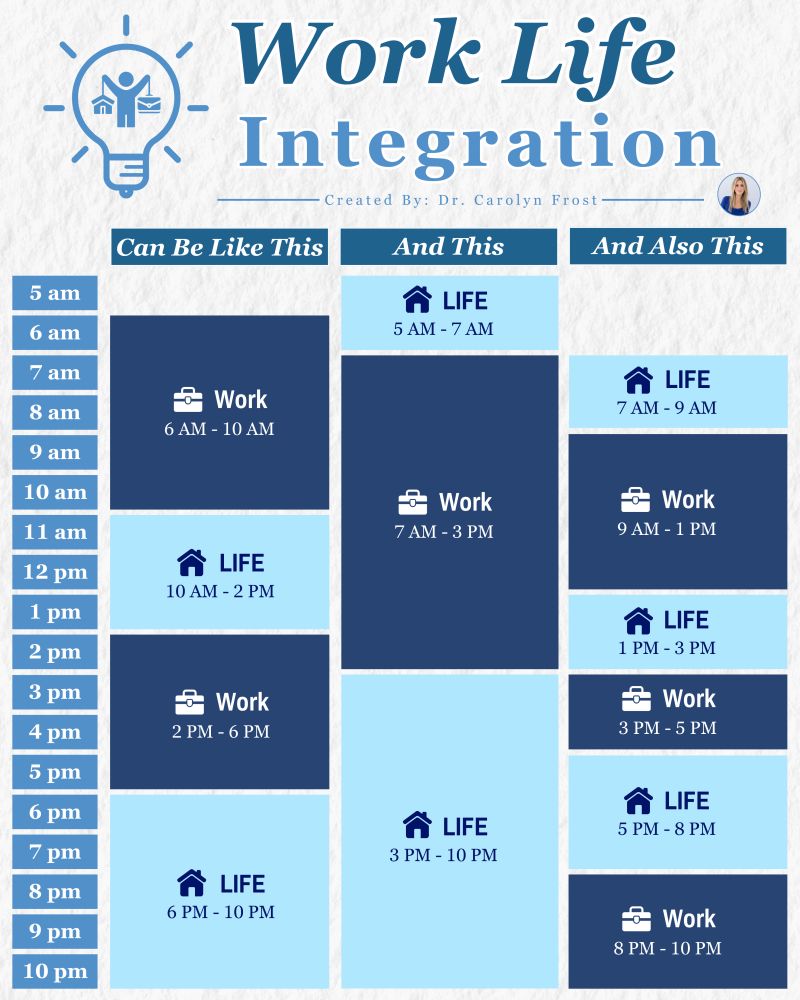
Work-life balance is a myth.
Here’s what actually works:
You’ve tried all the traditional advice.
Block your calendar
Set rigid boundaries
Separate everything neatly
But it’s not working.
You’re still exhausted from trying to split your life into perfect boxes.
Stop dividing your time.
Start integrating with purpose.
Here’s how 👇🏼
1) Design Your Power Blocks
↳ Schedule by energy, not the clock
↳ Some thrive at 5am, others at 10pm – own your pattern
2) Stack Instead of Separate
↳ Take that strategy call on your morning walk (my fav!)
↳ Turn your commute into learning time
3) Create Energy Transitions
↳ Small buffers between modes beat rigid boundaries
↳ Even a 5 min reset ritual naturally shifts your brain
4) Own Your Integration Style
↳ Some thrive in 2-hour blocks, others in quick sprints
↳ Match your natural rhythm, not someone else’s template
5) Master Purposeful Presence
↳ Fully engaged work means deeper focus
↳ Quality of attention beats quantity of hours
Balance divides your life into boxes.
Integration lets you design a life that actually works ✨
Any secrets that work well in your own life? Share below!
Let Me Sit With You for a Minute

There are moments when the world seems determined to move you along. To speed you up. To push you toward a solution before you’ve even had time to feel what you’re feeling. You say something is hard, and almost immediately someone reaches for advice. A tip. A lesson. A bright side. As if discomfort is something to be solved as quickly as possible.
But sometimes that’s not what we’re looking for at all.
Sometimes we’re just tired.
Tired of explaining. Tired of justifying why something hurts. Tired of being told that everything happens for a reason or that we should be grateful it isn’t worse. In those moments, advice can feel like noise. Solutions can feel like pressure. Even encouragement, when it comes too fast, can feel like a quiet way of saying, “You shouldn’t feel this way for long.”
What we want instead is simpler, and in some ways braver.
We want someone to pause with us. To listen without interrupting. To hear the full weight of what we’re carrying and say, “Yeah… that really is hard.” Not as a setup for a lesson, but as a complete sentence. Acknowledgment, without conditions.
There’s a kind of relief that comes from being seen like that. When someone doesn’t try to reframe your pain or rush you toward acceptance. When they don’t tell you what you should do next or how you should feel by now. They just let your experience be real. Valid. Enough.
Being understood doesn’t magically fix what’s broken. It doesn’t erase the problem or make the pain disappear. But it does something quieter and just as important. It tells your nervous system that you’re not alone in this. That you don’t have to defend your feelings or package them neatly to be worthy of care.
A lot of us learned, early on, that big feelings made people uncomfortable. So we learned to soften them. To joke. To minimize. To jump ahead to “I’ll be fine” before anyone could worry. Over time, we got very good at fixing ourselves in front of others. Even when what we really needed was permission to not be okay for a while.
And the truth is, not every moment needs a takeaway.
Some moments just need company.
When someone sits with you in your sadness, your confusion, your overwhelm, without trying to polish it into something more presentable, it creates space. Space to breathe. Space to feel. Space to eventually, at your own pace, figure out what comes next. Or not. Sometimes “next” can wait.
This is true not just for how we want to be treated, but for how we show up for others. It’s tempting to help by fixing. It makes us feel useful, competent, in control. But often the most meaningful thing we can offer is our attention. Our presence. Our willingness to tolerate discomfort alongside someone we care about.
To say, “I don’t have the right words, but I’m here.”
To say, “That makes sense.”
To say nothing at all, and mean it.
There’s a quiet kindness in letting feelings exist without trying to manage them. In trusting that being seen is, sometimes, enough for now. Not everything needs to be turned into growth or gratitude or a lesson learned. Some things just need to be acknowledged for what they are: heavy, complicated, and human.
So if you’re in a season where you don’t want advice, or solutions, or silver linings, that’s okay. You’re not broken for feeling that way. Wanting to be understood before being helped is deeply human.
And if you’re lucky enough to be that person for someone else, remember this: you don’t have to fix them to support them. Sometimes the most healing words are simply, “I see you. And what you’re feeling makes sense.”
The Power of Quiet People
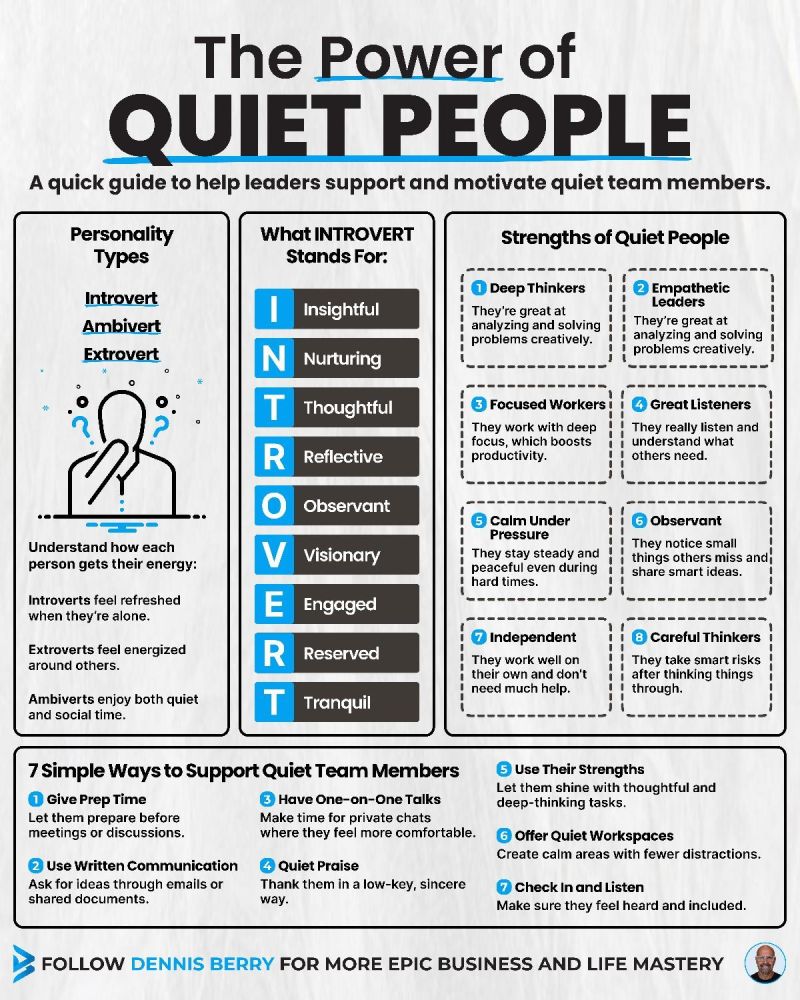
“Quiet people have the loudest minds.”
We don’t talk about this enough.
In a world that rewards the loudest voice in the room, quiet people are often overlooked… yet they carry a depth that can change everything.
While others speak to be heard, quiet people listen to understand.
While others rush to respond, they pause to think.🤔
While others seek attention, they focus on impact.
Here’s what happens when you underestimate them: 👇
❌ You miss the wisdom hidden between their words
❌ You overlook the calm strength they bring
❌ You mistake silence for weakness
The truth?
Quiet people move differently.
They don’t need the spotlight to lead, they lead by example, with precision and intention.
I’ve worked with people who barely said a word in meetings… and yet their one sentence at the right time changed the entire direction of a project.💡
Their strength is not in volume.
It’s in clarity.
It’s in the ability to see what others miss.
Here’s how quiet people create massive impact: 👇
✅ The Observation Edge
↳ They take in more than they put out, catching details that others overlook.
✅ The Patience Play
↳ They’re not rushing to “win” the moment… they’re playing for the long game.
✅ The Depth Advantage
↳ They think deeply before acting, which leads to sharper, more thoughtful decisions.
✅ The Empathy Effect
↳ They notice emotions, patterns, and unspoken truths, building trust without force.
✅ The Strategic Strike
↳ They know when to speak… and when they do, people listen.
Quiet people aren’t just part of the team, they’re often the steady hand that keeps it on course. 🔥
If you’re a quiet person reading this:
You don’t need to be louder to matter.
You just need to keep showing up as you are.
Your presence is already powerful. 💪
Who’s the quietest person you know that has made the biggest impact on your life❓
11 Public Speaking Strategies

75% of people fear public speaking more than death.
Yet it’s the no. 1 skill that accelerates careers.
An incredible resource from my friend Dr. Heather Maietta 🔥
(give her a follow)
Glossophobia, the fear of public speaking, held me back for years.
I wasn’t always afraid of public speaking.
Until I volunteered to present at a charity event and completely froze in front of the crowd.
Since then, I get anxiety for days leading up to a presentation.
But growth lives on the other side of fear.
And it’s never too late to rewrite your story.
Let’s put these 11 confidence-boosting tips into practice:
1/ The 5-5-5 Rule
→ Scan 5 faces, hold each gaze for 5 seconds
→ Repeat every 5 minutes
→ Creates an authentic connection
2/ Power Pause
→ Dead silence for 3 seconds after key points
→ Let your message land
3/ The 3-Part Open
→ Hook with a question
→ Share a story
→ State your promise
4/ Palm-Up Principle
→ Open palms when speaking = trustworthy
→ Pointing fingers = confrontational
5/ The 90-Second Reset
→ Feel nervous? Excuse yourself
→ 90 seconds of deep breathing resets your nervous system
6/ Rule of Three
→ Structure key points in threes
→ Our brains love patterns
7/ 2-Minute Story Rule
→ Keep stories under 2 minutes
→ Any longer, you lose them
8/ The Lighthouse Method
→ Plant “anchor points” around the room
→ Rotate eye contact between them
→ Looks natural, feels structured
9/ The Power Position
→ Feet shoulder-width apart
→ Hands relaxed at sides
→ Projects confidence even when nervous
10/ The Callback Technique
→ Reference earlier points later in your talk
→ Creates a narrative thread
→ Audiences love connections
11/ The Rehearsal Truth
→ Practice the opening 3x more than the rest
→ Nail the first 30 seconds and you’ll nail the talk
Your voice matters.
Don’t let fear choose who gets to hear it.
What’s helped you most with public speaking confidence?
Do More vs Do Better
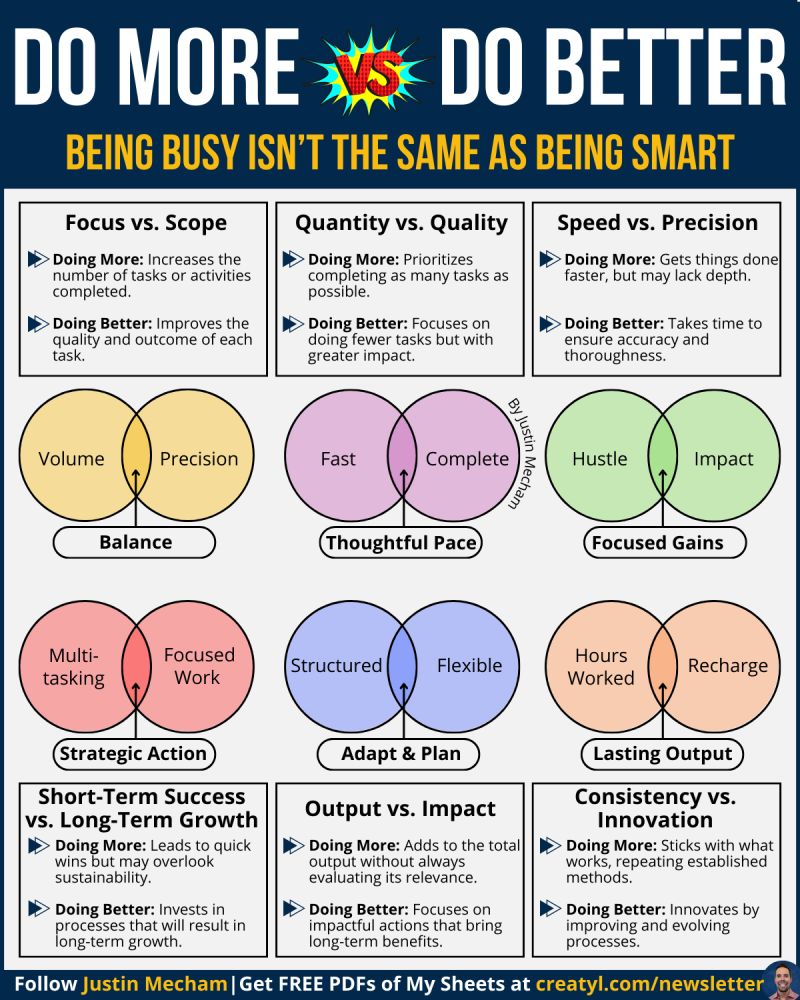
More doesn’t mean better—
It often means broken:
Here’s the hard truth:
Most people chase more —
But wonder why they feel stuck.
🔻 More apps.
🔻 More effort.
🔻 More noise.
🔻 More burnout.
🔻 More meetings.
🔻 More tabs open.
But more isn’t progress.
It’s a pattern.
And patterns don’t change results—
Only your approach does.
Let’s break it down:
The “More” Mindset
This is what keeps people busy but stuck:
🔴 Short-term thinking
🔴 Busy calendars
🔴 Hustle culture
🔴 High volume
🔴 Fast outputs
🔴 Multitasking
🔴 Quick wins
The “Better” Mindset
This is what creates momentum that actually lasts:
🟢 Real growth
🟢 Focused work
🟢 Clear priorities
🟢 Intentional time
🟢 Lasting progress
🟢 Strategic thinking
🟢 Meaningful results
Start small.
Pick one area to improve.
Then do it better — not more.
Popcorn Timing
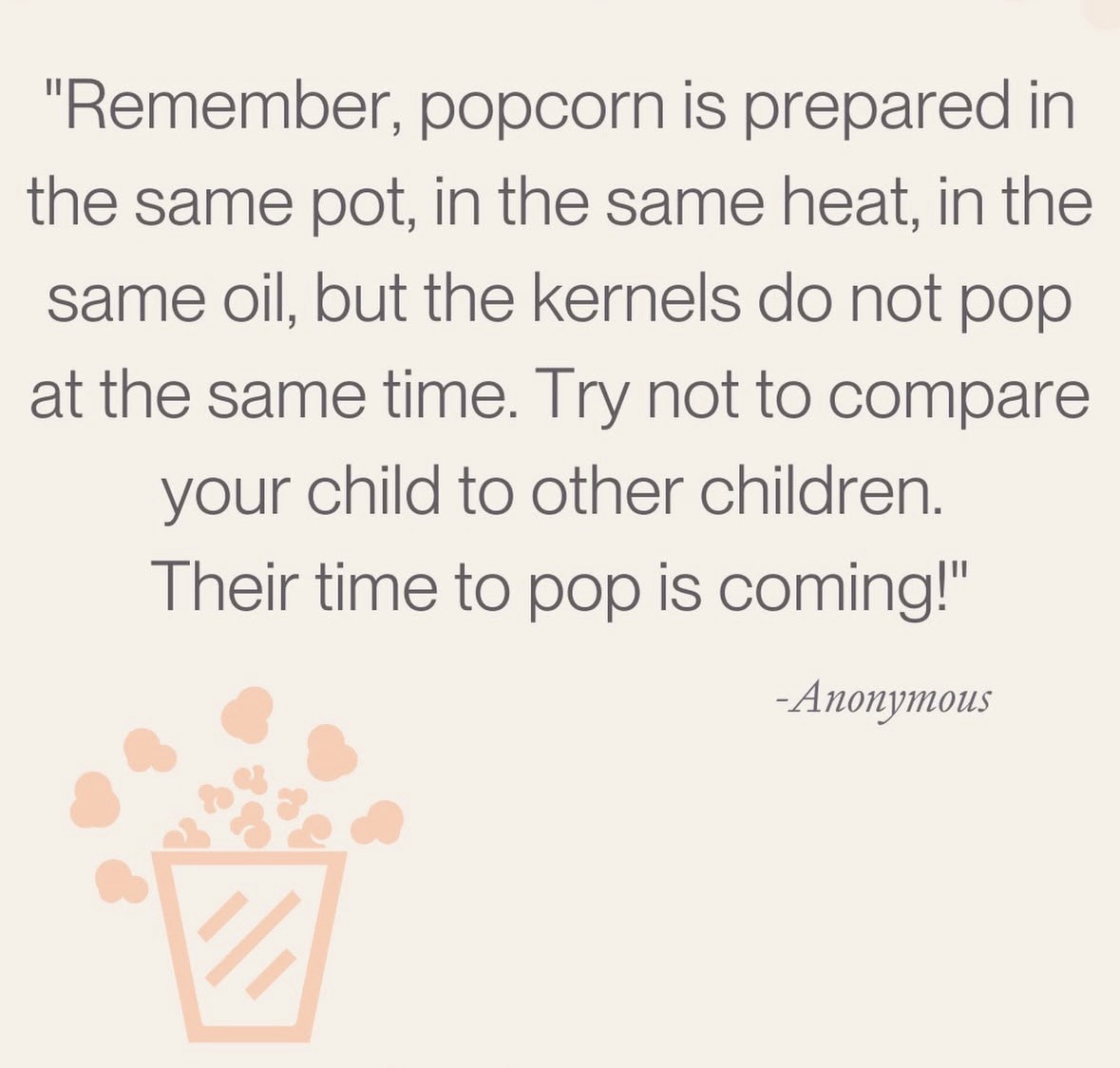
It’s hard not to look around and measure. At birthday parties, playgrounds, school drop-offs, even family gatherings, the comparisons sneak in quietly. Someone else’s child is talking sooner, reading earlier, sitting still longer, understanding faster. And without meaning to, you start asking yourself questions you never planned to ask. Is my child behind? Am I missing something? Should I be doing more?
That’s where the popcorn image lands so gently, and so truthfully.
Every kernel sits in the same pot. Same heat. Same oil. Same conditions. And yet, they don’t pop together. Some burst open almost immediately. Others take their time, quietly absorbing heat, changing on the inside long before anything shows on the outside. And a few wait until the very end, then pop so suddenly you wonder how they held on for so long.
Children are like that. Development isn’t a race, even though the world often treats it like one. Growth happens in layers, not timelines. What looks like “nothing happening” from the outside is often a lot happening underneath. Wiring is forming. Confidence is building. Safety is being felt. Curiosity is waking up.
When we compare, we assume that early popping means better popping. But that’s not how it works. Fast doesn’t equal strong. Early doesn’t mean lasting. Loud doesn’t mean right. Some children bloom early and plateau. Others move quietly and then surge forward when they’re ready, with depth and resilience that can’t be rushed.
It’s also worth remembering that the heat isn’t just school or milestones. It’s love, patience, encouragement, boundaries, mistakes, comfort, repetition. All of it matters. And you’re already providing far more of it than you probably give yourself credit for.
Comparison has a way of stealing joy from the present moment. It turns “look at what my child is discovering” into “why aren’t they doing that yet?” It shifts your focus from connection to concern. And kids feel that shift. They feel when they’re being watched with worry instead of wonder.
Trust doesn’t mean ignoring real needs or avoiding support when it’s required. It means understanding that different doesn’t automatically mean delayed, and slower doesn’t mean wrong. It means honoring the child you have, not the child you’ve been told to expect by a chart or a comment or a casual comparison.
Your child’s moment is coming. It may not look like someone else’s moment. It may surprise you. It may arrive quietly or all at once. But it will be theirs, shaped by who they are, not by how closely they matched someone else’s timeline.
So when the noise gets loud and the comparisons start creeping in, remember the pot. Same heat. Same care. Different timing. And that timing? It’s not a flaw. It’s part of the design.
 Kenrick Vaz