

Most leaders focus on the what and the how.
What needs to be done. How to get there.
But the best leaders focus on the who first.
Who are the people on their team?
What do they need to succeed?
How do they feel and what drives them?
That’s where real leadership lives.
The most impactful leaders I know all share
8 emotional intelligence traits:
✅ Sensing emotions
↳ They notice what’s not being said
✅ Genuine empathy
↳ They truly understand their team’s perspective
✅ Leading by example
↳ They model the behavior they want to see
✅ Authentic connection
↳ They build relationships that matter
✅ Deep listening
↳ They make people feel heard and valued
✅ Demonstrated commitment
↳ They show up when it counts
✅ Investment in growth
↳ They help others reach their potential
✅ Active involvement
↳ They work with their team, not above them
When you lead this way:
People don’t just complete tasks.
They go above and beyond.
They don’t just show up.
They show up as their best selves.
The leaders people remember and follow
aren’t the ones with all the answers.
They’re the ones who cared enough to understand
the people asking the questions.
They saw the who, first.
And understood it.
The Skill-Will Matrix
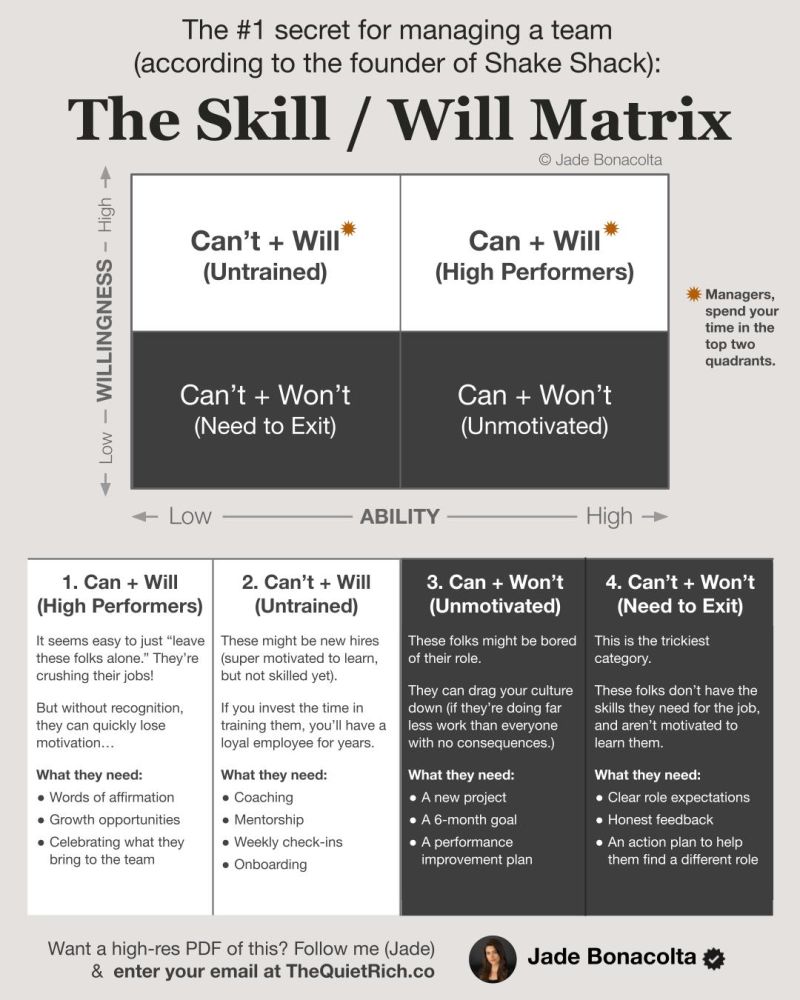
Heard of Danny Meyer?
He’s a legendary New York restauranteur known for
Shake Shack, Union Square Cafe, Gramercy Tavern, Manhatta, etc.
On the Tim Ferriss Show, he talked about this simple
(but brutally-effective) 2×2 matrix.
It’s the best framework for people managers to
decide which team members need most of their time.
He scores each team member on two things:
Willingness (motivation)
+ Ability (skill).
———
So, where on the chart does he spend the most time
as a leader?
Many people would say the bottom two quadrants
↳ the folks who need motivation or need to move on.
Danny disagrees.
He spends the MOST time with the top two quadrants
↳ the high performers and those who are new to the team.
Why? Because they are the key to long-term success.
It’s MUCH easier to teach a skill than to teach motivation.
———
And guess what…
Danny doesn’t just keep this matrix in his own head.
He put it on the mirror of his employees’ locker room.
He’s 100% transparent in how he manages his team.
So every time they get ready for work, they can decide
where they are now (and where they want to be). 🙌
How to handle stress at work
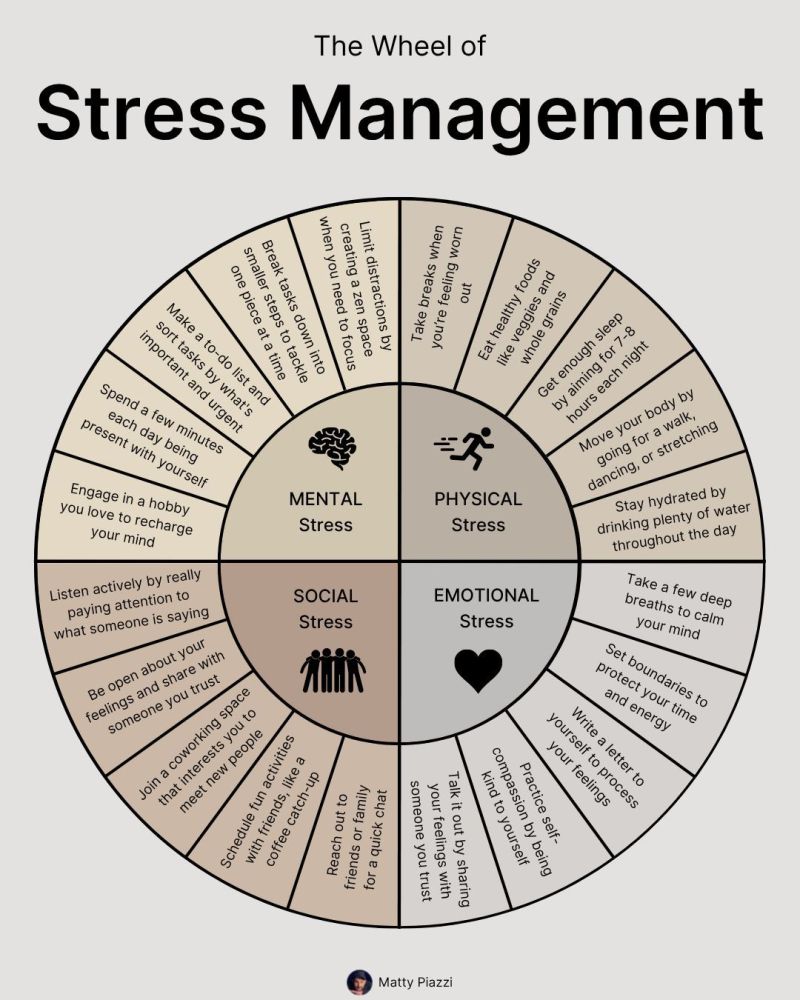
How to handle stress at work
Here’s a special tool that could help you:
→ Writing a letter to yourself (or to others)
I’m not joking :)
We’re gonna write a letter to Jasmine…
Let’s see how to give it a try!
1. First, grab a notebook and a pen.
Make sure to find a quiet spot without distractions.
2. Now, think about who you wanna write to.
This could be:
→ Yourself
→ Others — like a coworker, friend, or mentor
Let’s say you wanna write a letter to Jasmine, your mentor.
By the way, Jasmine is my favorite name.
Did you know that? :)
3. Alright, now it’s time to start writing.
Start your letter with a greeting, like:
“Dear Jasmine, I hope this letter finds you well.
I’m reaching out because…
I’ve been feeling overwhelmed with…”
4. Now, write about what’s bothering you.
And be honest!
Use these questions to help you write:
→ What specific situation is causing me stress?
→ How does it make me feel? (anxious, frustrated…)
→ Why do I think this situation is affecting me?
5. Okay, you’ve just expressed your feelings.
Now, think about how you can address the situation and write it down.
Keep writing like you’re talking to Jasmine.
So, write something like:
→ “You know what, Jasmine, I think I should…”
Get help from these 3 questions:
→ Are there any resources I can use?
→ What support do I need from others?
→ What steps can I take to feel better or manage the stress?
6. Alright, it’s time to say goodbye to Jasmine.
Wrap up your letter on a positive note.
Remind yourself that it’s okay to feel stressed.
For example, you can say:
“Yes Jasmine, I know it’s normal to feel this way.
And honestly, I’m proud of myself for recognizing my stress.
Here’s my promise:
I’ll take things one step at a time and seek help when I need it!”
7. Great job!
Now, take a moment to read your letter.
Reflect on what you’ve written to Jasmine.
This can help you gain perspective on your feelings.
Plus, you’ll have more clarity about your next steps.
Don’t Hang It in Your Gallery
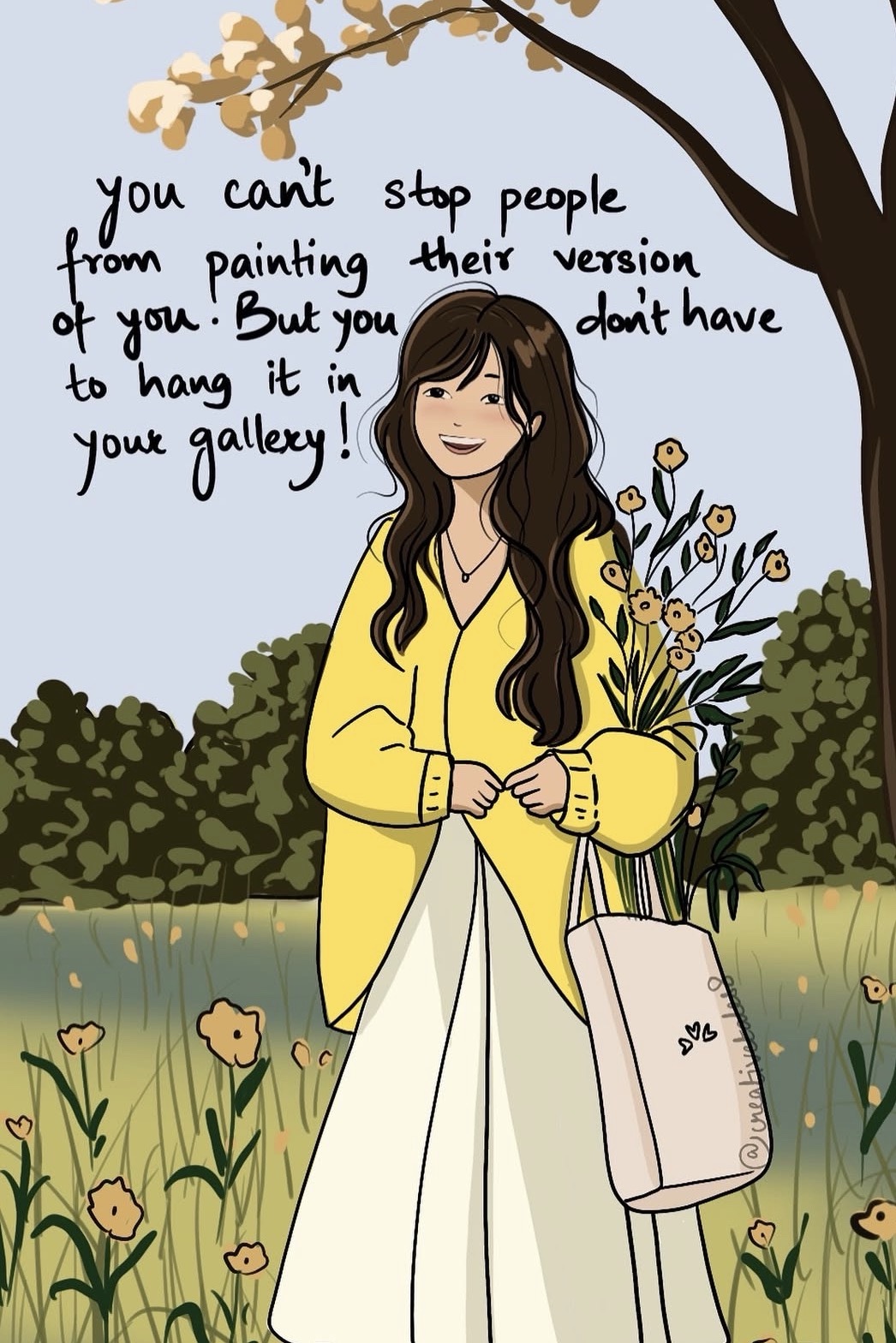
You can’t stop people from painting their version of you. Some will sketch from memory, others from imagination, and a few will draw from rumor. Everyone, it seems, has a canvas with your name on it. They’ll paint you in colors that match their mood, not your truth — and when they’re done, they’ll hold it up proudly as if it’s the real you.
It’s human nature. People interpret, assume, and project. Sometimes they see your confidence and call it arrogance. Your silence becomes rudeness. Your kindness, weakness. Your boundaries, attitude. They paint what fits their frame, not yours.
But here’s the thing: you don’t have to hang their painting in your gallery. You don’t have to look at it, defend it, or fix it. You don’t even have to acknowledge it. Not every opinion deserves wall space in your mind.
Your gallery — the inner space where you store your peace, your self-worth, your story — should be curated carefully. Let it hold only the art that reflects truth, growth, and grace. Keep the walls clean of cheap interpretations. Protect that space fiercely.
Because when you stop worrying about how others see you, you start living how you see yourself. You begin to notice the quiet beauty of your own strokes — the resilience, the kindness, the lessons learned in shades of light and shadow.
So let them paint. Let them post. Let them whisper. That’s their art, not yours. You’re under no obligation to buy the portrait they made of you. Smile, move on, and keep working on your masterpiece.
After all, the only gallery that truly matters is the one where you decide what deserves to stay.
Alternate Income Streams
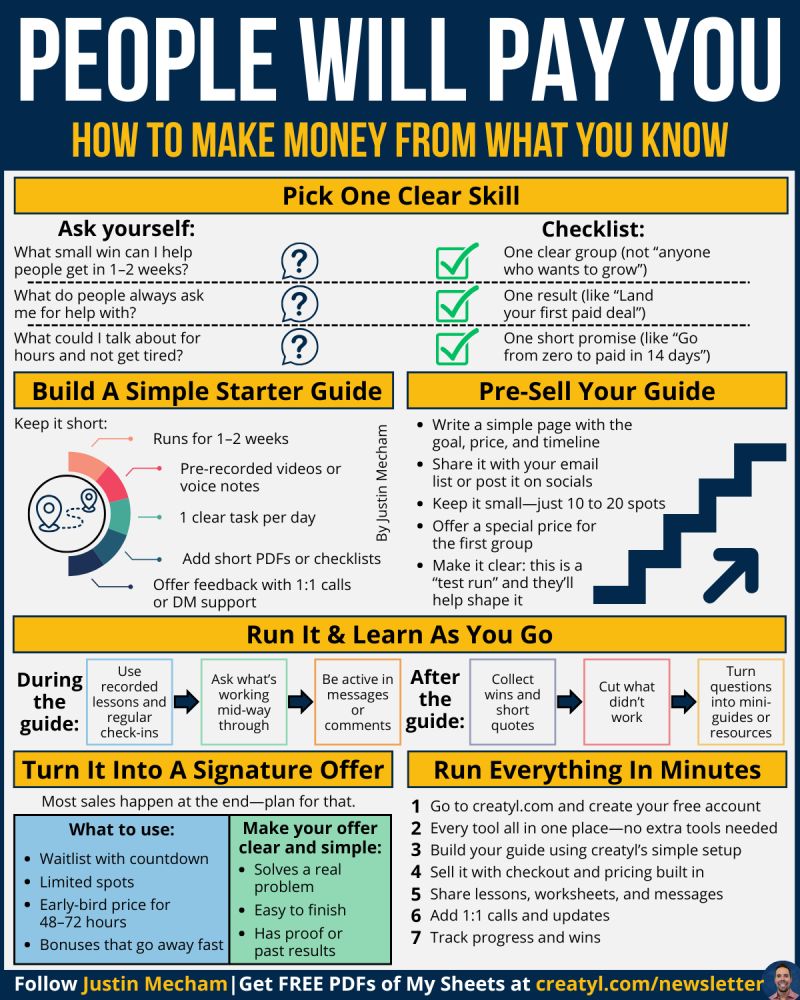
People already ask you for help—
Now it’s time to get paid for it:
You already have something valuable –
What you already know how to do.
Here’s how to turn that into income:
Then focus on:
🟡 One short promise
🟡 One specific skill
🟡 One clear result
Then build a simple guide,
keep it short, keep it real—
Make it easy to finish.
How?
🎯 1–2 weeks long
🎯 PDFs or checklists
🎯 1 clear task per day
🎯 Optional 1:1 support
🎯 Pre-recorded voice notes
Now, here’s the part people miss:
You don’t need a tech team.
You don’t need fancy software.
In just minutes, you can create:
✅ Digital products
✅ Online courses
✅ Coaching calls
✅ Communities
✅ Newsletters
✅ And more
It’s easier than you think—
Don’t wait for permission to be valuable.
Your knowledge is already useful to someone.
What’s missing is a clear way to earn from it.
💡The easiest way for creators to make money.
Safe in His Shadow

There’s something deeply comforting about shadows—not the kind that hide things, but the kind that protect. The kind you find on a blazing summer day when you step under a tree and instantly feel the coolness wrap around you. That’s the kind of shadow Psalm 91 talks about. Not darkness, not fear, but safety. A place where the chaos of the world slows down and you can breathe again.
“Whoever dwells in the shelter of the Most High will rest in the shadow of the Almighty.” It’s not a verse about running. It’s about staying. Dwelling. Choosing to remain close to God, not just when things are good, but when everything feels uncertain and wild. The word “abide” carries a sense of consistency—a quiet decision to anchor yourself in His presence no matter what’s happening outside.
The truth is, life has a way of shaking us. Some days, it’s a sudden storm that hits without warning. Other days, it’s just the slow erosion of peace—one worry, one disappointment, one heartbreak at a time. But in all of it, this psalm reminds us we don’t have to face it uncovered. There’s a shadow, a refuge, a fortress. And it’s not an escape from reality; it’s strength in the middle of it.
I love how personal the next line is: “I will say of the Lord, He is my refuge and my fortress, my God, in whom I trust.” It’s not just a statement of belief—it’s a declaration of relationship. The psalmist doesn’t talk about a God or the Lord in a distant way. He says my God. My refuge. My fortress. There’s something powerful about that intimacy. It’s what turns faith from ritual into reliance.
Think about it—shadows move with the light. To stay in His shadow, you’ve got to stay close to where He is. You can’t wander too far and expect to still feel covered. That’s the invitation of this passage: to stay close enough to God that His presence shapes your posture, your peace, your perspective. When you live in that nearness, even the fiercest heat of life’s trials can’t burn you out.
So maybe the call today isn’t to fight harder or fix everything. Maybe it’s to pause long enough to step back into the shadow of the Almighty—to remember that protection doesn’t always look like escape. Sometimes it’s quiet endurance under His wing, the kind of strength that’s steady because it’s not yours alone.
You don’t have to have it all together. You don’t have to outrun the storm. Just stay close. There’s peace in His presence, safety in His shadow, and rest for your soul right where you are.
How to handle difficult people without losing your mind.

Difficult people aren’t ruining your day.
Your lack of a strategy is.
You don’t need to argue.
You need a system.
Here’s a proven system to handle difficult people without losing your mind:
1/ Don’t Take the Bait
↳ Not every comment deserves a comeback. Silence is a power move.
2/ Their Chaos ≠ Your Problem
↳ You’re not responsible for fixing their drama. Let it stay their drama.
3/ Set Boundaries Early
↳ Be kind, but firm. “That doesn’t work for me” is a complete sentence.
4/ Don’t Match Their Energy
↳ They’re chaotic? You stay calm. That contrast speaks volumes.
5/ Stick to Facts, Not Feelings
↳ Document everything. Facts end arguments, emotions extend them.
6/ Stop Playing Therapist
↳ It’s not your job to decode their behaviour. You’ve got bigger things to do.
7/ Use Strategic Pauses
↳ Sometimes the most powerful response is: “Let me think about that.”
8/ Exit Toxic Convos
↳ Shift the topic or walk away. Your mental bandwidth is currency.
9/ Stay One Step Ahead
↳ Difficult people are predictable. Learn their patterns. Prep your responses. Turn every ambush into a non-event.
10/ Debrief With Your Circle
↳ Don’t carry that weight alone. Process it with someone you trust.
Why this matters:
The average professional spends nearly 3 hours every week dealing with difficult people.
That’s a full workday each month lost to workplace drama.*
But the real cost?
– Your peace of mind.
– Your team’s morale.
– Your best work.
Save this system.
Test it tomorrow.
Watch what changes.
Understanding your team’s thinking style

Do you talk to think — or think to talk?
This one question changed how I understand team dynamics.
A leader recently told me they were trying to “fix” their team’s communication:
“The quiet ones need to speak up. The vocal ones need to tone it down.”
This leader…
–>They weren’t solving a communication problem.
–>They were overlooking a processing difference.
People process ideas differently.
Some talk to think:
↳ They figure things out as they speak
↳ Refine ideas through sharing
↳ Gain energy from discussion
Others think to talk:
↳ They build ideas quietly
↳ Connect the dots internally
↳ Speak when their thoughts feel complete
Neither is wrong. Both are valuable.
What looks like “holding back” may be thoughtful reflection.
What feels like “taking over” might be thinking out loud.
Start designing for how they process.
-Time to talk
-Space to think
-Respect for both
The best ideas don’t come from uniformity.
They come when every thinking style has room to breathe.
The Quiet Power of Respect
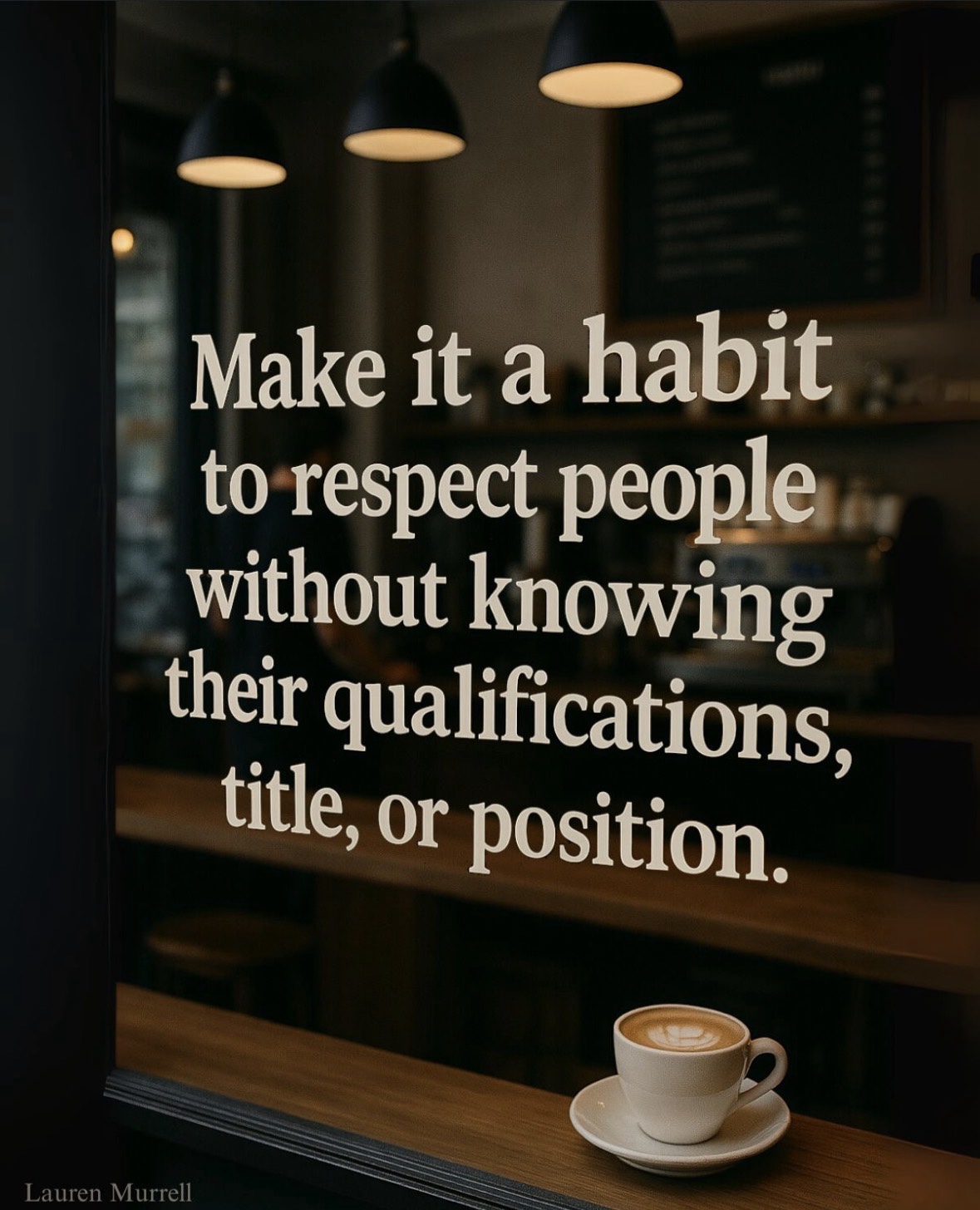
We live in a world that loves labels. CEO. Engineer. Doctor. Influencer. Titles have become shorthand for how we decide who deserves our time, attention, or kindness. But somewhere along the way, we’ve started forgetting one simple truth—respect isn’t something people should have to earn by flashing a designation. It’s something they deserve by simply being human.
Think about it. Some of the kindest, most grounded people you’ll ever meet won’t have fancy titles or blue checkmarks next to their names. They’re the ones who hold the door open, smile in passing, or ask how your day’s going because they mean it. Yet too often, we overlook them while rushing to impress someone “important.” That’s where we get it backward. The real mark of maturity isn’t how we treat those above us—it’s how we treat those who have nothing to offer us in return.
There’s a well-known story about Warren Buffett that captures this beautifully. When he was considering hiring someone for a senior role, he invited the candidate to breakfast at a local restaurant. The conversation went well, but Buffett wasn’t just paying attention to answers about finance or leadership—he was observing how the person treated the restaurant staff. The candidate was polite to Buffett but dismissive and impatient with the waiter. That was the end of it. Buffett later said that how a person treats someone who can’t do anything for them says more about their character than any résumé ever could.
That’s the essence of respect—it’s not selective. Making respect a habit changes how we move through the world. It softens our edges. It makes conversations more genuine. When you treat everyone with the same level of dignity—whether they’re a senior executive or the janitor keeping the office spotless—you create spaces where people feel seen, not sized up. That’s where trust begins. That’s where real leadership starts.
Respect also humbles us. It reminds us that everyone’s walking their own path with struggles we can’t see and stories we’ll never fully know. The barista who gets your name wrong might be juggling two jobs. The intern fumbling through their first presentation might be the next big innovator. The security guard greeting you every morning might carry wisdom far beyond your years. When you stop seeing people through the lens of titles, you start seeing their humanity—and that changes everything.
So here’s a thought worth carrying: make respect automatic. Don’t wait to find out someone’s position before deciding how to treat them. Smile. Listen. Be kind. Because the person in front of you today could very well be the person you need tomorrow—and even if they aren’t, you’ll walk away knowing you chose decency over ego.
At the end of the day, respect costs nothing—but it reveals everything about who you are.
12 Daily Habits That Will Change Your Life

12 small habits that will change your life.
These daily practices take minimal time but
deliver exponential returns.
I’ve tested them and seen the impact:
1️⃣ Exercise Session
Even 20 minutes moves the needle. It’s not about getting
ripped—it’s about showing up for yourself first thing.
2️⃣ 2-Minute Rule
Procrastinating the tiny tasks keeps them in your head.
If it takes 2 minutes, do it now.
3️⃣ Gratitude Practice
List 3 things you’re grateful for each morning. It rewires
your brain to spot opportunities instead of obstacles.
4️⃣ 4-7-8 Breathing
Breathe in for 4, hold for 7, exhale for 8. Use it before
big meetings or whenever tension hits.
5️⃣ Meeting Breaks
Back-to-back meetings kill productivity. Those 5-minute
gaps aren’t wasted time. They’re essential recovery periods.
6️⃣ 6-Second Pause
The space between stimulus and response is your power
zone. That tiny pause prevents reactive decisions.
7️⃣ Water Intake
Your brain is 73% water. Even mild dehydration tanks your
decision-making.
8️⃣ Sleep Commitment
Sleep deprivation isn’t a badge of honor. Prioritize quality
sleep to be at your best for yourself and others.
9️⃣ Daily Meditation
9 minutes to reset your mental operating system. It’s not
about emptying your mind—it’s about observing it.
🔟 Movement Goal
10,000 steps seem daunting? Walk while you take calls.
Use a standing desk. Small movement adds up.
1️⃣1️⃣ Skill-Building
11 minutes learning something new—a language, a skill,
a concept. Compound interest works for knowledge too.
1️⃣2️⃣ Reading Practice
12 pages daily is 24 books a year. Leaders are readers.
Make it non-negotiable.
Small steps compound over time.
Pick one habit. When you’re ready, add another.
Watch your life transform, one tiny change at a time.
 Kenrick Vaz