

72% of employees say they want more feedback.
But 95% of leaders struggle to deliver it effectively.
Why?
Because there’s a world of difference
between feedback that builds up
and feedback that deflates.
When feedback feels like judgment:
Trust breaks.
Growth stalls.
Good people pull away.
But when it feels like support,
teams can truly grow and learn.
Here’s how the most impactful leaders give tough
feedback without being harsh:
1️⃣ Give feedback in private
→ Not in front of others
→ Public criticism creates public armor
2️⃣ Be clear and neutral
→ Not vague or judgmental
→ Confusion breeds anxiety and delay
3️⃣ Start and end with positives
→ Don’t jump straight to criticism
→ Context in conversation creates safety
4️⃣ Focus on behavior, not character
→ Build trust, not blame
→ Progress comes through changed actions
5️⃣ Offer next steps and support
→ Don’t leave them hanging
→ Guidance builds confidence and elevates results
Here’s what most leaders miss:
Tough feedback isn’t what breaks trust.
Feedback without respect does.
When your team feels respected…
They lean in.
They learn.
They level up.
Leading people is all about being human.
About letting your team know you believe in them
enough to be honest.
And care about them enough
to highlight the areas they can grow.
How do you prefer to receive tough feedback?
(72% & 95% stat source: Harvard Business Review)
Level Up With Kindness
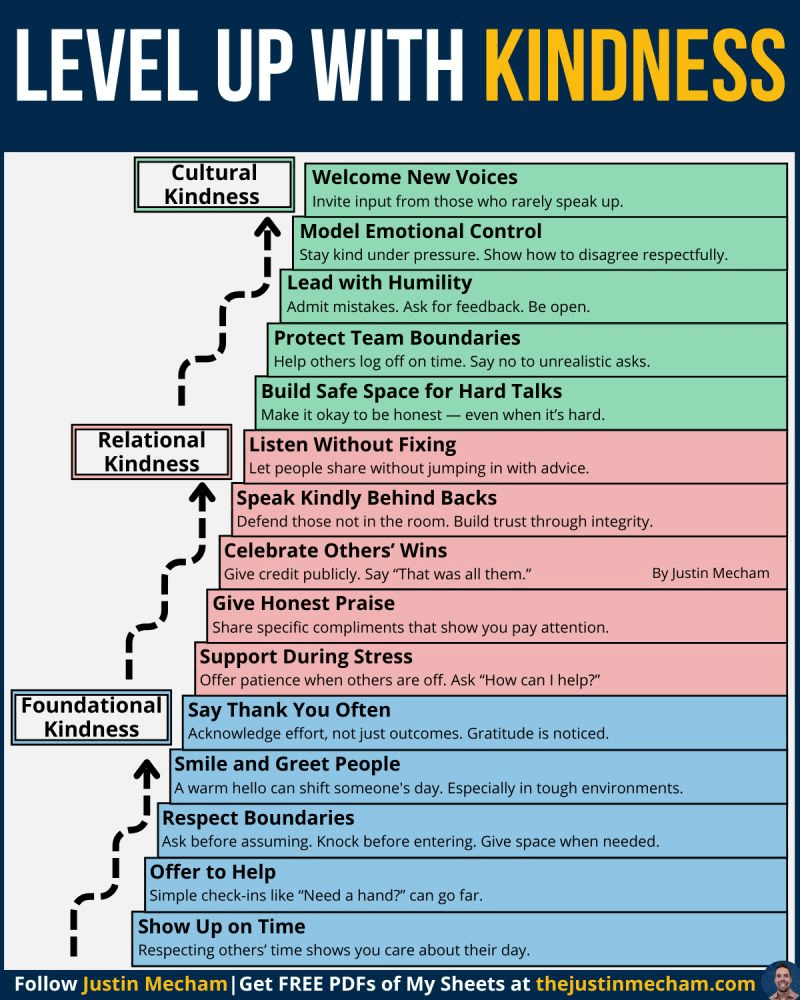
People don’t quit companies—
They quit unkind cultures:
Kindness isn’t about being soft.
It’s about being strong enough to respond,
instead of react.
Here’s how that happens, step by step:
🟧 Notice what you feel
Don’t mask it. Name it.
🟨 Understand your patterns
What drains you? What triggers you?
🟧 Pause before you react
A second of silence can save hours of regret.
🟨 Choose your response
Ask: “What’s a better way to handle this?”
🟧 See other perspectives
You don’t have to agree — just understand.
🟨 Speak with care
Say what’s real, not what’s rude.
🟧 Build respect in conflict
Tension is where trust is built.
🟨 Stay grounded under pressure
Lead with calm, not control.
Use my sheet to shift from reacting to responding.
Because kindness isn’t just something you give,
it’s something you build—
One step and choice at a time.
Leading With Empathy

The quietest leaders often make the biggest impact.
Not through bold declarations or power moves.
But through something deeper: empathy.
It’s more than just listening to words.
It’s hearing the unspoken.
Understanding the unsaid.
Real empathy in leadership means:
➟ Noticing when your star performer seems off
➟ Reading between the lines in conversations
➟ Sensing team tension before it erupts
When you lead with empathy:
✅ Trust deepens naturally
✅ Problems surface early
✅ Solutions emerge more easily
But here’s what many miss:
Empathy isn’t soft. It’s strategic.
It’s the difference between:
➟ A team that hides problems
➟ And one that solves them together
Between:
➟ People who do the minimum
➟ And those who give their best
Between:
➟ A group that works side by side
➟ And a team that moves as one
Want to strengthen your empathy?
Start with silence.
Listen more than you speak.
Watch for what isn’t being said.
Because in leadership, the greatest power
isn’t in being heard, but in truly hearing others.
That’s how you build teams that last.
That’s how you create impact that matters.
That’s how you leave a legacy worth leaving.
Your next level of leadership
starts with two simple words:
“I’m listening.”
Mean them.
10 Leadership Blind Spots

All CEOs have blind spots.
The toxic ones pretend not to.
Great leaders seek them out.
Because they understand true leadership
isn’t about safeguarding their ego.
It’s about safeguarding their people.
10 blind spots that push your best talent away:
Avoiding Conflict
↳ Every “not now” conversation becomes tomorrow’s crisis.
↳ Address issues head-on, don’t hope they disappear.
No Growth Path
↳ High performers need challenges like plants need sunlight.
↳ Without opportunities, they’ll go elsewhere to grow.
Micromanagement
↳ Micromanagement is fear disguised as efficiency.
↳ Trust your team to deliver; they’ll surpass your expectations.
Ignoring Feedback
↳ Dismissing input sends the message: “Your ideas don’t matter.”
↳ Ideas can come from anywhere. Make room for every voice.
Overloading Top Performers
↳ Rewarding excellence with overload accelerates burnout.
↳ Don’t let your best people suffer for their success.
Favoritism
↳ Playing favorites may drive short-term wins but erodes long-term culture.
↳ Create a level playing field: equal opportunity, equal accountability.
No Clear Vision
↳ Work without meaning leads to disengagement.
↳ Tie daily tasks to a larger purpose. Highlight their impact.
Inconsistent Leadership
↳ When everything is urgent, nothing is.
↳ Keep your focus on what matters.
Work-Life Neglect
↳ An “always on” culture produces “always looking” employees.
↳ Respect boundaries like they’re part of your bottom line.
No Recognition
↳ When exceptional becomes expected, motivation fades.
↳ Show your talent their impact is seen.
The truth?
Most leaders don’t recognize these blind spots until an exit interview.
Ask yourself:
👉 “Do I make my team feel valued?”
👉 “Am I helping them grow?”
👉 “Do I listen to understand or to respond?”
Because awareness isn’t just the first step.
It’s the most critical one.
Design an environment where success occurs naturally.
The Power of Changing Tables

Ever noticed how some people only recognize your value when you’re no longer within their reach? It’s a hard truth, but it happens often. We bring ideas, effort, and heart to a table, assuming it’s seen and appreciated. But sometimes, familiarity makes others blind to the brilliance you quietly bring every day.
Then one day, you move—maybe to a new role, a new circle, or a new opportunity—and suddenly, the same qualities they overlooked now seem extraordinary when viewed from the outside. Why? Because distance creates perspective.
Here’s the thing: your worth is not tied to the table you sit at. It’s in your skills, your integrity, your creativity, and the energy you bring wherever you go. If someone fails to see it now, that doesn’t diminish it. It just means the right table is still waiting.
So don’t shrink yourself to fit where you’re not valued. Don’t dim your light hoping someone will notice. Move with confidence, knowing that the right people—the ones who truly appreciate your presence—won’t need you to leave before they recognize your value.
Sometimes, the most empowering thing you can do is choose a different table!
7 Frameworks For A Growth Mindset

Growth doesn’t start with skill.
It starts with mindset.
Because the way you think shapes everything you do.
Here are 7 frameworks to help you develop a growth mindset:
1. GROW Model
Because action needs clarity:
→ Set specific Goals.
→ Get real about your Reality.
→ Explore your Options.
→ Commit with Willpower.
2. SMART Goals
Dreams are great – measurable outcomes are better.
→ Be Specific.
→ Track what’s Measurable.
→ Set Achievable targets.
→ Keep them Relevant.
→ Add a Time-bound deadline.
3. YET Framework
The mindset shift that changes everything:
→ You’re not there yet (but you will be).
→ Celebrate Effort, not just outcomes.
→ Progress comes one Step at a time.
4. LEARN Model
Growth demands curiosity and reflection:
→ Listen to feedback.
→ Evaluate what’s working (and what’s not).
→ Adapt as needed.
→ Refine constantly.
→ Nurture curiosity and passion.
5. POWER Framework
Because consistency wins:
→ Practise deliberately.
→ Take Ownership of your growth.
→ Leverage Willpower when it’s tough.
→ Honour the grind with Effort.
→ Reflect and repeat.
6. FAIL Framework
Failure’s not the end—it’s a stepping stone:
→ Accept the First stumble.
→ Attempt again with intention.
→ Improve with every setback.
→ Learn and level up.
7. ACT Framework
Keep moving forward:
→ Accept where you are.
→ Change what needs fixing.
→ Try new strategies, relentlessly.
Growth isn’t magic.
It’s effort, clarity, and learning from every stumble.
Which of these frameworks speaks to you?
𝗧𝗵𝗲 𝗕𝗶𝗴𝗴𝗲𝘀𝘁 𝗠𝗶𝘀𝗰𝗼𝗻𝗰𝗲𝗽𝘁𝗶𝗼𝗻 𝗶𝗻 𝗦𝘁𝗮𝗿𝘁𝘂𝗽 𝗩𝗮𝗹𝘂𝗮𝘁𝗶𝗼𝗻
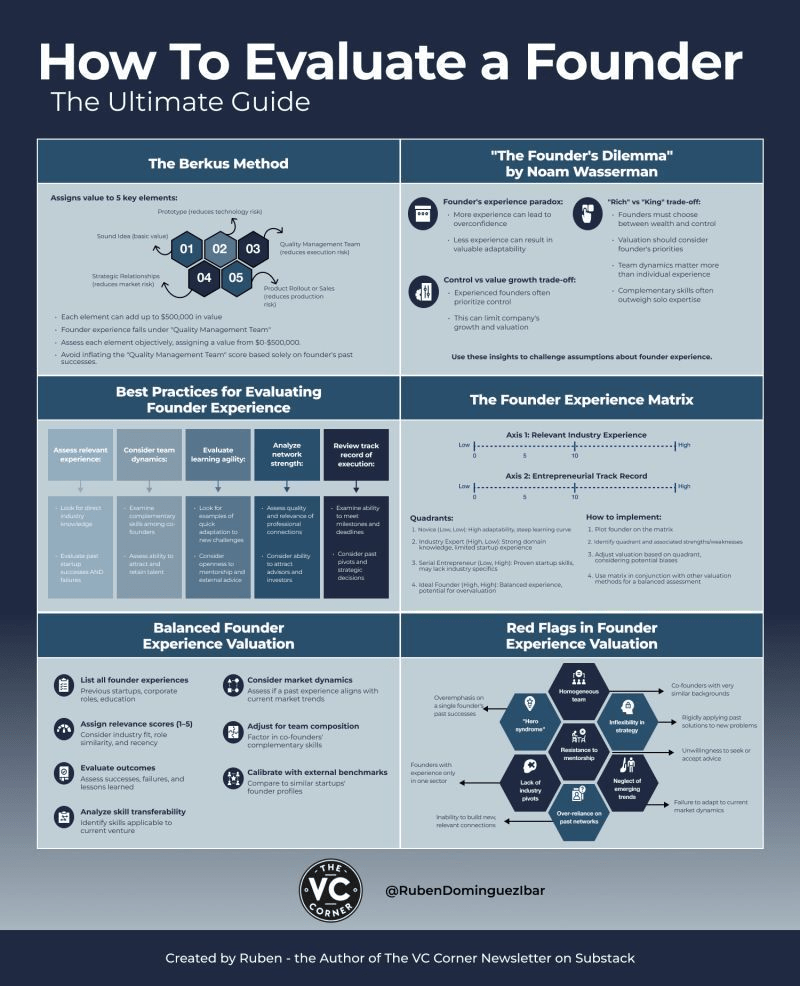
Many believe a serial entrepreneur with multiple exits is a safe bet.
But founder experience can often be overvalued in startup land.
Here’s why:
• 𝗣𝗮𝘀𝘁 𝘀𝘂𝗰𝗰𝗲𝘀𝘀 ≠ 𝗳𝘂𝘁𝘂𝗿𝗲 𝘀𝘂𝗰𝗰𝗲𝘀𝘀: Overconfidence can lead to poor decisions.
• 𝗜𝗻𝗱𝘂𝘀𝘁𝗿𝘆 𝘃𝗲𝘁𝗲𝗿𝗮𝗻𝘀 𝗺𝗮𝘆 𝘀𝘁𝗿𝘂𝗴𝗴𝗹𝗲 𝘁𝗼 𝗶𝗻𝗻𝗼𝘃𝗮𝘁𝗲: Deep expertise can limit adaptability.
• The “𝗵𝗼𝘁𝘀𝗵𝗼𝘁 𝗳𝗼𝘂𝗻𝗱𝗲𝗿” isn’t always the best bet: Charisma can mask red flags.
Want to level up your evaluation game? This cheat sheet covers:
1️⃣ The Berkus Method
2️⃣ Common Misconceptions About Founder Experience
3️⃣ Best Practices for Evaluating Founders
4️⃣ Balanced Founder Experience Valuation
5️⃣ “The Founder’s Dilemma” by Noam Wasserman
6️⃣ The Founder Experience Matrix
7️⃣ Red Flags in Founder Valuation
As Chris Tottman often advises, “It’s not just about past wins—it’s about adaptability, learning agility, and building the right team.”
Where Your Power Lives: The Art of Returning to Now

Anxiety has a way of pulling us into a place that doesn’t even exist yet—the future. We start imagining scenarios, predicting outcomes, and worrying about things that haven’t happened. Our minds race ahead, leaving our bodies behind, and suddenly we feel overwhelmed.
The truth is, anxiety often thrives when we live too far forward. It feeds on uncertainty, on the “what ifs” that spiral out of control. But here’s the good news: your strength isn’t in the future. It’s in this very moment.
Pause for a second. Feel your feet against the floor. Notice your breath moving in and out, steady and constant. This—right here—is where your power lives. Not in the worries of tomorrow or the regrets of yesterday, but in the simplicity of now.
When you bring yourself back to the present, you take away anxiety’s fuel. You remind yourself that this moment is manageable, and that’s all you truly need to handle.
So next time your thoughts start running ahead, gently call them back. Anchor yourself where your breath is. Where your feet are. That’s where peace begins—and where you find your power.
Success Focused Mindset

I used to think success was about
skills and strategy.
Then I watched brilliant people fail
while “average” ones soared.
The difference? Their mindset.
6 steps to build a success mindset that works:
1. Know yourself. Really know yourself.
What lights you up?
What drains your energy?
Where are you holding back?
2. Get crystal clear on your non-negotiables.
These aren’t just boundaries.
They’re your compass for every decision.
Most people stop here. But there’s more.
3. Master the 80/20 rule.
Focus on the few things that create real impact.
Cut the busywork that keeps you stuck.
4. Learn to say “no” without guilt.
Every “yes” to something unimportant
is a “no” to something that matters.
5. Choose your circle carefully.
The right people challenge you to grow.
The wrong ones keep you comfortable.
And here’s the real game-changer:
6. Show up. Especially when it’s hard.
When motivation fades (it will),
let discipline carry you forward.
Because success isn’t about feeling ready.
It’s about moving forward anyway.
Small steps on tough days build
the mindset that others envy.
Remember:
Your mindset isn’t just how you think.
It’s how you show up every day.
That’s how you build success that lasts.
How to Give Feedback
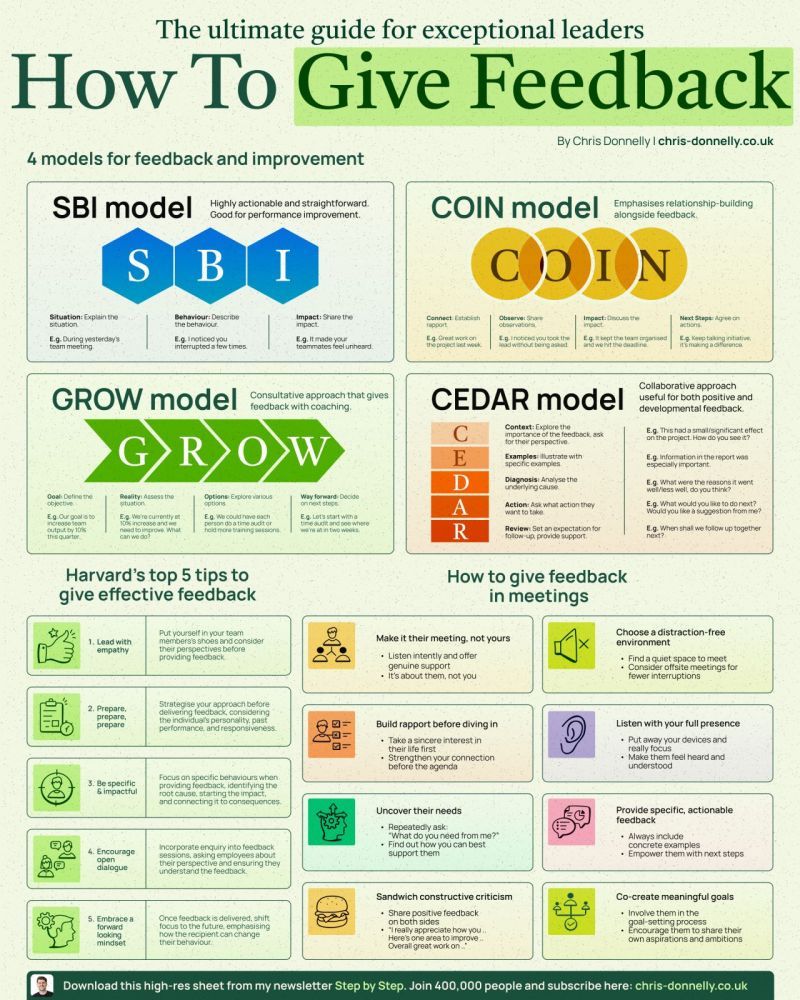
69% of employees say they want more feedback.
Steal this guide to become an exceptional leader:
Exceptional leaders give the best feedback.
They know it’s worth its weight in gold.
When feedback is given in the right way…
It can take your business to the next level.
Steal this cheat sheet to give better feedback.
Here’s a sneak peek at the content:
4 models for feedback and improvement
1. SBI model: Highly actionable and straightforward.
2. COIN model: Emphasises relationship-building in feedback.
3. GROW model: Consultative approach via coaching.
4. CEDAR model: A comprehensive deep-dive into complex topics.
Harvard’s top 5 tips to give effective feedback
👍 Lead with empathy
📋 Prepare, prepare, prepare
🎯 Be specific & impactful
🎙️ Encourage open dialogue
🧠 Embrace a forward-looking mindset
How to give feedback in meetings
👫 Make it their meeting, not yours
☑️ Build rapport before diving in
👤 Uncover their needs
🥪 Sandwich constructive criticism
🔇 Choose a distraction-free environment
👂 Listen with your full presence
💬 Provide specific, actionable feedback
🤝 Co-create meaningful goals
Stop letting poor communication be your bottleneck.
Use this sheet to give better feedback today.
 Kenrick Vaz