9 Leadership Styles

You’ve been told there’s one “best” way to lead.
That’s a lie.

The greatest CEOs and founders know a secret:
Leadership isn’t one-size-fits-all.

Here are the 9 leadership styles they actually use:

1. Visionary
→ Paints the big picture
→ Inspires long-term thinking

2. Democratic
→ Values everyone’s input
→ Builds team buy-in

3. Servant
→ Puts people first
→ Creates loyalty through service

4. Autocratic
→ Makes fast decisions
→ Drives rapid execution

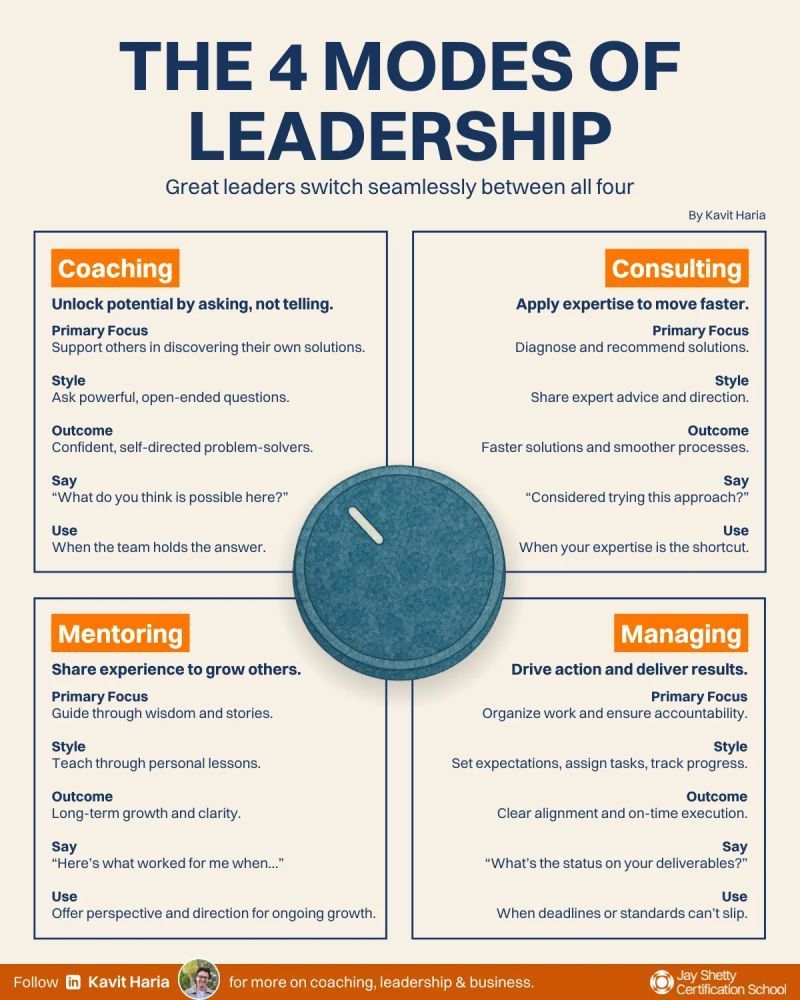
5. Coaching
→ Develops people’s potential
→ Focuses on growth

6. Transformational
→ Pushes bold change
→ Lifts teams to new heights

7. Transactional
→ Rewards results
→ Sets clear expectations

8. Laissez-Faire
→ Gives freedom to experts
→ Trusts people to deliver

9. Situational
→ Adapts to what’s needed
→ Reads the room perfectly

The truth?

Your team doesn’t need the “perfect” leader.
They need the RIGHT leader for RIGHT NOW.

• New team? More coaching.
• Crisis mode? Perhaps autocratic.
• Creative experts? Try laissez-faire.
• Building culture? Consider servant leadership.

Great leaders don’t stick to one style.
They have a toolkit and know when to use each tool.

Save this guide.
Study these styles.
Practice switching between them.

Your effectiveness will skyrocket.
Your team will thank you.

Because the best leaders aren’t rigid.
They’re responsive.

Change The Environment, Not The Plant

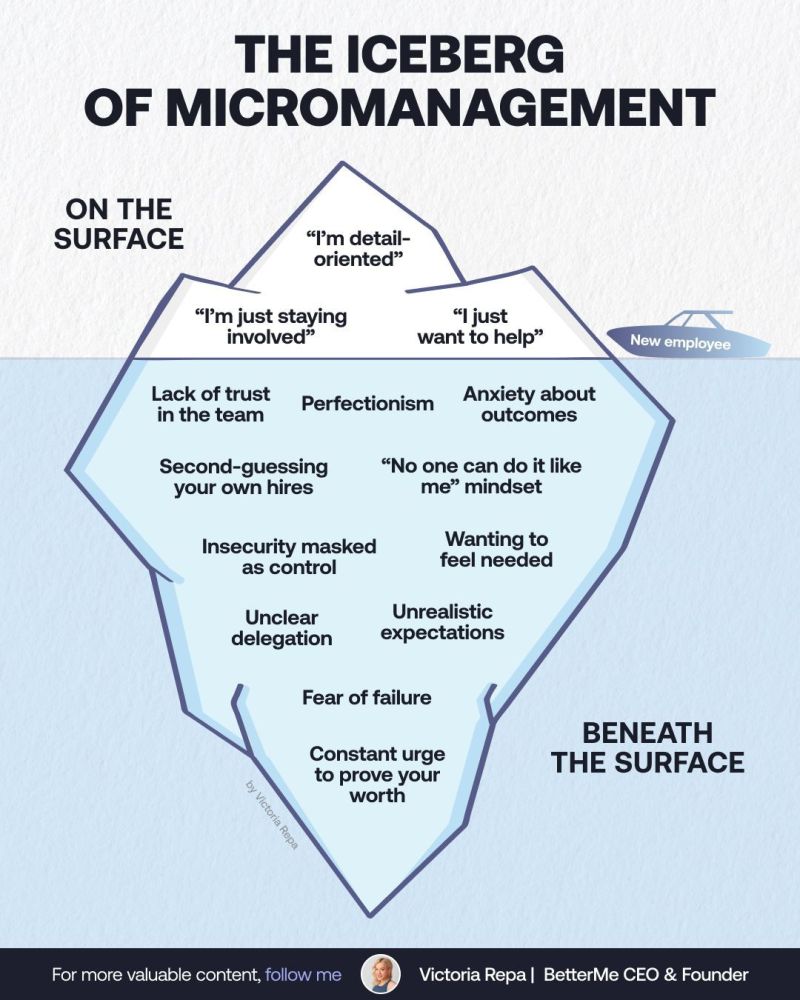
I recently had the pleasure of working with a leader who truly cared about their team’s success. They were not only kind and steady, but they also focused on nurturing strong relationships. However, the team seemed to be stuck in a bit of a challenging spot—things weren’t flowing smoothly, accountability was lacking, and some unhelpful micro-behaviors were being quietly accepted.

Initially, this leader couldn’t see their role in it. Not because they were disengaged or harmful—far from it. But because they were so focused on managing relationships that they avoided anything that might disrupt those connections.

They believed that keeping the peace was a sign of effective leadership. But in reality, they were preserving dysfunction. Relationship management had become the goal, not the means to move the team forward.

It reminded me of something I recently read from Charles Sull’s research on toxic culture:

“Fishes do not care if stuff is wet.”
In his research, he states that toxic leaders often fail to recognize the problem. So, poisonous cultures rarely get addressed because the people leading them don’t perceive an issue.

And when they do get feedback?
Sometimes, they can react a bit defensively, which makes it challenging to foster meaningful change. The reality is that culture truly needs nurturing from non-toxic leadership to flourish. Embracing change often hinges on strong commitment from the top, alongside leaders who genuinely embody the behaviors they wish to promote.

The wonderful news? Toxic cultures are fixable! With the right approach that includes coaching, accountability, identifying enabling factors, and, most importantly, leadership that’s eager to examine the culture they’ve helped create, positive change is possible!

That’s exactly what this leader did! They began to notice those moments when silence allowed the behaviors they wanted to change. Instead of casting blame, they stepped in with clarity and understanding. Over time, the culture began to shift positively!

It’s not necessary to be a “bad” leader to play a part in dysfunction. The essential part is being open to recognizing it, and making changes to improve it.

A truly stunning example of this dynamic that I’ve encountered is this beautiful piece of art by Roberto Ferraro

Source: Anna Datskiv

8 Relationship Habits That Win More

Feel like “selling” is pushing people away?
Try this instead.
(It works, and feels better too.)

Let’s be honest:
Growing your book of business is tough.

You start second-guessing everything:

Am I being too pushy?
Not persuasive enough?
Even talking to the right people?

But the truth is:
You don’t have to “sell” to grow.

Just do what you already know how to do:

Be helpful
Ask good questions
Work together to find solutions

By shifting how you connect…
The right opportunities start to show up.

8 small relationship habits that win more work
(no pitch required):

1. Ask: “How can I be helpful right now?”
➝ Flip the focus from 𝘺𝘰𝘶 to 𝘵𝘩𝘦𝘮. Then listen.

2. Share ideas with no strings attached
➝ Block 10 mins weekly to send one insight.
No ask. Just give.

3. Follow up like a friend, not a closer
➝ Skip the script. Try a thank-you, article, or intro instead.

4. Be the one who remembers
➝ Tiny details build big trust. Log a note after every chat.

5. Lead with curiosity, not your agenda
➝ Ask: “What’s your top priority right now?”
Then follow their lead.

6. Stay in touch without a reason
➝ A “thinking of you” message goes further
than you think.

7. Connect people who should meet
➝ One thoughtful intro can double your
relationship capital.

8. Celebrate progress, not just wins
➝ Acknowledge the journey. That’s what
most people miss.

You don’t need complex tactics.

You need consistent habits that make people feel seen.

Ones that turn a conversation into years of trust.

Because when you lead with relationships,
results don’t just follow.

They last.

Resilient People

Here’s a simple tool to help you do just that:

The Setback Action Plan.

Ready?

1. Start by writing down what happened.
Seriously—get it all out.

The frustration, the disappointment, the “ugh why did this happen?” thoughts.

Use paper or your phone. No rules here.

For example:

→ “I missed the deadline because I underestimated the time it’d take.”

→ “I didn’t get the promotion, and now I feel stuck.”
Just let it flow.

You’re clearing space in your mind—step one in any growth mindset reset.


2. Look at what you wrote and ask:

→ “What part of this was in my control?”

→ “What part wasn’t?”

This isn’t about blame—it’s about focus.

What’s done is done.

Now we zoom in on what you can influence.

That’s your power zone.

And trust me—you’ve got more power than you think.


3. Brainstorm a few next steps.

Not big, scary steps.

Just small, doable ones.

For example:

→ Missed a deadline? “I’ll ask for an extension or a way to make up for it.”

→ Got rejected? “I’ll ask for feedback and use it to improve for next time.”

Write down 2–3 ideas.

Nothing fancy. Nothing overwhelming.

You’re not behind.

You’re just getting clear.


4. Pick one thing to start with.

The easiest one. The one that feels doable today.

Maybe it’s:

→ Sending an email asking for feedback.

→ Blocking 30 minutes to plan your next steps.

→ Outlining a to-do list for tomorrow.

A growth mindset isn’t just about thinking differently.

It’s about acting differently, too.


5. Set a timeline.

When are you doing that step?

→ Today?

→ Tomorrow?

→ By the end of the week?

Write it down. Set a reminder.

Make it real.

Because you are doing this.


6. After you take that step, pause to reflect:

→ “What worked?”

→ “What’s next?”

That’s how you build momentum.

One small win at a time.

Look at you—already moving forward.


Here’s the truth:

Setbacks happen to everyone.

But not everyone learns from them.

Not everyone rises.

You will.

You’ve got this.

And better days?

They’re already on the way.

Taking Back the Power You Never Meant to Give Away

We rarely realize how much power we hand over to other people every single day. It happens in subtle ways — a co-worker’s offhand remark ruins your mood, a friend’s delayed reply leaves you spiraling, or a stranger’s criticism online makes you question your worth. None of these people own you, yet their opinions and reactions can feel like they do.

The truth is simple but uncomfortable: the problem isn’t you. The problem is the power you unknowingly give away.


How We Give Away Our Power

We do it when we let someone else’s approval determine our self-worth. We do it when we try to fit into expectations that were never ours to begin with. We do it when we allow criticism to silence our voice, or when we measure our progress by someone else’s yardstick.

Most of this power transfer happens unconsciously. We’re taught to “be liked,” “be polite,” “keep the peace,” “do what’s expected.” Before long, we’re living a life that feels slightly off-key — not because we’re broken, but because we’re following a tune written by someone else.


Recognizing What’s Yours

The first step to reclaiming your power is to recognize where it truly lies.

Your feelings belong to you. Your reactions belong to you. Your boundaries belong to you.

When you shift your focus inward — to what you can control, to what you value — the grip of outside opinions begins to loosen. You no longer bend every time someone pushes. You stand.


Practical Ways to Take Back Your Power

  • Pause before reacting. Ask yourself: “Is this about me, or about them?”
  • Name your values. The clearer you are about what matters to you, the harder it is for others to sway you.
  • Build internal validation. Compliment yourself. Track your wins. Anchor your identity in who you are, not who others think you are.
  • Practice saying no. Every no is a boundary reinforced, a small piece of power reclaimed.

Freedom Looks Like This

Taking back your power doesn’t mean becoming hard, bitter, or unapproachable. It means living with more ease. You become less reactive and more intentional. You find yourself less drained and more energized. You begin to make choices because you want to, not because you’re afraid of displeasing someone else.

This is the quiet confidence that shows up when you realize: You were never the problem. The problem was the power you gave away — and the freedom starts the moment you take it back.

How to Create a Killer Pitch

⏱️ Keep it under 60 seconds
Investors don’t have time. Get to the point.

📍 Answer these 6 key questions:

What does your company do?

Who are your customers?

What benefits do you offer?

Why are you better than competitors?

What gives you credibility?

Do you have a simple company message?

🎯 Pro tip:
Use comparisons people understand.
E.g. “We’re the Airbnb for small event spaces.”

📣 Then PRACTICE.
Say it out loud.
Tweak it until it flows naturally.

A strong elevator pitch opens doors.
A weak one ends conversations.

How to Build a Passionate Team

Struggling with low employee engagement?

This 5-step model will change everything ⬇️

Passionate teams deliver the best results.

But passion isn’t built on perks.
It’s built on meeting fundamental employee needs.

The Passion Pyramid was created by Integro Leadership Institute,
and it’s a 5-step model to drive engagement and performance:

1️⃣ People Skills to Build Trust
Employee Need: To be respected.
Outcome: Basic Level of Employee Engagement.

2️⃣ Coaching, Counselling & Mentoring
Employee Need: To learn and grow.
Outcome: More Talented, Skillful Employees.

3️⃣ Being Inclusive
Employee Need: To feel like an “Insider.”
Outcome: Employees Feel Emotionally Connected.

4️⃣ Aligning Team with Purpose, Values & Vision
Employee Need: To do meaningful work.
Outcome: Increased Commitment & Engagement.

5️⃣ Building a High-Performance Team
Employee Need: To be on a winning team.
Outcome: Passionate Employees.

How This Model Helps:

✅ Build Trust
Encourage open communication and listen actively.

✅ Enable Development
Coach and mentor your team consistently.

✅ Promote Inclusion
Ensure every voice is heard and valued.

✅ Align Purpose
Help employees see how their work connects to the bigger picture.

When you meet these needs, you unlock:

✅ Higher engagement.
✅ Stronger performance.
✅ Lower turnover.
✅ A truly passionate team.

🧠 Remember; People don’t give their best because they have to.
They give their best when they feel valued, heard, and inspired.

When the Page Turns: The Beauty of Starting Over

There’s a quiet kind of bravery in wiping the slate clean.

It doesn’t shout. It doesn’t demand applause. But it’s there — in the moment you decide to walk away from what no longer serves you and take the first step toward something new.

“Don’t be afraid to start over. You might like your new story better.”

We tend to think of “starting over” as a setback. In school, you’re supposed to get it right the first time. In careers, you’re told consistency is everything. In relationships, we’re conditioned to see endings as failures. Yet life, at its core, is a series of drafts. We are constantly revising, editing, and rewriting who we are becoming.

The Myth of the Permanent Path

Many of us grow up believing we need to pick a lane and stay in it. Choose one career. Stick with one passion. Commit to one version of yourself. But this myth can trap us in situations, jobs, and identities that we’ve outgrown. Starting over isn’t betrayal; it’s evolution. It’s how butterflies are born from caterpillars. It’s how artists reinvent themselves across decades. It’s how you discover who you really are — not once, but again and again.

The Gift of a Blank Page

When you start over, you’re not erasing the past. You’re leveraging it. Every mistake, every heartbreak, every false start is ink on your manuscript. But now you get to flip the page and choose a new chapter heading. That freedom can be terrifying — but it’s also the most powerful creative act you’ll ever make. A blank page says: You’re not finished. You’re free.

How to Begin Again Gracefully

Reframe it as growth, not failure. Each ending is data. It shows you what worked and what didn’t. Take small, deliberate steps. Starting over doesn’t mean abandoning everything at once. Often it’s small pivots that lead to big transformations. Lean into curiosity.

Ask yourself: “What excites me now? What energizes me? What do I want to explore?” Follow that. Tell yourself the truth. Change begins when you’re honest about what’s no longer working and what you want instead.

Your New Story is Waiting

The best stories rarely unfold exactly as planned. Heroes change direction. Characters grow in unexpected ways. Plot twists force them to reconsider everything. That’s what makes a story worth telling — and living.

Maybe the chapter you’re in isn’t the one you’ll stay in forever. Maybe the person you’re becoming won’t fit the life you’ve built. And maybe that’s not a problem but an invitation: an invitation to start over, to try again, to rewrite your narrative in a way that reflects the truest version of you.

So, don’t be afraid to turn the page. Your next chapter may not only surprise you — it might just become your favorite part of the story!

Mistakes

Admitting a mistake isn’t weakness. It’s leadership in action. But most people avoid it.

Not because they’re dishonest,
but because they’re afraid of shame.

Here’s what I’ve learned:
You can own a mistake
without owning self-blame.

Here’s how to do it with strength and clarity:
❶ Name it without a story
Don’t over-explain or deflect.
Just say: “I got this wrong.”

❷ Take responsibility, not all the blame
Own your part.
Avoid the trap of over-apologizing.

❸ Share what you learned
Mistakes are teachers,
but only if we reflect on them.

❹ Make it right
Ask: “What’s one step I can take to fix this?”
Then take it. Follow through.

❺ Let it go
Once you’ve made it right,
release the guilt. Move forward.

Mistakes don’t define you.
How you handle them does.

The most trusted leaders I know
are not mistake-free.

They’re just honest, humble, and human.

The Hidden Cost of Being Right

We live in a world that rewards sharp minds, quick rebuttals, and the ability to win an argument. From boardrooms to family dinners, there’s often an invisible scoreboard keeping track of who had the last word, who proved their point, who “won.”

But here’s the paradox: you can win the argument and still lose what truly matters.

Every time we insist on being right, we risk putting a dent in the relationship. Words meant to “correct” can sound like criticism. Truths shared without tenderness can harden into walls instead of opening doors. And when winning becomes the goal, connection becomes the casualty.

The wisest among us know this secret: it’s rarely about the argument. It’s about the person.

Choosing connection over correction doesn’t mean we silence our convictions or suppress our truth. It simply means we weigh the cost. Is proving this point worth the distance it creates? Is this disagreement important enough to risk someone’s trust, love, or respect? More often than not, the answer is no.

Saving your energy for what truly matters—your values, your purpose, your relationships—gives you more peace than a hundred arguments ever could. Sometimes, the bravest thing you can do is let someone else have the last word, not because you were wrong, but because the relationship was right.

In the end, people rarely remember the details of a debate. But they will always remember how you made them feel.

So the next time you’re tempted to prove a point, pause and ask yourself: Do I want to be right, or do I want to be happy?

Because happiness is rarely found in winning—it’s found in choosing love over ego, peace over pride, and connection over correction.