

Stress isn’t the enemy.
It’s actually your brain trying to protect you.
But without the right tools, stress can take over:
↳ Snappy reactions
↳ Racing thoughts
↳ Sleepless nights
Your mind shifts into survival mode. 🧠
Here’s the shift that changes everything:
❌ Stress isn’t something you eliminate.
✅ It’s something you learn to manage.
Here’s how to do it right: 👇
(From The American Psychological Association)
1/ Learn to recognize your triggers
↳ Is it pressure? Uncertainty? Lack of control?
↳ Track what sparks the tension
2/ Focus on what you can influence
↳ You may not control your boss
↳ But you can control your boundaries, reactions, and recovery
3/ Build daily recovery rituals
↳ A 10-minute walk
↳ Deep breathing before meetings
↳ Journaling or stillness before bed
4/ Reframe the story
↳ Instead of “I’m overwhelmed” try “I’m being stretched”
↳ That one shift rewires your response
5/ Ask for help when you need it
↳ You don’t get extra credit for burning out
↳ Strong people use support systems
The truth is:
Your nervous system is just trying to keep you alive.
But you can train it to help you thrive. 💪
Are you managing your stress or is your stress managing you❓
Team Building
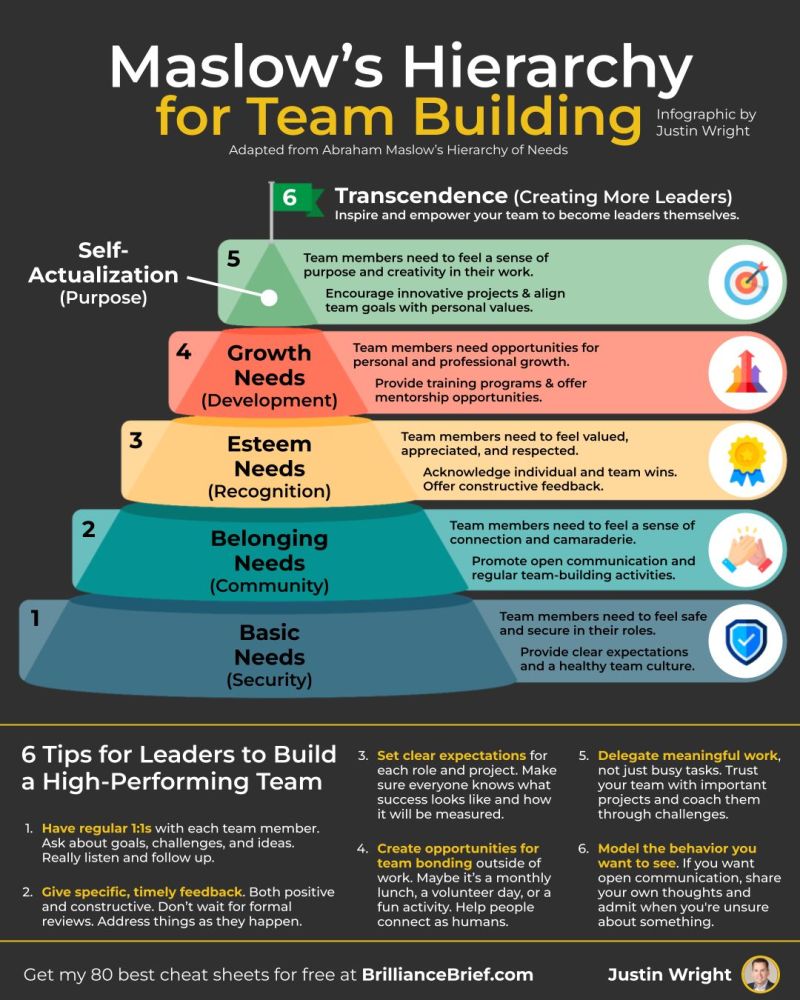
What does it take to build a strong team?
Start by understanding what drives people.
Maslow’s Hierarchy of Needs isn’t just a theory.
It’s a guidebook for team-building.
Let’s break it down:
1. Set a Foundation of Security
↳ Ensure clear roles and job stability.
↳ Trust and safety are non-negotiable.
2. Build Community
↳ Create real connections.
↳ Regular team-building is essential.
3. Create a Culture of Recognition and Respect
↳ Say “thank you” often. Celebrate wins.
↳ Make appreciation a habit, not a rarity.
4. Support Growth and Development
↳ Invest in training and mentorship.
↳ Support their personal and professional journey.
5. Instill a Sense of Purpose and Creativity
↳ Align team goals with individual passions.
↳ Encourage innovative thinking and passion projects.
6. Create Leaders, Not Just Followers
↳ Mentor your team to become future leaders.
↳ Empower them to take ownership and grow.
Why does this matter?
When you meet these needs,
your team isn’t just working…
They’re thriving.
The impact?
➟ Higher employee engagement
➟ Better team collaboration
➟ Increased productivity
➟ Healthier culture
➟ More fun
How do you make it happen?
✅ Lead with empathy.
✅ Understand their needs.
✅ Unlock your team’s potential.
The Energy I Choose

Somewhere along the way, I realized how exhausting hate really is. It drains you quietly, like a phone on low battery that never quite charges back up. You tell yourself you’re fine, that holding onto that resentment or anger is justified — but deep down, you know it’s just heavy. It eats at your peace, your sleep, your joy. And for what? To prove a point no one remembers or to hold a grudge no one cares about?
I don’t have energy for that anymore. I don’t want to keep replaying the things people said or did, or how unfair life seemed at certain moments. I’d rather save my energy for things that fill me up — for people who make me laugh till it hurts, for small acts of kindness that ripple outward, for moments that feel like light breaking through a cloudy day.
So now, it’s simple: I either love you, wish you well, or hope you heal. If you’ve brought goodness into my life, I love you for it. If our paths don’t align anymore, I still wish you well — genuinely. And if you’ve hurt me or left scars where there used to be trust, I just hope you heal. Because hurt people hurt people, and I refuse to keep that cycle spinning.
There’s so much freedom in letting go. You stop trying to understand every wrong or rewrite every ending. You stop being defined by who disappointed you. You start to reclaim your peace — and peace feels like power. Not the loud, showy kind, but the quiet confidence of knowing you’re not ruled by bitterness.
The world can be harsh enough on its own. I’d rather not add more hate to it. So I choose love when I can, grace when it’s hard, and distance when it’s necessary. No drama, no revenge, no explanations. Just a calm “I hope you heal,” and I move forward.
Because at the end of the day, my energy is sacred. And I want to spend it on what lifts me, not what drains me.
Self-Awareness
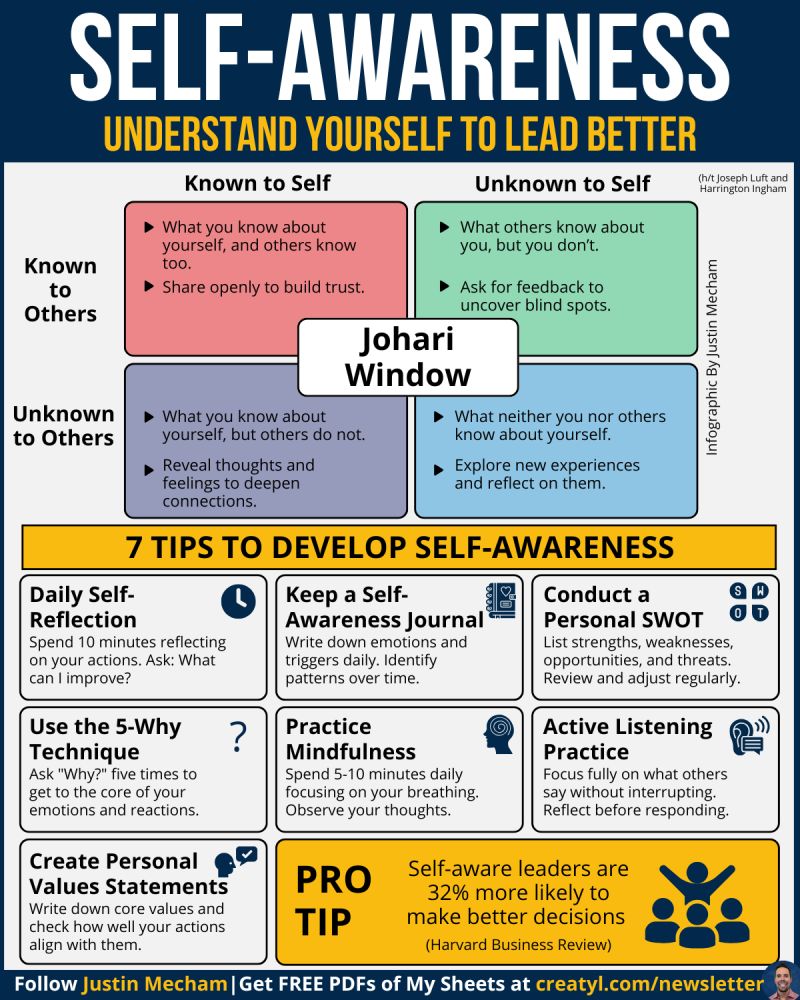
The hardest person to lead—
Is yourself:
When you know yourself, you make better choices.
➜ You see your own habits.
➜ You notice how others see you.
➜ You understand how you act under stress.
➜ You learn from feedback instead of ignoring it.
Without self-awareness, leaders can:
🚫 Lose trust without even knowing why
🚫 Push their stress onto the team
🚫 Blame others for their mistakes
🚫 Misunderstand their feelings
🚫 Miss chances to grow
But self-aware leaders:
🟢 Learn and grow every day
🟢 Listen when others speak up
🟢 Understand their own feelings
🟢 Ask for help when they need it
🟢 Take responsibility for their actions
Self-awareness builds trust—
first with yourself, then others.
It’s not the end of growth.
It’s the start of real progress.
The Periodic Table of Sales KPIs
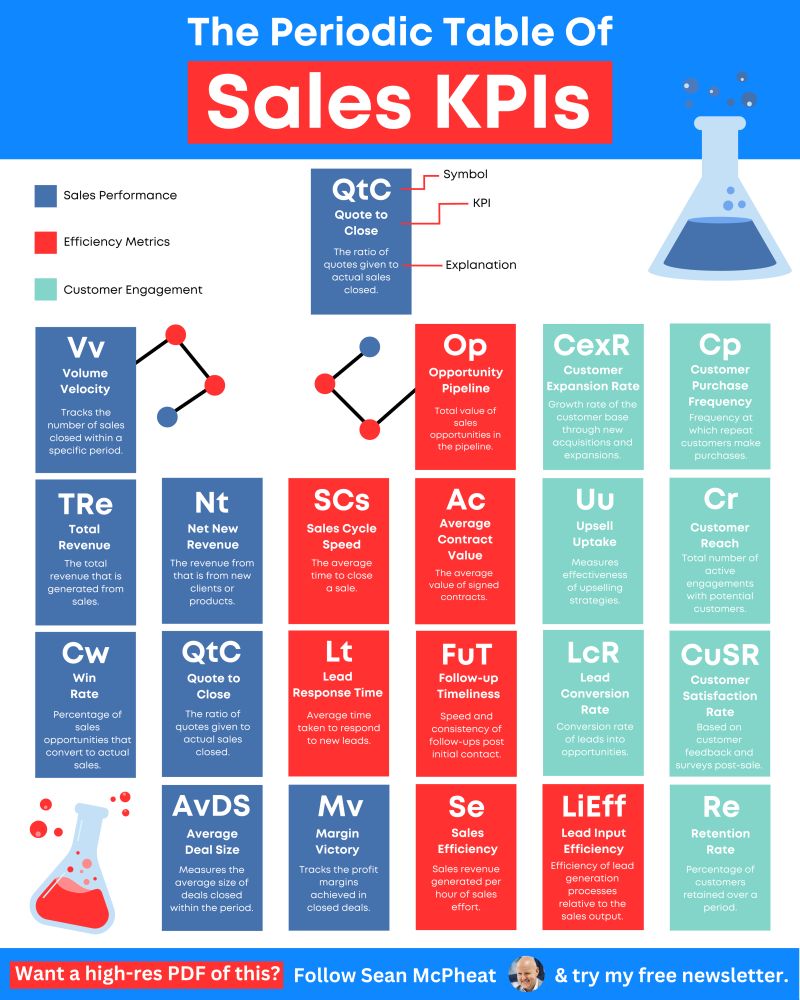
Vanity sales metrics look nice.
But they don’t pay the bills ⬇️
What really drives growth?
Tracking the right performance, not just any performance.
Most sales teams get buried in dashboards.
They’ve got data, but no direction.
There’s a flood of numbers, but no real clarity.
They measure activity without understanding impact.
They track everything except what actually moves the needle.
The result?
Missed targets, wasted time, and unclear priorities.
If you want to grow revenue, retain clients, and
sharpen your sales strategy, focus on these
three KPI categories:
→ Sales Performance
The outcomes that directly affect your bottom line.
These are the numbers that show whether the strategy
is working or not.
→ Efficiency Metrics
How effectively your team turns time and effort into results.
It’s about doing more with less, without burning out or losing steam.
→ Customer Engagement
Your connection with the buyer, post-sale and beyond.
How well you’re building relationships that last, renew, and expand.
Here are a few underrated KPIs that bring real insight:
→ Vv – Volume Velocity
How many deals you’re closing in a set timeframe.
→ QtC – Quote to Close Ratio
How often a proposal turns into a signature.
→ SCs – Sales Cycle Speed
How quickly leads become customers, speed matters.
→ Mv – Margin Victory
How profitable your deals are after discounts and costs.
→ Ac – Average Contract Value
The average value of each deal signed.
→ Se – Sales Efficiency
Revenue earned per hour of actual selling time.
→ CexR – Customer Expansion Rate
How much new business comes from current accounts.
→ Uu – Upsell Uptake
How often clients accept an upsell.
→ Cr – Customer Reach
The breadth and frequency of your outreach and follow-up.
→ CuSR – Customer Satisfaction Rate
A clear signal of future loyalty, retention, and referrals.
🧠 Remember; Metrics shouldn’t just look good,
they should mean something.
Track what matters. Drop what doesn’t. Lead with focus.
Communication is Key

This might be uncomfortable to read but…
Your team’s performance is a direct
reflection of your words.
I’ve spent +15 years watching exceptional CEOs work.
One pattern stands out clearly:
They speak a language that inspires action rather
than simply giving directions.
Here are 12 phrases great CEOs use to
lead with impact:
1. “I trust you to handle this.”
↳ Builds confidence and encourages ownership.
↳ Shows you believe in their ability.
2. “Let’s solve this together.”
↳ Turns problems into collaboration, not blame.
↳ Creates a problem-solving mindset.
3. “Let’s make this simple.”
↳ Helps cut through unnecessary complexity.
↳ Keeps projects moving forward smoothly.
4. “What would you do if you were in my position?”
↳ Encourages strategic thinking and ownership.
↳ Gives them a broader leadership perspective.
5. “Here’s what we can’t afford to miss.”
↳ Helps eliminate distractions and misalignment.
↳ Ensures the team works on high-impact tasks.
6. “Walk me through your thinking.”
↳ Encourages open discussion without pressure.
↳ Helps you understand their perspective.
7. “Before we wrap up, let’s get clear on the next steps.”
↳ Prevents misunderstandings and delays.
↳ Aligns expectations for smooth execution.
8. “What’s standing in our way?”
↳ Helps identify hidden obstacles.
↳ Turns roadblocks into actionable solutions.
9. “I see where you’re coming from.”
↳ Makes people feel heard and valued.
↳ Builds trust by acknowledging different viewpoints.
10. “What’s the simplest way to get this done?”
↳ Eliminates wasted effort and overcomplication.
↳ Helps find the most efficient approach.
11. “I might be missing something—help me see
what you see.”
↳ Shows humility and openness to new ideas.
↳ Encourages diverse thinking and better solutions.
12. “That’s a smart way to look at it.”
↳ Recognizes valuable ideas and input.
↳ Encourages people to speak up more.
The bottom line is this:
The words you choose determine how people respond.
Want a team that trusts, executes, and takes ownership?
Start with how you communicate.
The best CEOs don’t just give orders.
They inspire action.
What powerful phrase would you add to this list?
The Roads That No Longer Fit
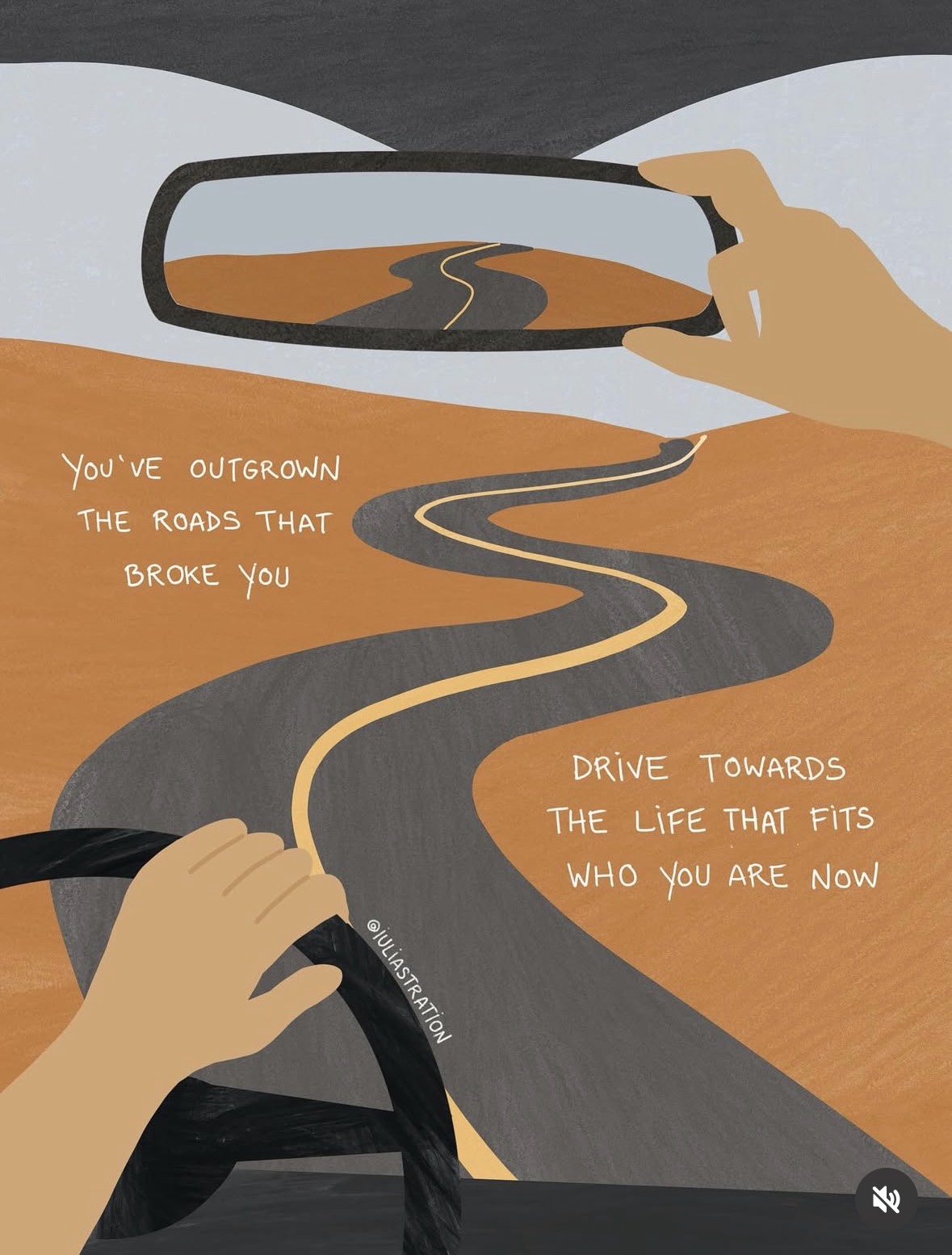
It’s funny how some roads once felt like the only way forward. We poured ourselves into them — the jobs, the friendships, the routines — believing they were the path to who we were meant to become. But somewhere along the way, we changed. And suddenly, those same roads that once built us began to break us.
Outgrowing something doesn’t always come with a grand realization. Sometimes it’s quiet. You wake up one morning and realize the things that used to excite you now drain you. The conversations that once felt comfortable now feel shallow. The ambitions you chased with fire now leave you cold. It’s not that you’ve lost passion — it’s that you’ve evolved. You’ve become someone new, and the life that once fit you perfectly now feels a size too small.
But here’s the hard part — letting go of those old roads. Because even when they hurt, they’re familiar. There’s comfort in knowing the curves, the bumps, the potholes. Stepping off them feels like betrayal. You think, maybe if I just try harder, maybe if I just care more, maybe I can make it work again. But deep down, you know the truth — you’ve outgrown what was only meant to teach you.
Growth isn’t always about adding more; sometimes it’s about leaving behind. Leaving behind versions of yourself that kept you safe but small. Leaving behind the people who only knew how to love the person you used to be. Leaving behind dreams that no longer match the rhythm of your heart.
And once you start driving toward the life that fits who you are now — not who you were — something shifts. The air feels lighter. The horizon looks clearer. You stop shrinking to fit into spaces that don’t honor you. You stop apologizing for wanting more peace, more purpose, more authenticity. You begin to realize that outgrowing is not abandonment — it’s alignment.
So if the roads that once built you now break you, it’s okay. You’re not lost — you’re being redirected. The detour isn’t punishment; it’s grace. It’s life saying, you’ve done the work here — it’s time to move forward.
Keep driving. The destination isn’t somewhere out there — it’s who you’re becoming along the way.
Resilient Leadership

The Harsh Truth:
If you can’t handle pressure, you can’t lead.
70% of leaders struggle to make decisions under pressure.
The other 30%?
They don’t just survive pressure. They thrive in it.
Here’s how you can join the top 30%:
1. Master Your Emotional Agility
Strong leaders don’t suppress emotions,
they manage them.
→ The next time pressure hits, stop asking
“Why is this happening?”
Instead, ask “What is this teaching me?”
That small shift changes everything.
2. Create a Decision-Making Playbook
Pressure magnifies indecision.
The best leaders don’t wing it.
They follow a process that keeps them
clear-headed when everything else is chaotic.
→ When facing a tough call:
• Define the problem.
• List 2–3 solid options.
• Weigh the risks.
• Act fast.
3. Turn Setbacks into Fuel for Growth
The strongest leaders don’t fear failure.
They use it as feedback.
→ Take on challenges outside your comfort zone.
If you’re not growing, you’re falling behind.
4. Protect Your Energy, Not Just Your Time
A packed calendar doesn’t make you a great leader.
Managing your energy does.
→ Set non-negotiable recovery time:
sleep, movement, and stillness.
5. Build a Strong Inner Circle
No leader wins alone.
The best ones build an inner circle of truth-tellers.
→ Identify 3–5 trusted advisors who give you
unfiltered feedback.
6. Lead with Clarity and Purpose
Under pressure, most leaders react.
The best ones stay anchored in their mission.
→ Revisit your leadership values regularly.
When everything is uncertain, your purpose
must be your north star.
Most leaders misunderstand resilience.
It’s not just about:
Toughing it out.
Grinding harder.
Pushing through.
Real resilience?
It’s about making pressure work for you.
Becoming stronger from it.
Being antifragile.
So next time the pressure’s on, ask yourself:
Am I just enduring this?
Or am I adapting, learning, and growing stronger?
10 Hats You Wear as a Great Leader

Bad leaders think they wear a crown.
Good leaders wear a hat.
Great leaders?
They wear 10.
Because your team doesn’t need just one kind of support.
They need the right kind. At the right time.
That’s what great leaders understand.
They don’t cling to one identity.
They adapt.
They serve.
They know when to wear:
1/ The Mentor
➟ Share wisdom without preaching
➟ Guide, don’t control
➟ Help them find their own answers
2/ The Coach
➟ Spot potential before they do
➟ Push when they hesitate
➟ Invest in their growth
3/ The Defender
➟ Shield them from politics
➟ Fight the battles they shouldn’t have to
➟ Protect without hovering
4/ The Translator
➟ Speak their language, not yours
➟ Bridge gaps between levels
➟ Simplify the complex
5/ The Cheerleader
➟ Spot the effort before the result
➟ Recognize in public, correct in private
➟ Make appreciation your daily habit
6/ The Therapist
➟ Hold space for human moments
➟ Listen before solving
➟ Show it’s okay not to be okay
7/ The Janitor
➟ Clean up the mess without blame
➟ Fix first, debrief later
➟ Roll up sleeves when needed
8/ The Student
➟ Learn from everyone
➟ Admit when you don’t know
➟ Make curiosity contagious
9/ The Mirror
➟ Reflect their best self back
➟ Show potential, not limits
➟ See who they’re becoming
10/ The Compass
➟ Point to true north in chaos
➟ Stay steady when others panic
➟ Remind them of the why
Leadership isn’t a rank or role.
It’s how you treat people.
Your service. Your support.
You don’t need a promotion.
You don’t need permission.
You don’t even need a title.
Just the courage to step up.
And serve.
Because the best leaders aren’t wearing a crown.
They’re switching hats.
One at a time.
Exactly when their team needs it most.
8 leadership mistakes that’ll burn out your team
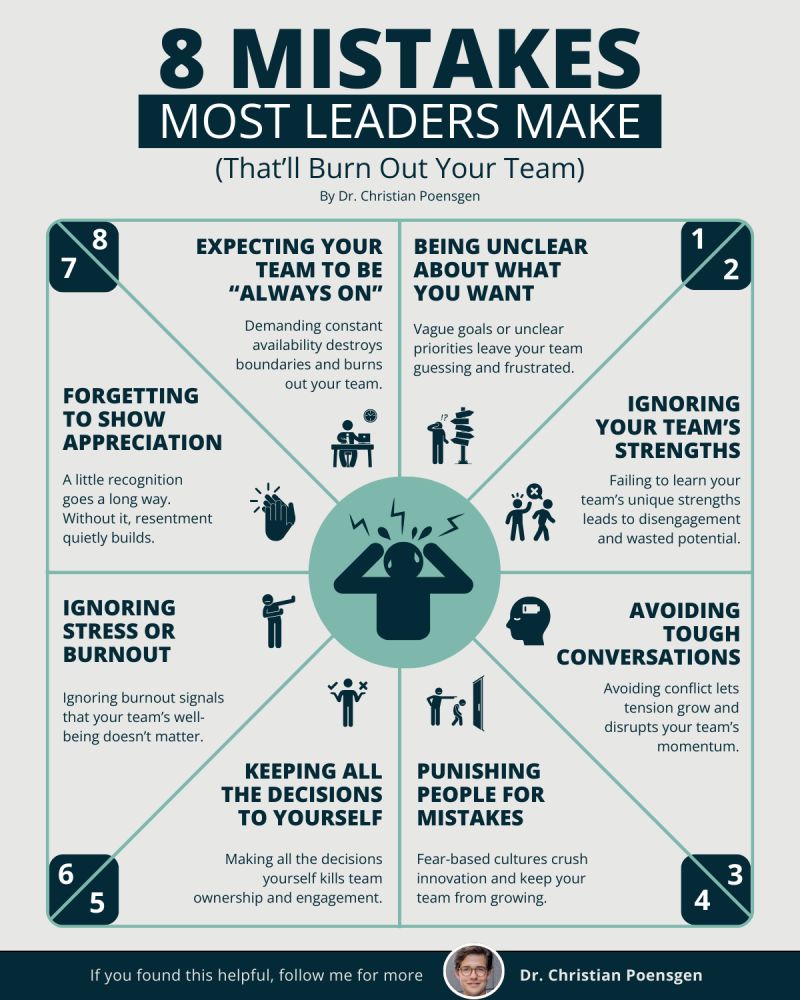
8 leadership mistakes that’ll burn out your team:
(and how to avoid each one)
1) Being Unclear About What Matters
↳ Vague goals create anxiety and confusion.
↳ Start every week by aligning on 1–3 key goals.
2) Ignoring Natural Strengths
↳ Overlooked strengths fade and disengage.
↳ Regularly ask your people what work energizes them.
3) Avoiding Hard Conversations
↳ Unspoken tensions slowly erode trust.
↳ Schedule monthly 1:1s and ask, “What’s not working?”
4) Making Fear the Driver
↳ Fear of failure kills creativity fast.
↳ Celebrate smart failures in retros or all-hands.
5) Hoarding Every Decision
↳ Centralized control drains energy and drive.
↳ Set clear boundaries, then get out of the way.
6) Ignoring Burnout Signs
↳ Stress signals grow into serious issues.
↳ Adjust workload or timelines when needed.
7) Forgetting to Recognize Effort
↳ Lack of recognition demotivates your best people.
↳ Give specific praise in public every week.
8) Demanding 24/7 Availability
↳ Always-on cultures exhaust everyone.
↳ Set the norm: no replies after 6 pm or on weekends.
– – – –
Dear leaders,
Your team isn’t burning out because they’re weak.
They’re exhausted because the system is broken.
And it’s your job to fix it.

