The Ones Who Quiet Your Storm

In a world that constantly shouts for our attention, the people who truly matter are often the ones who bring silence—not the awkward kind, but the kind that feels like home.

They’re the ones who understand you without explanations, who notice the shifts in your tone, and who make your heart feel like it belongs exactly where it is. Around them, you breathe easier. Your shoulders drop. Your thoughts slow down. Your nervous system finally stops scanning the horizon for threats, because it knows it’s safe.

We spend so much time searching for “our people,” as if they’re hidden in some far-off place. But the truth is, you already know who they are. They’re the ones who leave you lighter than they found you.

Yes. It’s that simple!

10 ways to keep your best people

1) Trust 🤝
↳ Let people own decisions and outcomes.
↳ Trust shown is trust returned.

2) Appreciation 🙏
↳ Say thank you often and mean it.
↳ Recognition fuels loyalty and drive.

3) Safety 🛡️
↳ Create space for honest ideas and risks.
↳ Safe teams speak up and grow.

4) Feedback 🗣️
↳ Listen deeply and act on insights.
↳ Your team sees what you might miss.

5) Challenge 🧗‍♂️
↳ Stretch people with meaningful work.
↳ Growth happens just past comfort.

6) Development 📚
↳ Invest in learning and coaching.
↳ When they grow, so do you.

7) Transparency 🪟
↳ Share the why behind decisions.
↳ Clarity boosts trust and focus.

8) Purpose 🎯
↳ Connect work to impact and meaning.
↳ Purpose fuels long-term commitment.

9) Wins 🏆
↳ Celebrate progress loudly and often.
↳ Recognition builds momentum fast.

10) Pay 💰
↳ Be fair, consistent, and transparent.
↳ Equity is the baseline for retention.

– – – –

Top talent doesn’t leave bad companies.
They leave bad leadership.

But a person who feels appreciated?

They will always do more than expected.

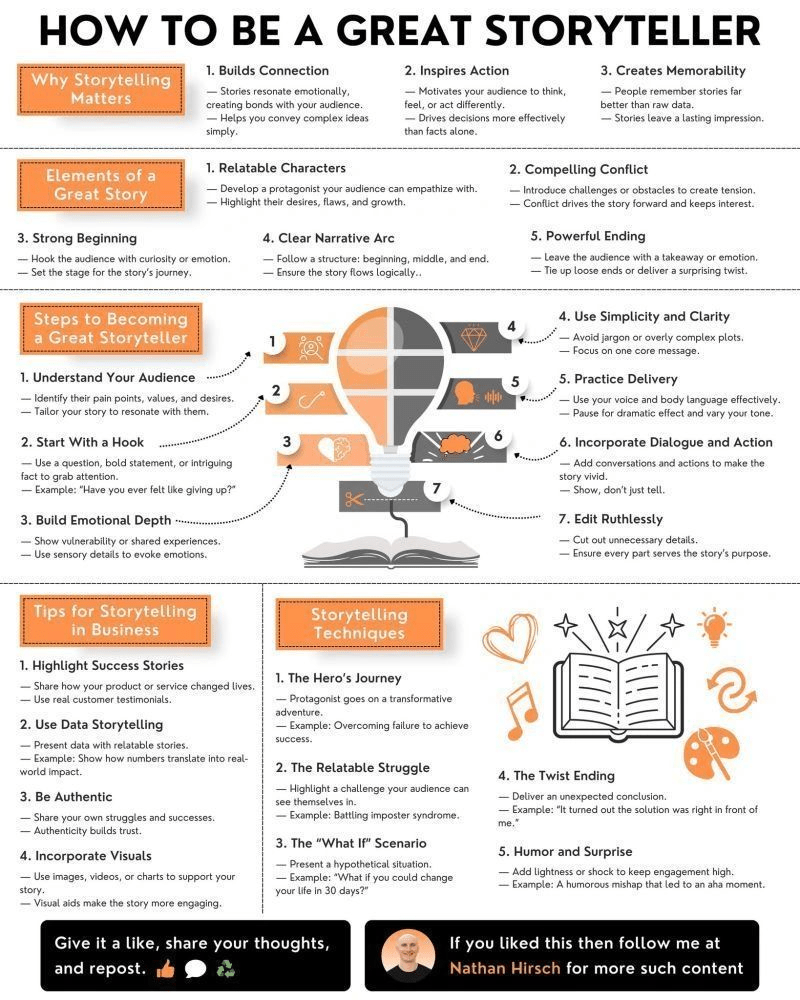
How To Be A Great Storyteller

Nike doesn’t sell shoes, it sells stories of perseverance.

Airbnb doesn’t sell rentals, it sells belonging.

The best entrepreneurs build narratives that move people.

Here’s how to be a great storyteller in business:

Master this, and your brand will sell itself.

𝗪𝗵𝘆 𝗦𝘁𝗼𝗿𝘆𝘁𝗲𝗹𝗹𝗶𝗻𝗴 𝗠𝗮𝘁𝘁𝗲𝗿𝘀

1/ Builds Connection

Stories resonate emotionally, creating bonds with your audience.

Helps you convey complex ideas simply. 

2/ Inspires Action

Motivates your audience to think, feel, or act differently.

Drives decisions more effectively than facts alone.

3/ Creates Memorability

People remember stories far better than raw data.

Stories leave a lasting impression. 

𝗘𝗹𝗲𝗺𝗲𝗻𝘁𝘀 𝗼𝗳 𝗮 𝗚𝗿𝗲𝗮𝘁 𝗦𝘁𝗼𝗿𝘆

1/ Relatable Characters

Develop a protagonist your audience can empathize with.

Highlight their desires, flaws, and growth. 

2/ Compelling Conflict

Introduce challenges or obstacles to create tension.

Conflict drives the story forward and keeps interest.

3/ Strong Beginning

Hook the audience with curiosity or emotion.

Set the stage for the story’s journey. 

4/ Clear Narrative Arc

Follow a structure: beginning, middle, and end.

Ensure the story flows logically.

5/ Powerful Ending

Leave the audience with a takeaway or emotion.

Tie up loose ends or deliver a surprising twist. 

𝗦𝘁𝗲𝗽𝘀 𝘁𝗼 𝗕𝗲𝗰𝗼𝗺𝗶𝗻𝗴 𝗮 𝗚𝗿𝗲𝗮𝘁 𝗦𝘁𝗼𝗿𝘆𝘁𝗲𝗹𝗹𝗲𝗿

1/ Understand Your Audience

Identify their pain points, values, and desires.

Tailor your story to resonate with them. 

2/ Start With a Hook

Use a question, bold statement, or intriguing fact to grab attention.

Example: “Have you ever felt like giving up?”

3/ Build Emotional Depth

Show vulnerability or shared experiences.

Use sensory details to evoke emotions. 

4/ Use Simplicity and Clarity

Avoid jargon or overly complex plots.

Focus on one core message.

5/ Practice Delivery

Use your voice and body language effectively.

Pause for dramatic effect and vary your tone. 

6/ Incorporate Dialogue and Action

Add conversations and actions to make the story vivid.

Show, don’t just tell.

7/ Edit Ruthlessly

Cut out unnecessary details.

Ensure every part serves the story’s purpose. 

𝗦𝘁𝗼𝗿𝘆𝘁𝗲𝗹𝗹𝗶𝗻𝗴 𝗧𝗲𝗰𝗵𝗻𝗶𝗾𝘂𝗲𝘀

1/ The Hero’s Journey

Protagonist goes on a transformative adventure.

Example: Overcoming failure to achieve success. 

2/ The Relatable Struggle

Highlight a challenge your audience can see themselves in.

Example: Battling imposter syndrome.

3/ The “What If” Scenario

Present a hypothetical situation.

Example: “What if you could change your life in 30 days?” 

4/ The Twist Ending

Deliver an unexpected conclusion.

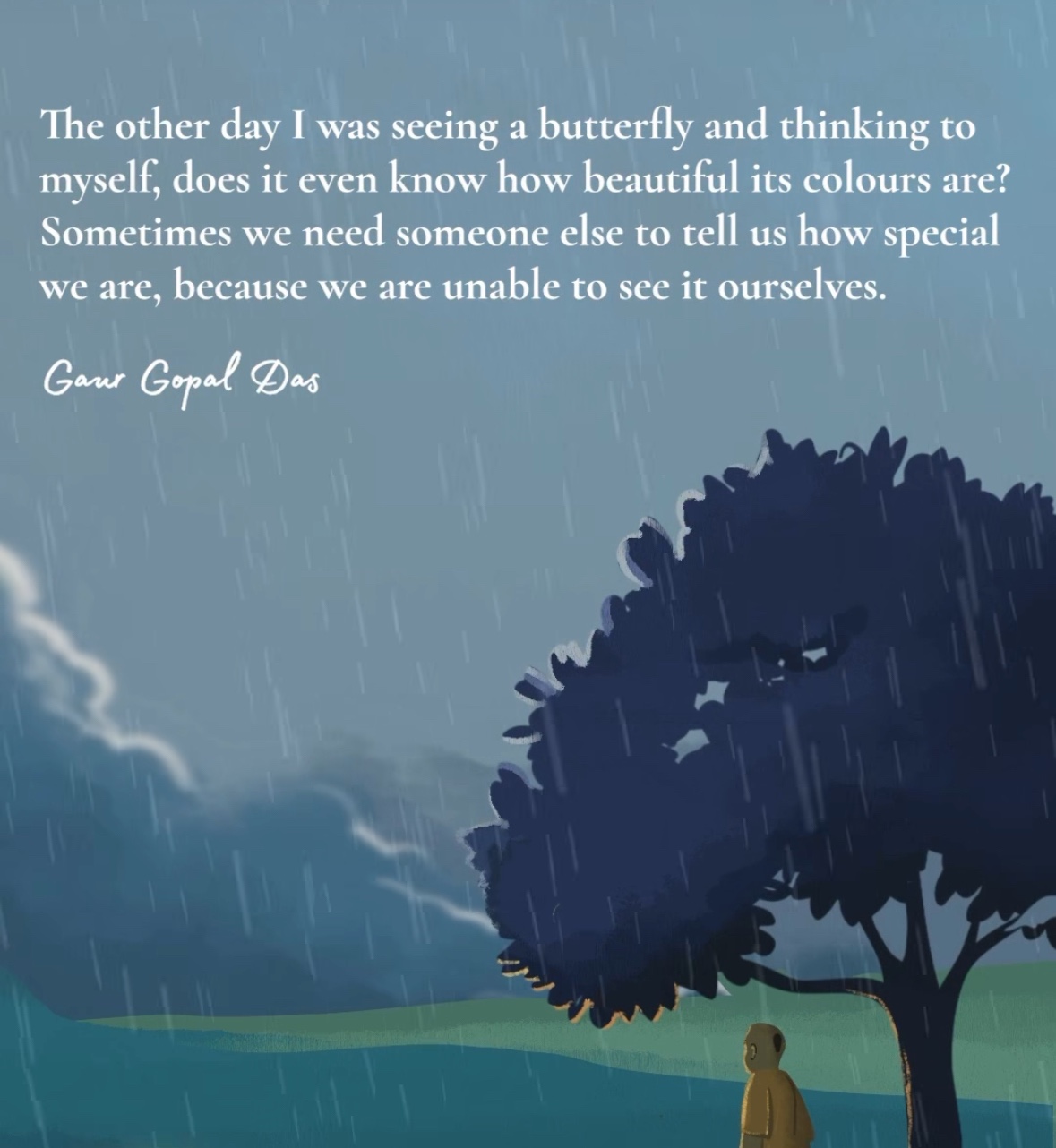
“The Butterfly Doesn’t Know” — Why We Need Reminders of Our Own Beauty

Reading this post on Instagram made me wonder how often we’re just like that butterfly.

We move through life carrying colors, talents, kindness, and quiet strengths we don’t even realize we have. Maybe because we see ourselves every day, we stop noticing the magic. Maybe because we’re focused on the next task, the next problem, the next “thing to fix,” we forget the things already shining.

And that’s when other people matter so much.

A friend who says, “You’re doing great.”

A colleague who notices your hard work.

A stranger who compliments your smile.

These moments are little mirrors, helping us see the beauty we’ve been carrying all along.

So here’s the reminder: You are more remarkable than you think. And if you can’t see it right now, borrow someone else’s eyes until you can.

Because just like the butterfly, you’re not meant to keep your colors a secret!

8 Signs of Toxic Work Culture


Struggling with a workplace that drains your energy and stifles your growth?

Whether it’s micromanagement, blame games, or unending gossip.

Toxic traits can sabotage your work environment and your peace of mind.

From experience, here’s the survival kit to get you through.

8 Signs of Toxic Culture – and What to Do About Them

1. Micromanagement Mayhem
The Sign: Every decision needs approval, no trust, constant checking-in.
Your Move: Set boundaries. Gently push back with facts and results. Show you’re capable, then reclaim autonomy bit by bit.

2. Blame Game Olympics
The Sign: Mistakes = finger-pointing, never learning.
Your Move: Document everything. Cover your back. Speak up with solutions, not just problems.

3. Zero Accountability at the Top
The Sign: Leaders never admit fault, deflect onto the team.
Your Move: Don’t play their game. Stay professional, and if it’s chronic—start planning your exit strategy.

4. Gaslighting Galore
The Sign: You’re told your valid concerns are “overreactions” or “misunderstandings.”
Your Move: Keep a journal. Record conversations, dates, and patterns. Trust your gut—it’s not all in your head.

5. Gossip and Cliques
The Sign: Inner circles rule. Info is currency. Exclusion is the norm.
Your Move: Don’t engage. Stay friendly, not involved. Build alliances based on trust, not tea.

6. Unrealistic Expectations, All. The. Time.
The Sign: Constant overwork, shifting goals, no praise—only pressure.
Your Move: Prioritize like a pro. Clarify what’s urgent vs noise. Say “no” (or “not now”) without guilt.

7. High Turnover = Red Flag
The Sign: People keep disappearing. Fast.
Your Move: Find out why. Learn from others’ exits. Use their reasons to evaluate your own timeline.

8. No Growth, No Recognition
The Sign: You’re stagnant. Promotions are for boss’s pets, not performance.
Your Move: Upskill on your own. Shine outside of work. Prep for a move where you’re valued.

12 signs you’re a top performer.

You’ll rise quickly if you: 

1) Take responsibility

You focus on what’s within your control and own the outcome – no blaming, no excuses.

2) Actively seek feedback

You invite critique, even when it stings, and use it to level up.

3) Find solutions

You don’t just flag issues, you suggest ways to fix them, too.

4) Chase growth

You lean into challenges and keep expanding your skills.

5) Manage your energy

You know when to sprint and when to rest, so you don’t burn out.

6) Stay cool in chaos

You don’t panic when things go sideways – you think clearly and adapt.

7) Go the extra mile

You consistently deliver more than what’s asked.

8) Prioritize impact

You aim for meaningful results, not just activity.

9) Elevate your team

You support others, share knowledge, and lead by example.

10) Embrace failure

You treat mistakes as data, not defeat, and you keep moving forward.

11) Communicate clearly

You speak up with honesty, respect, and purpose.

12) Stay consistent

Even when motivation dips, your discipline keeps you moving.

High performers aren’t just born with talent. 

They’re deliberate. 

They invest in what matters,

And do so consistently.

The Turtle Theory

In a world obsessed with hustle, urgency, and getting there first, turtles are quietly rewriting the rules.

They don’t rush. They don’t panic. They don’t waste energy looking sideways to see who’s ahead.

They simply keep moving — one stroke, one step, one breath at a time.

Through chaos, they keep swimming.

Through calm, they keep swimming.

And somehow, they always find their way to shore.

That’s the thing about patience — it’s not flashy, but it’s undefeated.

Speed means nothing if your journey isn’t sustainable.

You don’t need to sprint; you just need to stay in motion.

Slow progress is still progress. And in the long run, peace will always outlast pressure.

So, the next time you feel the urge to rush, remember the turtle.

You’re not here to win a race no one asked you to run.

You’re here to reach your shore — steady, calm, and on your own time!

The Giraffe Theory

We live in a world that loves to pull you into every argument, every distraction, and every uninvited opinion. It’s easy to get caught defending your path to people who don’t even understand where you’re headed.

But here’s the thing — giraffes don’t lower their necks to argue with turtles.

A giraffe sees further, not just because of its height, but because of its perspective. It lives in a space above the noise, above the daily squabbles, above the distractions that keep others trapped. From that vantage point, it doesn’t need to stop and justify its journey.

The higher you rise — in ambition, in mindset, in purpose — the fewer people there will be who can see what you see. That can feel isolating at times. But it’s also where the clarity lives.

Staying tall means staying true to your vision, even when others can’t grasp it. It means walking your path without constantly bending down to explain yourself to those who aren’t on the same journey.

So, the next time someone tries to pull you into the weeds, remember the giraffe.

Stay tall. Stay focused. And keep walking toward the view only you can see!

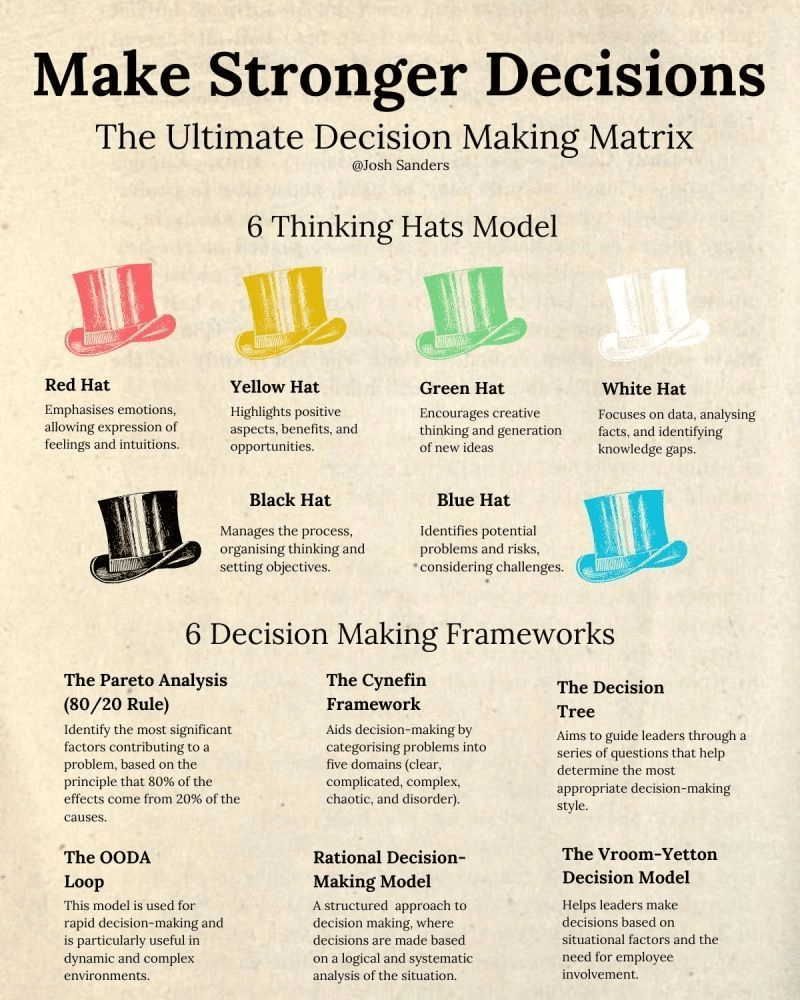
Make Stronger Decisions

Make Stronger Decisions

The Ultimate Decision-Making Matrix:

Every single day we make 1000s of small decisions.

Yet no one teaches us how to maximise them.

The impact of better decision-making is incredibly clear.

When we make faster and stronger decisions it can: 

↳ Relieve stress

↳ Reduce overthinking 

↳ Improve productivity 

Get started on systemising your decisions today! 

Steal these science-backed frameworks: 

The 6 Thinking Hats Model: 

1. Red Hat

↳ Focuses on emotions.

↳ Allowing the expression of feelings and intuitions.

2. Yellow Hat

↳ Prioritises positive aspects

↳ With a focus on benefits and opportunities

3. Green Hat

↳ Encourages creative thinking 

↳ Improve the generation of new ideas

4. White Hat

↳ Highlights the importance of data and analysing facts

↳ As well as identifying knowledge gaps.

5. Black Hat

↳ Spots potential risks and problems

↳ Allows you to consider challenges.

6. Blue Hat

↳ Prioritises processes and systems.

↳ Organises your thinking and helps set objectives.

6 bonus useful decision-making methods:

1. The Pareto Analysis [80/20 Rule]

2. The Cynefin Framework

3. The Decision Tree

4. The OODA Loop

5. Rational Decision-Making Model

6. The Vroom-Yetton Decision Model

From Fortune 500 CEOs to junior execs 

These methods can be utilised by anyone! 

Steal this cheat sheet today

To make stronger decisions in the future. 

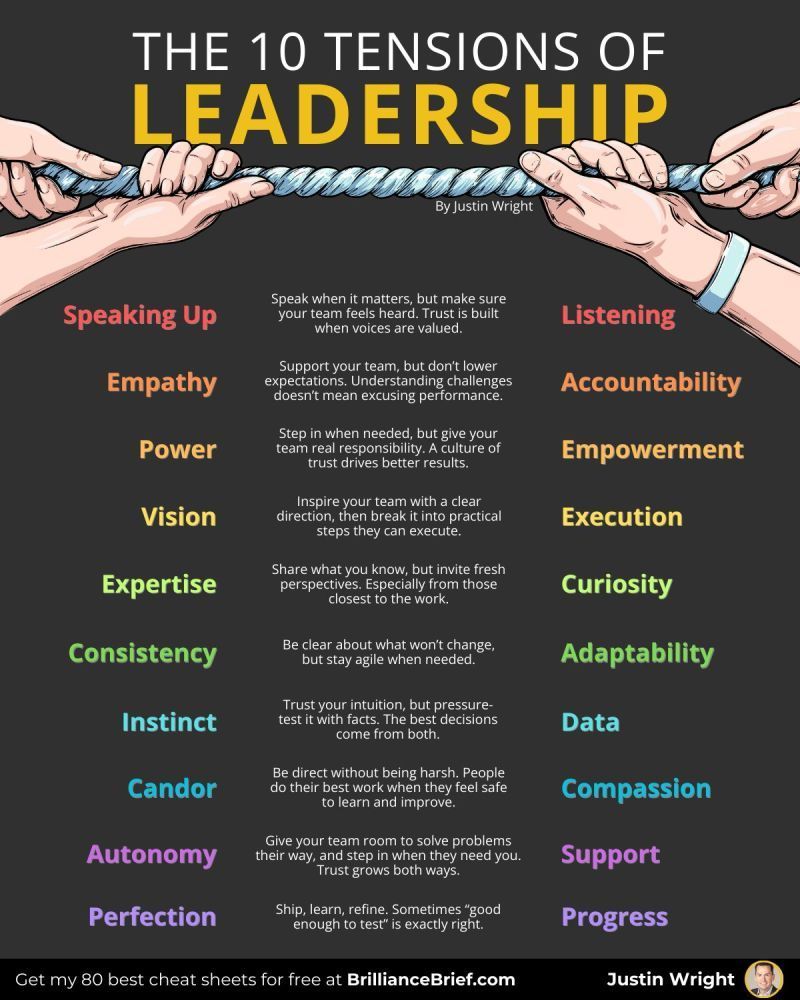
10 Tensions of Leadership

Leadership isn’t a straight line.

It’s a constant balancing act between
competing forces.

These 10 leadership tensions might be the most valuable
framework you’ll see this year:

1. Speaking Up vs. Listening
↳ Know when to voice your opinion and when to create
space for others.
↳ Teams thrive when everyone feels heard, not just
the loudest or highest-paid.

2. Empathy vs. Accountability
↳ Support your people through challenges without
lowering the bar.
↳ Understanding doesn’t mean excusing
poor performance.

3. Power vs. Empowerment
↳ Step in when needed, but give your team
real responsibility.
↳ The magic happens when people feel trusted to deliver
results their way.

4. Vision vs. Execution
↳ Paint the big picture, then break it down into
actionable steps.
↳ Dreams without details rarely become reality.

5. Expertise vs. Curiosity
↳ Share what you know, but actively seek
fresh perspectives.
↳ The best insights often come from those closest
to the work.

6. Consistency vs. Adaptability
↳ Be clear about what won’t change, while staying
flexible elsewhere.
↳ Teams need both stability and the ability to pivot quickly.

7. Instinct vs. Data
↳ Trust your gut, but test it with facts.
↳ The strongest decisions blend intuition with evidence.

8. Candor vs. Compassion
↳ Be direct without being harsh.
↳ People do their best work when they feel safe to
learn and grow.

9. Autonomy vs. Support
↳ Give space for your team to solve problems their way.
↳ Know when to step in and when to step back.

10. Perfection vs. Progress
↳ Sometimes “good enough to test” is exactly right.
↳ Ship, learn, refine. This cycle beats endless polishing
every time.

The truth is…

These tensions aren’t problems to solve.
They’re polarities to manage.

The magic happens in the middle.

In the balance.
In the both/and.

Average leaders choose a side.
Great leaders stand in the center.

The best teams don’t need “perfect” leaders.
They need balanced ones.

Are you brave enough to live in the tension?