I once heard someone say, If you don’t change you do not grow, But I waved the thought away, For who were they to think they know, I’d always stayed the same, A heart that thrived within the cold, At least that’s what I had been told, But deep within my mind, A thought grew slowly, bit by bit, Until I felt trapped in my skin, For it no longer seemed to fit, There’s a whole world sitting out there, Changing every single day, That proves it’s nothing to be scared of, If you do it the right way, For a day afraid to turn to night, Will miss the silver moon, And a flower that refuses to change, Will never get to bloom, I had thought I was a thorn bush, Only good for snagging clothes, But if you do not dare to change, You’ll never find out you’re a rose.
On October 18, the Church will celebrate the Feast of Saint Luke, one of the four evangelists, or Gospel writers. We will look at five unique facts about Saint Luke, the author of the third Gospel.
Luke was a physician
source: Archdiocese of Bombay (Instagram)
Prior to and during his time as a leader in the early Church, Saint Luke was a medical doctor by trade. In his letter to the Colossians, Saint Paul calls Luke “the beloved physician,” (Colossians 4:14). Luke’s profession as a doctor is even apparent from the way he wrote his Gospel. He includes more miracles of physical healing than do any of the other Gospels (thirteen, compared to twelve in Matthew, eleven in Mark, and only two in John). His description of the sick people whom Jesus cures sometimes displays a knowledge of medicine that is not present in the other Gospels, such as the use of precise medical terms such as “dropsy” (Luke 14: 1-6). In relating the scene in which Jesus cures a woman with a hemorrhage, Luke doesn’t include Mark’s verse that she “had suffered greatly at the hands of many doctors and had spent all that she had. Yet she was not helped but only grew worse,” (Mark 5:26). Perhaps Luke didn’t want to tread on the reputation of his own profession!
Luke’s symbol is the ox
source: Archdiocese of Bombay (Instagram)
In traditional Christian iconography, each of the four Evangelists is represented by a living creature: Matthew’s symbol is an angel or a man, Mark’s is a lion, Luke’s is an ox, and John’s is an eagle. Luke’s symbol is the ox, a creature known for its strength, reliability, and service to mankind. This is fitting because Luke emphasizes Jesus’ role as both priest (the one making the sacrifice) and the sacrifice itself. The third gospel includes much of what we know about the events leading up to Jesus’ birth and childhood (known as the infancy narratives). Very early on in the Gospel, Luke tells the story of Zechariah the priest, the father of John the Baptist, offering sacrifices to God in the temple (Luke 1: 8-9). Luke speaks of Mary’s role in Christ’s life and the sacrifices that she voluntarily made in order to usher in God’s plan of salvation for mankind. This can be seen, for example, when Joseph and Mary present Jesus in the temple as an infant, the prophet Simeon tells Mary that a sword will pierce her heart (Luke 2: 35). All of these sacrificial figures (Jesus, Mary and Zechariah) are symbolized in the ox.
Luke wrote the Acts of the Apostles
source: Archdiocese of Bombay (Instagram)
In addition to composing one of the four Gospels, Saint Luke also wrote the Acts of the Apostles, the book immediately following the Gospels. Although Saint Paul wrote more books, Luke’s two contributions are long enough that they actually make up a greater percentage of the New Testament (about 24%) than those of any other author.
Acts of the Apostles serves as a sort of “Volume Two” to Luke’s Gospel. Both are addressed to Theophilus, and Acts begins by referring back to Luke’s Gospel, calling it “the first book,” (Acts 1:1). The introduction to Acts establishes that the first book (Luke’s Gospel) was about the life, teachings, and miracles of Jesus, while this second book is about the acts of Jesus’ Apostles (hence the title), after His Ascension. Throughout Acts, Luke documents the events of the first few years of the Catholic Church, including the stoning of Stephen, the Church’s first martyr (Acts 6); the council of Jerusalem (Acts 15), in which the Church determined that Gentile converts did not need to become Jewish in order to follow Jesus; and a number of Saint Paul’s missionary journeys. A combination of history, travel log and theology, Acts of the Apostles makes for a fascinating glimpse into the life of the early Church.
Luke was a confidante of the Virgin Mary and an Artist!
Source: Illustrated Prayer website
As mentioned above, each of the four Gospels stresses different themes and facets of Jesus’ life. One of the emphases of Luke’s Gospel is the role of the Virgin Mary. The first two chapters of Luke’s Gospel, comprising a hundred and thirty-two verses, are dedicated to the infancy narratives, of which Mary plays the most central role, besides Jesus. Luke chronicles the archangel Gabriel’s visit to Mary to announce the Good News, Mary’s visit to Elizabeth, the Nativity, the visit of the shepherds, Jesus’ naming and circumcision, Jesus’ conversations in the temple at age twelve, and His family life with Mary and Joseph in Nazareth. The level of detail in Luke’s account of Jesus’ early years has led historians to believe that Luke must have known Mary personally, and heard about these events first-hand from her.
Tradition holds that he was the first one to paint a picture of the Virgin Mary! As the tradition goes, he spent a lot of time with the Virgin Mary at St. John’s house, where he got to know her story and about Jesus from her perspective. Thus, he was able to write Jesus’ infancy narrative that occurs in St. Luke. The tradition further goes that, being an accomplished painter, he painted Our Lady’s portrait, putting Christ as an infant with her, as some of the first church icons.
In addition to the Virgin Mary, Luke also mentions Elizabeth, Simon’s mother-in-law, a mourning widow, a prostitute, women of Galilee who followed Jesus, Jairus’s daughter, a woman with hemorrhages, Martha and Mary, a crippled woman, and Mary Magdalene. In doing this, Luke was highlighting the fact that the Gospel message is meant for the whole human race, men and women alike. While much of the ancient world was male-dominated, Jesus went out of his way to bring God’s love to women, many of whom were among the most forgotten and cast-out members of society. It is because of his emphasis on the Virgin Mary and women in general that Luke has been called the “Marian Gospel,” and the “Gospel of women.”
Luke was a companion of Saint Paul
Illustration by Michael Woodruff
Just as Mary is a central figure in Luke’s Gospel, so also Saint Paul occupies a prominent place in the Acts of the Apostles. Luke chronicles Paul’s conversion to the Catholic faith on the road to Damascus, his interactions with Peter and the other Apostles, and his early missionary journeys. This leads many theologians and scholars to believe that Luke must have been one of Paul’s travel companions. He might even have been Paul’s secretary for a time, since in his Second Letter to Timothy, Paul says, “Luke is the only one with me,” (2 Timothy 4:11). Someone like Paul might have had scribes write out their letters as they dictated them orally, and so it’s possible that Luke took dictation from Paul as his scribe. Even if he didn’t physically accompany Paul on all of his missionary journeys, Luke was at least a close confidante of Paul’s, since he probably would have acquired the details from Paul firsthand.
Luke’s occupation, his acquaintances, and his travels all contributed to the way he wrote Acts and his Gospel. This is just one of many examples of how the Bible is a work fully Divine and fully human. The Holy Spirit inspired each of the inspired writers of the Bible to say exactly what He wanted them to say, for the sake of our salvation. At the same time, each human author was truly an author; his own knowledge, style, background and personality went into his work, just as with any human author. Seeing Luke as the physician, the traveler, the friend of Mary, the companion of Paul – in a word, seeing him as a human being – provides a fascinating insight into his writings. The products of both the Holy Spirit’s inspiration and Luke’s own authorship, his Gospel and Acts give us a unique look at the Gospel message. On his feast day today let us pray for his intercession, that we may know Jesus more fully as the Son of Mary, the sacrificial victim of our sins, and the Divine Physician.
With over 6.3 billion global smartphone users, it’s critical mobile apps are inclusive of everyone, including those with vision impairment, hearing limitations, or other physical or cognitive conditions.
What do we mean by an accessible app?
An accessible app means that most people can use it without help from another person, regardless of ability or situation. When there’s a mismatch between the app and the users’ abilities, an app is considered inaccessible.
Web Content Accessibility Guidelines (or WCAG), as the name suggests is a guideline for making your web content or app accessible. The guidelines help you build your app so it’s consumable to a wide range of people. It doesn’t address every user’s needs but it covers the main points and best practices. Even though the guideline’s title suggests they are for the “web”, they’re useful for mobile too.
Mobile application accessibility especially matters because of the ways users interact with content. Mobile apps drive engagement, boost customer loyalty, and give brands more options for personalization of their experiences, so the implications of providing an inaccessible experience might be magnified.
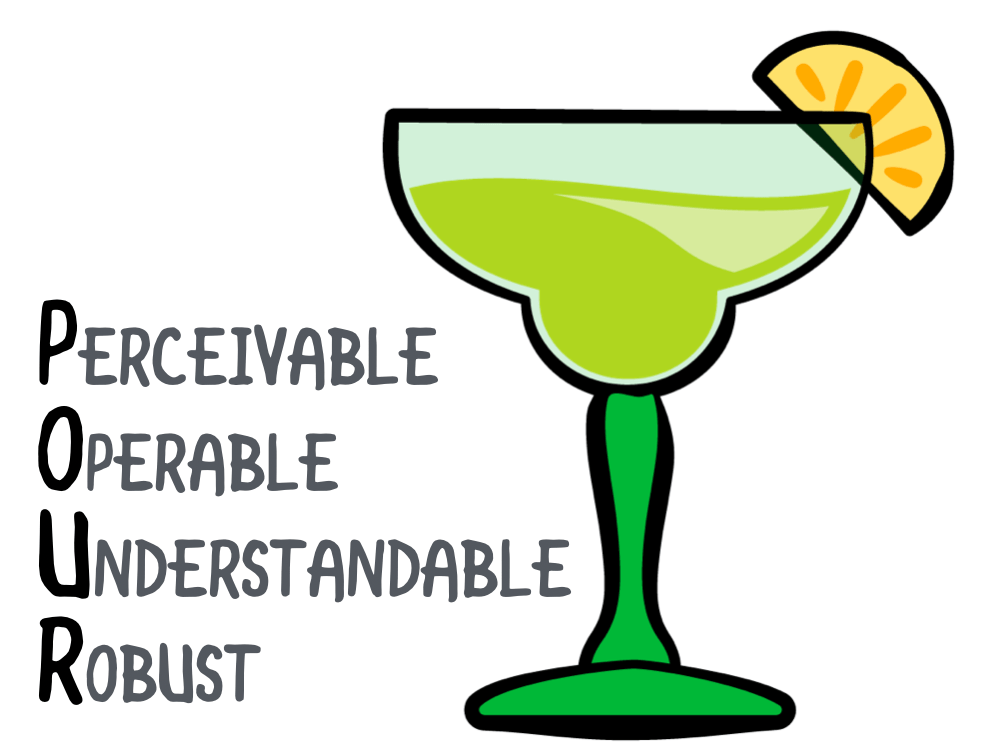
WCAG uses a lovely little acronym to categorize the principles of the requirements:
P erceivable
O perable
U nderstandable
R obust
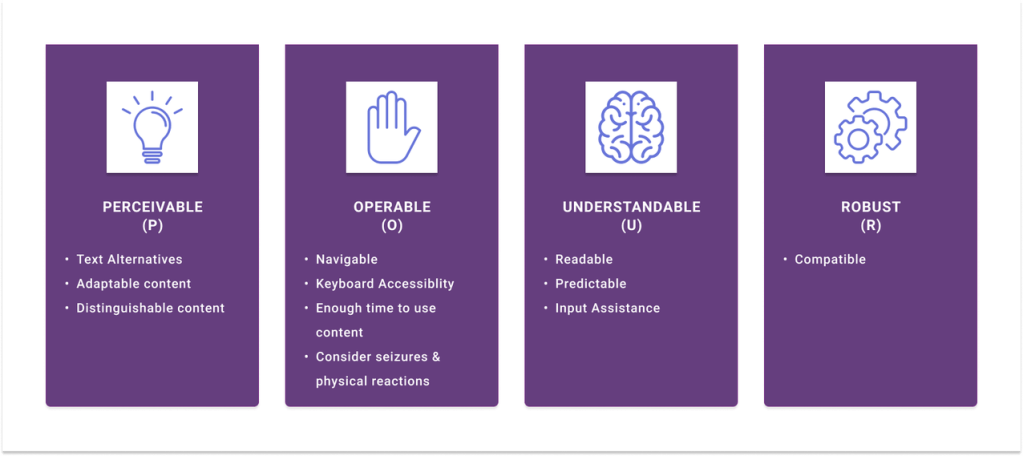
PERCEIVABLE Information and user interface components must be presented to users in ways they can perceive. This means that users must be able to comprehend the information being depicted: It can’t be invisible to all their senses.
OPERABLE User interface components and navigation must be operable: The interface cannot require interaction that a user cannot perform.
UNDERSTANDABLE Information and the operation of a user interface must be understandable: Users must be able to understand the information as well as the operation of the user interface.
ROBUST Content must be robust enough that it can be interpreted reliably by a wide variety of user agents, including assistive technologies: As technologies and user agents evolve, the content should remain accessible.
Source: blog.bitrise.io
So how do we achieve mobile app accessibility?
Here is a 6 step checklist which covers six inclusive design best practices for mobile apps that a mobile app designer or developer should focus on to ensure accessibility and usability.
1. Design for Varying Screen Sizes
Smaller screens and custom aspect ratios are hallmarks of mobile devices; designers need to account for them when building native apps. A smaller screen limits how much information people can take in at one time, especially when users need to magnify content due to poor vision.
Tips for helping users make the most of small screens include:
Minimizing the amount of information on each page (compared with a desktop or laptop) by providing a dedicated mobile website or designing the site responsively
Providing a reasonable default size for content and touch controls to minimize the need to zoom in and out for users with low vision
Adapting the length of link text to the viewport width
Positioning form fields below, rather than beside, their labels
2. Focus on Touch Targets and Placement
Higher resolution in mobile devices allows for multiple interactive elements to display together on a small screen. But these elements must be large and distanced enough so that users can easily target them by touch.
Tap targets within an app should be big enough for people to interact with precision and confidence, even when they have to perform tasks in a hurry.
Best practices for touch target size include:
Designing touch targets to be at least 9 mm high by 9 mm wide
Adding inactive space surrounding smaller touch targets (closer to minimum size above)
Mobile applications should also position interactive elements where they can be easily reached regardless of how the device is held. Developers should consider how an easy-to-use button placement for some users might cause difficulties for others (e.g., left- versus right-handed use, assumptions about thumb range of motion).
Tips for touch target placement include:
Place buttons where they are easy to access.
Allow flexible use for all interactive elements.
3. Keep Device Gestures Simple and Provide Ample Feedback
Most mobile devices are designed to be operated primarily through gestures on a touchscreen. These gestures can be simple (such as a one-finger tap) or complex (involving multiple fingers, multiple taps).
Gestures used to control native apps should be as easy to execute as possible. Complex gesture control can be particularly challenging for users with motor or dexterity impairments. Create alternatives to allow simple tap or swipe gestures in place of more complex ones.
In addition to simpler gesture control, native apps should be designed so that users can easily go back and fix their course in case of unintentional actions such as accidental clicking. For example, if a user swipes their finger on the wrong part of the application, they should be able to easily go back and access the correct interactive elements.
4. Ensure Consistent Layouts and Templates
Components that are repeated across pages in a mobile application should be presented in a consistent layout.
For example, a native application has a logo, a title, a search form, and a navigation bar. At the top of each page, these elements appear in the same relative order and position. When the app is viewed on a smaller screen in portrait mode, the navigation bar collapses into a single icon with a drop-down list, but the elements in that list are still in the same order.
Consistency is key to creating seamless cross-channel user experiences. It helps the user feel comfortable and in control while executing tasks, including those that may start on one device and finish on another.
5. Provide Easy Methods for Data Entry
Users can enter information in various ways on their mobile phones, including the on-screen keyboard, a bluetooth keyboard, and speech. Text entry can be time-consuming and difficult for some users, but it can be displaced through other data entry styles. Reduce the amount of text entry required by providing select menus, radio buttons, or check boxes, or by auto-filling known information.
Typing is a slow method of data entry. Providing alternatives such as autofill, data sharing between apps, or dictation improves the overall app experience and prevents errors.
6. Double-Check Color Contrast
WCAG outlines general color contrast ratios that are acceptable for most users, but extra attention must be paid to mobile devices and applications. Mobile devices are more likely to be used outdoors, where glare from the sun could impact ability to see the screen. Using good contrast is important for all users; bad contrast can compound the challenges that people with reduced vision have when accessing content on mobile devices.
Text legibility is preserved by an adequate contrast between the font color and the background. For WCAG 2.1 AA compliance, text should have a color contrast ratio of at least 4.5:1 (larger text at least 3:1). Allowing different contrast ratios for larger text is useful because wider character strokes are easier to read at a lower contrast than narrower character strokes. This allows designers more leeway for contrast, which is helpful for elements such as titles. But because app content is viewed on smaller screens and in different conditions, this allowance for lessened contrast on large text becomes complicated.
7. Give Proper Labels to UI Elements
UI elements such as images, buttons, and other controls should be labeled appropriately to be recognizable by assistive technology, such as the iOS Voiceover or Android TalkBack.
Many developers focus on app features, leaving accessibility as an afterthought. However, development teams shouldn’t overlook accessibility or view it as a last-minute task carried out at the end of the release. Doing this is inefficient and costly. To build an accessible app, you must weave in accessibility at the beginning of the app design and development.
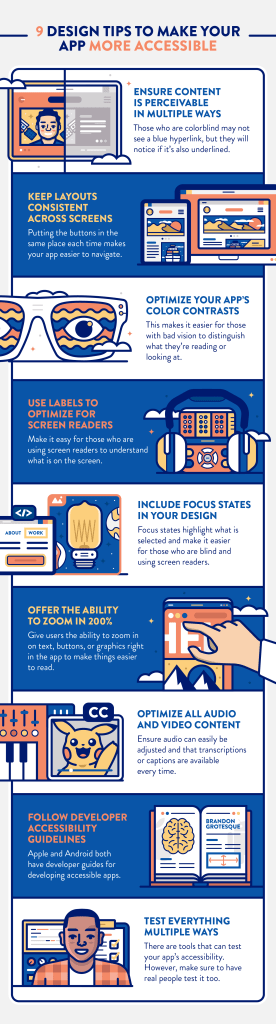
I’ll end with this lovely infographic I came across which summarizes things nicely!
The Catechism of the Catholic Church teaches us that, “The existence of the spiritual, non-corporeal beings that Sacred Scripture usually calls “angels” is a truth of faith. The witness of Scripture is as clear as the unanimity of Tradition” (#328).
Angels are pure, created spirits. The name angel means servant or messenger of God. Angels are celestial or heavenly beings, on a higher order than human beings. Angels have no bodies and do not depend on matter for their existence or activity. They are distinct from saints, which men can become. Angels have intellect and will, and are immortal. They are a vast multitude, but each is an individual person. Archangels are one of the nine choirs of angels listed in the Bible. In ascending order, the choirs or classes are 1) Angels, 2) Archangels, 3) Principalities, 4) Powers, 5) Virtues, 6) Dominations, 7) Thrones, 8) Cherubim, and 9) Seraphim.
Art unmatched creative divine badam leaves fallen gathered rain washed colour splashed each unique varied design rearranged…
He does it all the time this loving God all round every time plants flowers oceans creatures mountains insects butterflies… restlessly making more beautiful for us…
most wonderful of all each human being creations best in image likeness His very own
our grateful living: joyous response to glory gifts He gives to glory gift He is…
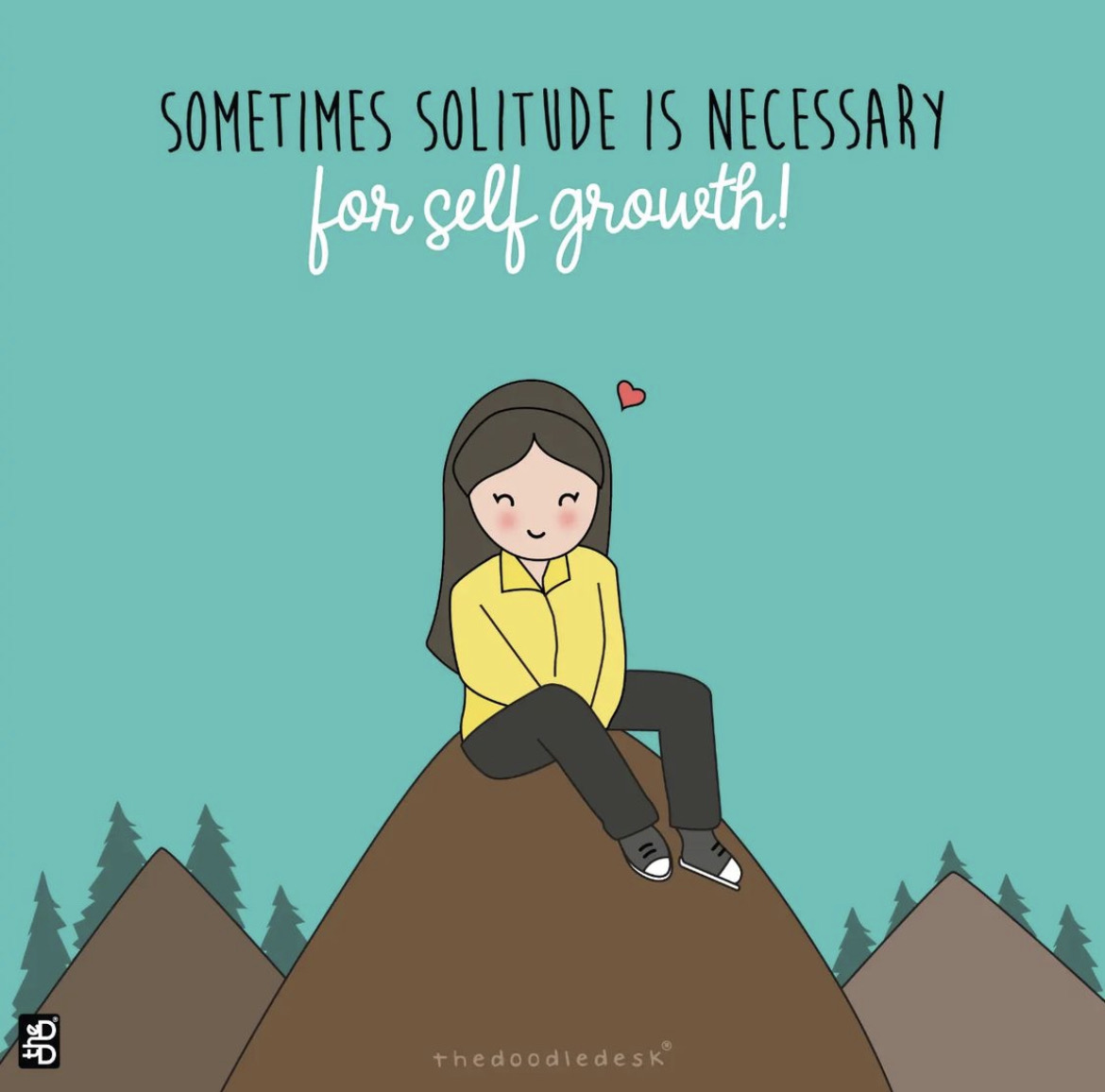
When we hear the word solitude, we probably jump right to feeling like we’re the odd man out or that we’re being isolated from others. Granted, after the lockdown and stay-at-home orders, the definition of isolation now includes phrases like remote work and distance learning.
Pandemic aside, the word solitude seems to be synonymous with feelings of loneliness for most of us. Even the media warns of a “lonely epidemic” where we’re dedicating less time to cultivating healthy connections, which only adds to our feelings of disconnection.
It’s important to spend time around people. You can improve your habits and learn new things when you’re surrounded by interesting people. Of course, much of life’s biggest joys stem from our relationships.
But too much “people time” might also be a bad thing. Our digital devices often make us feel like we need to be connected 24/7. And all of the noise, activity, and hustle can wear you out and ironically can leave you feeling lonelier than ever.
If you are lonely when you are alone, you are in bad company.
Sartre
Being alone and feeling lonely are two completely different things, however. Many people feel lonely even when they’re in a crowded room. And some people spend lots of time alone without ever actually feeling lonely.
In fact, building more solitude into your daily life might actually reduce your feelings of loneliness. Solitary skills take practice if you’re not used to being alone, but over time, you can grow more comfortable with being by yourself.
But shirking loneliness isn’t the only reason you should spend more time in solitude. There are many other reasons spending time alone can help you build the mental strength you need to reach your greatest potential.
1. Solitude helps you get to know yourself.
When you’re by yourself, you make choices without outside influences. You can choose how to spend your time without worrying about anyone else’s feelings. Making choices on your own will help you develop better insight into who you are as a person.
Being alone will help you grow more comfortable in your skin as well. The more you know yourself, the better equipped you’ll be to be your authentic self when others are around.
2. Alone time could improve your relationships.
Spending time with friends, family and colleagues contributes to a “we vs. them” mentality. Although unintentional, you’ll see people who don’t fit into your inner circle as different from you and you’ll develop less empathy for them.
Spending time alone breaks down those barriers. Studies show you’ll develop more compassion for other people when you set aside time for solitude.
3. Solitude boosts creativity and productivity.
There’s a reason artists, musicians, and authors seek solitude when they want to create something. A private space, whether it’s a secluded studio or a cabin in the woods, allows them to be more creative. Studies confirm that being alone often fosters creativity.
In addition to boosting creativity, solitude also skyrockets productivity. Studies consistently show people perform better when they have privacy.
4. Solitude improves psychological well-being.
Learning how to be comfortable by yourself may take some getting used to. But solitary skills could be help you become mentally stronger.
Studies have found people who set aside time to be alone tend to be happier. They report better life satisfaction and lower levels of stress. They’re also less likely to have depression.
5. Being alone gives you an opportunity to plan your life.
While it’s important to have joint goals with your spouse, partner, family members, or business partner, you also need to make sure that you’re living your best life as an individual. Be proactive about planning out your life, similar to the way you might plan for retirement or plan a vacation.
Setting aside time to be alone can help you reflect on your goals, dreams, and aspirations. Take a break from the hustle and bustle to think about whether you’re living life according to your values and whether you might want to make some changes.
If you’re not used to solitude, the silence and lack of activity can feel uncomfortable at first. But, setting aside time to be alone is an essential component of building mental strength and living a rich and full life.
Do you know what ‘sparks a light in you?’ Are you aware of what makes you feel excitedly creative, awakened, full of life and energy, brimming with enthusiasm and passion?
When you start to do the things that you truly love, it wouldn’t matter whether it is Monday or Friday; you would be so excited to wake up each morning to work on your passions.
Edmond Mbiaka
Here are 3 ways in which we can be inspired to spark that inner light:
Finding our Light in the Darkness
Sometimes, our lives feel full of darkness, pain and distress, perhaps in the form of loss, grief or illness.
Sometimes, it might feel as though that vital inner spark which carries us through has dimmed or disappeared.
Someone I loved once gave me a box full of darkness. It took me years to understand that this too, was a gift.
Mary Oliver
The poet Mary Oliver discovered that, in time, out of the box of darkness came some goodness, some light.
This can be in the form of insight, learning, life experience. Such awareness of the good that may come from bad experiences is part of a long process.
This is a process of resolution, of working through our painful darknesses in life and moving into something lighter and brighter.
Are we actually aware of our own ‘inner light’ which can still shine and guide us through the darkness?
You need to spend time crawling alone through shadows to truly appreciate what it is to stand in the sun.
Shaun Hick
It is essential that we become aware of the light, power, and strength within each of us, and that you learn to use those inner resources in service of your own and others’ growth.
Chiaroscouro (light-dark) is a term in art that refers to the use of powerful and contrasting light and dark tones, which can also be used to achieve a three-dimensional effect.
This artistic effect is also symbolic of the light and dark within ourselves.
Having both aspects in our personality in a balanced and integrated way, means that we are more fully-rounded as people, more whole, with each part of us enhancing the other parts.
It is true that we gain strength and power through having experienced suffering and having been very vulnerable. Out of our weakness emerges the kernel of our strength.
Rekindling The Inner Spark From Childhood
Nothing is more beautiful than seeing a child light up with enthusiasm. The zest for life, the excitement, the energetic, uninhibited, exuberance of a happy child is a joy to witness.
Can we hold onto this spark of childhood enthusiasm, whilst channelling it into adult life and work?
Childhood fantasies and excitement can be transformed into something equally beautiful…and lifelong.
Following one’s passions, allowing ourselves to light up with enthusiasm and creativity, can mean that we will hold onto this capacity to be fascinated and amazed.
What did you do as a child that made the hours pass like minutes? Herein lies the key to your earthly pursuits.
Jung
Being With Other People
Being with another who is brimming with passion and vitality for an idea, a cause, work, creativity, a book or a painting, is an infectious and inspiring experience.
It is helpful to be with people who have passion and interest, who can ‘relight our fire.’ Such creative energy is catching and it tends to boost our mood.
At times our own light goes out and is rekindled by a spark from another person. Each of us has cause to think with deep gratitude of those who have lighted the flame within us.
Albert Schweitzer
It is this that makes us feel uplifted. When we are enthusiastic, we feel stimulated, confident, creative, motivated.
It is an exciting, animated feeling, one that can propel us eagerly onwards and upwards.
In addition, when we are in the company of someone who has empathy for us, we can feel encouraged and inspired to develop ourselves, our ideas, our thoughts, no matter how absurd they might seem initially.
Don’t ask yourself what the world needs. Ask yourself what makes you come alive, and then go do that. Because what the world needs is people who have come alive.
Renee Swope
Our time on this planet is pretty limited. You’re too precious to not shine that light back into this big old world!
Authenticators are applications that serve several purposes for Android and iOS devices. They’re mainly used for two types of authentication, known as multi-factor authentication (MFA) and multi-step authentication (MSA). They provide advanced security for user sites.
What this means is that it’s not enough to know or have an account password. With increased hacking and cybercrime, authentication codes are necessary to guarantee the security of your online activities and personal data.
Having a protected account means no thief or hacker can access your data, whether on an Android or iOS device. Typically, you only need a password to sign in and log into your online account. With an Authentication app, you can use both the password and the OTP generating app simultaneously.
Here, you’ll need to apply 2- factor authentication (2FA), which includes the knowledge factor where you as the user know your password. The other factor is the possession factor where you have the smartphone.
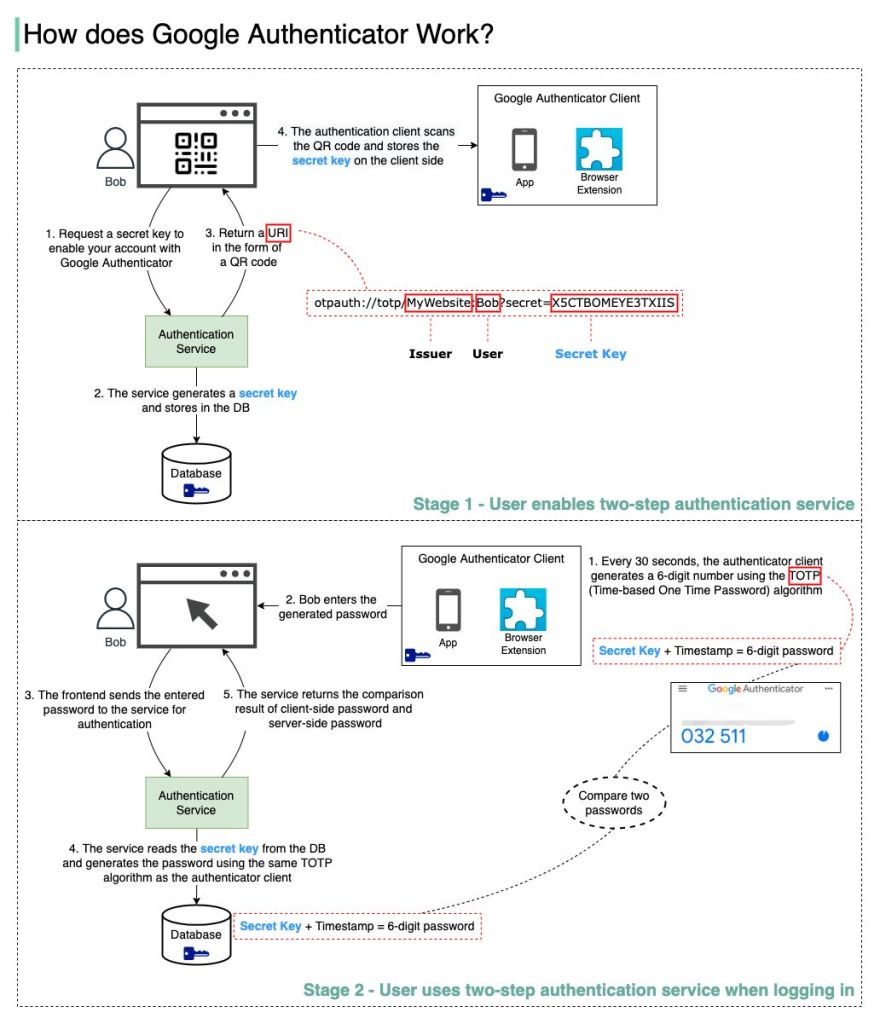
Let’s take a closer look at how the Google Authenticator app works.
There are two stages involved:
Stage 1 – The user enables Google two-step verification
Stage 2 – The user uses the authenticator for logging in, etc.
Let’s look at these stages.
𝐒𝐭𝐚𝐠𝐞 1 Steps 1 and 2: Bob opens the web page to enable two-step verification. The frontend requests a secret key. The authentication service generates the secret key for Bob and stores it in the database.
Step 3: The authentication service returns a URI to the frontend. The URI is composed of key issuer, username and secret key. The URI is displayed in the form of a QR code on the web page.
Step 4: Bob then uses Google Authenticator to scan the generated QR code. The secret key is stored in the authenticator.
𝐒𝐭𝐚𝐠𝐞 2 Steps 1 and 2: Bob wants to log into a website with Google two-step verification. For this he needs the password. Every 30 seconds, Google Authenticator generates a 6-digit password using TOTP (Time-based One Time Password) algorithm. Bob uses the password to enter the website.
Steps 3 and 4: The frontend sends the password Bob enters to the backend for authentication. The authentication service reads the secret key from the database and generates a 6-digit password using the same TOTP algorithm as the client.
Step 5: The authentication service compares the two passwords generated by the client and the server, and returns the comparison result to the frontend. Bob can proceed with the login process only if the two passwords match.
Here’s an illustration of the above 2 stages
Source: Hua Li, LinkedIn
Is this authentication mechanism 𝐬𝐚𝐟𝐞?
Can the secret key be obtained by others? We need to make sure the secret key is transmitted using HTTPS. The authenticator client and the database store the secret key, and we need to make sure the secret keys are encrypted.
Can the 6-digit password be guessed by hackers? No. The password has 6 digits, so the generated password has 1 million potential combinations. Plus, the password changes every 30 seconds. If hackers want to guess the password in 30 seconds, they need to enter 30,000 combinations per second.
Microsoft Vs. Google Authentication
Although there are other authentication apps, Google and Microsoft are the most widely used authenticators. However, the two apps differ slightly in terms of convenience and ease of use. For example, Microsoft provides a 30-second counter before the software token automatically resets instead of Google’s blue round fading countdown timer.
Furthermore, Microsoft has one-tap push notifications for all Microsoft Accounts, something that Google doesn’t provide. Microsoft also allows users to hide or copy the secret code. On the other hand, Google allows users to change email for all existing accounts.
Overall both authentication apps provide high-level security for all your devices to ensure your online services or data are protected.
UPI has gone through 𝐞𝐱𝐩𝐥𝐨𝐬𝐢𝐯𝐞 𝐚𝐝𝐨𝐩𝐭𝐢𝐨𝐧 since its inception in 2016. It builds a digital payments ecosystem with payment apps, banks, and NPCI (National Payments Corporation of India).
It now takes up 60% of digital retail transactions in India.
It is estimated that the digital payments market in India will grow by 3 times in 2026.
So, What exactly is UPI?
UPI is a payment markup language and a standard for interoperable payments in India.
To make the process of transacting money simple, UPI introduced the concept of human friendly unique IDs called UPI Virtual Payment Addresses (or VPAs). The VPAs are usually of the form <unique_identifier>@<address_provider>.
The UPI VPAs are similar to email addresses. They are interoperable. A gmail user can send an email to a yahoo user.
Some simple examples UPI VPAs are alice@ybl and bob@axis. Here, ybl and axis are two banks that provide virtual payment addresses. And, alice and bob are the unique identifiers in respective address providers.
Just like how domains get resolved to IP addresses, every VPA needs to be linked to a bank account. The UPI handles get resolved to bank accounts and IFSC during the payment
The Actors
The Banks
Banks hold your money. UPI works directly with the bank accounts, unlike Paytm, Venmo, or CashApp. The bank account will be debited from or credited to whenever you send money or receive money.
The banks that hold your money are also called Issuing Banks.
The Payment Apps
Payment Apps are consumer-centric products that can be used to link a bank account and transact in the real world. Some major apps are Google Pay, PhonePe, BHIM, etc. Almost all the banks have their own versions of UPI Apps. There is a wide variety of options to choose from.
Payment Apps allow users to create handles to make everyday transactions easier. However, not everyone can start creating UPI handles. Reserve Bank of India (RBI) regulates who can create UPI handles. Currently, only the member banks of the UPI ecosystem are allowed to do so.
That’s why all the payment apps will have to tie up with banks. These banks not only allow payment apps to create and manage UPI handles for their users, but they are also the interface to the UPI ecosystem.
These banks are called Acquiring Banks.
Google Pay has tied up with HDFC Bank, Axis Bank, and SBI. PhonePe has a tie-up with Yes Bank and ICICI Bank.
Banks provide separate APIs to allow payment apps to create and manage the UPI handles.
NPCI
National Payments Corporation of India (NPCI) is a non-profit set up by the Government of India to facilitate digital payments. They facilitate many payment schemes (like IMPS, BBPS, FASTag, etc.)
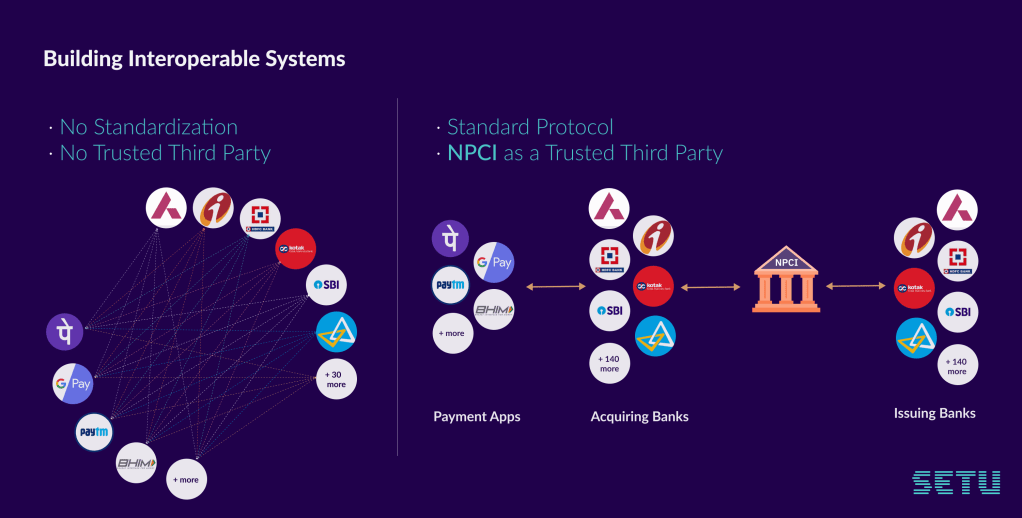
If we reflect back on the original objective of UPI, it was to build an interoperable system. An interoperable means anyone could download a payment app, link any bank (that they own), and transact with anyone else from any other bank.
The UPI creators made NPCI as the trusted switch and they standardized the protocol. NPCI makes sure that data flow between banks and payment apps are routed to the correct and verified destinations.
The end result, the payment apps, and banks talk just to NPCI and can be assured by NPCI that they are really interacting with who they intend to.
Source blog.setu.co
Apart from being the trusted router, NPCI also hosts non-financial meta APIs to serve everyone in the ecosystem.
Some examples of meta API are listAccountProviders (returns all details of all banks), validateAddress (helps in validating VPAs), requestOtp (for 2FA), etc.
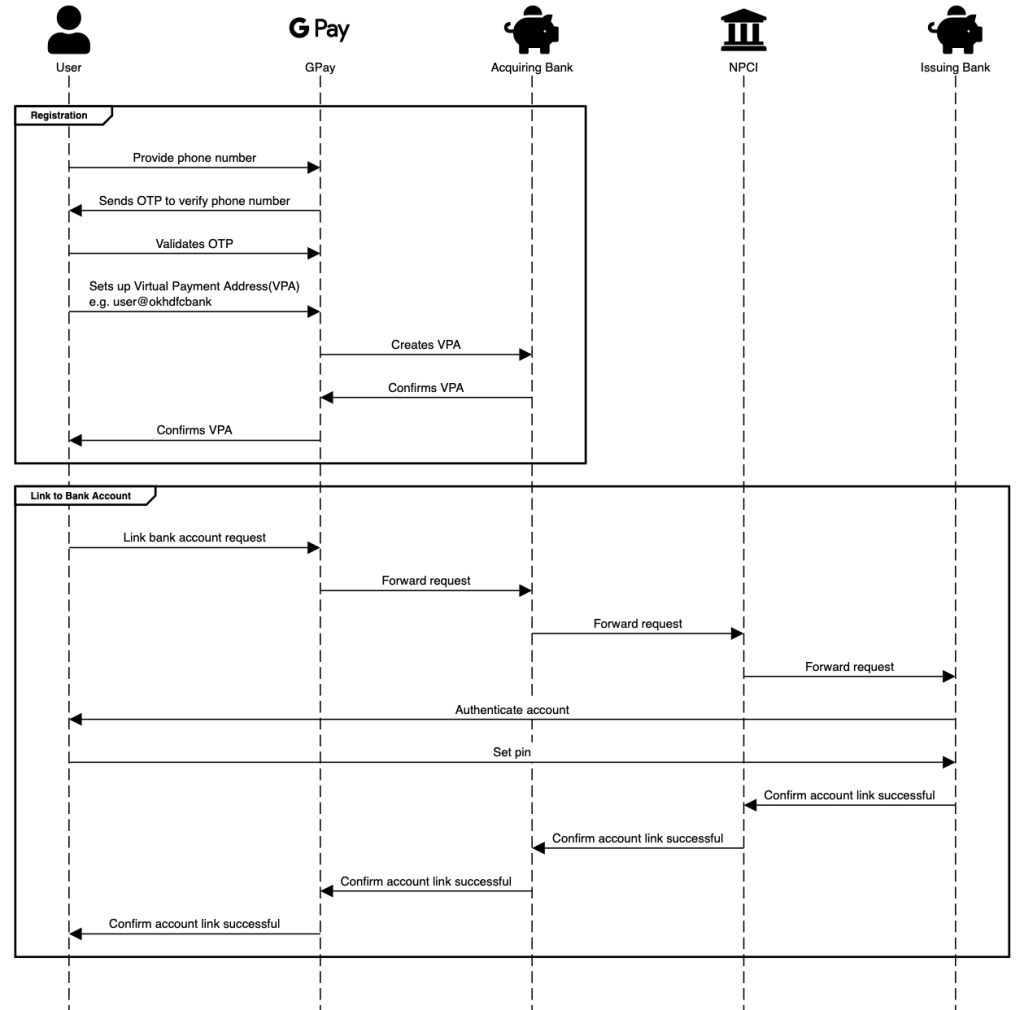
We will now see how these actors work together for the registration and account linking process
And how the flow of a transaction works
Hope this helped you understand what goes on behind the scenes when you are transferring money to your friend in a matter of seconds! :)

















 Kenrick Vaz