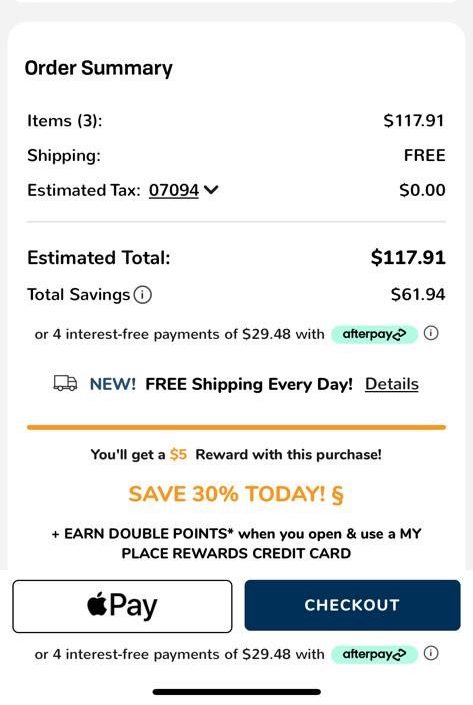
Earlier this year, we took over development of the mobile app for a retail app of a leading brand of kids clothings. And one of the features on the checkout page is the option of using Afterpay as you can see in the screenshot below.
This got me wondering how do 𝐁𝐍𝐏𝐋 (Buy Now, Pay Later) providers like Afterpay work? How do BNPL providers make money?
BNPL has grown dramatically in recent years. It rewrites the product payment flow for both eCommerce and POS (Point of Sale) and the BNPL provider is the 𝐩𝐫𝐢𝐦𝐚𝐫𝐲 𝐢𝐧𝐭𝐞𝐫𝐟𝐚𝐜𝐞 between the merchants and the customers.
Benefits for the merchants The merchants who offer the BNPL payment option see a 20% increase in cart conversion and a 40% increase in the average order size.
Benefits for the customers The customers can now acquire the product with only the down payment, and pay later with zero interests or fees.
Benefits for BNPL providers BNPL providers can sell future installments (receivables) to a lender at a discount. For example, a series of $100 installments to be received in 6 weeks can be sold at $96. This is quite a high interest for the lenders.
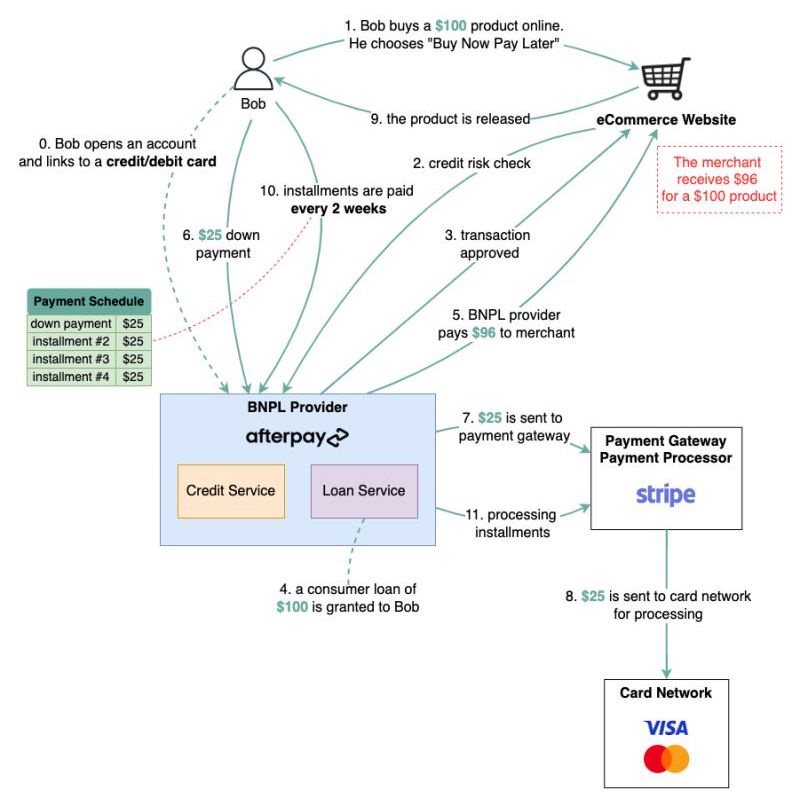
I came across this lovely illustration on Hua Li, Founding Member at ByteByteGo
Step 0 Bob opens an account with AfterPay. This account links to an approved credit/debit card.
Step 1 Bob wants to buy a $100 product and he chooses the “Buy Now, Pay Later” payment option.
Steps 2-3 BNPL provider checks Bob’s credit score and approves the transaction.
Steps 4-5 BNPL provider grants Bob a consumer loan of $100, which is usually financed by a bank. $96 out of $100 is paid to the merchant immediately (Yes, the merchant receives less with BNPL than with credit cards!) Bob now needs to pay back the BNPL provider according to the payment schedule.
Step 6-8 Now Bob pays the BNPL $25 down payment. The payment transaction is sent to Stripe for processing. Stripe forwards it further to the card network. Since this goes through the card network as well, an 𝐢𝐧𝐭𝐞𝐫𝐜𝐡𝐚𝐧𝐠𝐞 𝐟𝐞𝐞 needs to be paid to the card network.
Step 9 The product is released and can be shipped to Bob.
Steps 10-11 Bob pays installments to the BNPL provider every 2 weeks. The installments are deducted from the credit/debit card and sent to the payment gateway for processing.
Would you choose the interest free option of 4 installments or pay all at once?
Known as the “Curé d’Ars”, Jean-Baptiste-Marie Vianney was born on 8 May 1786 in France in the town of Dardilly, near Lyons. His devout Catholic parents were farmers, and from an early age, John worked in the fields. Without formal education, as a young man he was functionally illiterate; but thanks to his mother’s teaching, Vianney was able to memorise and understand numerous prayers, and live a devout religious life.
Source: Archdiocese of Bombay (Instagram)
At that time in France, the winds of Revolution were blowing. Young John made his Confession at home, rather than in a church, to a “non-juring” priest – that is, a priest who had not sworn loyalty to the revolutionary government. The same priest gave him his First Communion in a barn, during an “underground” Mass. At the age of 17, John Vianney felt the call to the priesthood. “If I am to be a priest,” he said, “I will win many souls for God.” But the path to ordination was not an easy one. It was only thanks to some wise priests – including Father Balley, the parish priest of d’Écully, that he finally received Holy Orders on 13 February 1815, at the age of 29.
If we really understood the priest on earth, we would die: not of fear, but of love.
St. John Marie Vianney
Source: Archdiocese of Bombay (Instagram)
Three years later, in 1818, Father John Vianney was sent to the town of Ars, which, with just 230 residents, was little more than a small French village. Here the young priest dedicated all his efforts to the spiritual care of the faithful. He visited the poorest families, restored the village church, organized patronal feast days. He also founded La Providence, a home for girls. But it was for his dedication to the Sacrament of Confession that the Curé of Ars is best known. He was always available to hear Confessions and offer forgiveness, spending up to sixteen hours a day in the confessional. Crowds of penitents travelled from every part of France to make their Confession to the holy priest. In time, Ars became known as “the great hospital of souls.” St John Vianney himself would keep vigils and fast to assist the expiation of the sins of the faithful. “I’ll tell you my recipe,” he told one of his confreres. “I give sinners a small penance, and the rest I do in their place.”
Source: Archdiocese of Bombay (Instagram)
Having given his whole life for God and his parishioners, John Vianney died on 4 August 1859. He was 73 years old. His relics can be found in Ars, in the sanctuary dedicated to him, which is visited by some 450,000 pilgrims every year. He was beatified by Pope St Pius X in 1905, and canonized twenty years later by Pope Pius XI. In 1929, the same Pope proclaimed him the “heavenly patron of all parish priests throughout the world.” During the centenary of his death in 1959, Pope St John XXIII dedicated an encyclical to St John Vianney, pointing him out as exemplary model for priests. Fifty years later, Pope Benedict XVI inaugurated a “Year of Priests” on the 150th anniversary of his birthday into heaven, in order “to deepen the commitment of all priests to interior renewal for the sake of a stronger and more incisive witness to the Gospel in today’s world.”
Most people have a love/hate relationship with mobile push notifications. On the one hand, they keep us updated with the information we willingly asked to be updated on. On the other hand, for people like me, that constant activity on my phone is annoying and distracting.
My friends tease me, but I can’t go to sleep or do anything, for that matter when I have a little red dot in the top right corner of an app on my iPhone. Once I’ve checked out that notification, only then I can move on. Nevertheless, I need those notifications, so I can’t turn them all off.
What are push notifications?
A push notification is a message that pops up on a mobile device, such as a sports score, an invitation to a flash sale or a coupon for downloading. App publishers can send them at any time, since users don’t have to be in the app or using their devices to receive them. Push notifications look like SMS text messages and mobile alerts, but they only reach users who have installed your app. All the mobile platforms – iOS, Android – have their own services for supporting push.
Why are push notifications important?
Push notifications are very effective at helping users stay engaged with an app or re-engaging with an app they haven’t opened in a while. This is particularly useful because re-engaged users have significantly higher in-app conversion rates and lower acquisition costs than new users. Because you can receive pushes while you’re browsing in-app or even when your device is locked, this makes them a great way to convey messages of urgency, such as breaking news, current traffic conditions, or limited-time offers.
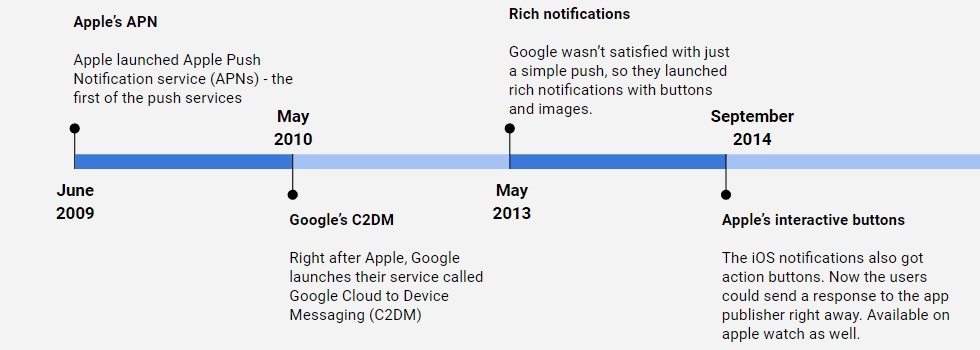
A Brief History of Push Notifications
Apple and Google are the leaders in the push notifications feature.
In 2009, Apple launched the first-ever push notification service – Apple Push Notification Service (APNs). Google didn’t stay behind for too long and launched its Cloud to Device Messaging service (C2DM) in 2010.
Rich notifications with images and calls to action appeared in 2013 on Google’s service, and then Apple added interactive buttons to their service in 2014.
In October 2014, Google acquired Firebase; it merged with Google’s push notification service and became known as Firebase Cloud Messaging (FCM).
So how does a notification reach your device?
Let’s see how this works with Firebase Cloud Messaging (FCM) which supports both iOS and Android notifications.
An FCM implementation includes two main components for sending and receiving:
A trusted environment such as Cloud Functions for Firebase or an app server on which to build, target, and send messages.
An Apple, Android, or web (JavaScript) client app that receives messages via the corresponding platform-specific transport service.
Source: Firebase
To setup our apps on FCM, we need to upload the relevant Apple and Google certificates. And then integrate the Firebase SDK into our mobile apps.
What follows is then what happens when users install the app and we give permissions to allow push notifications.
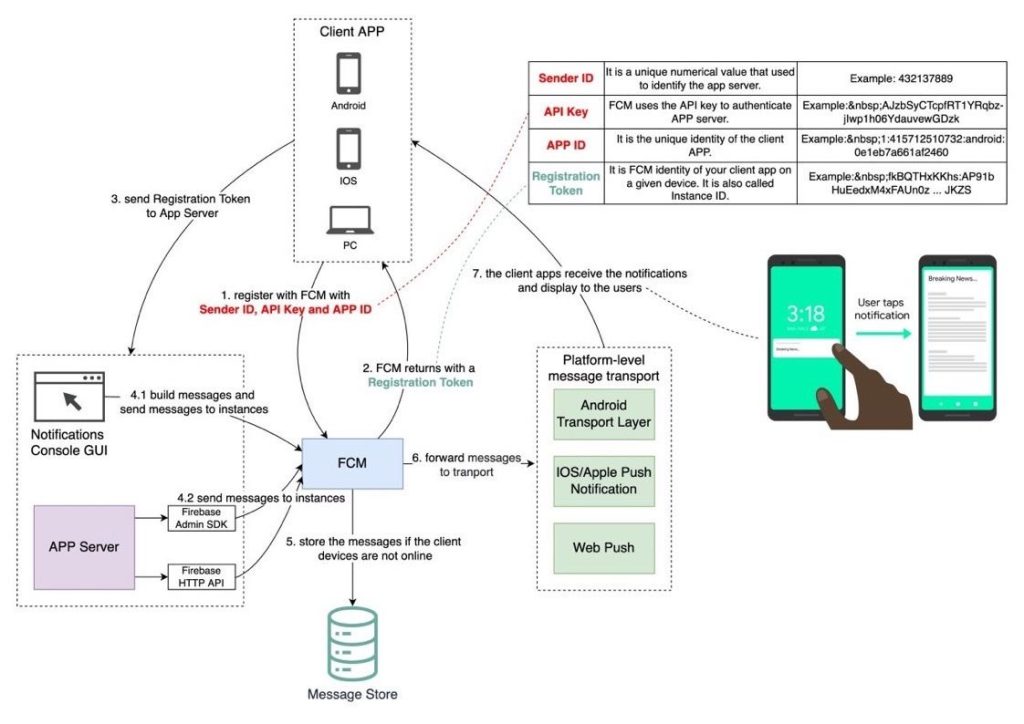
App registers with FCM the Sender ID, API Key and App ID.
FCM returns a registration token
This registration token is then sent to our backend where it needs to be stored along with the user details.
When our backend needs to send a notification, it sends the token, message and other details to FCM.
If the client is not online, Firebase stores the messages. It keeps checking regularly to see if the device/client is online to send the notification.
If the client is online it forwards the message to the relevant transport layer.
The client/app receives the notification and displays it to the user.
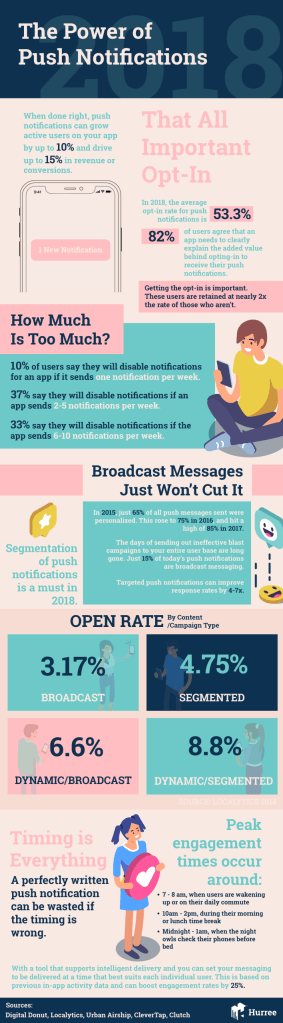
Here is a lovely infographic I came across on Push Notifications on huree.co
Fallen badam leaves scattered on the ground carelessly. Soon to be swept away to garbage. I wandered among them searching, selecting, picking up, putting together…
The three in the centre are long ago dried up pipal leaves… also very beautiful…
flip flit float fall fatal end now stayed picked purposefully as art hand propels to wild expanse beyond
arranged then mystic shape gracious pattern hue weaving dreams of please
content bound in still raising lives in hope
we ever have to very end fresh purpose yet ahead God keeps us always beautiful His magic still remains
After 3 long weeks in Secaucus, I finally managed to get myself to go to New York. I had gone around NY when I came to the US for the first time in 2018. And maybe that’s why I didn’t feel like going again. And also this time I am alone and sightseeing without company is something I don’t really enjoy! But yes, I finally made it. So here’s how my day went..
The weather in the morning was cloudy and this is the view from the bus before we entered the Lincoln tunnel which goes under the Hudson River that you see in the photo. Thankfully it got nice and bright and sunny once I got into Manhattan.
Few shots as I moved towards the 9/11 memorial
The United States Court House
The New York Public Library
Though I had visited the 9/11 Memorial the last time, I was still filled with heavy heart and a sense of wonder as I stood there this time.
Located where the Twin Towers once stood, there are now two large grey chasms in the ground from which water cascades down all four sides before gathering in a pool and finally plunging into a dark void in the middle, seemingly descending to the center of the Earth.
On the brass rims around these twin pools you’ll find stencil-cut names of every person who died in the terrorist attacks of February 26, 1993 and September 11, 2001. At night, lights shine up through each letter illuminating the names.
Today, at the World Trade Center site you’ll not only find the 9/11 Memorial & Museum, but also the Oculus building which is both a train station and shopping mall designed by Spanish architect Santiago Calatrava.
Its wholly unique design has been likened to everything from a bird’s wings to an armadillo to the twisted steel structures found at Ground Zero. Regardless of what it’s actually meant to be, the bright and lofty architecture is absolutely breathtaking and clearly provides some light to it’s darker counterpart, the 9/11 Memorial & Museum.
Across from the Oculus and 9/11 Memorial & Museum is the One World Trade Center (unofficially known as the Freedom Tower), the tallest building not only in New York City but the entire Western Hemisphere comprised of 104 floors and a height of over 500 meters.
On levels 100, 101, and 102 of the One World Trade Center, visitors can access the Observatory for a 360° view of New York City and the surrounding waterways.
From here I next visited Trinity Church where I was lucky to catch a service that was about to start. The choir was heavenly!
The New York Stock Exchange (NYSE) was very close to Trinity Church. Also caught a glimpse of the Charging Bull, sometimes referred to as the Bull of Wall Street
Next I saw the Statue of Liberty from Battery Park. Being a Sunday the ferries were super crowded and even though I had a ticket, I just felt like avoiding the crowds.
At Battery Park is also a memorial for those who gave their lives in service of the Navy during the second world war
Next to Battery Park is the National Museum of the American Indian
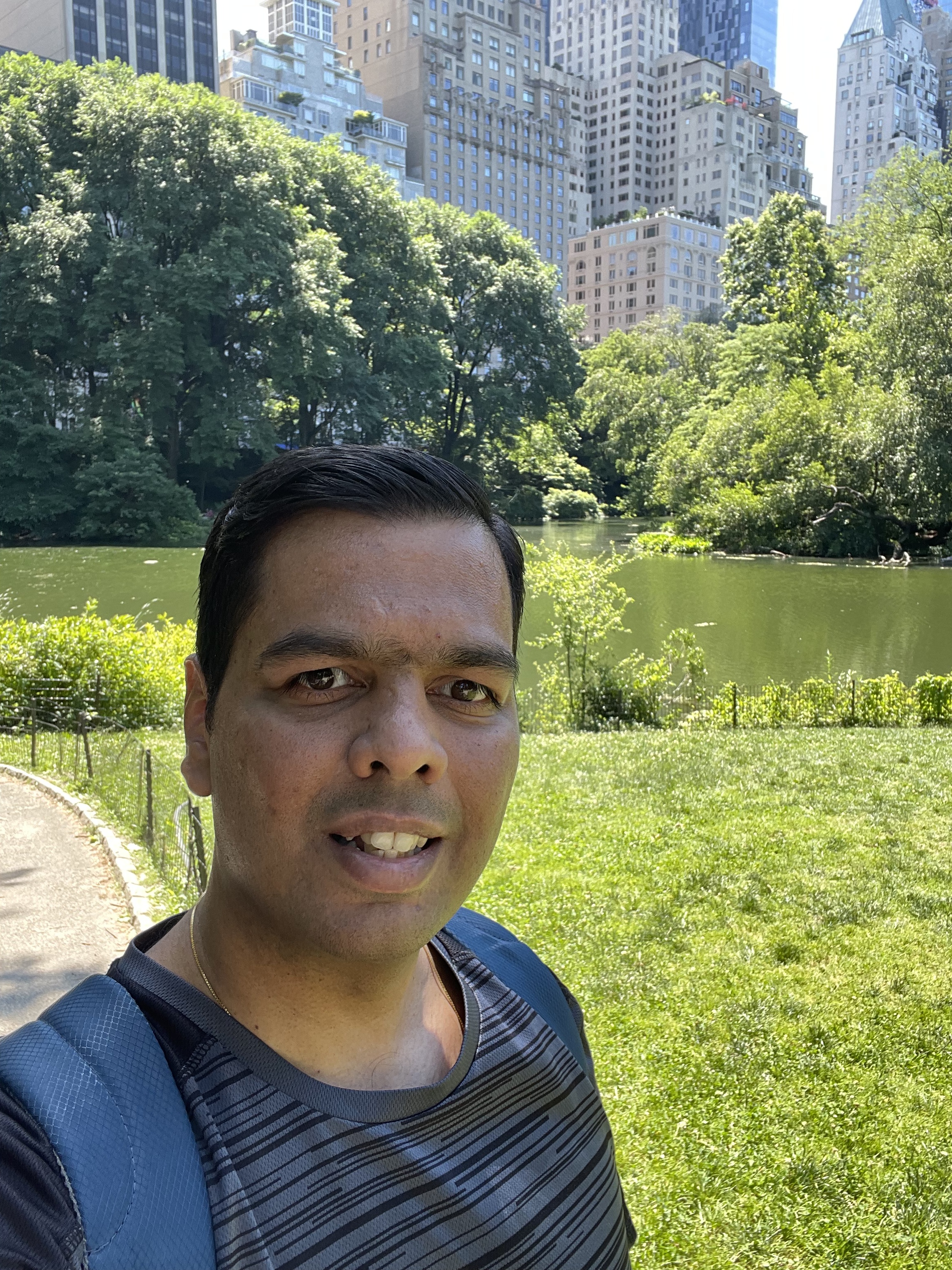
From there I went to Central Park which is so majestic and beautiful. There are horse carriages to take you around as well as cycles. I walked around a little. It is tooo huge to cover in a day. This lush 843-acre patch of nature in the middle of Manhattan. The park is home to scenic hills; meadows; playgrounds; skating rinks; ball fields; and many well-known attractions, including Strawberry Fields, Belvedere Castle, and the Central Park Zoo.
On my way back to the bus station, I passed by Radio City Music Hall where the Grammy’s and Tony’s are hosted as well America’s Got Talent and many other shows. You will also see the building which hosts Jimmy Fallon’s The Tonight Show.
Before I got into the bus station, I finally managed to get a clip of this big group of cyclists roaming the streets. I had crossed them twice during the day.
The Port Authority Bus Station is HUGE! I had to catch my bus back to Secaucus from here and what amazed me is that every bus number had their own little escalator to the waiting area for the bus.
Over the course of our lives upto this point, we all have probably done a few things we regret. Mistakes are normal to human growth. Still, the guilt that creeps in and stakes out space in your consciousness can cause plenty of emotional and physical turmoil.
You might know guilt best as the nauseating twist in your stomach that accompanies the knowledge you’ve hurt someone else. Perhaps you also struggle with recurring self-judgment and criticism related to your memories of what happened and your fear of others finding out.
As an emotion, guilt has a lot of power.
Guilt helps you acknowledge your actions and fuels your motivation to improve your behaviour. It might also lead you to fixate on what you could have done differently. If you’ve never felt able to come clean about a mess-up, your guilt might feel magnified to an almost unbearable degree.
Though guilt can sometimes promote positive growth, it can linger and hold you back — long after others have forgotten or forgiven what happened.
Letting go gives us freedom, and freedom is the only condition for happiness. If, in our heart, we still cling to anything—anger, guilt, or possessions—we cannot be free.
Thich Nhat Hanh
If you struggle with letting go of feelings of guilt you’re absolutely not alone. Most of us have all been there and continue to harbour feelings of shame or guilt about things long in the past. In the spirit of moving forward, here are seven ways to move on from guilty feelings.
1. Address It Sooner Rather Than Later The sooner we address what’s making us guilty, the less time it has to weigh us down. If the guilt is legitimate, and making amends is relatively easy then we should minimize the self-punishment phase and allow ourselves to move forward by apologizing.
2. Remember, No One Is Perfect Remember that absolutely no one is perfect, and we all make mistakes. Don’t engage in days, weeks or months of self-blame or battering your self-esteem because you should’ve known, should’ve acted differently, or should’ve been an ideal person. You’re not, and neither am I. That’s just life. Once you’re tried your best to make amends, try to let it go and not be so hard on yourself.
3. Don’t Keep It To Yourself Talking out your guilt or the incident that caused it with a relative/friend can be extremely therapeutic. Secrecy is the intensifier of guilt. Once you’ve bared something that you find troubling and discover that your friend isn’t nearly as shocked as you thought he or she would be, the guilt begins to drain away and you feel better.
4. Give Yourself A Reality Check Make sure your guilt is actually legitimate and not coming from a standard or expectation placed on you earlier in life, or even over something that isn’t upsetting anyone else.
5. Write It Down Try writing your feelings of guilt and shame down in a journal when you’re having trouble getting past them. Write down all of your thoughts and feelings honestly, then ask yourself some questions, like: Do I need to hold onto these thoughts and feelings anymore? How would changing these thoughts or feelings make a difference in my life? How is guilt holding me back?
6. Remember Your Self-Preservation Matters Always remember that your self-preservation matters. Maybe you couldn’t make it to your friend’s party because you were just too swamped that week, or couldn’t make it to your family member’s 30th because airline tickets were just too expensive. You are entitled to look out for your self-interest just as much as anyone else, and sometimes that means saying no or disappointing others. Remind yourself that your actions are valid, and don’t let others guilt-trip you into believing otherwise.
While guilt can often help us learn a valuable lesson, other times it weighs on us way longer than it should, affecting our self-esteem and our ability to move on. If you’re having trouble letting go, try to remember that everyone has been there and no one is perfect!
Each year Apple kicks off its Worldwide Developer Conference with a few hours of back-to-back-to-back announcements, generally covering things from iOS to watchOS to new hardware. Here are some of the key announcements made at the keynote on Monday.
iOS 16
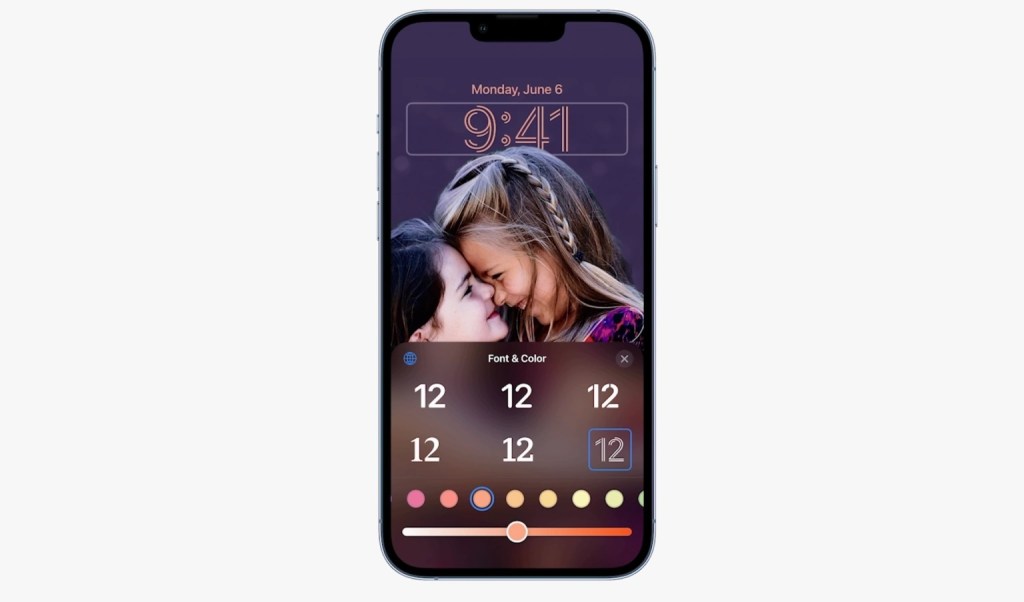
The lock screen is getting an overhaul. It’ll allow for more customization, plus support for widgets — including widgets for third-party apps. Notifications will now “roll in” from the bottom of the screen, while a “Live Activities” API will let developers update notifications in real time (think sports score tracking.)
Image Credits: Apple
SharePlay (which lets you, for example, watch a streamed movie in sync with a friend) will now work in iMessage, not just over FaceTime.
Apple is getting into buy now, pay later; Apple Pay Later will let you split an Apple Pay purchase over four payments with zero interest; Apple says it’ll work anywhere Apple Pay works.
Apple’s big Maps overhaul is coming to a bunch of new places this year, including “France, Switzerland, New Zealand, Belgium, Israel, Liechtenstein, Luxembourg, Monaco, Palestinian Territories, Saudi Arabia and the Netherlands.” It’s also getting improved multistop route support.
If you use Family Sharing to limit your kids’ iPad screen time, said kids will now be able to request more time via iMessage.
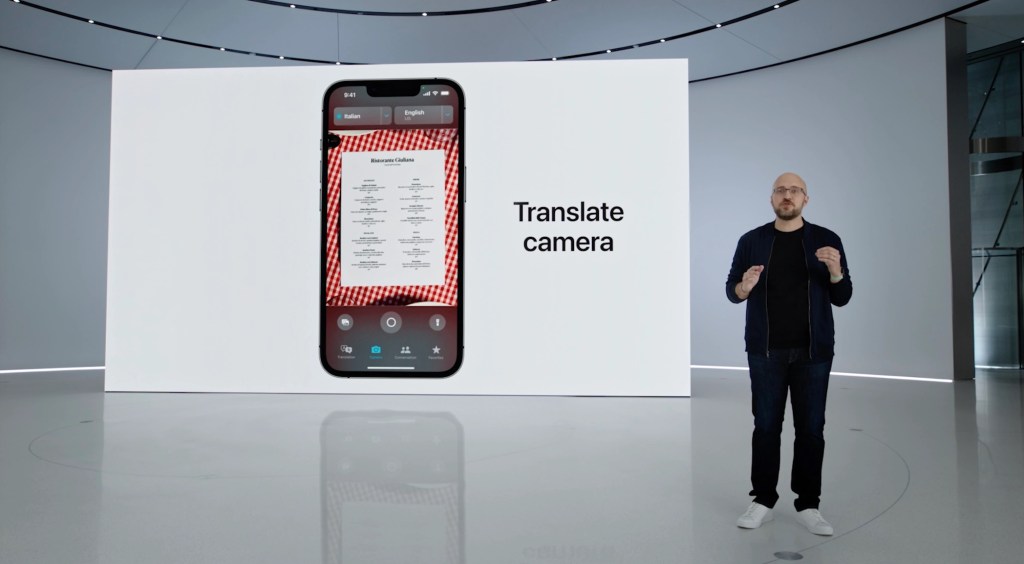
Live Text will be able to translate and replace text it detects in a photo, allowing you to more easily read through something like a menu in a language you don’t know.
Image Credits: Apple
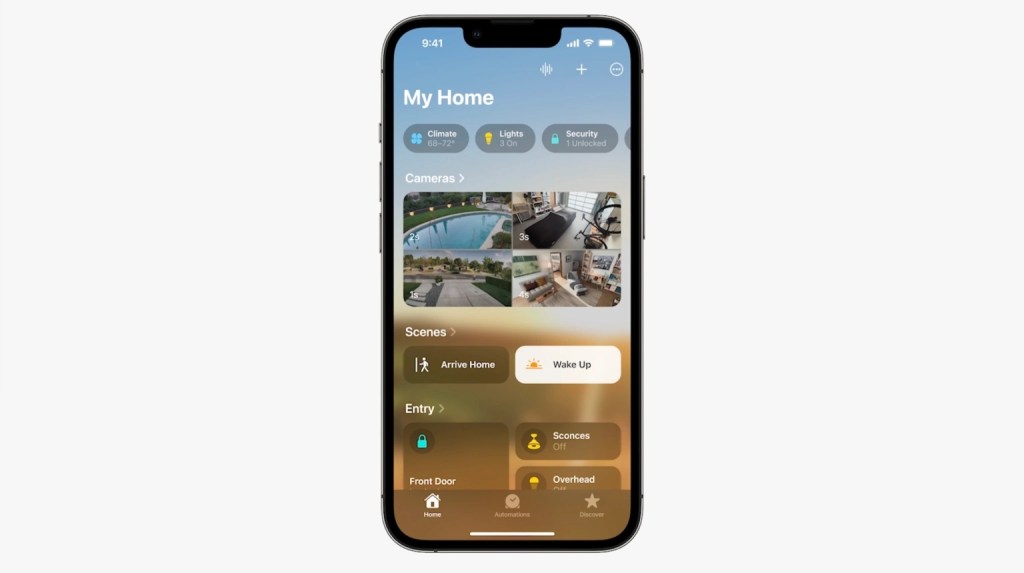
Apple says it has reimagined the Home app “from the ground up.” All of your various devices in different rooms are brought into one screen, including a side-scrolling view of all of your HomeKit-enabled cameras.
Image Credits: Apple
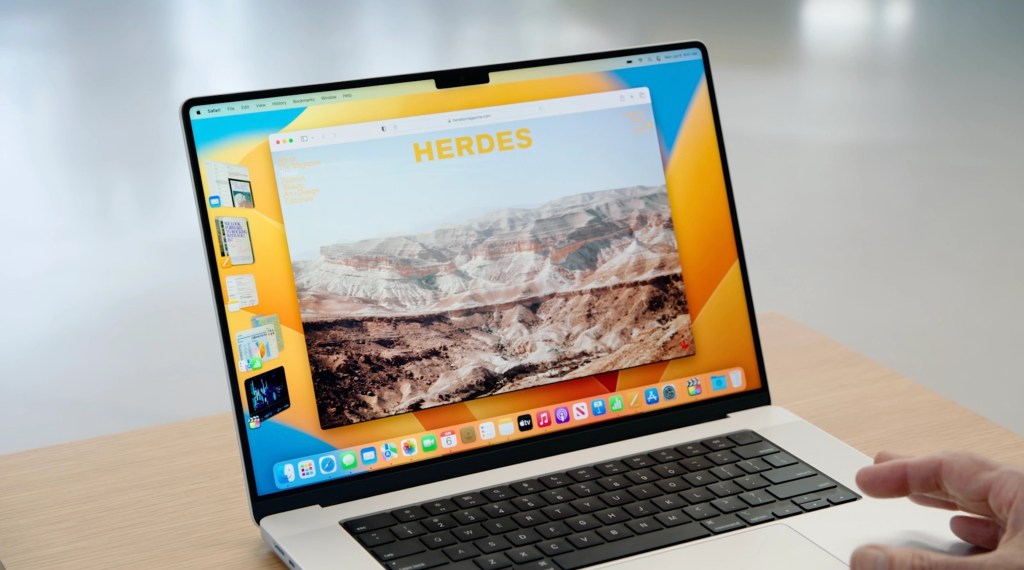
iPadOS will get a new desktop-style window management feature called “Stage Manager” that lets you run multiple windowed/overlapping apps on screen simultaneously.
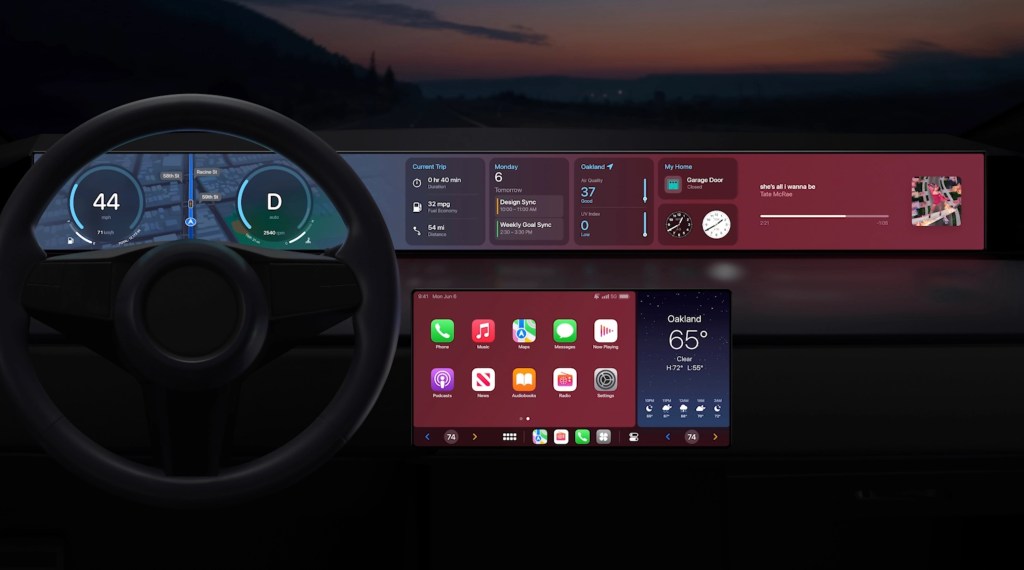
CarPlay is also getting a massive overhaul — Apple is basically looking to take over your car’s entire instrument cluster. It’ll support things like speed readouts, fuel gauges, AC control, etc; what works where, of course, will depend on what the car maker allows. Apple says to expect more news here “late next year.”
Image Credits: Apple
Apple Watch
Four new watch faces: Astronomy, Lunar, “Play time,” and “Metropolitan.”
New “banner” notifications will keep you updated without always taking over the whole screen.
Apple Watch will be able to track a few new running metrics, including vertical oscillation (“how much you move up and down” while running), stride length and ground contact time.
The Fitness app on iOS will now be enabled even for those who don’t have an Apple Watch, so everyone can close those rings.
Image Credits: Apple
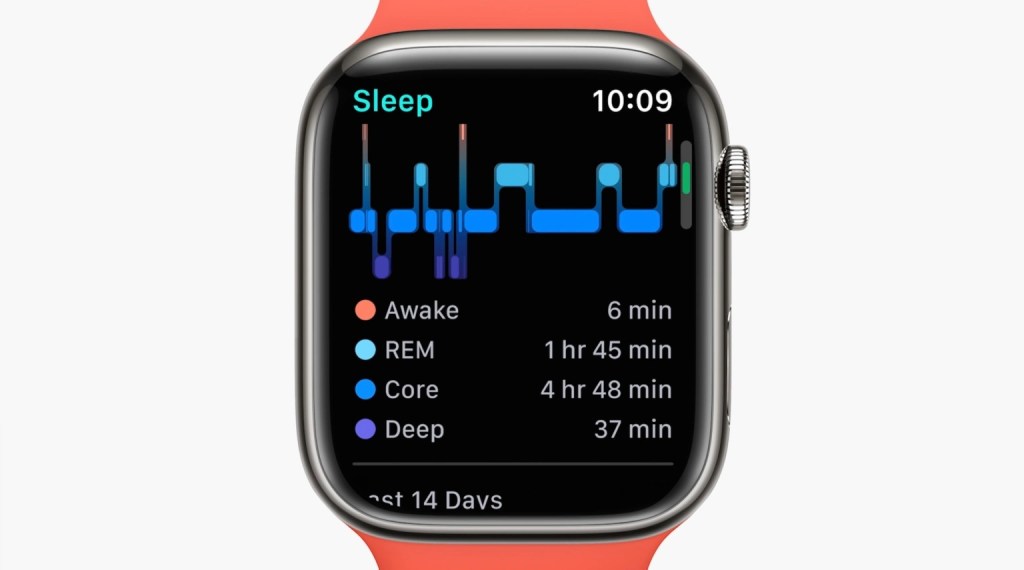
Sleep tracking will use the heart-rate monitor and accelerometer to determine how much time you spent in four different sleep stages (Awake/REM/Core/Deep) while trying to catch some Zzz’s.
Apple Watch will be able to track your “A-fib history” to help doctors monitor heart arrhythmia and determine if treatment is helping.
macOS
The next major release of macOS will be called “macOS Ventura.” Here’s what Apple highlighted for Ventura:
Image Credits: Apple
“Stage Manager” mentioned above is coming to macOS as well, pitched as a way to focus on one or two apps at a time. You can “group” running apps together; tapping into a group will minimize other apps, while putting the selected group front and center.
Spotlight is getting a bit of an overhaul; it’ll be able to pull rich results into a new scrolling view and allow you to do things like quickly preview a found file without actually opening it.
The Mail app is getting support for undo send, scheduled send and timed reminders. Search within Mail is getting smarter, automatically correcting for typos and knowing how to search for synonyms.
Safari will now be able to use “passkeys” instead of passwords — a system built along with Google and Microsoft to allow you to log in to websites and apps with biometrics (like fingerprint sensors or facial recognition) without any text-based passwords in the mix.
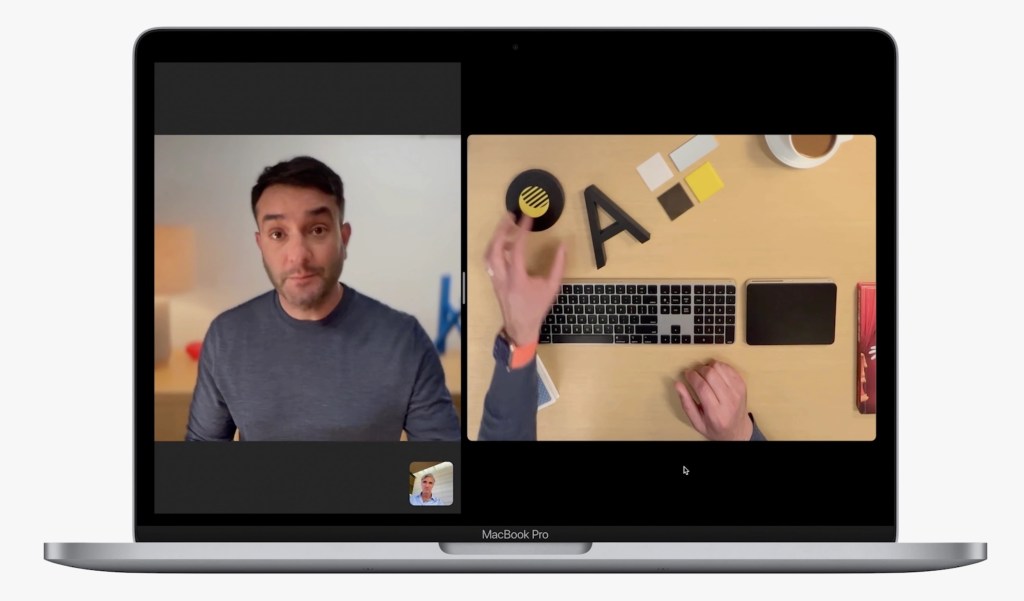
Continuity Camera: Your iPhone’s camera is almost certainly much better than the one built into your laptop — so Apple is going to let you use your iPhone’s Camera for video calls on macOS. Clamping the iPhone onto your laptop looks a little goofy, but the impact on quality is probably worth it for important calls. There’s also a wild “desk view” feature that uses the iPhone’s wide angle lens, combined with some tricky image manipulation, to capture what you’re doing on your desk in a simulated overhead view.
Like many companies, Airbnb has experienced growing pains with bundlers as its codebase grew. But even after its codebase quadrupled, the company was able to speed UX changes to the front end when it migrated its JavaScript code bundler from Webpack to Metro in 2018.
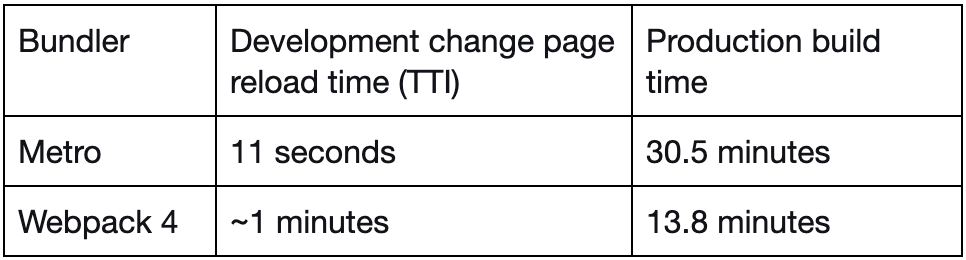
With build performance significantly improved, UI changes appeared 80% faster, as per the Time to Interactive (TTI) metric. Even the slowest production build, one compiling 49,000 modules (JavaScript files) is now 55% faster — down to 13.8 minutes from 30.5 minutes with Webpack.
Airbnb’s own Page Performance Scores also improved (~1%) with those pages built with Metro.
For reference, after the codebase quadrupled around 2018, the average page refresh time for a simple one-line code change was anywhere between 30 seconds to two minutes depending on the project size.
Airbnb software engineer Rae Liu covered some of the differences between Webpack and Metro and discussed some of the migration challenges which are summed up below.
What Is Metro?
Developed by Meta, Metro is the open-source JavaScript code bundler for React Native. As Airbnb’s stack doesn’t include React Native, their engineers worked directly with Metro’s engineers at Meta as well as on teams themselves to further develop the technology.
Metro breaks bundling down into three steps in the following order: resolution, transformation, and serialization.
Resolution: resolve the import/ require statements
Transformation: transpile code (source to source compiler which converts modern Typescript/ JavaScript source code into JavaScript and backwards compatible with old browsers), an example tool is babel
Serialization: combine the transformed files into bundles
In development, Airbnb engineers created a Metro server with custom endpoints to handle building dependency graphs and source maps, translation, and bundling JS and CSS files. For production builds, they ran Metro as a Node API to handle resolution, transformation, and serialization.
The migration took place in two phases. The first priority was the Metro development server as the slow Webpack development server was the source of significant development productivity costs. The second migration phase focused on bringing Metro to feature parity with Webpack and running an A/B test between Metro and Webpack in production.
Key Differences Between Metro and Webpack
Process JavaScript Bundles On Demand
Webpack pre-compiles the entire project on startup while Metro only compiles what is needed. What does this mean? A JavaScript bundle is technically just a serialized dependency graph, where an entry point is the root of the graph.
At Airbnb, every frontend project has a Node server that matches a route to a specific entry point. When a web page is requested, the DOM includes script tags with the development JavaScript URLs. Webpack needs to know all the entry points for all the pages before it can start bundling while Metro only needs one entry point and can process JavaScript bundles as requested.
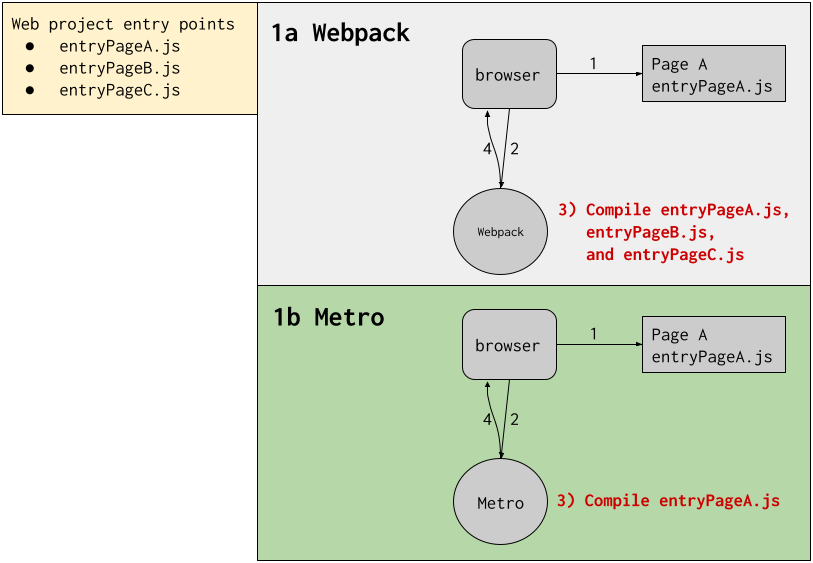
Unseen in the following image, a developer makes a change to Page A:
In both 1a and 1b in the diagram above the browser loads Page A (1) the requests the entryPageA.js file from the bundler (2) and the bundler responds to the browser with the appropriate bundles (4). The difference between figures 1a and 1b lies in action (3) as the Webpack diagram compiles entry points for pages B and C while Metro does not as the developer-only modified Page A in the example.
One of the largest frontend projects at Airbnb has 26,000 unique modules with the median number of modules per page being ~7.2 modules. The number of modules Airbnb ultimately has to process doubles to roughly 48,000 due to their use of server-side rendering. After putting Metro’s compile-on-demand model into action, approximately 70% is now taking place.
Multilayered Cache
Airbnb leverages Metro’s Multilayered Caching feature with persistent and non-persistent caches. Metro does provide more caching flexibility by allowing engineers to define the cache implementation, including mixing different types of cache layers.
Airbnb ordered their caching layers by order of priority. If a result is not found in one cache layer, the next layer will be used until the result is found. Compared with the default Metro implementation without a cache, hitting a remote read-only cache resulted in a 56% faster server build in a project compiling 22,000 files.
The third caching layer is a remote read-only cache rather than a read-write cache as writing to a remote cache incurs costly network calls especially on a slow network. This decision saved an additional 17% build time in development.
Webpack does have a caching layer though it does differ from what Metro offers.
Bundle Splitting
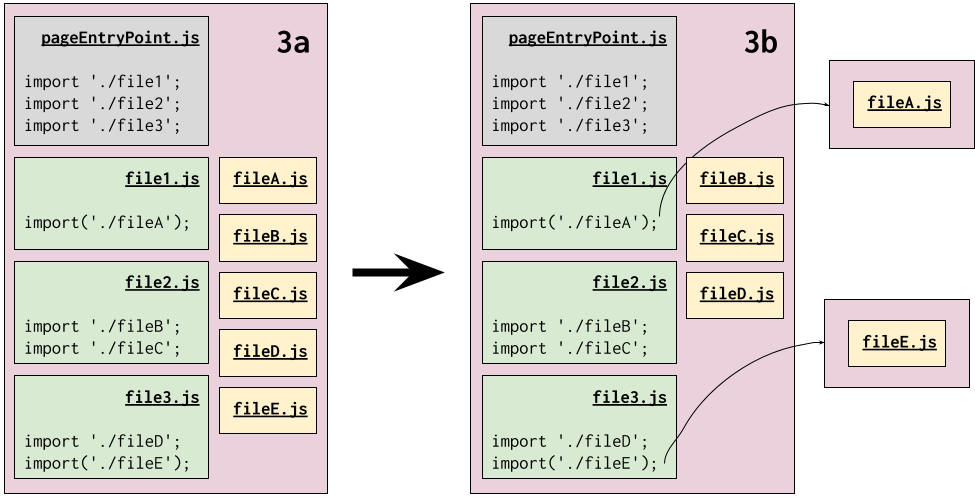
One of the technical challenges detailed in Airbnb’s blog post is Bundle Splitting. This is the process of splitting the bundles by dynamic import boundaries also known as code splitting. The out-of-the-box Metro solution produced giant ~ 5MiB bundles per entry point which were taxing on browser resources, network latency, and unable to HTTP cache.
In the image above, import(‘./file’) represents the dynamic import boundaries. The bundle on the left-hand side (3a) is broken down to three smaller bundles on the right (3b). The additional bundles are requested when the import(‘./file’) statements are executed.
Suppose fileA.js changed, the entire bundle needs to be re-downloaded for the browser to pick up the change in fileA.js. With bundles split by dynamic import illustrated in Figure 3b, a change in fileA.js only results in the re-downloading of the fileA.js bundle. The rest of the bundles can reuse the browser cache.
In production, there is no development server and the bundles are prebuilt. Airbnb engineers took some inspiration from Webpack’s bundle splitting algorithm and implemented a similar mechanism to split the Metro dependency graphs. The resulting bundle size decreased by ~20% (1549 KB –> 1226 KB) on airbnb.com as compared to the development splitting by dynamic import boundaries.
Development bundles were optimized differently as it takes time to run the bundle splitting algorithm and the engineers didn’t want to waste time splitting bundle size in development. In the instance of development, page load performance was prioritized over minimizing bundle size.
The Metro and Webpack bundle size metrics are comparable.
In Conclusion
The biggest Airbnb frontend project compiling ~48,000 modules (including server and browser compilations) saw a drop in the average build time by ~55% from 30.5 minutes to 13.8 minutes. Airbnb Page Performance Scores improved around 1% for pages built with Metro which was a nice surprise as the goal was a neutral result. Overall, the implementation of Metro is widely successful.
Metro has solved the bundling issues Airbnb was facing but the engineers also recognize that new technologies have emerged since their decision to move forward with Metro and that Metro isn’t a general-purpose JavaScript bundler.
My wife loves plants and when I saw this quote I recalled a lot of what I see in our garden. Some plants grow outward first while other spend months growing roots before they are able to show any fruit.some plants grow outward first while other spend months growing roots before they are able to show any fruit or flowers or growth.
In the end both grow, but the process could not be more different.
It can be super easy to compare one persons growth to another, to see the one plant that already has fruit and say it is doing better than the other plant. Yet just below the surface the other plant is doing just as well, the one difference is that you cannot see it.
We have to remember everyone defines success and growth differently – and that’s more than okay, it’s necessary!
What do I mean that success looks differently to everyone and that it’s necessary? It means, if you’ve accomplished your purpose and worked diligently at whatever you do, you are successful.
For some of you this means being a full-time mom or dad. For others, it means your family made it through the week, and you spent time teaching your children life skills, like being kind. For some of you, it means you made our streets safer or you provided healthcare in an emergency or you served a customer well.
Success has many faces. Too often, we let comparison get in the way of celebrating our own successes. We spend our days looking at others and thinking, “If I did that, I’d be successful,” or, “Wow, I should be doing more with my life. Look at so and so.” Comparison only takes us backwards though. It chokes us and keeps us from seeing the individual gifts we bring to the world around us.
How do we move past comparing ourselves to others? Here are some practical things you can do:
1) Make sure you know your values. When you measure yourself against what you value, you have a solid, non-moving goal. If my values include helping others, then I can evaluate if I did that today. Did I help someone today? Then it was a successful day. Our values provide an impartial measurement tool for us.
2) When you are tempted to compare your success to someone else’s, evaluate the cost of their success. We usually only look at the benefits of success in other people’s lives and neglect the costs. For example, some may look at an air hostess and say, “You get to travel to really great places.”
And, yes, he/she do. However, if you were to evaluate the costs of their travel, you would learn that they often end up with a migraine from the pressure changes in the plane. That’s a cost. It impacts their off day home and leaves them ineffective for their family who has missed having them home. We don’t often advertise the costs associated with success, but I guarantee everyone has costs they pay for their particular success.
3) Remind yourself everyone has a purpose in life. Sometimes the purpose is glamorous, other times someone’s purpose may not be glamorous, but their purpose is essential. Think of the number of administrative assistants in the world who may not lead glamorous lives, but who make our worlds go around! Without them, we’d be nothing. We may not count that as success, but it’s more than success. It’s essential for others to accomplish their purposes.
Everyone has value. Everyone has purpose. Most often, it’s our perspective that’s off-base. This week as you are tempted to look at someone else’s success, keep these things in mind. Most importantly, evaluate your own success in light of your impact on those around you. After all, that’s what really matters.
We often limit ourselves by deciding we can’t do something before we even try. These limiting beliefs may lead us to ask ourselves, “Why bother?” or tell ourselves, “This is silly.” When we do this, we are effectively telling ourselves the answer is “no” before we even ask the question. When we do that, we’ve stopped our growth and our path to success.
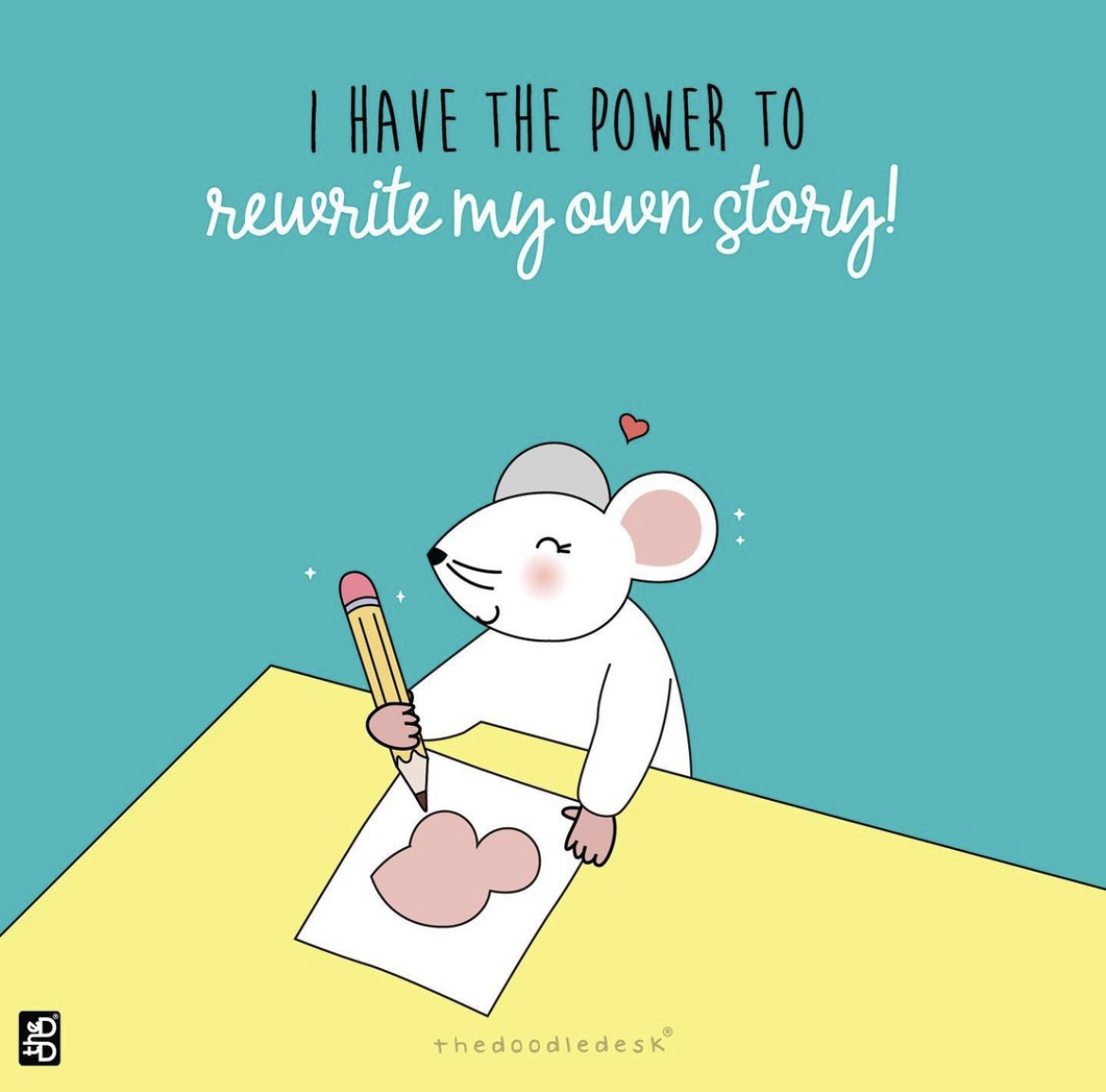
This negative self-talk is a clear sign that you need to rewrite your story. Our story affects what we do, where we go and how we approach life. A powerful story leads to a life of opportunity – change your story, change your life. The first step in changing your story is to stop telling yourself disempowering ones.
How many times have you said something like this to yourself?
I have to be perfect… I’m too old… I’m just not that kind of person.
These are exactly the type of damaging thoughts that keep us from achieving our goals and, ultimately, our dreams. By addressing the following damaging thoughts head-on and treating ourselves with kindness instead of doubt, you can change your mindset and learn how to change yourself.
The stories we tell ourselves make up our identity and dictate what we believe we can and cannot do. Here are some common stories that you tell yourself that limit your opportunities for growth and indicate it’s time for you to rewrite your story:
“I have to be perfect.”
Perfection is the lowest standard anyone can have – it leaves no room for growth. While completing a task perfectly may feel good for a little while, it’s through our mistakes that we develop our greatest strengths and find life’s impactful lessons. If you have done something perfectly, you haven’t really learned anything – how to do this task better, for example, or what to avoid. By telling yourself you have to be perfect, you’re putting limits around your own capabilities. When you want to learn how to change your life around, you have to give up perfection.
Rather than striving for perfection, strive for a balanced life. Accept that you will make mistakes and when you do, use them as a starting point to realize your next level. Trying to be perfect stems from one’s fear of failure. Instead of being afraid to fail, pursue your passion no matter the outcome.
Take the opportunity to learn from your mistakes: find the cause of your problem and eliminate it. Don’t try to be perfect; just be an excellent example of a human.
“My life is harder than anyone else’s.”
Everyone is fighting their own battle. It’s how you choose to handle difficulty that determines how to change your life around.
Look at the success stories of Oprah and Tony Robbins, and the hardships they overcame to achieve a life of greatness. As Tony says, “Identify your problems, but give your power and energy to solutions.”
A hard life doesn’t prevent you from success unless you tell yourself it will. There are plenty of examples of those who overcame seemingly overwhelming obstacles to achieve greatness, and just as many examples of those born with all the advantages in the world who failed to have fulfilling lives. When it comes to rewriting your story, you must let go of the past.
“If I ignore it, it will go away.”
If you want to learn how to change yourself, you must see things as they really are. Reality always catches up with us. While we can sometimes pretend they aren’t there, our problems will always be waiting for us when we return. It’s only when we choose to face them head on that they truly go away.
Our goal is not to ignore the problems of life, but to put ourselves in better mental and emotional states to not only come up with solutions but really meet the challenges and take action. Take a good look at yourself and where you are in life and the choices you have made that have brought you to this point. This is not an opportunity to beat yourself up. Rather, it’s a chance to take inventory and understand what you need to change in order to rewrite your story.
“I’m too young, or I’m too old.”
Do you think you’re too old to learn how to change your life around?
Here’s the truth: Your age only limits you if you allow it. Create a vision and never let your environment, other people’s beliefs or the limits of what has been done in the past shape your decisions. Ignore conventional wisdom.
When you look at a possible lifespan of up to 120 years if you live right, trying to rewrite your story at age 60 suddenly seems very plausible. You can do whatever you desire at any age – as long as you believe it to be true and put in the work to make it a reality.
“I’m just not the happy type.”
By telling yourself that you aren’t “the happy type,” you’re making yourself unhappy. Happiness is a choice we make – it is a state we can become through our actions. The path to happiness is more than material items and superficial things. Rather, happiness is an all-encompassing way of being. When you change your thoughts, you learn how to change your life – that is, when you choose to be happy, your negatives shift to positives.
As achievers we all seek greatness, but is there something holding you back from your next level of success and fulfillment?






























































































 Kenrick Vaz