A Postcard From Your Future Self

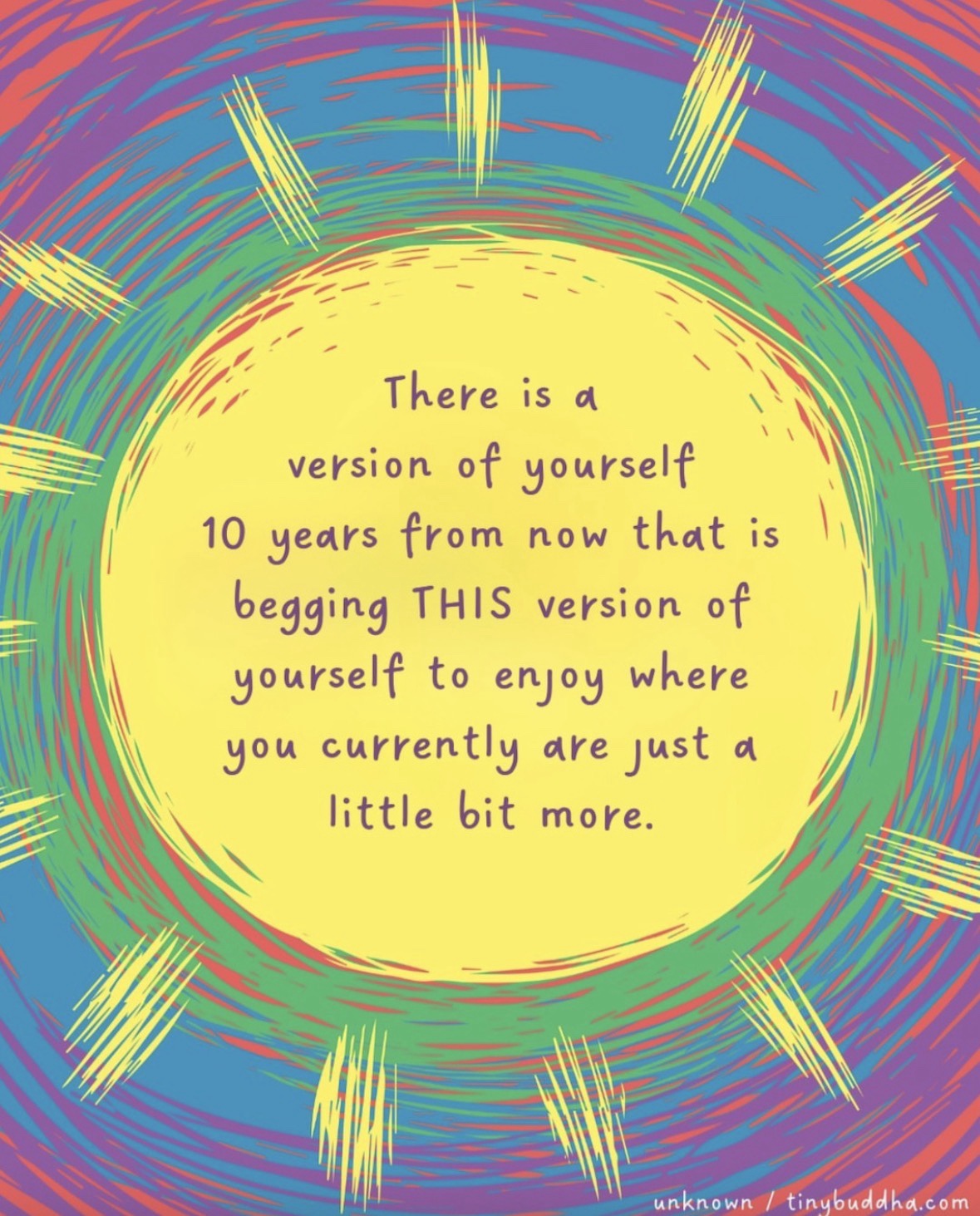
There’s a version of you, ten years from now, who’s looking back at today with a kind of wistful tenderness. They’re sitting somewhere in the future—maybe at a desk, maybe on a porch, maybe in a completely different life—thinking about the person you are right now. And if they could send you a postcard, if they could shout across time, they’d probably say something simple and a little desperate: please slow down and enjoy this moment a little more.

We spend so much time sprinting toward the next milestone, the next raise, the next level, the next version of ourselves that we forget the quiet magic of right now. We assume happiness is always waiting just beyond the next accomplishment, the next transformation, the next reinvention. But the future you already knows—this version of you, the one you are today, is the one they’ll miss the most.

Think about all the things you have today that you once prayed for. The friends, the home, the job, the small rituals, the freedom, the quiet mornings. Remember how hard you worked to get here. Remember the nights you wondered if it would ever feel like this. Now you’re living it. And yet, like we always do, you’re probably looking past it, already scanning the horizon for what’s next.

Your future self wants you to stop doing that. They want you to take a breath and notice how the light falls through your window, how your coffee tastes this morning, how the people you love sound when they laugh. They want you to celebrate the small wins, to take the walk without your phone, to write the journal entry, to make the call you’ve been putting off. They want you to remember that life isn’t a checklist. It’s a series of moments—this one included—that you’ll never get back.

And maybe the most radical thing you can do today is listen to them. Maybe you pause for a second and actually feel where you are. Not just notice it, but feel it. The weight of the chair you’re sitting on. The smell of the air. The quiet pulse of being alive. Because when you do that, even briefly, you’re not just living—you’re creating a memory your future self will treasure.

Someday, that version of you will look back and smile at the way you stopped, even for a heartbeat, to appreciate your life as it was. And you’ll be glad you didn’t let this version of you slip by unnoticed.
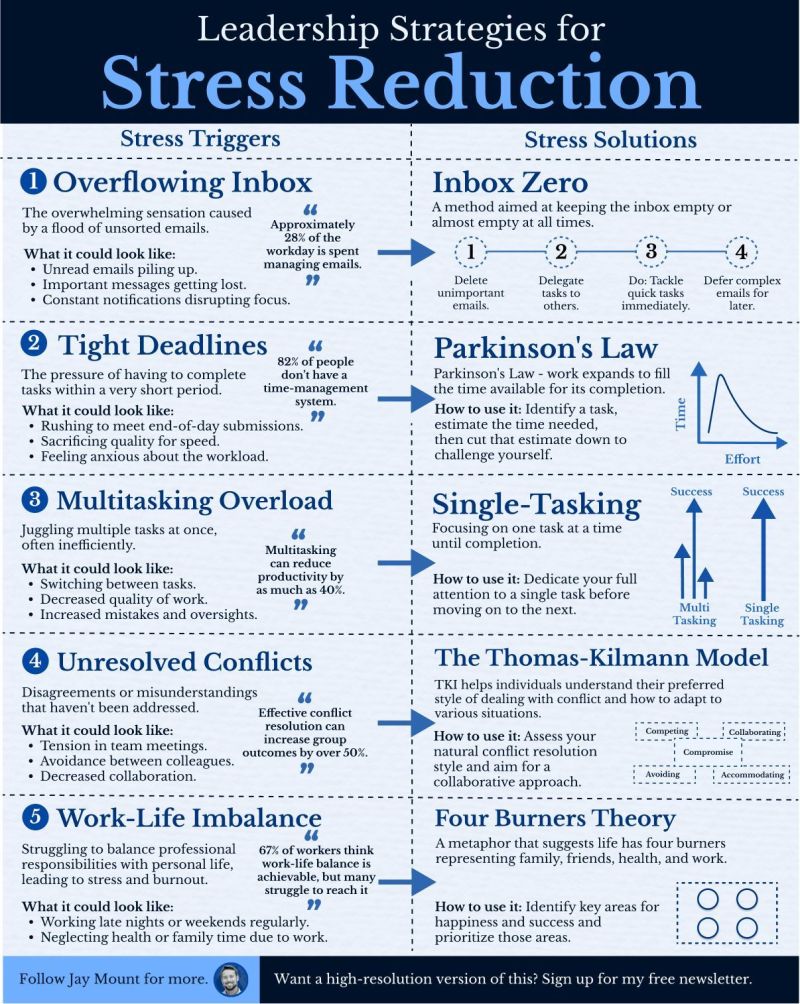
How to Reduce Stress

Burnout doesn’t always look dramatic. Sometimes it’s just slowly losing clarity.

You’re not broken—you’re just overloaded.

From endless inboxes to context-switching all day,
most leaders are forced to carry more without ever
being taught how to carry better.

Here are 5 stress signals—and the energy-protecting systems that help:

1. 📥 Inbox Avalanche?
Try: Inbox Zero
➤ Delete what doesn’t matter
➤ Delegate what you shouldn’t own
➤ Triage quick tasks, defer the rest

A clear inbox = a lighter mind.

2. ⏱ Drowning in Deadlines?
Try: Parkinson’s Law
➤ Give yourself less time
➤ Force clarity by racing the clock

Effort expands to fill time—cut it on purpose.

3. 🔀 Constantly switching gears?
Try: Single-tasking
➤ Focus fully
➤ Finish before jumping

Multitasking drains energy invisibly. Focus protects it.

4. 🤝 Team tension in the air?
Try: Thomas-Kilmann Conflict Styles
➤ Identify your default mode (avoid, compete, etc.)
➤ Shift toward collaboration

High-performing teams talk about what’s hard.

5. 🔥 Burners all on high?
Try: The Four Burners Theory
➤ You have 4: Work, Health, Family, Friends
➤ You can’t max them all—choose consciously

Energy is finite. Prioritize what matters most.

The Reframe:
Leadership isn’t about eliminating pressure.
It’s about protecting the power source: you.

Build Appreciation At Work

Appreciation isn’t a bonus—

It’s a must:

When people feel valued, they do their best.

Here’s what happens when appreciation is missing:

❌ More people quitting
❌ Poor engagement
❌ Fewer new ideas
❌ Less teamwork
❌ More burnout
❌ Low morale

But when people feel appreciated:

✅ Retention goes up
✅ Teams work better together
✅ People take pride in their work
✅ Productivity improves naturally
✅ Success becomes a shared goal

Why it matters:

81% of employees say they work harder
when they feel appreciated.
[Source: Glassdoor]

When appreciation is part of the culture—

People don’t just show up.

They show up with a purpose.

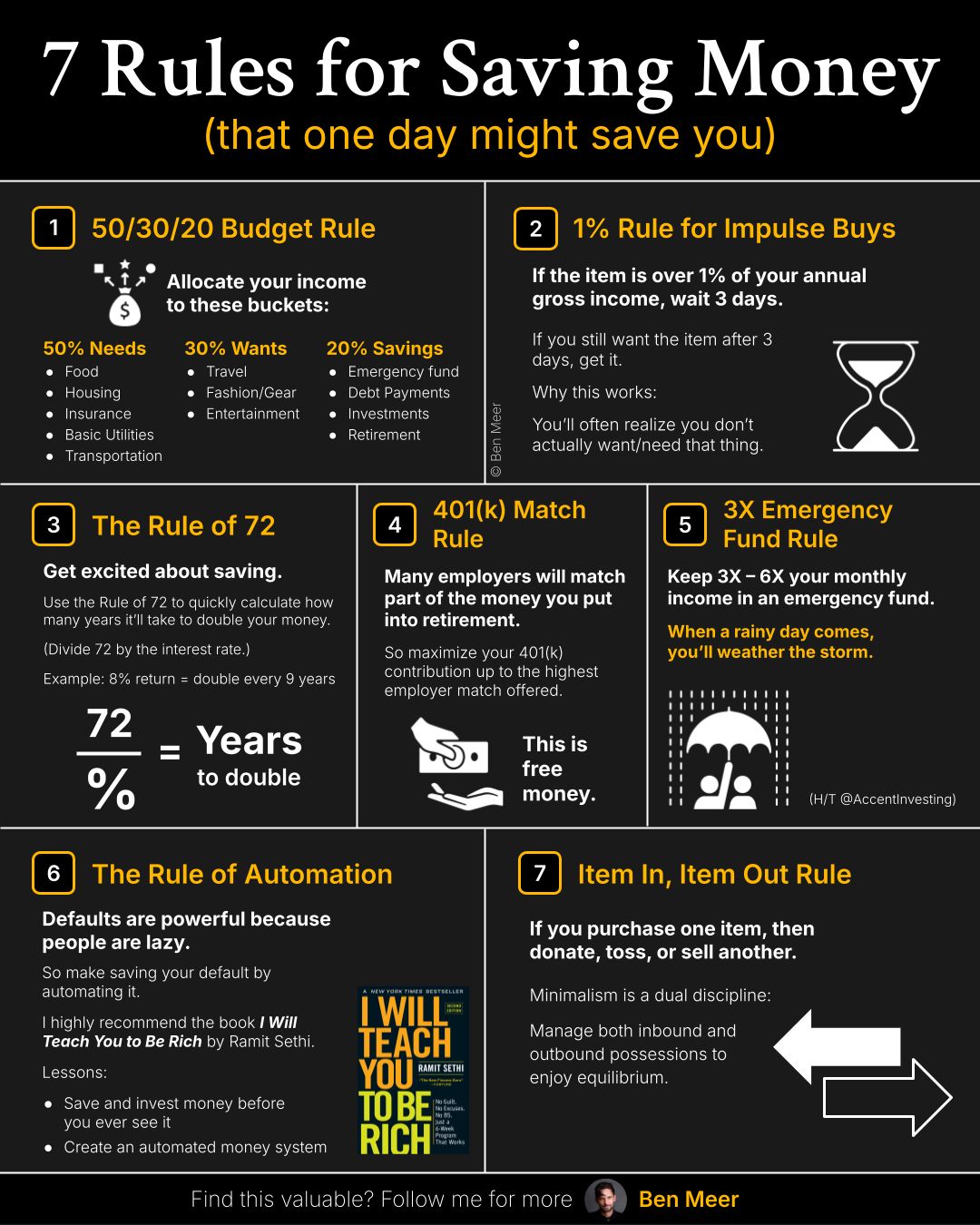
7 Rules for Saving Money

1. 50/30/20 Budget Rule

↳ Split your income wisely: 50% for essentials, 30% for desires, and 20% for savings.
↳ This balance keeps you grounded while leaving room for growth.

2. 1% Rule for Impulse Buys

↳ Wait 3 days if you want to buy something greater than 1% of your yearly earnings.
↳ This cooling-off period helps you avoid buyer’s remorse.

3. The Rule of 72

↳ Calculate how fast your money grows by dividing 72 by your interest rate.
↳ Knowing how fast your money doubles will motivate you to save more.

4. 401(k) Match Rule

↳ Take advantage of your employer’s retirement match (it’s free money).
↳ Every dollar matched is a step closer to financial freedom.

5. 3X Emergency Fund Rule

↳ Stash away 3 to 6 times your monthly expenses for unexpected events.
↳ This safety net ensures you’re ready for any surprises.

6. The Rule of Automation

↳ Set up automatic transfers from checking to savings accounts.
↳ Effortless savings lead to automatic money growth.

7. Item In, Item Out Rule

↳ Buy something new? Let go of something old.
↳ This minimalist approach keeps your finances (and spaces) in harmony.

What’s your favorite money-saving tip?

What Makes A Great Strategy?

Most strategies fail before they even start.

Because what people think strategy is…
isn’t what strategy actually is.

I’ve watched brilliant founders create 100-slide decks
filled with buzzwords and vision statements.

They talk about “beating the competition” and
“dominating the market.”

Then 6 months later? Nothing has changed.

Here’s the truth about real strategy:

What Strategy ISN’T:
❌ A pretty deck that sits on a shelf
❌ Copying what your competitors do (but “better”)
❌ Big goals without tough choices
❌ Trying to be everything to everyone

What Strategy ACTUALLY IS:
✅ Choosing what NOT to do (this one hurts)
✅ Being different, not better
✅ Making trade-offs that make you sweat
✅ Solving problems others don’t see yet

The best strategy I ever saw?

A founder who shut down 3 profitable product lines
to focus on just one.

His board thought he was crazy.
His team was terrified.
Even his wife questioned it.

But he knew:
Strategy is about putting all your chips on a few big bets.

Not hedging. Not playing it safe. Going all in.

18 months later?

That one product line did 10x the revenue of
all 3 combined.

Save this.
Share it with your team.
Use it in your next strategic planning session.

Here’s my test for a real strategy:
→ Can your newest employee explain it in 30 seconds?
→ Does it force you to say “no” to good opportunities?
→ Does it create rules your competition can’t follow?

If not, you don’t have a strategy.
You have a wish list.

Most leaders want strategy to be comfortable.
But real strategy should make you uncomfortable.

It’s not about having all the answers.

It’s about testing small, learning fast,
then going all in when you find what works.

Your turn: Agree? Disagree? What makes a great strategy?

How to Set Boundaries

Boundaries Aren’t About Saying No to Everything:

If you’re constantly overworked, overwhelmed, and undervalued, your boundaries may be ignored.

Here’s the truth:

Healthy boundaries don’t push people away.

They empower you to show up at your best.
Here’s how to protect your time & energy:

1) Communicate with Confidence:
↳ Express your limits without hesitation or apology.

2) Establish Work-Life Separation:
↳ Set defined work hours and stick to them to avoid burnout.

3) Master the Art of Saying NoL
↳ If it doesn’t align with your priorities, decline without guilt.

4) Set Expectations Early:
↳ Be upfront about your limits to prevent misunderstandings.

5) Document Agreements:
↳ Keep records of responsibilities and deadlines to ensure accountability.

6) Protect Your Personal Space:
↳ Maintain separation between work and personal life for mental well-being.

7) Enforce Boundaries Firmly:
↳ If someone repeatedly crosses the line, address it immediately.

8) Pause Before Committing:
↳ Take a moment before saying yes; don’t overextend yourself.

9) Lead by Example:
↳ Respect others’ boundaries to reinforce your own importance.

10) Clarify Your Priorities:
↳ Know what matters most so you can protect your time and energy.

Remember:

The boundaries you allow will define the balance you live.

Running the CEO of Me, Inc.

Somewhere along the way, it hit me: my life is the most important company I’ll ever run.

For years, though, I managed it like an accidental entrepreneur — winging it, saying yes to everything, hoping things would just work themselves out.

But here’s what I’ve learned the hard way:
Every relationship in my life is either an asset or a liability.
Every habit I keep is either an employee or a saboteur.
Every thought I entertain is either a strategic advisor or a toxic board member.

When I finally started treating my life like the company it is, things shifted. Here’s how I began:

1. My Vision & Strategy
I sat down and actually thought about where I wanted to be in one year, five years, and ten. I got honest about which people in my circle truly elevated me. I mapped out milestones — not a perfect plan, but a direction. For the first time, my “business plan” for life felt real.

2. My Firing Round
This was brutal but necessary. I cut ties with energy-draining relationships. I eliminated habits that gave me poor returns. And I started dismissing negative thoughts that wasted my mental resources. Each step felt like freeing up budget and bandwidth in my company.

3. My Hiring Process
I became much more intentional about who gets my time. I added habits that fuel growth instead of drain it. And I chose thoughts that support my vision rather than sabotage it. Slowly, my life started to feel like a healthy, thriving organization.

4. My Promotion Strategy
I doubled down on the people who bring out my best. I strengthened habits that actually produce results. And I amplified the thoughts that push me forward instead of hold me back. That’s when I started to feel real momentum.

What I’ve realized is this: the best CEOs aren’t afraid to make hard decisions. And neither can I be.
My time, my energy, and my talents are the most valuable assets I own. It’s on me to protect them.

I’m still figuring it out — some days I slip back into being an accidental entrepreneur. But the more I run my life like the CEO of “Me, Inc.,” the more intentional it becomes, and the better my returns.

9 Signs of an Inspiring Leader

I was a terrible leader when I first started.

I thought being the boss meant:

Having all the answers.
Never admitting mistakes.
Being the hero for your team.

Boy, was I wrong.
The best lesson I learned?

Leadership isn’t about being perfect.

It’s about being real.
Putting your people first.
Having the confidence to trust.
And the humility to know you’re not always right.

One day, I messed up. Bad.

I gathered the team and said:

“I made the wrong call. Here’s what I learned.”

And something incredible happened.

People opened up.
Trust deepened.
Ideas flowed.

The team got stronger.

Why?

Because when you lead with humility and humanity,
you give others permission to do the same.

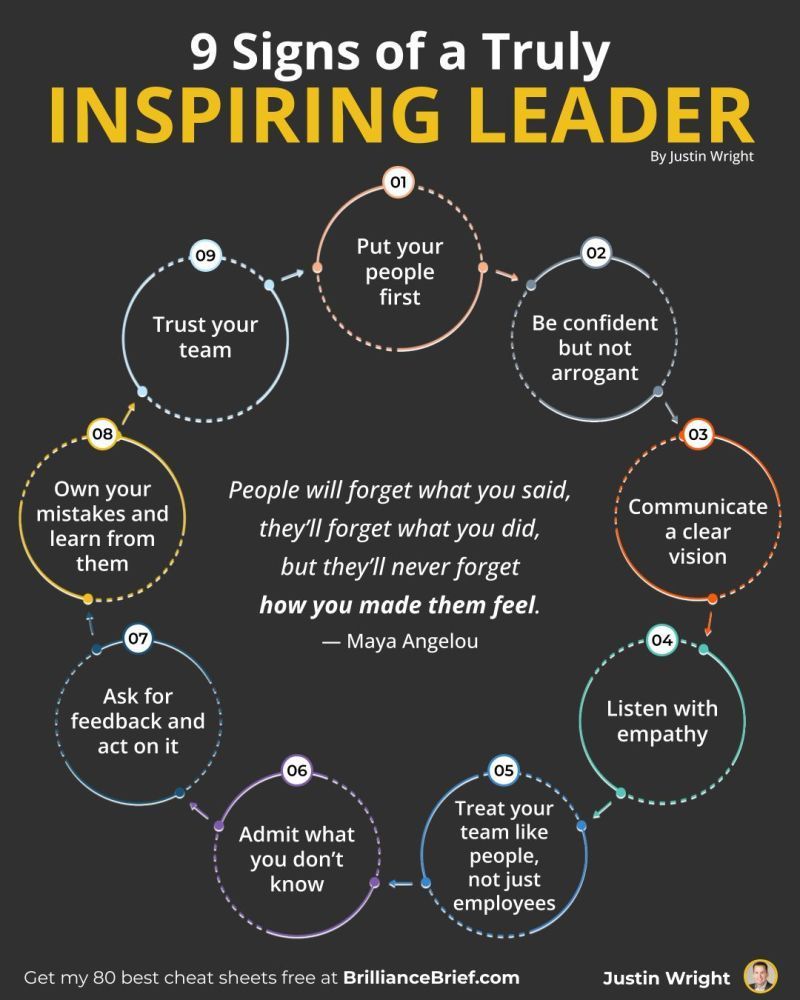
9 signs of an inspiring leader:

➟ Put your people first
➟ Stay humble
➟ Share your vision clearly
➟ Listen with real empathy
➟ Treat people like people
➟ Admit when you don’t know
➟ Ask for feedback (and use it)
➟ Own your mistakes
➟ Trust your team

None of that requires a title. Just courage.

Because at the end of the day,
people won’t remember your flawless slides
or 5-year strategy.

They’ll remember how you made them feel.

Waking Up to the Life You Built

There’s something powerful about the quiet moment before the day starts — when the world is still, the coffee hasn’t brewed yet, and the first light begins to seep in. It’s in that pause that you really feel the weight of the life you’ve built. Not the frantic to-do lists or the endless goals, but the actual day-to-day existence you’ve shaped with every choice you’ve made. Waking up grateful isn’t about ignoring what’s hard; it’s about noticing how much of the good is already here because of you.

It’s easy to get caught in the loop of “what’s next” — the next promotion, the next milestone, the next version of ourselves. But the goal isn’t to build a life so big or so shiny that it impresses everyone else. The goal is to build one that feels like home to you, one where you wake up and feel an almost quiet awe at how far you’ve come. That’s when gratitude stops being a practice and starts being a natural state.

Gratitude shifts everything. It makes ordinary mornings feel like blessings. It transforms routines into rituals. It softens the edges of stress and brings into focus the tiny, beautiful details you used to rush past — the way sunlight spills across your floor, the familiar sound of your own laugh, the comfort of knowing you’re surrounded by people who matter. It’s the invisible thread that ties together success and fulfillment.

Creating a life you’re grateful for doesn’t happen overnight. It’s built in small decisions — the ones that align with who you want to become, the boundaries you draw to protect your energy, the people you choose to keep close, and the risks you take even when they scare you. It’s built in the discipline to show up for yourself on days you’d rather not, and in the courage to let go of what no longer fits. Over time, those choices stack up until one day you realize you’re no longer chasing a dream; you’re living it.

So when you wake up tomorrow morning, don’t just reach for your phone. Pause for a moment. Breathe. Look around at the life you’ve built — even if it’s still a work in progress — and recognize the version of yourself who made it possible. Gratitude in that moment isn’t just appreciation; it’s power. It’s proof that you’re not only creating a life worth living but also truly living it.

Lead with Kindness

Kindness is a leadership skill most people overlook.

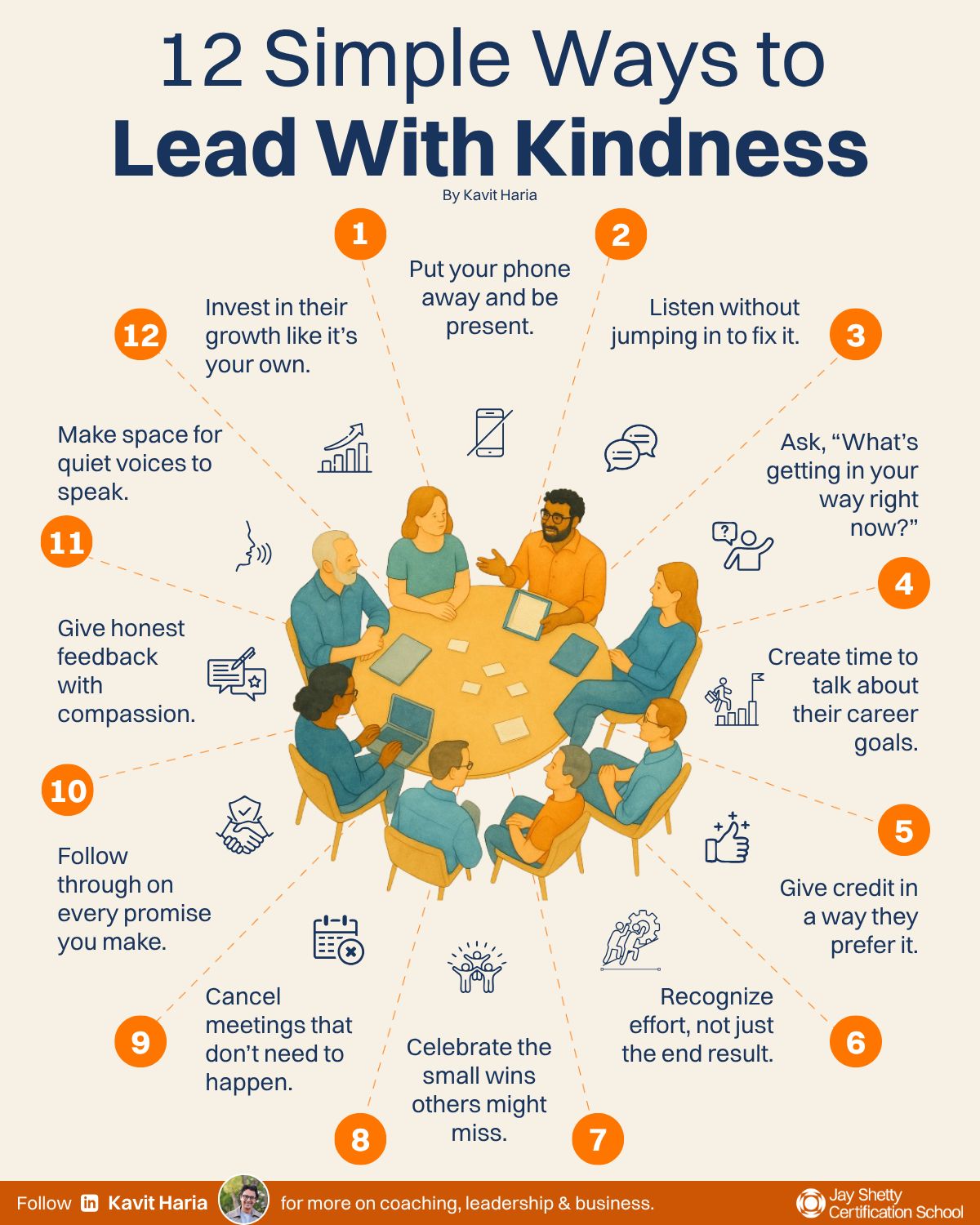
(Here are 12 ways to make sure you don’t.)

→ Listen, don’t jump in to fix it
→ Make space for quiet voices to speak
→ Recognize effort, not just the outcome
→ Celebrate the quiet wins that others miss
→ Give credit in the way they like to receive it
→ Cancel meetings that don’t need to happen
→ Ask: “What’s getting in your way right now?”
→ Create time to talk about their career goals
→ Put your phone away and be fully present
→ Give honest feedback with compassion
→ Invest in their growth like it’s your own
→ Follow through on every promise

When I’m coaching, I always remind my clients
kindness matters most when things get hard:

→ When trust is on the line
→ When emotions are high
→ When your patience is thin
→ When someone’s falling short
→ When a teammate feels unseen

Kindness isn’t lowering the bar.

It’s raising the way we support each other
to reach it.

That’s what leadership really looks like.
That’s what people remember.
That’s what earns loyalty.