
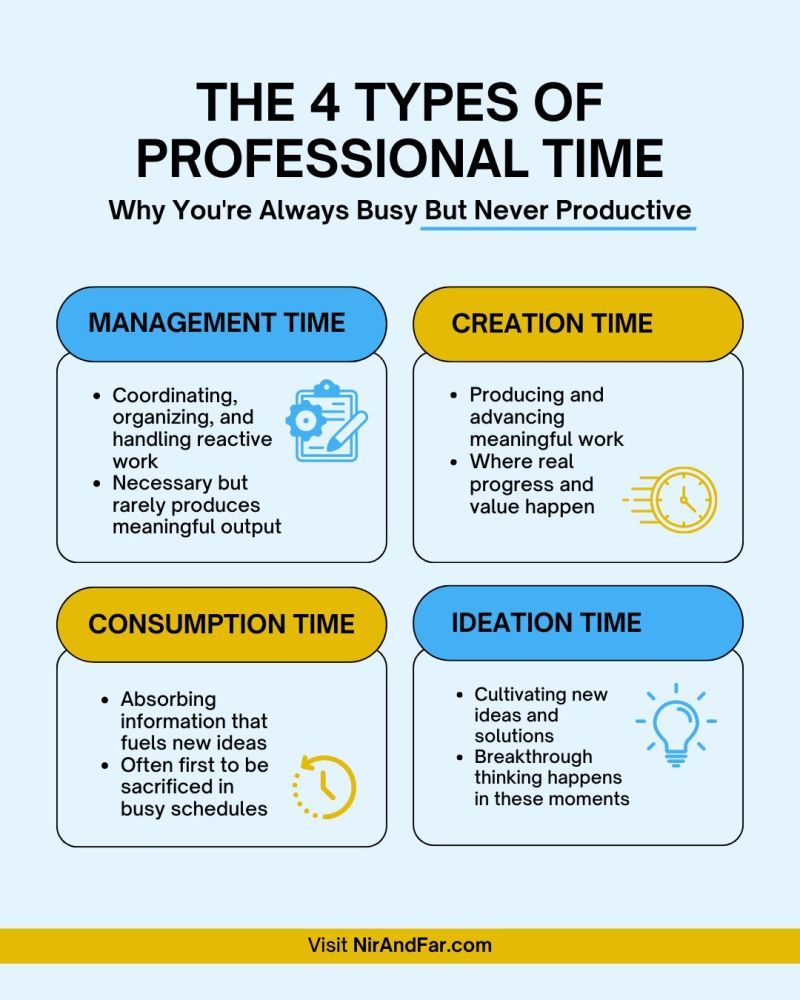
You’re trapped in the management time vortex.
Here’s how better time management could save you:
Most professionals spend 80% of their day on emails and meetings, leaving almost no time for the work that actually moves the needle.
Ideally, your workday should be split into four distinct types of time:
1. Management time (meetings, emails) is necessary but rarely produces meaningful output.
2. Creation time is where the real magic happens, when you’re building, writing, or advancing your most critical work.
3. Consumption time lets you absorb new knowledge that fuels future innovation.
4. Ideation time, perhaps the most neglected, is where breakthrough thinking happens.
Try this: Audit your calendar for the past week. How much time did you actually spend creating versus managing? Most people are shocked by the imbalance.
The solution here is to redesign your day to protect your most valuable work.
Timeboxing specific periods for each category is the simplest way to escape the busyness trap and start making real progress again.
When the Bar Keeps Moving

It’s strange how we can be so hard on ourselves without even realizing it. We set a goal, we reach it, and before we even pause to take it in, we’re already looking at the next one. We push forward, raise the bar, keep moving, thinking that’s what growth is supposed to feel like. And it is — but it also means we rarely stop long enough to see how far we’ve actually come.
Someone once said, “Maybe you don’t notice your progress because you’re always raising your bar.” That line hit me like a quiet truth I didn’t know I needed to hear. Because it’s so easy to lose perspective when you’re living inside your own growth. From the outside, people might be in awe of how much you’ve changed or accomplished. But on the inside, you’re just trying to meet the next deadline, the next milestone, the next version of yourself.
There’s a kind of beauty in ambition, in wanting to grow and evolve. But there’s also a danger in letting your ambition blur your self-recognition. When you never take the time to honor how far you’ve come, you start to believe you’re not doing enough. You forget the nights you stayed up late learning, the mornings you dragged yourself out of bed, the risks you took, the fears you overcame.
Sometimes it takes someone outside of you to remind you of your own progress. It’s like seeing yourself in a photo from years ago and realizing how much you’ve changed — not just on the surface, but deep down. That’s why words like the ones above can heal a little; they pull you back to a perspective you’ve lost. They remind you to pause.
Maybe this is your sign to stop and breathe for a second. To look back at the mountain you’ve climbed instead of staring only at the next peak. Maybe it’s time to recognize that your constant raising of the bar isn’t a failure — it’s evidence of your growth. And just for today, maybe you can give yourself credit for all the quiet, uncelebrated wins along the way.
Because progress isn’t only about how far you still have to go. It’s also about how far you’ve already come. And if you can hold that truth, even for a moment, it might heal you a little too.
Master Tough Conversations
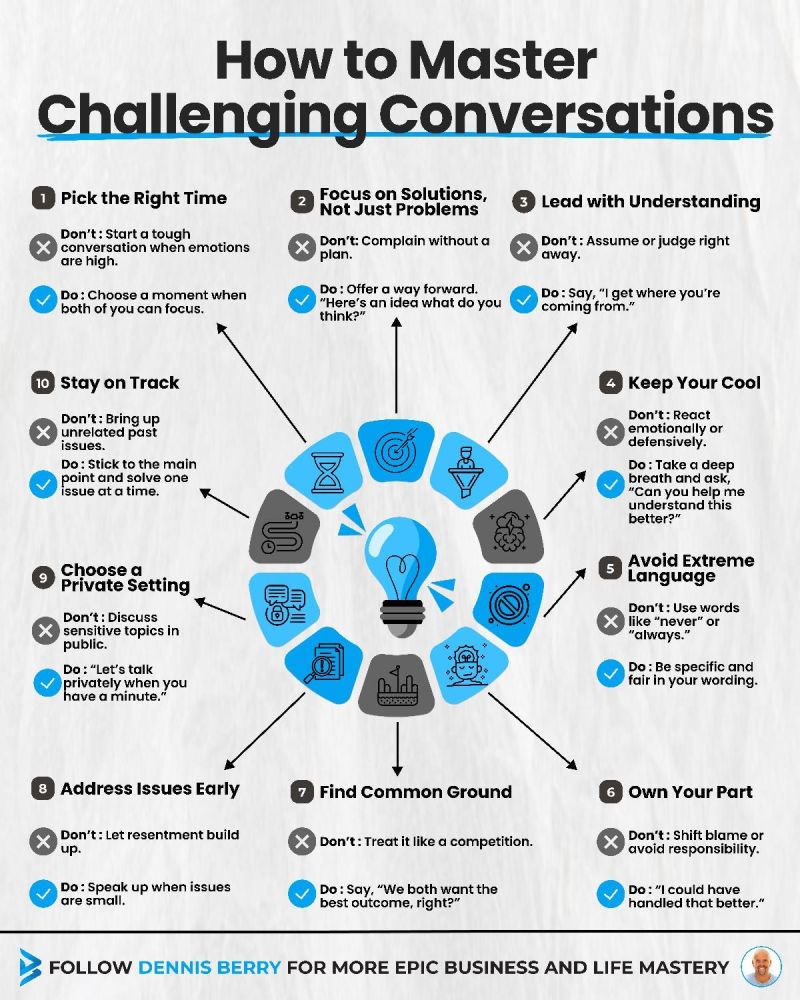
Difficult conversations don’t fall apart because of what’s said.
They fall apart because of how they’re handled.☹️
↳ It’s not about having the perfect script.
↳ It’s about setting the right conditions.
I’ve help hundreds of leaders through tough conversations.
Here’s what actually works (and doesn’t):👇
1/ Pick the right time
❌ Jump in when emotions are high or mid-crisis
✅ Choose a calm, private moment when both sides can focus
2/ Focus on solutions, not just problems
❌ Rant about what went wrong without a way forward
✅ Shift toward what can be done next and how to improve
3/ Lead with understanding
❌ Start with accusations or assumptions
✅ Ask questions, listen actively, and empathize
4/ Keep your cool
❌ Raise your voice or get defensive
✅ Stay calm, even when the topic gets heated
5/ Avoid extreme language
❌ Use words like “always” or “never” that escalate tension
✅ Speak in specific, neutral terms that stay grounded
6/ Own your part
❌ Pretend you’re blameless or deflect responsibility
✅ Acknowledge your role honestly and transparently
7/ Find common ground
❌ Turn the conversation into a battle of opposites
✅ Identify shared goals or values to anchor the discussion
8/ Address issues early
❌ Wait until resentment builds and it’s too late
✅ Tackle problems while they’re still small and manageable
9/ Choose a private setting
❌ Confront someone publicly or in a group
✅ Have the conversation in a one-on-one, confidential space
10/ Stay on track
❌ Spiral into unrelated complaints or old arguments
✅ Keep the focus on the issue at hand and the path forward
The reality…
↳ Challenging conversations are inevitable.
But with the right approach,
They can stop being something you dread…
And start being something you lead. 💪
7 Strengths Of Quiet People
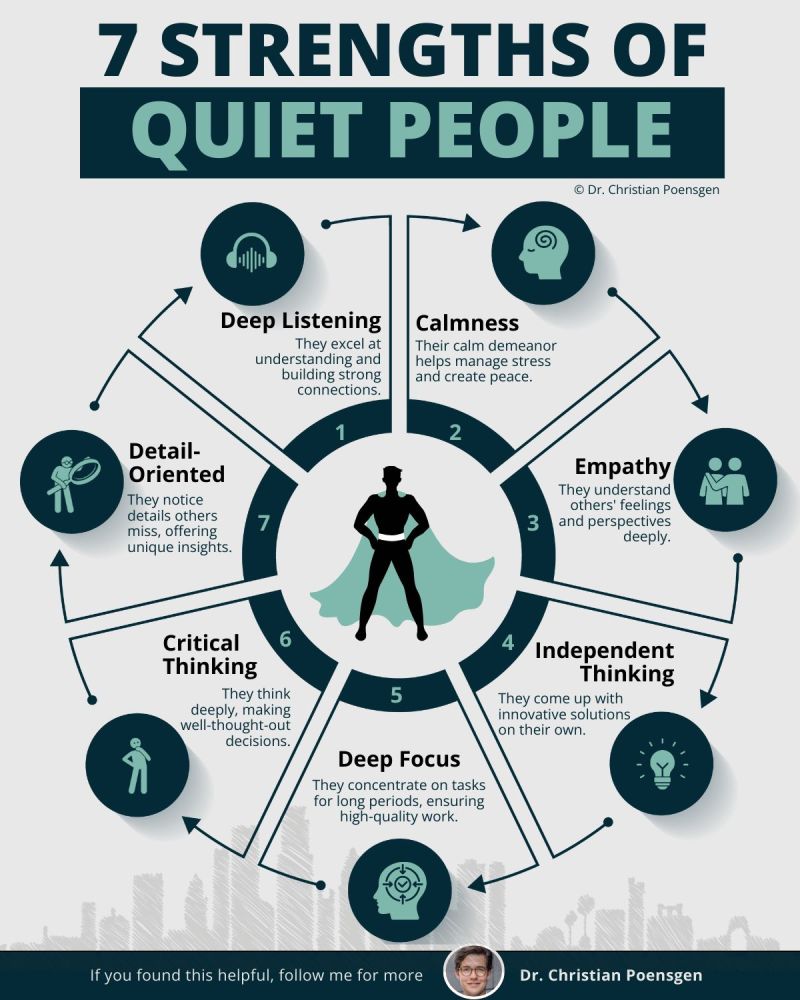
Quiet people have the loudest minds.
5 ways to support introverts at work:
1) Provide private spaces to think 🛋️
↳ Let them recharge without interruptions.
↳ Offer calm zones away from open offices.
2) Support remote and flexible work 🏡
↳ Trust them to thrive outside the spotlight.
↳ Allow deep work without constant chatter.
3) Allow for quiet hours with fewer people 🤫
↳ Create team norms around silent stretches.
↳ Block loud meetings during peak focus times.
4) Respect solitude as their source of energy 🌌
↳ Let breaks be truly solo, without pressure.
↳ Don’t mistake quiet for disengagement.
5) Design environments where silence is an option 🔇
↳ Encourage headphones to signal “focus mode”.
↳ Offer noise-free rooms for deep thinking.
– – – –
In a culture that tends to celebrate the loudest voice,
remember that true power can reside in silence.
The power to listen deeply.
The power to think for yourself.
The power to focus without distraction.
The power to explore ideas below the surface.
The power to notice what others overlook.
The power to feel what others miss.
The power to stay calm in chaos.
Silence is not empty.
It’s full of answers.
Take Back Your Time

Top performers protect their time differently.
Most of us lose precious hours to chaos
and distraction.
On the advice of my business coach, I did a time audit.
What I learned changed everything.
I tracked my hours for a week.
Captured everything I spent time on.
Now I’m working to eliminate, delegate, or automate
everything that doesn’t move the needle.
If you struggle to get the important things done,
here are 12 productivity tools that actually work:
1. Timeboxing
Divide your day into clear blocks.
Give each block one purpose.
Nothing else happens during that time.
It’s simple but powerful.
2. Pomodoro Technique
25 minutes of focus. 5-minute break.
No compromise, no distractions.
I was skeptical at first. Now I can’t work without it.
3. Two-Minute Rule
If something takes less than two minutes, do it now.
Those small tasks pile up and drain your energy
when ignored.
4. Kanban Board
See your work move from “to-do” to “done.”
It’s surprisingly motivating to watch progress
happen visually.
5. 1-3-5 Rule
Plan your day around:
1 big task
3 medium tasks
5 small tasks
This creates balance and prevents overwhelm.
6. Eat the Frog
Do your hardest task first thing.
Everything else feels easier after that.
7. Flowtime Technique
Work until your focus naturally fades.
Take a short break.
Learn your rhythm.
8. 80/20 Rule
Focus on the vital 20% that creates 80% of your results.
Be ruthless about cutting the rest.
9. Getting Things Done (GTD)
Capture everything.
Organize what matters.
Let go of what doesn’t.
10. Warren Buffett’s 25/5 Rule
List 25 goals.
Circle your top 5.
Ignore everything else.
11. Eisenhower Matrix
Organize tasks by urgency and importance.
It shows you what really needs your attention.
12. Task Batching
Group similar work together.
Your brain works better this way.
The reality is simple:
Time management isn’t about squeezing more
into your days.
It’s about making space for what matters most.
Choose your minutes wisely.
They become your life.
Lighter by Letting Go

We spend so much of our time trying to micromanage the world around us — the way people see us, how they behave, whether they understand our intentions, whether they like us. It’s exhausting, and most of the time it doesn’t even work. People are going to think what they think, act how they act, and feel what they feel. You can’t control that, no matter how much you try. And when you realize that, life starts to feel a lot lighter.
The real work isn’t about controlling others. It’s about coming back to yourself. Knowing who you are at your core and standing there firmly, no matter what’s swirling around you. When you stay rooted in your values and act with integrity, you stop needing everyone else’s approval to feel okay. You give yourself permission to be steady, even when everything else is moving.
That shift creates space — the kind of space where growth can actually happen. You start to notice what’s yours to carry and what isn’t. Other people’s opinions, insecurities, and projections don’t automatically become your responsibility. Their reactions aren’t yours to fix. You can have empathy without taking ownership. You can show up fully without losing yourself.
Letting go of what isn’t yours doesn’t make you cold or detached. It actually allows you to be more present and compassionate because you’re not weighed down by trying to control the uncontrollable. You have more energy for the things you can influence — your own evolution, your own peace, your own integrity. That’s where your power actually lives.
It’s not always easy. Some days you’ll slip back into old habits, trying to manage or control outcomes. But each time you remind yourself to return to your center, it gets a little easier. It’s like strengthening a muscle — the more you practice staying rooted in who you are, the lighter life becomes.
And somewhere along the way, you realize you’re not just letting go of people’s expectations — you’re letting go of your own self-imposed weight. You stop dragging around stories of who you “should” be or how things “should” go. You start meeting life as it is, with open hands instead of clenched fists. That’s when you feel the freedom. That’s when everything softens.
In the end, life doesn’t get lighter because the world changes. It gets lighter because you do. You stop carrying what isn’t yours and start living what actually is. That’s the quiet, liberating power of letting go.
How to Motivate your Team
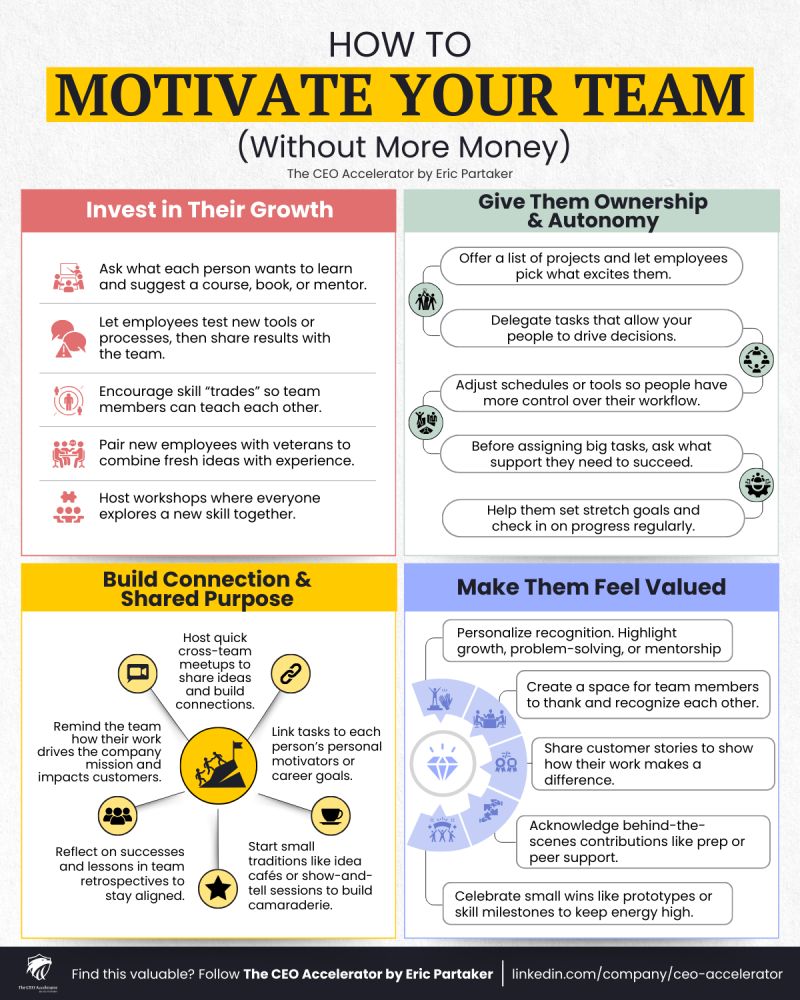
The secret to an unstoppable team doesn’t
involve the size of your budget.
Of course money matters.
People want to be compensated fairly.
But even more important?
How you lead, connect, and empower
your people every single day.
Here are the proven ways to ignite motivation
(that don’t require opening your wallet):
📚 Invest in Their Growth
↳ Ask each person what they want to learn,
then connect them with courses
↳ Pair newcomers with veterans share their
experiences
↳ Host workshops where everyone learns
something new
🎯 Give Them Ownership & Autonomy
↳ Let them pick projects that excite them
↳ Delegate decisions that impact their work
↳ Give them control over their workflow and
provide support when needed.
🤝 Build Connection & Shared Purpose
↳ Host quick cross-team meetups to share ideas
↳ Link tasks to personal motivators and career goals
↳ Remind them how their work drives company mission
⭐ Make Them Feel Valued
↳ Personalize recognition by highlighting specific
growth and problem-solving
↳ Create space for team members to appreciate
each other
↳ Acknowledge behind-the-scenes support
The critical thing to understand:
People don’t quit jobs.
They quit when they feel stuck.
They quit when they feel invisible.
They quit when they feel mistreated.
They quit when they feel disconnected.
The good news?
You can change that today.
Your team’s potential is already there.
Your job is to unlock it.
And the key isn’t more money.
It’s better leadership.
Kindness Without a Reason

We live in a world that constantly asks for context. Before we act, we want to know the backstory, the struggle, the “why” behind someone’s behavior. We feel more justified in extending kindness when we can attach it to a reason: they’ve had a bad day, they’re grieving, they’re stressed. But that mindset quietly conditions us to ration our humanity — to save it only for when it’s “deserved.”
The truth is we shouldn’t have to know what someone is going through to treat them with respect. Every person you meet is carrying something you can’t see. It could be minor frustrations or life-altering pain. It could be hope, heartbreak, or something in between. Most of the time, you won’t know, and you don’t need to. Kindness isn’t a transaction; it’s a baseline.
Think about the times you’ve been on the receiving end of unexpected kindness — someone holding a door, offering a smile, softening their tone when you were already at your limit. Those moments don’t just make the day easier; they restore your faith in people. They remind you the world can be softer than it often feels.
The same applies when we’re the ones giving it. Being kind without knowing the reason frees us from judgment. It stops us from playing gatekeeper to compassion. It’s a quiet act of rebellion against a culture obsessed with measuring worthiness. It also sets off a chain reaction: when you show up with patience or gentleness, the person on the other side often carries that forward.
We won’t always get it right. We’ll be tired, distracted, in a rush. But even small efforts — a neutral tone instead of a sharp one, a pause before snapping back, a moment to listen rather than dismiss — add up. These micro-acts of humanity ripple outward in ways we rarely see but always matter.
At its core, kindness without a reason is about dignity. Every person deserves to feel seen, safe, and respected — not because of their circumstances, but because they’re human. You don’t need the full story to show up with decency. You just need the willingness to do it.
Leadership = Building Doors

🪑Leadership isn’t about guarding your seat.
It’s about adding more chairs to the table.
High EQ leaders don’t build fences.
They build connection—and longer tables.
Still, many of us were taught this early:
❌ If you lift others, you’ll lose your edge.
❌ If you give access, you’ll lose authority.
❌ If you’re generous, you’ll get left behind.
Truth is?
The leaders who hold power tightly… lose it.
The ones who share it?
They become unignorable.
Because authority isn’t about exclusivity.
It’s about credibility that multiplies through others.
Want to be irreplaceable?
Make yourself a builder of doors, not fences.
Formula for Success

The only Success Formula you need:
Ideas + Execution + Consistency = Success
All 3 components will lead you to success.
But remove one of them, and you’ll fail.
↳ Without Ideas:
Sticking to the same old routines without seeking new ideas or innovative solutions can lead to stagnation and missed opportunities.
↳ Without Execution:
Without execution, even the best ideas remain mere concepts, and success remains out of reach. Delaying action can hinder progress and prevent you from reaching your goals.
↳ Without Consistency:
Starting and stopping frequently or lacking a steady pace of progress can result in lost momentum and hinder your ability to achieve significant results.
👇 So it’s crucial to support all 3 parts of this formula:
1) Ideas:
Foster creativity through brainstorming, research, and exposure to diverse perspectives.
2) Execution:
Develop a bias towards action, break tasks into manageable steps, and learn from failures to iterate and improve.
3) Consistency:
Establish routines, set achievable goals, and stay focused on long-term progress rather than short-term results.
Success isn’t just about good ideas, effective execution, or consistency.
It’s about blending all three into your strategy.
 Kenrick Vaz