Keep Going—The Quiet Power of Consistency

We live in a world obsessed with instant outcomes. We track likes, count steps, chase metrics, and crave overnight success. But here’s the truth we don’t talk about enough: the real magic isn’t in the spikes—it’s in the steady climb.

That quote? It’s a quiet revolution. A reminder that whether we’re crushing it, crashing, or just cruising, the answer is the same—keep going.

Think about it:

  • Didn’t lose weight this week despite working out? Keep going.
  • Launched a new idea and got zero traction? Keep going.
  • Finally saw success after months of effort? Great. Still—keep going.

Consistency doesn’t guarantee perfection. It guarantees progress.

It teaches us discipline when motivation fades.
It builds resilience when results disappoint.
It keeps our ego in check when success shows up.

Some days you’ll feel invisible. Others, invincible. But if you only show up when it’s easy, you’re not building a habit—you’re feeding a mood.

The athlete trains on the days they don’t feel like it.
The writer writes even when inspiration is silent.
The leader leads even when doubts scream louder than the vision.

So whether today feels like a win, a loss, or a flatline—lace up, show up, and keep going.

Because the people who go far aren’t always the most talented—they’re often just the most consistent.

The Real Dream Team: Where Brilliance Meets Humility

In the world of tech, consulting, design—or really any profession—there’s a familiar buzz around hiring “smart people.” The kind of individuals who crack problems before most even see them coming. Their brilliance lights up meetings, whiteboards, and Slack channels. Working with them is undeniably exhilarating.

But here’s the truth no one puts on job descriptions:

Working with smart people is great. Working with kind and humble people is next-level amazing.

Because while intelligence solves problems, kindness solves people.

Humility creates space for others to contribute.

Kindness builds safety to fail and learn.

And when smart people check their egos at the door, the real magic happens—collaboration becomes frictionless, ideas compound, and teams soar.

In contrast, working with someone who’s smart but dismissive? That brilliance can quickly feel like a burden. A team that values only IQ over EQ can achieve goals, sure—but often at the cost of morale, creativity, or mental well-being.

Give me a team where people:

say “I don’t know” with confidence, celebrate others’ wins more than their own, and bring their best while bringing out the best in others—

That’s the team I’ll bet on every single time.

In a world obsessed with who’s the smartest in the room, let’s start noticing who’s making the room better for everyone else.

Because next-level isn’t just intelligence.

It’s smart + kind + humble. That’s the future of great teams!

Overcome Procrastination

Most people don’t fail.

They just never start.

I used to spend hours staring at tasks.
Not doing them. Just overthinking every step.
The overwhelm? Crippling.

But everything changed when I learned to start small.
And stay consistent.

Here’s what procrastination is really costing you:
↳ 88% of people waste at least an hour daily
↳ That’s 55 days lost every year
↳ Productivity loss = $10,000+ annually per employee

It’s not a laziness issue.
It’s a habit design issue.

10 proven ways to beat procrastination:
(No fluff. Just what works.)

1/ Start Tiny
↳ Open the doc. That’s it. Let momentum handle the rest.

2/ Use the 2-Minute Rule
↳ If it takes less than 2 mins, do it now. If not, just commit to 2 mins of effort.

3/ Gamify It
↳ Turn your tasks into a points system. Reward progress. Coffee helps.

4/ Make It Public
↳ Tell someone your goal. Accountability beats motivation.

5/ Avoidance Archive
↳ List what you’re avoiding. Pick one. Do it. Repeat daily.

6/ Location Reset
↳ Stuck? Move. A new space often brings a new mindset.

7/ Visualise the Win
↳ Take 60 seconds. Picture the finish line. Let it drive you.

8/ Use a Timer
↳ Try 25 minutes work / 5-minute break. It’s gold.

9/ Find Your ‘Why’
↳ Link every task to a deeper reason. Purpose fuels progress.

10/ Reward Progress
↳ Even tiny wins deserve celebration. Build positive reinforcement.

These are the tools I still use.
And they’ve helped thousands reset their habits too!

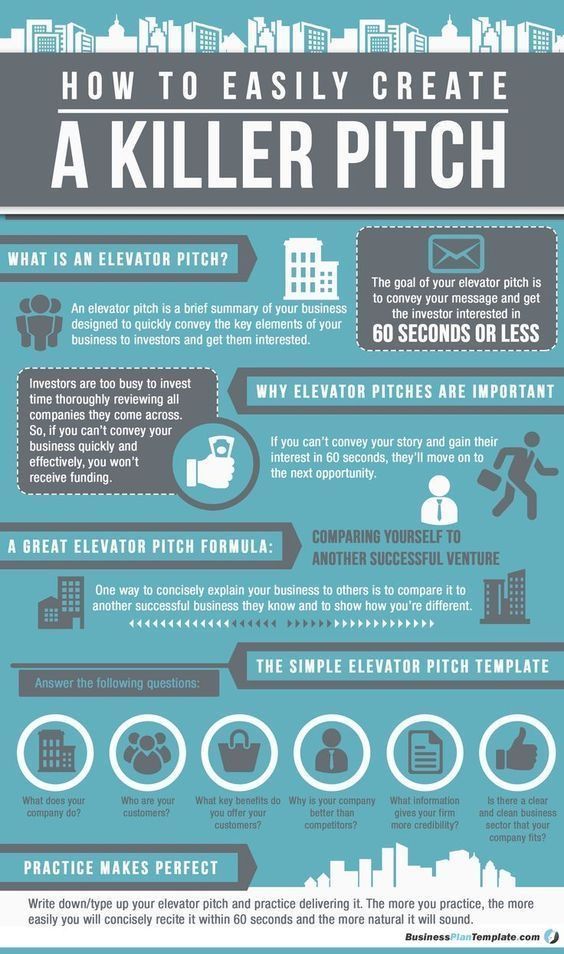
How to Create A Killer Elevator Pitch

⏱️ Keep it under 60 seconds
Investors don’t have time. Get to the point.

📍 Answer these 6 key questions:

What does your company do?

Who are your customers?

What benefits do you offer?

Why are you better than competitors?

What gives you credibility?

Do you have a simple company message?

🎯 Pro tip:
Use comparisons people understand.
E.g. “We’re the Airbnb for small event spaces.”

📣 Then PRACTICE.
Say it out loud.
Tweak it until it flows naturally.

A strong elevator pitch opens doors.
A weak one ends conversations.

12 Top Future Skills

If you’re not learning these skills—

Prepare to get replaced:

Are you assuming your current skills
will still matter in 5 years?

The world is shifting fast.

And by 2030, the people who lead,
won’t just know more—

They’ll know what matters most.

That means building skills that are:
🔸Human
🔸Flexible
🔸Strategic
🔸Tech-aware

These are some future-ready
skills that will define success:

🟧 Design & UX
🟨 Critical Thinking
🟧 Customer Focus
🟨 AI & Data Expertise
🟧 Emotional Intelligence
🟨 Strategic Problem Solving
🟧 Cybersecurity & Network Savvy
🟨 Personal Development
🟧 Leading With Impact
🟨 Staying Adaptable
🟧 Idea Generation
🟨 Tech Fluency

(Source: World Economic Forum:
Future of Jobs Report 2025)

The world won’t wait for you to catch up.

Most people avoid change until it’s too late.

The most valuable skill is
learning what matters next.

What helped you grow before
won’t carry you forward.

Future-ready people always
stay one step uncomfortable.

No Mess Is Too Big for Him to Find You

In the shadows of life’s darkest alleys, where brokenness meets despair, there is One who runs—not walks—after us. That’s what this powerful illustration captures: Jesus, the Good Shepherd, sprinting down a grimy, cluttered alleyway, chasing a lone, frightened sheep. A mess surrounds them—garbage bins toppled, windows broken, the alley drenched in a heavy darkness. But none of it slows Him down.

This image echoes the heart of the parable of the lost sheep (Luke 15:4-7), where Jesus tells of a shepherd who leaves the ninety-nine in open pasture to go after the one that is lost. Not because the one is more important—but because the one is hurting, lost, afraid. The pursuit is relentless, not because we are perfect, but because we are loved.

Too often, we convince ourselves that we have strayed too far, made too big a mess, or fallen too deep into the dark. But this illustration, like the parable, reminds us that no mess is too big for Jesus to find you. He doesn’t wait for you to clean up. He comes to where you are—in your chaos, in your regret, in your hiding—and He runs to you.

Grace doesn’t flinch in the face of your mess. It moves toward it.

That’s the radical love of the Shepherd. Not passive. Not hesitant. But urgent and unafraid.

And when He finds you, He doesn’t scold you. He lifts you. Carries you. Rejoices over you.

So if you find yourself today in a dark alley of your own making, remember: You are not too far gone. You are not too lost. The Shepherd is already on His way.

He sees the mess—and He still runs after you.


Illustration: Kevin Carden

The Ultimate Project Plan: You

Restart. Reset. Refocus. Repeat.

In a world obsessed with deliverables, deadlines, and KPIs, it’s easy to forget that the most important project we’ll ever work on isn’t a product or a pitch—it’s ourselves.

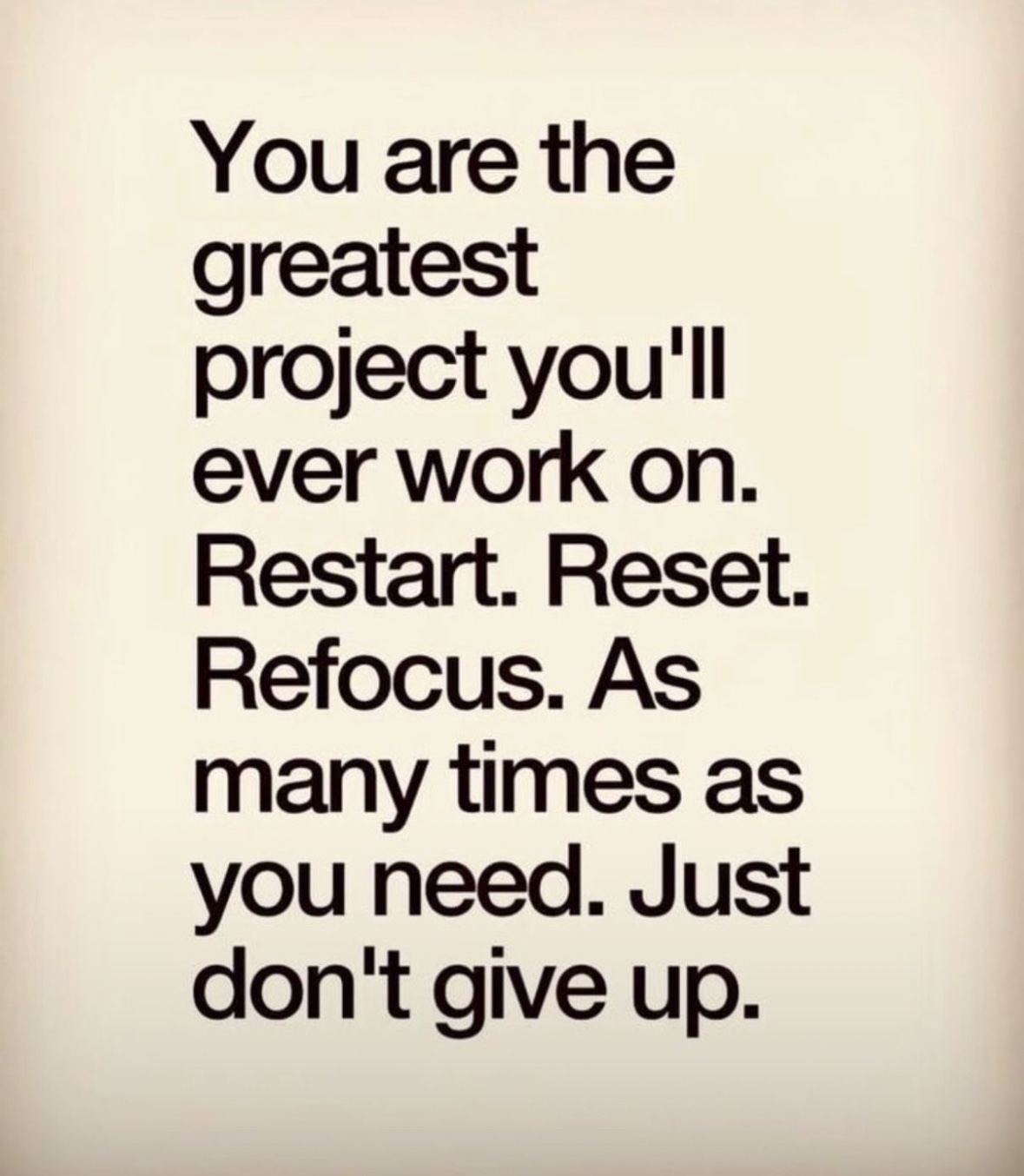
“You are the greatest project you’ll ever work on.”

This simple, powerful truth is both a permission slip and a wake-up call.

Unlike a client assignment or quarterly OKR, you don’t come with a fixed roadmap. You evolve. You break. You rebuild. And in that messy, magical process lies real growth.

So if you’ve hit pause lately—on your goals, your health, your dreams—know this: it’s not failure.

It’s just a reset.

Restart as many times as you need.

Reset without shame.

Refocus without guilt.

Because progress isn’t linear, and purpose isn’t always loud.

Sometimes it whispers, “Just don’t give up.”

You’re allowed to iterate.

You’re allowed to pivot.

You’re allowed to begin again.

And every time you do, you’re one step closer to the version of you that’s been waiting patiently on the other side of doubt.

So keep building. The blueprint is in your heart.

And the deadline? Yours to define!

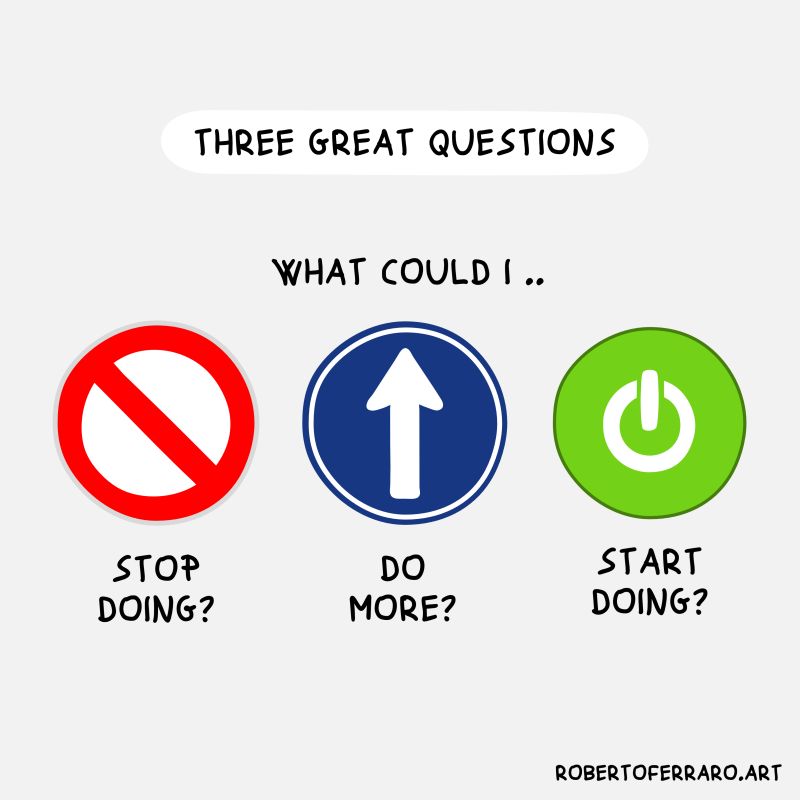
Do you know how to ask good questions?

According to an article by John Coleman, asking better questions is the key to critical thinking. Here are a few ways to enhance your ability:

➡️ Hold your hypotheses loosely. Be willing to review your assumptions.

➡️ Listen more than you talk. Active listening is understanding what another person is saying while being engaged and interested.

➡️ Leave your queries open-ended. Avoid asking yes-or-no questions. Rather “how”, “what”…

➡️ Consider the counterintuitive. Fight against groupthink, propose a counterintuitive question, one that challenges the group’s conventional thinking

➡️ Stew in a problem. Don’t jump the gun. Wait and reflect a bit.

➡️ Ask the hard follow-up questions. Do not accept easy answers, ask the “why”.

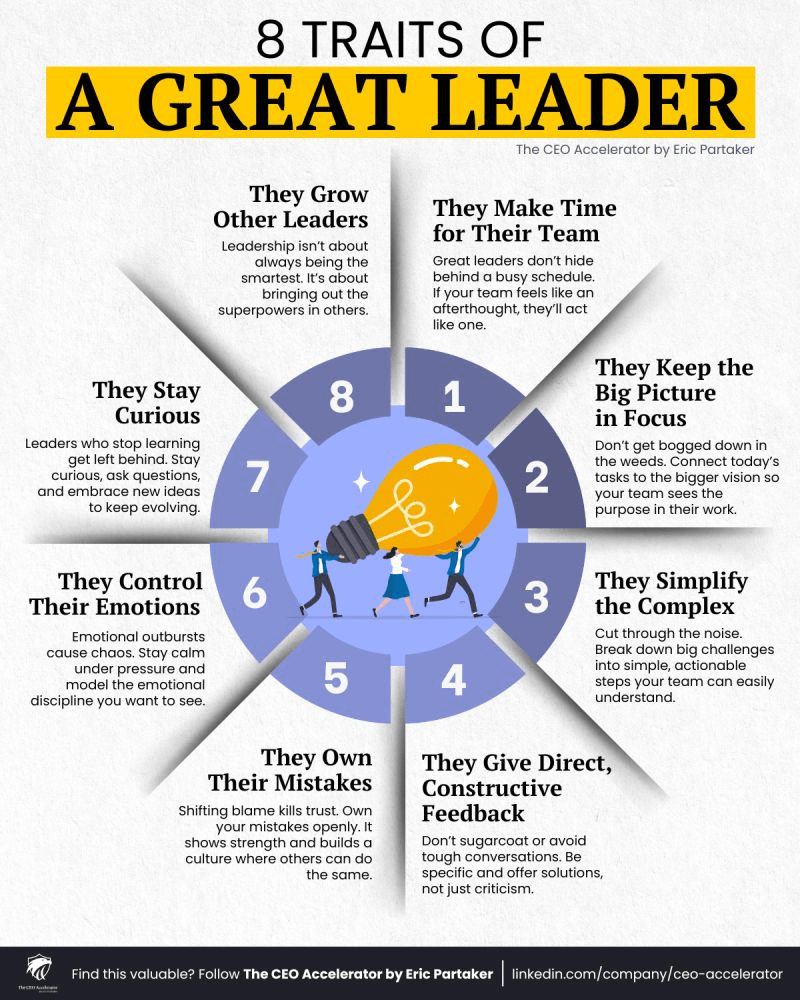
8 Traits of a Great Leader

Great leaders aren’t born. They’re built.

These 8 traits separate the good from the great:

Want to level up your leadership?

Here’s what exceptional leaders do differently:

1. Put Their Team First

↳ They never hide behind “too busy”

↳ Their people know they matter

2. Keep Eyes on the Horizon

↳ Connect daily work to bigger goals

↳ Help others see their impact

3. Make the Complex Simple

↳ Break big problems into small steps

↳ Give direction that leaves no room for confusion

4. Give Real Feedback

↳ Have the tough conversations when needed

↳ Offer specific solutions, not empty criticism

5. Own Their Mistakes

↳ Take responsibility instead of pointing fingers

↳ Show everyone it’s human to make mistakes

6. Stay Emotionally Steady

↳ Maintain composure when pressure builds

↳ Set the emotional tone their team needs

7. Never Stop Learning

↳ Keep their curiosity alive and growing

↳ Ask questions that make others think deeper

8. Grow Future Leaders

↳ Bring out the hidden strengths in others

↳ Focus on building people, not just profits

Leadership isn’t about being the smartest in the room.

It’s about making everyone around you better.

The best part?

These traits aren’t magic. They’re skills.

Skills you can build, starting today.

Rest to Sustain, Not to Survive

We live in a culture that glorifies hustle and grind — where rest is often seen as something you “earn” after pushing yourself to the edge. But here’s the truth that hits hard and heals deeper:

Rest isn’t a reward. It’s a requirement.

If you only give yourself rest after a collapse, you’re not resting — you’re recovering.

There’s a big difference.

Recovery is what happens after your body or mind says “no more” — when burnout sets in, when motivation is gone, when even joy feels out of reach. Rest, on the other hand, is the proactive choice to pause, recharge, and honor your humanity before you break.

We don’t wait to fill up the gas tank after the car stalls on the highway. So why do we wait to take care of ourselves until we’re running on empty?

Rest isn’t lazy.

It isn’t indulgent.

It isn’t weakness.

It’s wisdom.

It’s sustainability.

It’s strength.

Let’s stop seeing rest as something to be earned through exhaustion. Instead, let’s start building it into our rhythm — because rest isn’t a luxury. It’s the fuel that powers everything else!