The Essence of Being a Good Person

In a world where chaos and complexities abound, the concept of being a good person may seem simplistic, but it holds profound significance. Being a good person transcends religious, cultural, and societal boundaries, as it resonates with the universal values of kindness, compassion, and empathy.

At its core, being a good person is about treating others with respect and dignity. It involves acknowledging the intrinsic worth and value of every individual, regardless of their background or circumstances. A good person seeks to lift others up, fostering an environment where people feel seen, heard, and understood.

Importantly, being a good person does not require grand gestures or extravagant displays of virtue. Rather, it is found in the small, daily acts of kindness that shape the world around us. Holding a door open, offering a sincere compliment, or lending a listening ear can have an immeasurable impact on someone’s day, reminding them that goodness and compassion exist in the world.

Being a good person is not just an abstract ideal but a conscious choice to embody positive values and virtues. It is about treating others with respect, compassion, and empathy while striving for personal growth and emotional intelligence. Being good is a simple yet profound way to make the world a better place, one small act of kindness at a time. As we embrace the essence of being a good person, we contribute to a collective consciousness that fosters understanding, acceptance, and love, ultimately leaving a lasting and meaningful impact on the lives of others.


When I saw this quote I thought of this lovely poem by Francis Duggan

One only can hope to live good as one can 
To be a good woman or be a good man 
To learn how to receive you must know how to give 
And live by the moral of live and let live 
Most people in their ways can be good and kind 
But if you only look for flaws in others then flaws you will find 
You never will become the toast of the town 
If in your words you do like to put others down 
You can only be the best that you can be 
And if you look for good in others then good you will see 
And if you cannot say good things of others nothing of them say 
You are doing well in life if you can live in this way 
On learning to walk the child often does fall 
And to be a good person not easy at all.

The Power of The Pause

In a world often characterized by haste and impulsiveness, the simple act of pausing before responding can have profound healing effects on our emotional well-being. In our fast-paced environment, this has become a precious skill, one that holds the potential to transform not only our relationships but also our inner well-being.

Pausing before responding is the act of taking a brief moment to collect our thoughts, emotions, and intentions before crafting a reply. This pause allows us to step away from the heat of the moment, giving us the opportunity to respond with greater clarity and composure. Instead of reacting impulsively, we embrace emotional intelligence, a vital aspect of effective communication.

Emotions are powerful forces that can cloud our judgment and skew our responses. When we pause before responding, we grant ourselves the space to understand and manage our emotions. This self-awareness helps prevent emotional outbursts and ensures that our reactions are thoughtful and respectful.

Pausing also allows us to actively listen to the other person. Instead of formulating our response while they speak, we give them our full attention, demonstrating genuine interest and empathy. By understanding their perspective more comprehensively, we can respond in a way that addresses their concerns and fosters a deeper connection.

Furthermore, the practice of pausing fosters a culture of mindfulness in our interactions. In the midst of a conversation, we may encounter complex or emotionally charged situations. By taking a moment to pause, we access our higher cognitive functions, enabling us to analyze the situation objectively and respond rationally rather than emotionally.

Pausing before responding is particularly valuable in conflict resolution. In heated discussions, responding impulsively can escalate tensions and cause further damage. By pausing, we allow for de-escalation, which opens up the possibility of finding common ground and resolving conflicts amicably.

It is essential to recognize that pausing does not imply weakness or indecisiveness. On the contrary, it exemplifies thoughtfulness and self-control. It is a powerful tool that enhances our communication skills, enabling us to express ourselves more effectively and persuasively.

While pausing before responding is highly beneficial, it requires practice and mindfulness. Implementing this habit into our daily lives takes conscious effort and patience. However, the rewards are profound, as it contributes to healthier relationships, enhanced emotional intelligence, and overall well-being.

Pausing before responding is a transformative practice that elevates our communication skills and emotional intelligence. The power of the pause grants us the opportunity to respond thoughtfully, fostering understanding, empathy, and connection in our interactions. Embrace this invaluable skill, and witness how it enriches your relationships and enriches your own growth as an individual.

Dare to Change

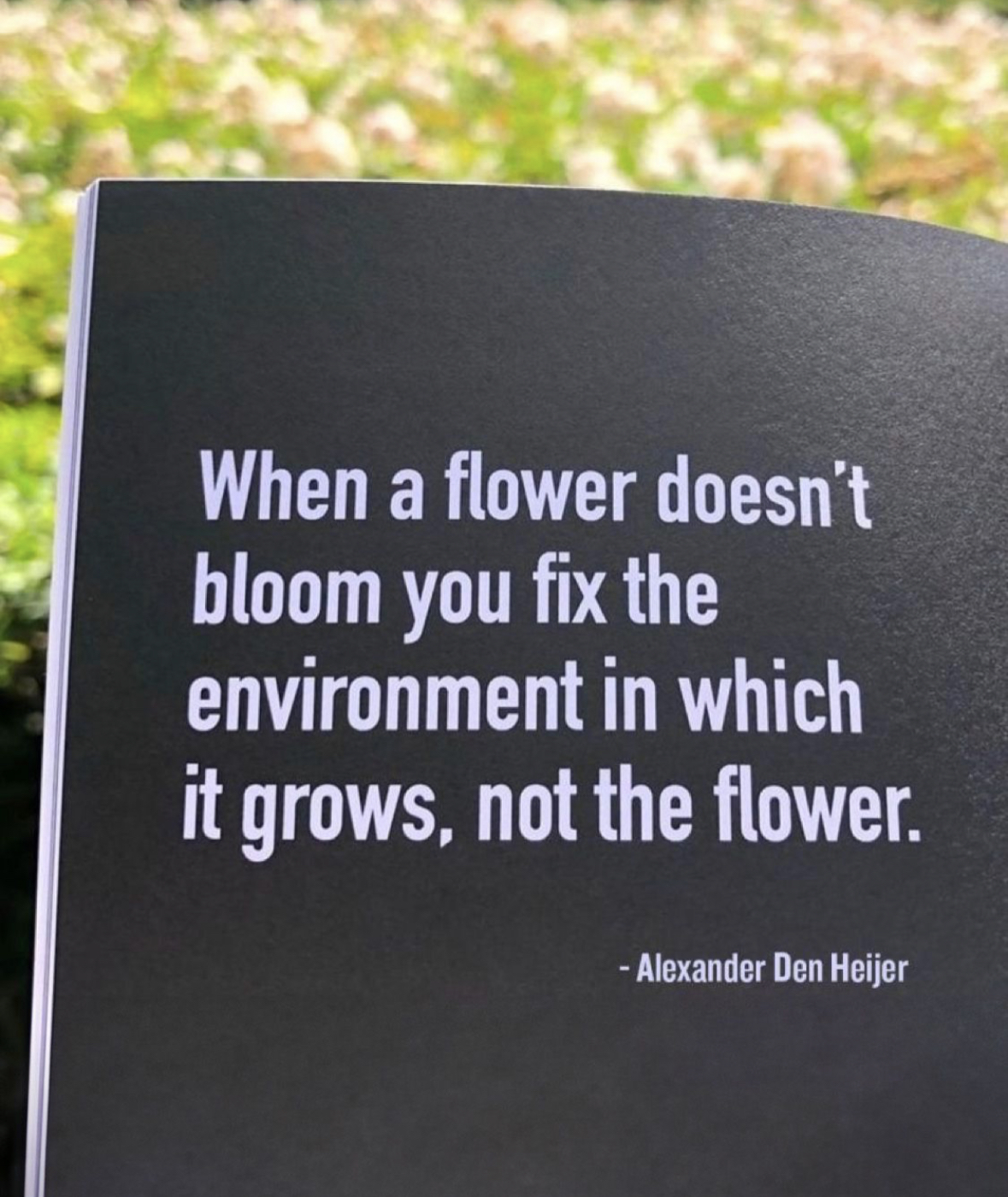
In the pursuit of personal growth and fulfillment, one must be willing to embrace change and recognize when their current environment no longer serves their development. Stagnation can be detrimental to one’s well-being and potential, making it essential to dare to change your environment if you are not experiencing growth.

Change is an inherent part of life’s natural progression. Like the seasons, our lives go through cycles, and each phase offers unique opportunities for growth and transformation. It is crucial to remain open to change, especially when we find ourselves feeling stuck or unfulfilled in our current situation.

When we dare to change our environment, we are essentially stepping out of our comfort zones and into the realm of possibility. It may involve leaving behind familiarity, security, and routine, which can be daunting. However, growth occurs outside of our comfort zones. By embracing change, we expose ourselves to new experiences, perspectives, and challenges that ultimately contribute to personal development.

Change often requires courage and resilience, but the rewards are immeasurable. A new environment can expose us to fresh opportunities, allowing us to discover hidden talents and passions we never knew existed. We may encounter inspiring individuals who motivate us to reach for higher aspirations, pushing us to surpass our previous limitations.

Moreover, changing our environment provides a chance to break free from negative patterns and influences that may have hindered our growth. Sometimes, we may find ourselves surrounded by people or circumstances that hold us back, creating a sense of complacency or even negativity. By stepping away from such environments, we create space for positive influences and conducive conditions for personal growth to thrive.

However, embracing change does not mean abandoning responsibility or recklessly leaping into the unknown. Thoughtful reflection and planning are essential before embarking on a transformative journey. Setting clear intentions, defining goals, and identifying the kind of environment that aligns with our values and aspirations are crucial steps in making a meaningful change.

It is also essential to remember that change is not always immediate. Growth and transformation take time and effort. Be patient with yourself during the process, and don’t be discouraged by setbacks or challenges. Every step, no matter how small, contributes to your evolution.

Daring to change your environment when you are not growing is an act of self-love and courage. Staying in situations that stifle your potential can prevent you from becoming the best version of yourself. By embracing change, you open yourself up to new opportunities, fresh perspectives, and a world of possibilities. Be brave, step out of your comfort zone, and create an environment that nurtures your growth. Remember, life is an ever-evolving journey, and the willingness to embrace change is the key to unlocking your true potential.

Fortifying the Heart and Mind: Embracing Inner Strength

A dear friend shared this quote on Instagram and it made me go “WOW”! In a world where we are constantly surrounded by people and influenced by their thoughts and actions, it can be challenging to maintain our own sense of peace and contentment. However, the key to protecting our hearts and preserving our peace of mind lies in cultivating inner strength and resilience.

One of the primary steps towards safeguarding our hearts and minds is to recognize the distinction between external events and our internal responses. While we cannot control the actions of others, we have absolute control over our reactions. By acknowledging this fundamental truth, we free ourselves from the burden of carrying the emotional weight caused by external influences.

Developing emotional intelligence is paramount in maintaining inner peace. It involves understanding and managing our emotions effectively, allowing us to respond thoughtfully rather than react impulsively to external stimuli. When we learn to detach from negative emotions triggered by others, we can approach situations with a calm and composed demeanor.

A powerful tool in fortifying the heart and mind is the practice of self-compassion. Instead of being overly critical of ourselves for experiencing vulnerability or hurt, we should extend the same empathy and understanding we offer to others. Embracing self-compassion allows us to build emotional resilience, strengthening our hearts against the impact of external judgments or negativity.

Letting go of the need for external validation is a liberating step towards protecting our peace of mind. When we depend on others’ approval for our happiness, we inadvertently grant them the power to influence our emotional state. Embracing self-acceptance and recognizing our intrinsic worth help us build an unshakable foundation for our well-being.

Another vital aspect is learning to set and maintain healthy boundaries. Not everyone in our lives will have our best interests at heart, and it is crucial to protect ourselves from toxic or negative influences. By asserting our boundaries, we create a safe space that nurtures our inner peace and protects us from external harm.

Mindfulness practices offer a refuge from the hustle and bustle of the external world. Engaging in meditation, yoga, or simply taking moments of stillness enables us to reconnect with our inner selves, creating a shield against external pressures and disturbances.

Lastly, surrounding ourselves with positive, supportive, and like-minded individuals fosters an environment that nourishes our hearts and minds. Choosing our company wisely allows us to share our journey with people who understand and respect our values, uplifting us rather than draining our energy.


In conclusion, preserving our peace of mind and guarding our hearts is a continuous journey of self-awareness and inner growth. By recognizing that we have control over our reactions, developing emotional intelligence, practicing self-compassion, detaching from external validation, setting healthy boundaries, embracing mindfulness, and choosing our company wisely, we cultivate the inner strength necessary to remain unruffled amidst external influences. Let us embark on this empowering journey of self-discovery and fortification, and in doing so, we will discover a profound sense of peace that emanates from within.

Here are 26 things you can control!

Finding Joy in Celebrating Others

Life is an intricate journey, filled with a whole lot of experiences, both joyous and challenging. At times, we find ourselves confronted with personal struggles, burdens that weigh heavily on our hearts and minds. In these moments, it can be exceedingly difficult to witness the happiness and success of others. However, it is during these very moments of struggle that embracing the joy of others becomes an invaluable virtue, contributing to our own growth and well-being.

Being genuinely happy for others despite our hardships is a reflection of emotional maturity and empathy. It demonstrates an understanding that life’s challenges are not meant to be a competition of suffering. Instead, it serves as a reminder that everyone’s journey is unique, and each individual is bound to encounter their own obstacles and triumphs. Celebrating others’ happiness does not diminish our struggles but allows us to be part of their moments of joy, creating a sense of unity and shared positivity.

Moreover, when we embrace the happiness of others, we foster an atmosphere of support and compassion. As we extend genuine congratulations and encouragement, we inspire a ripple effect of kindness and goodwill. Our actions can be a beacon of hope for others, reminding them that happiness is attainable even amidst adversity. This fosters a sense of community and interconnectedness, where individuals can find solace in knowing they are not alone in their struggles and that their successes are worth celebrating.

Furthermore, celebrating others’ happiness can offer a much-needed perspective shift. While we may be going through challenging times, witnessing the joy of others can remind us of the beauty and potential life holds. It serves as a gentle nudge to focus on the positive aspects of our own journey and appreciate the small moments of happiness that may have gone unnoticed otherwise. By looking beyond our struggles and rejoicing in the happiness of others, we can find renewed hope and optimism for our own future.

Nonetheless, it is essential to acknowledge that embracing others’ happiness while facing personal struggles is not always easy. It requires a conscious effort to set aside envy, resentment, and comparison. Self-compassion plays a crucial role during this process, reminding us that it is okay to feel down or discouraged but encouraging us to rise above those emotions and share in the joy of others.

In conclusion, being happy for others in times of our own personal struggle is a powerful testament to our emotional maturity, empathy, and ability to find joy in interconnectedness. By celebrating the happiness of others, we cultivate an environment of support and compassion, inspiring hope and positivity in the face of our challenges. In doing so, we discover that happiness is not a limited resource but a boundless emotion that can be shared, magnified, and cherished by all. Let us embrace the happiness of others, even in the midst of our struggles, for it is through unity and kindness that we find the strength to navigate life’s unpredictable journey.


Here’s a lovely poem I came across by Shereen Bingham

You can feel happiness in others’ joy
even when you’re discouraged and alone,
forgotten in shadows of their glory, 
wobbly with disappointment of your own.

Comparing yourself is just as futile 
as comparing the mountains to the sea,
as measuring sun rays against moon beams
or assessing lady bugs in terms of bees.

Together we are present in nature
each with unique beauty and brilliance
that cannot be withered, dulled or subdued
by the others’ splendour or resilience

Build a Chatbot with Hugging Face and Gradio

Over the last few weeks, I have been reading up a lot on LLM stack. Tools such as LangChain, Aviary, Hugging Face. Over the weekend, I thought I’d explore creating a chatbot using Hugging Face and Gradio, two cutting-edge frameworks that simplify the development and deployment of conversational AI models.

I started out with building a simple chatbot using the Microsoft DialoGPT model, Hugging Face Space, and Gradio interference. I am sure you will be able to develop and customize your own one using a similar technique. So let’s get started!

First head over to https://huggingface.co/ and create a free account. After that, click on your display image on top right and select “New Space” option.

Fill out the form with App name, Licence, Space hardware, and visibility. 

Press “Create Space” to initialize the application. 

Next, on the space you just created, click on the “Files” tab > + Add file > Create a new file.  

First let’s create the requirements.txt file to add the required Python packages. You can add the following

transformers
torch

We will next create app.py which basically has the Gradio interface. 

I have loaded the “microsoft/DialoGPT-large” tokenizer and model and created a `predict` function for getting the response and creating the history.  You can take the full code for app.py below

from transformers import AutoModelForCausalLM, AutoTokenizer
import gradio as gr
import torch
​
​
title = "🤖AI ChatBot"
description = "A State-of-the-Art Large-scale Pretrained Response generation model (DialoGPT)"
examples = [["How are you?"]]
​
​
tokenizer = AutoTokenizer.from_pretrained("microsoft/DialoGPT-large")
model = AutoModelForCausalLM.from_pretrained("microsoft/DialoGPT-large")
​
​
def predict(input, history=[]):
    # tokenize the new input sentence
    new_user_input_ids = tokenizer.encode(
        input + tokenizer.eos_token, return_tensors="pt"
    )
​
    # append the new user input tokens to the chat history
    bot_input_ids = torch.cat([torch.LongTensor(history), new_user_input_ids], dim=-1)
​
    # generate a response
    history = model.generate(
        bot_input_ids, max_length=4000, pad_token_id=tokenizer.eos_token_id
    ).tolist()
​
    # convert the tokens to text, and then split the responses into lines
    response = tokenizer.decode(history[0]).split("<|endoftext|>")
    # print('decoded_response-->>'+str(response))
    response = [
        (response[i], response[i + 1]) for i in range(0, len(response) - 1, 2)
    ]  # convert to tuples of list
    # print('response-->>'+str(response))
    return response, history
​
​
gr.Interface(
    fn=predict,
    title=title,
    description=description,
    examples=examples,
    inputs=["text", "state"],
    outputs=["chatbot", "state"],
    theme="finlaymacklon/boxy_violet",
).launch()

I have provided my app with a customized theme: boxy violet. You can browse Gradio Theme Gallery to select the theme according to your taste. 

After this, your app will start building, and within a few minutes, it will download the model and load the model inference.

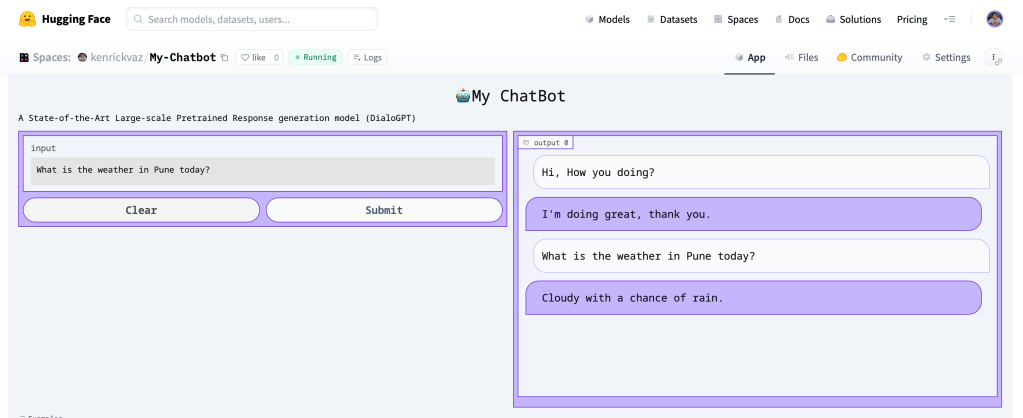
The Gradio App looks awesome. We just have to create a `predict` function for every different model architect to get responses and maintain history.

You can now chat and interact with the app on https://kenrickvaz-my-chatbot.hf.space

Hope you enjoyed building this simple chatbot along with me. You can check out hundreds of chatbots on Spaces for inspiration. And of course, please share your Gradio demo in the comment section!

Managing vs Leading

In the realm of organizational dynamics, managing people and leadership are two distinct yet interconnected concepts. While both involve influencing individuals and achieving collective goals, they differ in their approaches, perspectives, and overall impact on the team or organization.

Here are the key differences between the two

  1. Focus: Managing people revolves around operational efficiency, task completion, and maintaining organizational structure, while leadership emphasizes vision, inspiration, and strategic alignment.
  2. Authority vs. Influence: Managers often exercise authority based on their positional power, while leaders influence others through their personal qualities, expertise, and ability to connect with individuals on a deeper level.
  3. Transactional vs. Transformational: Managing people is often transactional, focusing on exchanges and meeting objectives, while leadership is transformational, aimed at inspiring growth, unleashing potential, and driving positive change.
  4. Short-term vs. Long-term: Managers are typically focused on short-term goals, immediate results, and operational effectiveness, while leaders have a long-term perspective, envisioning the future and guiding the organization towards sustainable success.
  5. Task vs. Relationship Orientation: Managing people is primarily task-oriented, with a focus on processes and outcomes, while leadership places equal emphasis on building strong relationships, fostering collaboration, and developing individuals.

A compelling example that illustrates the difference between managing people and leadership is the story of Steve Jobs, the co-founder and former CEO of Apple Inc. Jobs was widely recognized as a visionary leader who transformed multiple industries and revolutionized technology.

As a manager, Steve Jobs was known for his attention to detail, insistence on perfection, and ability to drive results. He had a keen eye for design and functionality, and he relentlessly pushed his teams to deliver products of exceptional quality. He was deeply involved in the day-to-day operations of Apple, overseeing every aspect of the company’s products and services. Jobs had a reputation for being demanding and challenging, setting high standards and expecting nothing less than excellence from his employees.

However, what truly set Steve Jobs apart was his leadership style. He was not just focused on managing the company; he had a clear vision and the ability to inspire others to share that vision. Jobs had an unwavering belief in the power of innovation and the impact technology could have on people’s lives. He had a remarkable ability to communicate his vision, captivating his audience with his charisma, passion, and storytelling skills.

Jobs empowered his team members to think creatively, take risks, and push boundaries. He encouraged a culture of collaboration and encouraged diverse perspectives, recognizing that breakthrough ideas often emerged from interdisciplinary teamwork. He challenged his employees to never settle for mediocrity. Jobs was not afraid to make bold decisions and was willing to go against conventional wisdom to pursue his vision.

Steve Jobs’ story exemplifies the difference between managing people and leadership. While Jobs exhibited strong managerial qualities, such as attention to detail and driving results, his true impact came from his exceptional leadership skills. He had a clear vision, inspired others to share that vision, and created a culture of innovation and excellence.

St. Thomas, The Apostle

On July 3, the Church celebrates the feast day of St. Thomas the Apostle. Best known for his initial unwillingness to believe the other apostles in their claim that Jesus had risen from the dead, St. Thomas can teach the faithful about believing without seeing.

Little is recorded of St. Thomas the Apostle. Thomas was probably born in Galilee to a humble family, but there is no indication that he was a fisherman. He was a Jew, but there is no account of how he became an apostle to Christ. Nevertheless, thanks to the fourth Gospel his personality is clearer to us than some of the other Twelve. Thomas’ name occurs in Matthew (10:3), Mark (3:18), Luke (6) and Acts of the Apostles (1:13), but in the Gospel of John he plays a particularly distinctive part. Thomas is often condemned for his lack of belief, but Thomas was equally courageous, willing to stand by Jesus in dangerous times. He also relentlessly sought the truth. Like an inquisitive child, he constantly asked questions. And, his wonderful profession, “My Lord and my God,” is the clearest declaration of Jesus’ divinity in Holy Scripture.

Thomas, Loyal Follower
When Jesus announced His intention of visiting the recently deceased Lazarus in Judea—a few miles from Jerusalem and dangerously close for someone as unpopular as He—Thomas said to his fellow disciples: “Let us also go, that we may die with him” (John 11:16). When the worried disciples wanted to keep Jesus from going for fear He would be stoned, Thomas, in a moment of bravery not often expressed by the Apostles before Pentecost, rallied the others to stay by their Master come what may.

Thomas, Inquisitive Student 
Later, in John 14:1-5 it was St. Thomas who raised an objection prior to the Last Supper:

Thomas said to Jesus, “Lord, we do not know where You are going, how do we know the way?”

With the keenness typical of the Twelve, Thomas misunderstands Jesus’ reference to His death and resurrection. Thomas’ question provides Jesus an opportunity to teach one of the most profound and difficult truths of His ministry. Jesus said to Thomas: (John 14:6) “I am the way, and the truth, and the life; no one comes to the Father but through Me.”

Thomas, Doubting Apostle
Lastly, and more famously, St. Thomas is remembered for being absent from the Upper Room the first time Jesus appeared to the disciples after His Resurrection. Thomas dismissed the accounts of the others by saying, “Unless I see the mark of the nails in His hands and put my finger into the nail marks, and put my hand into His side, I will not believe”(Luke 20:25). Eight days later Thomas made his act of faith. He fell at the feet of Jesus and said, “My Lord and my God!” and Jesus replied, “Because you have seen me, Thomas, you believed. Blessed are they that have not seen, and yet believe” (John 20:25-29). This incident gave rise to the expression “doubting Thomas.”

Thomas, Reluctant Missionary
Accounts of Thomas’ missionary activities are unreliable, but the most widely accepted report holds that he preached in India, although he was reluctant to start the mission. According to the Acta Thomae, the apostles divided up the world for their missionary labors, and India fell to Thomas. However, Thomas claimed that he was not healthy enough and that a Hebrew could not teach Indians; even a vision of Christ could not change his mind. Christ then appeared to a merchant and sold Thomas to him as a slave for his master, a king who ruled over part of India. And that’s how he landed up in India!

Here’s an illustration of 6 facts about St. Thomas

To this day, Saint Thomas is venerated as the Apostle of India. In fact, there exists a population of Christians along the Malabar Coast, on the western coast of India, who lay claim to conversion by St. Thomas. Their tradition holds that he built seven churches, was martyred during prayer by a spearing on the “Big Hill” near Madras, and was buried in Mylapore, on the east coast of India. Ultimately, St. Thomas’ remains were transported to Ortona, Italy, where they reside today.

Winning Faith

Photo, Poem by Fr. Terry Q

Amidst the rough and rubble
discard and garbage heap
they stand firm base and stature tall
with promises to keep
no matter what surrounds may be
they know they have a place
so grow and bloom
they must and will
whatever circs they face
papaya bougainvillea tall
with fruit and spread of bloom
as woodpile grass and garbage pile
concede for them make room

we find ourselves oft circumstance
denied of full control
surrounded by unsettling waves
disturbances untold despair the chances to survive
we question all the cost
we don’t believe we’ll come out live
despairingly we’re lost

but then a ray of beaming sun
through smog and smoke and fumes
comes piercing through
and loving grace
makes magic life resume
like nature plants and blooming flowers
we resurrect to glow
God’s love forever always there
our winning faith will show

How does SSO work?

We’ve just begun working on an internal portal for a client. One of the things our dev team has to work on is integrating SSO for authentication. Single sign-on (SSO) is a user authentication tool that enables users to securely access multiple applications and services using just one set of credentials.

Instead of twelve passwords in a day, SSO securely ensures you only need one.

Single sign-on puts an end to the days of remembering and entering multiple passwords, and it eliminates the frustration of having to reset forgotten passwords. Users can also access a range of platforms and apps without having to log in each time.

How Does an SSO Login Work?

Let’s see how SSO works with an example that we are all familiar with, accessing Gmail and YouTube

Step 1: A user visits Gmail, or any email service. Gmail finds the user is not logged in and so redirects them to the SSO authentication server, which also finds the user is not logged in. As a result, the user is redirected to the SSO login page, where they enter their login credentials.

Steps 2-3: The SSO authentication server validates the credentials, creates the global session for the user, and creates a token.

Steps 4-7: Gmail validates the token in the SSO authentication server. The authentication server registers the Gmail system, and returns “valid.” Gmail returns the protected resource to the user.

Step 8: From Gmail, the user navigates to another Google-owned website, for example, YouTube. 

Steps 9-10: YouTube finds the user is not logged in, and then requests authentication. The SSO authentication server finds the user is already logged in and returns the token.

Step 11-14: YouTube validates the token in the SSO authentication server. The authentication server registers the YouTube system, and returns “valid.” YouTube returns the protected resource to the user.

The process is complete!

Here is a short video from one of my favorite tech blogs that helps illustrate SSO.

What Is Single Sign-On (SSO)? How It Works. | Video: ByteByteGo


One of the key issues with SSO is that it has a lot of security implications if user credentials are compromised. IT teams use security concepts like the principle of least privilege and role-based access to ensure no user receives more permissions than they need or extensive access to apps they don’t use. Alternatively, if a user’s account is locked out for one reason or another, they will be unable to access all systems or applications that use the SSO account.

The use of multi-factor authentication (MFA) with SSO is a must. MFA provides an added layer of authentication that makes it more difficult for a malicious individual to successfully login to SSO services using stolen credentials. This significantly reduces the risk of an unauthorized user gaining access to multiple services or applications using a single account. 

In conclusion, Single Sign-On (SSO) has revolutionized the way users authenticate and access multiple applications, providing a seamless experience, improved security, and enhanced productivity. As technology continues to evolve, SSO will likely remain a vital component in modern authentication and access management systems, facilitating efficient and secure user journeys in a connected digital landscape.