The Secret of Happiness is Less Expectations

How many times in your life have you experienced hurt, disappointment, anger, or stress, from the difference between your imagination and reality? We’re very creative creatures. And when we set out to do things, we always expect that everything will turn out exactly the way we want. Does this sound familiar?

  • “I’m going to finish my degree. And then all the companies will line up for me. I’ll pick the one with the best compensation. And I’ll be rich.”
  • “I really like her. We’ll date for a few months. Move in together. Get married. She’ll want four kids. We settle for two. Get a holiday home at the beach. Boom. Happy life.”
  • “My business idea is awesome. I’ll raise some cash. Hire a few people to build the product. We’ll roll it out. The media will write about it. I’ll get on TV. And then I’ll sell the company.”
  • “I’ll make a few videos. Put them on YouTube or Insta. People will share them. One of my videos will go viral. And I’m in. Show me the money.”

Chances of those scenarios coming true? I don’t know exactly. But I guess it’s somewhere close to ZERO. On top of that, unexpected events can put an end to all our plans. Right now, we’re dealing with the war after dealing with the coronavirus, and after that, we probably have to deal with a recession.

It’s not the end of the world. We’ve been through challenging times before. And I’m not trying to bash your dreams here. It’s not practical to have high expectations because they hardly come true. So why have them in the first place?

They do more harm than good.

  • When you have high expectations and the outcome is worse: You’ll be frustrated.
  • When you have low expectations and the outcome is better: You’ll be grateful.

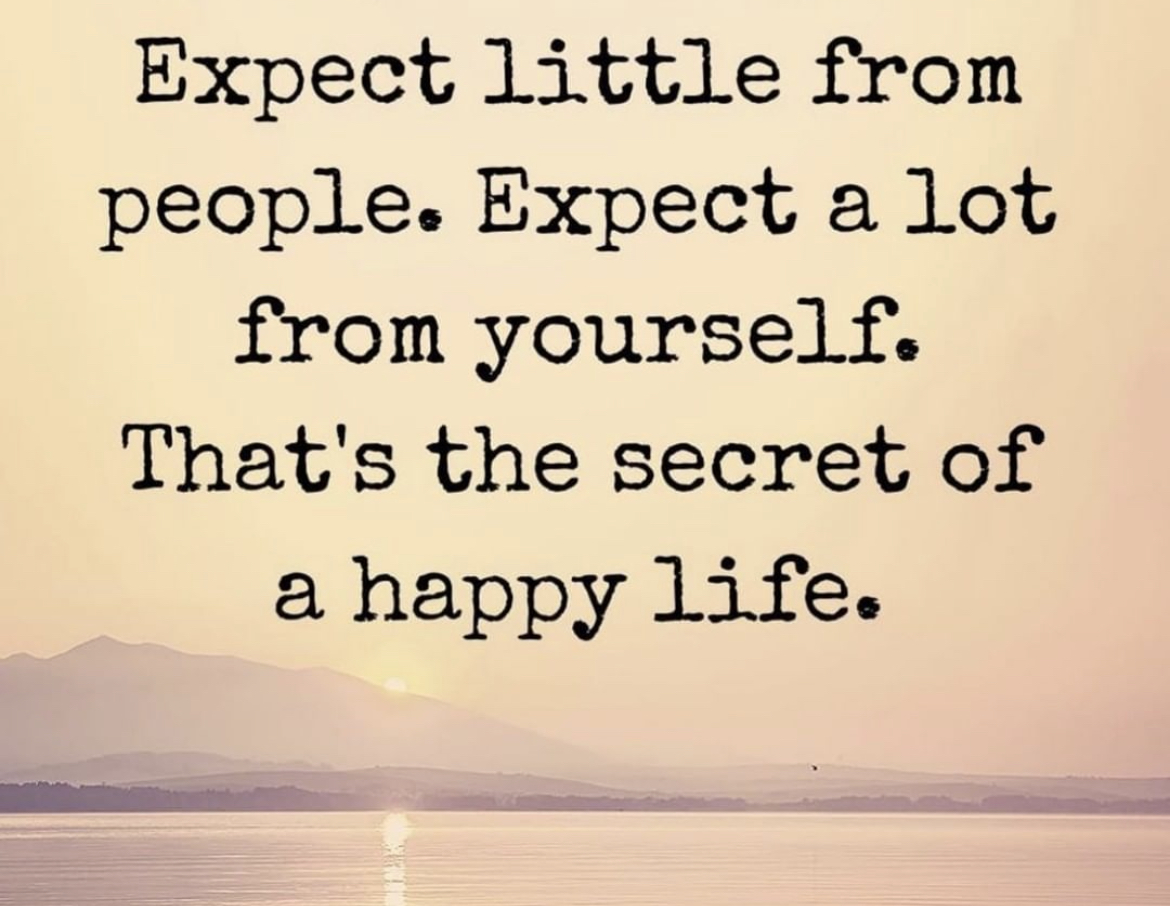
Barry Schwartz, a psychologist, and author of The Paradox of Choice, put it best: “The secret to happiness is low expectations.”

Now, this is not new information. Most of us know that high expectations are not helpful. Why do we still have them?

We still desire more, more, more. And when you want more, you expect more.

You see? You can’t fix your expectations without fixing your desires.

When you desire more, you also have more options.

“What should I do? Work more? Earn more money? Help more people? Spend more time with my family?”

In general, having more options is a bad thing. More means confusion. And confusion often results in anxiety and regret. Do you know this feeling: “What if I made the wrong decision?”

And more importantly: Don’t expect so much from others. You don’t control them anyway. Plus, no one’s perfect. People will disappoint you sometimes. And vice versa. Accept that it’s not the end of the world.

When you live your life free of expectations, you see things for what they are.

And let’s be real for a second: Being alive is the best thing in the world—no matter what the external situations are. We don’t need anything to be happy.

Tough Times Don’t Last

We all go through difficulties in life. Failure, losing your job, bankruptcy, the death of a loved one and countless other scenarios. Going through these situations is never easy. Sometimes, we just want to give up and throw our hands up in silent resignation. It’s easy to see why. These are all painful situations that hit right at our very core as human beings.

But often, when you look back, you realize that those tough times didn’t last. And they also didn’t break you. In fact, they did more for you than success or good times ever could do. There’s a reason why they say that tough times don’t last, but tough people do. It’s because, when you don’t give up and you don’t relent, you come away a stronger and more resilient person.

Here’s the truth. Life and the series of events that make up our lives, are highly subjective. Meaning, it’s easy to look at things in comparison to whatever we experienced in the past. But it’s also important to understand that for this very reason you should know that everything is subjective. We’re the ones who associate meaning to them. No one else.

What To Do When You’re Going Through Tough Times

When you’re going through tough times, it truly is heart-wrenching. You feel isolated. Alone. In the dark. And there’s often no one to turn to. Maybe you’re struggling to raise kids as a single parent or you’re in financial desperation. Whatever that struggle might be, it’s tough to go through those situations in life. Who do you talk to? Where do you turn? Often, it feels like we’re teetering on the brink of disaster.

But understand this. God will get you through it. Whether you believe in God, Allah, Buddha or the spiritual oneness that binds us all, there is a force out there and it is undeniable. That doesn’t mean you can just sit idle and hope for things to get better. Prayer mixed with massive action will bring God’s love and beauty into your life. No matter what you think or say or believe, your problems might seem big, but your God is much bigger.

At the end of the day, it truly does boil down to belief. No. Not just your belief in a higher power. Also your belief in yourself. The conversations that are running through your mind in any given moment have a huge impact on the state and quality of your life. It will send you in one direction or another.

How To Make Sure You Outlast The Tough Times In Life

I remember sitting there on Marine Drive, looking out over a breathtaking sunset. The shimmering Arabian Sea that stretched far out towards the west. And a sprawling city that lay behind me with millions of people going about their lives. None of whom knew exactly what had just happened.

I had just decided to leave the Jesuits and my life along with it. The one dream that I grew up with now over, shattered and broken. Not only was it a tough time. I felt it was surely the end of the road. I had nothing. In a state of true desperation. You would have never known it looking at me. I kept a straight face, trying to pretend to have it all together. But I was a mess. A wreck. I was in a state of true emotional and physical duress.

Sitting there, I cringed. There was this crushing weight pushing down on me from above. I ignored my problems for so long that it finally bubbled up to the brim. The serenity of that moment and that view with the sun just kissing the horizon but my life in shambles was so ironic. At that point I knew things had to change. I didn’t know how. I couldn’t even think back then. But I had to do something and do something fast.

1. Breathe & Let Go

One thing I had a hard time with was letting go of things. Not just letting go of anger and animosity. But also giving up control of what was to come. You can’t always be in the driver’s seat. Sometimes you have to have faith and trust in what’s to come. That doesn’t mean you should sit idly by and watch your life fall apart. It just means that so much of our sanity is wrapped up in having a tight grip on the outcome of our lives that it’s unhealthy.

Learn to breathe. Download a breathing app on your phone. When you’re completely stressed out and anxious, just breath. Breathe in through your nose, hold it, then let it out. And as you let that breath out of your lungs, picture all of your problems going out with it. You might think that sounds silly, but I promise you that your reality is directly tied to your thoughts and your interpretation of reality.

Sounds crazy. I know. But it’s not. I assure you this is real. Sometimes, letting go is actually the best thing that you can do. And you can do this by practicing your breathing exercises. It works. Really and truly, it does work. Try it. Breathe in for 4 seconds. Hold that breath for 7 seconds. Then exhale for 8 seconds. As you breathe out, envision your problems floating away inside hot air balloons. Do this repeatedly for 5 minutes and watch as the tension melts away.

2. Do Not Sit Idle. Take Consistent Action Now.

It’s easy to sit idle as things collapse all around you. Like a sheet of glass shattering all around you into a million little pieces, you’re petrified to step in any direction. The shards of glass threaten to cut you. But I promise you that if you sit idly, it will do you absolutely no good. Get up. Right now. And take action. Massive action. Make a plan and go do that thing you need to do. Sometimes, tough times are the best thing that can happen to us.

When you go through tough times, it truly shows you your real character. It reveals what you’re made of. Because, you really do have two choices. You can set some real goals and make a plan, then take massive action. Or you can just sit around and watch things continue to crumble. When you have no choice, you kick into survival mode. But remember this. Human beings weren’t just made to survive. We were made to thrive.

In fact, we’ve been thriving for tens of thousands of years. Human civilization and technology is flourishing. In fact, we’re reaching an inflection point in time where things are changing so rapidly that it’s overwhelming. Remember to take your problems with a grain of salt. Then go out there and do what it takes to overcome any issues you might be having in your life or your business.

3. The Magic Is In The Follow-up – Never Take No For An Answer

Too many people just give up because someone told them no. Or maybe multiple people told them no. Maybe they failed a handful of times. Maybe more. But here’s the thing. When you’re going through those tough times in life, that’s when you need to double down and put in an exponential amount of effort. You can’t just lay down your arms and accept what you think fate has in store for you. No way.

The magic is in the follow-up. What do I mean? Whether we’re talking about failure or sales or anything else, the follow-up is the key. Think about this for a moment. The most famous and successful people failed the most times. Yes. Seriously. I’m not talking about just a handful of failures. I’m talking about hundreds, even thousands of failures and difficulties to get things right.

When you think about things that way, you’ll push through. You’ll persist and persevere. You won’t give up and throw in that towel. You’ll keep going and going and going. In the iconic book, Think and Grow Rich, Napoleon Hill recants a powerful tale. It’s the story of a man who headed west during the Gold Rush. When he arrived, he purchased a mine. At first, the mine produced gold and the man was ecstatic.

However, soon after that, the gold dried up. The vein of gold ore had disappeared. They mined and mined for months on end. And nothing. Zero. Zilch. Nada. So he gave up. Threw in the towel. And sold the mine to a junk trader. That junk trader hired an engineer who surveyed the land and discovered something very fascinating.

Three feet from gold…

The engineer, who was very familiar with the topography of the land and gold ore veins, predicted that Darbys were just three feet from gold where they had stopped drilling. And that’s exactly where they were. Three feet from gold! What’s my point? When they say that tough times don’t last, but tough people do, it means that those who are tenacious win. Those who don’t expect success, give up at the first sign of disappointment.

The magic is in the followup. This is true back then as much as it is now. Everything happens in the follow-up sequence. It doesn’t happen off the bat. Don’t expect to build your app in one go or do whatever right away. Be tenacious. Follow up. Keep hammering away and eventually you will sort things out. If you have to wade through some mud and dirt along the way, do it. And do it happily.

It’s the worst times in life that create our character. Those are the defining moments. Like nature’s chisel, it chips away at us until we reach a state of perfection. You might feel down and out today, but just know and understand that this is priming you for something bigger and greater. But only if you don’t relent. Only if you don’t give up.

Tough times don’t last, but tough people do.”

Robert H. Schuller

Microhabits to Change your Life

Is it really possible to change one’s life in such a short timeframe?

Well, yes. Just don’t expect a complete overhaul of your life in 30 days or you’ll be terribly disappointed! You can, however, change your life to a certain degree in 30 days. Remember, 1% positive change in a month is still change. Realistic professional athletes aim for less than 1% change in a month and they’re satisfied with it.

So the first step is to define what change(s) are you looking to have in your life. Ask yourself the following questions:

  • What do you want to change in your life?
  • Why do you want to change it?
  • What do you need to do to change it?
  • How can you track your progress?
  • Who can help you change it?
  • What are you willing to risk to change it?
  • When can you start to change it?
  • Why not now?

That will bring you clarity on what it means for you to change your life.

Breakthroughs don’t change your life. Microhabits do.

Benjamin Hardy compares this concept to compounding interest, and how, given the choice, most people would take $1,000,000 in their bank account right now as opposed to a penny that doubles in value over the course of the month.

What most people don’t realize is that those who take the big payout end up with significantly less money than those who opt for the cent per day. He explains: “The doubling penny actually ends up being $10.7 million dollars. Yet, the majority of the growth happens at the very end, and most people aren’t patient enough for the big return. The “live for the moment” culture of today stops people from investing.”

The point is that if you want to have a completely different life in a year or two, you need to start now, and you need to start small. 

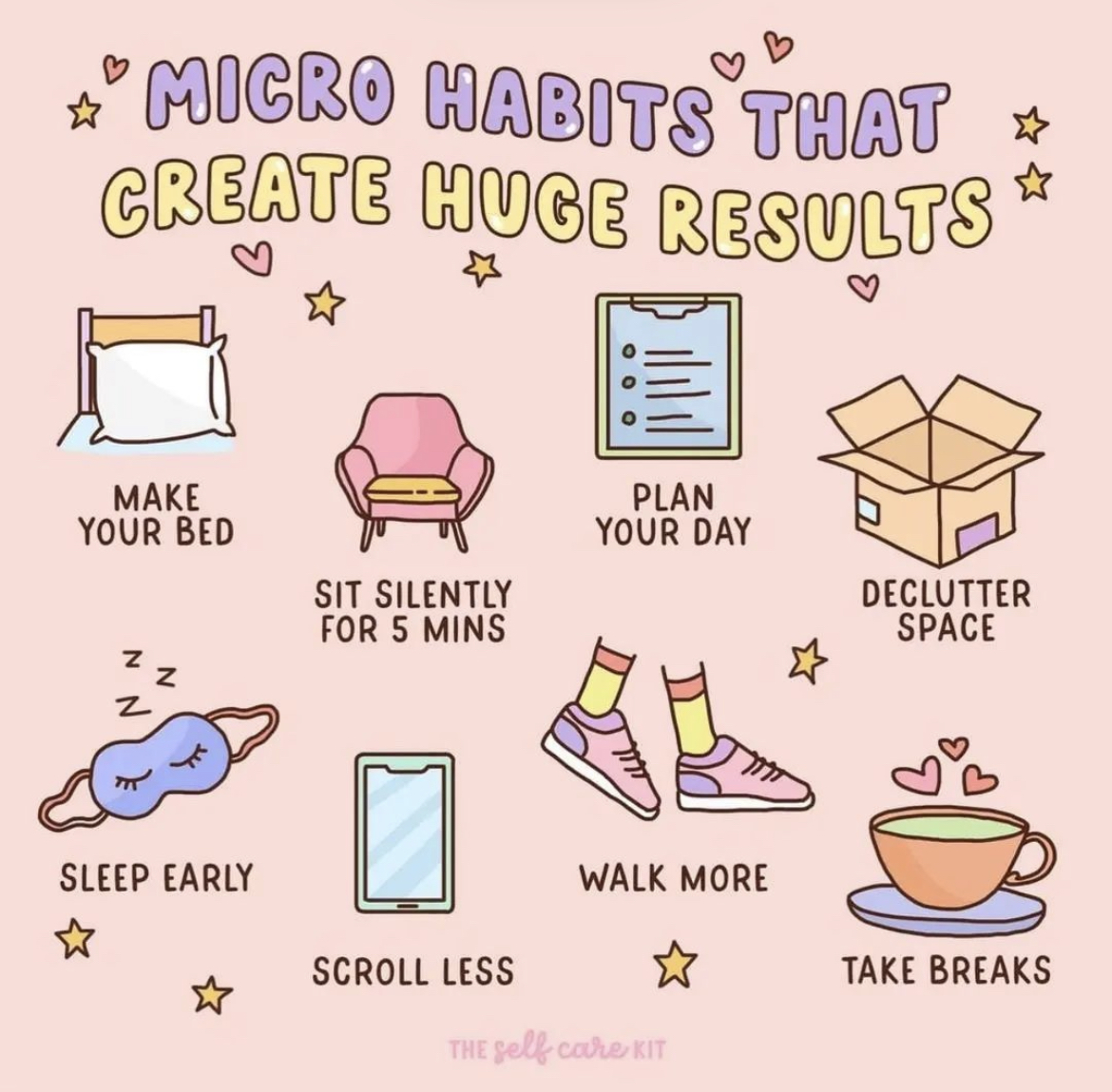
The micro-habits below cover most aspects of health, wealth, love and happiness.

When reading the list below, always keep in mind what you want to change. Note the micro-habits you think can help you and do them every day for the next 30 days and beyond. Of course there are some that can’t be done every day or you may miss a day or two. That is completely okay! Get back on track and continue.

Reading uplifting content before going to bed
Don’t let yourself go to bed in a bad mood, or by filling your brain with “crap”. I understand that you need to decompress before going to bed. I completely get that. But what you do before bed affects how you wake up, and the state of mind you’re going to be in for the first part of the day.

Listen to uplifting music, podcasts, and people
My most productive days seem to be when I’m dancing to music on my chair. Great music puts me in flow state. I feel like I can do anything!

Be more responsive
If someone sends a text, answer it when you see it. As often as you are able, respond to important emails as they come in. This will ensure that you aren’t left with a backlog of work that needs to be tended to.

Be less reactive
When you see or hear something that immediately enrages you or upsets you (even if it’s just a negative thought that crops up in your head) before reacting to it and pouring your energy into it, question it. Figure out where it came from, and ask yourself whom your reaction to it would serve. Learning to take that micro-pause between a stimulus and your response will change the way you look at everything.

Keep inspiring quotes near you
Quotes are powerful. One thing I had realized early on when I started writing was that things people highlighted most in my stories were the quotes I put in them. And I get it. People far smarter than me have said far smarter things I have.

Reading at least one good quote a day puts you in the right mood. Keep it on your fridge/desk. Let it be in your face as frequently as possible.

Scroll less
Whereas sifting through TV channels was once the mindless past time of years past, now it’s scrolling through news feeds. Train yourself to limit your “scroll” time each day. You don’t have to delete apps entirely, but you should be mindful that you’re not spending multiple hours a day effectively doing nothing.

Practice saying “no
Your energy is limited each day. Make sure it is only going toward that you truly care about. You should not feel bad about saying “no” to some things. It is ultimately a means of self-preservation.

Work out, even if just a little
The best months of my life was when I was doing physical activity. I was feeling great in my body. When I’m exercising and seeing even small gains in my weight-loss journey, I feel incredible. Whatever your goals are health-wise, be active, measure every little gain, and keep going.

Keep or make good habits, drop the bad ones
This is the starting point, and most likely the most important one. Habits are strong. We’re creatures of habits. Good or bad. Keep the good ones. Drop the negative or ineffective ones. Make new, better ones.

The hard part is consistency, consistency is key! If you can’t be consistent, add accountability.

Eat one less unhealthy snack.
Don’t worry about trying to completely overhaul your diet and perfect every single thing that crosses your lips. Focus only on foregoing one single unhealthy choice that you’d make on any given day. Just one.

Have monthly goals and track them
How many of us have truly stuck to our New Year resolutions? They’re near-impossible to achieve.

Monthly goals, on the other hand, are excellent. Committing to goals for a month is doable, and leads to building great habits. It’s great to experiment and see what works for you, and what doesn’t.

Make a clear task list
I’ve been disorganized and lost many times. I had a really hard time tracking my progress on the various projects. Not anymore. It doesn’t matter the tool you use as long as your list is clear.

Aim freaking high
Always make your lists bigger than you can chew. We, as humans, like comfort. If we allow ourselves to be comfortable, we end up doing close to nothing. Make your lists big. But make sure the tasks are small and achievable. I have about 15–20 things to do every day. Most are 10 minute-tasks.

If I aim to accomplish 10 tasks. I will. And I will be “satisfied”. Now if I aim to accomplish 20 tasks and complete 15–18 of them, I’ll be pumped. I won’t see time go by and the dopamine rush I’ll get rush for accomplishing so much will strongly contribute to building that momentum up.

Prepare your next day the night before
What I’m proposing you here is to simply make a list of things you want to accomplish for the next day a few hours before bed, and then review it shortly before “calling it a night”. Don’t make it too complex. Just a simple list. It shouldn’t take more than 5 minutes. I usually come up with a list of anywhere between 10–20 things to do.

Here’s what happens when you prepare your next day the night before:

While you sleep, your subconscious is “working on” things you “fed it” before going to bed. When you feed it with things you want to accomplish for the next day, it will “prepare” you for them.

Write for yourself
Writing has been a powerful medium for me to express myself. I never knew I had so much to say. I did it for myself, really.

Yet putting all my thoughts in writing has been a phenomenal way to free my mind and think clearly, ultimately leading to some momentum.

Delegate to people you trust
This is WAY underrated! I thought people who delegated were lazy. There are so many things I am doing that could easily be done by someone either more qualified or with more time doing simpler things.

Don’t stop when it hurts

How do you build muscles? You continue when it starts hurting!

And you know what? That’s how you grow in anything in life. No pain no gain.

If you stop when it’s hard, you just wasted valuable energy. Recognize when you’re in a dip, and then get out of it!

Surround yourself with motivated people
Here’s one of my favourite quote of all times:

You are the average of the 5 people you spend the most time with

Jim Rohn

This is so true.

I seek mentors. I seek positive people. I seek people who get stuff done.

Constantly learn new things
That’s probably contributed the most to the changes in my life.

The future belongs to those who learn more skills and combine them in creative ways

Robert Greene

Everything I’m doing today — my “successes”, my “failures” — it’s all because I had decided I wanted to consciously and continuously learn new skills.

Take a well-deserved vacation
It’s hard to brake when your pedal is all the way back. But you know what, sometimes that’s exactly when you need to brake.

You can’t function at peak state when you’re constantly under pressure.

Do good, be grateful
Doing good is so rewarding and gives you such a high. And when someone does good to you, be grateful. Gratefulness is almost as powerful as doing good yourself.

Celebrate The Small Wins
Every time a small event happens where it could be considered a “win”, acknowledge it. Take note of it. Have a “success” journal.

Begin each day asking yourself: “How can I change my life today?”
Get out of the mindset that you have to “get through” the day and get into the mindset that the coming hours are filled with open-ended potential for you to take action that will change your life forever. The only difference is your willingness to see things differently, and your effort in trying to make them better.


Changing your life for the better can seem daunting, but it’s important to remember that you can make a difference by taking small, manageable steps.

By implementing some of these micro habits into your daily routine, you’ll be on your way to a happier and healthier life. So get started today and see how much of a difference these small steps can make.

You’re already one step closer to changing your life.

How Easter’s Date is Determined

Without a doubt one of the most important celebrations in the Christian calendar, Easter is a holiday that celebrates the Resurrection of our Lord Jesus Christ. After his crucifixion, death, and burial, three days later, He rose from the grave. By this, He conquered death and redeemed us from sin.

Easter is a “lunar feast” or a “movable feast” that is always held on a Sunday between March 22 and April 25.

Easter this year happens just one day after April’s full Moon (Saturday, April 16), which is the first full Moon to occur after the spring equinox (March 20, 2022) and is therefore known in the Christian calendar as the “Paschal Full Moon.” To make a long story short, Easter always occurs on the first Sunday after the Paschal Full Moon.

Let’s break it down: In 2022, the spring equinox happens on Sunday, March 20. The first full Moon to occur after that date rises on Saturday, April 16. Therefore, Easter will be observed on the subsequent Sunday, which is Sunday, April 17. 

Many Eastern Orthodox churches follow the Julian calendar rather than the Gregorian. In this case, the observance of Easter can occur between April 4 and May 8.

The name “Easter” was derived from “Eostre,” “originally a Saxon word (Eostre), denoting a goddess of the Saxons, in honor of whom sacrifices were offered about the time of the Passover.”

Another probability is the Norse eostur, eastur, or ostara, which meant “the season of the growing sun” or “the season of new birth.” The word east comes from the same roots. In this case, easter would be linked to the changing of the season.

Holy Saturday

Holy Saturday is the day in the Christian liturgical calendar that celebrates the 40-hour-long vigil that the followers of Jesus Christ held after his death and burial on Good Friday and before his resurrection on Easter Sunday. Holy Saturday is the last day of Lent and of Holy Week, and the third day of the Easter Triduum.

In the second century, people kept an absolute fast for the entire 40-hour period between nightfall on Good Friday recollecting the time Christ was removed from the cross and buried in the tomb and dawn on Easter Sunday when Christ was resurrected.

In the early church, Christians gathered on the afternoon of Holy Saturday to pray and to confer the Sacrament of Baptism on catechumens—converts to Christianity who had spent Lent preparing to be received into the Church. As the Catholic Encyclopedia notes, in the early Church, “Holy Saturday and the vigil of Pentecost were the only days on which baptism was administered.” This vigil lasted through the night until dawn on Easter Sunday, when the Alleluia was sung for the first time since the beginning of Lent, and the faithful—including the newly baptized—broke their 40-hour fast by receiving Communion.

With the reform of the liturgies for Holy Week in 1956, those ceremonies were returned to the Easter Vigil itself, that is, to the Mass celebrated after sundown on Holy Saturday, and thus the original character of Holy Saturday was restored.

Until the revision of the rules for fasting and abstinence in 1969, strict fasting and abstinence continued to be practiced on the morning of Holy Saturday, thus reminding the faithful of the sorrowful nature of the day and preparing them for the joy of Easter feast. While fasting and abstinence are no longer required on Holy Saturday morning, practicing these Lenten disciplines is still a good way to observe this sacred day.

As on Good Friday, the modern church offers no Mass for Holy Saturday. The Easter Vigil Mass, which takes place after sundown on Holy Saturday, properly belongs to Easter Sunday. The modern Easter Vigil Mass often begins outside of the church near a charcoal brazier, representing the first vigil. The priest then leads the faithful into the church where the paschal candle is lit and the mass is held. 

What’s So Good about Good Friday?

What is Good Friday and why do we call Good Friday “good” when it is such a dark and bleak event commemorating a day of suffering and death for Jesus?

Good Friday, the Friday before Easter, is the Christian holy day to commemorate the crucifixion of Jesus and His death at Calvary. It is also known as Holy Friday, Great Friday, Great and Holy Friday, and Black Friday.

For Christians, Good Friday is a crucial day of the year because it celebrates what we believe to be the most momentous weekend in the history of the world. Ever since Jesus died and was raised, Christians have proclaimed the cross and resurrection of Jesus to be the decisive turning point for all creation. 

What is the Meaning of Calling it “Good” Friday?

Still, why call the day of Jesus’ death “Good Friday” instead of “Bad Friday” or something similar? Some Christian traditions do take this approach: in German, for example, the day is called Karfreitag, or “Sorrowful Friday.” In English, in fact, the origin of the term “Good” is debated: some believe it developed from an older name, “God’s Friday.” Regardless of the origin, the name Good Friday is entirely appropriate because the suffering and death of Jesus, as terrible as it was, marked the dramatic culmination of God’s plan to save his people from their sins.

In order for the good news of the gospel to have meaning for us, we first have to understand the bad news of our condition as sinful people under condemnation. The good news of deliverance only makes sense once we see how we are enslaved.

In the same way, Good Friday is “good” because as terrible as that day was, it had to happen for us to receive the joy of Easter. The wrath of God against sin had to be poured out on Jesus, the perfect sacrificial substitute, in order for forgiveness and salvation to be poured out to the nations. Without that awful day of suffering, sorrow, and shed blood at the cross, God could not be both “just and the justifier” of those who trust in Jesus (Romans 3:26). Paradoxically, the day that seemed to be the greatest triumph of evil was actually the death blow in God’s gloriously good plan to redeem the world from bondage.

Good Friday marks the day when wrath and mercy met at the cross. That’s why Good Friday is so dark and so Good.


Here are my two favorite hymns for Good Friday

Five things to know about Maundy Thursday

Christians today observe Maundy Thursday, which commemorates the Last Supper and Jesus washing the feet of his disciples. It is possibly one of the most important, complex, and profound days of celebration in the Catholic Church. Maundy Thursday celebrates the institution of the Eucharist as the true body and blood of Jesus Christ and the institution of the sacrament of the priesthood.

Here are five important things to know about Maundy Thursday:

What does Maundy mean?
The Thursday before Easter is known as either Maundy Thursday, or Holy Thursday. Maundy is derived from the Latin word for “command,” and refers to Jesus’ commandment to the disciples to “Love one another as I have loved you.”

What does it commemorate?
Maundy Thursday commemorates the Last Supper, which Christians consider the institution of Holy Eucharist, also known as the Lord’s supper or communion. It is described in the Gospel of Luke, chapter 22. At the Last Supper with his disciples, Jesus breaks bread, saying, “This is my body,” and pours wine, saying, “This is my blood.” He then asks the disciples to “Do this in remembrance of me.”

What holiday was Jesus observing?
The Last Supper is derived from Jesus’ Jewish heritage and his observance of a Jewish holiday. The Last Supper was a Passover Seder, the feast of unleavened bread. Jesus and the disciples are eating unleavened bread. Passover is the Jewish festival commemorating the exodus of the Jews from Egypt, when they left so quickly there was no time for the bread to rise.

Why foot-washing?
Maundy Thursday is also associated with foot-washing. Jesus washed the feet of the disciples, an act described in the Gospel of John, chapter 13, as Jesus teaching them to be servants. It’s the ultimate act of “servant leadership.” Jesus instructs his followers to love and to serve. Most Catholic churches will have a Mass tonight, with a Eucharistic celebration that includes the washing of feet..

Maundy Thursday has a dark side
Jesus foretells his death, saying he will eat no more until the kingdom of God is fulfilled. It also marks an act of betrayal. “One of you will betray me,” Jesus says. Judas Iscariot, one of Jesus’ 12 disciples, is pointed out by Jesus as the one who will betray him.

Solitude: How & Why to Spend Time Alone

When was the last time you were alone? Not lonely, or isolated, or missing someone. But alone, happily, by choice?

If you’re still thinking, it’s been too long. 

Modern society has developed some negative associations with the idea of being alone. When kids misbehave, parents send them to their rooms to sit in silence as a punishment for their bad behavior. Staying at home alone on a Friday or Saturday night is frowned upon. You’d be considered a “loser” for doing so and your friends would ask if you’re okay.

We’ve been wired to believe that solitude is our enemy.

We’ve also confused “being alone” with “being lonely”. But that, of course, is not the case. Being alone doesn’t necessarily cause loneliness and many people can feel lonely despite being in the constant presence of other people.

Loneliness is about perceiving that no one is there for you. But solitude is about making a choice to be alone with your thoughts.

Amy Morin

The truth is, solitude is necessary for our well-being and potential success.

Research has come to prove that there are several long-term benefits to solitude.

  1. It allows you to learn more about yourself and find your own voice.
    In a world where information is available at your fingertips and everyone has an opinion to share, sometimes it’s incredibly rewarding to trust that you have the answers you seek. All it takes it to build the habit of looking within to converse with yourself. Solitude becomes a medium to learn more about who you are as a person. 
  2. It empowers you to become comfortable with who you are.
    The more you learn to shun out external influence, the more comfortable and confident you feel about your authenticity. This confidence, in turn, will project in the future decisions you will make. 
  3. It boosts your creativity. A recent study found that people who enjoy solitude tend to be more creative. I personally really appreciate my alone time. It allows me to rewind, to reflect and more so, allow my imagination to wander. Most often it’s when I roam in nature that I get my best ideas.
  4. It gives you an opportunity to plan your life.
    We plan our business meetings and our upcoming vacations. At work, there are quarterly business reviews and bi-annual performance reviews. We plan and reflect for work and fun — but why don’t we do the same for our dreams, aspirations and personal lives? Take a break from the rhythm of rush to reflect on whether you’re living a life true to you and your goals. 
  5. It improves your mental wellbeing.
    Studies have shown that people who learn to find comfort in solitude tend to be happier, experience lower levels of stress and are less likely to have depression.

How to Spend Your ‘Alone Time’

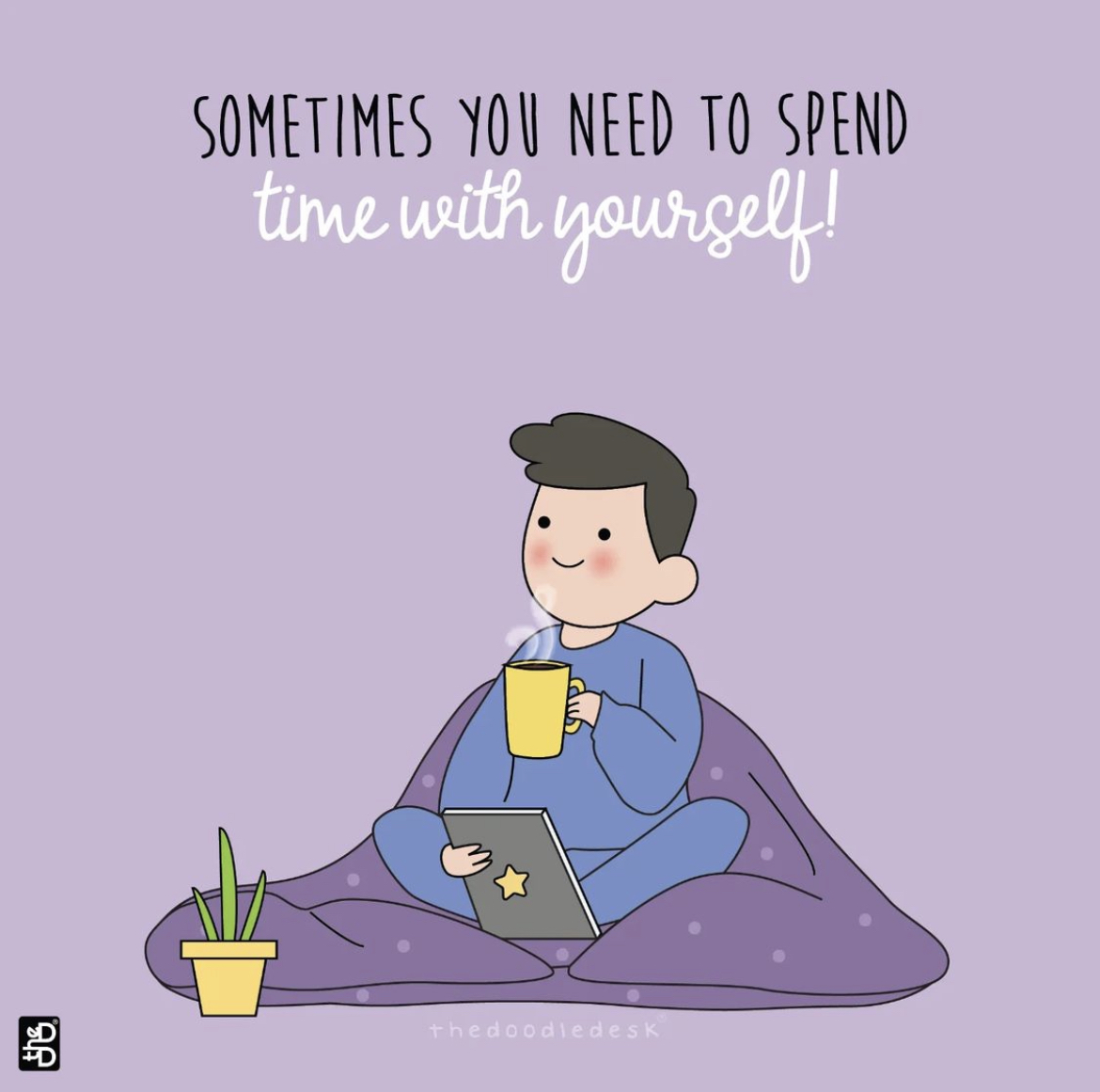
You don’t have to go to a cabin in the woods or fly all the way to a remote island to learn how to spend time alone. All it takes is to integrate 10 minutes per day to be alone with your thoughts — and if that’s too difficult to start with, I recommend you block out 10 minutes every Sunday evening for yourself.

Is that too difficult of a task to do? I highly doubt it.

But how do you actually spend time with yourself? Is there more to it than just sitting in silence with no distractions? You bet! Here are a few other recommendations that might inspire you.

1. Pick Up An Old Hobby Or Try A New One

What better way to pass the time than by doing something you love? Maybe it’s something that you did during your college days. Or maybe it’s something that you’ve always wanted to do. 

News flash: you don’t need anyone else! You can do it by yourself. Using your alone time to do something that makes you happy will never feel like a chore. 

2. Journal Through Your Thoughts

Grab your pen and paper and have a heart-to-heart with your journal. Journaling has so many benefits for mental health, which makes it an excellent way to spend your coveted alone time. 

3. Do Nothing

Sometimes it’s really powerful to just sit and do nothing. Let your mind wander and be reassured knowing there’s absolutely nothing you have to do except be there in the moment. 

4. Meditate

Meditation calms you down and sharpens your focus muscle. It’s hard at first, but with time, you will love it so much that it becomes a pillar in your daily routine. 

5. Set Goals

Take control of your life. If you don’t invest the time to be alone with your thoughts and ask yourself “what do I want to achieve this year” then you’ll end up living your life on autopilot. You need a goal — a destination to work towards. Take the time to plan where you want to go in life.

Give me six hours to chop down a tree and I will spend the first four sharpening the axe.

Abraham Lincoln

It’s not easy to be able to sit alone with your thoughts for extended periods of time, but at an age when social connectivity is the constant, it’s imperative for our mental health to frequently unplug.

You need to give yourself the time you deserve to be with your mind, to look within, and engage in a meditative experience. You can sit in silence. You can journal. You can plan your week ahead. You can go for a walk in nature.

It doesn’t matter what you use your time alone for.

The most important thing is that you build the habit of embracing solitude and inviting more of it into your life. You’ll learn more about yourself and you’ll become more aware of your emotions. In short, it’s the best form of self-care.

Own your Flaws

We see our physical imperfections every time we look at ourselves in a mirror. We sometimes reflect on our shortcomings or imperfections of character after we fail to respond to a situation in an emotionally-balanced way; When we realize we were untruthful to ourselves and to others, or when we harshly criticize ourselves for not having achieved something that is defined as successful or good by social convention.

All of this we come to see as our own imperfections. We see it as imperfect because it falls short of what we think, believe or expect to be perfect, a construct or idea we have in our head that we have built ourselves or that was handed down to us by society.

Better to do something imperfectly than to do nothing flawlessly.

Robert H. Schuller

Sometimes we make the mistake of assuming that we need to be perfect to be lovable, which sets us up for disaster. No one is perfect, and anyway, our imperfections are what make us unique. Here’s why owning your flaws makes you a lot more lovable than pretending to be perfect does:

1. IT MAKES OTHER PEOPLE MORE COMFORTABLE.
It’s not your job to make sure that other people aren’t intimidated by you, but when you pretend to be perfect, it can put up a wall and make you seem unapproachable and unrelatable.

2. PEOPLE CAN GET TO KNOW THE REAL YOU.
We want people to like us for who we really are, but for that to happen, we have to learn how to let people get to know who we really are. You can’t be guarded and known deeply at the same time.

3. PEOPLE AREN’T LOOKING FOR PERFECT.
We might want someone that is perfect for us, but that’s very different from wanting a perfect person. Imagine how hard it would be to really date a flawless person. S/He would probably be a total nightmare.

4. YOU COME OFF AS AUTHENTIC.
Nothing is more appealing than people who are totally authentic. That’s exactly why you might love certain people who you consider “weird” or “crazy,” because they’re comfortable with it and because of that, so are you.

5. YOU’VE ACCEPTED YOURSELF.
When you accept yourself for who you are, then other people can, as well. Knowing you’re flawed and moving forward shows people that you don’t need saving, because you’re doing it yourself.


So how do you start owning your flaws??? Here are ten tips for embracing your flaws and accepting yourself completely.

1 Acknowledge what’s bothering you
Without understanding the root of your concerns, it’s hard to come to terms with your flaws. Dig deep and see if there are issues beneath the flaws that you need to address.

2 Use your flaws to guide self-improvement
Embracing your flaws doesn’t mean you can’t improve yourself. In some cases, recognizing certain flaws gives you the opportunity to work on those imperfections. If your flaw is something you want to change, go for it!

3 Appreciate your individuality
Your flaws may make you different from everybody else, but that’s a good thing! Don’t make the mistake of trying to fit the mold.

4 Put things in perspective
Instead of focusing on everything that’s bothering you, grab a notepad and jot down three things you are grateful for. Wouldn’t you rather have your health and your beautiful family than be a stunning beauty without those precious gifts?

5 Flip your flaw
If you can find the strength in your flaw, you’re a lot more likely to own it. For example, if you’ve always considered yourself quiet and shy, that probably means you’re an amazing listener and observer.

6 Don’t compare yourself
Stop comparing yourself to others and love yourself for who you are — the good, the bad and the ugly. Everyone has their own idiosyncrasies. That’s what makes life interesting!

7 Be flawsome
Yes, flawsome is an actual term. I had shared a post Be Flawsome last June. This term was coined to describe brands that show humanity by being open about their flaws. In their words, “Human nature dictates that people have a hard time genuinely connecting with, being close to, or really trusting other humans who (pretend to) have no weaknesses, flaws, or mistakes.” Who wants that? Embrace your flaws — and be flawsome!

Benefits of Setting Boundaries

You can’t be all things — or do all things — for all people. A life without limits means rarely saying “no” and considering everyone else’s feelings before your own. Not only are these people-pleasing habits wholly exhausting, they put you on the direct road to burnout, a major health hazard in its own right. They disregard how much work or effort you can handle on a regular basis. That’s where boundaries come into play. In simple words, boundaries aren’t a way to keep people out. They make life as enjoyable as possible for you and for your loved ones as a result.

It’s not mean or wrong to set boundaries. Boundaries protect us from being hurt and taken advantage of. Boundaries create healthy relationships and clear expectations. And we can learn to set boundaries without feeling guilty or like we’re being mean!

Often, we assume that people will respect our boundaries because we were brought up and taught what is acceptable by our family and/or culture. Unfortunately, this is not always the case.  Although we can choose who we interact with in our personal life such as choosing close friends, this is not always the case in other environments such as work, family, community, etc. We can feel uncomfortable or even violated if we interact with those who have poor boundaries. But it is important to know how to establish healthy emotional, psychological, and physical boundaries in relationships so we can feel respected and safe.

Below are a few great things that happen when you learn to set your own limits:
Source: Boundaries expert Chad Buck, a clinical psychologist at Vanderbilt University’s Work/Life Employee Assistance Program

1. You’re more self-aware.
Creating your own limitations is an inherently self-aware act — and that can be incredibly beneficial for your own welfare.

2. You become a better friend and partner.
Boundaries make it possible to allow yourself to recharge. And when you’re not totally tapped out, you have more energy to devote to the ones you love. You’re also more respectful of their own needs as a result.

3. You take better care of yourself.
Boundaries help you prioritize your own well-being — plain and simple. It is not selfish to take care of yourself and your needs while also considering the needs of others. It makes you more effective and less burned out from helping if you set some limits.

4. You’re less stressed.
Without establishing your own limits, you open yourself up to the risk of taking on everyone’s problems in addition to your own. Or worse, you ignore your own happenings entirely. If you have a reasonable boundary, you don’t take on additional stress.

5. You’re a better communicator.
In order to really establish limits, you have to state what you can or cannot tolerate. That means being clear and concise. Expressing your own needs will also allow you to be more transparent. All of these characteristics are elements of good communication.

6. You start trusting people more.
Expressing your limitations to others means you’re trusting them to handle those emotions you’re conveying. And more trust means better relationships.

7. You’re less angry.
When you don’t have set boundaries you give other people the power over your own life — and that can lead to anger. We let people get away with things that are not okay. Then we just become more resentful and hateful.

8. You learn how to say “no.”
“No” may be a small word but it’s certainly powerful. The most basic way of establishing a boundary is declining anything you don’t have the capacity to handle.

9. You end up doing things you actually want to do.
Imagine your life without unnecessary obligations all because you started exercising your right to say “no.” Limits free you up for more opportunity to do the work and activities that you actually desire to do.

10. You become a more understanding person.
When you’re compassionate toward yourself about what you can tolerate, you’re better able to express that to other people who have their own boundaries they want to follow.


A more fulfilling life, a warm personality and better relationships all because you set up healthy limits for yourself? Doesn’t sound like a bad deal.