Beyond the Paycheck – The True Currency of Happiness

We all know the thrill of a salary increase. That moment when the email arrives or the conversation happens—it feels rewarding, exciting, and validating. For a few days, maybe even a few weeks, there’s a glow of satisfaction. But soon, life settles back into routine. The bills get paid, the novelty fades, and the happiness tied to that number on a paycheck quietly slips into the background.

That’s because salary increases, while important, are temporary boosters. They make us happy once a year, but they don’t carry us through the everyday rhythm of work. What really sustains us—day after day, week after week—is the feeling of being valued.

When someone recognizes your effort, appreciates your ideas, or simply acknowledges your presence, it does something deeper than money ever can. It says: you matter here. It reminds you that your contribution is seen, that you’re more than just a role or a title, and that your work is shaping something bigger.

Feeling valued turns workplaces into communities. It transforms tasks into purpose and challenges into opportunities. It fuels motivation, sparks creativity, and builds loyalty—not because of what’s deposited in a bank account, but because of what’s deposited in the heart.

So yes, a raise is wonderful. But what truly keeps people happy, engaged, and thriving every single day is knowing that they are respected, appreciated, and valued. Recognition costs nothing, but it can mean everything.

A raise lifts your year. Feeling valued lifts your life!
Being Helpful

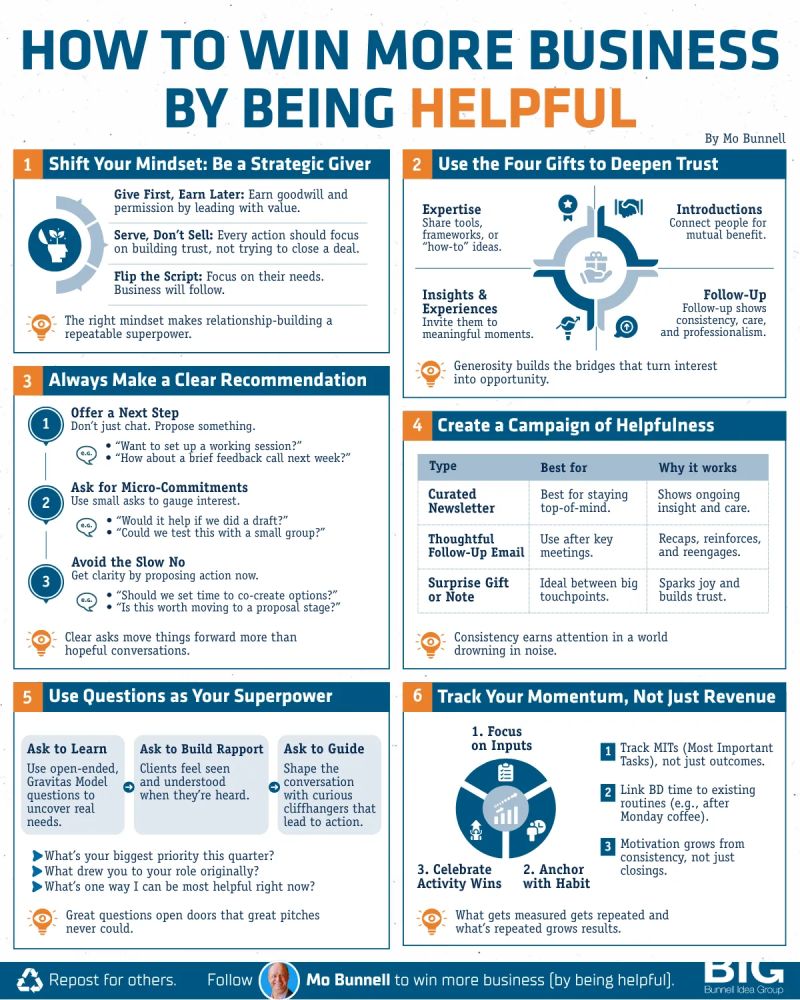
Want to grow your business 10x faster?

Stop selling. Yes, you heard right.

After 20+ years helping professionals
win more business, here’s what I know for sure:

The ones who win the most don’t “sell” more.
They’re the most helpful.

I’ve watched thousands of people transform their
results by shifting their mindset:

From “getting” to “giving.”

Here’s exactly how they do it:

1. Give before you get

↳ Share something valuable first.
↳ A framework that could save them time.
↳ An introduction that could change their business.

You earn permission by leading with generosity.

2. Master the Four Gifts

1. Expertise (that framework that changed their business)
2. Introductions (“You need to meet Sarah”)
3. Insights (“Join me at this exclusive event”)
4. Follow-up (“Saw this and thought of you”)

These aren’t random acts.
They’re strategic investments in relationships.

3. Always Make a Clear Recommendation

↳ “Let’s stay in touch” = relationship death.
↳ “Would a 30-minute working session help?” = momentum.

Clear asks create clear paths to yes.

4. Create a Campaign of Helpfulness

↳ One touch? Forgettable.
↳ Monthly value? Unforgettable.
↳ A rhythm of sequences keeps you top of mind
when opportunities arise.

Consistency beats intensity.

5. Ask questions that matter

↳ Skip: “Need any help?”
↳ Try: “What would make this your best year ever?”

Great questions position you as a thinking partner,
not a vendor.

6. Track Your Momentum, Not Just Revenue

↳ Closed deals? That’s the result.
↳ Track the cause: helpful conversations,
valuable connections, problems solved.

This “Give to Grow” framework has helped
thousands win more business
by being more helpful.

When you make every interaction helpful,
you don’t need to sell.

Your helpfulness does it for you.

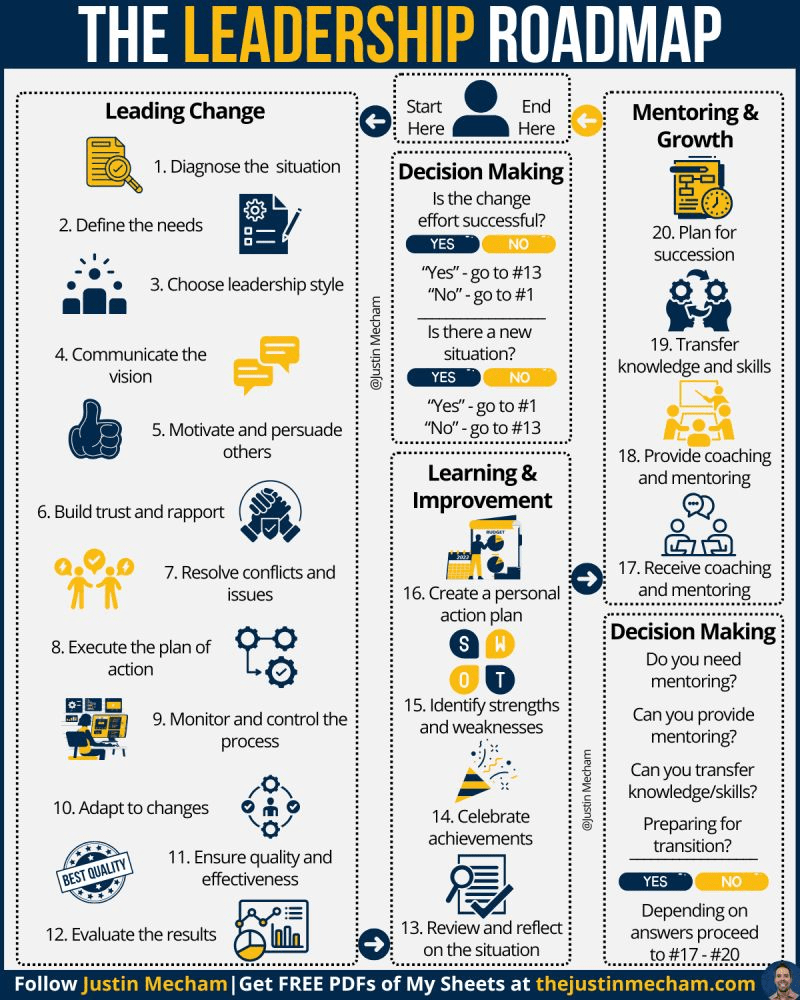
Leadership Roadmap

Most leaders don’t fail for lack of effort.

They fail because they lack clarity.

Without a clear path, even

the best intentions fall short.

Teams lose direction.

People lose trust.

Momentum stalls.

This leads to:

• Confusion instead of clarity

• Missed moments for growth

• Talent wasted instead of developed

• Hesitation instead of confident action

• Teams reacting instead of anticipating

• Mistrust instead of strong relationships

• Short-term wins without long-term impact

To stop this cycle, great leaders build roadmaps

that guide action and shape culture:

1️⃣ Leading Change:

• Start with a clear vision, not just a plan

• Define the real problem before you solve it

• Choose the style that fits the moment, 

 not just your comfort zone

• Communicate the “why” behind every decision

• Inspire action, don’t just demand it

• Build trust before you need it

• Address conflict head-on, don’t let it fester

• Focus on execution, not just ideas

• Measure what matters, not just what’s easy

• Adapt without losing your core principles

• Hold yourself to a high standard—always

• Reflect and refine as you go

2️⃣ Making Smart Moves:

• Know when to keep pushing and when to pivot

• Recognize patterns others miss

• Ask the tough questions before problems surface

3️⃣ Learning & Improvement:

• Focus on strengths, but address weaknesses

• Turn lessons into leverage

• Celebrate progress to fuel momentum

• Reflect with purpose, not just routine

4️⃣ Mentoring & Growth:

• Share what you know without holding back

• Create leaders, not just followers

• Think beyond your tenure—

 build for the next generation

• Prepare others to lead without you

Great leaders don’t just react.

They anticipate, plan, and adapt.

They make every move count.

The Day We Wake Up to Life

Confucius once said, “We have two lives, and the second begins when we realize we only have one.”

Most of us live our first life on autopilot. We race from one milestone to another, measuring ourselves against others, filling our days with noise and busyness. We tell ourselves we’ll start “living” once we achieve that next promotion, buy that dream house, or find the right time. Tomorrow always feels like a guarantee.

But then something shifts. It may come through loss, through love, through failure, or through a quiet moment of clarity—suddenly we understand that our time isn’t infinite. That this one life is not a dress rehearsal. And in that instant, our second life begins.

The second life is not about cramming in more achievements. It’s about noticing what truly matters. It’s about laughter at the dinner table, the warmth of a hug, the courage to pursue a dream, the grace to forgive, the joy of slowing down. It’s about no longer postponing happiness for “someday.”

When we step into this second life, the weight of comparison lightens. Gratitude deepens. Choices become more intentional. We realize that meaning was never in the future; it was always hidden in the present.

Your second life doesn’t have to begin with something dramatic. It can start right now—with a pause, a breath, and a choice to live as though today is the gift it truly is.

Because once we realize we only have one life, we finally learn how to live it.

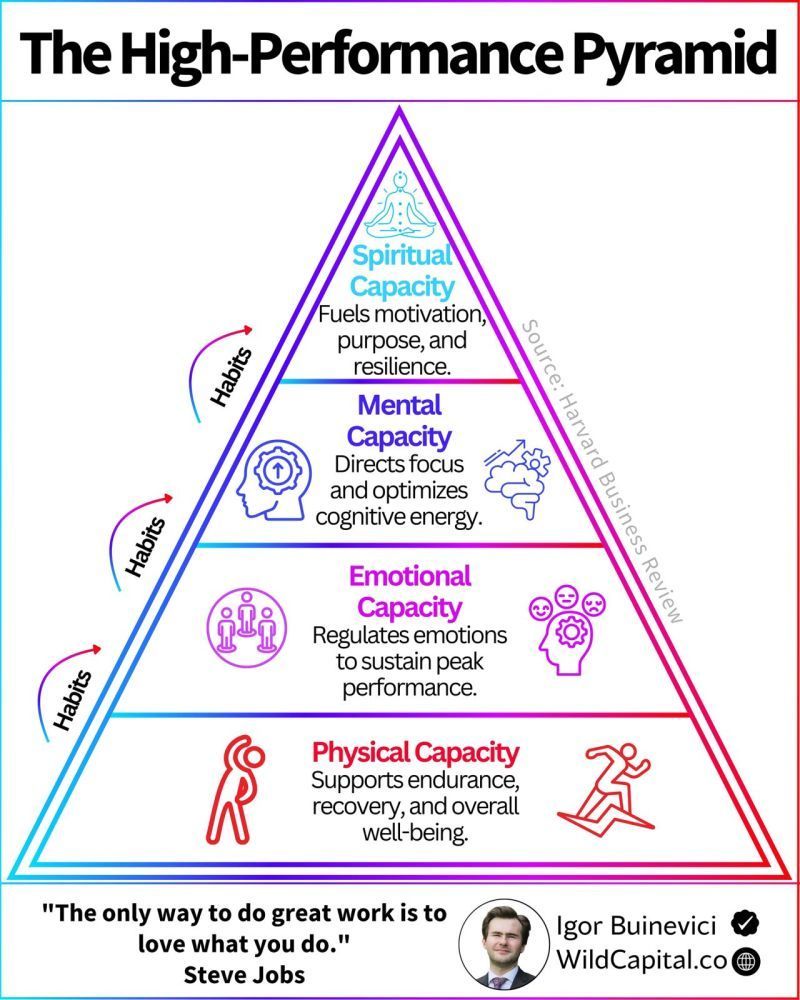
The High-Performance Pyramid

Only 7% of people are fully productive.

Harvard shares a great concept that can help:

The High-Performance Pyramid.

Success and efficiency isn’t about working harder:

It’s about managing your capacity.

🔴 Physical Capacity

Your foundation.

Supports endurance, recovery, and overall well-being.

If your body crashes, so does your performance.

🟣 Emotional Capacity

Regulates emotions to sustain peak performance.

Stress under control = better decisions, stronger leadership.

🔵 Mental Capacity

Directs focus and optimizes cognitive energy.

Master this, and you get more done in less time.

🟢 Spiritual Capacity

Fuels motivation, purpose, and resilience.

Without a deeper why, everything else crumbles.

Key?

Build the right habits at every level.

Performance isn’t just about grinding – it’s about balance.

Distraction Matrix

It takes 28 minutes to recover from a single distraction!

That’s from a study by Gloria Mark, Professor of Informatics at UC Irvine. 

Multiply that by every ping, buzz, and pop-up in your day—and you’re losing hours.

The truth – You don’t need more hours – you need more focus. 

The Cost of Noise?

Distractions kill momentum, dilute creativity, and fracture your ability to think deeply.

It doesn’t just slow you down, it erodes your edge.

Those who do more focused work are the winners in today’s world – Not by doing more but focused on less.

Study my infographic to install a deep work defense system and go to war against your distractions:

Study my 10 tactical steps to eliminate distractions!

1/ Turn off all notifications.

↳ Protect your cognitive budget.

2/Activate “Do Not Disturb” mode.

↳ Protect your time during key work blocks.

3/ Keep your phone out of reach and out of sight.

↳ Charge it in the other room. 

4/ Batch-check email and Slack twice a day.

↳ Minimize your email browser to keep it out-of-sight.

5/ Use headphones as a signal to others!

↳ The signal – Focused mode is on.

6/ Begin each day with your highest-leverage work.

↳ Eat That Frog each morning. (Brian Tracy) 

7/ Use the Pomodoro Method—25 on, 5 off.

↳ Combine it with the 80/20 Rule.

8/ Close all tabs but one. 

↳ Multitasking is a myth.

9/ Work in 90-minute sprints with real recovery in between.

↳ Take phone calls while walking to get the juices flowing. 

10/ End the day with a short shutdown ritual to clear your mental cache.

↳ Clear you desk of clutter as a final step. 

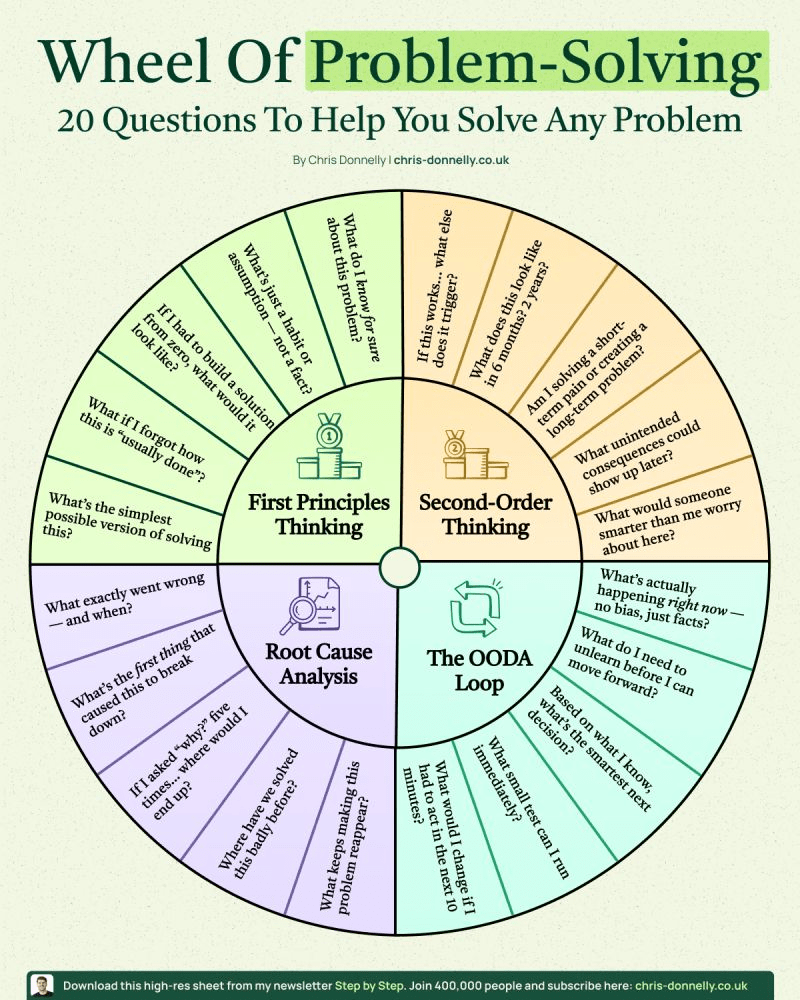
Wheel of Problem Solving

You’re not born a natural problem-solver.

It’s a skill that needs developing with time:

Especially if you want to build a successful digital business. 

Most people don’t realise it, 

But a founder’s job is mostly just problem solving on repeat…

Day in and day out. 

Over the last few years, I’ve used different problem-solving models

Depending on what needed my attention: 

💸 Keeping revenue consistent and predictable.

🔧 Setting a strategy that’s clear and actionable.

⭐️ Building a culture people actually want to be part of. 

⚙️ Running smooth operations, even when I’m not in the room.

As you can imagine, each one requires a completely different approach. 

These are the four models that I return to most often 👇

🔍 First Principles Thinking

↳ Strip everything back and start from zero. 

1. What do I know for sure about this problem?

2. What’s just a habit or assumption — not a fact?

3. If I had to build a solution from zero, what would it look like?

4. What if I forgot how this is “usually done”?

5. What’s the simplest possible version of solving this?

🔄 Second-Order Thinking

↳ Zoom out and see the bigger picture. 

1. If this works… what else does it trigger?

2. What does this look like in 6 months? 2 years?

3. Am I solving a short-term pain or creating a long-term problem?

4. What unintended consequences could show up later?

5. What would someone smarter than me worry about here?

🧠 Root Cause Analysis

↳ Fix an entire system, not just a symptom. 

1. What exactly went wrong — and when?

2. What’s the first thing that caused this to break down?

3. If I asked “why?” five times… where would I end up?

4. Where have we solved this badly before?

5. What keeps making this problem reappear?

⚡️ The OODA Loop

↳ When you just need to take the leap. 

1. What’s actually happening right now — no bias, just facts?

2. What do I need to unlearn before I can move forward?

3. Based on what I know, what’s the smartest next decision?

4. What small test can I run immediately?

5. What would I change if I had to act in the next 10 minutes?

It’s easy to panic when an issue arises, 

But it will do nothing to actually solve the problem. 

To problem solve like the top 1%, 

You need to stop reacting emotionally…

And start responding strategically. 

If you want to stay sharp under pressure, 

My weekly newsletter will help you solve real business problems. 

Dropping the Heaviest Outfit You’ll Ever Own

Some people change their style with age — swapping heels for sneakers, flashy trends for timeless classics. But the most freeing wardrobe edit you’ll ever make has nothing to do with clothes. It’s quitting the habit of wearing the weight of other people’s opinions.

When we’re younger, we’re wired to seek approval — to fit in, to be liked, to match the expectations of friends, family, and even strangers. But as the years go by, you start to see the cost of that habit. Carrying other people’s judgments is like wearing a coat made of lead. It’s bulky. It’s uncomfortable. And worst of all, it hides the person you’re meant to be.

Here’s the thing: nobody else is living your life. They don’t wake up in your skin, face your challenges, or pay the price for your choices. So why hand them the pen to write your story?

As you get older, start editing your emotional closet. Let go of the unnecessary weight. Choose clothes — and a life — that fit you. Wear your truth like your favorite hoodie: comfortable, authentic, and unapologetically yours.

Because the freedom to be yourself never goes out of style!

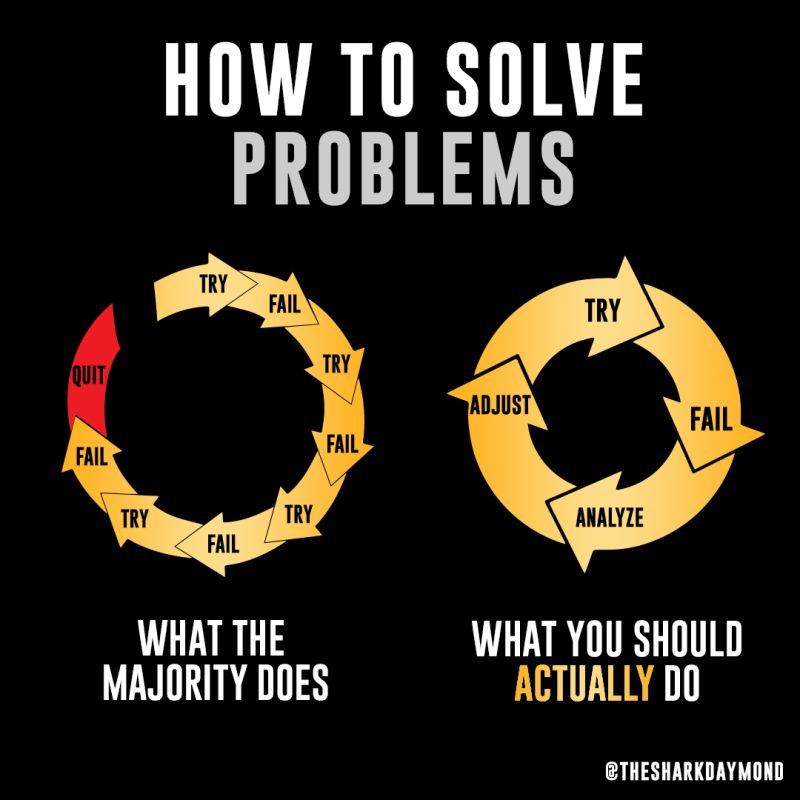
Fail. Learn. Adjust: The Real Art of Problem-Solving

We’ve all heard the phrase, “fail fast, fail often.” It encourages experimentation, innovation, and bold thinking. But too often, we glorify the “fail” and forget the follow-through.

In today’s fast-moving world—especially in tech, product, and business—we don’t just need people who try. We need people who analyze, learn, and adjust.


Trying Isn’t Enough

Solving problems isn’t a game of chance. It’s a game of pattern recognition.
When something doesn’t work, the real question is:

“Why didn’t it work, and what are we doing differently next time?”

Trying and failing without reflection is just randomness. But trying, failing, reflecting, and adapting—that’s how mastery is built.


The Adjust Loop

Here’s a simple loop that separates effective problem-solvers:

  1. Try – Take a calculated first shot.
  2. Observe – Track what worked and what didn’t.
  3. Analyze – Understand the root cause, not just the symptoms.
  4. Adjust – Tweak your approach based on the insight.
  5. Repeat – Try again with version 2.0.

This mindset applies whether you’re debugging code, designing products, leading teams, or navigating life.


In Tech, This Matters More Than Ever

We work in a world of uncertainty—shifting requirements, moving goals, and unpredictable systems.

Trying alone won’t cut it.

We need:

  • Engineers who debug deeply
  • Product owners who listen and refine
  • Leaders who inspect outcomes, not just effort

Build the Habit of Adjustment

Next time something doesn’t go your way—pause.

Don’t just move on.

Ask yourself:

  • What was the hypothesis?
  • What assumption failed?
  • What signal did we miss?
  • What will we do differently now?

That’s how we build resilience, not just speed.


Trying takes courage.
Failing takes humility.
But analyzing and adjusting—that’s where the real impact lies.

Because it’s not the number of attempts that matter—
It’s what we learn and how we evolve from each one.

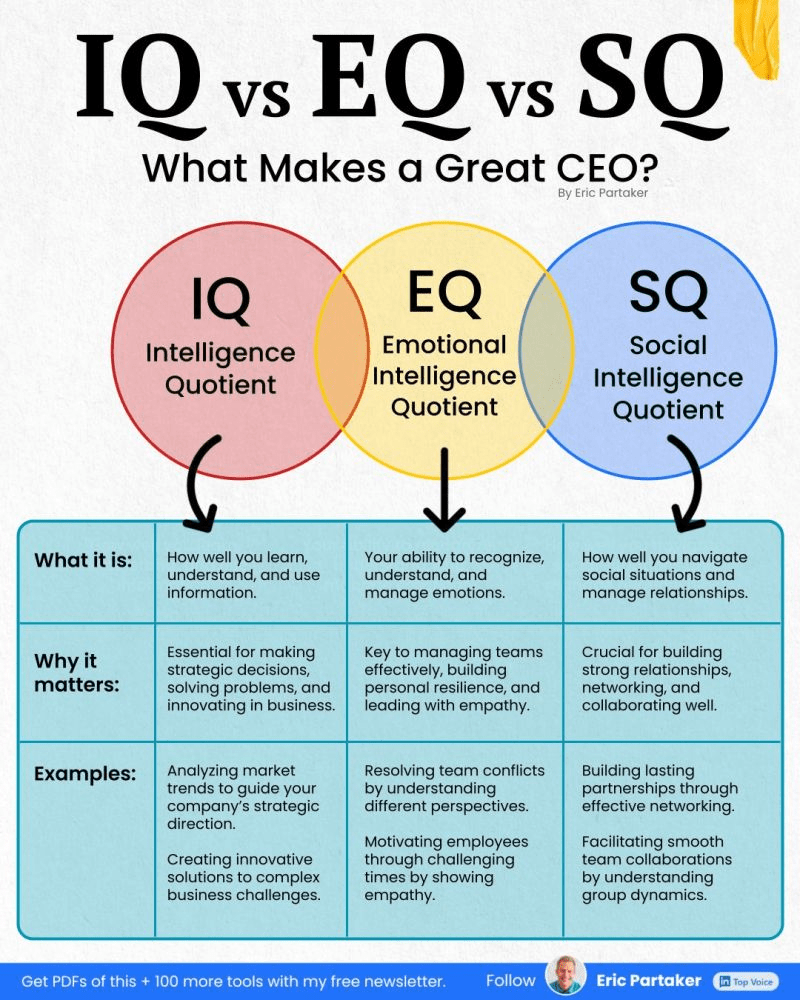
IQ vs EQ vs SQ

Leaders are made, not born.

But what makes a great leader?

Think about a leader you admire.

What words describe them?

• Focused

• Inspiring

• Visionary

• Assertive

• Confident

• Adaptable

• Supportive

• Trustworthy

• Approachable

• Compassionate

• Collaborative

• Transparent

• Charismatic

• Innovative

• Strategic

• Resilient

• Decisive

• Ethical

These qualities don’t just happen.

You have to learn and practice them.

But how?

It’s about developing your IQ, EQ, and SQ.

And you can improve each one with effort.

🧠 IQ is about how smart you are.

It’s using your brain to:

➟ Learn

➟ Solve problems

➟ Make good decisions

❤️ EQ is about understanding emotions.

Your own and those around you.

Great leaders manage their emotions.

They recognize and connect with others’ too.

🤝 SQ is about building relationships.

It’s being good at working with people.

You show it when you:

➟ Network

➟ Make friends

➟ Lead by influence

➟ Collaborate in teams

All 3 are beneficial.

But EQ is often the most crucial for leaders.

Why? Because it helps the leader:

• Connect

• Build trust

• Understand

• Inspire others

Leadership is all about people.

And leaders with high EQ tend to lead people better.

So, how can you improve your EQ?

1. Reflect on Your Emotions:

Take time to think about how you feel and why.

This helps you understand yourself better.

2. Listen Actively:

Really hear what others are saying.

It’s not just the words, but the feelings behind them.

3. Empathize:

Try to put yourself in someone else’s shoes.

How would you feel in their situation?

4. Seek Feedback:

Ask people you trust about how you handle emotions.

Be open to what they say.

5. Manage Stress:

Find ways to stay calm and think clearly.

Especially when things get tough.

A leader’s job isn’t just to lead.

It’s growing, helping, and inspiring others.

Improve your EQ to be more than a leader.

Be someone who makes a real difference.

Grow your EQ.

Grow as a leader.